Department of Strategic Foresight & Scenario Planning · Situational Reports · Geopolitics ·
Saudi Arabia, Turkey and Pakistan Mutual Defence Pact: What the Mecca Agreement Means for West Asia and India
Saudi Arabia, Türkiye and Pakistan’s new mutual defence pact signals a shift towards greater regional security cooperation amid escalating turmoil in West Asia. While the agreement strengthens deterrence, military coordination and defence ties, its operational scope remains unclear. For India, the immediate risk of direct intervention in an India-Pakistan conflict remains limited, but deeper Turkish-Saudi-Pakistani military cooperation could strengthen Pakistan’s strategic position and reshape South Asia’s wider security environment.
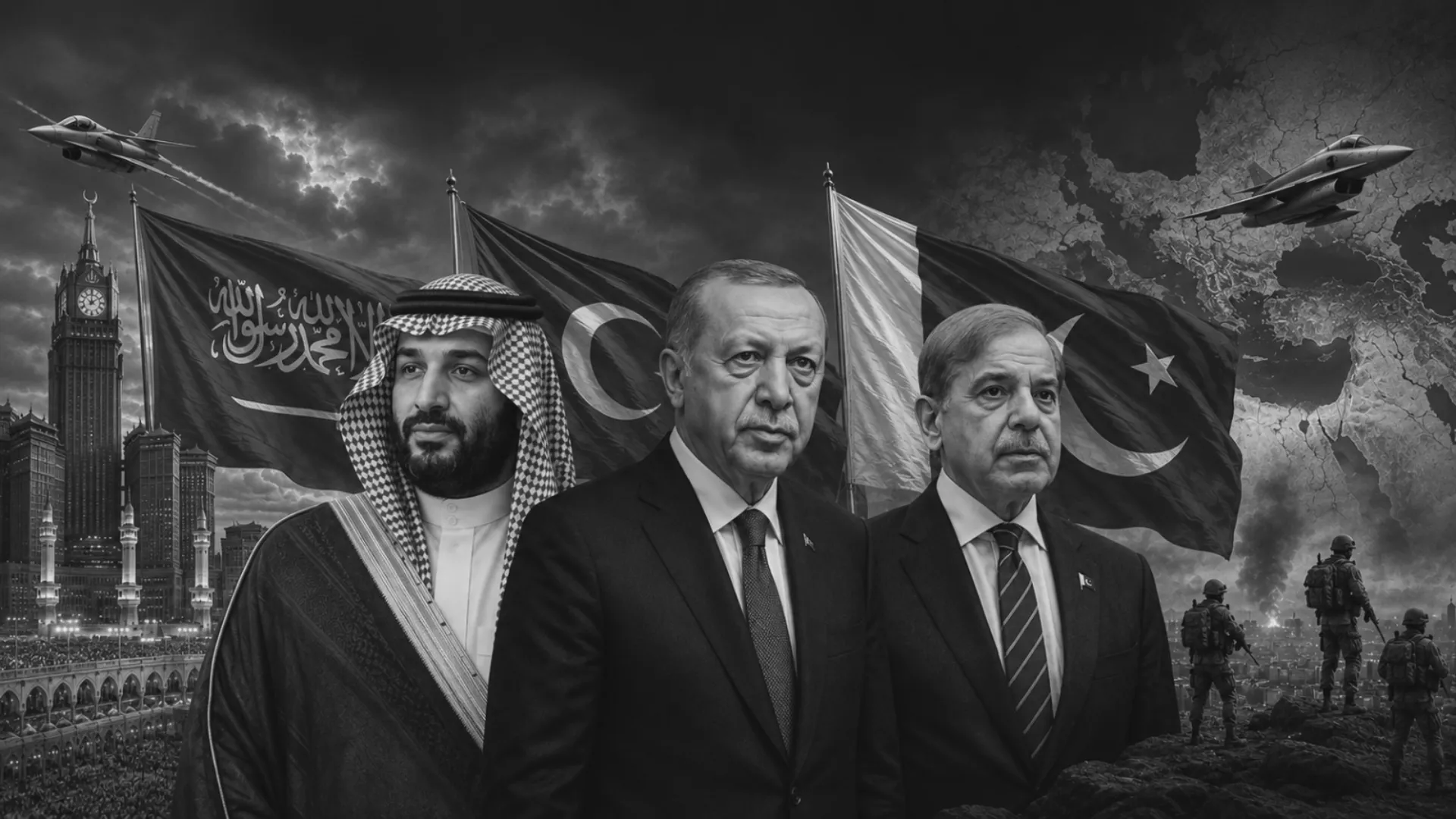
Saudi Arabia, Türkiye and Pakistan have taken a significant step towards creating a new security framework stretching from the eastern Mediterranean to South Asia. On 7 August 2026, the three countries signed the Mecca Joint Defence Agreement, declaring that an armed attack against any one of them would be regarded as an attack against all three.
The wording is deliberately powerful. It borrows the political logic of collective defence without, at least from what has been made public, reproducing the military machinery that makes alliances such as NATO credible. The agreement nevertheless matters. It connects Saudi financial power and strategic geography, Türkiye’s large armed forces and rapidly expanding defence industry, and Pakistan’s sizeable military establishment and nuclear status within a single formal security framework.
More importantly, the agreement has arrived while West Asia is passing through its most dangerous security crisis in decades. Saudi Arabia has been struck by Iran and Iran-aligned groups, the Houthis have again threatened Saudi territory and maritime traffic, Iraqi militias have emerged as another potential vector of attack, the Strait of Hormuz has been severely disrupted, and questions about the reliability of the traditional American security umbrella have become harder for Gulf capitals to ignore. According to the Reuters report on the Mecca agreement, Saudi Arabia, Türkiye and Pakistan are concerned not only by Iran and its regional network, but also by Israel's increasingly assertive military posture.
For India, the development deserves careful attention, but not alarmist conclusions. The immediate danger is not that Saudi and Turkish forces will automatically enter the next India-Pakistan conflict. The more serious long-term issue is that Pakistan is gradually embedding itself within a wider network of Gulf and Turkish defence relationships that could provide it with additional diplomatic leverage, financing, technology, military interoperability and strategic depth.
What Is Actually Public About the Mecca Joint Defence Agreement?
The most important publicly disclosed provision is straightforward: an armed attack against Saudi Arabia, Türkiye or Pakistan will be regarded as an attack against all three. The agreement is intended to strengthen collective deterrence and the security of the participating countries.
Yet the public statement stops at the principle. It does not reveal what each country is legally or militarily required to do after such an attack. There is no publicly available provision requiring an automatic declaration of war, no specified level of military assistance, no published joint command structure, no known integrated operational headquarters and no publicly announced standing trilateral military force. It is also unclear how the three governments will determine what constitutes an "armed attack", particularly when attacks are carried out by proxies, militias or non-state actors.
A Turkish official told Reuters that the agreement was purely defensive, was not aimed at any particular country, was open to participation by other regional states and would not replace existing bilateral or multilateral arrangements. That last point is particularly important because Türkiye remains a NATO member, Saudi Arabia retains its extensive defence relationship with the United States, and Pakistan maintains separate security partnerships with Saudi Arabia and other Gulf states.
The Associated Press account of the agreement reported that officials expect cooperation to extend into areas such as joint military exercises, training, intelligence sharing and defence technology. These are potentially more consequential over time than the headline collective-defence declaration because they can gradually create operational interoperability between the three militaries.
What remains unknown is as important as what has been announced. The full treaty text has not been released publicly. There is no clarity regarding geographical limitations, decision-making procedures during a crisis, whether assistance requires a formal request, how aggression is defined, how conflicts initiated by a member would be treated, or whether obligations differ when the attacker is a state and when it is a proxy organisation.
These ambiguities will be central to understanding how the agreement might apply to both the Iran conflict and a future India-Pakistan confrontation.
The Agreement Did Not Appear Overnight
The timing makes the Mecca agreement appear to be an immediate response to the present West Asian crisis, but its origins predate the latest escalation.
Saudi Arabia and Pakistan had already signed a Strategic Mutual Defence Agreement on 17 September 2025. The official Saudi statement said that the agreement sought to strengthen joint deterrence and stipulated that aggression against either Saudi Arabia or Pakistan would be considered aggression against both. The Saudi Press Agency statement on the 2025 agreement confirms that it built on nearly eight decades of Saudi-Pakistan strategic and military cooperation.
Türkiye's entry had also been under discussion well before August 2026. By January, reports indicated that negotiations had reached an advanced stage. Chatham House assessed the prospective trilateral arrangement in January 2026, noting that a draft agreement had already been prepared and that Ankara saw advantages in linking Turkish military and defence-industrial capabilities with Pakistani capabilities and Saudi financial resources.
Reuters now reports that the final agreement followed almost a year of negotiations. The West Asian war therefore accelerated the political importance of the arrangement rather than creating it from scratch. That distinction matters because it suggests this is not simply an emergency coalition assembled against Iran. The three governments appear to be experimenting with a longer-term regional security structure.
The Iran War Has Given the Agreement Its Urgency
The immediate security environment cannot be separated from the agreement. Since the United States and Israel attacked Iran on 28 February 2026, Iran and Iran-aligned forces have struck targets across the Gulf. Saudi Arabia has faced Iranian attacks as well as threats and attacks associated with the Houthis in Yemen and Shiite militias operating from Iraq. The conflict has also heavily disrupted shipping through the Strait of Hormuz, through which roughly one-fifth of global energy supplies moved before the war.
Saudi Arabia's vulnerability is no longer theoretical. Riyadh has spent decades purchasing some of the world's most sophisticated combat aircraft and air-defence systems, but the contemporary threat is distributed across ballistic missiles, cruise missiles, one-way attack drones, maritime attacks and proxy organisations operating from several directions.
The Saudi security problem is therefore geographical as much as technological. Iran lies across the Gulf. Iraqi militias can threaten Saudi Arabia from the north. The Houthis can strike from Yemen to the south. Maritime traffic is exposed in the Red Sea, Bab al-Mandab and Persian Gulf.
The Mecca agreement gives Riyadh something that additional weapons purchases alone cannot provide: access to military manpower, operational experience and external defence-industrial capacity from two large Muslim militaries.
Pakistan has already demonstrated that this assistance can go well beyond ceremonial cooperation.
In May 2026, Reuters reported on the scale of Pakistan's deployment to Saudi Arabia. Approximately 8,000 Pakistani troops, a squadron of around 16 aircraft, mostly JF-17 fighters, two drone squadrons and a Chinese-origin HQ-9 air-defence system had reportedly been sent to the kingdom. The equipment was being operated by Pakistani personnel and financed by Saudi Arabia. Reuters' sources described the deployment as a substantial, combat-capable presence rather than a symbolic training mission.
This is perhaps the most important evidence when assessing the new trilateral pact. The Saudi-Pakistan relationship has already progressed from political declarations to significant military deployments. The Mecca agreement potentially provides a framework through which Türkiye could become part of a similar architecture.
Saudi Arabia Is Diversifying, Not Abandoning the United States
It would nevertheless be incorrect to interpret the agreement as Saudi Arabia abandoning Washington.
Saudi Arabia remains deeply connected to the American defence establishment. In November 2025, Washington and Riyadh signed a U.S.-Saudi Strategic Defense Agreement. The White House described it as strengthening the more than 80-year defence relationship between the two countries. Earlier in 2025, the United States had announced a defence sales package worth nearly $142 billion, covering air and missile defence, aviation, maritime security, border security and communications systems.
The Saudi approach is therefore better understood as diversification.
Riyadh does not necessarily want to replace the United States with Pakistan or Türkiye. It wants additional options so that Saudi security is not dependent exclusively on American political decisions.
There is historical reasoning behind this. Washington's restrained reaction following the 2019 attacks on Saudi oil facilities raised concerns in Riyadh. Israel's September 2025 strike in Qatar added another layer of anxiety about whether traditional partnerships could reliably prevent military operations against Gulf states. Chatham House consequently described the original Saudi-Pakistan agreement as part of a wider attempt by Riyadh to diversify its security relationships rather than depend exclusively on Washington. The Mecca agreement strengthens this policy by adding Türkiye.
Israel Is Also Part of the Equation
It would be equally misleading to describe the agreement simply as an anti-Iran coalition. Saudi Arabia regards Iranian missiles, drones and proxies as immediate security threats. Yet Saudi Arabia, Türkiye and Pakistan have simultaneously become increasingly critical of Israeli military actions in Gaza and elsewhere in the region.
Reuters specifically reported that the three governments are concerned by the increasingly aggressive military postures of both Iran and Israel.
Türkiye has been particularly outspoken. President Recep Tayyip Erdoğan has repeatedly accused Israel of widening the regional conflict. In July 2026, while appearing alongside Pakistani Prime Minister Shehbaz Sharif, Erdoğan argued that a lasting regional settlement required participation by regional states and accused Israel of trying to undermine the U.S.-Iran peace process. Reuters reported Erdoğan's remarks on 4 July.
This creates an unusual strategic geometry.
Saudi Arabia is threatened directly by Iran and its partners, but does not want an open-ended confrontation with Tehran. Türkiye competes with Iran across several regional theatres but also strongly opposes Israeli military actions. Pakistan maintains relations with Iran, has tried to mediate between Tehran and Washington, strongly supports Saudi security and remains hostile towards Israel. The agreement therefore does not fit neatly into an Iran-versus-Arab-states framework. It is better understood as an attempt by three significant Muslim states to increase their ability to act independently as the American-led regional order becomes less predictable.
Is This an “Islamic NATO?”
For the moment, no. The phrase is attractive because the agreement contains a collective-defence clause, but it obscures more than it explains.
NATO is not simply a treaty containing the words “attack on one is an attack on all”. It possesses decades of integrated command structures, common planning, interoperability standards, standing headquarters, intelligence arrangements, military exercises and an established political mechanism for responding to crises.
None of that has yet been publicly demonstrated for the Mecca agreement.
Even NATO's Article 5 itself does not require every member automatically to declare war. According to NATO's official explanation of Article 5, each ally is required to assist an attacked member but determines the action it considers necessary, which may or may not include armed force.
The comparison is therefore even weaker when applied to a brand-new agreement whose operational provisions remain secret.
Chatham House argued months before the agreement was signed that calling the emerging arrangement an “Islamic NATO” was misleading. Most Muslim-majority states remain outside it, religious identity does not erase major regional rivalries, and the three participants have different strategic priorities.
The more important question is whether the three countries now begin institutionalising the agreement. Regular trilateral exercises, a permanent secretariat, intelligence fusion centres, common air-defence planning, joint procurement, defence-industrial projects and pre-positioned forces would gradually transform a political declaration into a genuine military alliance. That process, rather than the title of the agreement, should be watched.
Türkiye's NATO Membership Does Not Extend NATO Protection to Pakistan
Türkiye's participation has already generated speculation that Saudi Arabia and Pakistan could somehow acquire indirect access to NATO's security guarantees.
That is not how NATO works. Pakistan and Saudi Arabia do not become NATO partners protected by Article 5 simply because Türkiye has entered another defence agreement with them. NATO obligations apply to attacks on NATO members within the treaty framework. They do not automatically extend to separate allies of a NATO country.
A complicated situation could nevertheless arise if Türkiye entered a conflict under the Mecca agreement and Turkish territory subsequently came under attack. Whether NATO obligations applied would depend heavily on the circumstances of the conflict and how other NATO members assessed the attack.
Ankara has therefore created another layer in an already complicated network of security obligations, but it has not extended NATO's umbrella over Riyadh or Islamabad.
The Nuclear Question Needs Particular Caution
Pakistan's nuclear weapons inevitably make the agreement more sensitive, especially in India. There is, however, no publicly available evidence that the Mecca Joint Defence Agreement extends Pakistan's nuclear deterrent to Saudi Arabia or Türkiye.
The earlier Saudi-Pakistan pact created similar speculation. Pakistan's Defence Minister Khawaja Asif initially made expansive comments about Pakistan's capabilities being available under that agreement, but later clarified that a nuclear umbrella was not under consideration.
Chatham House's assessment of the original Saudi-Pakistan agreement concluded that the announcement did not explicitly mention nuclear weapons or nuclear cooperation and that Pakistan had not formally offered its nuclear deterrent to Riyadh.
Regarding the new trilateral agreement, Reuters quoted Australian National University analyst Mansoor Ahmed as assessing that it would likely not contain a nuclear component because Pakistan's nuclear deterrent remains overwhelmingly structured around India.
For New Delhi, this distinction is critical. The presence of a nuclear-armed Pakistan gives the arrangement political weight, but it should not automatically be interpreted as the creation of a Pakistani extended nuclear-deterrence system covering Saudi Arabia and Türkiye. That would require far more substantial evidence than has appeared publicly.
What Pakistan Gains
Pakistan may ultimately emerge as the biggest relative beneficiary. For decades, Pakistan's geopolitical value to Gulf monarchies was based partly on its ability to provide trained military personnel, advisers and security assistance. The Mecca agreement upgrades that longstanding relationship into something politically much more visible.
Pakistan can now present itself not merely as a South Asian military power but as a security provider connecting South Asia with the Gulf and the wider Muslim world.
That has financial implications. Saudi Arabia has repeatedly provided Pakistan with deposits, oil facilities, investment and economic assistance. Increased Saudi dependence on Pakistani military capabilities could deepen that relationship.
There are defence-industrial implications as well. Pakistan can offer JF-17 aircraft, drones, training, ammunition, maintenance and military manpower. Türkiye brings a much larger and technologically more sophisticated defence industry, particularly in unmanned systems, missiles, naval platforms and electronics. Saudi Arabia supplies capital and a rapidly expanding defence market. The combination could eventually produce joint ventures involving Saudi financing, Turkish technology and Pakistani manufacturing capacity. For India, that possibility deserves more attention than dramatic speculation about Saudi troops entering Kashmir.
Pakistan Also Acquires a New Vulnerability
The agreement is not cost-free for Islamabad. Pakistan shares a long border with Iran and has historically tried to prevent competition between Tehran and Riyadh from forcing it into a binary choice. It also has significant domestic sectarian sensitivities.
Pakistan's previous Saudi commitment has already produced precisely this problem. During the Iran war, Islamabad tried simultaneously to mediate between Iran and the United States while deploying thousands of troops and combat systems to protect Saudi Arabia. The deeper the Mecca agreement becomes, the harder this balancing act will be.
If Iranian missiles strike Saudi territory again, Pakistan could face pressure to provide greater military assistance. If Saudi forces retaliate and the confrontation expands, Islamabad would have to distinguish between defending Saudi territory and participating in offensive operations against Iran. That distinction could determine whether the alliance becomes a source of deterrence or a mechanism for dragging its members into one another's wars.
What Türkiye Gains
For Türkiye, the agreement serves somewhat different purposes. Ankara does not need Pakistan or Saudi Arabia to replace NATO. Instead, the agreement reinforces Türkiye's effort to become an autonomous centre of power capable of operating across Europe, the Middle East, Central Asia and the Muslim world.
It also creates significant opportunities for the Turkish defence industry. Saudi Arabia already has substantial Turkish defence ties. In 2023, Riyadh agreed to purchase Turkish drones in what Ankara described at the time as Türkiye's largest defence export contract. Türkiye and Pakistan also have established cooperation in naval construction, aviation, training and defence technology. A trilateral framework could create a much larger market for Turkish technology while bringing Saudi capital into joint development programmes.
There is also political value for Erdoğan. Participation places Türkiye alongside two of the most consequential Muslim-majority states at a time when Ankara is seeking a larger role in shaping regional security rather than simply responding to decisions made in Washington, Brussels or Moscow.
The Most Important Implication for India Is Not Immediate War
The collective-defence language will naturally be read in India through the prism of Pakistan. The obvious question is what happens if India and Pakistan fight again. There is no public answer. Suppose a Pakistan-based terrorist organisation conducts a major attack in India and India responds militarily against targets inside Pakistan. Islamabad could describe India's action as an armed attack and attempt to invoke the agreement. Whether Riyadh and Ankara would accept that interpretation would be a political decision unless undisclosed treaty provisions remove that discretion. This is precisely why the definition of aggression matters.
The 2025 Saudi-Pakistan agreement used sweeping language about aggression against either member. Yet Pakistan's subsequent security challenges did not produce automatic Saudi military intervention. The existence of a defence clause therefore cannot be treated as proof that military participation follows automatically from every confrontation.
Saudi Arabia would have powerful reasons to distinguish between an unprovoked attack on Pakistan and an India-Pakistan escalation arising from terrorism, border incidents or military action initiated by Pakistan.
Türkiye's political position could be less favourable to India, particularly given Ankara's longstanding support for Pakistan on Kashmir and its support for Islamabad during the 2025 India-Pakistan confrontation. But even Turkish diplomatic or material assistance would be very different from automatic Turkish entry into a direct war with India.
The Greater Risk Is Pakistan's Expanding Strategic Depth
The more consequential Indian concern is structural. Pakistan already enjoys a deep defence relationship with China. If it simultaneously becomes embedded within a Saudi-Turkish security and defence-industrial network, Islamabad's room for strategic manoeuvre increases.
The benefits could include financing for weapons procurement, access to Turkish unmanned and electronic warfare technologies, greater training and interoperability, Saudi financial support for Pakistani defence production, intelligence exchanges and stronger diplomatic support during crises.
This does not overturn the conventional military balance between India and Pakistan, but it could reduce some of Pakistan's vulnerabilities. It could also affect Pakistani risk calculations. Alliances sometimes deter wars, but they can also encourage weaker states to behave more assertively if leaders believe external partners will shield them from the consequences of escalation. India will therefore need to watch whether the Mecca agreement changes Pakistani military behaviour rather than merely Pakistani rhetoric.
Türkiye May Be the More Important Variable for India
From an Indian perspective, Türkiye's inclusion deserves particular scrutiny. Saudi Arabia has a deep relationship with Pakistan, but Riyadh simultaneously has major strategic, economic, energy and increasingly defence relationships with India. Türkiye's relationship with Pakistan is politically different. Ankara has regularly supported Islamabad's position on Kashmir and has developed close military-industrial cooperation with Pakistan.
The Turkish defence industry is also becoming increasingly capable in precisely the fields shaping contemporary warfare: drones, loitering munitions, electronic warfare, precision weapons, missiles, sensors and naval systems. A structured Turkey-Pakistan-Saudi defence ecosystem could therefore matter to India even if the collective-defence clause is never invoked. The critical indicator will be whether trilateral cooperation begins producing weapons, technologies or intelligence capabilities that directly strengthen Pakistan's military position against India.
Saudi Arabia Has Powerful Reasons to Preserve Its India Relationship
At the same time, assumptions that Riyadh has chosen Pakistan over India ignore the scale of Saudi interests in India. According to the Embassy of India in Riyadh's latest bilateral brief, India-Saudi bilateral trade reached $41.88 billion in FY 2024-25. India is Saudi Arabia's second-largest trading partner, while Saudi Arabia is India's fifth-largest trading partner. Saudi investments in India are estimated at approximately $10 billion.
The energy relationship is even more important. India imported 33.14 million metric tonnes of Saudi crude oil in FY 2024-25, accounting for 13.58 percent of India's total crude imports. Saudi Arabia also supplied almost 15 percent of India's LPG imports.
Defence relations have expanded as well. India and Saudi Arabia established a new Ministerial Committee on Defence Cooperation in 2025, have conducted naval and land exercises, initiated service-to-service talks and expanded defence-industrial engagement. Saudi Arabia also purchased Indian ammunition under a contract worth approximately $225 million.
Riyadh therefore has no obvious incentive to turn the Mecca agreement into an anti-India instrument. Saudi Arabia's relationship with Pakistan is important, but so is its relationship with India. Saudi foreign policy under Mohammed bin Salman has increasingly sought to maintain multiple partnerships simultaneously rather than dividing the world into permanent camps. India should exploit that characteristic rather than force Riyadh into a binary choice.
Energy Security May Be India's More Immediate Vulnerability
The agreement's biggest short-term consequence for India may have little to do with Pakistan. It may instead arise from the conflict that produced the agreement.
India depends heavily on West Asia for energy. Continued Iranian attacks on Gulf infrastructure, Houthi operations in the Red Sea and restrictions in the Strait of Hormuz can raise crude prices, tanker insurance costs and shipping expenses regardless of whether India is directly involved in the conflict.
Saudi Arabia's importance to Indian energy security makes the stability of the kingdom a direct Indian economic interest. If the Mecca agreement deters attacks and strengthens Saudi defensive capacity, India could indirectly benefit.
If, however, the pact contributes to harder bloc formation between Iran and a Saudi-Turkish-Pakistani security grouping, the possibility of a broader regional war increases. Such a conflict would place Indian energy imports, shipping routes, investments and citizens across the Gulf under significantly greater pressure.
This is why India should assess the pact through two different lenses: the South Asian military balance and the security of the Gulf. The second may prove economically more important than the first.
What India Should Watch Next
The significance of the agreement will become clearer through implementation rather than declarations. The most consequential development would be creation of permanent trilateral military institutions. A joint command, integrated air and missile defence architecture, intelligence fusion centre or permanent planning mechanism would indicate movement from political signalling towards a genuine alliance.
Joint defence production would be equally significant. Saudi financing combined with Turkish technology and Pakistani manufacturing could become an important new defence-industrial relationship.
Another critical indicator will be the geographical scope of exercises. Exercises designed around territorial defence in Saudi Arabia would support the claim that the arrangement is primarily Gulf-focused. Exercises simulating wider interstate warfare, long-range strike operations or scenarios applicable to South Asia would carry different implications.
India should also watch the accession question. Reuters reported that the agreement is open to other regional countries. If states such as Kuwait or other Gulf countries eventually join, the arrangement could evolve from a trilateral pact into a broader regional security organisation. Pakistan is already negotiating wider Gulf security arrangements, including discussions with Kuwait.
Finally, New Delhi should follow the language used during the next India-Pakistan crisis. If Riyadh explicitly limits the agreement to unprovoked aggression and refuses Pakistani efforts to internationalise bilateral disputes, India's concerns would diminish. If Saudi Arabia begins treating Pakistani security disputes with India as alliance matters, the strategic implications would become considerably more serious.
India Should Avoid Treating the Pact as an Enemy Bloc
An excessively hostile Indian reaction would probably be counterproductive. India has spent years building strategic relationships across West Asia precisely by avoiding rigid bloc politics. It maintains substantial relationships with Saudi Arabia, the UAE, Israel, Iran and other regional actors despite their competing interests.
That flexibility should continue.
New Delhi's objective should not be to break the Saudi-Pakistan relationship, which is unrealistic given its historical depth. It should instead ensure that Saudi Arabia has sufficiently important independent interests with India that Riyadh sees no benefit in allowing its Pakistan relationship to damage ties with New Delhi.
The same logic, although more difficult, applies to Türkiye. India's relationship with Ankara has experienced serious political tensions, but permanent estrangement would only increase Pakistan's ability to shape Turkish perceptions of South Asia.
At the military level, India should treat the agreement as another reason to accelerate capabilities it already requires: integrated air and missile defence, counter-drone systems, electronic warfare, long-range surveillance, resilient command networks, munition stockpiles and maritime protection.
Not because Saudi Arabia is about to join a war against India, but because Pakistan's defence partnerships are becoming more technologically and geographically diversified.
A New Security Architecture Is Beginning to Take Shape
The Mecca Joint Defence Agreement should neither be dismissed as symbolism nor exaggerated into a fully operational Muslim military alliance. For now, it occupies the space between the two.
The agreement contains a politically significant collective-defence commitment, but many of the mechanisms needed to convert that commitment into automatic military action remain undisclosed. Pakistan's substantial deployment to Saudi Arabia demonstrates that at least one leg of the alliance already has operational substance. Türkiye adds considerably greater military-industrial capacity. Saudi Arabia supplies financial resources, strategic geography and political weight.
The West Asian conflict has accelerated this convergence. Iranian missile and drone attacks have exposed Gulf vulnerabilities. Israeli military actions have simultaneously increased concerns about an increasingly unstable regional order. Doubts about depending exclusively on Washington have encouraged regional governments to develop additional security relationships even while retaining their American partnerships.
For India, the agreement does not fundamentally alter the military balance in South Asia today. Nor does it mean Saudi Arabia and Türkiye will automatically fight alongside Pakistan during the next India-Pakistan confrontation.
But it does represent something strategically important: the growing interconnection of the West Asian and South Asian security systems.
Pakistan is positioning itself as a bridge between them. Saudi Arabia is acquiring additional military options. Türkiye is extending its defence-industrial and political influence eastward. The result could eventually become far more significant than the collective-defence declaration signed in Mecca.
India's response should therefore be measured rather than emotional. The priority is to preserve the strategic relationship with Saudi Arabia, prevent Türkiye-Pakistan cooperation from becoming an exclusively anti-India military ecosystem, monitor the operationalisation of the agreement and ensure that India's own military capabilities continue to outpace whatever advantages Pakistan gains from its new partnerships.
The real test of the Mecca agreement will not come from its wording. It will come when one of its members is attacked and the other two have to decide what “an attack on one is an attack on all” actually requires them to do.
Tags
- #Geopolitics
- #India Pakistan relations
- #Middle East Conflict
- #Mutual Defence Pact
- #pakistan
- #Saudi Arabia
- #Turkey
- #West Asia security
Author