Pakistan–Afghanistan Conflict: From Strategic Depth to the 2026 Crisis
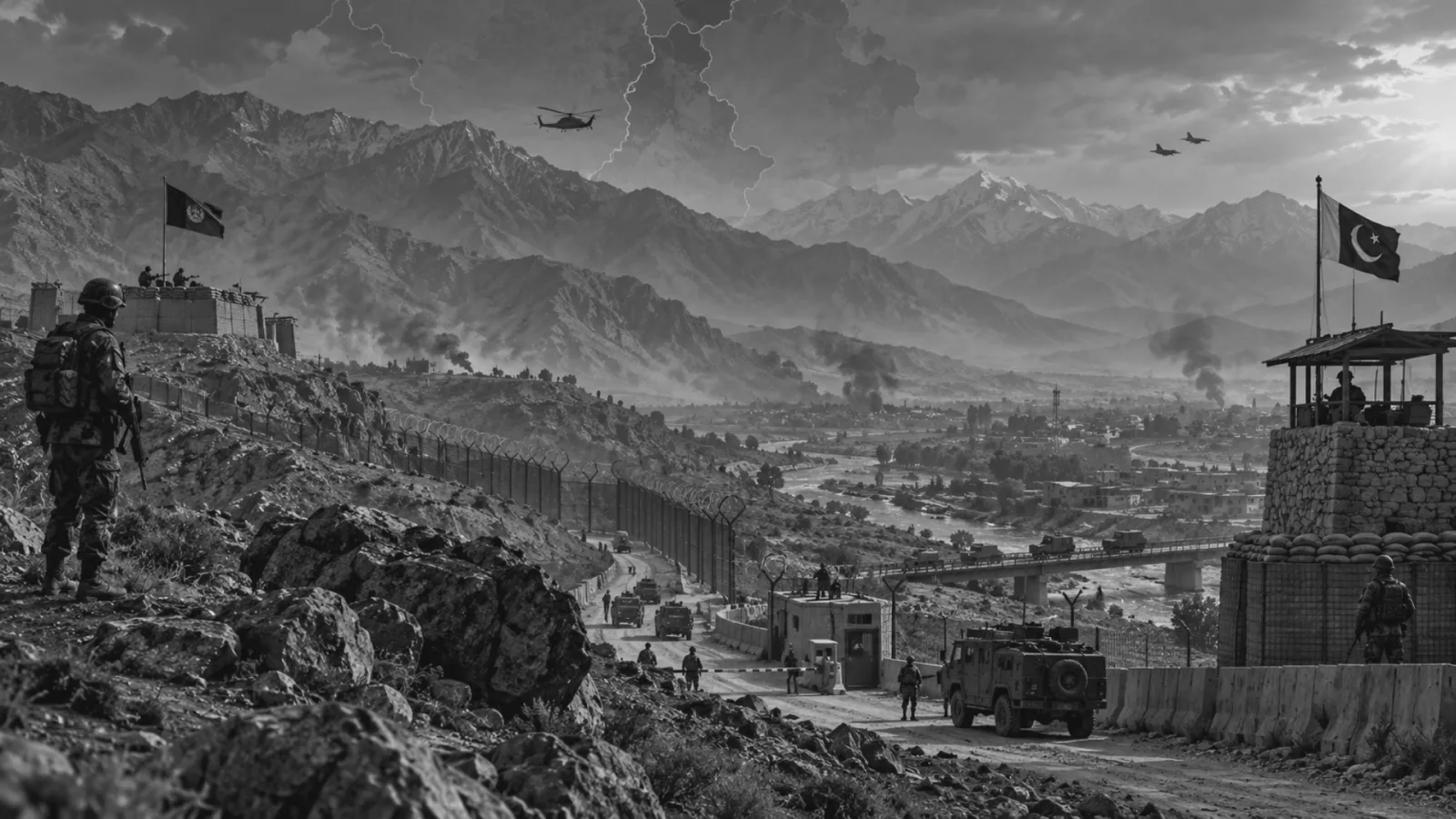
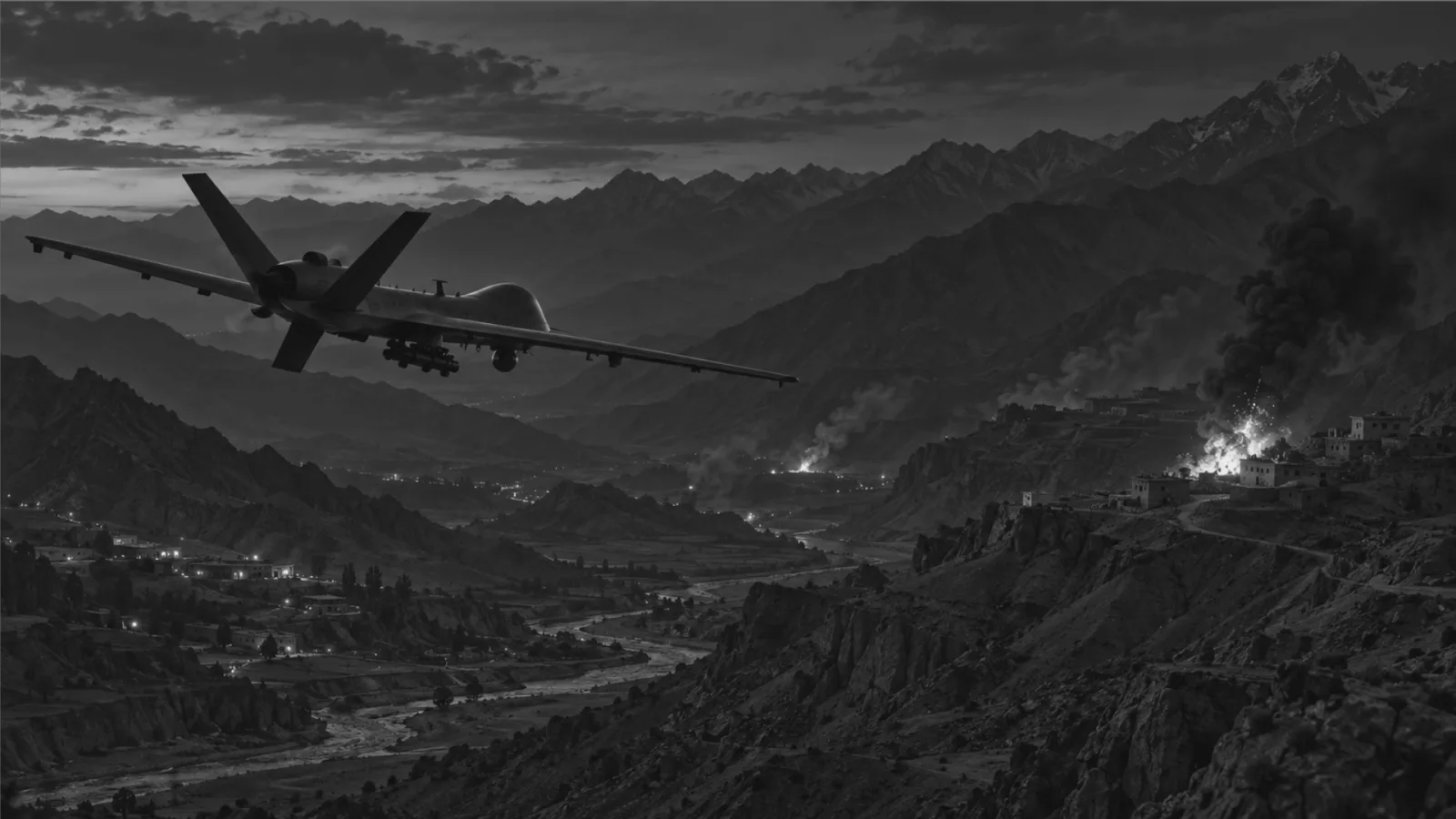
The Afghanistan–Pakistan conflict is rooted in a strategic reversal. For decades, Pakistan sought influence over Afghanistan to limit Indian influence and maintain what its security establishment described as strategic depth. The Taliban’s return to power in August 2021 initially appeared to strengthen that position. Instead, the new Afghan authorities have proved unwilling or unable to eliminate the Tehrik-e-Taliban Pakistan (TTP), whose campaign against the Pakistani state has intensified the security crisis along the frontier. The central dispute is not simply a disagreement over the Durand Line. It concerns whether Afghanistan’s de facto authorities will act against armed groups operating from Afghan territory, whether Pakistan can strike those groups without provoking Afghan retaliation, and whether either side can enforce a durable settlement. The October 2025 escalation demonstrated how quickly a counterterrorism dispute can become direct interstate fighting. Pakistani airstrikes inside Afghanistan were followed by multi-sector clashes, further strikes, civilian casualties and border closures. The ceasefire announced on 19 October 2025 reduced the immediate danger of a prolonged campaign but did not resolve the underlying dispute. Renewed fighting in October 2026, following unsuccessful diplomatic efforts, reinforces that conclusion. The most likely trajectory over the next six months is continued intermittent fighting, punctuated by diplomatic initiatives and temporary pauses. A larger escalation remains possible if a mass-casualty TTP attack inside Pakistan is followed by another strike on high-profile targets in Afghanistan.
1. How the conflict developed
The post-2021 reversal
The Taliban’s takeover of Kabul in August 2021 transformed Pakistan’s strategic environment. Islamabad had long maintained relationships with Afghan Taliban networks and expected a government in Kabul more responsive to Pakistani security interests than its predecessor. Yet ideological affinity did not translate into control over the new Afghan government’s decisions.[i]
The TTP is a separate organisation from the Afghan Taliban, although the groups share ideological affinities and historical connections. The TTP seeks to overthrow Pakistan’s political order and impose its own interpretation of Islamic governance. In the immediate aftermath of the takeover, Pakistan reported that two soldiers were killed by cross-border militant fire in Bajaur on 29 August 2021, an attack subsequently claimed by the TTP. The group’s campaign intensified later that year: it claimed 32 attacks in August and 37 in September, followed by a further increase after a ceasefire with Pakistan collapsed in November. The takeover did not initiate TTP violence, but it marked a significant turning point in the group’s operating environment.[ii]
Pakistan’s principal allegation is that Afghan territory has become a sanctuary from which the TTP plans, prepares and supports attacks inside Pakistan. Kabul has rejected accusations that it deliberately allows its territory to be used against Pakistan and has resisted Islamabad’s demands for coercive action. Evidence of cross-border activity and militant presence does not, by itself, establish that the Afghan Taliban directly commands TTP operations.
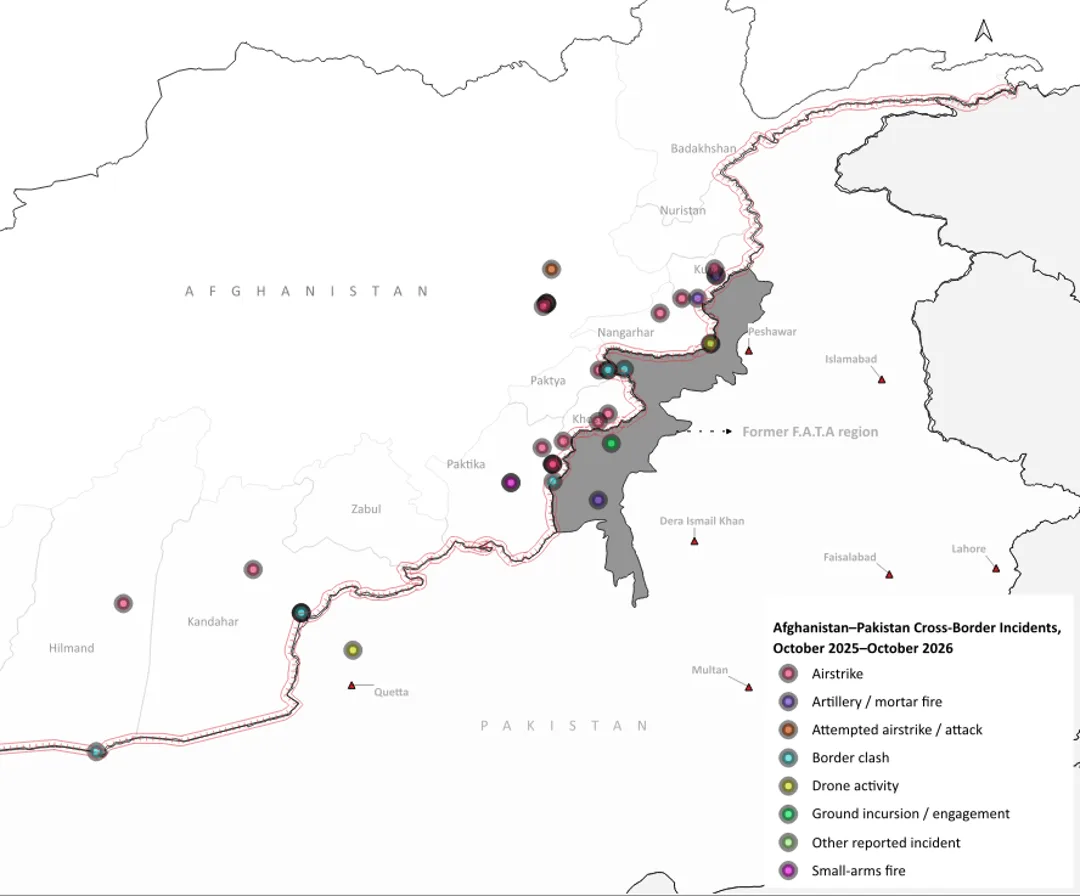
Afghanistan-Pakistan Cross-Border Incidents (Timeline: October 2025 - October 2026)
The unresolved status of the Durand Line adds another layer of friction. Pakistan regards the line as its international border and has pursued fencing and tighter movement controls. Afghanistan’s historical objections, disputes over border installations and the social and economic links spanning the frontier make routine border management politically sensitive. These disputes are not the sole cause of the conflict, but they provide recurring opportunities for local incidents to escalate.
The December 2024 strikes and early 2025 friction
Pakistani airstrikes in Afghanistan’s Paktika province on 24 December 2024 marked an important escalation in bilateral tensions. Pakistan said the operation targeted suspected TTP hideouts, while Afghan authorities condemned it as a violation of sovereignty and reported civilian casualties. The strikes intensified an existing dispute over militant activity in Afghanistan.[iii]
During early 2025, tensions continued through reported skirmishes in Helmand and exchanges of fire around the border, including near Torkham in February and March. Disputes over border installations and security positions contributed to these confrontations.[iv] On 27–28 August, Afghan sources reported suspected Pakistani drone strikes in Khost, Nangarhar and Kunar, alleging civilian casualties. Pakistan did not publicly confirm responsibility.[v]
The broader pattern was one of deteriorating security relations. Pakistan increasingly framed cross-border militant activity as a threat requiring action against suspected sanctuaries in Afghanistan, while the Afghan authorities characterised Pakistani strikes as violations of sovereignty. These competing security claims, alongside disputes over border management, increased the risk that local incidents would escalate into wider confrontations.[vi]
2. October 2025: From counterterrorism to interstate fighting
The October escalation developed through a sequence of events rather than a single isolated border incident. Reporting on 8 October described deadly attacks and fighting involving Pakistani security forces in Khyber Pakhtunkhwa. Reuters reported an ambush on a Pakistani convoy in Kurram that killed nine soldiers and two officers, while a separate Pakistani military operation in neighboring Orakzai reportedly killed 19 militants and 11 Pakistani soldiers. These were distinct incidents and should not be combined into a single engagement.[vii]
On 9 October, Pakistani airstrikes hit targets in Kabul and eastern Afghanistan. Pakistani security sources said a vehicle associated with TTP leader Noor Wali Mehsud had been targeted. Mehsud survived, and the Afghan authorities condemned the strikes as a violation of sovereignty. Pakistan did not initially provide a comprehensive public account of the operation, leaving uncertainty over the precise targets and the extent of militant losses.[viii]
The airstrikes were the immediate catalyst for the interstate escalation. On 11–12 October, Afghan Taliban forces and Pakistani troops fought across several border sectors. Reporting identified areas including Angoor Adda, Bajaur, Kurram, Dir and Chitral, as well as southern sectors around Bahram Chah. Both sides reported attacks on military positions and the use of small arms and heavier weapons. Pakistan claimed substantial militant and Afghan Taliban losses; Afghan officials made much higher claims about Pakistani casualties.[ix]
Fighting continued during the following week, including violence around Spin Boldak and Chaman on 15 October and reports of further strikes in Paktika on 17 October. Border crossings were disrupted, and civilian communities on both sides faced displacement and interrupted trade.
The humanitarian cost is better documented than many of the military claims. On 16 October, the United Nations Assistance Mission in Afghanistan (UNAMA) reported that preliminary information indicated at least 17 civilians had been killed and 346 injured in Spin Boldak alone. Its later assessment for the period 10–17 October recorded 47 civilians killed and 456 injured across Afghanistan.[x] A ceasefire announced on 19 October, following diplomatic engagement involving Qatar and Türkiye, halted the immediate cycle of major clashes. It did not settle the question of militant sanctuaries, establish an accepted border-management mechanism or create a reliable process for investigating cross-border incidents.
3. Selected incident chronology
The following table summarizes consequential reported events.
Date | Location and event | Strategic significance |
24–25 December 2024 | Pakistani airstrikes in Paktika; Afghan authorities reported civilian deaths. | Preceded renewed border friction and deepened the sovereignty dispute. |
1–3 January 2025 | Reported exchanges and border-position incidents around Bajaur and adjacent Afghan areas. | Early reported confrontation; not established as the definitive first incident of 2025. |
February–March 2025 | Further reported skirmishes in northern border sectors, including Mohmand, Bajaur and areas near Torkham. | Demonstrated that the dispute persisted beyond individual airstrikes. |
27 August 2025 | Reported Pakistani drone strikes in Khost, Nangarhar and Kunar; Afghan sources alleged civilian casualties. | Renewed allegations of Pakistani cross-border targeting. |
8 October 2025 | TTP-linked ambush reported in Kurram; separate Pakistani operation in Orakzai. | Immediate security context for Pakistan’s subsequent strikes. |
9 October 2025 | Pakistani airstrikes in Kabul and eastern Afghanistan; Mehsud was targeted according to Pakistani security sources and survived. | Direct catalyst for Afghan Taliban retaliation. |
11–12 October 2025 | Multi-sector clashes across northern, central and southern border areas. | Shift from episodic friction to sustained interstate fighting. |
15 October 2025 | Fighting around Spin Boldak–Chaman and reported strikes; UNAMA documented severe civilian harm in Spin Boldak. | Demonstrated the humanitarian and trade consequences of escalation. |
17 October 2025 | Further strikes reported in Paktika during a fragile truce period. | Highlighted the weakness of temporary de-escalation arrangements. |
19 October 2025 | Ceasefire announced after regional diplomatic engagement. | Reduced immediate fighting without resolving the TTP dispute. |
5–6 December 2025 | Renewed firing reported around Spin Boldak–Chaman, with competing accounts of casualties and responsibility. | Demonstrated that the ceasefire did not remove local triggers. |
26 February–5 March 2026 | Cross-border fighting and airstrikes; UNAMA verified 56 civilian deaths and 129 injuries in Afghanistan. | A major renewed escalation with substantial verified civilian harm. |
10–17 October 2026 | Further clashes were reported around Kurram and Paktia amid unsuccessful diplomatic efforts. | Confirmed that the underlying dispute remained active one year after the October 2025 ceasefire. |
Sources.[xi] Early-2025 incident details remain less consistently corroborated than the October 2025 and 2026 escalations.
4. Geography, military asymmetry and operational constraints
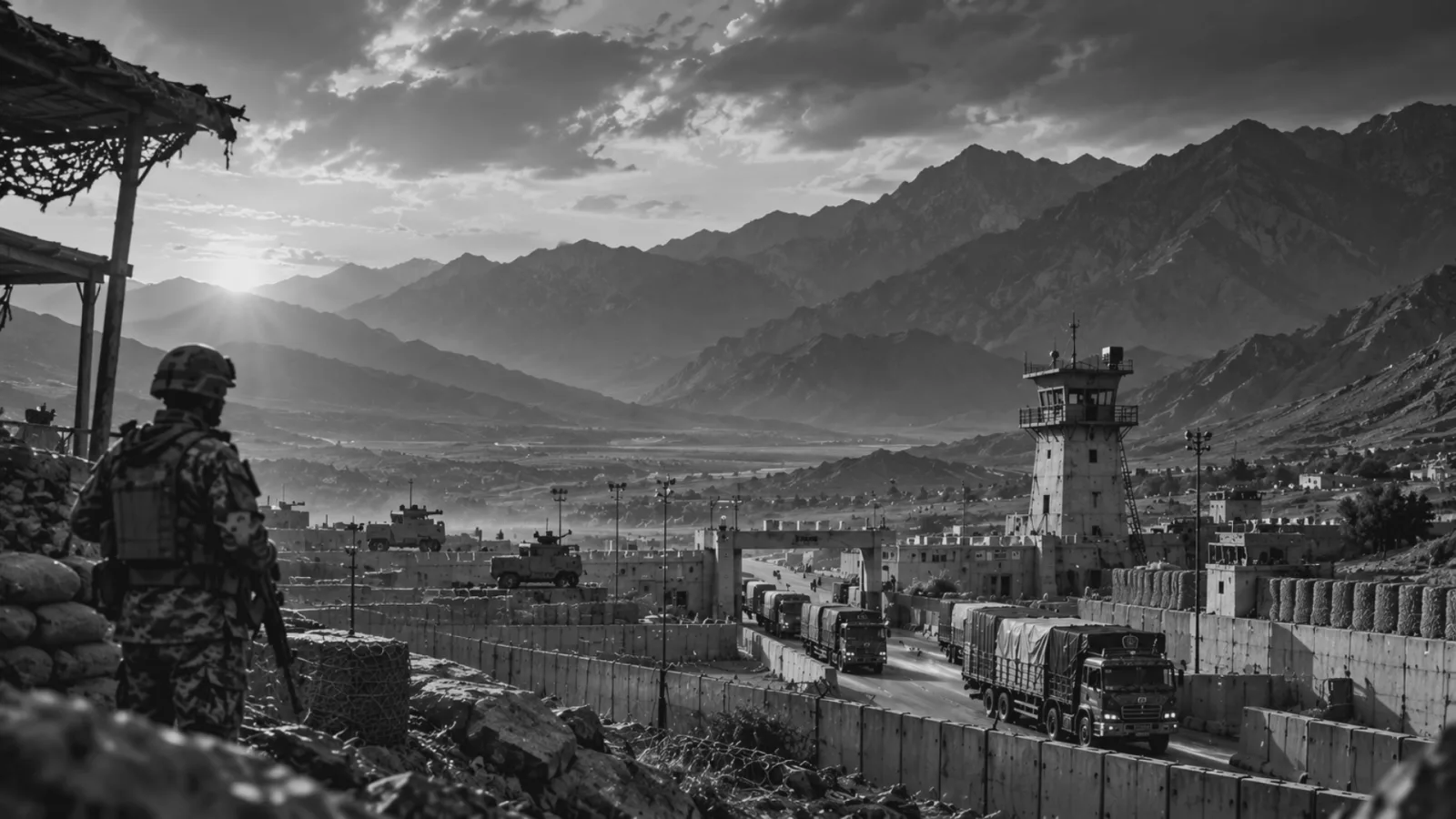
The fighting has not been confined to a single crossing or valley. Reports from October 2025 placed incidents in northern sectors around Chitral and Dir and in southern areas including Bahram Chah and Spin Boldak. The outermost reported locations imply a rough north-to-south geographic envelope of approximately 700–900 kilometers.
The geography favors recurrent, localized clashes. The frontier crosses mountainous terrain, narrow valleys, remote settlements and established crossing points. Forces can exchange fire around individual posts without either state possessing the ability or political willingness to sustain a continuous front across the entire border. The same geography complicates verification: a report of fighting in a district does not necessarily identify the exact position, the unit involved or the direction from which fire originated.
The military balance is asymmetrical. Pakistan has a conventional air force, modern combat aircraft, artillery, surveillance capabilities and a more developed military command structure. The Afghan Taliban government does not possess a comparable conventional air force or an equivalent ability to sustain a large-scale air campaign. Although Afghan forces have access to some inherited aircraft and helicopters, their condition, availability and operational capacity do not create parity with Pakistan. Pakistan therefore has a substantial advantage in the ability to conduct airstrikes and impose costs at distance.
That advantage does not automatically produce strategic success. Airstrikes may kill individual commanders or disrupt facilities, but they cannot reliably eliminate a dispersed insurgent network whose members can move across difficult terrain and blend into local environments. Strikes that cause civilian casualties may also strengthen anti-Pakistan sentiment, undermine Afghan authorities who favor accommodation, and invite retaliation against exposed border positions.
Afghan Taliban forces have a different set of options. They can contest border posts, employ mortars and other indirect fire, mobilize local forces and raise the political cost of Pakistani operations. Their ability to impose costs is therefore not equivalent to conventional military parity. It rests on local geography, the capacity to sustain irregular confrontation and Pakistan’s difficulty in translating superior firepower into a durable political outcome.
5. The TTP problem and the failure of strategic depth
The Tehrik-e-Taliban Pakistan (TTP) is the principal link between Pakistan’s domestic insurgency and its deteriorating security relationship with Afghanistan. Islamabad maintains that the group uses Afghan territory to organize attacks, shelter fighters and move personnel across the border. United Nations monitoring reports have also identified the TTP’s presence in Afghanistan and its attacks against Pakistan as a significant regional security concern. Afghanistan’s de facto authorities deny allowing militant groups to use Afghan territory to threaten other countries. The available evidence supports serious concern over the TTP’s cross-border activity, but responsibility for individual attacks and the degree of direction or assistance provided by Afghan officials must be assessed separately.[xii]
Several factors may help explain Kabul’s approach. Historical and ideological connections between the Afghan Taliban and the TTP raise the political cost of a direct confrontation. The Afghan authorities may also face practical constraints in monitoring and controlling dispersed militant networks. Some analysts have further suggested that relationships with anti-Pakistan groups could provide leverage in bilateral relations, although this should be treated as an interpretation rather than an established explanation of Afghan policy.
Pakistan’s dilemma is that it expects the Afghan authorities to act against groups Islamabad considers a security threat, while Kabul resists measures it regards as coercive interference in Afghan affairs. Pakistani officials have repeatedly called for concrete and verifiable action against the TTP; Afghan officials have emphasized sovereignty, non-interference and the resolution of disputes through dialogue. Cross-border strikes may demonstrate Pakistan’s willingness to act, but they risk civilian harm, retaliation and further deterioration in bilateral relations.
Diplomatic initiatives have attempted to contain this cycle. In October 2025, Qatar and Türkiye mediated talks in Doha that produced an immediate ceasefire, followed by meetings in Istanbul. On 30 October, the parties announced that the ceasefire would continue and agreed to develop a monitoring and verification mechanism. Pakistan subsequently stressed the need for verifiable action against militant groups, while the Afghan side maintained that outstanding differences should be resolved through diplomacy and mutual respect.[xiii] The temporary Eid al-Fitr truce announced in March 2026, following calls for de-escalation by Qatar, Saudi Arabia and Türkiye, demonstrated that diplomatic channels remained active even as tensions persisted.[xiv]
These efforts have not resolved the underlying dispute. The strategic-depth concept, historically associated with Pakistan’s desire for a friendly government in Kabul and greater strategic security on its western flank, has therefore encountered a fundamental contradiction. The return of the Afghan Taliban did not give Islamabad control over Afghanistan’s security decisions or eliminate the threat posed by the TTP. Instead, Pakistan has had to contend with militant violence inside its territory alongside recurring confrontations with Afghan forces. This is not a conventional two-front war between equivalent state militaries, but it is a dual security challenge involving an internal insurgency and an increasingly militarized frontier. Its resolution depends not only on military pressure, but also on verifiable security arrangements, sustained diplomacy and a workable understanding of each side’s concerns.
6. Civilian harm and economic pressure
Civilian casualties have become one of the most consequential features of the Afghanistan–Pakistan conflict. UNAMA verified 185 civilian casualties in Afghanistan between 26 February and 5 March 2026, including 56 deaths and 129 injuries. Women and children accounted for 55 percent of those casualties. During the cross-border hostilities of 10–17 October 2025, UNAMA recorded a further 503 civilian casualties, including 47 deaths and 456 injuries.[xv] These figures highlight the human cost of sustained cross-border operations, particularly where airstrikes and indirect fire affect populated areas. Although responsibility for individual incidents must be assessed on the available evidence, the scale of the recorded casualties raises serious questions about civilian protection and the precautions taken during military operations.
The effects extend beyond immediate deaths and injuries. Damage to homes, displacement and disruption to essential services place additional pressure on communities already facing economic and humanitarian difficulties. Where military operations are conducted in or near populated areas, the burden of escalation falls heavily on civilians who have limited influence over the decisions driving the conflict. UNAMA’s figures cover Afghanistan and do not provide a complete accounting of civilian harm in Pakistan; a balanced assessment must recognize this limitation while examining the documented consequences on each side.
Border closures have compounded these humanitarian pressures with substantial economic disruption. Torkham, Chaman and other crossings are vital to bilateral trade, transit cargo and the movement of people. During the October 2025 shutdown, vehicles and commercial consignments were stranded, while traders and transport operators faced delays, losses and deterioration of perishable goods. Reporting also documented rising prices for essential commodities, including tomatoes, in Pakistani markets during the disruption.[xvi] These consequences illustrate how border restrictions imposed during security crises can transfer the costs of interstate confrontation to farmers, small businesses, transport workers and ordinary consumers.
Pakistan’s use of military pressure and border restrictions reflects its stated objective of compelling action against militant networks operating from Afghan territory. However, such measures carry costs of their own. Airstrikes risk civilian casualties and further deterioration in bilateral relations, while prolonged border closures disrupt legitimate commerce and livelihoods on both sides. Their effectiveness ultimately depends on whether they produce verifiable security improvements or instead deepen grievances and encourage further confrontation. The economic and humanitarian consequences therefore form part of the strategic assessment, not merely a parallel concern: measures intended to improve security can also impose substantial costs on civilians without necessarily resolving the underlying dispute.
7. Six-month outlook: 19 October 2026 to 19 April 2027
The most plausible outlook is continued intermittent fighting, punctuated by temporary ceasefires and diplomatic efforts, with a material risk of wider escalation. The October 2026 clashes and the failure of the Moscow Format consultations to produce agreement indicate that the central dispute remains unresolved. Pakistan continues to demand verifiable action against the Tehrik-e-Taliban Pakistan (TTP), while the Afghan Taliban authorities reject allegations that they permit Afghan territory to be used for attacks against Pakistan. Neither side has demonstrated a willingness to abandon its core position.
The following scenarios represent structured analytic judgments about the predominant trajectory over the forecast period, rather than statistically derived probabilities.
Scenario | Relative likelihood | Assessment |
Continued clashes and fragile pauses | High | Localised firefights, intermittent strikes and border restrictions continue, interspersed with temporary ceasefires and mediation efforts. |
Major escalation | Moderate | A high-casualty attack in Pakistan attributed to Afghanistan-based militant networks, or a strike causing substantial civilian casualties, triggers wider Pakistani air operations and Afghan retaliation across multiple sectors. |
Sustained de-escalation | Low to moderate | Renewed mediation produces a functioning incident-monitoring mechanism, improved crisis communication and verifiable steps to reduce cross-border militant activity. |
Continued clashes and fragile pauses
This scenario is supported by the combination of recurring border violence and the continued availability of diplomatic channels. The failure of recent consultations to resolve the dispute suggests that negotiations face substantial obstacles, while the costs of a prolonged confrontation provide both sides with incentives to contain escalation. Under this scenario, localized exchanges of fire, intermittent strikes and temporary border closures continue despite periodic ceasefire efforts. Political leaders may seek to limit confrontation without resolving the underlying disagreement over the TTP.
Major escalation
The principal escalation pathway would involve a high-casualty attack inside Pakistan followed by Pakistani strikes in Afghanistan, or an operation causing substantial Afghan civilian casualties followed by retaliation against Pakistani positions. The risk would increase if either side attributed an incident directly to the opposing government before responsibility had been adequately established. A sequence of retaliatory actions across several border sectors could transform localized confrontations into a wider military campaign, even if neither government initially sought a prolonged war.
Sustained de-escalation
A durable reduction in violence would require more than another ceasefire declaration. The parties would need a practical mechanism for reporting and investigating border incidents, reliable communication channels during crises, measures to protect civilians and verifiable steps addressing Pakistan’s concerns about TTP activity. External mediation could facilitate such arrangements, but implementation would depend on decisions by the parties themselves. A sustained decline in reported attacks, fewer border closures and regular security contacts would provide stronger evidence of progress than diplomatic statements alone.
Indicators to monitor
The assessment should be reviewed against four indicators: changes in the frequency and lethality of TTP attacks inside Pakistan; the scale and geographic spread of Pakistani air operations and Afghan retaliation; progress towards a monitoring and verification mechanism; and the duration of border closures, civilian displacement and disruption to commercial traffic.
Overall assessment: Continued intermittent fighting, punctuated by fragile pauses, is the leading scenario for the six-month period. Confidence in this judgment is limited because the trajectory will depend heavily on future attacks, decisions by political and military leaderships, and the effectiveness of mediation. A major attack or a functioning verification mechanism could materially change the outlook. The scenarios should therefore be reassessed as new evidence emerges.
Conclusion
The Afghanistan–Pakistan conflict has evolved from a dispute over border management and militant sanctuaries into a recurring interstate security crisis. The October 2025 fighting showed that Pakistani counterterrorism strikes can trigger geographically dispersed retaliation, while the renewed clashes in 2026 demonstrate that ceasefires without a mechanism for resolving the TTP issue are unlikely to last.
Pakistan retains a clear conventional military advantage, especially in air power. Yet that advantage has not resolved the political problem that drives the conflict. The Afghan Taliban’s ability to resist, retaliate and contest border positions, combined with the TTP’s continued threat inside Pakistan, limits what military pressure alone can achieve.
The central strategic question is therefore not whether Pakistan can strike targets inside Afghanistan. It is whether Islamabad and Kabul can create an arrangement that reduces the TTP threat without turning every cross-border operation into another confrontation between the two governments. Without such an arrangement, the most likely future is neither stable peace nor uninterrupted war, but a cycle of militant attacks, retaliatory strikes, border clashes and temporary diplomatic pauses.
Endnotes:
[i] Congressional Research Service. (2022). U.S. military withdrawal and Taliban takeover of Afghanistan: Frequently asked questions (Report No. R46879). https://www.congress.gov/crs_external_products/R/PDF/R46879/R46879.6.pdf
[ii] Combating Terrorism Center at West Point. (2023). The Tehrik-i-Taliban Pakistan after the Taliban’s Afghanistan takeover. https://ctc.westpoint.edu/the-tehrik-i-taliban-pakistan-after-the-talibans-afghanistan-takeover/ ; South Asia Terrorism Portal. (2021). South Asia Intelligence Review, Volume 20, No. 18. https://satp.org/south-asia-intelligence-review-Volume-20-No-18
[iii] Associated Press. (2024, December 24). Airstrikes target suspected Pakistani Taliban hideouts in Afghanistan. https://apnews.com/article/aac6f1f0aa42f1f3ad88f619b7305724
[iv] Reuters. (2025, March 3). Pakistani, Afghan security forces clash at closed main border crossing. https://www.reuters.com/world/asia-pacific/pakistani-afghan-security-forces-clash-closed-main-border-crossing-2025-03-03/ ; Reuters. (2025, March 4). Pakistan-Afghanistan border clashes ease, thousands seek shelter. https://www.investing.com/news/economic-indicators/pakistanafghanistan-border-clashes-ease-thousands-seek-shelter-3904886
[v] Afghanistan International. (2025, August 28a). Taliban condemns Pakistani drone strikes, summons envoy in Kabul. https://www.afintl.com/en/202508287279 ; Afghanistan International. (2025, August 28b). Unidentified drones strike Pakistani Taliban in Khost, Nangarhar and Kunar. https://www.afintl.com/en/202508283467
[vi] Reuters. (2025, March 3). Pakistani, Afghan security forces clash at closed main border crossing. https://www.reuters.com/world/asia-pacific/pakistani-afghan-security-forces-clash-closed-main-border-crossing-2025-03-03/ ; Reuters. (2025, March 4). Pakistan-Afghanistan border clashes ease, thousands seek shelter. https://www.investing.com/news/economic-indicators/pakistanafghanistan-border-clashes-ease-thousands-seek-shelter-3904886
[vii] Associated Press. (2025, October 8). 11 Pakistani soldiers, 19 militants killed in clash in northwest near Afghan border. https://apnews.com/article/815a9797371db3798d6f996aae0e0c4e ; Reuters. (2025c, October 8). Islamist militants kill 11 Pakistani soldiers in ambush, sources say. https://ca.marketscreener.com/news/eleven-pakistan-paramilitary-troops-killed-in-ambush-by-islamist-militants-sources-say-ce7d5bd2dd8af621
[viii] Afghanistan accuses Pakistan of air attacks; Islamabad warns of action against militants. (2025, October 10) https://www.streetinsider.com/Reuters/Afghanistan%2Baccuses%2BPakistan%2Bof%2Bair%2Battacks%3B%2BIslamabad%2Bwarns%2Bof%2Baction%2Bagainst%2Bmilitants/25441958.html
[ix] Al Jazeera. (2025, October 12). Afghanistan-Pakistan border clashes: What we know so far. https://www.aljazeera.com/news/2025/10/12/afghanistan-pakistan-border-clashes-what-we-know-so-far ; Reuters. (2025b, October 11). Firefights erupt between Pakistani and Afghan forces along the border. https://www.streetinsider.com/Reuters/Firefights%2Berupt%2Bbetween%2BPakistani%2Band%2BAfghan%2Bforces%2Balong%2Bthe%2Bborder/25446036.html
[x] United Nations Assistance Mission in Afghanistan. (2025, October 16). UNAMA welcomes Afghanistan-Pakistan ceasefire, urges protection of civilians. https://unama.unmissions.org/en/node/63882
[xi] Associated Press. (2026, October 18). Pakistani forces, Afghan Taliban exchange fire after militants attempt to infiltrate Pakistan. https://apnews.com/article/af35955a49d8ec9948b4a946bf07d37c ; Reuters. (2025b, October 11). Firefights erupt between Pakistani and Afghan forces along the border. https://www.streetinsider.com/Reuters/Firefights%2Berupt%2Bbetween%2BPakistani%2Band%2BAfghan%2Bforces%2Balong%2Bthe%2Bborder/25446036.html ; Selber, W. (2026, October 12). Taliban-Pakistan border clashes continue after Moscow talks end without agreement. FDD’s Long War Journal. https://www.longwarjournal.org/archives/2026/10/taliban-pakistan-border-clashes-continue-after-moscow-talks-end-without-agreement.php ; United Nations Assistance Mission in Afghanistan. (2025, October 16). UNAMA welcomes Afghanistan-Pakistan ceasefire, urges protection of civilians. https://unama.unmissions.org/en/node/63882
[xii] United Nations Security Council. (2025, December 8). Sixteenth report of the Analytical Support and Sanctions Monitoring Team submitted pursuant to resolution 2763 (2024) concerning the Taliban and other associated individuals and entities constituting a threat to the peace, stability and security of Afghanistan (S/2025/796). https://digitallibrary.un.org/record/4095910
[xiii] Ministry of Foreign Affairs of Pakistan. (2025, November 7). Statement by the spokesperson regarding the Pakistan-Afghanistan talks held in Istanbul. https://mofa.gov.pk/press-releases/statement-by-the-spokesperson-8 ; Ministry of Foreign Affairs of Qatar. (2025, October 19). Pakistan and Afghanistan agree to an immediate ceasefire during a round of negotiations in Doha. https://mofa.gov.qa/en/latest-articles/statements/pakistan-and-afghanistan-agree-to-an-immediate-ceasefire-during-a-round-of-negotiations-in-doha ; Ministry of Foreign Affairs of Türkiye. (2025, October 30). Joint statement on the talks between Afghanistan and Pakistan through the mediation of Türkiye and Qatar. https://www.mfa.gov.tr/joint-statement-on-the-talks-between-afghanistan-and-pakistan-through-the-mediation-of-turkiye-and-qatar-30-10-2025.en.mfa
[xiv] Reuters. (2025c, October 8). Islamist militants kill 11 Pakistani soldiers in ambush, sources say. https://ca.marketscreener.com/news/eleven-pakistan-paramilitary-troops-killed-in-ambush-by-islamist-militants-sources-say-ce7d5bd2dd8af621
[xv] United Nations Assistance Mission in Afghanistan. (2025, October 16). UNAMA welcomes Afghanistan-Pakistan ceasefire, urges protection of civilians. https://unama.unmissions.org/en/node/63882 ; United Nations Assistance Mission in Afghanistan. (2026, March 6). Update on civilian casualties in Afghanistan. https://unama.unmissions.org/en/press-releases/update-civilian-casualties-afghanistan
[xvi] Government of Pakistan, Press Information Department. (2025, October 24). Customs clearances at Pak-Afghan border crossings. https://pid.gov.pk/site/press_detail/30751 ; Reuters. (2025, October 23). Pakistan-Afghanistan border closures push up prices of essentials such as tomatoes. https://www.investing.com/news/world-news/pakistanafghanistan-border-closures-push-up-prices-of-essentials-such-as-tomatoes-4304733
Tags

Author
Sushant Pawar
Sushant serves as the Intelligence/ Lead Analyst for the Pakistan Security Desk at CNAWS, specializing in the Balochistan insurgency and Tehrik-e-Taliban Pakistan (TTP). His work spans monitoring the broader regional security environment , including insurgency trends, militant networks, and cross-border dynamics, to assess their impact on stability across South Asia. Beyond terrorism analysis, Sushant tracks Pakistan's evolving political and security landscape, delivering insights that inform regional stability and India's national security priorities.