Department of Hybrid Warfare & Irregular Conflict · Situational Reports · Terrorism and Militancy ·
BLF Launches Female Combat Unit KAAD in Balochistan: What It Means for the Baloch Insurgency
The Balochistan Liberation Front’s announcement of the Karima Armed Assault Division (KAAD) represents a potentially important organisational development within the Baloch insurgency. The BLF claimed that the newly formed female combat unit conducted its first armed operation near Jusak, on the outskirts of Turbat in Kech district, on 22 September 2026. The group subsequently released imagery and training footage showing female personnel handling weapons and conducting combat-related drills. While these materials demonstrate that the BLF is publicly presenting a distinct female formation, they do not independently establish KAAD’s numerical strength, command structure, permanent deployment pattern or sustained operational capability. BLF-KAAD BLF-KAAD
KAAD is significant primarily because it may indicate a transition from the episodic participation of women in Baloch militancy toward a more institutionalised female combat structure. Female participation has already become increasingly visible through suicide attacks and operational roles associated particularly with the BLA’s Majeed Brigade. The BLF itself had previously been linked to a female suicide operative in 2025. KAAD potentially moves this evolution further by giving female personnel a distinct organisational identity, training framework and public-facing military role. BLF-KAAD
The unit also has a strong symbolic and information-warfare dimension. Its name invokes Karima Baloch, a prominent figure in Baloch nationalist politics, linking female political activism with armed participation. The BLF’s rapid release of operational claims, imagery and training footage suggests that recruitment, propaganda, organisational prestige and competition with other Baloch armed groups are central to KAAD’s present utility. BLF-KAAD BLF-KAAD
At present, KAAD should therefore be treated as an early indicator of possible structural change rather than evidence of a mature female combat arm. The key intelligence indicators will be independently corroborated attacks, recurring personnel, identifiable commanders, geographic expansion and evidence of sustained integration into BLF operational structures.
The Balochistan Liberation Front (BLF) has announced the formation of a new female combat formation, the Karima Armed Assault Division (KAAD), and claimed that the unit conducted its first armed operation near Jusak, on the outskirts of Turbat in Kech district, on 22 September 2026. The announcement was accompanied by the release of video footage depicting female personnel in military attire conducting weapons and combat training. The development is significant not because it establishes, by itself, a new level of BLF military capability, but because it indicates a possible shift from the episodic participation of women in the Baloch insurgency towards the creation of a dedicated female organisational structure within the BLF.
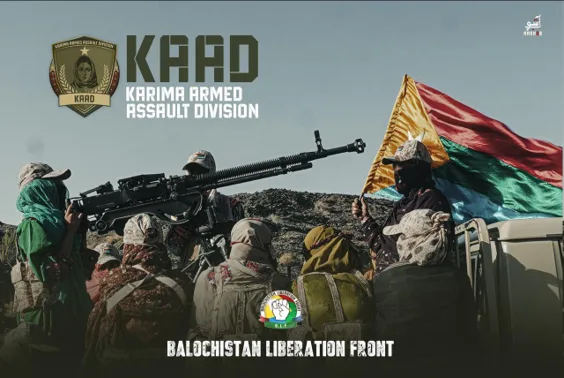
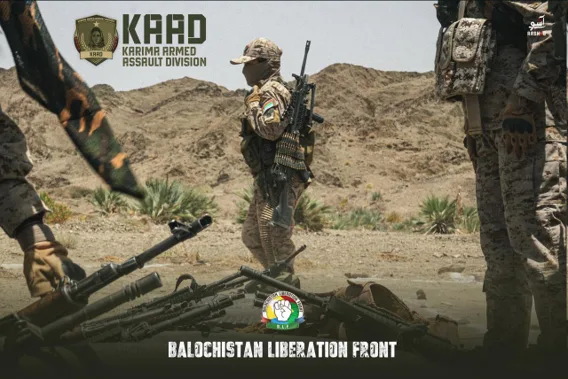
Posters released by BLF
KAAD’s First Claimed Attack Near Turbat and the CPEC Highway
According to BLF spokesperson Major Gwahram Baloch, KAAD fighters conducted a coordinated ambush against a Pakistani military Action Task Force convoy travelling along the CPEC highway near Jusak. The BLF claimed that several military personnel were killed and wounded and that military vehicles were damaged. No precise casualty figure was provided, and the claims have not been independently verified. The Balochistan Post reported the BLF statement on 23 September, while the South Asia Terrorism Portal separately recorded the claim and noted that the reported casualties could not be independently verified.¹ ²
The operational claim was followed by a more consequential information release. BLF-linked Aashob channels circulated dedicated KAAD material, including an operational statement, imagery and a training video. The footage shows women handling small arms and heavier weapons, conducting firing drills and participating in mobility exercises involving vehicles and motorcycles. The sequence is important. BLF did not merely announce the creation of a new unit; it immediately sought to establish a visual representation of the organisation, its personnel and its purported military preparedness.³
This makes KAAD both an organisational development and an information operation. The evidence currently available demonstrates that BLF is publicly presenting a distinct female formation and possesses access to a group of women receiving military-style training. It does not, however, establish the unit's numerical strength, command hierarchy, permanent area of deployment or the extent to which the personnel shown in the footage participated in the Jusak operation. Nor does the footage independently corroborate the BLF's account of casualties.
The Jusak incident itself requires similar caution. A separate report recorded a remote-controlled explosive attack near the Jusak Police Station on the N-8 highway on 22 September, in which one Quick Response Force member was reportedly killed and two wounded. The available reporting did not initially establish responsibility for that incident. The occurrence in the same geographical area should therefore not automatically be treated as independent confirmation of the BLF's subsequent account.²
BLF’s Growing Role in the Baloch Insurgency
The emergence of KAAD is best understood against the institutional development of the BLF and the wider evolution of the Baloch insurgency. The contemporary BLF emerged as one of the principal armed organisations in the Baloch nationalist insurgency and has maintained a particularly strong operational presence in southern Balochistan, including the Makran region. Research by the Combating Terrorism Center at West Point describes the BLF as a distinct organisation within the fragmented Baloch insurgency, with its operational history extending across military, intelligence and infrastructure targets. The organisation maintains specialised components, including an Intelligence Wing, Qurban Unit and Sniper Tactical Team, although the precise structure and strength of these elements remain opaque.⁴
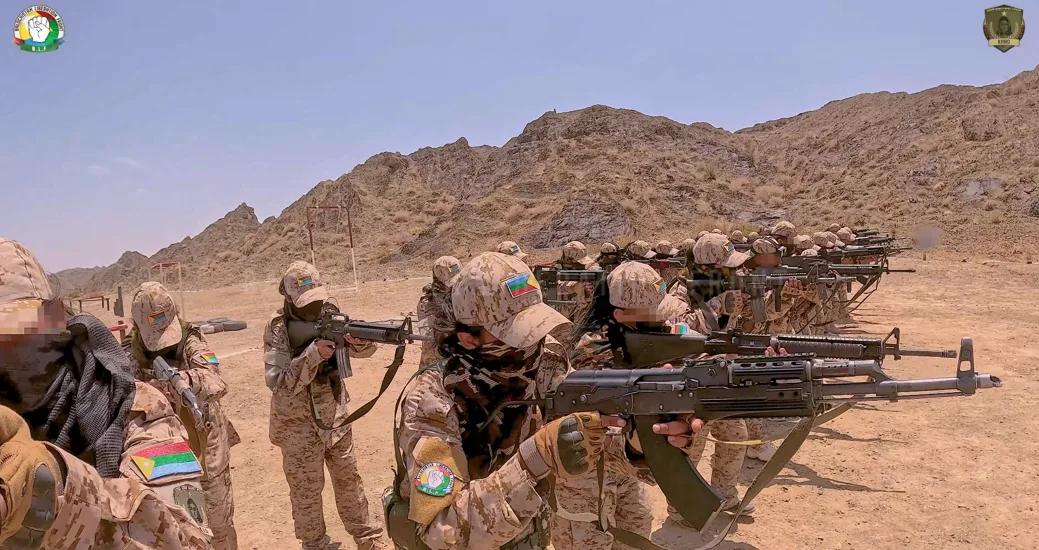
BLF-released imagery showing female personnel identified as members of the newly established Karima Armed Assault Division (KAAD) conducting weapons training in mountainous terrain. Screenshot from video released by BLF-affiliated media, September 2026.
The BLF's contemporary organisation is also closely associated with Dr. Allah Nazar Baloch, who emerged as its principal leader during the current phase of the insurgency. The group's organisational trajectory has been shaped by the broader fragmentation of Baloch militant politics. The Baloch Liberation Army (BLA) and BLF have historically shared aspects of the wider separatist project while maintaining separate command structures and strategic identities. The CTC assessment notes that the BLF developed into an important armed organisation in its own right and that competition over recruits, resources and operational space has contributed to organisational differentiation within the insurgency.⁴
The distinction is relevant because the creation of KAAD should not be interpreted simply as a tactical response to the Pakistani security establishment. It also occurs within an insurgent environment in which Baloch organisations have increasingly competed over operational sophistication, media visibility, recruitment and symbolic legitimacy.
BLF has traditionally received less international attention than the BLA, particularly the BLA-Jeyand faction and its Majeed Brigade. Yet its operational activity has remained substantial. The CTC's 2025 assessment described the BLF as a high-tempo organisation that had conducted hundreds of claimed attacks in preceding years and had developed a more systematic media apparatus than is sometimes acknowledged. Its targeting has included Pakistani security forces, state infrastructure, Chinese personnel and projects associated with the China-Pakistan Economic Corridor.⁴
This background gives particular significance to the location of the reported KAAD debut. Jusak lies within the Turbat-Kech operational environment, an area that has historically been important to the BLF. The CPEC corridor has also become an increasingly important element of the Baloch insurgency's targeting environment. Consequently, the reported attack was not conducted in an operationally peripheral area. It occurred within one of the organisation's established geographical theatres and against a security element associated with the protection of strategically important infrastructure.
Who Was Karima Baloch and Why Did BLF Name KAAD After Her?
The designation "Karima Armed Assault Division" is itself politically significant. The name appears to invoke Karima Baloch, the prominent Baloch activist and former chairperson of the Baloch Students Organization-Azad (BSO-Azad). Karima was one of the most prominent female figures in contemporary Baloch nationalist politics and became particularly influential among younger Baloch activists. She left Pakistan and received asylum in Canada after years of political activism. She was found dead in Toronto in December 2020. Toronto police stated at the time that the death was being treated as non-criminal and that there were no believed suspicious circumstances. Her family and supporters disputed this interpretation and called for a fuller investigation.⁵ ⁶
Her political significance to Baloch nationalism, rather than the circumstances of her death, is what makes her name particularly relevant to KAAD. Karima represented female participation in Baloch political activism before the current expansion of female participation in armed organisations. Naming a military formation after her creates an explicit symbolic bridge between female political activism and female participation in the insurgency.
There is also an organisational connection worth noting. Karima was associated with BSO-Azad, a political student organisation that became an important component of the Baloch nationalist movement. Pakistan subsequently proscribed BSO-Azad in 2013. The same political milieu historically intersected with figures who later became prominent in the armed insurgency.⁵ ⁷
The symbolism therefore appears calculated. KAAD is not merely a gender-specific designation. By adopting Karima Baloch's name, BLF is attaching the formation to an established symbol of female Baloch political activism and attempting to place armed female participation within a longer narrative of Baloch nationalism.
Female Combatants and Suicide Attacks in the Baloch Insurgency
This is particularly important because women have already assumed increasingly visible roles within Baloch militant organisations. The best-known example is Shari Baloch, who carried out the 2022 suicide bombing at Karachi University's Confucius Institute on behalf of the BLA's Majeed Brigade. Subsequent female suicide operations associated with Baloch militant organisations further demonstrated that women were no longer confined to peripheral logistical or political roles within the insurgency. The CTC's 2025 assessment specifically noted the increasing use of women in suicide operations by Baloch militant organisations.⁴
The BLF itself subsequently entered this pattern. The emergence of Zareena Rafiq as a female suicide operative associated with the BLF in 2025 represented an important precedent for the organisation. The significance of KAAD is that it potentially moves the BLF beyond individual female participation. Instead of a woman appearing as an isolated operative within an existing male-dominated structure, BLF is now presenting women as members of a dedicated formation with its own name, imagery and organisational identity.
Individual female participation can be incorporated into an existing insurgent structure without altering the organisation's basic force architecture. A dedicated female unit implies something different. It suggests that recruitment, training, political socialisation and operational deployment of women may be developing into a recognised organisational function.
The available evidence is not yet sufficient to determine whether this has occurred on a substantial scale. Nevertheless, the visual material released by BLF is intended to establish precisely that impression. The footage shows multiple female personnel training together rather than an isolated individual. A separate organisational identity is repeatedly displayed. The unit is presented as a collective formation rather than a collection of individual recruits.
How BLF Is Using KAAD for Recruitment and Information Warfare
The information dimension is consequently as important as the military dimension. BLF has developed a comparatively sophisticated media apparatus over the course of the insurgency. Its Aashob platform distributes statements, operational claims, imagery and video material, while the organisation has also used publications to articulate its political and strategic narratives. The CTC has noted BLF's extensive media production, including its Asper magazine, which has devoted substantial attention to China, CPEC and the organisation's interpretation of the conflict.⁴
KAAD fits naturally within this established media strategy. The release of the training footage one day after the claimed operation creates a narrative progression from formation, to combat, to visual confirmation of preparedness. For an insurgent organisation, this has several potential functions. It can demonstrate organisational vitality, encourage recruitment, reinforce the perception of operational reach and generate psychological pressure on the adversary. None of these effects requires every element of the underlying operational claim to be independently verified.
BLF-BLA Competition Over Female Militants and Operational Prestige
The creation of KAAD may also reflect an element of organisational competition within the Baloch insurgency. Female participation has become increasingly associated with the BLA, particularly through the Majeed Brigade's use of female suicide operatives and the subsequent publicisation of female personnel. The BLF's decision to establish a named female formation gives it a mechanism through which to develop its own identity in an area where the BLA has previously occupied considerable symbolic space. The issue should therefore be considered within the broader competition between Baloch armed organisations over recruitment, operational prestige, political legitimacy and media visibility.
How Significant Is BLF’s Karima Armed Assault Division?
At the same time, there is a danger in treating the term "division" literally. There is currently no evidence establishing that KAAD possesses the personnel strength or organisational depth normally associated with a military division. The designation is an internal organisational title used by BLF. Until additional evidence emerges, it is more analytically sound to describe KAAD as a newly announced female combat formation rather than infer a conventional military order of battle from its name.
The same caution applies to the reported Jusak operation. BLF's claim that KAAD conducted a coordinated ambush is plausible within the organisation's established tactical repertoire, but the available evidence does not establish the number of attackers, the precise composition of the target convoy, the duration of the engagement or the casualties inflicted. The training footage demonstrates access to trained female personnel and military equipment, but it cannot independently establish operational effectiveness.
What to Watch Next From KAAD and the Balochistan Liberation Front
The more consequential intelligence question is therefore what happens after the announcement. If KAAD conducts additional operations over the coming months, particularly operations independently corroborated through local reporting or official Pakistani statements, the evidence for a functioning female combat formation would become considerably stronger. Repeated appearances of identifiable personnel could also permit assessment of the unit's approximate strength, leadership and geographic deployment. Conversely, if KAAD's subsequent activity remains concentrated on videos, statements and recruitment messaging, its principal function may be organisational branding and mobilisation rather than the creation of a large autonomous combat force.
The geographic distribution of future activity will also be important. A formation restricted primarily to the Turbat-Kech area would suggest that KAAD remains closely integrated with the BLF's established Makran networks. Operations in Awaran, Panjgur, Washuk, Khuzdar or further east would provide stronger evidence of the organisation's ability to deploy female personnel beyond its traditional operating environment.
The relationship between KAAD and the existing BLF command structure is another major intelligence gap. The organisation has not publicly established whether KAAD possesses an independent commander or whether it operates under an existing BLF operational formation. Similarly, it remains unclear whether the women shown in the training footage constitute a single operational unit or represent personnel drawn together specifically for propaganda purposes.
At present, the strongest conclusion is therefore relatively narrow but significant. BLF has publicly established and promoted a dedicated female combat formation, has associated that formation with an armed operation near Jusak, and has released visual material intended to demonstrate its training and organisational existence. The evidence does not yet establish KAAD's force strength, independent command structure or sustained operational capability.
The development nonetheless represents a meaningful evolution in the gender composition of the Baloch insurgency. Female participation has already moved beyond isolated political activism and into operational violence. KAAD potentially represents the next stage, in which female participation is incorporated into the insurgency as a distinct organisational identity.
For intelligence purposes, the most important development to monitor is therefore not the initial announcement itself but whether KAAD becomes a recurring operational entity. A pattern of independently corroborated attacks, identifiable commanders, recurring personnel and geographically distributed activity would indicate genuine institutionalisation. Continued emphasis on training footage and propaganda without corresponding operational evidence would suggest a different organisational function. The September 2026 announcement should consequently be treated as an early indicator of possible structural change within the BLF, rather than definitive evidence that a mature female combat arm has already been established.
References
The Balochistan Post. “BLF Says Newly Formed Female Unit Carried Out First Attack Near Turbat.” September 23, 2026. The Balochistan Post
South Asia Terrorism Portal. “Terrorism Update Details: 23-9-2026.” September 23, 2026. South Asia Terrorism Portal
The Balochistan Post. “BLF Releases Training Video of Newly Formed Female Armed Unit.” September 23, 2026. The Balochistan Post
Ayush Verma, Imtiaz Baloch, and Riccardo Valle. “The Baloch Insurgency in Pakistan: Evolution, Tactics, and Regional Security Implications.” CTC Sentinel 18, no. 4 (April 2025). Combating Terrorism Center at West Point
Shah Meer Baloch and Hannah Ellis-Petersen. “Karima Baloch, Pakistani Human Rights Activist, Found Dead in Canada.” The Guardian, December 22, 2020. The Guardian
Shah Meer Baloch and Hannah Ellis-Petersen. “Grief, Anger and a Curfew as Pakistani Activist Karima Baloch Buried.” The Guardian, January 25, 2021. The Guardian
National Counter Terrorism Authority, Government of Pakistan. “73 Organizations Proscribed by Ministry of Interior under Section 11-B(1) read with Schedule I, Anti-Terrorism Act, 1997.” NACTA
Pakistan Institute for Conflict and Security Studies. “Copying the BLA: The Strategic Logic Behind KAAD.” September 2026. PICSS
Security Risks Asia. “TRAC Report of Claims by BLF's Female Unit Karima Armed Assault Division (KAAD).” September 2026.Security Risks Asia
Tags
- #Baloch insurgency
- #Baloch Liberation Front
- #Balochistan
- #Balochistan conflict
- #Balochistan insurgency
- #Balochistan Liberation Front
- #BLF
- #CPEC security
- #female combatants
- #KAAD
- #Karima Armed Assault Division
- #pakistan
Author
Sushant Pawar
Sushant serves as the Intelligence/ Lead Analyst for the Pakistan Security Desk at CNAWS, specializing in the Balochistan insurgency and Tehrik-e-Taliban Pakistan (TTP). His work spans monitoring the broader regional security environment , including insurgency trends, militant networks, and cross-border dynamics, to assess their impact on stability across South Asia. Beyond terrorism analysis, Sushant tracks Pakistan's evolving political and security landscape, delivering insights that inform regional stability and India's national security priorities.