Department of Hybrid Warfare & Irregular Conflict · Explainers · Terrorism and Militancy ·
What is State-Sponsored Terrorism?
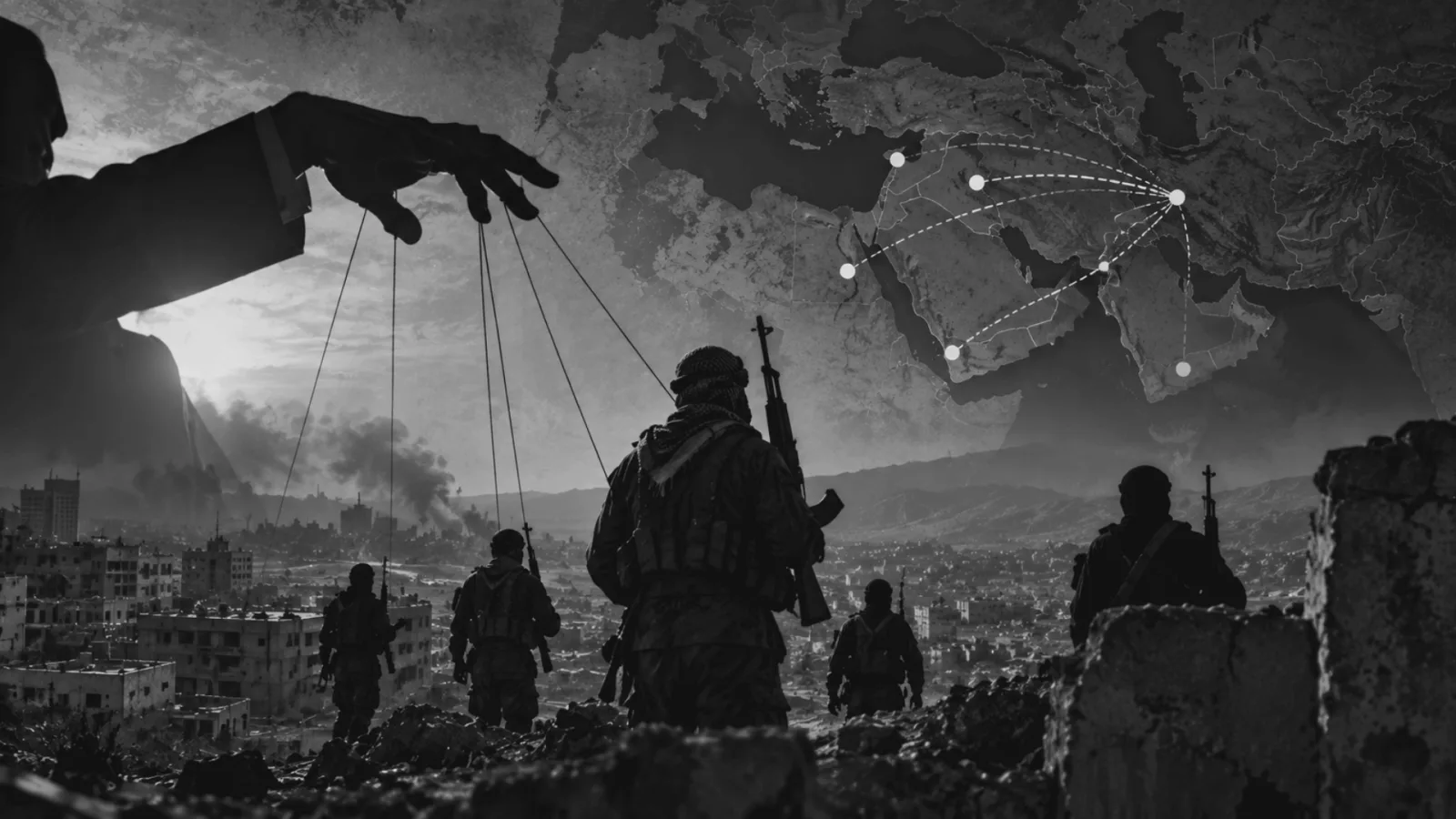
State-sponsored terrorism refers to the use of non-state actors by governments to pursue political or strategic objectives through violence, support networks and proxy structures. From Cold War-era proxy conflicts to contemporary cases involving Iran, Hezbollah and other armed groups, the practice blurs the line between covert statecraft, political violence and terrorism.
1. Introduction
State sponsored terrorism is one of the most controversial forms of political violence in modern international relations. Unlike terrorism which is usually carried out by independent extremist groups, state-sponsored terrorism involves some level of support, direction, or protection from a government. That support can include money, weapons, safe havens, intelligence, training, diplomatic cover, or even direct planning.
This concept matters as it shows how states can use violence indirectly to influence events beyond their borders. Governments may want to weaken rivals, intimidate opponents, destabilize a region or advance ideological objectives without entering conventional conflicts. In that sense, state sponsored terrorism blurs the line between covert statecraft and overt terrorism.
2. Definition
While the very definition of the term terrorism is rather subjective due to its political nature, the term “state-sponsored terrorism” also follows this subjectivity. In simple terms, it is terrorism carried out by non-state actors (NSAs) with the support, encouragement, tolerance or direction of a state. The state may not always be the group that commits the attack itself but it plays a meaningful role in enabling this violence. Different sources phrase this idea slightly. The US State Department uses the term “State Sponsors of Terrorism” for countries that repeatedly provide support for acts of international terrorism while academic sources often use the broader idea of state sponsorship to describe any deliberate government assistance to violent groups. It is important to distinguish this from ordinary state repression or lawful military action. A state using police force at home is not automatically engaging in state sponsored terrorism. The term is usually reserved for situations where a government uses proxies, clandestine networks, or deniable actors to commit violence for political purposes.
3. Historical Evolution
The roots of state sponsored terrorism stretch back decades but the phenomenon itself became especially visible during the Cold War. Competing superpowers and regional governments often backed militant groups as part of proxy conflicts, using them to weaken enemies without direct confrontation. This was attractive because it offered plausible deniability and reduced the risks of open war. During the Cold war, support for militant groups expanded across the Middle East, Latin America, Africa, and South Asia. Governments aided insurgents, guerrillas, or nationalist movements that could serve strategic aims. Some states did this for ideology, some for regional power, and others for retaliation against opponents with the Soviet Union being one of the clearest examples of a state that used overt and covert support for revolutionary and anti-Western movements in Africa. Ultimately, the line between “freedom fighter” and “terrorist” often depended on who was speaking.
Iran offers an important case study. After the 1979 Iranian revolution, Khomeinism and the need to export the revolution abroad became central to the state’s identity. This was enshrined in constitutional provisions like Article 154 which obligates the state to support liberation movements worldwide while abstaining from interference in internal affairs of states. This language helps explain why Iran has often described support for foreign movements not as subversion but as revolutionary solidarity or assistance to liberation struggles.
International law has shaped this debate but has not settled it. The 1970 Declaration on Friendly Relations affirms the right of peoples to self-determination and condemns forcible action that deprives them of that right. At the same time, it requires states to refrain from organizing, assisting or participating in terrorist acts or civil strife in another state. Meanwhile, Article 51 of the UN charter protects individual and collective self-defence when an armed attack occurs. It is not a general authorization for outside states to arm non-state movements. The resulting tension that emerges is central to this debate. Claims of liberation and self determination may explain why support is politically defended but these do not erase rules on non-intervention, civilian protection, or the prohibition of terrorism.
4. Key Components
State-sponsored terrorism usually involves several elements. First, there is a state actor that provides support or encouragement. Second, there is a non-state group that carries out or threatens violence. Third, there is a political goal, such as destabilizing an enemy, resisting occupation, or projecting influence. Fourth, there is some form of support, which may be military, financial, diplomatic, logistical, ideological, or political.
Importantly, plausible deniability is not always required. While some states prefer to operate through secrecy and proxies, others are openly supportive of armed groups and still justify their actions as legitimate resistance, revolutionary solidarity, or anti-imperial duty. This means that the concept of state-sponsored terrorism cannot be reduced only to covert operations. It also includes overt sponsorship, public endorsement, and state-aligned support networks. Another key point is that support is not always material. It can also include diplomatic protection, safe political space, official rhetoric, training, intelligence, and channels that keep a movement alive. In that sense, sponsorship can be broad enough to shape the capacity of a group even when the state is not directly controlling every attack. For instance, Sudan’s National Islamic Front government explicitly invited Osama bin Laden and his followers to relocate from Afghanistan to Khartoum with the state offering land, official residency, commercial infrastructure and tax exemptions for their front businesses which offered Al Qaeda the breathing room to transition from a decentralized group of Anti-Soviet fighters into an organized, professionalized global network.
5. Why does it matter today?
Modern conflict has evolved into an increasingly indirect and asymmetric form of combat. States often prefer proxies, local militias, and support networks because they are cheaper, deniable, and politically flexible. However even when sponsorship is overt, the strategic consequences can be severe such as the spread of violence, fueling regional instability, and groups may be stronger than the states that helped them in the first place. This is one of the biggest reasons state-sponsored terrorism remains relevant in contemporary international politics.
Sri Lanka is a powerful example of how sponsorship can backfire. India’s involvement with Tamil militant groups like the Liberation Tigers of Tamil Eelam (LTTE) emerged from a mix of regional influence, Tamil political grievances, and strategic calculations about Sri Lanka’s internal balance of power. The logic of the policy was to shape events in a neighboring state and preserve leverage in a sensitive regional environment. However, the LTTE did not remain a controllable instrument of Indian strategy. Although Indian intelligence agencies initially trained several Tamil militant groups in an attempt to fracture the movement and prevent any single group from becoming too powerful, the LTTE eventually consolidated power, emerging as the most dominant force. Over time it became a highly organized militant force with its own political ambitions, tactical sophistication, and an unrelenting capacity for independent violence. In this sense, the Sri Lankan case shows how support for a proxy can produce long-term blowback rather than short-term influence.
Hezbollah illustrates a different but equally important issue of the relationship between state sponsorship and internal sovereignty. Critics argue that Iran’s support for Hezbollah has weakened Lebanon’s ability to monopolize force, created parallel military structures outside of the authority of the Lebanese armed forces and repeatedly pulls the country into wider regional conflicts. From this perspective, the problem becomes less about the potential violence but also the way external support reshapes domestic politics inside the target state. That is why some Lebanese leaders like Nawaf Salam have supported disarming Hezbollah and monopolizing armed activity with the state as they see the organization as a challenge to sovereignty and a source of instability that drags Lebanon into confrontations it does not fully control.
At the same time, Hezbollah’s supporters present a very different interpretation. They argue that the organization emerged in response to Lebanon’s weakness, foreign occupation, and vulnerability to external threats. In this paradigm, Hezbollah operates more as a local resistance force that fills a security vacuum in a fragile post-conflict state. This makes the case especially useful because it shows how state-sponsored terrorism is not just a question of whether weapons or money are provided but also a question of political legitimacy, sovereignty, and the contested meaning of resistance. When a state supports an armed actor in another country, the consequences can reach far beyond military violence and reshape the internal structure of the target state itself.
This deep disruption of a nation’s internal architecture brings to light a profound ethical argument articulated by philosopher Micheal Walzer in Just and Unjust Wars. Walzer notes that while non-intervention may be the ideal standard, leaders frequently look for “rules for disregard” to justify crossing borders. However he insists that the moral burden of proof of altering a foreign country’s domestic life through armed force is immensely heavy not only because of the inevitable fatality of military action, but also because “the citizens of a sovereign state has a right, insofar as they are to be coerced and ravaged at all, to suffer only at one another’s hands.” While this argument was largely used against state/intergovernmental foreign interventions, this perspective works well on the current issue. State-sponsored terrorism would directly violate this fundamental moral right. By utilizing proxies and clandestine networks, sponsoring states avoid the immediate international backlash of a conventional invasion while discreetly dictating a target nation’s internal arrangements. They strip local populations of their right to settle their own domestic grievances and force them to suffer from an external will rather than their own organic political process.
Conclusion
The phenomenon of state-sponsored terrorism fundamentally alters how global conflicts are fought, managed, and understood. By operating via proxies and clandestine networks, governments can project power, destabilize rivals, and pursue strategic ambitions without triggering the catastrophic costs of conventional warfare. This strategy can often result in devastating strategic blowback, hollows out the domestic sovereignty of target nations, and violates what Michael Walzer identified as a population fundamental’s right to determine its own political identity free from external sabotage. Ultimately, state-sponsored terrorism remains one of international relations’ most volatile challenges because it is fought as much in the realm of narrative as it is on the battlefield. What one nation condemns as a lawless proxy network is what another fiercely defends as an act of revolutionary solidarity or legitimate resistance. In an increasingly interconnected and asymmetric world, state sponsorship blurs the line between covert statecraft and overt violence. Understanding this manipulation of political violence is not just an academic exercise but rather essential for decoding the fluid mechanisms of modern warfare and anticipating the unpredictable conflicts of tomorrow.
The views expressed are those of the authors and do not represent the views of CNAWS.
ImageSource: ChatGPT
Tags
- #Covert Statecraft
- #Geopolitics
- #International Relations
- #modern warfare
- #national security
- #non-state actors
- #Political Violence
- #Proxy Conflicts
- #proxy warfare
- #State Sponsorship of Terrorism
- #State-Sponsored Terrorism
- #terrorism
- #Terrorism and Security
- #terrorist networks
Author
Sanjay Panicker Reghulal
Sanjay Panicker Reghulal is an undergraduate student at the Symbiosis College of Arts and Commerce with a strong interdisciplinary interest in international security, conflict analysis, and strategic technologies. His work spans OSINT-based research, geopolitical analysis, and policy-oriented writing, with a particular focus on emerging warfare, regional security issues, and the evolving nature of conflict. He has also contributed to Project Khthon, where he has worked on documenting war crimes and conflict-related human rights abuses using open-source and satellite-based methods. Broadly, he is interested in the intersections of law, security, and technology, and is especially drawn to questions involving hybrid warfare, CBRN threats, counterterrorism, and strategic policy.