
Pakistan’s Shrinking Options in Kashmir Could Make It More Dangerous for India
As Pakistan's terrorist infrastructure in Jammu and Kashmir suffers unprecedented setbacks, its growing internal instability and the concentration of power under Field Marshal Asim Munir could create the conditions for another strategic miscalculation against India.
Pakistan is arguably at its weakest in Jammu and Kashmir in decades, and that is precisely what could make it more dangerous. The shrinking operational space available to Pakistan-sponsored terrorist organisations, declining local recruitment and systematic elimination of experienced terrorist commanders have significantly undermined Islamabad's ability to sustain its proxy war in the Union Territory. However, Pakistan's history suggests that military setbacks do not necessarily compel its establishment to abandon confrontation with India. Instead, they have, on several occasions, encouraged the pursuit of alternative means to restore strategic relevance. The possibility that Pakistan might attempt to compensate for its deteriorating position in Jammu and Kashmir by facilitating a terrorist attack in the Indian hinterland, therefore, deserves serious consideration.
Pakistan's Declining Terrorist Infrastructure in Jammu and Kashmir
The consolidation of India's counter-infiltration and counter-terrorism grid along the Line of Control and in the hinterland began well before the abrogation of Article 370 in August 2019. However, the subsequent years witnessed a further contraction of the operational space available to terrorist organisations, particularly in the Kashmir Valley. Sustained intelligence-led operations, disruption of terrorist financing and support networks, improved coordination among security agencies and declining local recruitment gradually weakened the infrastructure through which Pakistan had sustained militancy for decades. While terrorist violence did not disappear, Pakistan found it increasingly difficult to regenerate the local militant ecosystem on which its Kashmir strategy had historically depended.
The scale of this decline becomes evident from the latest figures published by India's Ministry of Defence. According to its Annual Report for 2025–26, local recruitment into terrorist organisations in Jammu and Kashmir declined from 146 individuals in 2021 to 121 in 2022, 19 in 2023, four in 2024 and just one in 2025. The ministry also recorded only six infiltration attempts along the Line of Control in 2025, compared with 18 in 2023 and ten in 2024. These figures represent more than a statistical improvement. They suggest that Pakistan's ability to replenish terrorist organisations through local recruitment has been severely constrained.
The remaining local militant presence has also become exceptionally small. In August 2026, security-agency records cited in media reports identified Mohammed Lateef Bhat, a resident of Kulgam who reportedly joined the Lashkar-e-Taiba-linked militant network in 2025, as the only surviving active local militant in the Kashmir Valley. He was being sought in connection with attacks on a police officer and migrant workers. Subsequently, an assessment reported on 1 October 2026, citing security sources, estimated that approximately 35 to 40 foreign terrorists remained active across Jammu and Kashmir, predominantly Pakistani nationals. Taken together, the available assessments place the active terrorist presence at roughly 40 individuals, overwhelmingly foreigners, although this is an approximate assessment rather than a consolidated government figure released on a single date.
The declining indigenous component is particularly significant. For decades, Pakistan attempted to project militancy in Jammu and Kashmir as an expression of indigenous political resistance. The near disappearance of local recruitment, accompanied by the increasing dependence of terrorist organisations on infiltrated Pakistani cadres, has weakened the credibility of that narrative. It has also transformed the nature of the remaining threat. Pakistan-sponsored militancy is becoming less a locally sustained insurgency and more an externally maintained terrorist enterprise dependent on infiltration, clandestine logistics and small operational groups.
Pakistan's Strategic Shift Towards Jammu Division
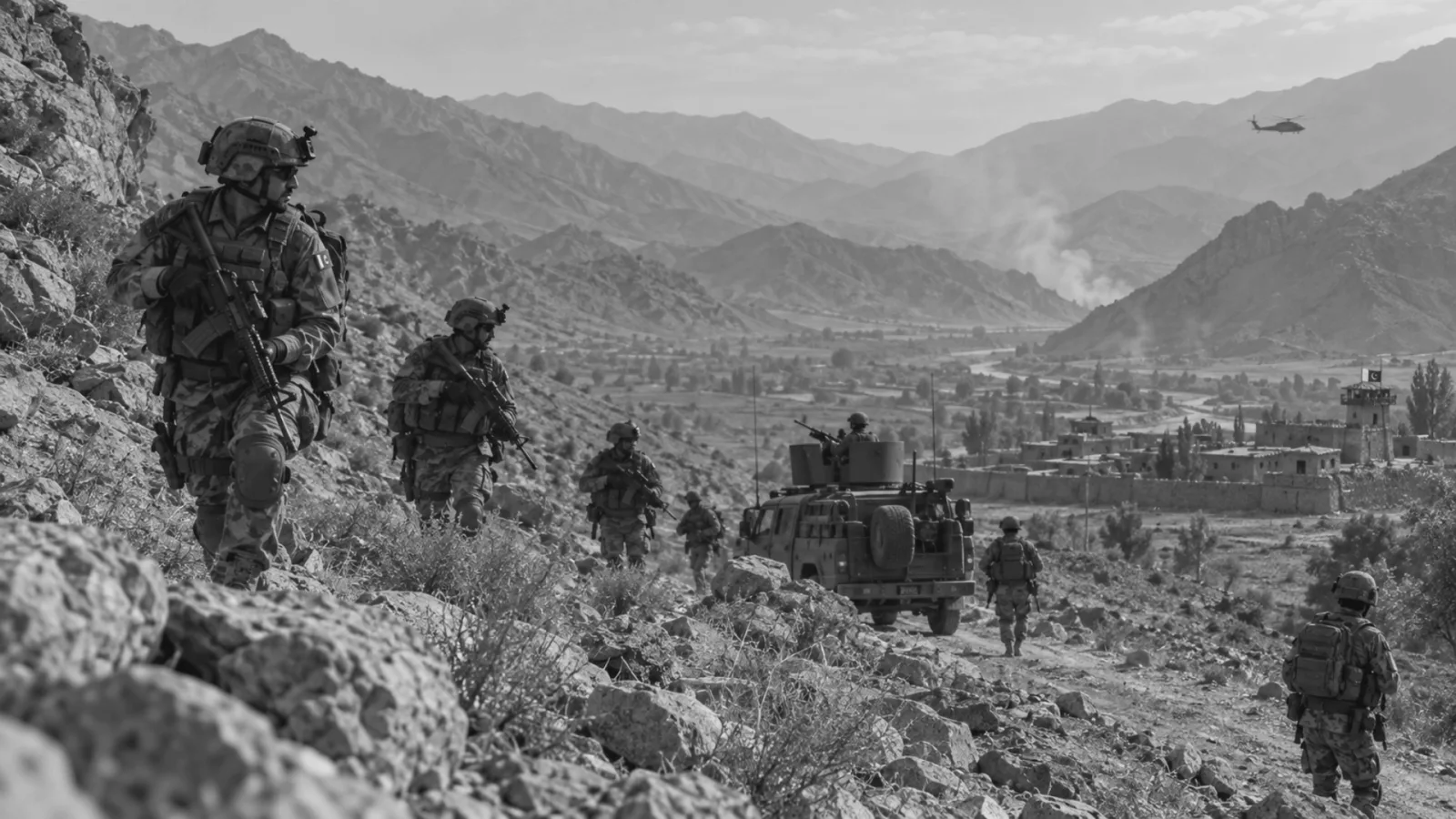
Pakistan's response to the growing constraints in the Kashmir Valley was to identify and exploit vulnerabilities in the counter-infiltration and counter-terrorism architecture elsewhere in Jammu and Kashmir. Beginning around 2021, Lashkar-e-Taiba-linked terrorist networks expanded their operational focus towards the forested terrain of Rajouri and Poonch, with the People's Anti-Fascist Front (PAFF) emerging as one of the names used to claim responsibility for attacks. The unfamiliar terrain, dense forests, difficult surveillance conditions and the ability of small groups to move between mountainous areas presented new challenges for Indian security forces. The expansion was not an indication that Pakistan had abandoned its terrorist strategy. It was an attempt to preserve that strategy by shifting its geographical centre of gravity.
A similar pattern became visible in 2024, when Jaish-e-Mohammed-linked groups expanded their activities across the mountainous districts of Jammu division. The Kashmir Tigers, also associated with the Azrael Group, emerged as a front for JeM-linked operations, particularly in Kishtwar and adjoining areas. The Chenab Valley, comprising Doda, Kishtwar and Ramban, along with the forested belts of Udhampur and Kathua, provided opportunities for small infiltrated groups to evade surveillance and conduct attacks against security forces. The objective was to stretch India's counter-terrorism resources, create fresh areas of operational pressure and demonstrate that Pakistan-sponsored terrorism remained capable of inflicting casualties despite its declining position in the Valley.
For a period, this adaptation proved costly for India. Terrorist groups operating in the forests of Rajouri, Poonch, Kishtwar and adjoining districts repeatedly exploited their familiarity with the terrain, the limitations of conventional search operations and the challenges of sustaining intelligence coverage across large mountainous areas. Indian forces continued to eliminate terrorists during this period, including Pakistan-based operative Qari in Rajouri in November 2023 and LeT-linked terrorist Arbaz Ahmad Mir in 2024. Nevertheless, the persistence of small, experienced groups and the casualties inflicted on security forces demonstrated that the counter-terrorism grid required further tactical adaptation.
Elimination of Terrorist Leadership and the Collapse of Operational Networks
By 2024 and 2025, that adaptation was increasingly visible. Greater integration of human and technical intelligence, prolonged area-specific operations, coordinated action by the Army, Jammu and Kashmir Police and Central Armed Police Forces, and sustained pressure on terrorist hideouts gradually deprived these groups of their operational advantages. The results became increasingly significant during 2025 and 2026.
The most consequential blow to the Lashkar-e-Taiba network came with the elimination of its experienced commanders. On 30 September 2026, the Ministry of Home Affairs announced the killing of senior LeT commander Hashim Musa, also known as Asif Fauji, in Budgam during an intelligence-led joint operation. The ministry stated that his death completed the elimination of a four-member senior LeT group operating in Jammu and Kashmir since 2022. Its other members, Junaid Bhat, Suleman and Yasir, had been killed in December 2024, July 2025 and September 2026 respectively. According to the government, the group had been responsible for several major attacks, including those in Rajouri and Poonch, the Shiv Khori pilgrimage attack, the Gagangir and Bootapathri attacks, and the April 2025 Baisaran massacre in Pahalgam. The elimination of the group represented a serious disruption to one of the most experienced components of Lashkar's operational network in Jammu and Kashmir.
Jaish-e-Mohammed suffered comparable setbacks in the Jammu region. In February 2026, Indian security forces eliminated senior JeM commander Saifullah and two associates in Kishtwar during Operation Trashi-I. The operation culminated in the elimination of a seven-member group of Pakistani terrorists that had reportedly infiltrated in April 2024 and subsequently operated in the region. The National Investigation Agency later identified Saifullah as a commander associated with the Kashmir Tigers, or Azrael Group, operating under JeM. Other encounters in Udhampur and neighbouring areas further weakened the networks that had attempted to establish a sustained presence in the mountainous districts of Jammu.
The significance of these developments lies not merely in the number of terrorists eliminated but in the loss of experienced operational leadership. Foreign terrorist commanders who survive for years in unfamiliar territory accumulate knowledge of terrain, local support structures, escape routes and the methods employed by security forces. Replacing such individuals requires more than infiltrating another group across the border. It requires rebuilding operational familiarity, developing dependable logistical arrangements and maintaining communications without exposing the network to Indian intelligence. The losses suffered by LeT and JeM have consequently undermined both their immediate operational capabilities and their capacity for regeneration.
Pakistan's Deepening Domestic and External Crises
However, the weakening of Pakistan's terrorist infrastructure in Jammu and Kashmir is taking place at a particularly volatile moment within Pakistan itself.
On the domestic front, Islamabad is confronting a convergence of economic, political and security pressures. Although successive IMF-supported stabilisation measures have helped Pakistan avoid an immediate financial collapse, the economy continues to suffer from structural vulnerabilities, high financing requirements and limited fiscal space. At the same time, the growing militancy of the Tehreek-e-Taliban Pakistan in Khyber Pakhtunkhwa and the continuing Baloch insurgency have imposed substantial costs on the Pakistani state. Both security challenges demand military resources, expose weaknesses in internal security management and challenge the establishment's long-standing claim that the Pakistan Army remains the ultimate guarantor of national stability.
Political instability has compounded these problems. The violent Tehreek-e-Labbaik Pakistan protests in October 2025 demonstrated the ability of Islamist mobilisation to generate confrontation with the state. In Pakistan-occupied Jammu and Kashmir, successive protests led by the Joint Awami Action Committee have exposed serious grievances over governance, representation and economic conditions. The unrest escalated further in 2026, resulting in deadly clashes, prolonged shutdowns and arrests. These developments are particularly embarrassing for an establishment that has historically sought to use Kashmir as an instrument of political legitimacy while struggling to address discontent in the territory under its own administration.
The confrontation with Imran Khan's Pakistan Tehreek-e-Insaf has added another layer of instability. The federal government's decision in October 2026 to impose emergency rule in Khyber Pakhtunkhwa, suspend its PTI-led provincial administration and detain political figures has intensified allegations that Pakistan's democratic institutions are being subordinated to the military establishment. Subsequent clashes between security forces and PTI supporters demonstrate that political confrontation remains unresolved. Pakistan is consequently facing the simultaneous challenges of terrorism, separatist violence and political opposition at a time when its military leadership has accumulated extraordinary authority.
Externally, the situation is equally complicated. Pakistan's confrontation with the Afghan Taliban administration has escalated into repeated cross-border clashes along the Durand Line, driven largely by Islamabad's accusations that anti-Pakistan militant groups operate from Afghan territory. This has undermined one of Pakistan's traditional strategic expectations, namely that a Taliban government in Kabul would provide it with a favourable western security environment. Instead, the military establishment now faces serious security pressures on both its eastern and western fronts.
Pakistan's commitments to Saudi Arabia have created an additional strategic dilemma. The renewed Houthi attacks against Saudi infrastructure have increased pressure on Islamabad to honour its defence commitments under the Makkah Alliance and its bilateral arrangements with Riyadh. Reports of Pakistani fighter aircraft being involved in operations against the Houthis have circulated, although Pakistan's Foreign Office has denied that its aircraft conducted cross-border strikes in Yemen and maintains that its deployment is defensive. Even without confirmed participation in offensive operations, the possibility of deeper involvement in a regional conflict presents Islamabad with another difficult decision, particularly given its economic dependence on Saudi Arabia and the domestic political sensitivities associated with the conflict.
These pressures have developed in the aftermath of Operation Sindoor. During the May 2025 military confrontation, India struck terrorist infrastructure in Pakistan and Pakistan-occupied territory before the conflict expanded into exchanges involving military installations. Pakistan's air-base infrastructure sustained damage, including at locations such as Nur Khan and Rahim Yar Khan, some of which was subsequently documented through satellite imagery. Islamabad nevertheless projected the confrontation as a military victory, seeking to reinforce the credibility of its armed forces before both domestic and international audiences. Pakistan and India continue to dispute several claims concerning the extent of their respective military losses, but the documented damage to Pakistani installations makes any uncomplicated narrative of a Pakistani triumph difficult to sustain.
Asim Munir's Consolidation of Military and Political Power
Paradoxically, the confrontation strengthened the political position of Pakistan Army Chief General Asim Munir. In May 2025, he was elevated to the rank of Field Marshal, becoming only the second Pakistani military officer after Ayub Khan to receive the designation. What followed was not merely a symbolic promotion but a far-reaching consolidation of power within Pakistan's constitutional and military structures.
The Twenty-Seventh Constitutional Amendment, enacted in November 2025, fundamentally altered Pakistan's military command architecture. It created the position of Chief of Defence Forces, placing the Army Chief at the apex of a unified command arrangement encompassing the Army, Navy and Air Force. The position of Chairman Joint Chiefs of Staff Committee was abolished, while the new structure gave the Army Chief an enhanced role in appointments associated with strategic command. Munir was subsequently appointed to the combined position of Chief of Army Staff and Chief of Defence Forces for a five-year term in December 2025. The constitutional changes also provided exceptional protections for five-star officers, including retention of rank and privileges and lifelong legal immunity.
Equally consequential were changes affecting Pakistan's judiciary. The amendment transferred constitutional jurisdiction from the Supreme Court to a newly established Federal Constitutional Court, a development that provoked strong criticism from opposition parties and senior judges. Two Supreme Court judges resigned in protest. These changes, combined with the imprisonment of Imran Khan, the weakening of the principal opposition and the military's already substantial influence over economic and national-security policy, have further concentrated authority around Munir.
Pakistan retains a civilian government and a formal constitutional framework. Nevertheless, Munir now occupies an exceptionally powerful position, with institutional control extending across the military hierarchy and considerable influence over the country's wider political direction. The significance of this concentration of power becomes clearer when viewed against Pakistan's history. An institution that has repeatedly defined itself as the custodian of the country's national interest is now led by an individual whose authority has been reinforced by a confrontation with India and constitutionally protected against many ordinary mechanisms of accountability.
Historical Precedents of Pakistan's Strategic Miscalculations
This combination is not without precedent. In 1965, Field Marshal Ayub Khan's military establishment launched Operation Gibraltar on the assumption that the infiltration of Pakistani personnel into Jammu and Kashmir would trigger a local uprising and alter the political status quo. The calculation was fundamentally flawed. The expected uprising did not materialise, and the operation contributed to a full-scale war with India. Pakistan's political and military leadership had mistaken its own assumptions about Kashmiri sentiment and India's likely response for strategic realities. The consequences extended well beyond the original operation.
The period under General Zia-ul-Haq demonstrated another dimension of Pakistan's military strategy. Zia's Islamisation programme strengthened the role of religious ideology within Pakistan's political and military discourse. The Afghan jihad of the 1980s facilitated the development of militant networks, organisational relationships and infrastructure that subsequently influenced Pakistan's proxy strategy towards Jammu and Kashmir. Religious militancy increasingly became an instrument through which the establishment could pursue strategic objectives while avoiding direct conventional confrontation. The consequences of this approach were eventually felt within Pakistan itself, as militant organisations and extremist ideologies acquired influence that the state could not always control.
The Kargil conflict of 1999 provided another example of military adventurism rooted in a questionable reading of India's political and military response. Under General Pervez Musharraf's leadership, Pakistani forces infiltrated positions across the Line of Control despite the diplomatic opening created by the Lahore process. The operation sought to alter the military situation in Kashmir through a limited, covertly initiated conflict. Instead, it resulted in international pressure, military reverses and another deterioration in India-Pakistan relations. The subsequent military coup placed Musharraf at the centre of Pakistan's political system.
These episodes occurred under different circumstances and cannot be reduced to a single explanation. Nevertheless, they reveal a recurring problem in Pakistan's strategic decision-making. Its military establishment has repeatedly demonstrated a willingness to pursue high-risk initiatives against India on the assumption that the potential political or strategic gains outweigh the danger of escalation. When decision-making becomes concentrated within a small military leadership, those assumptions become even more consequential.
India as an Existential Adversary in Pakistan's Military Thinking
Underlying this behaviour is the Pakistan Army's deeply institutionalised perception of India as an existential adversary. The perception extends beyond conventional territorial rivalry. Pakistan's founding Two-Nation Theory, the unresolved territorial dispute over Jammu and Kashmir, the memory of the 1971 war and the military's need to justify its central position within the Pakistani state have collectively shaped an ideological and strategic framework in which India occupies a defining role. Within that framework, India is not viewed merely as a neighbouring competitor but as a persistent challenge to Pakistan's territorial integrity, national identity and strategic relevance.
The Islamisation of this framework, particularly under Zia-ul-Haq, further complicated the relationship. The use of religious vocabulary in military discourse, the cultivation of Islamist militant organisations and the portrayal of Kashmir as an unfinished ideological struggle have historically allowed sections of Pakistan's establishment to combine strategic objectives with religious mobilisation. This does not mean that Pakistan's entire military or society holds a uniform extremist worldview. It does mean that religious nationalism has repeatedly been used to legitimise confrontation with India and to sustain a proxy conflict that conventional military calculations alone might not justify.
Munir's own rhetoric demonstrates the continued relevance of this worldview. In April 2025, shortly before the Pahalgam attack and Operation Sindoor, he publicly reiterated the Two-Nation Theory, emphasised the fundamental differences between Hindus and Muslims and described Kashmir as Pakistan's jugular vein. The timing and content of the speech were significant. At a moment when Pakistan faced serious internal problems, its Army Chief reaffirmed the ideological centrality of the confrontation with India. Such rhetoric cannot by itself establish an intention to authorise terrorist violence, but it offers an important indication of the political and ideological lens through which the current leadership interprets the relationship.
For Pakistan's military establishment, confrontation with India has historically served more than an external strategic purpose. It has also provided a means of reinforcing the Army's domestic legitimacy, redirecting political attention towards national security and presenting military leadership as indispensable to the country's survival. Consequently, when Pakistan faces political instability or declining strategic leverage, sections of the establishment may calculate that renewed confrontation with India could help restore initiative, mobilise domestic support and internationalise the Kashmir dispute.
The Emerging Threat to the Indian Hinterland
This is where the present situation becomes particularly concerning. Pakistan's ability to sustain a prolonged terrorist campaign within Jammu and Kashmir has been substantially weakened. Its foreign terrorist cadres have suffered heavy losses, local recruitment has almost disappeared, and the surviving networks face sustained pressure from Indian security forces. Rebuilding these networks would require time and resources, with no assurance of success. An attack in the Indian mainland, however, could be perceived by planners within Pakistan-based terrorist organisations as an alternative means of generating strategic impact without first restoring the militant infrastructure in Kashmir.
The objective of such an attack would not necessarily be to achieve any lasting military advantage. It could instead be intended to demonstrate that Pakistan-sponsored terrorist networks retain the ability to strike India, provoke an Indian military response, generate international diplomatic intervention and restore Kashmir to the centre of international attention. From the standpoint of an establishment that has repeatedly sought to exploit the distinction between conventional war and proxy violence, the prospect of gaining political leverage through a comparatively limited terrorist operation may appear attractive. Yet Operation Sindoor has also demonstrated that India's threshold for responding militarily to terrorism has changed, making any such calculation exceptionally dangerous.
Importantly, concerns regarding the Indian mainland are not based solely on historical analogy. Developments following Operation Sindoor indicate that Pakistan-based terrorist organisations have continued attempts to establish, recruit and activate networks beyond Jammu and Kashmir.
A case-wise compilation of reported arrests since Operation Sindoor identifies 28 individuals allegedly affiliated with Jaish-e-Mohammed across nine cases, involving multiple Indian states. During the same period, 14 individuals allegedly associated with Lashkar-e-Taiba were arrested across four cases. These figures should be treated as a working compilation of reported cases rather than a separately certified, consolidated government total, and the individuals concerned remain suspects unless their involvement is established in court. Nevertheless, the geographical spread and alleged organisational connections of these cases merit attention.
Several of the individual investigations are particularly revealing. In July 2026, the Gujarat Anti-Terrorism Squad arrested eight individuals from Gujarat and Madhya Pradesh for their alleged involvement in establishing a Jaish-e-Mohammed network. According to investigators, the suspects maintained contact with Pakistan-based handlers and were engaged in activities intended to expand the organisation's presence and recruitment capabilities. Additional arrests followed during the investigation. Similarly, in February 2026, the Delhi Police Special Cell announced the disruption of an alleged Lashkar-linked network involving arrests in Tamil Nadu and West Bengal. Investigators reported foreign-handler connections, suspected reconnaissance activity and attempts to establish covert operational infrastructure.
These investigations do not, on their own, prove that Pakistan's military leadership has authorised a new campaign against the Indian hinterland. Nor does the discovery of suspected networks necessarily establish that an attack was imminent. What they demonstrate, however, is that the weakening of terrorist organisations in Jammu and Kashmir has not eliminated their interest in developing operational capabilities elsewhere in India. The persistence of these networks must therefore be assessed alongside Pakistan's deteriorating position in Kashmir, the internal pressures confronting Islamabad and the extraordinary concentration of authority under Asim Munir.
Conclusion
The principal danger for India is not that Pakistan has become militarily stronger or that its terrorist infrastructure in Kashmir is recovering. It is that Pakistan's military establishment may respond to declining strategic options by undertaking greater risks. A weakened proxy infrastructure, an increasingly centralised military leadership and the political utility of confrontation with India could combine to produce a calculation that would be deeply flawed but entirely consistent with several episodes in Pakistan's history.
India must therefore resist the temptation to interpret Pakistan's declining terrorist strength in Jammu and Kashmir as the definitive end of the threat. The success of the counter-terrorism campaign has altered the operational environment in India's favour, but it has also changed the incentives confronting Pakistan-based terrorist organisations. The challenge is no longer confined to preventing infiltration and eliminating armed groups operating in the mountains of Jammu and Kashmir. It also involves identifying attempts to rebuild terrorist networks across the Indian mainland, detecting clandestine recruitment and financial connections, and preventing the use of geographically dispersed cells to compensate for the loss of conventional militant infrastructure in Kashmir.
Pakistan's history suggests that military leaders who confuse ideological conviction with strategic opportunity are particularly prone to miscalculation. Under Asim Munir, the concentration of institutional power raises the stakes of that possibility. Whether Pakistan chooses further confrontation is uncertain. But the collapse of its terrorist ecosystem in Jammu and Kashmir should not lead India to assume that Islamabad has exhausted its options.
Pakistan may be losing its ability to sustain terrorism in Kashmir on the scale it once did. The danger is that, rather than accepting that reality, its military establishment may attempt to shift the costs of its strategic failure to the rest of India.
Tags

Author
Mohit Vashisth
Mohit Vashisth is a Doctoral Research Fellow at Jindal School of International Affairs, O.P. Jindal Global University, Haryana, India. He was earlier associated with Max Security Solutions as a coordinator at Global Security Operations Centre (GSOC). At MAX, he was responsible for intelligence gathering, analysis, travel & security operations, and risk mitigation on a global scale during routine and emergency. He also has three years of experience working in the renewable energy sector. He is an engineering graduate with a major in Electronics and Communications and holds a Master’s degree in Political Science and International Affairs. His research areas are critical and disruptive defence technologies, counter-terrorism and Open-Source Intelligence (OSINT).