Fault Lines Within the Taliban: The Haqqani–Kandahar Rivalry and the Struggle for Power in Afghanistan
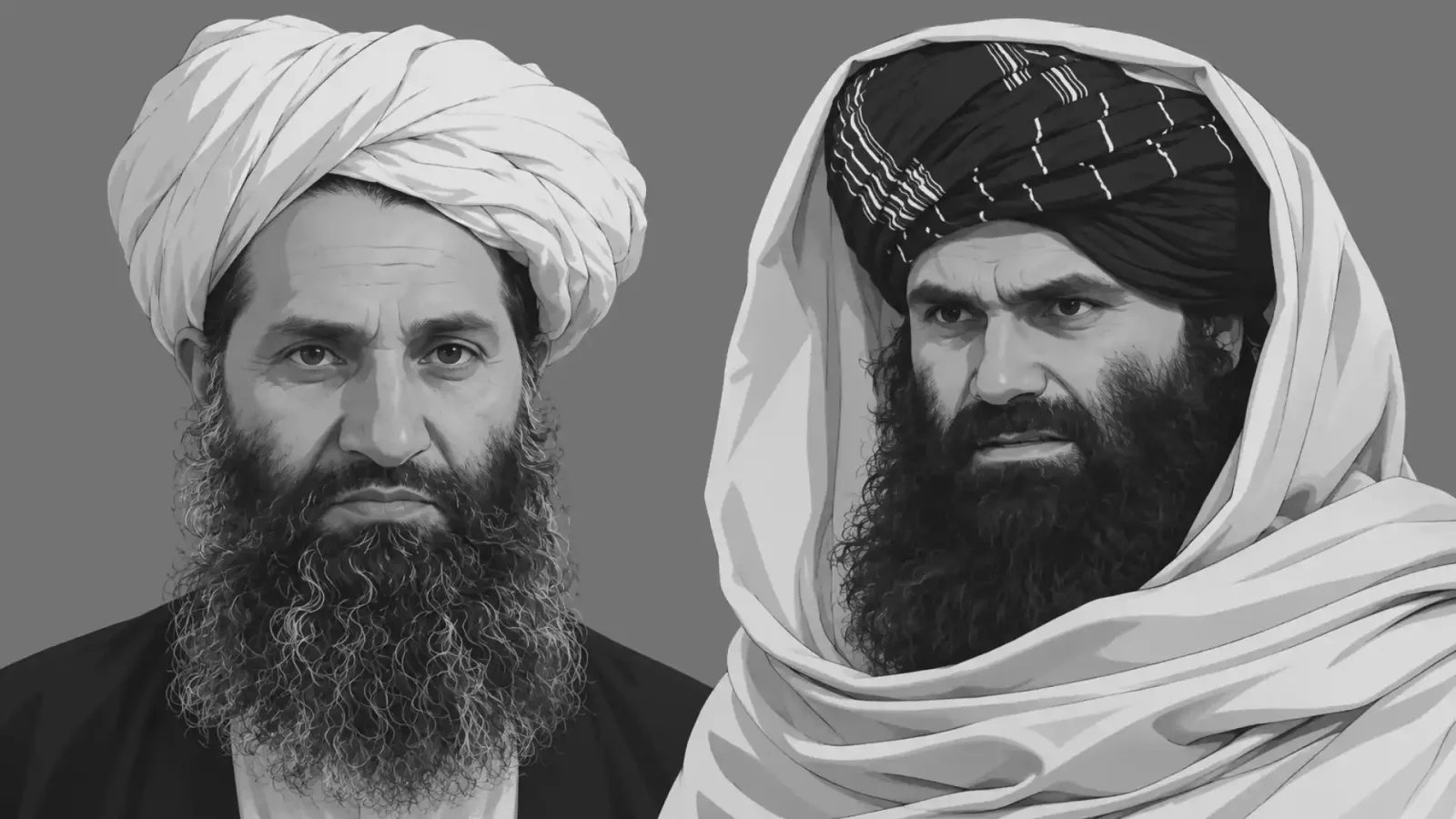
Afghanistan's ruling Taliban movement is experiencing a consequential internal struggle over the distribution of authority, although the available evidence does not demonstrate that the Islamic Emirate is approaching an imminent organisational split. The dispute pits the supreme leader, Hibatullah Akhundzada, and his Kandahar-centred clerical establishment against influential officeholders in Kabul, particularly Interior Minister Sirajuddin Haqqani. Defence Minister Mohammad Yaqoob, Deputy Prime Minister Abdul Ghani Baradar and other figures share some concerns but do not constitute a proven, unified opposition faction. In November 2026, Haqqani publicly questioned personalised government and Akhundzada responded by demanding unity and obedience during a rare visit to Kabul. 1,2,3
The historical record shows that this tension has institutional roots. Kandahar exercised final authority over a Kabul administration in the first Islamic Emirate. The Haqqanis entered the Taliban alliance in 1995 with a distinct southeastern military and tribal base; later, succession crises and insurgency-era command arrangements made elite bargaining indispensable to movement cohesion. Since 2021, Akhundzada has consolidated influence over decrees, appointments, security equipment and religious oversight. Some ministers have criticised particular policies, but they continue to operate within the ruling structure. 4,5,6
Key judgment: Managed competition is more plausible than an immediate schism. Further Kandahar consolidation is the principal alternative. A contested succession, significant security-force defections or sustained rival chains of command would be necessary to raise the fragmentation assessment materially. The worsening conflict with Pakistan and dispute over the Tehreek-e-Taliban Pakistan (TTP) increase pressure on the leadership without proving that either side is controlled by an external patron.
1. The Emerging Rift Within the Taliban
The confrontation that became visible in November 2026 did not begin with a sudden break between two previously unified leaders. It emerged from years of controversy about who may interpret the movement's governing obligations, who may question a decree and who controls the institutional means of enforcing it. The immediate contest, however, has a distinctive feature. Senior Taliban personalities now speak about the relationship between the system and its supreme leader in terms that invite competing readings of political legitimacy. This is much more consequential than an ordinary disagreement over a provincial appointment.
On 16 November, Sirajuddin Haqqani addressed an event at Kabul University connected to the implementation of the emir's decrees. According to Afghanistan International's reporting of the remarks, he argued that the Islamic system, rather than any single personality, should be the priority; warned that insistence on individual views would make government dependent on one person; and discouraged excessive praise of Akhundzada. His argument also stressed the importance of public support and effective administration. It would be misleading, though, to recast the speech as a rejection of Taliban religious rule. Haqqani explicitly endorsed governance based on Sharia and did not declare an alternative leadership or refuse allegiance. 7,8
On 17 November, Akhundzada travelled from Kandahar to Kabul, a rare public journey independently witnessed by AFP journalists. His address defended the jurisprudential foundation of his decisions, warned against discord and called for obedience to the emir. The intense security around the venue demonstrated the practical power attached to the office, although security arrangements cannot alone be used to infer a threat from a specific faction. Subsequent reports describe consultations at the presidential palace on 18 November and Akhundzada's visit to Maidan Wardak on 19 November, where unity and administrative responsibilities again featured. A Taliban state agency acknowledged a meeting with senior officials, making the existence of consultations firmer than any interpretation of their private substance. 9,10,11,12
The critical uncertainty concerns reconciliation. Afghanistan International reported, citing Taliban insiders, that Akhundzada travelled to contain dissent and was expected to meet Haqqani. The same report described discussions with Deputy Defence Minister Abdul Qayum Zakir. These accounts illuminate what insiders believed the visit was intended to achieve; they do not establish that a separate Akhundzada–Haqqani meeting occurred, that concessions were offered or that the disagreement was resolved. The reported consultations should therefore be treated as an attempted management of tension, not as proof of either agreement or schism. 13
The sources of friction extend across three overlapping domains. The first is religious-political authority: Kandahar regards obedience to the emir as a condition of unity, while critics question whether ministerial judgment and public welfare have been subordinated too completely to unilateral decrees. The second is governmental competence: decisions on girls' education, employment, telecommunications and international engagement generate practical costs borne by ministries responsible for administration, finance and public services. The third is coercive and patronage power: appointments, security-service oversight and weapons allocation determine how much discretion nominally powerful ministers retain. A public speech may therefore be a symptom of a deeper institutional contest rather than its cause.
The evidence also argues against a neatly opposed two-camp model. Haqqani controls an important ministerial portfolio and has an identifiable historical network; Yaqoob's legitimacy draws on Mullah Omar's family and his Defence Ministry role; Baradar derives influence from his founding generation credentials and diplomatic history; and intelligence chief Abdul Haq Wasiq heads a separate apparatus. Their interests may converge on administrative autonomy without producing coordinated collective action. Meanwhile, Akhundzada retains clerical allies, direct oversight mechanisms and control over appointments. The UN reported in December 2025 that policy disputes generally remained behind closed doors because the Taliban placed unusually high value on regime unity. 14,15
The correct initial classification is consequently open political disagreement within a continuing ruling coalition, not an established breakaway. A genuine organisational split would require observable acts such as a rival leader, refusal of allegiance, competing security orders or substantial defections. None is established by the November speeches or the reported meetings. The key question for the rest of this report is how long a system built around supreme obedience can accommodate influential officials who regard administrative discretion as necessary for its survival.
2. Historical Origins, the Haqqanis and the Tribal Foundations of Power
2.1 The Kandahar establishment and the first Islamic Emirate
The Taliban emerged from the disorder that followed the Soviet withdrawal and the collapse of the Najibullah government in 1992. Competing mujahideen formations fragmented state authority, contested roads and customs revenues, and exposed communities to predation. Mullah Mohammad Omar and a circle of religious students, former fighters and local clerics mobilised around Kandahar in 1994. The movement's early appeal was shaped by its promise to restore order and by a religious authority that claimed to transcend the rivalries of commanders. Its emergence was not exclusively a product of Pakistani seminaries: historical research identifies substantial Afghan-based religious education among its founding leaders, alongside important cross-border religious and logistical relationships. 16,17
The Taliban captured Kabul in September 1996 but did not relocate the ultimate centre of power there. A contemporaneous UN Special Rapporteur described a six-member caretaker body headed by Mullah Mohammad Rabbani in Kabul while important decisions remained with Omar and the Supreme Council in Kandahar. Declassified American diplomatic reporting identified overlapping inner and outer councils, religious figures and administrators with differing practical influence. The 1996 conferment of the title Amir al-Mu'minin on Omar converted military leadership into a claim of religious-political supremacy. That claim was never synonymous with the routine management of a capital-city bureaucracy. 18,19
The distinction was both functional and hierarchical. The Kabul officials administered territory, consulted with foreign representatives and managed departments; Kandahar claimed final say on policy, appointments and religious questions. Taliban-era orders reproduced in International IDEA's study show delegation of administrative responsibilities alongside reserved powers of the emir. Such arrangements could sustain a movement with multiple local networks, but they also produced ambiguity: senior officials could exercise power daily without owning the authority to change the rules under which they acted. Reports in 1998 that Mohammad Rabbani was being marginalised demonstrated that anxieties about the Kabul–Kandahar relationship existed under Omar himself, though diplomatic cables recorded conflicting accounts and no established organisational rupture. 20,21
The contemporary parallel is therefore institutional, not genealogical. Akhundzada did not inherit an unchanged hierarchy or every personal loyalty that surrounded Omar. Yet the precedent matters because it shows that administrative authority located in Kabul and final religious authority located in Kandahar can coexist in a deliberately unequal arrangement. The 2021 government reproduced this separation under a vastly different geopolitical and economic environment.
2.2 Jalaluddin Haqqani before the Taliban
The Haqqani network predates the Taliban and was never simply the latter's eastern branch. Its founding figure, Jalaluddin Haqqani, came from the Zadran tribal setting of Greater Paktia, the interlinked southeastern area of Paktia, Paktika and Khost. He developed a religious and military following in the 1970s, entered exile and built relationships with Afghan Islamist networks based in Pakistan. During the anti-Soviet struggle, he became one of the best-known commanders associated with Hezb-e Islami Khalis. His position rested on a mixture of battlefield reputation, local mediation, access to cross-border sanctuary and independent relations with supporters and other armed groups. 22,23,24
His network was not a family militia in the narrow sense. Members of the Haqqani family formed its enduring core, but the organisation incorporated non-relatives, religious students, local field commanders, logistical specialists and connections extending beyond the Zadran population. Historical studies and sanctions narratives describe relationships with foreign jihadist figures and external financing arrangements. Pakistani territory and security-linked contacts mattered to its development, but the record must distinguish contemporaneous assistance and sanctuary from the stronger claim that present-day policy is externally commanded. The network built influence because it could organise violence and local authority, and because other actors needed access to its territorial and social relationships. 25,26,27
The transition after the Soviet war reinforced its distinctiveness. Jalaluddin operated through the civil-war period as a powerful southeastern figure, at times engaging with the mujahideen government in Kabul. When the Taliban advanced in 1995, the alliance was negotiated against a background in which Jalaluddin already possessed a power base. Specialist research recounts that local tribal mediation helped bring him into the Taliban rather than into open confrontation with it. For the movement founded in Kandahar, the relationship offered access to a region with different tribal alignments and leadership histories. For Jalaluddin, it preserved relevance within an expanding nationwide organisation while protecting influence in his own area. 28
Alliance did not imply unrestricted influence. Jalaluddin later held a ministerial position in the first Emirate, yet a declassified January 1997 US cable considered him an important military commander with limited leverage over central political and social policy. Historical reporting also records friction between Haqqani-linked fighters and commanders associated with Kandahar, including disputed accounts of losses and desertions in 1997. The exact numbers are not independently established. The most supportable interpretation is that military usefulness and political inclusion did not remove differences in command authority. 29,30
2.3 From Jalaluddin to Sirajuddin
After 2001, the Haqqani network reconstituted around sanctuaries, recruitment ties and military operations in eastern Afghanistan and across the border. Sirajuddin progressively assumed operational leadership as Jalaluddin aged and became ill. Other family members performed different functions: Khalil ur-Rahman was important in political and logistical relationships, Anas later acquired a public diplomatic profile, and various relatives were identified by sanctions records as financial or operational facilitators. The organisation's evolution cannot be reduced to a single chain of command based on surnames; not everyone bearing the scholarly designation Haqqani is related to this family or belongs to the network. 31,32,33,34
Figure 1: The Haqqani Family and Organisational Network: Familial Relationships, Leadership Succession and Wider Organisational Connections.
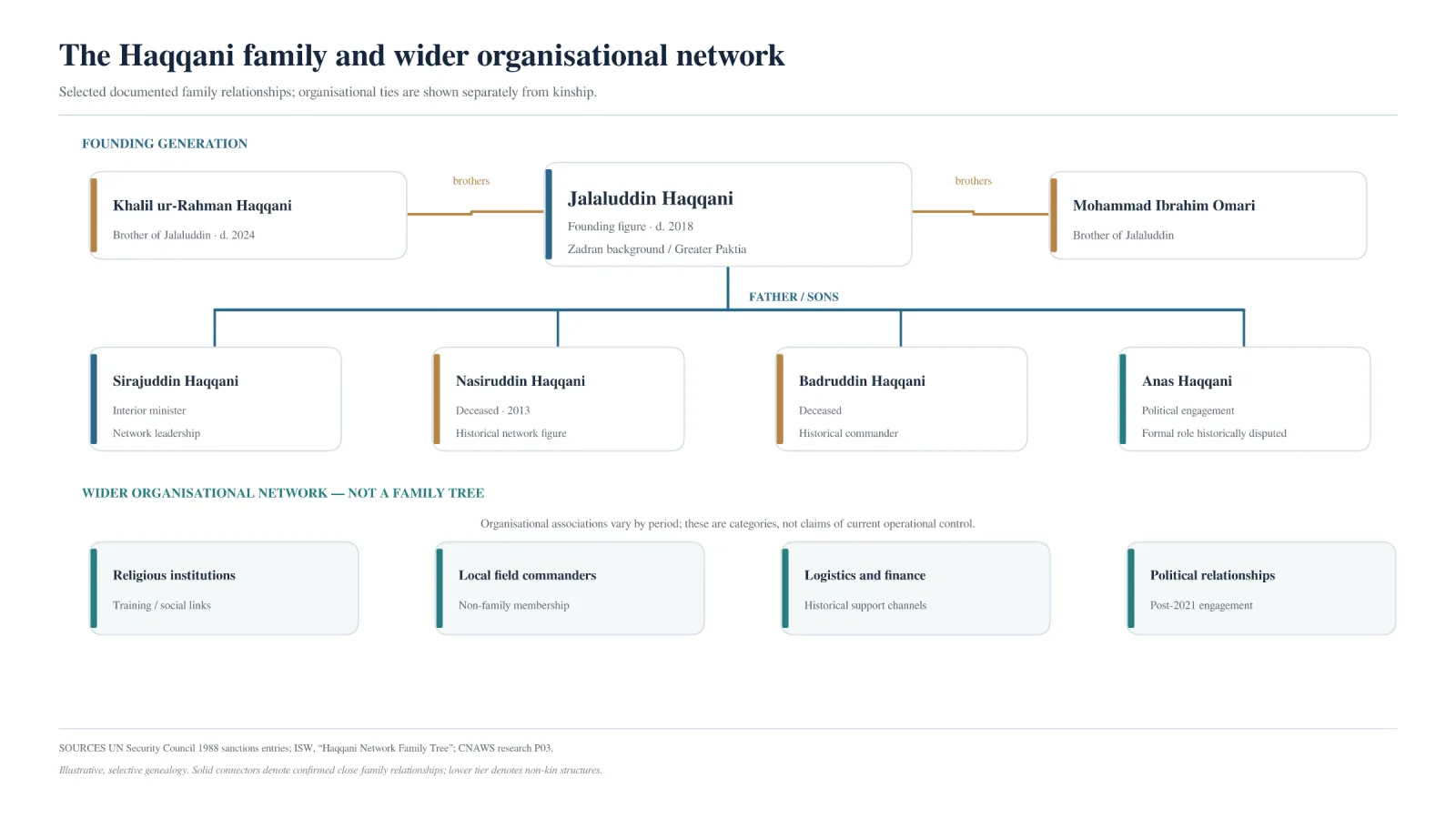
Its relationship with al-Qaeda and other armed organisations was a major part of its historic strategic identity. United Nations and US government descriptions identify longstanding ties, while scholarly accounts trace contacts with transnational jihadist leadership and wartime training networks. These documented relationships are relevant to assessing why the Haqqanis acquired an importance greater than their regional footprint. Nevertheless, they must be treated as historically specific: the existence of an earlier link does not by itself identify the degree of present coordination, much less the position of every Kabul minister in 2026. 35,36
The decisive political elevation occurred in 2015. When Akhtar Mohammad Mansour became Taliban leader following disclosure of Mullah Omar's death, Sirajuddin became one of the deputy leaders. The move was an act of coalition management: incorporating a powerful, geographically distinctive network into the movement's highest leadership at a moment of contested succession. Akhundzada retained Sirajuddin in the deputy structure after taking over in 2016. What had once been a relationship between a regional commander and the Kandahar leadership was now a relationship between nationally prominent Taliban officeholders, although the network's territorial and organisational roots remained distinct. 37,38
2.4 Tribal identity is not a factional map
Tribal background helps explain access and social capital but is an unreliable shortcut to current political alignment. Akhundzada is identified with the Noorzai, a Durrani group linked to Kandahar. Baradar comes from the Popalzai, another Durrani lineage associated with the southern region. Mullah Omar and his son Mohammad Yaqoob are associated with the Hotak, a Ghilzai lineage. The Haqqani family's Zadran background is generally classified within the Karlani grouping, not the Ghilzai confederation. Historical and contemporary leadership circles are thus cross-cut by different tribal affiliations even within the same geographic power centre. 39,40
The political unit often described locally as qawm can incorporate tribe, locality, kinship, religious education, wartime association and networks of patronage. Two commanders of the same lineage may compete; leaders from different lineages may remain loyal through decades of warfare. The political importance of Kandahar rests on more than Durrani identity, while Greater Paktia's significance is not exhausted by the Zadran tribe. Non-Pashtun Taliban commanders, including Tajik and Uzbek figures in the north, developed their own insurgency-era influence and faced distinct bargaining problems after 2021. The UN's reporting on northern appointments and security-force downsizing indicates that regional and ethnic tensions cannot all be folded into a Haqqani–Kandahar confrontation. 41,42,43
Figure 2: Geographic and Tribal Foundations of Taliban Leadership: Historical Associations in Greater Kandahar and Loya Paktia.
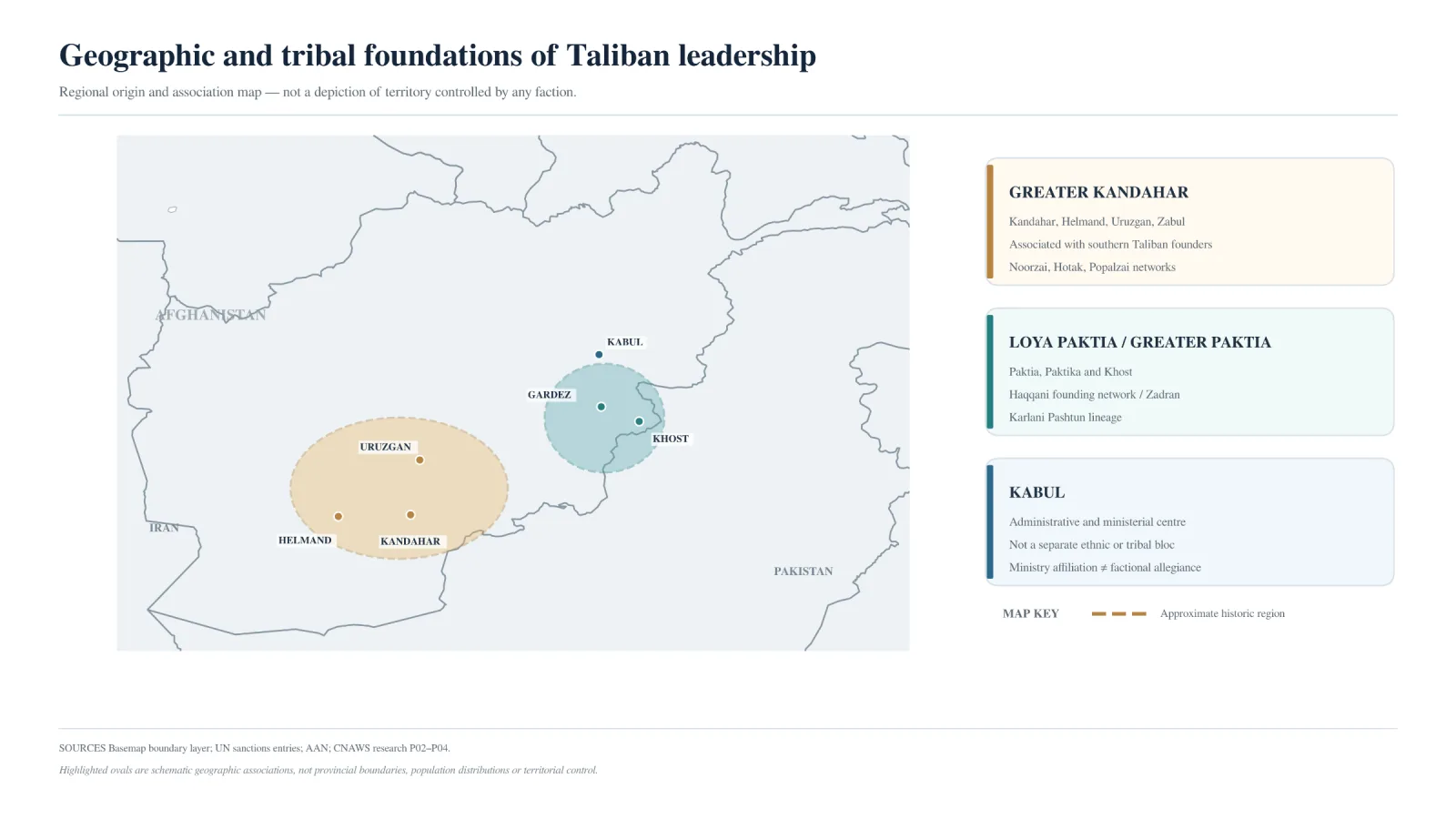
The implication is methodological as well as political. Any claim that an appointment, dismissal or security mobilisation represents tribal favouritism should establish the person's actual connections, the appointing authority, the posts redistributed and a plausible causal relationship. A surname or tribal label is insufficient. The enduring fault line is the relationship among religious legitimacy, inherited organisational resources and state office, not an irreducible war between two Pashtun confederations.
3. Earlier Taliban Disputes and Leadership Succession Crises, 1994–2021
The Taliban's reputation for discipline has coexisted with repeated leadership challenges. Under the first Emirate, reports about Mohammad Rabbani's place in Kabul and tensions involving commanders such as Jalaluddin Haqqani showed the limits of cohesion behind the public commitment to obedience. These were disputes about influence and management; available records do not establish a successful alternative supreme leadership in the 1990s. The movement's collapse in 2001 altered the distribution of power more dramatically by allowing geographically separated command and logistical systems to develop during the insurgency. 44,45
The Quetta-centred leadership claimed overarching political and religious authority, while networks associated with Peshawar, Miranshah and other areas developed varying degrees of operational discretion. The Haqqanis preserved a particularly recognisable organisation. Taliban leaders needed regional commanders who could recruit and operate effectively, while commanders benefited from membership in a broader movement with ideological legitimacy. This symbiosis explains how extensive autonomy could persist without an immediate breakaway. It also created recurring arguments about money, military coordination, communications and command appointments. Academic and specialist research identifies earlier rivalries involving Abdul Qayum Zakir, Akhtar Mansour and other commanders as part of this continuing struggle over leadership discretion. 46,47,48
The most serious historical test followed a concealed succession. Mullah Omar died in 2013, but the death was publicly disclosed only in July 2015. Mansour's elevation triggered objections to the concealment itself and to the process by which his appointment was decided. Tayyeb Agha resigned from the Doha political office; figures associated with Mullah Omar's family initially withheld support; Zakir maintained a separate political and military position; and Mullah Mohammad Rasul eventually led an identifiable breakaway group. In some areas these disputes produced armed clashes. Crucially, these responses were not identical: resignation, internal dissent, withholding allegiance and forming an armed rival were different levels of rupture. 49,50,51
Mansour sought to resolve the crisis through appointments, bargaining and the mobilisation of support among influential networks. Elevating Sirajuddin Haqqani to deputy leader was part of the consolidation, not evidence of a Haqqani revolt. Support from Omar's family was later secured, but smaller dissident structures and armed opposition persisted. After Mansour was killed in a US strike in May 2016, Akhundzada inherited a leadership coalition that included Sirajuddin and, in the deputy structure, Mohammad Yaqoob. The outcome displayed the Taliban's ability to absorb major disputes without necessarily extinguishing local grievances. 52,53,54
The Doha negotiations subsequently exposed a different division of labour. Baradar's return to political prominence and his selection as head of the Qatar office in January 2019 strengthened the negotiating arm. But the movement's diplomatic process remained subject to senior religious oversight and coexisted with commanders who believed military pressure was decisive. The 29 February 2020 US–Taliban agreement laid out the terms of foreign withdrawal and counterterrorism assurances while leaving a permanent ceasefire for later intra-Afghan negotiations. Abdul Hakim Ishaqzai's selection as chief negotiator in September 2020 reinforced the importance of clerical confidence in the political process. 55,56,57
By 2020–2021, Mohammad Yaqoob had a significant military-commission position and the Haqqanis retained operational influence. The UN Monitoring Team attributed to Member States the assessment that Yaqoob and Sirajuddin favoured military victory rather than a negotiated compromise; this was intelligence reporting, not an established joint factional manifesto. In February 2021, Akhundzada reportedly sought to constrain the autonomy of formations operating across provincial boundaries. The takeover of Kabul therefore occurred after, not before, attempts to discipline an uneven command architecture. 58
This earlier record provides the comparison against which 2026 claims must be judged. A leadership rivalry is not automatically a split. The 2015–2016 crisis possessed observable hallmarks that are not established in November 2026: explicit competing leadership claims, sustained non-allegiance and armed clashes attributable to identifiable rival Taliban organisations. History also shows that elite settlements can preserve unity while leaving enduring organisational interests intact. The strongest analogy with the present is not that a second civil war is inevitable, but that political cohesion is the outcome of continuing negotiation over legitimacy and resources.
4. Evolution of Leadership Rivalries Since the Return to Power, 2021–2026
4.1 The caretaker government and its unsettled bargain
The seizure of Kabul in August 2021 changed the Taliban's political economy. During the insurgency, senior commanders needed access to sanctuary, fighters and financing; in government they could claim ministries, police forces, budgets, border posts and international interlocutors. The question ceased to be solely how the movement would win a war and became who would decide the rules by which it governed. The caretaker cabinet announced on 7 September 2021 was an accommodation among important constituencies rather than a coalition cabinet based on elected representation. Mohammad Hassan Akhund became acting prime minister, Baradar his first deputy, Sirajuddin interior minister, Mohammad Yaqoob defence minister and Abdul Haq Wasiq intelligence chief. Later appointment rounds reinforced the predominance of established Taliban personalities. 59,60
The cabinet's composition is important for two reasons. First, the Haqqanis obtained control of a major coercive institution and related administrative services without acquiring the supreme leadership. Second, Yaqoob and Haqqani, who had previously shared deputy positions in the movement, now occupied different institutional commands within a government subject to decisions from Kandahar. Baradar, despite his diplomatic profile and proximity to the movement's founding generation, was assigned an economic and deputy-premier role rather than supreme authority. No one received an unconditional veto over the emir.
Reports of an early confrontation between Baradar and Haqqani-associated officials contributed to speculation about factional rivalry. News accounts described disagreement over the composition of government and credit for victory; more sensational claims included a physical altercation and Baradar's disappearance. Baradar publicly denied rumours of his death or injury. The record supports political friction during government formation, but not the treatment of an alleged armed clash at the palace as confirmed fact. The dispute nonetheless reveals a plausible structural tension between men whose influence arose through negotiations and those who controlled militarised networks. 61,62
4.2 Kandahar centralises policy and oversight, 2022–2023
The March 2022 reversal of a planned reopening of secondary schools for girls was an early test of the relationship between cabinet administration and the supreme leadership. Officials had prepared for reopening, but the decision was reversed following leadership consultations in Kandahar. The significance lay not merely in the policy's content, which denied girls access to education, but in its institutional meaning: assurances and preparations by education officials could be displaced by a higher religious-political decision. Subsequent restrictions on women's higher education, employment and participation in public life further narrowed the scope for departmental discretion and intensified Afghanistan's external isolation. 63,64,65
The December 2022 UN reporting described an increasingly centralised process in which Akhundzada and a close circle shaped senior appointments and major decisions. By February 2023, Haqqani's public criticism of monopolised power brought the disagreement into the open. Taliban spokespeople responded by arguing that advice and criticism should be communicated privately. This interaction is revealing: the dispute concerned the permissible channels for disagreement as much as the desirability of a specific decree. The 2023 UN Monitoring Team reported substantial Kandahar–Kabul tensions and attributed claims of attempted removals of senior ministers, but those alleged dismissals were not publicly implemented. Claims of a purge must therefore remain categorised as reported internal manoeuvring, not completed personnel actions. 66,67,68
Centralisation was institutionalised rather than confined to speech. The Taliban established a directorate for implementation and oversight of the emir's decrees, reportedly with a sizeable staff and a reporting relationship beyond ordinary ministry supervision. Religious councils, judicial authorities and provincial officials increasingly participated in enforcing decrees. These mechanisms offered Kandahar channels through which it could supervise ministries without replacing their nominal heads. The result was a distinctive arrangement: officials could retain influential portfolios while losing discretion over the decisions most likely to provoke disagreement. 69,70
4.3 The conflict becomes more visible, 2024–2025
During 2024, international monitoring and Afghan reporting identified continued tension over personnel, policy and relations with Pakistan. Haqqani publicly argued against religious exclusivity and more restrictive conceptions of governance. At the same time, Akhundzada's leadership continued to exercise control over appointments and core decrees. The restrictions on women's medical training introduced in late 2024 sharpened the distinction between the ideological preferences of the supreme leadership and the government's need for basic services. These policy differences, however, should not be mistaken for proof that Haqqani sought constitutional pluralism or secular government. His public position remained within an Islamic Emirate framework. 71,72,73
On 11 December 2024, a bombing in Kabul killed Khalil ur-Rahman Haqqani, the acting refugee minister and an important member of the family network. Islamic State Khorasan Province claimed responsibility. The killing removed an influential family figure and demonstrated the vulnerability of Taliban officials even under a government that claimed major security successes. It does not, on existing evidence, establish responsibility by Akhundzada's followers or an internal assassination plot. Such insinuations would require evidence beyond the political fact that the Haqqanis suffered an important loss. 74,75
Early 2025 brought a different test of dissent. Deputy foreign minister Sher Mohammad Abbas Stanikzai publicly challenged the prohibition on girls' education, arguing from a religious standpoint that it could not be justified. Reporting subsequently described an order against him and his departure from Afghanistan. The record contains an unresolved chronological inconsistency: the December 2025 UN Monitoring Team report gives a May 2024 date for his removal, whereas contemporary January 2025 coverage still called him deputy minister. The exact effective date of his dismissal should not be asserted without an original decree. The case remains significant as an instance in which a prominent Taliban figure incurred consequences after publicly opposing an important social restriction. 76,77,78
Sirajuddin's own movements in early 2025 also fuelled speculation. UN reporting recorded his absence from normal duties and subsequent return; regional media described appearances without establishing that routine ministerial business had fully resumed. A religious travel exemption and accounts of pilgrimage should not be conflated with proof of political exile. His absence was compatible with a period of tension, but the reason for each journey and the terms of his return have not been authoritatively established. 79,80,81
The clearest test came with the telecommunications shutdown in September–October 2025. Restrictions spread across provinces before nationwide telecommunications services were disrupted on 29 September. UNAMA documented the enormous effect on banking, hospitals, businesses, emergency response and women already restricted in physical access to education and work. Services resumed on 1 October after roughly 48 hours of national interruption. The BBC subsequently reported that ministers, including Baradar, Haqqani and Yaqoob, acted through the prime minister's office to reverse Akhundzada's decision. The restoration is independently established, but the precise chain of authority and whether ministers deliberately countermanded the emir rest on confidential-source reporting. The UN's own account did not independently verify the BBC's attribution. 82,83,84,85
This distinction should not diminish the incident's analytical importance. If ministers collectively secured reversal against an explicit instruction, it would constitute an unusual practical constraint on supreme authority. If instead the change was authorised through consultation with Kandahar, it would demonstrate the leadership's capacity to retreat from a costly decision while preserving formal obedience. Both explanations fit the observed restoration; they imply very different levels of institutional autonomy. The event is therefore a decisive research test, not a settled example of rebellion.
4.4 From renewed criticism to the November 2026 confrontation
In December 2025, Haqqani warned that governance sustained through intimidation rather than public confidence would be insecure. Yet he also publicly affirmed adherence to leadership decrees, a combination of criticism and accommodation that resists simple factional labelling. The UN Monitoring Team's report issued that month characterised Akhundzada's position as secure and observed that leaders prioritised unity despite policy differences. 86,87,88
During 2026, the political setting grew more difficult. Centralisation continued through administrative appointments and provincial religious oversight; Afghanistan–Pakistan hostilities imposed additional security and economic costs; and different Taliban officials maintained external diplomatic channels. In September, new regulations reportedly formalised provincial religious councils' supervisory role over officials. In November, the competing rhetorical emphases became unmistakable: Haqqani urged officials not to personalise the Islamic system, while Akhundzada defended the necessity of obedience and unity. The substantive issue was whether ministers could exercise responsibility without independent authority over policies they had to implement. 89,90,91,92
The pattern from 2021 to November 2026 is therefore not a linear march towards fracture. There are episodes of open criticism, some reported reversals and movements of personnel, but also continued service, declarations of loyalty and functioning government institutions. The political conflict has become visible precisely because the Taliban's centralisation has increased the costs of administering unpopular or economically disruptive decisions. For now, elite competition remains bounded by a shared interest in retaining power; the question is whether those bounds can survive a future succession crisis or a serious external shock.
5. Anatomy of the Power Struggle: Institutions, Resources and Competing Interests
Figure 3: Overlapping Centres of Power Within the Taliban State: Formal Authority, Ministerial Institutions and Historical Leadership Networks.
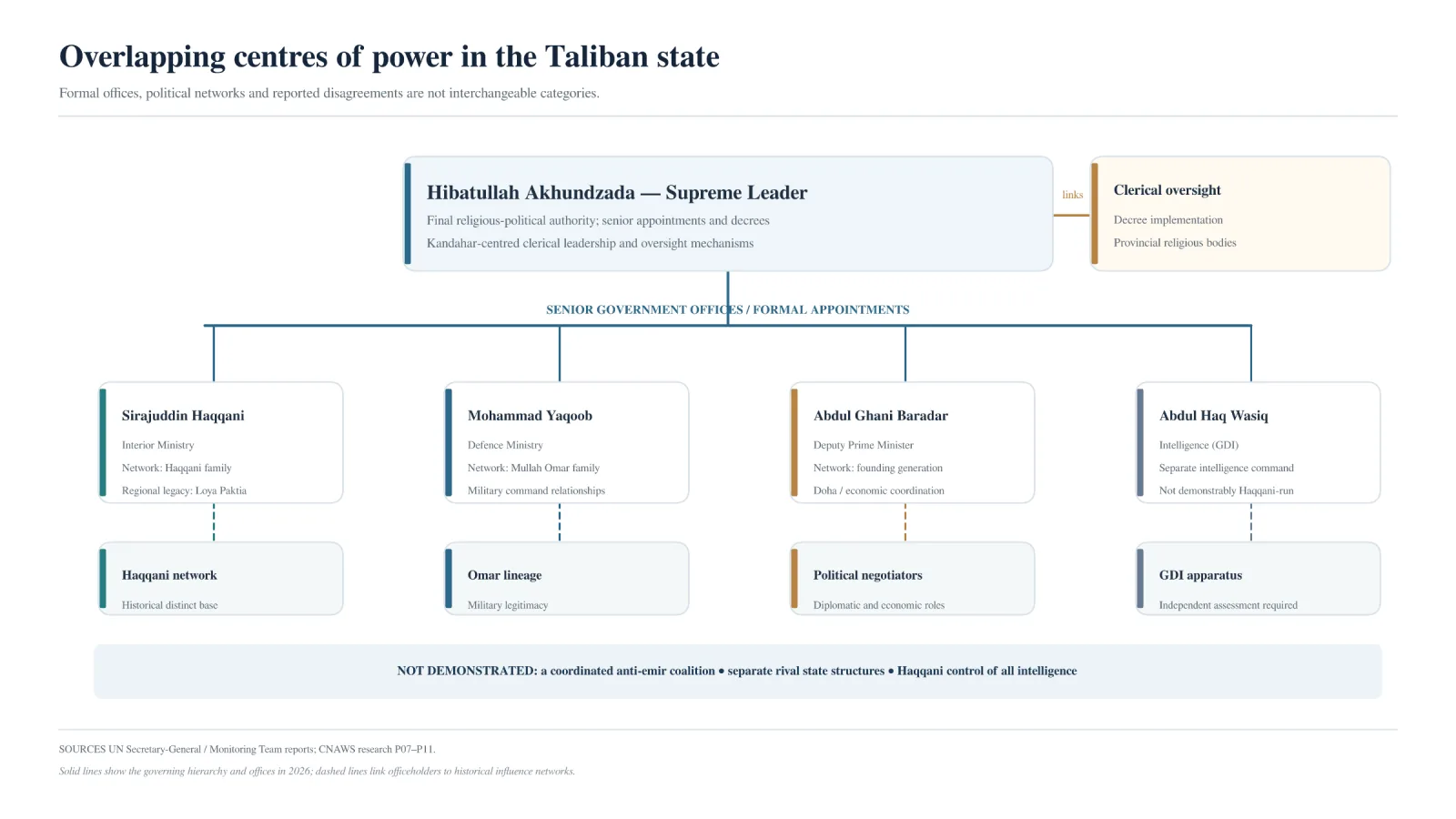
5.1 Religious supremacy and administrative subordination
The Taliban does not operate under a publicly agreed constitutional division of powers comparable to the former Afghan republic. Under the current order, Akhundzada's religious-political authority is the organising principle, backed by decrees, personal networks, appointments and bodies supervising compliance. The September 2026 UN Secretary-General report described a highly centralised governing system in which key decisions are taken by Akhundzada and mechanisms of consultation remain opaque. This creates uncertainty about which authorities can review a decision, when disagreement is legitimate and who can independently protect an official who questions it. 93
Kandahar's instruments are more substantial than the emir's personal reputation. The directorate overseeing the implementation of decrees, clerical councils, judicial authorities and the Ministry for the Propagation of Virtue and the Prevention of Vice create parallel lines of monitoring. The 2026 provincial ulema regulation reportedly formalised a direct role for scholars in supervising local officials. These mechanisms can influence recruitment, policy compliance and the political standing of ministers whose formal mandates otherwise resemble conventional executive offices. They do not imply that every district official obeys uniformly, but they give the supreme leader a way to intervene without relying solely on the ordinary chain of ministry instructions. 94,95
The system thus encourages a recurring conflict between responsibility and discretion. A minister may be blamed for telecommunications disruption, delayed revenue, international criticism or local unrest without having the power to determine the underlying policy. A clerical establishment may see such executive objections as dangerous challenges to the unity required by the emirate's theology of obedience. The struggle is not simply over whether power is centralised, but over whether practical costs can become an acceptable argument for revising a decision.
5.2 Security institutions and the limits of factional control
Sirajuddin Haqqani's Interior Ministry commands national policing and important administrative functions, and its initial staffing reflected the network's prominence after 2021. The Defence Ministry under Mohammad Yaqoob inherited a different personnel pool, including military-commission veterans and regional commanders. Neither portfolio should be read as personal ownership of every officer or weapons depot under its formal hierarchy. The UN's 2024 and 2025 reporting describes central appointments, efforts to insert loyal oversight officers and steps to restrict control over arms distribution; a reported November 2024 directive centralising weapons allocation was also acknowledged in general terms by a Taliban spokesperson. 96,97,98
The General Directorate of Intelligence is particularly important because it is frequently but incorrectly subsumed within a supposed Haqqani camp. Abdul Haq Wasiq and senior intelligence figures have institutional interests of their own, while the UN has described specialised formations and reporting arrangements that connect directly to the emir. The existence of overlapping security bodies may provide Kandahar with coercive insurance against ministerial autonomy. At the same time, their operational effectiveness and exact chains of command are difficult to establish from outside Afghanistan. A security official's history of cooperation with the Haqqanis is insufficient evidence that the official would disobey an order from Akhundzada. 99,100
The reported April 2025 order for a 20 per cent reduction in security-force strength under budget pressure was a consequential test. The UN Monitoring Team described the push as originating in Kandahar and proceeding despite resistance from some Kabul officials, with substantial dismissals concentrated in northern provinces. The resulting institutional grievances may affect local loyalties, but the evidence does not establish a coordinated Haqqani-led armed response. Likewise, reported disturbances among Badakhshan commanders in 2026 demonstrate that local ethnic, appointment and resource disputes can produce friction without neatly mapping onto the senior Kandahar–Haqqani axis. 101,102,103
A meaningful measure of factional power would ask which authority can appoint and remove corps commanders, allocate fuel and ammunition, redeploy units across provinces, arrest senior personnel and enforce a disputed order. The answer may differ by institution and over time. Control of a ministry gives access; it does not necessarily confer a sovereign command or a reliable veto. The current evidence is strongest for Akhundzada's final appointment and oversight powers, and much weaker for claims that any Kabul grouping could sustain an independent, nationwide security command.
5.3 Appointments, patronage and economic administration
Political influence is reproduced through offices below the most prominent ministries. Provincial governorships, police leadership, intelligence postings, customs administration and commissions responsible for contracts can reward loyalists, move regional commanders and dilute local patronage. The Taliban's security institutions contain veterans whose loyalties formed during different phases of the insurgency. Those historical ties matter, but a factional assessment needs a dated sequence of appointments, identifiable reporting relationships and proof of the capacity to protect or dismiss subordinates. A claim that a leader prefers members of his own tribe cannot stand without systematic appointment data. 104,105
Finance presents an analogous problem. The government collects taxes and customs revenues and oversees trade, mining and procurement, but the public budget is opaque. The financial-accounting law reported in August 2025 expanded scrutiny of institutional accounts by authorities linked to the supreme leader's office. Yet Baradar continued to preside over high-value procurement meetings during 2026. These two facts demonstrate that fiscal oversight and economic administration coexist in different parts of government. Neither proves that Baradar independently controls the treasury, nor that Akhundzada personally allocates each contract. Without auditable financial records, estimates of factional income from customs or mining remain speculative. 106,107,108
Historical Haqqani financing provides another caution. Specialist investigations documented sophisticated wartime revenue and facilitation networks. But the persistence, legal form and distribution of these funds after 2021 cannot be inferred from their insurgency-era existence. State office may have brought new access to contracts and public resources, while central oversight may have restricted it. The direction and magnitude of this change require evidence, not projection. 109,110
5.4 Ideology, legitimacy and the problem of succession
The dispute over women and girls' education is the clearest illustration of policy divergence, but the distinction is not one between democracy and theocracy. Many critics of Akhundzada's restrictions continue to endorse an authoritarian Islamic system, Sharia-based law and the Taliban's monopoly of political authority. Haqqani's emphasis on public confidence is a claim about how the Emirate should govern and survive; it is not evidence of an intention to restore competitive elections or accept an opposition government. Conversely, Akhundzada's allies treat uniform implementation of decrees as a test of religious integrity and institutional unity. 111,112
This difference creates competing sources of legitimacy. Akhundzada's strength rests on his status as emir, clerical endorsement, control over religious decisions and appointments. Haqqani's rests on family and network history, a major ministry and a record of wartime mobilisation. Yaqoob combines the founding leader's family name with Defence Ministry authority. Baradar derives influence from his role in the early movement, the Doha negotiations and economic administration. Intelligence and judicial figures contribute additional centres that may align differently depending on the question. None has been shown to possess a complete substitute for the others' resources or the emir's claim to supreme authority. 113,114,115
The greatest vulnerability is succession. The 2015 crisis proved that the concealment of a leader's death and opaque selection procedures can generate genuine splits. Akhundzada's present office has accumulated even more concentrated authority, making the absence of a transparent, widely accepted procedure for transferring it potentially destabilising. A would-be successor would need clerical legitimacy, recognition from powerful military networks and acquiescence from the state apparatus. The fact that prominent figures possess only part of that combination helps explain why they may prefer bargaining within the existing structure to direct confrontation today. It also suggests why a sudden leadership vacancy could radically alter their calculations.
In comparative terms, Akhundzada retains the strongest claim to final political authority; Haqqani retains an important but constrained institutional and network position; Yaqoob is an indispensable military actor whose alliance preferences cannot be assumed; Baradar has administrative and diplomatic leverage but lacks proven independent coercive command. The present relationship is asymmetric competition inside a centralised regime, not a demonstrated balance between two equal sovereign centres.
6. Pakistan, Regional Powers and the External Dimension
Pakistan is the most immediate external variable affecting Taliban cohesion, but the historical relationship cannot be read as a stable patron–client division between a Pakistan-friendly Haqqani camp and an anti-Pakistan Kandahar faction. Jalaluddin's network benefited from cross-border relationships and sanctuary during the anti-Soviet war and later insurgency. Pakistani officials also engaged other Taliban leaders, while figures such as Baradar experienced detention by Pakistan's security apparatus. These different histories matter for trust and access. They do not establish that Islamabad can direct any Afghan leader's decisions under the political conditions of 2026. 116,117,118
The TTP dispute has transformed this relationship. Pakistan accuses Afghanistan's Taliban authorities of permitting TTP members and infrastructure to operate on Afghan soil; the Afghan authorities reject responsibility for attacks inside Pakistan. UN monitoring reports have identified TTP activity and relationships in Afghanistan, while describing the risk to regional stability. The violence has produced border closures, military exchanges, civilian harm and repeated mediation efforts. These outcomes impose a collective cost on the Emirate, even where different officials disagree about the management of relations with Islamabad. 119,120,121,122
There is concrete evidence that Kandahar has sought greater influence over channels once associated with the Haqqanis. The UN Monitoring Team reported that Kandahar governor Mullah Shirin undertook a Pakistan visit in January 2024 and appeared to displace Sirajuddin's earlier role as an intermediary on the TTP issue. Yet in August 2026 Haqqani was again associated with a proposal for bilateral security committees, to which Pakistan publicly responded. The two episodes show that interlocutor access shifts over time. They do not prove either that Haqqani has lost all influence or that he controls TTP policy independently of the emir. 123,124,125
A further complication is that the supreme leadership itself has reportedly explored measures to ease the TTP problem. A UN monitoring assessment in August 2026 described alleged messages to TTP commanders and movements of some fighters and families within Afghanistan. Those claims, based on member-state information, should not be promoted to independently verified orders. Nevertheless, they challenge any analytical framework in which Kandahar has no interest in reducing cross-border pressure and only Kabul favours accommodation. The more reliable explanation is that different leaders face overlapping incentives to preserve Afghan sovereignty, avoid losing authority domestically and limit the costs of confrontation with Pakistan. 126
Other external powers operate through diplomatic and economic relationships rather than proven factional sponsorship. Qatar's role in the Doha process and, with Türkiye, its mediation of the Afghanistan–Pakistan crisis provide channels to several Taliban officials. The UAE has hosted Sirajuddin and other senior figures; Saudi Arabia has restored diplomatic operations. China hosted talks among Afghan and Pakistani officials in Urumqi in April 2026, while Russia formally recognised the Taliban government in July 2025. Such contacts create opportunities for particular leaders to demonstrate usefulness, but meetings with a foreign head of state are not evidence of foreign control over Kabul's internal rivalries. 127,128,129,130,131,132
For India, the relevant question is less which Taliban personality is supposed to be friendly to New Delhi than how internal authority affects the reliability of security assurances, counterterrorism coordination, diplomatic engagement and regional connectivity. India expanded its diplomatic engagement in 2025 without thereby acquiring an ability to influence Taliban succession or institutional design. A fragmented Afghan security apparatus could generate additional operating space for militant groups, but a more centralised Emirate that tolerates cross-border militancy could also threaten regional security. Indian policy analysis should therefore distinguish engagement with the Afghan state apparatus from endorsement of any factional project. 133,134
7. Strategic Assessment: Cohesion, Fragmentation and the Next Twelve Months
The evidence yields a paradox. The Taliban's political system is more centralised than it was when the movement seized Kabul, yet that centralisation creates grievances among precisely the officials needed to keep its ministries and security forces functioning. Akhundzada has a strong claim to religious-political legitimacy and significant mechanisms of oversight. Haqqani, Yaqoob and Baradar possess different kinds of organisational and administrative influence, but no verified common platform for replacing him. The movement's leaders share a powerful incentive not to risk the state they won after two decades of insurgency. The UN's December 2025 monitoring assessment and September 2026 political report both support the conclusion that internal disagreements coexist with substantial institutional continuity. 135,136
There are important arguments on both sides of the risk assessment. Favouring cohesion are the concentration of final appointment authority, the absence of a public rival emir, ministers' continued service, shared ideological commitments and the memory of destructive succession disputes. Against cohesion are the costs of restrictive decrees, opacity in consultation, personal competition, potentially uneven security-force loyalties, financial stress, provincial grievances and pressure arising from the TTP and Pakistan conflict. Neither list is sufficient alone to demonstrate the direction of change. What matters is whether grievances translate into observable organisational acts.
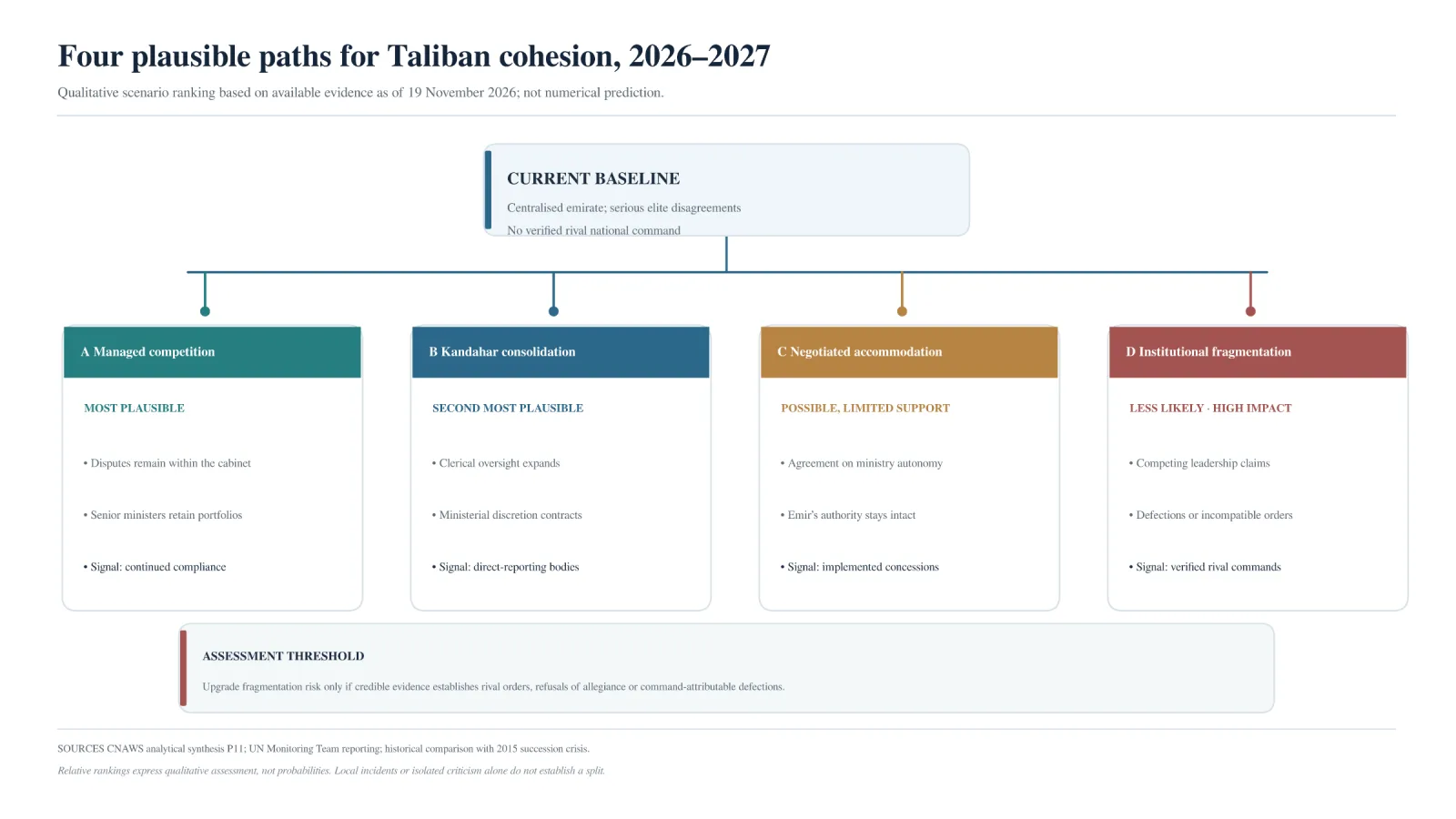
Four competing scenarios
A. Managed internal competition — leading assessment. Senior ministers periodically contest policy or complain about authority, but maintain their portfolios, comply with core decrees and negotiate exceptions privately. Kabul's administrative requirements exert some constraint without changing Kandahar's supremacy. Historical bargains and the continued functioning of the current government support this outcome. Its principal weakness is that costly policy disputes can recur without a trusted mechanism for resolving them.
B. Further consolidation by Kandahar — plausible second outcome. Akhundzada expands clerical oversight, uses senior appointments and weapons-allocation rules to limit ministerial autonomy, and places additional loyal monitors in security and provincial administrations. The trend since 2022 is consistent with this path. Yet further centralisation could reduce effective administration, increase regional grievances and make an eventual succession more brittle. A reduction in public criticism after dismissals would not, by itself, establish genuine elite consent.
C. Negotiated redistribution of administrative authority — possible but unproven. The emir retains supreme religious legitimacy while allowing ministries clearly bounded discretion over communications, economic affairs or public services. Some reversals of unpopular measures might be possible under this arrangement. Evidence for it would require documented changes in orders and observable sustained implementation, not rumours that leaders met or agreed privately. The 2025 internet case remains suggestive but insufficient to prove this model has been adopted.
D. Serious organisational fragmentation — less likely, high impact. A succession shock, punitive purge or severe external crisis produces competing leadership claims, significant command defections or rival administrative and revenue structures. The 2015 crisis shows such fractures are conceivable within Taliban history. But the 2026 record has not established the necessary organisational predicates. A local firefight or one minister's criticism cannot be equated with a nationwide schism. The plausibility of this scenario would rise sharply only after credible evidence of security units refusing mutually incompatible orders or a significant leader retaining armed forces outside the emir's authority. 137,138
The most serious escalation pathway is an uncertain succession. The Taliban has no transparent, broadly institutionalised public mechanism that demonstrably guarantees consensus on a replacement for Akhundzada. A sudden vacancy would elevate the relative importance of clerical endorsement, commanders' allegiance and control over security communications and ministries. Under those circumstances, Haqqani's distinct network, Yaqoob's founding-family legitimacy and Kandahar's clerical establishment could become competitors or indispensable brokers. None should be presumed to act as a single permanent coalition in advance.
Figure 4: Alternative Trajectories of Taliban Internal Competition: Scenarios, Relative Likelihood and Indicators of Institutional Fragmentation.
Indicators for continuing CNAWS monitoring
The highest-priority indicators are: authenticated changes in the heads of Interior, Defence and intelligence; new direct-reporting security or religious oversight bodies; sustained refusals to implement decrees; verified transfers of weapons, personnel or revenue authority; the formation of a rival leadership council; command-attributable armed incidents; and any explicit refusal of bay'ah, or pledge of allegiance. A serious report of fragmentation should require more than one corroborated class of evidence. Public statements, official appointment gazettes, UN monitoring, reliable incident data and independently attributable local reports should be compared before any assessment is upgraded.
A second tier of indicators concerns external and social stress: extended closures of the Pakistan border, attacks attributed to TTP or ISKP, provincial clashes linked to appointments or extraction interests, persistent budget arrears, and restrictions producing additional administrative disruption. These pressures can reinforce centralisation as readily as fragmentation. They should therefore be evaluated according to the observed reaction of senior leaders and commands rather than treated as automatic warning signs of regime collapse.
The final CNAWS judgment is that the Kandahar–Haqqani dispute is a serious internal power struggle within a still-functioning and highly centralised regime. The pattern of historical alliances, bureaucratic competition and unequal religious authority helps explain both its persistence and its limits. The coming twelve months should be assessed not by the temperature of rhetoric alone but by whether disagreement becomes an alternative chain of command. Until such evidence emerges, describing the Taliban as already divided into two separate factions overstates what can be demonstrated.
Appendix A. Selected Timeline of Institutional and Leadership Disputes
Date | Development | Significance |
1995 | Jalaluddin Haqqani aligns with Taliban expansion | Regional network incorporated without disappearance of local power base |
1996–2001 | Kandahar Supreme Council exercises ultimate authority over Kabul administration | Historical precedent for separate religious and administrative centres |
July 2015 | Mullah Omar's death disclosed; Mansour succession contested | Major actual legitimacy crisis, later armed breakaway |
May 2016 | Akhundzada succeeds Mansour; Haqqani retained as deputy | Reconciliation through leadership accommodation |
February 2020 | US–Taliban Doha agreement | Political diplomacy alongside continuing military operations |
September 2021 | Caretaker cabinet announced | Senior insurgent networks occupy separate ministries |
March 2022 | Reversal of girls' secondary-school reopening | Kandahar decision overrides ministerial preparations |
February 2023 | Haqqani publicly criticises monopoly of power | Elite disagreement becomes more visible |
December 2024 | Khalil ur-Rahman Haqqani killed in ISKP-claimed attack | Network loss; no proven internal Taliban responsibility |
29 September–1 October 2025 | Nationwide internet and telecommunications blackout | Verified disruption; disputed mechanism of restoration |
16–19 November 2026 | Haqqani criticism, Akhundzada's Kabul visit and consultations | Public contest over obedience, ministerial authority and unity |
Appendix B. Evidence and Interpretive Boundaries
Independently established: Public speeches and visits, official appointments and decrees, the 2025 outage and restoration, and the continuing operation of the Taliban's main ministries.
Credibly reported but not independently resolved: The intended private reconciliation with Haqqani, the identity of officials who ordered internet restoration, and some security transfers or attempted dismissals.
Not established: A coherent two-faction anti-emir coalition, independent Haqqani control over the intelligence apparatus, completed armed mobilisation against Akhundzada, or foreign direction of a leadership challenge. In addition, the precise end date of Stanikzai's deputy-ministerial tenure remains disputed in the available source record.
Endnotes
1. Afghanistan International, “Many People Disagree with Akhundzada’s Policies, Says Haqqani” (2026-11-16). Source
2. Agence France-Presse via Ahram, “Taliban Supreme Leader Makes Rare Visit to Afghan Capital” (2026-11-17). Source
3. Afghanistan International, “Taliban Leader Seeks to Contain Internal Dissent During Kabul Visit” (2026-11-18). Source
4. United Nations Commission on Human Rights, “Report of Special Rapporteur on Afghanistan, E/CN.4/1997/59” (1997). Source
5. Thomas Ruttig / Afghanistan Analysts Network, “The New Taleban Deputy Leaders: Is There an Obvious Successor to Akhtar Mansur?” (2016). Source
6. UN Security Council Monitoring Team, “Sixteenth Taliban monitoring report, S/2025/796” (2025-12-08). Source
7. Afghanistan International, Many People Disagree with Akhundzada’s Policies… Source
8. Pajhwok Afghan News, “Kabul Conference Stresses Strengthening Islamic System” (2026-11-16). Source
9. Agence France-Presse via Ahram, Taliban Supreme Leader Makes Rare Visit to Afgha… Source
10. Afghanistan International, “Taliban Leader Defends Authority and Warns against Divisions” (2026-11-17). Source
11. Bakhtar News Agency, “Amir al-Mu’minin Meets with Prime Minister and Several Islamic Emirate Officials” (2026-11-19). Source
12. Afghanistan International, “Taliban Leader Travels to Maidan Wardak, Calls for Obedience and Unity” (2026-11-19). Source
13. Afghanistan International, Taliban Leader Seeks to Contain Internal Dissent… Source
14. UN Security Council Monitoring Team, S/2025/796. Source
15. UN Secretary-General, “Situation in Afghanistan, A/81/363–S/2026/724” (2026-09-09). Source
16. Human Rights Watch, “Crisis of Impunity — Afghanistan’s Civil Wars” (2001-07-01). Source
17. Anand Gopal and Alex Strick van Linschoten, discussed by AAN, “From Traditionalist Islam to Modern Islamist Nationalism: Ideology in the Afghan Taliban” (2017). Source
18. United Nations Commission on Human Rights, Report of Special Rapporteur on Afghanistan, E/C… Source
19. US Embassy Islamabad, via National Security Archive, “Afghanistan: Taliban Decision-Making and Leadership Structure, cable ISLAMA 11233” (1997-12-30). Source
20. International IDEA, “The Constitution and Laws of the Taliban 1994–2001: Hints from the Past and Options for the Future” (2022). Source
21. US Embassy Islamabad, via National Security Archive, “Afghanistan: The Taliban’s Mullah Rabbani: Contender for Taliban Leadership?, cable ISLAMA 02685” (1998-04-07). Source
22. UN Security Council 1988 Sanctions Committee, “Haqqani Network, narrative summary, TAe.012” (2012-11-05). Source
23. Thomas Ruttig / Afghanistan Analysts Network, The New Taleban Deputy Leaders: Is There an Obvi… Source
24. Don Rassler and Vahid Brown / CTC West Point, “The Haqqani Nexus and the Evolution of al-Qaida” (2011-07-13). Source
25. Don Rassler and Vahid Brown / CTC West Point, The Haqqani Nexus and the Evolution of al-Qaida. Source
26. Gretchen Peters / CTC West Point, “Haqqani Network Financing: The Evolution of an Industry” (2012-07). Source
27. U.S. Department of the Treasury, “Treasury Sanctions Taliban and Haqqani Network Financiers and Facilitators” (2018-01-25). Source
28. Thomas Ruttig / Afghanistan Analysts Network, The New Taleban Deputy Leaders: Is There an Obvi… Source
29. US Embassy Islamabad / National Security Archive, “Afghanistan: Jalaluddin Haqqani’s Emergence as a Key Taliban Commander, ISLAMA 00154” (1997-01-07). Source
30. National Security Archive / George Washington University, “The Haqqani History: Bin Ladin’s Advocate Inside the Taliban” (2012-09-11). Source
31. UN Security Council 1988 Sanctions Committee, “Jalaluddin Haqqani, narrative summary, TAi.040” (2001-01-31 (listing); updated later). Source
32. UN Security Council 1988 Sanctions Committee, “Sirajuddin Jallaloudine Haqqani, narrative summary, TAi.144” (2007-09-13 (listing); later updates). Source
33. UN Security Council 1988 Sanctions Committee, “Khalil Ahmed Haqqani, narrative summary, TAi.150” (2011-02-09 (listing); later updates). Source
34. UN Security Council 1988 Sanctions Committee, “Nasiruddin Haqqani, narrative summary, TAi.146” (2010-07-20 (listing); later updates). Source
35. UN Security Council 1988 Sanctions Committee, Haqqani Network, narrative summary, TAe.012. Source
36. Don Rassler and Vahid Brown / CTC West Point, The Haqqani Nexus and the Evolution of al-Qaida. Source
37. Thomas Ruttig / Afghanistan Analysts Network, The New Taleban Deputy Leaders: Is There an Obvi… Source
38. Borhan Osman / Afghanistan Analysts Network, “Taleban in Transition: How Mansur's death and Haibatullah's ascension may affect the war (and peace)” (2016-05-27). Source
39. EUR-Lex, European Union sanctions, “Council listing: Mohammed Omar Ghulam Nabi (Hotak; disputed birthplaces)” (2016-09-29). Source
40. Middle East Institute, Taliban Leadership Tracker, “Taliban Tracker: Demographics” (2026-05 update). Source
41. Obaid Ali / Afghanistan Analysts Network, “The Non-Pashtun Taleban of the North (1): A case study from Badakhshan” (2017-01-03). Source
42. Obaid Ali / Afghanistan Analysts Network, “Non-Pashtun Taleban of the North (2): Uzbek Taleban in Faryab and Sar-e Pul” (2017). Source
43. UN Security Council Monitoring Team, S/2025/796. Source
44. US Embassy Islamabad, via National Security Archive, Afghanistan: The Taliban’s Mullah Rabbani: Conte… Source
45. US Embassy Islamabad / National Security Archive, Afghanistan: Jalaluddin Haqqani’s Emergence as a… Source
46. Anand Gopal / CTC West Point, “Serious Leadership Rifts Emerge in Afghan Taliban” (2012-11). Source
47. Claudio Franco and Antonio Giustozzi / Central Asian Affairs, “Revolution in the counter-revolution: Efforts to centralize the Taliban's military leadership” (2016). Source
48. Texas National Security Review, “Unbeatable: Social Resources, Military Adaptation, and the Afghan Taliban” (2018-05). Source
49. Borhan Osman / Afghanistan Analysts Network, “Toward Fragmentation? Mapping the post-Omar Taleban” (2015-11-24). Source
50. Thomas Ruttig / Afghanistan Analysts Network, “From Mullah Omar to Mansur: Change at the Taleban's top leadership” (2015-07-31). Source
51. UN Security Council Monitoring Team, “Seventh report concerning Taliban sanctions, S/2016/842” (2016-10-05). Source
52. Thomas Ruttig / Afghanistan Analysts Network, “The New Taleban Deputy Leaders: Is there an obvious successor to Akhtar Mansur?” (2016-02-10). Source
53. Borhan Osman / Afghanistan Analysts Network, Taleban in Transition: How Mansur's death and Ha… Source
54. UN Security Council Monitoring Team, S/2016/842. Source
55. RFE/RL, “Taliban Appoints New Political Leader Amid Peace Talks with U.S.,” (2019-01-24). Source
56. International Crisis Group, “Intra-Afghan Negotiations Set to Begin,” (2020-09). Source
57. Congressional Research Service, “Intra-Afghan Talks Commence in Doha, Qatar,” (2020-09-16). Source
58. UN Security Council Monitoring Team, “UN Security Council Analytical Support and Sanctions Monitoring Team, Twelfth Report, S/2021/486, June 1, 2021.” (2021-06-01). Source
59. Afghanistan Analysts Network / Martine van Bijlert, “The Taleban’s Caretaker Cabinet and Other Senior Appointments” (2021-10-07). Source
60. Congressional Research Service, “Taliban Government in Afghanistan: Background and Issues for Congress,” (2021-11-02). Source
61. Afghanistan Analysts Network / Martine van Bijlert, “The Focus of the Taleban’s New Government: Internal Cohesion, External Dominance” (2021-09-12). Source
62. Reuters, “Taliban Deny Their Deputy Prime Minister, Mullah Baradar, Is Dead” (2021-09-14). Source
63. Afghanistan Analysts Network / Ashley Jackson, “The Ban on Older Girls’ Education: Taleban Conservatives Ascendant and a Leadership in Disarray” (2022-03-29). Source
64. United Nations in Afghanistan, “UN Condemns Reported Ban on Women Working for NGOs and International Organizations” (2022-12-24). Source
65. UNAMA, “UN Protests Order Prohibiting Afghan Women from Working with the UN” (2023-04-05). Source
66. UN Secretary-General, “The Situation in Afghanistan, A/77/636–S/2022/916” (2022-12-07). Source
67. Associated Press / Riazat Butt, “Ruling Taliban Display Rare Division in Public over Bans” (2023-02-16). Source
68. UN Security Council Monitoring Team, “Previous Taliban monitoring report, S/2023/370” (2023-05). Source
69. UN Security Council Monitoring Team, S/2023/370. Source
70. Afghanistan Analysts Network, “Decrees, Orders and Instructions of Taleban Supreme Leader Mullah Hibatullah Akhundzada” (2023-07-15). Source
71. UN Monitoring Team, “Fifteenth report concerning the Taliban S/2024/499” (2024-06-10). Source
72. Amu TV, “Senior Taliban Leader Haqqani Warns Against Religious Exclusivity” (2024-12-08). Source
73. Radio Free Europe/Radio Liberty, “Taliban Orders Further Restrictions on Medical Education for Women” (2024-12-02). Source
74. Reuters, “Afghan Taliban Refugees Minister Killed in Kabul Blast” (2024-12-11). Source
75. Associated Press, “An Explosion in the Afghan Capital Kills the Taliban Refugee Minister” (2024-12-11). Source
76. Associated Press via PBS NewsHour, “Taliban Deputy Presses Leader to End Education Bans on Afghan Women and Girls” (2025-01-19). Source
77. The Guardian, “Taliban Minister Forced to Flee Afghanistan after Speech in Support of Girls Education” (2025-02-03). Source
78. UN Security Council Monitoring Team, S/2025/796. Source
79. UN Secretary-General, “Situation in Afghanistan, A/79/947–S/2025/372” (2025-06). Source
80. TOLOnews, “UNSC Discloses Travel Exemptions for 3 Islamic Emirate Officials” (2025-02). Source
81. Amu TV, “Sources Say Haqqani Has Yet to Return to Interior Ministry Post” (2025-04-02). Source
82. UNAMA / OHCHR, “Out of Reach: Impact of Telecommunications Shutdowns” (2025-10-27). Source
83. United Nations Assistance Mission in Afghanistan, “UNAMA Calls to Restore Internet and Telecommunications Access” (2025-09-30). Source
84. BBC Afghan, “Rift at Top of the Taliban: Clash of Wills Behind Internet Shutdown” (2026-01-15). Source
85. UN Security Council Monitoring Team, S/2025/796. Source
86. Radio Television Afghanistan (RTA), “Haqqani: Government Based on Intimidation Is Not a Government” (2025-12-13). Source
87. Amu TV, “Haqqani Stresses Obedience to Leader’s Decrees” (2025-12-10). Source
88. UN Security Council Monitoring Team, S/2025/796. Source
89. Amu TV, “Taliban leader formalizes clerics oversight role, jihadi mindset” (2026-09-30). Source
90. UN Secretary-General, S/2026/724. Source
91. Afghanistan International, Many People Disagree with Akhundzada’s Policies… Source
92. Afghanistan International, Taliban Leader Defends Authority and Warns again… Source
93. UN Secretary-General, S/2026/724. Source
94. UN Security Council Monitoring Team, S/2023/370. Source
95. Amu TV, Taliban leader formalizes clerics oversight role… Source
96. UN Monitoring Team, S/2024/499. Source
97. Afghanistan International, “Taliban Leader Strips Haqqani, Yaqoob, and Wasiq of Arms Distribution Authority” (2024-11-08). Source
98. UN Security Council Monitoring Team, S/2025/796. Source
99. UN Monitoring Team, S/2024/499. Source
100. Middle East Institute Taliban Tracker, “Mawlawi Abdul Haq Wassiq Leadership Profile” (2026). Source
101. UN Security Council Monitoring Team, S/2025/796. Source
102. Afghanistan International, “Taliban Security Chiefs Divided over Badakhshan Operation, Say Sources” (2026-08-14). Source
103. Afghanistan International, “More Taliban Commanders Defy Kandahar Leadership in Badakhshan” (2026-08-31). Source
104. UN Monitoring Team, S/2024/499. Source
105. Pajhwok Afghan News, “IEA announces new appointments in ministries, Badakhshan, Sar-i-Pul” (2026-08-25). Source
106. Afghanistan Analysts Network, “What Do The Taleban Spend Afghanistan’s Money On?” (2023-04; rev 2024-08). Source
107. Pajhwok Afghan News, “Financial Accounting Law approved: Ministry of Justice” (2025-08-19). Source
108. Government of Afghanistan, ARG, “Procurement Commission approves twelve projects, AFN 2.7 billion” (2026-09-12). Source
109. Gretchen Peters / CTC West Point, Haqqani Network Financing: The Evolution of an I… Source
110. U.S. Department of the Treasury, Treasury Sanctions Taliban and Haqqani Network F… Source
111. Afghanistan International, Many People Disagree with Akhundzada’s Policies… Source
112. UN Security Council Monitoring Team, S/2025/796. Source
113. Thomas Ruttig / Afghanistan Analysts Network, The New Taleban Deputy Leaders: Is There an Obvi… Source
114. Afghanistan Analysts Network / Martine van Bijlert, The Taleban’s Caretaker Cabinet and Other Senior… Source
115. UN Monitoring Team, S/2024/499. Source
116. Don Rassler and Vahid Brown / CTC West Point, The Haqqani Nexus and the Evolution of al-Qaida. Source
117. Congressional Research Service, “Afghanistan: Background and U.S. Policy” (2019). Source
118. International Institute for Strategic Studies, “The Taliban after Five Years in Power” (2026-10). Source
119. UN Security Council Monitoring Team, S/2025/796. Source
120. UN Analytical Support and Sanctions Monitoring Team, “S/2026/44, 37th ISIL/Al-Qaida report” (2026-02-04). Source
121. UN Analytical Support and Sanctions Monitoring Team, “S/2026/651, 38th ISIL/Al-Qaida report” (2026-08). Source
122. UN Secretary-General, S/2026/724. Source
123. UN Monitoring Team, S/2024/499. Source
124. Pakistan Ministry of Foreign Affairs, “Press briefing on Sirajuddin Haqqani bilateral committee proposal” (2026-08-27). Source
125. Amu TV, “Pakistan open to Taliban-proposed bilateral mechanism” (2026-08-27). Source
126. UN Analytical Support and Sanctions Monitoring Team, S/2026/651. Source
127. State of Qatar Ministry of Foreign Affairs, “Pakistan and Afghanistan agree immediate ceasefire, Doha” (2025-10-19). Source
128. Republic of Türkiye Ministry of Foreign Affairs, “Joint statement on Afghanistan-Pakistan talks, Istanbul” (2025-10-30). Source
129. PRC Ministry of Foreign Affairs, “Mao Ning regular press conference on China-hosted Urumqi talks” (2026-04-08). Source
130. Emirates News Agency, “UAE President receives Afghan Interior Minister” (2024-06-04). Source
131. Associated Press, “Afghanistan welcomes Saudi Arabia reopening its embassy in Kabul” (2024-12-23). Source
132. Reuters, “Russia becomes first to recognise Taliban government” (2025-07-03). Source
133. Afghan Ministry of Foreign Affairs, “Afghanistan-India joint statement of 10 October” (2025-10-10). Source
134. Indian Council of World Affairs, “Strategic Necessity over Normative Distance: India’s Approach to Afghanistan” (2026-08). Source
135. UN Security Council Monitoring Team, S/2025/796. Source
136. UN Secretary-General, S/2026/724. Source
137. Borhan Osman / Afghanistan Analysts Network, Toward Fragmentation? Mapping the post-Omar Tale… Source
138. ACLED; Pearl Pandya, “Five years since seizing power in Afghanistan, internal tensions test the Taliban’s vulnerabilities” (2026-08). Source
ImageSource: ChatGPT
Tags
Author