
Pakistan's 100,000 Turkish Kamikaze Drones: Assessing Islamabad's Shift Towards Mass-Scale Unmanned Warfare
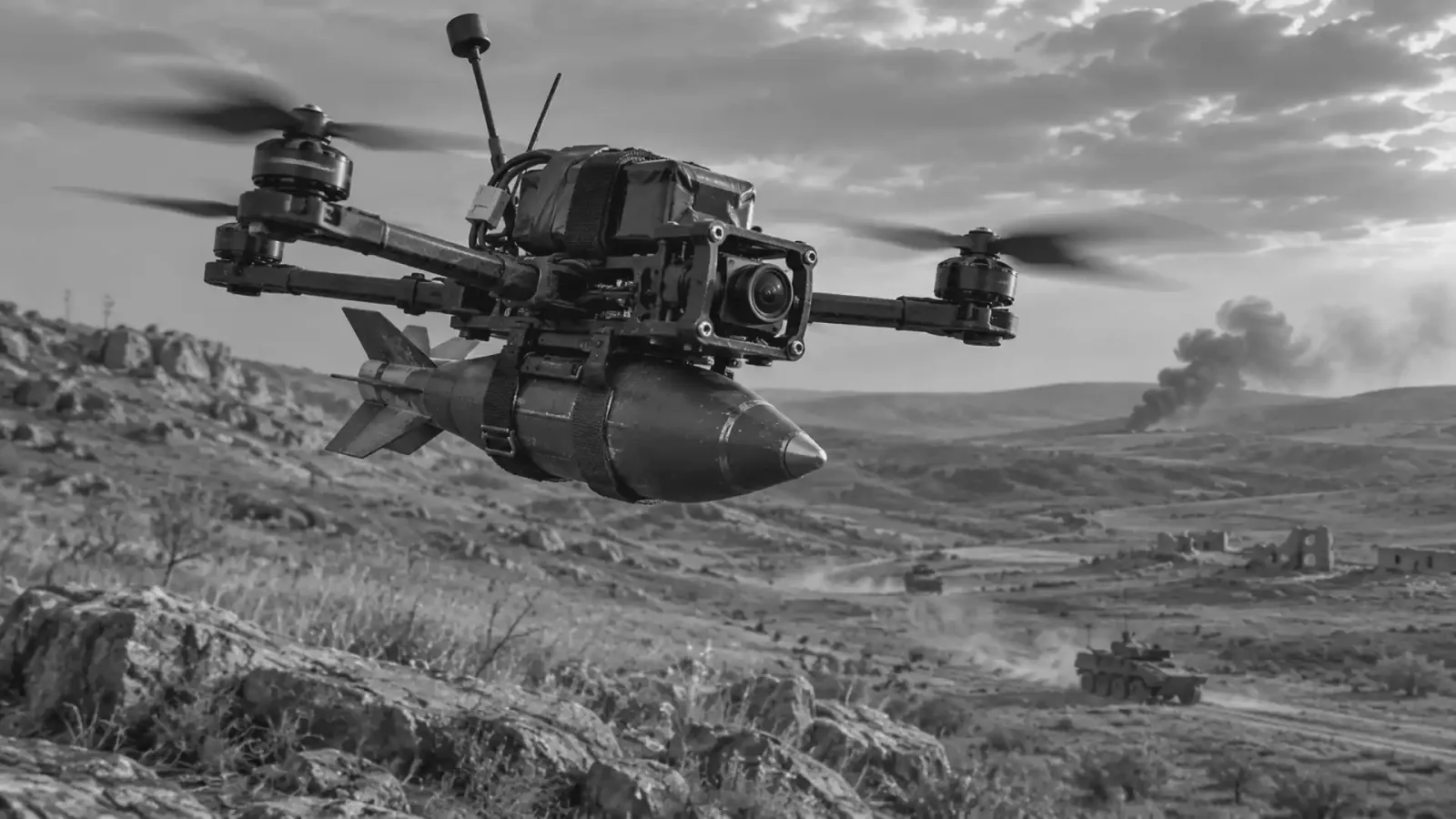
Pakistan's agreement with Türkiye's Pasifik Teknoloji for 100,000 Merküt first-person-view (FPV) kamikaze drones represents a significant potential change in the scale and organisation of its tactical unmanned warfare capabilities. The agreement, formally signed with Pakistan's National Radio and Telecommunication Corporation (NRTC) on 18 September 2026, also covers 500 Deli loitering munitions, 10 Alpin unmanned helicopters, 25 Dumrul mini unmanned helicopters and 250 Korgan autonomous ground-support systems. Its three-year duration and provisions for local assembly and production suggest an ambition extending beyond conventional arms imports towards establishing a replenishable industrial base for unmanned warfare.¹
The defining feature of the agreement is not the technological sophistication of any individual platform. It is the combination of considerable procurement volume, diversified unmanned systems and potential domestic manufacturing. An inventory of 100,000 expendable attack drones could enable Pakistan to distribute precision-strike capabilities across numerous tactical formations, sustain considerable attrition and supplement its existing artillery and conventional missile inventories. However, this potential depends on production rates, trained operators, secure communications, target acquisition, operational integration and the ability to deliver useful effects against increasingly sophisticated counter-drone defences.
The announced quantity is remarkable in the South Asian context, but it should not be described as unprecedented in contemporary warfare. Ukraine has already demonstrated industrial demand for unmanned systems on a considerably larger scale. The important question is therefore why Pakistan, which is not presently engaged in a prolonged conventional ground war comparable to Ukraine, considers a six-figure FPV procurement programme necessary.
Three explanations merit particular attention. Pakistan may be attempting to institutionalise lessons from its May 2025 military confrontation with India, establish an affordable means of imposing sustained tactical attrition, and develop the industrial capacity necessary to maintain unmanned operations without depending entirely on imported finished weapons. These objectives are not mutually exclusive. They also do not establish that every acquired system is intended for use against India, since Pakistan faces separate internal and western-border security requirements.
For India, the principal danger would be an adversary capable of repeatedly employing inexpensive, comparatively precise weapons against exposed personnel, lightly protected equipment and logistical activity while imposing disproportionately expensive defensive demands. This threat must nevertheless be assessed realistically. Short-range FPV drones have serious limitations in payload, endurance, weather tolerance, communications reliability and susceptibility to physical interception. Their effectiveness is highly dependent on reconnaissance, trained crews and integration with other weapons.
The central assessment is that Pakistan's procurement could alter the economics of tactical engagements along India's western front, but the contract itself does not demonstrate an operational force of 100,000 drones. India's response should prioritise layered, economical counter-UAS protection, battlefield adaptation and domestic mass-production capacity rather than treating each inexpensive drone as a target for conventional air-defence missiles.
1. From an Unidentified Friendly Country to Pakistan's NRTC
The origins of the agreement can be established through two primary regulatory disclosures issued by Pasifik Teknoloji on Türkiye's Public Disclosure Platform, commonly known as KAP. These documents are particularly important because much of the reporting circulated in November 2026 concerns an agreement that was publicly disclosed almost two months earlier.
1.1 The original announcement of 4 May 2026
On 4 May 2026, Pasifik Teknoloji informed investors that it had signed a framework agreement with a leading technology and defence organisation belonging to a friendly and allied country. The customer was not identified. The company nevertheless disclosed the intended equipment and quantities. The proposed package comprised 100,000 Merküt FPV kamikaze drones, 10 Alpin unmanned helicopters, 25 Dumrul mini unmanned helicopters, 500 Deli tactical kamikaze systems and 500 Korgan autonomous ground-support and observation units. Pasifik described the arrangement as an important step towards its first defence export.²
The scale of the proposed acquisition distinguished it from an ordinary evaluation order. Nevertheless, a framework agreement is not equivalent to completed procurement, delivery or operational induction. At that stage, the public evidence established the proposed acquisition programme and its intended scale, but not the customer's identity, payment terms, manufacturing commitments or implementation schedule.
1.2 Evaluation and the September agreement
Between May and September, the company reported the completion of field testing, end-user evaluations, simulation training and pilot training involving the equipment covered by the arrangement. On 18 September 2026, Pasifik signed a subsequent agreement identifying Pakistan's NRTC as the customer. The company disclosed this development to KAP on 19 September at 14:30 Turkish time.³
The September agreement was described as covering sales, distribution and local assembly or production. Four of the five stated quantities remained unchanged. The Korgan component, however, fell from 500 units in May to 250 in September, a reduction of 50 per cent. Neither disclosure explains the reason for this adjustment. It could reflect revised operational requirements, changes in the intended deployment architecture or commercial negotiations, but none of these explanations can presently be established as fact.
The contractual language also matters. The company stated that production and deliveries were expected to begin in the coming period. It did not announce that the complete order had entered Pakistan's military inventory. Neither the value of the contract nor a verified platform-by-platform delivery schedule was disclosed.
1.3 Developments up to 15 November 2026
The agreement resurfaced in specialist defence reporting between 11 and 14 November, attracting renewed attention because of its scale and the identification of Pakistan as the customer. This reporting did not establish a new contract signed in November. It largely revisited the September disclosure.⁴
Pasifik's interim corporate activity report, published on 9 November 2026 and covering the period ending 30 September, also records the Pakistan agreement. Separately, the company reported product demonstrations involving Merküt, Deli-S and Dumrul at Turkish and multinational military exercises during September and October. These activities provide evidence of continued technical development and demonstration, but they do not independently establish Pakistani deliveries or operational deployment.⁵
The distinction is fundamental to any assessment of the programme. As of 15 November 2026, the verifiable position is that a substantial agreement exists, pre-contract testing was reportedly completed, and a framework for local production has been announced. The precise number of accepted aircraft, the proportion to be manufactured in Pakistan, the equipment configuration selected by NRTC and the timetable for operational induction remain publicly unverified.
2. The Equipment Pakistan Is Acquiring
The procurement package comprises five categories of unmanned systems with substantially different operational purposes. Their combination is important because Pakistan is not merely acquiring 100,000 independent flying munitions. It is obtaining a mixture of expendable strike platforms, reusable surveillance and support aircraft, and ground infrastructure that could eventually support a more integrated unmanned warfare capability.
NRTC's involvement is relevant in this regard. Based in Haripur and operating under Pakistan's Ministry of Defence Production, the corporation manufactures military communications equipment and develops electronic warfare, anti-drone, surveillance and electronic systems. Its existing technical infrastructure could support assembly, integration and maintenance. However, its experience in defence electronics does not establish that it can immediately manufacture all the aircraft, sensors, motors and specialised components covered by the Turkish agreement.⁶
2.1 Merküt FPV Kamikaze Drone

Image Source: Link
Merküt is the central component of the agreement. Developed by SAVX Teknoloji, it is a short-range multirotor attack drone intended primarily for tactical engagements. Its distinguishing feature is a purpose-designed fragmentation munition with a proximity fuze. Unlike improvised FPV drones carrying modified grenades or anti-tank charges, the manufacturer presents Merküt as an integrated aircraft-and-munition system.
The technical literature requires careful interpretation because different versions and manufacturer publications provide materially different specifications. The following table distinguishes those figures rather than treating them as interchangeable.⁷ ⁸ ⁹ ¹⁰
Specification | Published manufacturer data |
|---|---|
Flight range | 8 km for the thermal version; 10 km for the current electro-optical version |
Endurance | Approximately 20 minutes with a warhead; up to 30 minutes without one on the EO version |
Take-off weight | 2.5 kg on current EO specifications; 4 kg in an earlier brochure |
Maximum speed | 144 km/h in current SAVX specifications; 150 km/h in an earlier TİTRA brochure |
Warhead | Directional anti-personnel fragmentation |
Fragmentation | 1,000 steel balls of 3 mm diameter in current EO literature; 1,000 fragments of 4 mm in an earlier brochure |
Advertised effective radius | 20 metres |
Detonation | Adjustable proximity fuze, with the current EO version specifying 0.5–12 metres |
Guidance | FPV control with advertised visual tracking and GNSS-independent capabilities |
Available configurations | Electro-optical, thermal and fibre-optic-controlled variants |
The first point concerns its warhead. Merküt's documented fragmentation configuration is primarily intended to engage exposed personnel and other vulnerable targets. The manufacturer claims that its proximity fuze can detonate the munition at a selected distance, dispersing fragmentation towards the target. This is potentially useful against personnel who might otherwise be difficult to engage through direct impact alone.
However, a manufacturer's stated 20-metre effectiveness radius does not mean reliable neutralisation of every target within that distance. Fragmentation effects depend on orientation, protective cover, distance and the characteristics of the target. An anti-personnel fragmentation warhead also cannot be assumed to have the armour-penetration capability of a purpose-designed shaped-charge munition. Although armour-piercing developments have been discussed, the Pakistani contract does not identify the warhead variants selected.
The second consideration is its navigation and control architecture. SAVX advertises electro-optical and thermal options, visual target tracking, and forms of autonomous terminal guidance capable of functioning without satellite navigation. It also offers a fibre-optic version, with cable-length options of 10, 15, 20 and 30 kilometres. Fibre-optic control can reduce exposure to conventional radio-frequency jamming, but cable length should not be confused with independently demonstrated operational strike range. The fibre-optic aircraft also carries additional weight, and its endurance and flight performance cannot automatically be equated with those of the lighter radio-controlled version.
Finally, the difference between published specifications matters for India's threat assessment. Earlier reports described Merküt as an 8-kilometre weapon with approximately 950 fragments and a maximum speed of 200 km/h. Current manufacturer material describes other configurations. These are not necessarily erroneous accounts; they may reflect design revisions, differing prototypes or distinct product versions. Nevertheless, there is insufficient public information to identify the exact Merküt configuration that Pakistan will manufacture or receive.
2.2 Alpin Unmanned Helicopter

Image Source: Link
The Alpin family serves a different purpose. It is a comparatively large unmanned helicopter designed for logistics, intelligence gathering, surveillance and potentially armed missions. The manufacturer's current Alpin 2 specifications include a maximum take-off weight of 550 kg, payload capacity of up to 200 kg, a 200-kilometre control radius, a service ceiling of approximately 21,000 feet and maximum speed of 203 km/h. Endurance is advertised as exceeding nine hours under favourable conditions, but the manufacturer's more detailed figures show that greater payloads substantially reduce time airborne.¹¹
The Alpin acquisition is therefore best understood as a small fleet of reusable military support aircraft rather than an extension of the Merküt order. Depending on the final equipment fit, such platforms could provide surveillance, aerial communications support and logistics functions. Alpin 2 has also been displayed carrying smaller attack drones, and TİTRA has advertised the ability to integrate up to eight Merküt systems with the helicopter.
The latter capability is significant as a developmental concept, but there is no public confirmation that Pakistan has contracted for this particular integration. Moreover, the acquisition of only ten Alpin helicopters limits the scale at which such a capability could be maintained. Aircraft servicing, payload configuration, trained personnel and availability would determine its practical utility.
2.3 Dumrul Mini Unmanned Helicopter

Image Source: Link
Dumrul occupies the intermediate category between the much larger Alpin and the expendable Merküt. The manufacturer's current specifications describe a 23-kilogram maximum take-off weight, an 8-kilogram payload capacity, approximately 90 minutes of endurance, a 60-kilometre control radius and a service ceiling of 4,000 metres. An earlier company brochure advertised up to 120 minutes under some configurations, demonstrating the importance of payload-dependent performance claims.¹²
Dumrul can accommodate different sensor and weapons configurations. TİTRA has publicised options involving 60 mm and 81 mm mortar ammunition, grenade launchers and Roketsan METE miniature guided missiles. These are available or demonstrated equipment configurations, not evidence that Pakistan has purchased every weapons option.
Operationally, the system's possible contribution lies in combining observation and limited armed functions within a smaller, reusable aircraft. Such a platform could supplement conventional reconnaissance and provide persistent situational awareness over selected areas. Its value would depend less on the number of aircraft purchased than on the quality of its sensors, communications and maintenance support.
2.4 Deli Tactical Kamikaze Systems

Image Source: Link
The September agreement identifies 500 Deli tactical kamikaze systems but does not specify the variants. This is a consequential omission because the Deli family includes aircraft with differing launch requirements, warheads and guidance capabilities.
The manufacturer's Deli-2 specifications describe a fixed-wing loitering munition with a 50-kilometre flight range, 45-minute endurance, 3.8-kilogram warhead, 15-kilogram maximum take-off weight and maximum speed of 162 km/h. Its declared control range is 20 kilometres. The electro-optical configuration incorporates visual navigation and targeting features. Other Deli-family aircraft are lighter and intended for different operating conditions.¹³
The hand-launched Deli-S, demonstrated during Turkish military technology activities in October 2026, weighs approximately 10 kilograms and carries a 2-kilogram warhead, according to Pasifik. The company also advertises coordinated operations involving Deli-S and other unmanned platforms.¹⁴
Compared with Merküt, the Deli family could offer Pakistan a broader range of tactical engagements through fixed-wing aircraft. The larger warhead and longer advertised flight range of Deli-2 would make it a different class of munition. However, until the variant distribution is disclosed, its precise operational contribution remains uncertain.
2.5 Korgan Autonomous Ground Support and Observation Systems

Image Source: Link
Korgan is potentially the most overlooked component of the programme. Although it is not a strike aircraft, it provides supporting infrastructure for unmanned aerial operations. TİTRA describes the Korgan family as providing autonomous mission management, image transmission, environmental monitoring and other support functions.
The publicly advertised Korgan-M configuration is an autonomous drone station weighing approximately 400 kg. It incorporates automated recovery and charging infrastructure, environmental sensors, encrypted communications and an advertised eight-kilometre local radio link. Its specified charging time is approximately 35 minutes from 20 to 80 per cent battery capacity.¹⁵
The manufacturer also offers other Korgan configurations. In an earlier brochure, Korgan 2 was described as a ground-support and monitoring unit capable of remote or autonomous operation, encrypted video transmission and integration with fixed or mobile platforms. Since the Pakistani agreement does not specify the model, the specifications of Korgan-M cannot be assumed to apply to every unit Pakistan will receive.
More importantly, the presence of 250 Korgan systems does not establish an equivalent number of autonomous attack positions. The relationship between Korgan, expendable Merküt aircraft and reusable surveillance drones depends on the actual model and integration arrangements.
Nevertheless, demonstrated concepts offer an indication of the manufacturer's direction. In March 2026, SAVX demonstrated a Korgan platform launching three Merküt FPV drones simultaneously. Such demonstrations suggest possibilities for more organised, remotely supported deployment, although they do not prove Pakistan has acquired that configuration.¹⁶
3. Why 100,000 Drones Is an Unusual Procurement Figure
A six-figure order would be highly unusual for a single publicly disclosed Turkish FPV export programme. Its strategic significance, however, emerges only when the number is placed in the correct military-industrial context.
Illustrative procurement rate over three years
33,333Merküt drones per year | 2,778Per month | 91Per day |
|---|
Arithmetic averages assuming an even distribution of 100,000 systems over 36 months. These are not reported delivery schedules or production rates.
The quantity represents a procurement approach built around expendability and replenishment rather than the traditional acquisition of a small fleet of expensive reusable aircraft. A kamikaze drone is generally consumed when employed against a target. It must therefore be assessed partly as ammunition, with implications for manufacturing capacity, storage, quality control and replacement rates.
The abnormality is not that militaries have begun using FPV drones by the tens of thousands. Ukraine provides a much larger precedent. Its Ministry of Defence stated in 2025 that the country's industrial capacity was approximately 4.5 million FPV drones annually, with plans to procure that output. In January 2026, Ukraine's National Security and Defence Council stated that domestic production capacity had increased beyond eight million FPV drones annually.¹⁷
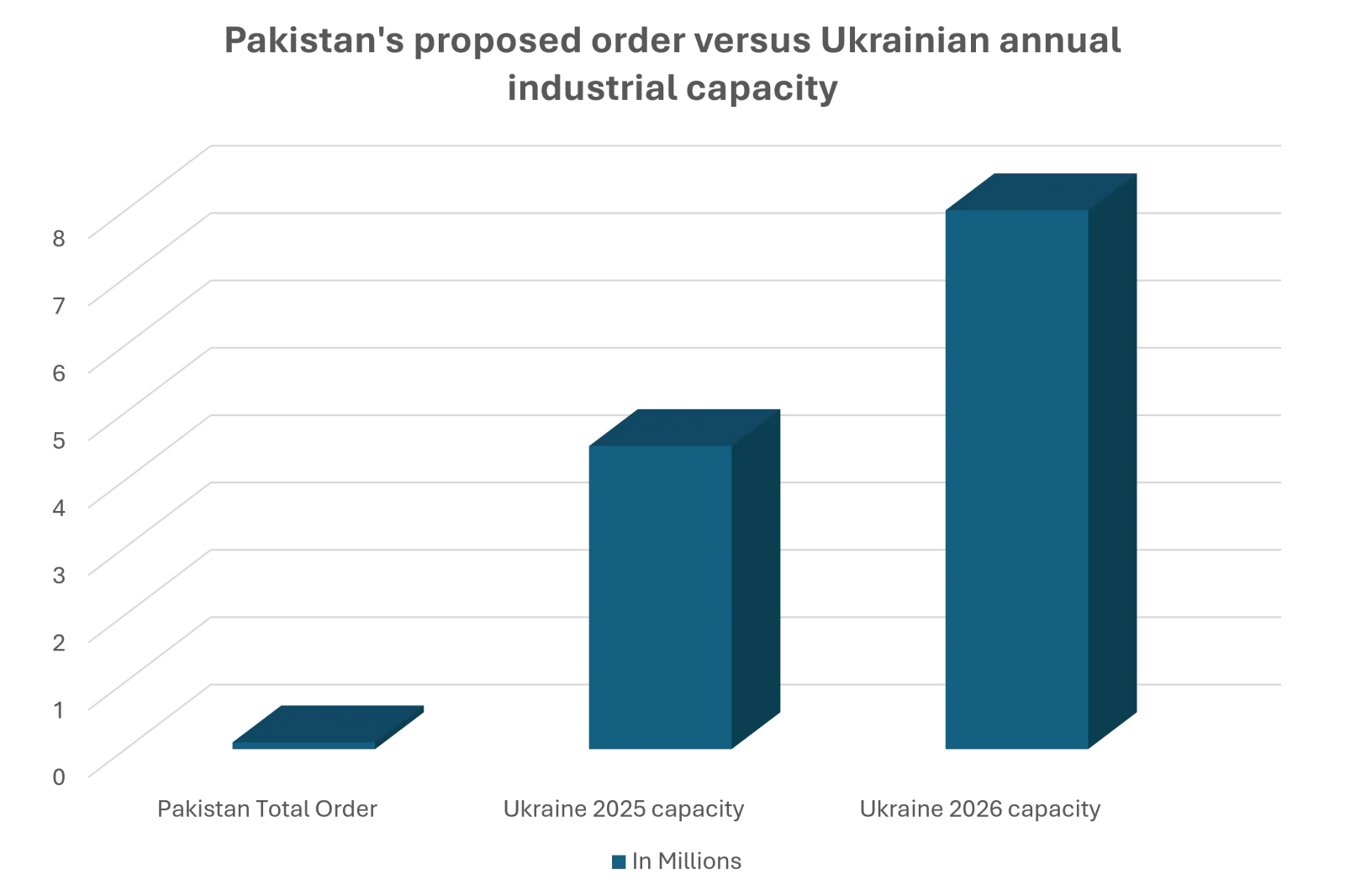
Quantities are not directly equivalent: Pakistan's figure is a three-year contractual total; Ukraine's figures refer to reported annual capacity.
The comparison highlights the distinction between a large peacetime procurement commitment and industrial production during an extended war of attrition. Pakistan's order is much smaller than Ukraine's claimed annual capacity. Nevertheless, it would represent a considerable step towards standardising mass-produced tactical strike drones within Pakistan's military establishment.
The volume also raises an important institutional question. An effective FPV force requires trained operators, instructors, maintenance personnel, target-acquisition capabilities and a system for coordinating drone operations with other military activities. A large number of aircraft can be stored relatively easily compared with the institutional requirements for employing them consistently.
Consequently, the procurement cannot be understood as merely an expansion of Pakistan's drone inventory. If successfully implemented, it could constitute an effort to introduce expendable unmanned weapons as a routine component of tactical operations.
There is also an important distinction between the capacity to launch many drones and the ability to conduct a coordinated swarm attack. The term swarm is frequently used loosely in defence reporting. Independent FPV aircraft launched within a short period do not necessarily possess autonomous cooperation, distributed decision-making or coordinated target allocation. The manufacturer has demonstrated elements of multi-platform integration, but the contract provides no evidence of the scale or maturity of such capabilities in Pakistani service.
A further possibility is that Pakistan intends to use the initial procurement as the foundation for subsequent domestic manufacturing. The inclusion of local production provisions strengthens this interpretation. It would also explain why NRTC, rather than an individual frontline military formation, appears as the contracting institution.
Nevertheless, the commercial terms remain insufficiently disclosed to determine whether the arrangement guarantees 100,000 completed aircraft, represents a programme ceiling subject to subsequent orders, or involves particular delivery milestones and payment conditions. These distinctions must be resolved before the announced figure can be converted into a credible estimate of future operational strength.
4. Previous Operational Experience and Combat Effectiveness
The Turkish systems' service histories must be distinguished from the wider combat record of FPV and loitering-munition technology.
4.1 What is known about the specific systems
The original Alpin unmanned helicopter has an established Turkish operational history. In May 2024, TİTRA's then chief executive told Defense News that the aircraft had been used during Turkish military operations in northern Iraq. This supports the existence of operational experience with the Alpin family, particularly in logistics-related roles. It does not independently establish the combat performance of the newer Alpin 2 configuration or its proposed integration with Merküt.¹⁸
Merküt entered Turkish security-force inventory in 2025, according to contemporary Turkish defence reporting. Subsequently, the manufacturer demonstrated its capabilities during exercises and technical evaluations. Dumrul has also been described by Pasifik as operationally deployed within the Turkish Armed Forces and participated in REPMUS 2026 in Portugal and the Turkish Navy's TURNAs-2026 exercise.
The Deli-S programme received a Turkish defence procurement contract in September 2026 and was demonstrated at the ALFA 2026 technology event in October. Merküt's storage and deployment concept was also presented during the October Ateş Serbest military exercise. These developments indicate technological maturation, procurement interest and a growing record of exercises.¹⁹
However, no independently verified battlefield assessment was identified establishing combat kill rates, attrition rates or sustained wartime performance for the specific Merküt–Deli–Korgan combination being acquired by Pakistan. It would therefore be incorrect to describe the entire package as combat-proven solely because Turkish forces have accepted or demonstrated some of its components.
The evidence is stronger for the underlying categories of weapons than for this particular procurement package.
4.2 Lessons from the Russia–Ukraine war
The Russia–Ukraine war provides the clearest contemporary evidence of the military value and limitations of mass-employed FPV systems. Both sides have used relatively inexpensive drones to attack personnel, vehicles, artillery, logistical movements and other tactical targets. Their proliferation has increased the dangers of movement and concentration near the front line.
Yet the effectiveness of these weapons is more conditional than strike videos often imply. A 2025 study by the Royal United Services Institute (RUSI) observed that FPV drones are useful against moving targets and certain military equipment but remain constrained by weather, payload limitations, electronic warfare and the vulnerability of operators. The study also found that their effectiveness increases when used alongside conventional firepower rather than as a substitute for it.²⁰
The Polish Centre for Eastern Studies (OSW) similarly assessed in October 2025 that approximately 60–80 per cent of FPV strikes failed to destroy their intended targets. Its discussion attributed this to electronic warfare, physical protection and the limited effects of some munitions. The figures should be treated as estimates derived from wartime observations, not universal failure rates applicable to every drone model or operational environment.²¹
Three broad findings emerge from this experience.
First, FPV drones can impose persistent costs on an opponent even when many individual attacks fail. Their presence can restrict exposed activity, complicate movement and increase the defensive resources necessary to sustain routine operations.
Second, their lethality is highly dependent on reconnaissance. An attack drone cannot compensate for the absence of reliable target identification. Surveillance, communications and the ability to distinguish military targets become especially important when large numbers of weapons are available.
Third, improvements in offensive technology generate corresponding defensive adaptations. Russia and Ukraine have repeatedly altered drone guidance, communications, protective structures and interception methods in response to developments by the opposing side. No particular configuration has established permanent immunity from countermeasures.
4.3 Electronic warfare and the fibre-optic response
Radio-controlled FPV drones depend on functioning command and video links. Electronic warfare has therefore been an important means of disrupting them. Russian and Ukrainian forces have used jamming systems to interfere with drone operations, while drone manufacturers have responded with alternative frequencies, improved links and autonomous guidance features.
Fibre-optic control provides a different solution. By transmitting commands and imagery through a physical cable, it removes dependence on the conventional radio link and makes ordinary radio jamming ineffective against that connection. NATO identified this as a growing counter-UAS challenge in 2025.²²
Nevertheless, fibre-optic drones are not invulnerable. They retain physical limitations associated with airframe performance, endurance, cable management and exposure to physical interception. Their operators and supporting infrastructure remain subject to detection and attack by other means. Moreover, fibre-optic immunity to radio jamming does not necessarily imply that every onboard sensor, navigation function or control subsystem is immune to interference or degradation.
Merküt's fibre-optic version consequently deserves attention, but without evidence of the variants selected by NRTC, it would be premature to conclude that all 100,000 aircraft will resist conventional electronic countermeasures.
4.4 Physical protection and countermeasures
The Russia–Ukraine war has demonstrated that physical countermeasures remain relevant despite rapid advances in electronics. Both sides have employed protective netting, overhead barriers, improvised vehicle screens, hardened structures and other measures to reduce the effects of short-range drones.
These measures have achieved varying results. Physical barriers can obstruct drone access or cause premature detonation, but poorly protected openings, damaged barriers and repeated attacks can reduce their effectiveness. A West Point study of drone-related threats describes both the widespread adoption of protective structures and their operational limitations.²³
The principal lesson is that low-cost protection can reduce the effectiveness of low-cost attack weapons. This does not eliminate the requirement for electronic detection or active interception. It shows why an economically sustainable defence should combine different protective measures rather than depend on a single technological solution.
A second lesson concerns the limits of fragmentation munitions. A drone carrying a directional anti-personnel warhead is generally more threatening to exposed personnel and lightly protected equipment than to a properly protected armoured target. Effective protective structures can therefore alter the military value of the weapon without necessarily preventing every aircraft from reaching its destination.
5. Pakistan's Possible Military Objectives
The evidence establishes that Pakistan has entered a substantial procurement arrangement. It does not establish the precise operational doctrine that Islamabad intends to implement. Several objectives can nevertheless be assessed from the composition of the package, Pakistan's existing security requirements and the lessons of recent warfare.
5.1 Expanding distributed tactical strike capabilities
The most immediate potential benefit would be the ability to equip a broader range of formations with relatively inexpensive precision-attack weapons. Traditional artillery and missile systems generally remain concentrated within specialised organisations. Small FPV systems can, in principle, be distributed more widely, provided the necessary training and command arrangements exist.
Such distribution would enable Pakistan to complement its conventional firepower with additional tactical attack options. Its value would be greatest against targets that are difficult or uneconomical to engage with more expensive weapons. This should not be interpreted as a replacement for artillery. FPV drones carry much smaller payloads, operate under different constraints and are unsuitable for several missions performed by conventional fire systems.
The procurement may therefore indicate an effort to expand the number of formations able to employ precision weapons rather than merely increase the national stockpile.
5.2 Developing sustained attrition capacity
A second objective could be the ability to sustain repeated unmanned attacks over an extended confrontation. In a high-attrition environment, the number of aircraft available initially may be less important than the speed at which losses can be replaced.
The Ukrainian experience has demonstrated that mass production, component availability, rapid modification and operator training are central to maintaining drone operations. Pakistan's agreement for local assembly and production is consistent with an attempt to address these requirements before a prolonged conflict emerges.
There is, however, a considerable gap between local assembly and independent manufacturing. If Pakistan receives imported kits containing the aircraft's critical components, it would remain exposed to supply interruptions. Greater autonomy would require domestic production capabilities, access to technical documentation, quality assurance and sustainable component procurement.
NRTC's industrial role is therefore more strategically significant than the simple location of an assembly facility.
5.3 Applying lessons from Operation Sindoor
The May 2025 India–Pakistan confrontation provides an important context for the procurement.
During the confrontation, Indian officials reported that Pakistani forces attempted drone intrusions at 36 locations on the night of 8–9 May, involving approximately 300–400 drones. Indian authorities stated that numerous aircraft were neutralised using kinetic and non-kinetic means. Preliminary examination of recovered debris pointed to Turkish-origin systems, including Asisguard's Songar. Reuters subsequently reported that Pakistan had employed Turkish-origin and domestically produced unmanned systems during the conflict.²⁴
These reports demonstrate that Pakistan had already begun incorporating unmanned aircraft into its operations against India. However, the aircraft identified in the 2025 confrontation should not be confused with the Merküt systems now covered by the September 2026 agreement. There is no verified evidence that Pakistan used Merküt, Deli, Dumrul or Korgan against India during Operation Sindoor.
The chronological relationship is nevertheless significant. The initial Turkish framework agreement was announced approximately one year after the conflict. A plausible interpretation is that Pakistan's subsequent procurement decisions were influenced by its experience with unmanned aircraft, Indian air defences and the logistical requirements of large-scale drone employment.
It would be excessive to treat the agreement as conclusive evidence of a particular offensive plan against India. It is better understood as evidence of a possible shift towards making unmanned strike capacity more abundant, institutionalised and easier to replenish.
5.4 Supporting internal security and western-border operations
The India-focused interpretation should not obscure Pakistan's other security requirements. Its continuing counterterrorism operations in Khyber Pakhtunkhwa and Balochistan, and tensions along the Afghan frontier, create separate demands for surveillance and tactical unmanned systems.
Short-range attack drones, autonomous surveillance stations and unmanned helicopters could support various military activities in those environments. Some of the systems in the procurement package are particularly relevant to difficult terrain and operations requiring persistent observation or limited logistical support.
This broader applicability complicates any attempt to assign the entire order to the eastern front. The more defensible assessment is that Pakistan is acquiring a flexible military capability that could be allocated among several operational theatres.
5.5 Creating a longer-term defence-industrial partnership with Türkiye
The agreement also represents an expansion of Turkish-Pakistani defence-industrial cooperation beyond established major platforms.
Unlike the acquisition of a small number of complex aircraft or naval vessels, a large FPV programme potentially creates continuous requirements for components, training, software, testing and replenishment. This could support a durable manufacturer-customer relationship.
For Türkiye, the agreement offers a substantial export opportunity and a potential foothold in Pakistan's unmanned-systems manufacturing sector. For Pakistan, the attraction lies in access to foreign designs and production expertise without necessarily bearing the full initial research and development costs.
The strategic question is whether the arrangement ultimately develops into genuine manufacturing independence. A production line dependent on imported engines, electronics and sensors would provide some logistical advantages but limited industrial sovereignty.
6. Implications for India's Security
The principal implications for India arise from the potential interaction between procurement scale, tactical employment and existing defensive vulnerabilities.
6.1 Increasing pressure on frontline formations
Merküt's advertised range places the basic aircraft primarily within the tactical battlefield rather than the category of deep-strike weapons. Its greatest relevance would be to exposed activity in areas accessible to relatively short-range drones.
This matters because the consequences of a drone attack are not limited to physical destruction. Persistent aerial threats can affect movement, observation, resupply, engineering tasks and the ability of personnel to operate without additional protection.
If Pakistan can combine large inventories with effective reconnaissance and trained crews, these pressures could become more sustained. However, the distance constraints of the aircraft, the need for functioning communications and the availability of suitable targets would continue to limit its effectiveness.
6.2 Complicating the economics of air defence
An expensive interceptor employed against a comparatively cheap FPV drone may represent an unfavourable exchange even when the interception succeeds. The seriousness of this problem depends on the value of the defended asset, the cost and availability of alternative countermeasures, and the damage avoided.
India therefore cannot assess success solely through the number of hostile drones destroyed. It must also consider the cost of interception, ammunition expenditure, equipment availability and the ability to sustain protection during repeated attacks.
This is particularly important because the threat varies considerably across the purchased systems. Merküt is a short-range weapon, while the Deli family may present a different engagement profile. The Alpin and Dumrul are reusable aircraft whose loss would impose a different cost on Pakistan. A defensive architecture should distinguish these threats rather than treat every unmanned aircraft as equivalent.
6.3 Exposure of critical infrastructure and military logistics
Small unmanned aircraft create challenges for installations and logistical activity that were historically protected primarily against conventional aerial or ground threats.
Their ability to approach at relatively low altitude, their limited physical size and the possibility of operating in numbers complicate detection and interception. These characteristics can be particularly relevant to dispersed facilities and equipment that cannot receive the same level of protection as major airbases.
Nevertheless, the operational range of the basic Merküt means that the procurement does not, by itself, create a nationwide deep-strike threat. Any wider threat would depend on additional platforms, launch arrangements or other capabilities not established by the agreement.
6.4 Electronic warfare may become less decisive on its own
India's counter-UAS planning must account for the possibility that a greater proportion of adversary drones will use alternative control architectures. Conventional jamming remains useful against susceptible systems, but it cannot be the sole defensive measure.
The fibre-optic and visual-guidance options advertised by Turkish manufacturers reinforce this point. At the same time, manufacturer's claims of autonomous target tracking should not be equated with reliable performance against all targets under combat conditions. RUSI's Ukrainian field research has identified substantial limitations in some forms of automatic visual target tracking, particularly when operators can maintain effective manual control.²⁵
The requirement is therefore for layered protection capable of addressing different guidance methods, rather than an assumption that any single technology will defeat all incoming aircraft.
6.5 The risk of misjudging escalation
Mass-produced attack drones could also complicate crisis management between India and Pakistan. Their comparatively low cost may encourage more frequent use in limited confrontations. At the same time, attacks against personnel or important facilities can produce consequences disproportionate to the cost of the weapon employed.
The danger is that low-cost tactical systems may lower the perceived threshold for initiating an attack without reducing the political or military consequences of the damage caused. This is particularly relevant between nuclear-armed neighbours where local incidents can generate rapid strategic escalation.
Accordingly, the challenge is not simply technical. It also concerns deterrence, command discipline and the management of military responses during periods of heightened tension.
7. What India Should Do
India already possesses counter-drone capabilities and has announced further acquisitions. The requirement is to ensure that these capabilities are deployed economically, integrated effectively and adapted to increasingly diverse unmanned threats.
7.1 Establish layered counter-UAS protection as a routine military requirement
India's existing DRDO–Bharat Electronics counter-drone systems provide detection, tracking and both electronic and physical neutralisation options. The Ministry of Defence describes the D4 system as capable of responding to micro and small unmanned aircraft through an integrated architecture.²⁶
This foundation should be expanded through a layered approach combining surveillance, identification, electronic countermeasures, appropriate low-cost interception and passive protection.
The objective should be to reduce the overall military effectiveness of hostile unmanned systems. Successful defence does not require every drone to be destroyed by a missile. It requires an appropriate combination of measures that protects personnel and equipment while preserving defensive resources for more serious threats.
7.2 Prioritise economical and scalable interception
India should continue developing inexpensive counter-drone technologies that can be produced and deployed in considerable numbers. The effectiveness of such systems must be assessed against realistic combinations of drone types rather than single-aircraft demonstrations.
The Ministry of Defence's July 2026 approval for the proposed Akash Tarang anti-UAV electronic warfare system and its October 2026 approval for platform-based counter-UAS acquisitions indicate that this requirement is already receiving attention. However, Acceptance of Necessity is an administrative procurement milestone, not evidence of completed delivery or deployment.²⁷
The next challenge is ensuring that procurement, trials, training and operational integration proceed at a pace consistent with the evolving threat.
7.3 Improve passive protection and battlefield survivability
Lessons from Ukraine indicate that passive protection can significantly affect drone effectiveness. India should systematically evaluate how existing protective measures, hardened structures, dispersed equipment and physical barriers can reduce the exposure of vulnerable military assets.
Such measures should be tailored to different environments and assessed against practical operational requirements. A static installation, a mobile military formation and a logistical facility do not face identical vulnerabilities.
The advantage of passive protection is not that it provides an impenetrable shield. It can reduce the probability of successful damage and limit the defensive resources required against repeated inexpensive attacks.
7.4 Build domestic capacity for mass-produced unmanned systems
India's response should not be confined to defensive procurement. The expansion of inexpensive tactical drones changes the industrial requirements of contemporary warfare.
Sustained operations demand dependable production, component availability, repair and replacement. Expensive high-performance platforms remain necessary, but they cannot substitute for adequate quantities of simpler systems.
India should therefore develop procurement arrangements that support sustained domestic production, rapid technological upgrades and resilient component supply chains. The objective should be to ensure that military formations can maintain their capabilities during prolonged periods of attrition, rather than relying solely on stocks accumulated before a conflict.
7.5 Treat operator training and organisational adaptation as essential
Hardware procurement alone does not produce military effectiveness. Both FPV operations and counter-UAS defence require skilled personnel, reliable coordination and routine training.
India should incorporate realistic unmanned threats into field exercises, including scenarios involving multiple aircraft, electronic interference, reduced visibility and mixed types of aerial threats. Equally important is the integration of counter-drone procedures into ordinary military activities, so that protection does not depend entirely on specialist teams arriving after a threat has been detected.
This organisational dimension is often less visible than new equipment purchases but may prove decisive during sustained operations.
7.6 Develop a reliable assessment of Pakistan's actual induction
Finally, India should distinguish Pakistan's procurement announcements from confirmed operational capabilities.
A useful assessment would examine verifiable manufacturing milestones, deliveries, training programmes, organisational developments and changes in Pakistan's publicly observable unmanned-systems infrastructure. Particular attention should be paid to whether NRTC establishes genuine component-level manufacturing capacity or remains primarily an assembly and integration centre.
These indicators would provide a more reliable understanding of the threat than projecting Pakistan's announced quantity directly into present combat strength.
8. Assessment of the Emerging Military Balance
The procurement indicates that Pakistan is taking mass-produced tactical unmanned systems seriously. Its scale is sufficient to justify Indian attention, while its industrial provisions suggest a longer-term programme rather than a one-time purchase of finished aircraft.
Nevertheless, three limitations prevent the announcement from being treated as an immediate transformation of Pakistan's military capabilities.
The first is uncertainty over implementation. Production and deliveries are not yet publicly verified at the scale implied by the agreement. The contract provides evidence of procurement intent and a commercial framework, not confirmed operational readiness.
The second is the technical diversity of the package. Merküt, Alpin, Dumrul, Deli and Korgan perform different functions and have different support requirements. Their effective integration would require substantial investment in training, communications, maintenance and command structures.
The third is the continuing adaptability of countermeasures. The Russia–Ukraine war has established both the value of expendable drones and the substantial limitations imposed by electronic warfare, physical protection, weather and operator vulnerability. Numbers matter, but they do not eliminate these constraints.
Pakistan may nevertheless derive important advantages from the acquisition if it successfully establishes domestic production and integrates tactical unmanned systems into its military organisations. Even without achieving exceptional individual strike effectiveness, an affordable and replenishable inventory could place sustained pressure on poorly protected targets and complicate conventional military activity.
For India, this development reinforces the need to treat unmanned warfare as an industrial, organisational and operational challenge rather than a narrow air-defence problem.
Conclusion
Pakistan's agreement to acquire 100,000 Turkish Merküt drones is significant because it points towards the institutionalisation of expendable unmanned weapons at scale. The incorporation of larger unmanned helicopters, fixed-wing loitering munitions and autonomous ground-support systems suggests a broader interest in developing integrated unmanned capabilities. Local assembly and production provisions could further strengthen Pakistan's ability to sustain such operations.
However, the publicly available evidence does not establish that Pakistan already possesses the announced quantity, that every system is intended for use against India, or that the manufacturer-specific equipment has demonstrated exceptional combat effectiveness. The technical specifications themselves require careful interpretation because the contracted variants have not been disclosed.
The most consequential outcome would be Pakistan's successful transition from acquiring unmanned weapons to maintaining a sustainable capacity for their production, adaptation and employment. Such a development could gradually alter the economics of tactical engagements and complicate India's defensive requirements.
India's response should therefore be measured by its ability to make hostile unmanned operations ineffective and economically unsustainable, while preserving its own capacity to manufacture, adapt and employ unmanned systems at scale. The procurement warrants serious attention, but it should be assessed through verified induction and operational developments rather than the announced quantity alone.
Endnotes
1. Pasifik Teknoloji A.Ş., “Material Event Disclosure (General),” Türkiye Public Disclosure Platform (KAP), September 19, 2026. Original regulatory disclosure.
2. Pasifik Teknoloji A.Ş., “Material Event Disclosure (General),” Türkiye Public Disclosure Platform, May 4, 2026. Original framework announcement.
3. Pasifik Teknoloji A.Ş., “Material Event Disclosure (General),” September 19, 2026. September disclosure and contract details.
4. Quwa, “Pakistan's NRTC to Acquire & License Produce Drones From Türkiye's TİTRA Technology,” November 2026. Defence procurement analysis.
5. Pasifik Teknoloji A.Ş., “30 September 2026 Interim Activity Report,” published November 9, 2026; Pasifik Holding, “TİTRA Technology Makes Its Mark on Military Exercises with DELİ-S, the MERKÜT Magazine and Live Demonstrations of DUMRUL,” November 5, 2026. Interim activity report; Company exercise report.
6. National Radio Telecommunication Corporation, “Research & Development” and “Production Halls,” official corporate website, accessed November 15, 2026. NRTC institutional capabilities.
7. SAVX Teknoloji, “MERKÜT E/O,” manufacturer's technical specifications, accessed November 15, 2026. Merküt electro-optical technical specifications.
8. SAVX Teknoloji, “MERKÜT Thermal,” manufacturer's technical specifications, accessed November 15, 2026. Merküt thermal specifications.
9. SAVX Teknoloji, “MERKÜT Kablolu,” manufacturer's technical specifications, accessed November 15, 2026. Merküt fibre-optic version specifications.
10. TİTRA Teknoloji, Our Technology Holds the Future, corporate product catalogue, n.d., 22–24. Manufacturer's technical catalogue (PDF).
11. TİTRA Teknoloji, “Alpin,” manufacturer's product specifications; Nicholas Fiorenza, “IDEF 2025: Titra Unveils Alpin 2 Rotary-Wing UAV,” Janes, July 2025. Alpin technical specifications; Janes technical assessment.
12. TİTRA Teknoloji, “Dumrul,” manufacturer's technical specifications, accessed November 15, 2026; TİTRA Teknoloji, Our Technology Holds the Future, 12–14. Dumrul specifications; Earlier manufacturer catalogue.
13. TİTRA Teknoloji, “Deli-2,” manufacturer's product specifications, accessed November 15, 2026. Deli-2 technical specifications.
14. Pasifik Holding, “TİTRA Technology Makes Its Mark on Military Exercises,” November 5, 2026. Deli-S specifications and demonstration.
15. SAVX Teknoloji, “KORGAN-M,” manufacturer's technical specifications, accessed November 15, 2026. Korgan-M technical specifications.
16. TURDEF, “SAVX's KORGAN UAV Nest Releases a Salvo of MERKÜT FPVs,” March 26, 2026. Korgan multi-launch demonstration.
17. Ministry of Defence of Ukraine, “Glib Kanievskyi: In 2025, the Ministry of Defence Plans to Procure 4.5 Million FPV Drones,” 2025; National Security and Defense Council of Ukraine, report on FPV drone production capacity, January 2026. Ukrainian Ministry of Defence statement; Ukraine's 2026 industrial-capacity statement.
18. Tayfun Ozberk, “Titra, Airbus Team Up to Modify Alpin Drone for Naval Missions,” Defense News, May 23, 2024. Alpin operational background.
19. Pasifik Holding, “TİTRA Teknoloji's DUMRUL Mini Unmanned Helicopter Makes Its International Debut at REPMUS 2026,” September 21, 2026; Pasifik Holding, “TİTRA Technology Makes Its Mark on Military Exercises,” November 5, 2026. Dumrul operational and exercise record; October 2026 demonstrations.
20. Royal United Services Institute, Emergent Approaches to Combined Arms Manoeuvre in Ukraine, October 2025. RUSI field research.
21. Centre for Eastern Studies (OSW), “Game of Drones: The Production and Use of Ukrainian Battlefield Unmanned Aerial Vehicles,” October 14, 2025. OSW analysis of drone effectiveness and attrition.
22. NATO Allied Command Transformation, Countering Fiber-Optic-Controlled FPV Drones: Detect, Track, Neutralize, 2025. NATO counter-fibre-optic drone research challenge.
23. Combating Terrorism Center at West Point, “Moving Targets: Implications of the Russo-Ukrainian War for Drone Terrorism,” 2025. Analysis of drone threats and protective countermeasures.
24. Government of India, Press Information Bureau, “Operation Sindoor: A New Benchmark in India's Military Response,” May 2025; Reuters, “India and Pakistan's Drone Battles Mark New Arms Race in Asia,” May 27, 2025. Government of India account; Reuters investigation.
25. Royal United Services Institute, Emergent Approaches to Combined Arms Manoeuvre in Ukraine, October 2025, discussion of FPV guidance, electronic warfare and limitations of automated terminal tracking. RUSI tactical assessment.
26. Department of Defence Production, Ministry of Defence, Government of India, “Anti-Drone System,” manufacturer and product description, accessed November 15, 2026. Official DRDO–BEL counter-drone system description.
27. Ministry of Defence, Government of India, “DAC Approves Capital Acquisition Proposals Worth Rs 52,000 Crore to Enhance Combat Readiness of Defence Forces,” July 3, 2026; Ministry of Defence, “DAC Clears Capital Acquisition Proposals Worth Rs 2.12 Lakh Crore for Defence Forces,” October 26, 2026. July 2026 acquisition approval; October 2026 acquisition approval.
Tags

Author