India’s Maritime Domain Awareness Network: The Role of IMAC, IFC-IOR and Coastal Communities
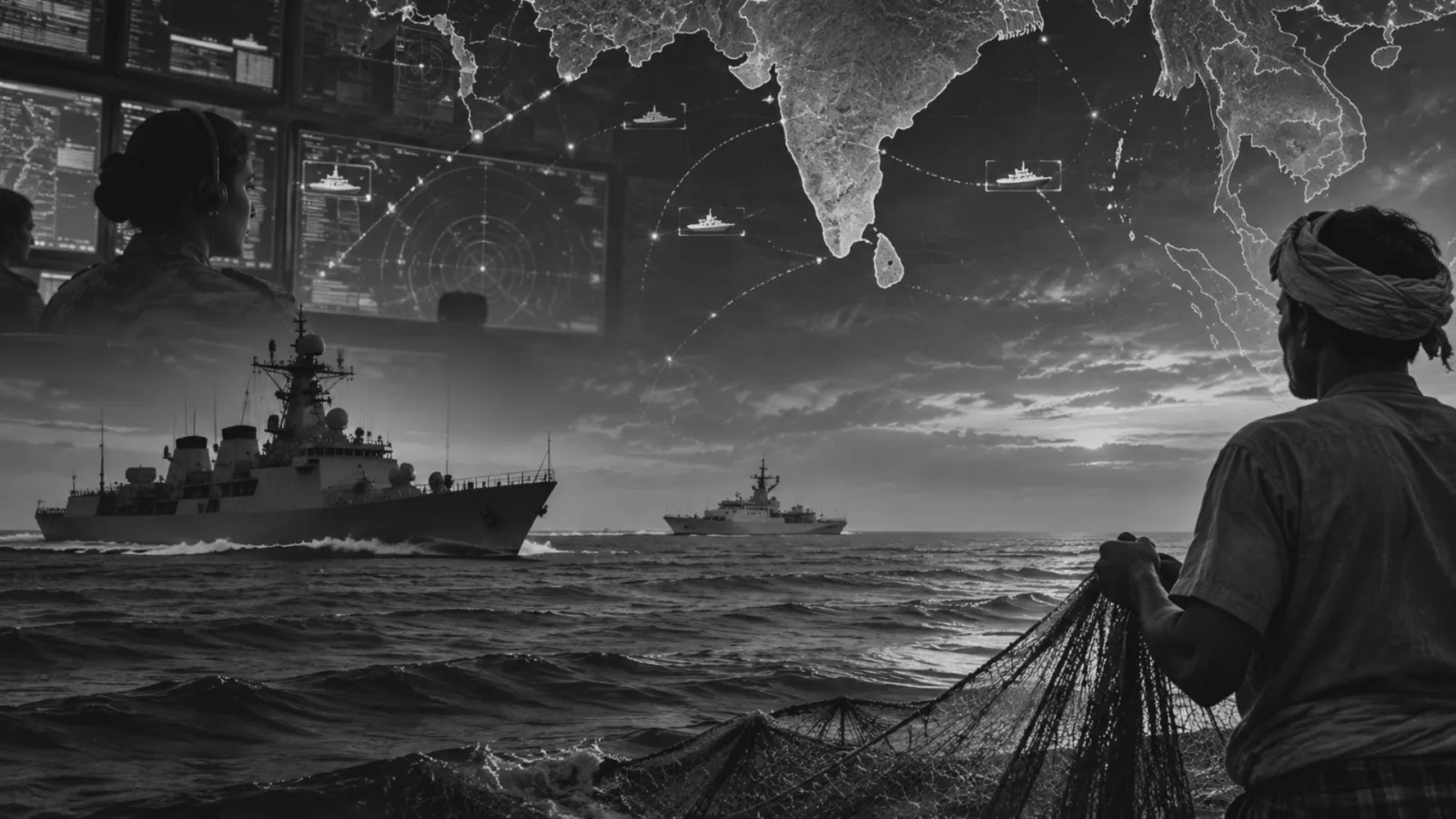
India’s maritime security depends not merely on its ability to monitor activity at sea, but on how effectively information is collected, verified, shared and translated into timely action. This article examines the role of the Information Management and Analysis Centre (IMAC), the Information Fusion Centre–Indian Ocean Region (IFC-IOR), and coastal communities in strengthening India’s Maritime Domain Awareness (MDA) network. It distinguishes IMAC’s role in national-level information coordination from IFC-IOR’s regional information-sharing function, while highlighting how fishing communities can contribute valuable local knowledge that formal surveillance systems may overlook. The article argues that technological investments, including the National Maritime Domain Awareness project and the Vessel Communication and Support System, must be complemented by accessible reporting channels, clear institutional responsibilities, effective verification mechanisms and greater trust between authorities and coastal communities. Ultimately, India’s maritime awareness will depend not simply on how much information it collects, but on how effectively that information informs coordinated responses.
1. Introduction
India’s maritime security relies on not only on what happens at sea, but also on how swiftly and precisely information about those activities reaches the authorities responsible for responding to them. A vessel may be detected by a surveillance system, reported by a coastal community, or identified through information shared by another country. Yet detection alone does not guarantee that the activity will be understood, verified or acted upon.
This is an important challenge for India’s Maritime Domain Awareness (MDA) network. The country has invested in monitoring infrastructure, information sharing arrangements and institutional coordination. The Information Management and Analysis Centre (IMAC), the Information Fusion Centre Indian Ocean Region (IFC-IOR), and the growing use of vessel communication technologies form important parts of this effort. At the same time, coastal communities, particularly fishing communities, possess local knowledge that formal surveillance systems may not capture.
The central argument of this article is that India’s MDA network must focus not only on collecting more information, but also on improving the movement of information from local observation to institutional verification and timely response. IMAC and IFC-IOR provide important national and regional links, while coastal communities can strengthen the local picture of maritime activity. However, these elements will be most effective when they are connected through trusted reporting channels, clear institutional responsibilities and meaningful feedback.
2. IMAC and the Impediments of National Information Coordination
Maritime activity is challenging to monitor because the sea is a constantly changing environment. Commercial shipping, fishing, offshore energy operations, naval movements and other activities take place across large areas. Some activities are routine, while others may indicate illegal fishing, trafficking, piracy or threats to maritime infrastructure.
The International Maritime Organization describes MDA as an effective understanding of activities in the maritime domain that could affect security, safety, the economy or the marine environment.[1] This definition is important because it shows that maritime awareness is broader than identifying the location of vessels. It also requires understanding the nature and possible implications of what is happening at sea.
India established IMAC as part of its efforts to improve information-sharing and coordination between maritime security agencies following the 2008 Mumbai attacks. It serves as an important point for bringing together information from different sources and supporting a common understanding of maritime activity.
The next stage in this development is the National Maritime Domain Awareness (NMDA) project. In July 2025, the Ministry of Defence announced a contract with Bharat Electronics Limited for its implementation. The project involves upgrading the existing NC3I network and developing an AI-enabled information environment. It also envisages upgrading IMAC at Gurugram into a multi-agency centre that can host national agencies.[2]
This development is significant because maritime information is often held by different institutions. The Navy, Coast Guard, intelligence agencies, port authorities and other departments may each possess information relevant to the same incident. The challenge is to bring these separate pieces together in a way that allows decision-makers to understand the wider situation.
Research on India’s maritime information architecture has repeatedly highlighted the importance of integration. Shishir Upadhyaya, in his study of a Pan-Indian Ocean information grid, argues that the existence of multiple information centres does not automatically produce effective maritime awareness. Their value depends on how well information is connected and shared.[3]
For IMAC, therefore, the key test is not simply whether more information can be collected. It is whether different agencies can interpret that information together, identify suspicious patterns and communicate the findings to the authorities responsible for action. Technology can support this process, but it cannot independently resolve institutional gaps or unclear responsibilities.
3. IFC-IOR and the Regional Dimension of Maritime Awareness
India’s maritime security cannot be understood within its national maritime boundaries alone. The Indian Ocean connects major shipping routes, energy supplies, ports and coastal economies. A security incident in one part of the region can affect commercial shipping and maritime operations far beyond its immediate location.
The Information Fusion Centre–Indian Ocean Region (IFC-IOR) was established by the Government of India at Gurugram on 22 December 2018 and is hosted by the Indian Navy.[4] Its purpose is to improve maritime information-sharing and cooperation with partner countries and agencies across the Indian Ocean Region and adjoining seas.
The centre monitors and shares information concerning a range of maritime incidents, including piracy, armed robbery, contraband smuggling, illegal, unreported and unregulated fishing, irregular migration and other activities affecting maritime security. Its role is particularly important because vessels and maritime incidents frequently cross national jurisdictions.
The distinction between IMAC and IFC-IOR is therefore important. IMAC supports national information coordination, while IFC-IOR strengthens regional information-sharing and cooperation. They serve connected but different purposes. One supports India’s national maritime picture; the other helps place that picture within a wider regional environment.
Manoranjan Kumar’s study of IFC-IOR examines the centre’s contribution to addressing maritime security challenges through information-sharing and regional cooperation.[5] Such cooperation is essential because information held by one country may help another identify a vessel, understand an incident or assess a developing threat.
However, information-sharing should not be confused with a complete regional response mechanism. Countries may have different legal systems, maritime priorities, surveillance capacities and levels of willingness to share sensitive information. Even when information is exchanged, the ability to verify it and respond may vary between states.
This creates a practical challenge for IFC-IOR. Its effectiveness depends not only on the volume of information shared, but also on the quality, timeliness and usefulness of that information. Regional cooperation must help participating countries move from exchanging reports to developing a clearer and more consistent understanding of maritime activity.
4. Coastal Communities: The Local Dimension of Maritime Awareness
A major part of maritime activity takes place close to the coast, where fishing communities, small vessel operators and coastal residents often have direct and repeated contact with the sea. Their knowledge of local waters, seasonal patterns, fishing routes and unusual vessel movements can provide information that may not be immediately visible through formal surveillance systems.
Fishing communities can notice changes in vessel behaviour, unfamiliar boats operating in regular fishing areas, unusual activity near coastal infrastructure or incidents that require attention from maritime authorities. Their observations may be particularly useful in areas where surveillance coverage is limited or where local conditions are difficult to interpret remotely.
Yet community participation needs to be understood carefully. Fishing communities should not simply be treated as additional surveillance personnel or as informal extensions of law enforcement. They are also people whose livelihoods and safety are directly affected by maritime security policies.
Andrew M. Song’s research on fisheries and maritime border security demonstrates that fishing communities occupy a complicated position. They may contribute to maritime security, become subjects of enforcement, or themselves face risks arising from maritime insecurity and border controls.[6] This is why their role in MDA should be based on trust and cooperation rather than on the assumption that fishers can automatically serve as the eyes and ears of the state.
India’s Vessel Communication and Support System (VCSS) is a relevant development in this context. In February 2026, the Government of India announced a national rollout involving indigenously developed transponders for one lakh mechanised and motorised fishing vessels across 13 coastal States and Union Territories. The system is intended to support two-way satellite communication, safety alerts, weather warnings and other vessel-related information.[7]
This is an important step towards improving the safety and visibility of fishing vessels. However, vessel tracking and community-based maritime reporting are not the same thing. A transponder can help authorities understand where a vessel is located, but it cannot independently explain why an unfamiliar vessel is operating in a particular area or what a fisher has observed during a journey.
The distinction matters. Technology can provide information about a vessel’s movement, while people can provide context about what is happening around them. Both can contribute to maritime awareness, but they perform different functions.
Research on India’s monitoring, control and surveillance arrangements for illegal fishing has also identified gaps between policy and implementation, including challenges involving vessel tracking, coordination and stakeholder participation.[8] These findings underline why community involvement needs to be supported by functioning institutional channels rather than treated as a policy objective in isolation.
5. The Missing Link: From Detection to Response
The most important challenge for India’s MDA network is the connection between identifying an activity and taking an appropriate response.
Consider a situation in which a fishing community notices an unfamiliar vessel operating close to a sensitive coastal area. A fisher may report the observation to a local authority or through an available communication channel. That information must then be recorded, assessed and checked against other available sources. If the activity appears significant, it may need to be shared with the relevant maritime agencies.
At each stage, information can lose value if reporting channels are unclear, verification takes too long or responsibility for follow-up is uncertain. A report that reaches an authority but receives no feedback may also discourage future reporting.
This is where the relationship between IMAC, IFC-IOR and coastal communities becomes important. Local observations can help identify activity that requires attention. IMAC can support national-level information coordination. IFC-IOR can help connect relevant information with regional partners when an incident has a wider regional dimension.
However, these functions should not be assumed to operate as one automatic process.
Publicly available information on the NMDA project and VCSS does not, by itself, establish how community observations are routinely incorporated into IMAC’s national assessment process. Greater clarity on reporting procedures, verification responsibilities and feedback arrangements would help assess how effectively these different parts of India’s MDA network are connected.
This is not simply a technological question. It is also a question of institutional design and public trust. Communities need to know whom to contact, what information is useful, how their reports will be handled and whether reporting an incident could expose them to unnecessary risk.
A reliable system should also protect the people providing information. Fishers should not be expected to investigate suspicious vessels, confront potentially dangerous actors or carry out enforcement responsibilities. Their role should be limited to safe observation and reporting, while trained authorities remain responsible for verification and action.
6. What India Should Prioritise
India’s MDA network would benefit from greater attention to the practical links between national institutions, regional partners and coastal communities.
First, establish clearer community reporting channels. Fishing communities should have accessible and clearly communicated ways to report unusual maritime activity. These channels should be available in relevant local languages and should not require fishers to understand complicated institutional procedures.
Second, clarify how local information is verified and shared. A community report should not automatically be treated as a confirmed security incident. It should be assessed alongside vessel tracking, AIS information, coastal surveillance and other available sources. Clear responsibilities between local authorities, the Coast Guard and other agencies would help prevent reports from being delayed or lost.
Third, strengthen the relationship between IMAC and regional information-sharing. When an incident has implications beyond India’s maritime jurisdiction, relevant verified information should be shared through appropriate regional channels, including IFC-IOR. This would support a more connected understanding of maritime activity across the Indian Ocean.
Fourth, build trust through feedback and community engagement. Communities are more likely to participate when they understand how their information is used. Authorities should, where operationally possible, acknowledge reports and communicate their outcomes without disclosing sensitive information. Regular engagement with fishing associations and coastal representatives can also help improve reporting practices.
Finally, evaluate MDA by its outcomes, not only its technological capacity. The number of transponders installed, information systems upgraded or reports exchanged can indicate progress. However, these measures do not necessarily show whether suspicious activity is being identified earlier, whether information is verified efficiently or whether agencies are responding effectively. Performance assessment should also consider the quality of coordination, the timeliness of verification and the safety of participating communities.
Conclusion
India has made important investments in maritime surveillance, information coordination and regional cooperation. IMAC, the NMDA project and IFC-IOR provide important institutional foundations for understanding maritime activity at national and regional levels. The expansion of VCSS also offers opportunities to improve communication with fishing vessels and strengthen their safety.
However, a stronger MDA network requires more than additional technology or larger volumes of information. It requires a reliable connection between what is observed at sea, how that information is verified, which institutions receive it and what action follows.
Coastal communities can contribute valuable local knowledge, but their participation must be voluntary, safe and supported by trusted reporting arrangements. Their role should complement formal surveillance and institutional capabilities, not replace them.
The future effectiveness of India’s maritime awareness network will depend on how well these different sources of information work together. The objective should be to ensure that information does not stop at detection or remain within institutional boundaries, but contributes to a timely and informed response. In this sense, the strength of India’s MDA network will be measured not only by how much it can see, but by how effectively it can understand and act on what it sees.
References:
1. International Maritime Organization, “Maritime Domain Awareness,” https://www.imo.org/en/ourwork/security/pages/maritime-domain-awareness.aspx.
2. Press Information Bureau, Ministry of Defence, Government of India, “Indian Navy Signs Contract with M/s BEL for Implementation of NMDA Project,” July 8, 2025, https://www.pib.gov.in/PressReleasePage.aspx?PRID=2143191.
3. Shishir Upadhyaya, “A Case for a Pan-Indian Ocean Information Grid for Improved Maritime Domain Awareness,” Journal of the Indian Ocean Region 13, no. 3 (2017): 335–354, https://doi.org/10.1080/19480881.2017.1332716.
4. Indian Navy, “Information Fusion Centre–Indian Ocean Region,” https://ifcior.indiannavy.gov.in/.
5. Manoranjan Kumar, “Addressing Maritime Security Challenges through Maritime
Domain Awareness: A Study of the Role of the Information Fusion Centre-Indian Ocean Region,” Australian Journal of Maritime & Ocean Affairs 18, no. 1 (2026):
21–36, first published online in 2024, https://doi.org/10.1080/18366503.2024.2389680.
6. Andrew M. Song, “Civilian at Sea: Understanding Fisheries’ Entanglement with Maritime Border Security,” Geopolitics 28, no. 3 (2023): 1161–1185, first published online in 2021, https://doi.org/10.1080/14650045.2021.1997995.
7. Press Information Bureau, Government of India, “National Rollout of Vessel Communication and Support System (VCSS),” February 10, 2026, https://www.pib.gov.in/PressReleasePage.aspx?PRID=2225774.
8. Abhishek Dudi, Claire Collins, Ana Nuno, and Divya Karnad, “Bridging Policy and
Practice: A Review of Monitoring, Control, and Surveillance in Managing Illegal Fishing in India,” Marine Policy 182 (2025): 106881, https://doi.org/10.1016/j.marpol.2025.106881.
The views expressed are those of the authors and do not represent the views of CNAWS.
ImageSource: ChatGPT
Tags

Author
Muskan Mehta
Muskan Mehta is a postgraduate researcher in International Relations and Geography, currently pursuing an MA in International Relations at Amity University Noida and an M.Sc. in Geography from IGNOU with a focus on spatial analysis and GIS. Her work centres on South Asian security, geopolitical risk, maritime affairs, and open-source intelligence. She has experience in threat actor profiling, policy research, and risk analysis, and has contributed to research on militant networks, submarine cable security, and India Vietnam cooperation. She maintains a strong interest in how regional political and security developments shape policy and strategic outcomes.