
Tracking the People's Liberation Army (PLA): 18th - 24th October, 2026
Dear Reader,
Thanking you for reading this newsletter.
The week marked the culmination of the 90th Anniversary Celebrations of the Long March. In his address, President Xi paid rich tributes to the Long March revolutionaries and called on the Party and the Chinese people to undertake a New Long March towards the Second Centennial Goal of “building a great modern socialist country in all respects and to advance the great rejuvenation of the Chinese nation in all areas”. The PLA Daily covered that units across the PLA had studied Xi’s speech and affirmed their commitment to achieve new greater heights as part of the New Long March.
On 23 Oct 2026, China released its position paper on Strengthening Outer Space Governance. The paper calls for peaceful exploration of Outer Space in a manner beneficial to all countries. It calls for the implementation of UN Space2030 Agenda, abiding by international rule of law, safeguarding common security and preventing armed conflict, strengthening global cooperation and promoting Global Governance.
In China’s neighbourhood, US-Japan Joint Exercise Keen Sword 2027 commenced on 19 Oct 2026 with approximately 57 thousand personnel and USS Charleston conducting Freedom of Navigation Operations in South China Sea.
The PLA Daily coverage included recent exercises which highlight refinement/upgradation of its tactical and technical proficiency at the brigade level and below. A set of three articles covered the criticality of LEO in modern warfare and call for measures to strengthen own capabilities and counter enemy’s capabilities. The PLA was also involved in rescue operations in the aftermath of recent earthquake inTibet.
Read on.
Neighbourhood
US-Japan Joint Exercise Keen Sword 2027 commences
The 18th iteration of biennial US-Japan Joint Exercise - Keen Sword 2027 commenced at Ishigaki Island on 19 Oct 2026. A US Pacific Fleet release announced that the exercise will provide “participating forces with opportunities to train together in realistic, complex scenarios while refining the coordination required to respond to regional security challenges”. The current iteration of the exercise will feature approximately 45,000 personnel from Japan and 11,000 from US besides troops from Australia, Canada, France, Germany, Netherlands, New Zealand and Philippines, and observers from South Korea and UK. (US Pacific Fleet. 19 Oct 2026. Exercise Keen Sword 2027 Commences in Japan) The Ishigaki Island is located 110 km from Taiwan.
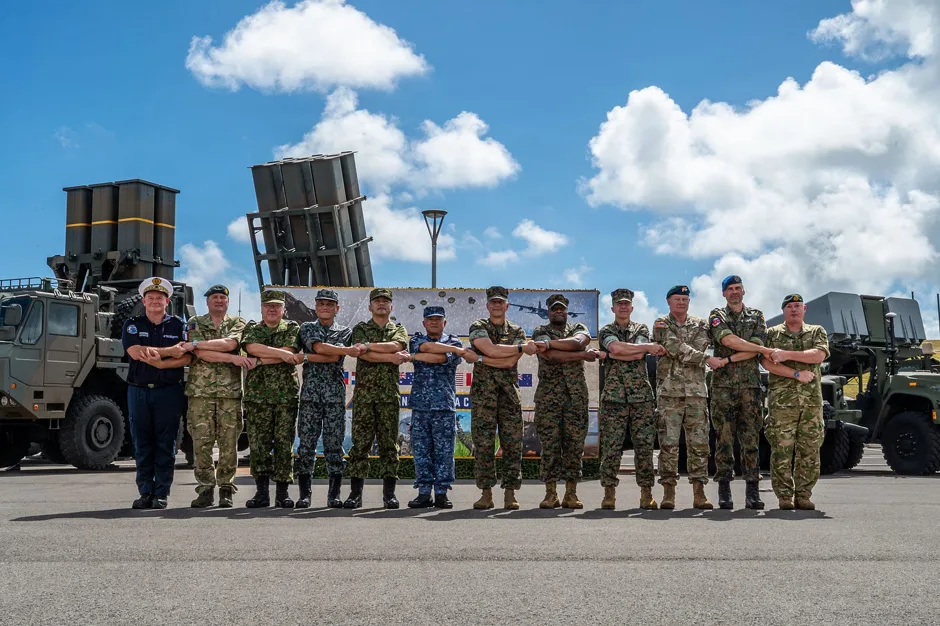
(Leaders from various countries at Opening Ceremony of US-Japan Joint Exercise ‘Keen Sward 2027. Image Source; US DoD)
US Freedom of Navigation Operations in South China Sea
On 20 Oct 2026, USS Charleston sailed close to Sabina Shoal /Xianbin Jiao in Spratlys. The PLA’s Southern Theatre Command Navy spokesperson called it an infringement on China’s sovereignty and announced that PLAN had despatched forces to track and monitor the movement. The US State Department rejected the claim and informed that US will operate wherever international law permits, including South China Sea under the right to freedom of navigation.
Stand-off Along the LAC between India and China
In a recent address, DG ITBP, Mr Shatrujeet Singh Kapur confirmed that face-offs between the PLA and Indian Security Forces were continuing at multiple locations in Arunachal Pradesh. The Indian MEA Spokesperson in his media briefing on 23 Oct 2026 replied that the situation along the LAC gets disturbed when Chinese troops depart from established patrolling patterns and that both sides were utilising existing military and diplomatic mechanisms to resolve outstanding issues. (Dainik Bhaskar. 23 Oct 2026. ITBP Chief confirms face-off with China in Arunachal Pradesh; Focus on drone force to prevent repeat of Galwan—Statement made 7 days before retirement (ITBP चीफ बोले- अरुणाचल में चीन से झड़पें हुईं:गलवान रिपीट न हो इसलिए फोकस ड्रोन फोर्स पर, रिटायरमेंट से 7 दिन पहले बयान). MEA, India. Transcript of Bi-Weekly Media Briefing by the Official Spokesperson (October 23, 2026))
Operations
East China Sea
PLA flew four Y-9 sorties and two UAV sorties during the week. Of this TB-001 sortie flew between Taiwan and Taketomi Island to East of Japan and flew parallel to Japan’s coast line and then returned to the mainland through Miyako Straits. (Source: https://x.com/JapanJointStaff?s=20)
Taiwan Straits
PLA aircraft flew a total of 49 sorties this week of which 24 crossed the Median Line. 29 sorties were flown on 20 Oct 2024 which included J-10, J-11, J-16, JH-7, H-6, and KJ-500 aircraft. Of these, 23 out of sorties crossed the median line, entered Taiwan's Northern, Central, and SW ADIZ and subsequently flew to the Western Pacific for joint air-sea training and long-distance flights. No sorties were flown from 21 to 24 Oct 2026. PLAN and Chinese official ships continued to operate adjacent to the waters of Taiwan with a maximum of 6 PLAN and 9 official ships on 21 Oct 2026. (Source: https://x.com/MoNDefense?s=20)
Combat Theory
Developing Military Governance
A PLA Daily Editorial highlights the criticality of Military Governance (军事治) in modern warfare. While Military Governance parallels administration in other armed forces, it encompasses a larger scope within the PLA. The editorial calls for synergy between strategic planning and reforms; the need for a robust framework of laws and regulations to govern and synergise interconnected operational elements, operational tempo, precise management, and complex coordination of forces in a multi-dimensional, all-domain operational environment; and to ensure power is exercised in accordance with the law. Contrasting the success of PLAN’s aircraft carrier Fujian and handling of the Shenzhou-20 crisis, with problems faced by USS Gerald R. Ford, the editorial highlights that the same is due to fundamental differences in governance, including system design, operational maintenance, and personnel management and calls for systemic development, institutional innovation, and meticulous management. (PLA Daily. 21 Oct 2026. Page 7. Victory in Warfare depends on Sound Governance(兵以治为胜))
Multi-Domain Operational Logistics
Wei Yijun and Chen Yonglong draw logistic lessons from Northern Desert Campaign (漠北之战) in 119 BCE in which the Han Army traversed the vast Gobi Desert into the heartland of Xiongnu, for modern day multi-domain warfare. By strategic pre-positioning, relay supply chain, region-specific allocation of resources, and capturing enemy supplies, the Han Army overcame the operational dilemma of deep penetration into the Gobi Desert leading to exhaustion and depleted supplies. The authors utilise the lessons from the campaign and call for leveraging Big Data and AI to analyse consumption patterns across domains and optimise the location and quantum of pre-positioned reserves; leveraging IoT to create a three-tiered distributed logistic network comprising of intelligent warehouses, unmanned relay nodes and forward mobile support to achieve a resilient, multi-domain support system; creating a domain specific customised support and delivery system; and intelligent sensing to identify and exploit (enemy) battlefield resources for own use. (PLA Daily. 18 Oct 2026. Page 6. Prioritising Logistics for a Decisive Victory (保障先行 决胜千里))
Warfare in LEO
The week’s Global Military Review was written by researchers from Space Engineering University and focused on warfare in LEO. Feng Songjiang* and Wang Xiaoyan* highlight that LEO constellations are reshaping warfare due to their growing integration into operational and tactical levels, reduction in time between sensing, deciding and shooting to minutes, and expansion of operational range of unmanned systems. Pointing out that major powers are focused on building multi-layered counter measures including electronic jamming, kinetic ASAT and targeting ground segment. they assess the need for a new Space Security Order which increasing use of AI, systemic resilience, and the need to restructure Global Space Governance. In another article, Wang Xiaoyan* and Chen Ning** call for new approach to target large constellations in the LEO such as Starlink, which are costly and difficult to target owing to their number, widespread distribution and manoeuverability. Citing US’ Space Operating Environment 2040 and Ukraine’s strike against Progress Rocket Space Centre, they call for targeting ground segment owing to their high cost and long replacement time. In defence, they suggest integrated defence of ground and space assets.(PLA Daily. 19 Oct 2026. Page 8. Offensive and Defensive operations in LEO Constellations move to Battlefield(低轨星座攻防加速走向战场). “Controlling Space from the Ground”: An Effective Approach to Countering LEO Constellations (“以地制天”成为反低轨星座有效途径)
*Researchers at Space Security Research Centre of Space Engineering University.
**Researcher and PhD Candidate at Space Engineering University
The first article highlights that LEO has an upper limit of 1,00,000 satellites and that 12,000 satellites are already in place. The article is of course silent about Chinese plans for LEO. As of Dec 2025, China had filed plans for 154 constellations comprising more than 2,00,000 satellites in LEO. Under the ITU’s rules, China must launch its first satellite within seven years, 50 per cent within 12 years and the remaining within 14 years. The other competition is in terms of radio spectrum. Successful occupation of slots as well as the spectrum will deny the same to other countries. While the huge number of satellites planned seems impractical, China is ramping up assembly line production of satellites and rockets and enhancing launch capabilities in a manner not seen before. As the SMS 2020 puts it, Space Dominance is the key to winning future wars, which emphasises the importance of Space in the PLA’s scheme of things.
Training
A PLA Daily article covers current focus of PLA Rocket Force exercises - achieving successful completion of missile launch tasking under battlefield conditions and validating streamlining of procedures within brigades. Over a 24 hour cycle, launch crews were exercised in more than a dozen extreme contingencies including vehicle damages, precision strikes on launch positions and several crew members ‘killed/severely injured’. The brigade adapted to these contingencies by reorganising personnel from three launch battalions to create launch crews under a unified command structure and redeploying them successively to complete the missile launch tasking. The article also covers the standardisation of operational protocols and drills and familiarity of launch crews with peculiarities of launch positions across the complete brigade. (PLA Daily. 21 Oct 2026. Page 8. Three Launch Battalions shouldering a Single Mission(3个发射营,同扛“一杆枪”))
The article highlights the focus on refinement / upgradation of launch crew capabilities. Over the past decade, the content and tone of articles in the PLA Daily have changed with the current articles suggesting a confidence in capabilities. The article also covers some of the characteristics of this particular missile - prolonged launch sequence, multiple equipment components and need for complex specialisation. In addition, the equipment performed differently at different launch locations and along with varying levels of operator experience added to the complexity. While I am unable to identify the type of missile or the brigade which is located in the central plains, at present, this information could help to identify the equipment and the brigade in the long run.
Are PLA’s Ground Operations becoming Slow-paced?
Two PLA Daily articles cover two-sided tactical exercises at an unidentified tactical base* highlights experiments in warfighting by an unidentified brigades of CTC. Instead of fast paced operations, the focus is on commanders at all levels to independently conduct multi-domain reconnaissance, fuse data with data received from higher HQ, assess the situation and decide on how to engage the enemy in smaller teams along multiple approaches. The brigade commander pointed out that old methods of fighting are obsolete and it was essential for all ranks to be slow, deliberate and focus on refining tactics at the squad, platoon and company levels. In the second exercise conducted at the base of Yanshan ranges, another unidentified brigade spent six hours on the exercise covering 13 scenarios and 37 tactical challenges and one and half days carrying out After Action Review. Some of the lessons learnt include slow decision making resulting in destruction of tank by enemy, (unmanned?) ammunition vehicle losing contact due to Electronic Magnetic Interference and poor coordination with flanking units during assault. (PLA Daily. 20 Oct 2026. Page 8. This Battle proved rather “Protracted”(这一仗,打得有点“冗长”). Six Hours of Exercise, One and Half days of After-Action Review(演练六小时 复盘一天半))
The articles along with others suggests that PLA has recommenced brigade level exercises. In the first exercise likely to have been held at Zhurihe, three different units suffering heavy setbacks at a particular position previously, suggests that the BLUFOR has free conduct of the exercise. In the second exercise, the BLUFOR unit was performing the role of OPFOR for the first time unlike Zhurihe where 195 Heavy Combined Arms Brigade has been performing the role for BLUFOR. Assessment of the articles suggests that the PLA brigades have attained reasonable amount of proficiency in tactical operations and are now focused on refining/upgrading their tactical and technical proficiencies.
Naval Aviation Regiment carries out Three Cargo drops in Single mission
An unidentified Naval Aviation Regiment carried out three cargo air drops in a single pass recently. The three cargo platforms were of different types and together weighed several tons. The drop was conducted in a lake surrounded by several mountains. The After Action Review identified the need to refine adjusting to low-altitude turbulence and improve coordination amongst aircrew. According to the article, this is the first time multiple platforms have been dropped in a single pass. (PLA Daily. 24 Oct 2026. Page 3. Heavy Cargo “drops from the skies”(重装物资“从天而降”))
Organisation and Equipment
Developments in an SSN Unit
A PLA Daily article covers some of the developments in an unidentified nuclear submarine unit. Since being inducted with a new type of submarine, the unit made 500 suggestions for improvement. Over the years, the challenges overcome during operation of this particular type of submarine include malfunction in one of the compartments necessitating a check of pipelines, electrical circuits and control panels, replacement of critical equipment while remaining submerged, a critical situation involving a torpedo tube and water leakage through access hatch. The unit has also developed an Innovation Research Laboratory which acts as a digital battlefield incorporating hydrography, which has provided data for more than a dozen major research projects. Created by collaborating with naval academies and defence industry, the platform incorporates Big Data and AI and acts as a direct link between research institutions and operational platforms. (PLA Daily. 20 Oct 2026. Pages 1 & 2. Forging the Nation’s “Underwater Shield”(锻造共和国“水下盾牌”))
Going by the article’s highlight that Xi Jinping had visited the unit in June 2018 and based on analysis of CGTNs coverage of Xi’s visit, the unit is based in Qingdao and is equipped with Type 93B SSNs - Long March 15 and 16. The number of problems reports suggests that there are design issues/quality control problems with the Type 93B (Shang Class) submarine. The operationalisation of Innovation Research Laboratory is in sync with what has been observed with other services and TCs, where digital twins of operational platforms and environment are used for obtaining environmental data and experimenting with new concepts before being implemented during operations and training. Atleast some of this data is shared with academia and industry for development/refinement of concepts and equipment.
Reorganisation of Artillery Company
Analysis of a PLA Daily article suggests that an unidentified artillery company of Eastern Theatre Command was reorganised and reequipped with new system, last year. Going by the picture in the article, the company is equipped with PHL-13 MLRS. After initial hiccups such as failures during a operational readiness validation and a major exercise, the unit carried out an After Action Review and focused on developing coordination capabilities such as command procedures, combat grouping, fire distribution, and ammunition support. The measures paid off and the unit was awarded a collective second-class merit within a year of its establishment. (PLA Daily. 19 Oct 2026. Page 2. Footsteps of the Charge, Tracks of Growth(冲锋的脚步 成长的足迹))
In the past few months, atleast two cases of reorganisation of units in the past one year, have been reported. It remains to be seen if these are isolated cases or there is an ongoing reorganisation. While the number of MLRS in the company is not known, there are atleast six squads with the squads being deployed in pairs. The unit had participated in 17 joint exercises and 4 operational readiness validations by the Theatre Command suggesting that this is possibly a Theatre Command unit. Another aspect is the units figuring out exploitation of new equipment by themselves with minimal coordination by Staff at higher levels.
Innovation
NCO Innovators
PLA Army recently recognised 97 NCOs who collectively hold 1,164 patents, as “Army Craftsman” (工匠型). The article suggests that the PLA Army commenced the processes of developing innovators in critical areas, emerging technologies and urgent operational requirements in 2022, though appropriate policies, professional platforms and funding. 19 high-technology laboratories have been established which are fully equipped with learning resources, material and equipment. Some of the innovations highlighted include tools for maintaining artillery guns, equipment for cleaning barrels and an AI-based software for to reduce the training cycle of elite marksmen. (PLA Daily. 18 Oct 2026. Page 1. Army’s Initiative to cultivate “Craftsman-Style” NCOs yields fruit (陆军“工匠型”军士人才培养硕果累累))
HADR
Earthquake
On night of 22/23 Oct, an earthquake measuring 7.0 on Richter Scale hit Baqen County, Nagqu City, Tibet. The State Council’s Earthquake Relief Headquarters and Ministry of Emergency Management activated Level IV national emergency response for earthquake disasters and subsequently upgraded it to Level III. More than 5,000 personnel were deployed for relief operations. The PLA’s WTC activated emergency response while TMD activated its earthquake relief plan. Two drones were deployed by PLAAF for aerial reconnaissance and risk assessment while other assets remained on standby. Personnel from Nagqu Military Sub District and Nagqu Detachment of PAPF and militia were deployed to rescue victims. clear roads and erect tentage. A field medical team of PAPF and rescue team from Xining Joint Logistic Support Force were on standby. (PLA Daily. 24 Oct 2026. Page 1. Conduct Rescue Operations professionally to reduce casualties (科学实施救援 尽最大努力减少人员伤亡). PLA, PAPF and Militia deploy Rapidly for Rescue Operations (解放军和武警部队官兵、民兵迅速投入救援))
International Cooperation
48th Escort Task Force Returns
The 48th Escort Task Force comprising of Type 52DL destroyer Tangshan (Hull No 122), Type 54A frigate Daqing (Hull No 576), and Type 903A replenishment ship Taihu (Hull No 889), returned to Qingdao after completing its escort mission in the Gulf of Aden on 23 Oct 2026. The PLA Daily informed that the task force had safely escorted 423 Chinese and foreign vessels and participated in joint maritime exercise “Peace Will 2026” joint maritime exercise with South Africa and Pakistan and the China-Pakistan Joint Exercise “Sea Guardians 4”. The task force also participated in the 50th Anniversary Celebrations of Seychelles’ independence, conducted friendly visits to Bangladesh, Myanmar, and Malaysia and made technical port calls in Oman, Kenya, and Singapore to strengthen traditional friendships and strategic trust with these nations. (PLA Daily. 24 Oct 2026. Page 4. 48th Chinese Naval Escort Task Force returns to Qingdao after completing of Mission (中国海军第48批护航编队完成任务返回青岛) Global Times. 25 Oct 2026. Far-sea capabilities on display as China's 48th naval escort formation completes record Gulf of Aden mission)
2026 Western Pacific Naval Symposium Medicine Seminar organised
The 2026 Western Pacific Naval Symposium Medicine Seminar was organised at Shanghai on 21 and 22 Oct 2026. The seminar held on the theme “Maritime Medical Service in the AI Era: Challenges and Solutions” brought together more than 100 delegates from 16 Western Pacific countries. 18 topical discussions organised into four areas - maritime disaster medicine and emergency rescue, medical support for submarine rescue, maritime medical support and casualty care, and training of maritime medical services - were held. The conference aims to strengthen cooperation in martime medical rescue. (PLA Daily. 23 Oct 2026. Page 3. 2026 Western Pacific Naval Symposium Medicine Seminar held at Shanghai(2026年西太平洋海军论坛医学研讨会在上海举办))
China organised Drone Course for UN Peacekeepers
The Peacekeeping Affairs Center of China’s MND and Air Force Engineering University, organised a drone course for UN peacekeepers at Xi’an in Shaanxi Province from . The training was aimed at improving the capacity of participating countries to employ drones in UN peacekeeping operations in a professional and efficient manner. The curriculum includes modules on UN Peacekeeping framework, code of conduct, deployment and utilization of drone units in peacekeeping missions, and counter-drone technologies and their application and covering 31 topics including principles of drone employment during UN peacekeeping, deployment, command and control, and safety aspects. The participants included personnel from UN and eight countries including Algeria, Malaysia, and South Africa. (PLA Daily. 21 Oct 2026. Page 4. UN Peacekeeping Drone Training Course Begins in Xi’an(联合国维和无人机培训班在西安开训))
That is all for this week, folks. Have a nice weekend.
Tags
.png)
Author
Colonel KK Venkatraman (Retd.)
Colonel KK Venkatraman (Retired) was commissioned in the Indian Army in December 1997. An alumnus of the Defence Services Staff College, Wellington, he has served extensively in Counter Terrorist Operations in Jammu and Kashmir, Counter Insurgency Operations in Assam and along the Line of Actual Control in the Eastern Theatre. He has served in General Staff appointments in the Eastern, Central and Northern theatres. While in service, the author was part of an in-service Study Group on “Teachings of Sun Tzu and its impact on Modern Day Polity, Society and Psyche” which piqued his life-long interest in China Studies. He holds an MPhil in Defence and Strategic Studies from Punjabi University, Patiala. His MPhil dissertation entitled, “International Dynamics of China’s Belt and Road Initiative (BRI): An Analytical Study”, analyses the BRI and its impact at the global, regional and national levels. He is currently pursuing his PhD in International Affairs at OP Jindal Global University, Sonepat, where he is working on China’s Holistic Approach to National Security. Previously, he was Research Fellow at Institute of Chinese Studies, New Delhi where he researched on ‘Application of Artificial Intelligence by PLA and its Implications on Warfighting’. The officer was NASC Fellow (Non-Resident) of 2023 and 2024 cohorts at The Takshashila Institution, Bengaluru where he researched on the PLA’s Western Theatre Command and the PLA Army Aviation respectively. He is a mentor at Atma Nirbhar Soch, independent think tank on Strategic Studies, and has delivered guest lectures at Takshashila Institution, Bengaluru and Delhi University. His weekly newsletter titled, “Tracking the PLA” covers happenings in the People’s Liberation Army of China.