
The Quad's Critical Minerals Strategy: Can India Break China's Grip on Defence Supply Chains?
The Quad's renewed commitment to securing critical-mineral supply chains marks an important development in the strategic competition between China and the Indo-Pacific's major powers. At their meeting in Atlanta on 31 October 2026, the foreign ministers of India, Australia, Japan and the United States reaffirmed their opposition to economic coercion and arbitrary export restrictions while announcing further cooperation on mineral recovery and recycling. The meeting also welcomed a US commitment of $10 million to support facilities in India and ASEAN countries for recovering critical minerals from waste. This builds upon the Quad Critical Minerals Initiative Framework adopted in May 2026, which envisages mobilising up to $20 billion in public and private support for diversified supply chains. These commitments demonstrate growing recognition that control over specialised industrial materials can translate into strategic leverage over technologically advanced economies and their defence-industrial bases.¹ ²
The immediate significance of this cooperation has been reinforced by China's export-control policies. On 9 November, Beijing extended the suspension of certain expanded rare-earth restrictions until 10 January 2027. However, earlier controls covering seven rare-earth elements remain in effect. The distinction matters because the latest suspension may ease some commercial uncertainty without substantially changing China's capacity to influence international supply chains.³ ⁴
China's advantage is not confined to its mineral deposits. According to the International Energy Agency, China accounted for approximately 60 per cent of global magnet rare-earth mining in 2024, but 91 per cent of refining and 94 per cent of sintered permanent magnet production. The concentration of these downstream capabilities gives Beijing considerable influence over materials used in precision motors, aerospace systems, military electronics and numerous other strategic technologies.⁵
For India, the challenge is particularly significant. Its expanding defence-industrial ambitions depend on imported specialised materials and components even as domestic manufacturing capabilities improve. In July 2026, the government acknowledged that India continued to import its entire requirement of sintered neodymium-iron-boron permanent magnets, despite possessing upstream rare-earth capabilities. This dependence illustrates the distinction between possessing mineral resources and controlling the technologies required to convert them into militarily useful components.⁶
CNAWS assesses that the Quad's critical-minerals strategy could reduce China's long-term economic and strategic leverage, but only if cooperation moves beyond mineral extraction and diplomatic commitments towards commercially sustainable refining, metal production, advanced manufacturing and assured industrial procurement. India could become an important manufacturing and processing centre within such a network. However, this requires overcoming substantial technological, financial and institutional constraints. The immediate strategic objective should not be the complete elimination of Chinese inputs, which is unlikely in the foreseeable future, but the creation of sufficient alternative capacity to ensure that foreign restrictions cannot readily interrupt essential military production.
1. The Strategic Context: Supply Chains Become Instruments of Geopolitical Power
The strategic importance of critical minerals is often explained through the increasing demand for electric vehicles, renewable energy equipment and consumer electronics. Although these industries account for much of the commercial demand, the national-security implications extend considerably further. The same industrial ecosystem supplies the materials required for high-performance motors, radar electronics, aerospace components, precision-guided munitions and specialised military equipment. Consequently, a disruption originating in the civilian mineral economy can affect defence manufacturing even when military products are not the direct targets of trade restrictions.
This introduces an important dimension to contemporary economic warfare. Traditional coercive instruments such as sanctions, financial restrictions and energy embargoes generally attempt to impose costs by withholding access to markets, capital or fuel. Critical-mineral restrictions can produce a different effect by interrupting relatively small industrial inputs upon which the production of considerably more valuable systems depends. A shortage of a specialised material may have limited significance in terms of its monetary value but substantial consequences if manufacturers cannot obtain a qualified substitute. The resulting vulnerability is determined by the material's function within the production process rather than its share of the finished product's overall cost.
China is particularly well positioned to exploit this form of industrial dependence because of the integration it has achieved between mineral processing, refining, metallurgy and component manufacturing. Its industrial strength has developed over several decades through investment in processing technology, manufacturing scale, specialised expertise and domestic demand. Other countries may possess commercially attractive mineral deposits, but this does not automatically provide them with independent supply chains. In several critical-mineral markets, material extracted outside China must still pass through Chinese processing facilities before becoming suitable for advanced manufacturing.
The political significance of this arrangement became especially apparent in April 2025, when China introduced licensing controls on seven rare-earth elements and associated products. The International Energy Agency subsequently documented how disruptions to the availability of permanent magnets affected manufacturers in several major economies, with some automotive facilities reducing production or temporarily suspending operations. The episode demonstrated that control over specialised industrial inputs could affect manufacturing activities well beyond China's borders.⁵
In October 2025, Beijing announced considerably broader restrictions, including provisions covering certain products manufactured outside China using Chinese-origin rare-earth materials or associated technologies. Their implementation would have extended China's regulatory influence much further into international supply chains. These expanded restrictions were subsequently suspended, with the suspension extended on 9 November 2026. However, the earlier licensing regime was not similarly eliminated. The result is a supply environment in which temporary commercial relief coexists with a structural dependence on Chinese industrial capacity.
For India, the significance of these developments is intensified by the possibility of simultaneous geopolitical and industrial pressures. During a period of military tension with China, New Delhi's ability to sustain defence production would depend not only on the preparedness of its armed forces but also on the availability of specialised industrial inputs. This does not establish that Beijing has decided to use mineral restrictions against Indian defence manufacturers. Rather, China's market position creates a potential instrument of pressure whose relevance increases during periods of strategic confrontation.
The Quad's critical-minerals initiative should be understood against this background. It is an attempt to reduce the ability of concentrated suppliers to influence the economic and industrial choices of other states. Its strategic importance lies in strengthening the material foundations of national power rather than establishing a conventional military mechanism directed against China.
2. China's Real Advantage Lies Beyond the Mine
The concentration of Chinese influence becomes clearer when the rare-earth supply chain is examined as a sequence of distinct industrial processes. Extraction produces mineral-bearing material, but this must undergo beneficiation, chemical separation, conversion into high-purity oxides, reduction into metals, alloying and finally the manufacture of specialised components. Each stage requires different technologies and infrastructure, while the transition from purified oxides to high-performance magnets presents particularly difficult technical and commercial challenges.
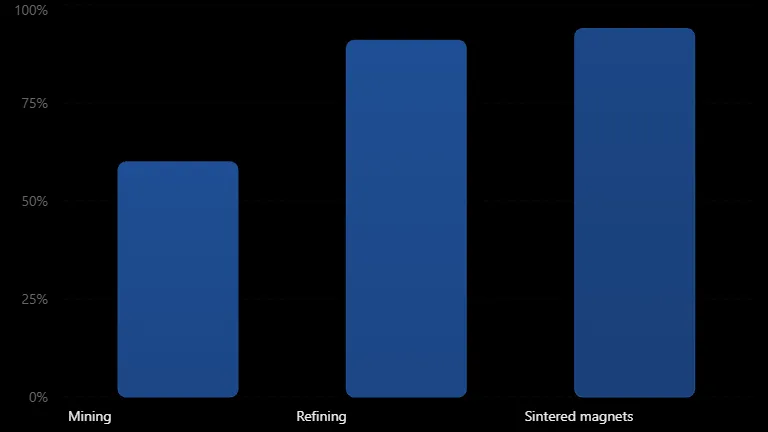
China's share of the global magnet rare-earth supply chain
2024 data, published by the International Energy Agency in April 2026
IEA figures refer specifically to magnet rare earths and sintered permanent magnets, not the entire critical-minerals sector.
The disparity between mining and manufacturing reveals the fundamental weakness in many diversification strategies. Even if alternative mineral production expands substantially, dependence may persist unless corresponding processing and manufacturing capacity is created. The IEA's 2026 assessment estimates that existing and announced capacity outside dominant suppliers will remain insufficient to meet projected demand through 2035. For magnet rare earths, diversified mining capacity could exceed 50,000 tonnes of rare-earth content, while planned refining capacity remains below 40,000 tonnes and downstream metals, alloys and magnet production is much more limited.⁵
This imbalance is not merely a consequence of insufficient financial investment. Rare-earth separation requires specialised chemical expertise, stable industrial processes and management of environmentally hazardous residues. Magnet manufacturing introduces additional challenges involving metallisation, alloy composition, microstructural control and precision manufacturing. The resulting products must satisfy performance specifications that vary according to temperature, vibration, corrosion resistance and other operating conditions. Establishing facilities capable of producing commercially acceptable material is therefore substantially more demanding than constructing basic processing infrastructure.
The economics are equally restrictive. The IEA's Global Critical Minerals Outlook 2026 estimates that capital costs for refining projects outside established dominant suppliers can be between 20 per cent and more than 150 per cent higher, while operating costs average approximately 50 per cent higher. These disadvantages arise from differences in industrial scale, equipment availability, technical expertise, energy costs, infrastructure and access to feedstock. Furthermore, projects must compete with suppliers that already possess established customer relationships and extensive production experience.⁷
China's position gives it several mutually reinforcing advantages. Its processing companies benefit from relatively large production volumes, while domestic manufacturers provide sustained demand for refined materials and advanced components. This scale helps support further investment in technology and manufacturing efficiency. New entrants face the opposite problem. A processing plant may struggle to secure customers without demonstrating reliable production, while customers may hesitate to sign long-term contracts before the plant is commercially established. Financial institutions consequently confront significant investment risks.
There is also a more subtle form of dependence embedded in production equipment and technical knowledge. Processing facilities outside China may require specialised machinery or technical inputs that remain concentrated among a small number of suppliers. Even a country that secures alternative mineral deposits and financing could encounter difficulties establishing production if equipment, proprietary processes or qualified technical personnel are unavailable.
The strategic implication is that the Quad cannot substantially reduce Chinese leverage by focusing predominantly on mineral exploration and extraction. Its most valuable investments will likely be those that create reliable midstream and downstream capabilities, particularly separation, refining, metal conversion and magnet manufacturing. These are the stages at which relatively limited quantities of specialised materials can exercise an outsized influence over sophisticated military and civilian production.
3. The Defence-Industrial Dimension: Why Small Material Shortages Matter
The military significance of critical minerals is best understood through their role in enabling particular technological functions. Modern weapons systems require components that provide high magnetic strength, precise electromechanical control, efficient power conversion, specialised sensing and reliable performance under demanding operating conditions. The materials supporting these functions may represent only a small fraction of the cost of the completed platform, but their absence can interrupt production if a qualified substitute is unavailable.
Rare-earth permanent magnets provide a particularly clear example. Neodymium and praseodymium form the basis of powerful neodymium-iron-boron magnets, while dysprosium and terbium can improve their resistance to demagnetisation at elevated temperatures. These characteristics are valuable in compact motors, actuators, generators and precision control systems. Samarium-cobalt magnets serve another category of demanding applications, particularly where thermal stability is important. The United States Department of Defense has identified rare-earth magnets in military systems including the F-35 fighter aircraft, Tomahawk cruise missiles, Virginia-class submarines, radar systems and unmanned aircraft.⁸
This does not mean that every weapons system requires identical magnet compositions or quantities. Material requirements vary substantially according to design, performance specifications and available substitutes. Nevertheless, these examples illustrate how specialised components become embedded in technologically advanced military platforms and why the industrial capacity to manufacture them matters.
The vulnerabilities extend beyond rare-earth magnets. Gallium is relevant to compound semiconductors such as gallium nitride and gallium arsenide, which have important applications in radio-frequency electronics, radar and communications. Germanium is used in specialised optical and semiconductor applications, including infrared systems. Tungsten has applications in high-density components, wear-resistant materials and certain munitions, while other critical materials support aerospace alloys and advanced electronic manufacturing. These are distinct mineral supply chains, and securing rare-earth production alone would not resolve their vulnerabilities.
Material or group | Selected defence-related applications | Principal supply-chain concern |
|---|---|---|
Neodymium and praseodymium | High-performance magnets for motors, actuators and generators | Conversion of oxides into metals, alloys and magnets |
Dysprosium and terbium | Improved high-temperature performance of selected magnets | Concentrated separation, refining and limited alternative supply |
Samarium and cobalt | Thermally stable magnets for demanding equipment | Specialised metallurgy, manufacturing and qualification |
Gallium | GaN and GaAs radio-frequency components used in radar and communications | High-purity refining and specialised semiconductor processing |
Germanium | Infrared optics and specialised electronics | Concentrated processing and optical-grade material supply |
Tungsten | High-density components, tooling and selected munitions | Concentrated processing and qualified industrial products |
Applications represent established material uses and do not establish the material composition of specific Indian military platforms. Sources include the IEA's 2026 critical-minerals assessments and US Department of Defense industrial-base reporting.
The operational consequences of a material shortage would depend on its duration, available inventories, production requirements and the ability of manufacturers to source alternatives. A short disruption might be absorbed through existing stocks or changes in procurement. A prolonged disruption could become more serious if essential components cannot be manufactured or replaced at the rate required to sustain military operations.
This creates a distinction between maintaining an existing military inventory and replenishing that inventory during a prolonged confrontation. A country may possess sufficient weapons and equipment for initial operations while its manufacturing system remains vulnerable to restrictions affecting replacement components. The consequences would emerge through delayed deliveries, reduced production flexibility, higher costs and difficulties in sustaining equipment availability.
For India, the issue is relevant to its expanding missile, aerospace, air-defence, naval and unmanned-systems industries. These sectors depend on sophisticated electronic and electromechanical components, while the government's indigenisation policies seek to increase domestic production and reduce dependence on imported equipment. However, domestic manufacture of the final platform does not necessarily establish independence from foreign inputs. An Indian supplier may assemble a component domestically while importing the underlying magnetic material, semiconductor device or specialised alloy.
This distinction becomes particularly important during a crisis involving China. The vulnerability would not necessarily be direct Chinese ownership of an Indian defence supplier. It could instead arise several tiers below the principal contractor, where an intermediate component or material originates in a Chinese-controlled supply chain. Procurement from a third country would not automatically eliminate this exposure.
At the same time, such vulnerabilities should not be exaggerated. Open-source information does not establish that India's principal missile or air-defence programmes would become inoperable following a specific Chinese mineral restriction. Defence manufacturers may possess stockpiles, alternative suppliers or qualified substitutes that are not publicly disclosed. The stronger analytical conclusion is that these material dependencies constitute a potential defence-industrial risk requiring systematic assessment, rather than evidence of an immediate operational deficiency.
The broader lesson is that military industrial resilience must be assessed according to the ability to sustain production under restricted supply conditions, not solely through the percentage of indigenous content in completed weapons systems.
4. What Has the Quad Actually Committed?
The Quad's critical-minerals cooperation has progressed through several distinct stages. The initiative announced in July 2025 established the political basis for coordination on mineral supply chains. In May 2026, the four countries adopted a more detailed framework covering investment and project development, regulatory cooperation, technology-related capacity building and mineral recovery from waste. The framework envisages mobilising up to $20 billion in government and private-sector support through new and existing activities. It includes potential instruments such as development financing, loans, guarantees, equity investment, insurance and long-term purchasing arrangements.²
The scale of this proposed mobilisation is important, but it must be interpreted carefully. The framework does not constitute a $20 billion jointly funded defence-industrial programme, nor does the announcement establish that the full amount has been committed to identified projects. It is an intended mobilisation target across critical-mineral activities, including mining, processing and recycling. Consequently, its strategic significance will depend on the projects that eventually receive financing and the industrial capabilities they develop.
The 31 October meeting introduced a more specific development. The ministers welcomed the US commitment of $10 million for infrastructure and facilities in India and ASEAN countries to recover critical minerals from waste. They also supported private-sector investment in collection networks, processing facilities and refineries while discussing the possibility of simplifying procedures governing cross-border movements of recyclable materials.¹
This approach indicates that the Quad is seeking to diversify supplies through both primary extraction and secondary recovery. The latter is important because discarded electronics, industrial scrap and retired equipment can contain recoverable quantities of strategically valuable materials. Establishing collection and processing networks could supplement imported mineral supplies while helping create regional industrial capabilities.
However, the $10 million commitment should not be confused with financing for a comprehensive rare-earth refining industry. The October statement did not announce a fully operational processing network, identify all beneficiary facilities or establish that the funding had already been disbursed. Its immediate significance is that the Quad has identified recycling infrastructure in India and Southeast Asia as a practical area of cooperation.
The choice of India and ASEAN is strategically noteworthy. Southeast Asia contains important mineral resources, industrial manufacturing centres and growing electronics markets. India has an expanding industrial base and ambitions to become a significant producer of advanced materials and manufactured products. Closer coordination between these economies could create alternative regional pathways for recovering, processing and consuming strategic materials.
Recycling nevertheless has limitations. The recovery of rare-earth elements from discarded equipment requires efficient collection, sorting, dismantling and specialised processing. The economics depend on the composition of available waste streams, recovery rates and the quality required by manufacturers. In particular, recycled material must still be converted into products meeting relevant industrial specifications. A recycling facility does not automatically eliminate dependence on foreign refining or magnet manufacturing.
The Quad's potential value therefore lies in connecting financing, technology, industrial demand and diversified material flows. The framework permits such cooperation, but it has not yet created a unified Quad supply chain. Its effectiveness should be assessed through subsequent project awards, commissioned facilities, verified output and the commercial relationships established among participating companies.
5. India's Critical Mineral Position: Abundant Resources, Limited Industrial Conversion
India occupies an unusual position within the critical-minerals economy. It possesses a substantial rare-earth resource base, has developed domestic capabilities in mineral separation and oxide refining, and operates an expanding industrial economy. Nevertheless, the country continues to depend heavily on imports for several downstream products required by sophisticated manufacturing industries. This contradiction is central to understanding both India's vulnerabilities and the opportunities presented by Quad cooperation.
According to information submitted to Parliament in April 2026, India's Atomic Minerals Directorate for Exploration and Research had identified approximately 7.23 million tonnes of rare-earth oxide equivalent within 13.15 million tonnes of monazite deposits. Additional rare-earth resources have been identified in hard-rock formations in Gujarat and Rajasthan. However, the existence of these resources does not establish their immediate commercial availability. Monazite is associated with thorium, making extraction and processing subject to significant technical, environmental and regulatory considerations. The government has also acknowledged that low grades, restrictions affecting coastal and environmentally sensitive areas, and limited downstream industrial capacity constrain commercial exploitation.⁹
The composition of the resource base is another important consideration. Rare-earth deposits contain different proportions of individual elements, and the availability of abundant light rare earths does not automatically ensure adequate supplies of the heavy rare earths required for particular high-performance magnets. Consequently, even with expanded domestic extraction, India may still need to secure specific materials through overseas partnerships. The appropriate strategic objective is therefore dependable access to the complete range of required inputs rather than mineral self-sufficiency defined solely by geological reserves.
India's dependence becomes especially visible in the permanent magnet industry. A government assessment published in February 2026 stated that China accounted for approximately 85–90 per cent of India's permanent magnet imports by quantity during 2022–25. More importantly, the Ministry of Heavy Industries informed Parliament in July that India imported its entire requirement of sintered neodymium-iron-boron magnets because industrial-scale capabilities for converting rare-earth oxides into metals, alloys and finished magnets remained insufficient.⁶ ¹⁰
The July assessment, undertaken by IREL (India) Limited, the Defence Metallurgical Research Laboratory and the Bhabha Atomic Research Centre, projected India's consolidated permanent magnet demand at 8,220 tonnes annually by 2030. This requirement includes demand from electric vehicles, industrial motors, consumer electronics, wind turbines and other applications. The assessment demonstrates that demand for high-performance magnets is likely to expand significantly as India's industrial economy develops. It does not, however, provide an independently verified breakdown of the quantity required by specific defence programmes.
The policy response has become more substantial since 2025. The National Critical Mineral Mission, approved in January that year, includes planned government expenditure of ₹16,300 crore and expected investment of ₹18,000 crore by public-sector undertakings and other participants over seven years. Its activities cover exploration, mining, processing, recycling and overseas resource acquisition.¹¹
A separate ₹7,280 crore scheme approved in November 2025 seeks to establish 6,000 tonnes per annum of integrated sintered rare-earth permanent magnet manufacturing capacity. The programme is designed to support conversion from rare-earth oxides to metals, alloys and finished magnets. Its financing includes sales-linked incentives and capital subsidies, with production capacity intended to be allocated among selected manufacturers through competitive bidding.¹²
The proposed capacity is commercially significant, but its relationship with projected demand illustrates the limits of the scheme. Even if the entire 6,000-tonne annual capacity is commissioned and operates at its intended output, it would remain below the government's projected 2030 requirement of 8,220 tonnes. Domestic production would also need to meet the grades, technical specifications and delivery requirements of different users. Installed capacity alone would not ensure that every application could be supplied domestically.
The latest procurement developments make this an especially relevant issue for a November 2026 assessment. On 13 August, the Ministry of Heavy Industries announced that it had received 20 bids for the magnet manufacturing scheme, including submissions from Coal India, Larsen & Toubro, recycling enterprises and specialised materials companies. On 9 November, ETEnergyWorld reported that financial bids had been opened, with 16 bidders having qualified after technical evaluation. The report also described differences in the incentives sought by participating companies, suggesting that the commercial terms of domestic production are becoming a central issue in the selection process.¹³ ¹⁴
These developments represent progress towards implementation, but they must not be mistaken for commissioned manufacturing capacity. The available evidence establishes an active competitive selection process, not that all proposed facilities have been constructed, qualified or brought into commercial operation. The scheme's own structure envisages a two-year gestation period following the award of projects. Consequently, India's near-term exposure to imported magnets remains important even as its domestic manufacturing programme advances.
The government has also announced dedicated rare-earth corridors in Odisha, Kerala, Andhra Pradesh and Tamil Nadu under the Union Budget 2026–27. Their intended role is to encourage industrial ecosystems connecting mineral resources, research, processing and manufacturing. However, these corridors will deliver strategic value only if they help establish commercially reliable industrial activity. The concentration of research institutions and proposed investments within designated regions is not equivalent to the creation of integrated production networks.
For India, these initiatives represent the beginning of a transition from resource ownership towards advanced materials manufacturing. Their successful implementation would strengthen domestic industry, but whether they can provide meaningful defence-industrial security will depend on the availability of reliable feedstock, technical expertise, specialised equipment and qualified finished products.
6. India's Role Within the Quad: Manufacturing Partner Rather Than Mineral Supplier Alone
The Quad offers India an opportunity to address industrial limitations that would be difficult to overcome through national investment alone. The four countries possess capabilities that could become mutually reinforcing if supported by coordinated financing and dependable commercial relationships.
Australia has an established mining industry and access to important mineral resources. Japan possesses substantial expertise in advanced materials, manufacturing processes and precision industrial components. The United States combines sophisticated industrial demand with defence procurement capabilities, financing institutions and advanced technology. India possesses an expanding manufacturing economy, a sizeable domestic market and a growing requirement for strategically important materials across civilian and military sectors.
These characteristics provide the basis for a complementary industrial arrangement. Mineral resources extracted in Australia could support processing and manufacturing activities in India, while Japanese technological participation and American investment or procurement commitments could improve the financial viability of selected projects. Such cooperation might also strengthen the capacity of Indian manufacturers to supply international aerospace, electronics and defence industries.
However, this should be viewed as a potential industrial architecture rather than an arrangement already established by the Quad. The May framework does not assign exclusive production responsibilities to individual members or prescribe a single supply-chain model. Commercial agreements, technology licensing, investment decisions and applicable export-control regulations will determine whether such arrangements emerge.
India already possesses some experience in overseas critical-mineral cooperation. Through Khanij Bidesh India Limited, it secured exploration and development rights over five lithium brine blocks in Argentina's Catamarca province. India has also pursued cooperation with Australia on mineral investment opportunities. These initiatives demonstrate the government's efforts to secure access to resources beyond its territory, although exploration rights do not establish commercial mineral output or secure corresponding refining capacity.¹⁶
The latest Quad initiative could complement this approach by creating additional opportunities for Indian companies to participate in downstream manufacturing. Its potential importance is not limited to supplying India with raw materials. If Indian enterprises develop competitive refining, metal production and magnet manufacturing, they could become suppliers to industries in other Quad economies. This would create commercial incentives for technological cooperation and make India's industrial development relevant to the wider grouping.
The connection with Southeast Asia is equally significant. An OECD study published in October 2026 identifies considerable opportunities for cooperation between India and ASEAN economies in mineral processing, refining, recycling and industrial development. It also emphasises the need for transparent investment frameworks, environmental safeguards and technical capacity building.¹⁵
This wider regional dimension matters because countries seeking alternatives to Chinese mineral supply chains cannot depend exclusively on the resources of the four Quad members. Southeast Asia contains diverse mineral deposits and manufacturing capabilities, while Latin America and Africa offer additional opportunities for resource partnerships. A geographically distributed network would be more resilient than one centred on a small number of domestic mines and refineries.
Yet the strategic value of diversification should not be confused with simple geographical dispersion. A mineral mined in Australia and refined in a third country using Chinese technology, equipment or critical intermediate inputs may still retain substantial exposure to China. Similarly, an Indian magnet manufacturer dependent on imported processed alloys would not necessarily be independent merely because the final manufacturing activity takes place domestically.
The Quad must therefore distinguish between the location of production facilities and the origin of their technological and material dependencies. This requires greater supply-chain transparency, especially at intermediate stages where firms frequently purchase components without complete visibility over their upstream origins.
7. Strategic Implications for India
The most immediate implication for India concerns the relationship between industrial dependence and strategic autonomy. New Delhi's defence modernisation programmes seek to expand domestic production, improve technological capabilities and reduce reliance on foreign suppliers. However, the critical-minerals challenge demonstrates that localisation of weapons manufacturing is not necessarily accompanied by control over the materials and technologies required to sustain it.
During peacetime, a diversified international supply chain can provide sufficient material at competitive prices. During a severe geopolitical confrontation, the same arrangement may become vulnerable to licensing restrictions, financial sanctions, shipping disruptions or decisions taken by suppliers located in third countries. For India, this creates a requirement to assess industrial resilience under conditions different from those prevailing during routine commercial procurement.
An especially important question concerns the ability to replenish military inventories during prolonged operations. Modern precision-strike systems, unmanned platforms, aerospace equipment and electronic systems are supported by complex industrial networks. The disruption of a relatively small number of specialised inputs could constrain the production of replacements or delay repairs, even when larger manufacturing facilities remain operational.
Such a risk is not exclusive to India. The United States and other advanced military powers face comparable vulnerabilities, which helps explain their increasing investment in domestic and allied critical-material supply chains. Nevertheless, India's position is complicated by the fact that it is simultaneously expanding defence production and attempting to develop the upstream and midstream industrial capabilities needed to sustain that expansion.
A second implication concerns the economics of strategic resilience. Alternative processing and manufacturing facilities may initially produce materials at higher costs than established Chinese suppliers. From a purely commercial perspective, manufacturers may prefer the cheaper option. From a national-security perspective, however, the difference in price can be interpreted as a premium paid to reduce the probability of a more serious disruption.
The IEA has argued that the additional costs associated with diversified material production can be economically justified when compared with the consequences of supply interruptions. This is particularly relevant to high-value defence equipment, where the cost of a specialised mineral input may be modest relative to the value of the final platform.⁷
India's procurement institutions may therefore need to treat supply security as a separate consideration alongside price, indigenous content and technical performance. This does not require indiscriminate purchasing from more expensive suppliers. Rather, higher costs should be justified where a material is strategically essential, difficult to substitute and vulnerable to disruption.
A third implication concerns the convergence of civilian and military industrial policy. India's defence requirements alone may not generate sufficient demand to support integrated production of every strategic material. The much larger commercial markets for electric vehicles, industrial automation, electronics and energy equipment can help provide the production volumes required to sustain viable facilities. Defence manufacturers could then benefit from industrial capabilities developed primarily for civilian markets.
This makes the permanent magnet scheme particularly relevant. Its commercial success could create manufacturing expertise, skilled employment, quality-control infrastructure and supplier networks that would also support strategic industries. However, defence applications may require additional material specifications and qualification processes, meaning that commercial production cannot automatically be treated as military-grade capability.
A fourth implication is the need to consider the strategic importance of technology rather than simply mineral availability. India could secure substantial overseas mineral supplies while remaining dependent on foreign equipment for metal production, alloying and specialised manufacturing. As Chinese export restrictions increasingly cover processing technologies and associated equipment, access to technical knowledge becomes inseparable from access to the materials themselves.
India's strongest position within Quad cooperation may therefore emerge from targeted technology partnerships and joint industrial projects that establish capabilities unavailable domestically. This would provide more durable benefits than resource acquisition alone.
Finally, India's critical-minerals strategy must account for the possibility that restrictions could emerge without an outright embargo. Licensing delays, selective approvals, uncertain delivery schedules and sudden changes in commercial availability can impose significant costs on manufacturers. The ability to maintain alternative suppliers and sufficient inventories may therefore be valuable even when trade continues.
The strategic objective should be to increase India's capacity to withstand such disruptions without having to make immediate political or military concessions in response to industrial vulnerability.
8. What Would Make the Quad's Strategy Effective?
The Quad's principal weakness is not the absence of complementary resources or capabilities, but the difficulty of converting them into integrated industrial production. The four governments can identify common interests, announce financing mechanisms and support cooperation, but private companies ultimately have to construct facilities, acquire technologies, secure feedstock and manufacture products that customers are willing to purchase.
This produces a coordination problem. Mining companies need confidence that processing facilities will purchase their output. Refiners need reliable feedstock and customers capable of using their products. Magnet manufacturers require specialised equipment and access to suitable metals and alloys. Defence and aerospace manufacturers, meanwhile, may hesitate to commit to new suppliers until those suppliers have demonstrated consistent quality. Each stage depends on investment and commercial decisions at other stages.
A more effective Quad strategy would address these dependencies through coordinated project development rather than treating each investment as a separate national initiative. Long-term purchasing agreements, government-backed financing and shared technical standards could help connect emerging producers with manufacturers. Public procurement could also provide predictable demand for materials whose commercial markets are relatively small but whose strategic importance is considerable.
India should seek a prominent role in this process. The combination of its industrial ambitions, domestic demand and manufacturing incentives makes it a plausible location for selected downstream activities. However, it should avoid dispersing resources across too many competing initiatives before establishing commercially viable capabilities in strategically important areas.
Rare-earth magnet manufacturing offers one such opportunity because India has already identified a concrete industrial deficiency and initiated a manufacturing programme to address it. The next challenge will be integrating these facilities with dependable sources of rare-earth oxides, suitable processing technologies, qualified domestic customers and international industrial partnerships.
There is also an argument for approaching strategic minerals according to the severity of the vulnerabilities they create. Gallium, germanium, heavy rare earths and other specialised materials have different production structures, applications and substitution possibilities. A uniform investment strategy would be inefficient. The Quad would achieve greater resilience by concentrating on those processing or manufacturing stages where a single supplier controls a disproportionate share of internationally available production and where substitution would be technically difficult.
The timing of these investments is crucial. Establishing mines, refineries and sophisticated manufacturing facilities can take years, while export restrictions or licensing disruptions may occur with limited warning. Consequently, long-term industrial development must be accompanied by shorter-term measures that protect essential production during the transition. These could include strategically targeted inventories, diversified contracts, better supplier mapping and agreements facilitating emergency procurement from trusted partners.
The Quad's progress should ultimately be judged through practical outcomes. Announced investment is important, but commissioned capacity, qualified output, reliable supply contracts and reduced exposure to concentrated suppliers provide more meaningful measures of success. Similarly, India's contribution should be assessed through the industrial capabilities it acquires rather than merely the number of international agreements it signs.
9. Outlook and CNAWS Assessment
The Quad's critical-minerals strategy is unlikely to displace China's industrial dominance in the near term. China retains substantial advantages in refining, manufacturing scale, technical expertise and established supply networks. Alternative projects face higher costs, long development periods and difficulties securing commercially viable production. These structural disadvantages cannot be eliminated through diplomatic declarations or isolated investment announcements.
Nevertheless, China's dominant position should not be interpreted as permanent or immune to competition. The gradual expansion of alternative processing and manufacturing capabilities can reduce the strategic consequences of supply concentration even without substantially displacing Chinese production. A smaller but dependable alternative supply chain can provide disproportionate security benefits if it protects industries that would otherwise become vulnerable to disruption.
The IEA estimates that developing diversified magnet rare-earth supply chains sufficient to meet projected demand outside dominant suppliers would require approximately $60 billion in investment over the next decade. This estimate covers a particular global industrial requirement and should not be directly equated with the Quad's broader $20 billion mobilisation objective, which encompasses multiple critical minerals and activities. The comparison nevertheless illustrates that achieving meaningful diversification will require sustained financing, commercial demand and industrial coordination beyond the initiatives announced so far.⁵
India is unlikely to emerge as a comprehensive replacement for China within this period. However, it could establish a strategically valuable position in selected segments of the critical-minerals economy. Its domestic magnet manufacturing programme, mineral processing ambitions and partnerships with other Quad members provide an opportunity to move beyond raw-material dependence towards greater control over essential industrial processes.
Three considerations will determine whether this opportunity produces a meaningful change in India's strategic position. The first is whether domestic investments develop actual manufacturing capability rather than remaining announced capacity. The second is whether Indian firms obtain the technologies, feedstock and commercial arrangements required to operate competitively. The third is whether these developments improve the ability of India's strategic industries to sustain production when international supply conditions deteriorate.
The most consequential aspect of the Quad initiative may therefore be its effect on the relationship between industrial dependence and strategic decision-making. China does not need to exercise complete control over global mineral production to retain leverage. It only needs to occupy processing and manufacturing positions that other economies cannot easily bypass during periods of disruption.
For India, reducing this leverage is inseparable from its broader ambitions of defence indigenisation and strategic autonomy. A country that manufactures sophisticated weapons domestically but remains dependent on concentrated foreign supply chains for their essential components retains vulnerabilities that may become consequential during a prolonged military confrontation.
CNAWS assesses that India's most realistic objective is not to break China's dominance over the global critical-minerals industry, but to break the connection between Chinese supply-chain control and India's freedom of strategic action. The Quad can contribute significantly to this objective if its members translate complementary resources and capabilities into resilient industrial networks. Until that happens, its critical-minerals strategy will remain an important statement of intent rather than a decisive alteration of the Indo-Pacific's economic-security balance.
Endnotes
1. Australian Department of Foreign Affairs and Trade, “Quad Joint Press Release on Economic Prosperity and Security,” October 31, 2026. Official statement issued following the Quad foreign ministers' meeting in Atlanta, including the $10 million US commitment for recovery infrastructure in India and ASEAN countries.
2. Australian Department of Foreign Affairs and Trade, “Quad Critical Minerals Initiative Framework Among the United States, Japan, Australia, and India,” May 26, 2026. Official framework establishing investment, regulatory and recycling cooperation and the objective of mobilising up to $20 billion.
3. Lewis Jackson, “China Extends Suspension of New Rare Earth Controls Until January,” Reuters, November 9, 2026.
4. Euan Sadden, “China Extends Rare Earth Export Suspension to January 2027,” S&P Global Energy, November 9, 2026. Provides the distinction between suspended expanded controls and the earlier restrictions that remain in effect.
5. International Energy Agency, Rare Earth Elements: Pathways to Secure and Diversified Supply Chains, Paris, April 8, 2026, particularly the executive summary. Includes global mining, refining and magnet manufacturing concentration, diversification requirements and long-term investment estimates.
6. Ministry of Heavy Industries, Government of India, “Assessment of Rare Earth Permanent Management Scheme,” Press Information Bureau, July 21, 2026. Parliamentary reply containing projected Indian permanent magnet demand, import dependence and deficiencies in industrial-scale midstream manufacturing.
7. International Energy Agency, Global Critical Minerals Outlook 2026, Paris, July 16, 2026. Assessment of mineral-market concentration, refining costs, export-control risks and policy measures for diversification.
8. United States Department of Defense, “DOD Looks to Establish 'Mine-to-Magnet' Supply Chain for Rare Earth Materials,” March 11, 2024. Identifies military applications of rare-earth magnets and US defence-industrial efforts to diversify production.
9. Ministry of Earth Sciences, Government of India, “Parliament Question: Rare Earth Reserves and Magnet Manufacturing,” Press Information Bureau, April 2, 2026. Contains India's rare-earth resource estimates and the technical, environmental and industrial constraints affecting extraction and magnet manufacturing.
10. Press Information Bureau, Government of India, “India's Rare Earth Strategy: Manufacturing, Corridors, and Global Integration,” February 3, 2026. Provides import-dependence data and the policy background to India's planned rare-earth corridors.
11. Ministry of Mines, Government of India, “Cabinet Approves National Critical Mineral Mission to Build a Resilient Value Chain,” Press Information Bureau, January 29, 2025.
12. Prime Minister's Office, Government of India, “Cabinet Approves Rs. 7,280 Crore Scheme to Promote Manufacturing of Sintered Rare Earth Permanent Magnets,” November 26, 2025. Official approval of the proposed 6,000-tonne-per-annum manufacturing scheme.
13. Ministry of Heavy Industries, Government of India, “MHI Receives 20 Bids Under the Scheme to Promote Manufacturing of Sintered Rare Earth Permanent Magnets,” Press Information Bureau, August 13, 2026.
14. Twesh Mishra and Shilpa Samant, “Coal India, IRP Seek No Sops to Make Rare Earth Magnets,” ETEnergyWorld, November 9, 2026. Reports the opening of financial bids and the incentives sought by participating manufacturers.
15. Organisation for Economic Co-operation and Development, Critical Minerals in Southeast Asia and India, executive summary, October 2026. Assesses regional mineral governance, downstream investment opportunities, industrial development and India–ASEAN cooperation.
16. Ministry of Mines, Government of India, “Strategic Supply Chain Management for Critical Minerals,” Press Information Bureau, March 24, 2025. Parliamentary reply detailing KABIL's Argentine lithium exploration arrangements and cooperation with Australian institutions.
Header Image Credits: Photo by MiningWatch Portugal on Unsplash
Tags

Author