Department of Strategic Foresight & Scenario Planning · Situational Reports · Geopolitics ·
The Pratas Problem: Taiwan Hardens a Vulnerable South China Sea Outpost as Chinese Maritime Pressure Grows
Taiwan has quietly strengthened its ability to hold and police the Pratas Islands, or Dongsha, as Chinese maritime activity around the isolated South China Sea outpost becomes increasingly regular. On 23 September, Taiwan's Coast Guard Administration announced that renovation of the island's wharf had been completed on 1 July, allowing a newly built 100-tonne patrol boat to be permanently stationed there. Larger Coast Guard vessels are now being deployed regularly around Pratas alongside smaller multipurpose patrol craft, creating what Taipei describes as a layered maritime enforcement capability. Taiwan also says it has confiscated nine Chinese boats in eight cases around the islands this year after shifting from simply expelling vessels engaged in what it considers illegal fishing to detaining them and seizing their equipment.¹ The announcement is significant because it represents more than an infrastructure upgrade. Pratas has increasingly become a focal point in the contest between Beijing's expanding maritime enforcement presence and Taipei's attempt to maintain effective control over its geographically exposed offshore territories.
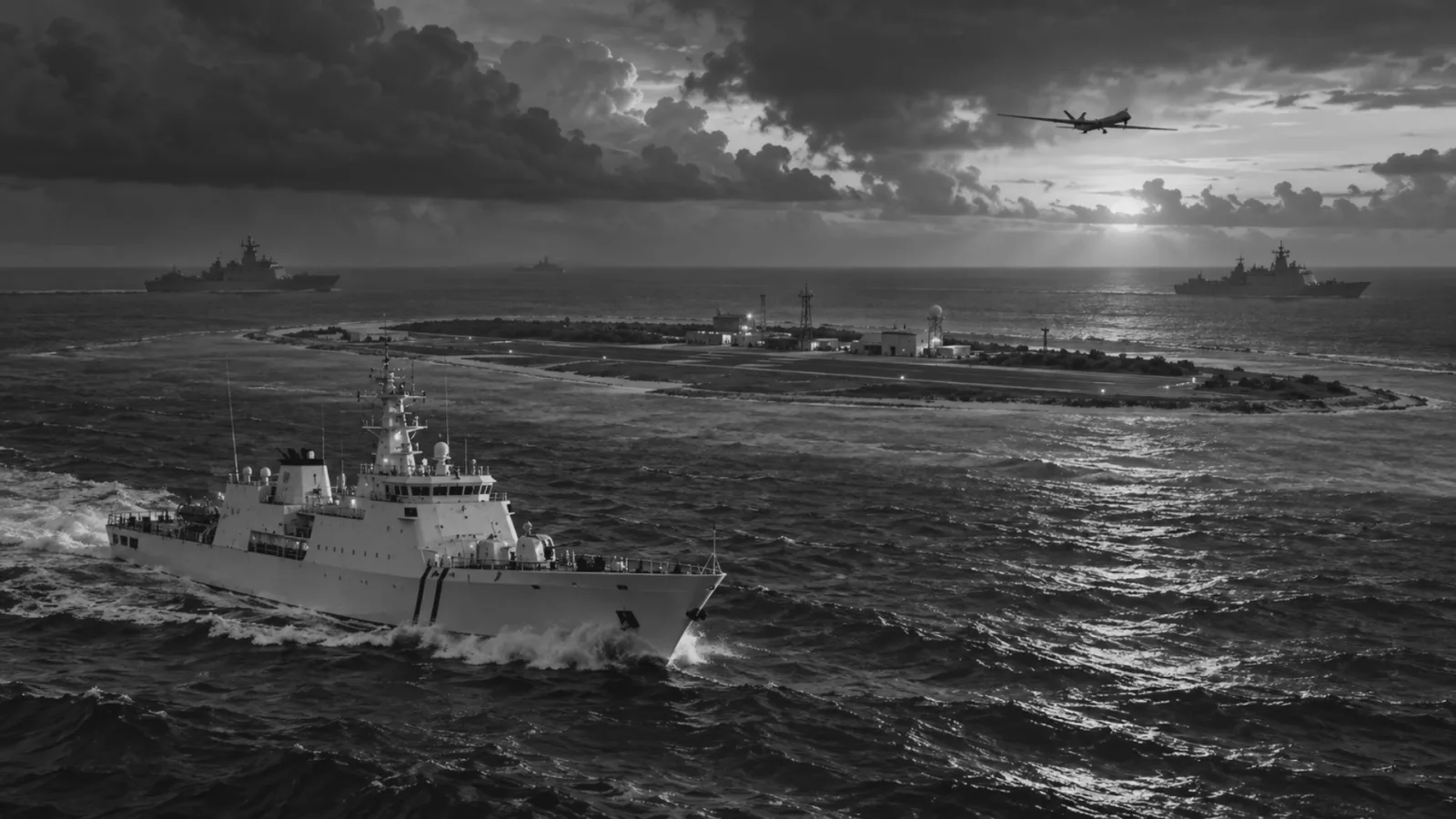
The immediate military significance of the new patrol boat should not be exaggerated. Taiwan has not announced the transformation of Pratas into a major fortified base, and security there remains primarily the responsibility of the Coast Guard rather than the armed forces. What is changing is Taiwan's ability to sustain a persistent presence and respond more quickly to maritime incursions. That distinction matters because the pressure around Pratas has largely taken place below the threshold of conventional warfare. Chinese Coast Guard vessels, fishing boats, maritime agencies and, on at least one occasion, a People's Liberation Army reconnaissance drone have increasingly operated near or inside waters and airspace claimed by Taiwan. The resulting confrontation is therefore developing through patrol patterns, jurisdictional claims, vessel interceptions and law-enforcement encounters rather than through overt naval combat. This makes Pratas an increasingly useful case study for understanding how a future confrontation over Taiwan might begin through measures short of a full-scale invasion.²
Why Pratas matters
Pratas is strategically unusual because of both its location and its isolation. The atoll lies more than 400 kilometres southwest of Taiwan's main island, roughly between southern Taiwan and Hong Kong, and is considerably closer to the Chinese coast than to Taiwan itself. The main island contains an airstrip and Coast Guard facilities but has no permanent civilian population. Its position near the northern South China Sea and west of the Bashi Channel places it close to important routes connecting the South China Sea with the western Pacific and waters surrounding Taiwan. Japanese and Taiwanese analysts have consequently described Pratas as strategically important for monitoring maritime movement across this wider operating area.³ Beijing claims sovereignty over Pratas as part of its broader claim over Taiwan, while Taipei exercises effective administration of the islands.
Geography is also Pratas's principal weakness. Unlike Kinmen, which sits only kilometres from the Chinese coast but is comparatively close to Taiwan's established military infrastructure, Pratas would have to be sustained over hundreds of kilometres of sea and airspace during a serious crisis. The United States Department of Defense has previously assessed that China could attempt to seize small Taiwan-controlled islands in the South China Sea such as Pratas or Itu Aba with substantially less preparation than would be required for an assault on Taiwan's main island. The same assessment emphasised that such an operation would nevertheless entail major political and escalatory risks, including international opposition and potentially stronger resistance within Taiwan.⁴ There is no public evidence that Beijing is presently preparing to seize Pratas, and the current Coast Guard activity should not be treated as proof of an impending military operation. The significance lies instead in the fact that sustained peacetime activity can generate operational familiarity with an area that would become considerably more difficult for Taiwan to reinforce once a crisis had already begun.
Chinese presence has moved from occasional to persistent
The most important trend around Pratas is not any single confrontation but the frequency of Chinese government activity. An analysis by the Asia Maritime Transparency Initiative using AIS data and Taiwan Coast Guard reporting identified 24 different Chinese Coast Guard and Maritime Safety Administration vessels operating around Pratas for a combined 94 days between 2021 and 2025. No such activity was observed in 2021, while the number of patrol days rose to 25 in 2024 and 60 in 2025. The geographical pattern changed as well. Chinese vessels that initially operated mainly in the surrounding contiguous zone began appearing within waters Taiwan treats as its territorial sea, while activity increasingly coincided with larger Chinese exercises around Taiwan. By March 2026, AMTI had already recorded five Chinese Coast Guard patrols around Pratas during a period that had historically seen little activity.⁵
The pattern continued throughout 2026. On 6 February, Taiwan said Chinese Coast Guard vessels 3501 and 3107 entered the restricted area around Pratas before Taiwanese cutters Yilan and Hualien intercepted them and eventually compelled them to leave. Taiwan's Coast Guard said at that point that Chinese vessels had already entered the restricted area on three occasions during the year. By 18 August, Taiwan reported that CCG 3303 and CCG 3107 had again entered restricted waters and said it had expelled Chinese Coast Guard vessels on 11 occasions involving five vessels since January.⁶ Beijing rejects Taiwan's jurisdictional framing and describes its operations as legitimate law-enforcement activity in Chinese waters. That difference in interpretation is central to the confrontation because the presence of Coast Guard vessels allows Beijing to assert jurisdiction without having to characterise every encounter as a military operation.
The January drone flight widened the contest into the air
A significant escalation occurred on 17 January when Taiwan reported that a PLA reconnaissance drone entered the airspace it claims around Pratas. Beijing did not deny the flight. The PLA Southern Theater Command instead confirmed that it had conducted UAV training around Dongsha and described the activity as completely legitimate and lawful, referring to the location as "China's Dongsha Island". China's Taiwan Affairs Office later reiterated that position while rejecting Taipei's accusation that the incident constituted a provocation.⁷ The episode is important because it introduced a military aviation component into a confrontation that had previously been dominated by fishing vessels and maritime law-enforcement ships.
Taipei interpreted the drone flight very differently. Taiwan's government described it as part of a broader expansion of Chinese pressure into waters and airspace surrounding its offshore territories, while outside analysts characterised the activity as another example of incremental or "grey-zone" coercion. The terminology itself is contested because Beijing argues that its forces are operating within Chinese sovereign territory rather than crossing an international boundary. Nevertheless, the operational effect is clear regardless of the competing sovereignty claims. Taiwan now has to monitor not only fishing activity and Coast Guard vessels around Pratas but also PLA unmanned aircraft capable of approaching or entering the airspace around the island without requiring a large-scale military deployment. This increases the surveillance burden on the outpost and creates more opportunities for closely spaced encounters involving military and paramilitary forces.
Taiwan is responding with a Coast Guard-first defence
Taipei's response is notable for remaining centred on the Coast Guard. Ocean Affairs Council Minister Kuan Bi-ling said in April that Taiwan was renovating Pratas's wharf, planned to deploy vessels with greater operational capacity and was examining development of what she called an island defence system. She also said China's growing activity was accelerating Taiwan's efforts to improve the transition between peacetime and wartime readiness. Taiwan's Anping-class Coast Guard corvettes illustrate the dual-use dimension of that approach. The vessels are based on the Taiwanese Navy's Tuo Chiang-class design and have provisions that could accommodate anti-ship missiles in wartime, although their normal role remains maritime law enforcement.⁸
The September announcement indicates that part of this plan has now moved from intention to implementation. The renovated wharf allows a 100-tonne patrol craft to remain permanently at Pratas, while larger Coast Guard ships can rotate through the surrounding waters. The smaller vessel improves nearshore responsiveness, where larger cutters cannot always operate efficiently, while the regular presence of heavier ships gives Taiwan greater endurance farther from the reef. Taipei's decision to confiscate rather than merely expel Chinese fishing boats also demonstrates a willingness to exercise jurisdiction more assertively. None of these measures fundamentally alters the conventional military balance between Taiwan and China, but they make it more difficult for routine incursions to go unanswered and reduce the extent to which Taiwan has to dispatch every response from hundreds of kilometres away.
From the “Kinmen model” to Pratas
Some analysts see the developing pattern around Pratas as an extension of tactics first employed more intensively around Kinmen. Following a deadly incident involving a Chinese fishing boat near Kinmen in February 2024, Chinese Coast Guard vessels progressively expanded their patrols around the Taiwan-controlled islands and challenged Taipei's previously enforced maritime boundaries. A July 2026 Jamestown Foundation analysis described this approach as a pattern in which an incident or dispute provides a trigger, Chinese maritime law-enforcement vessels establish a presence, official messaging asserts Beijing's jurisdiction and repeated patrols gradually make that presence routine. The report argued that Pratas had become one of the clearest locations where this pattern was being extended beyond the Taiwan Strait.⁹ This remains an analytical interpretation rather than an officially declared Chinese strategy.
Beijing's own language nevertheless demonstrates its interest in making maritime enforcement activity around Taiwan appear normal rather than exceptional. Since June, the China Coast Guard has publicly described deployments east of Taiwan as "routine law-enforcement patrols" and in July said such operations would continue in waters China regards as falling under its jurisdiction. On 3 September, Beijing again announced a routine patrol east of Taiwan led by the vessel Putuoshan, saying the formation was maintaining navigation order and protecting the rights of people on both sides of the Strait. Taiwan rejects this jurisdictional claim and has accused China of using ostensibly civilian maritime enforcement to create the appearance that Beijing administers waters currently controlled or policed by Taipei.¹⁰ The competition is therefore partly physical and partly legal. Each successful Chinese patrol reinforces Beijing's claim that its presence is ordinary law enforcement, while each Taiwanese interception seeks to demonstrate the opposite.
Pratas offers a pathway for coercion short of invasion
The importance of this pattern becomes clearer when Pratas is considered within the broader debate over a possible Chinese quarantine or blockade of Taiwan. A conventional blockade would be an overt military operation with significant escalatory consequences. A quarantine-like operation could begin more ambiguously, using Coast Guard or other government vessels to announce inspections, establish temporary exclusion areas, interfere with selected traffic or assert regulatory control without immediately employing large-scale military force. CSIS and other research organisations have increasingly examined such scenarios because Chinese maritime agencies have demonstrated growing coordination with the PLA while expanding operations around Taiwan's offshore islands and, more recently, into waters east of the main island.¹¹
Pratas presents a particularly revealing environment for such activity because its physical isolation magnifies relatively limited disruption. Sustained Chinese patrols would not have to conquer the island to complicate resupply. Persistent vessel inspections, temporary navigation restrictions, fishing enforcement or an unusually dense Coast Guard presence could force Taipei to decide whether to continue responding exclusively with law-enforcement vessels, introduce naval forces or accept restrictions on access. This is a scenario analysis rather than evidence of an existing Chinese plan, and Beijing publicly maintains that its Coast Guard activity is intended to protect navigation, fishing rights and Chinese sovereignty. The significance for crisis stability is that Pratas creates a setting in which both sides could disagree not only over sovereignty but over whether a particular action constitutes routine policing, coercion, quarantine or the opening phase of a military operation. That ambiguity could make signalling and escalation control considerably more difficult than in an unmistakable conventional attack.
Pressure extends beyond Coast Guard ships
Maritime law enforcement is also only one component of the competition surrounding Pratas. Research published by the Jamestown Foundation has documented Chinese state-owned offshore energy infrastructure operating within waters Taiwan claims as its exclusive economic zone near the islands, including oil-production platforms and associated support vessels. The authors interpret these structures as potentially contributing to what they call a broader grey-zone effort to establish an enduring Chinese presence and erode Taiwan's practical jurisdiction. Beijing does not recognise Taiwan as possessing separate sovereign maritime rights and therefore rejects the legal premise underlying Taipei's objections.¹² The importance of the infrastructure lies less in whether an individual platform has a military role and more in the accumulation of Chinese governmental, commercial, fishing and security activity around an island that is geographically isolated from Taiwan.
This layered presence complicates the distinction between a routine maritime environment and a security crisis. A Chinese Coast Guard cutter, survey ship, fishing vessel, offshore installation and military drone each belongs to a different institutional category, yet together they can increase surveillance, familiarity with local operating conditions and the frequency with which Taiwanese authorities must respond. Taiwan's upgraded wharf and permanent patrol craft can therefore be understood as an attempt to create an equally persistent presence rather than simply a reaction to one recent incursion. The contest around Pratas is becoming one of endurance, jurisdiction and presence, where the ability to remain on station may be as politically important as the ability to deploy high-end weapons.
Strategic Assessment
The latest Taiwanese measures do not indicate that a battle for Pratas is imminent, and current evidence does not support treating increasing Chinese patrols as preparation for a specific attack. What they do show is that both sides are adjusting to a sustained maritime confrontation that has become progressively more regular since 2024. Beijing has increased the frequency and geographic scope of Coast Guard activity while publicly framing those operations as normal exercises of Chinese jurisdiction. Taipei has responded by strengthening its Coast Guard infrastructure, stationing additional vessels, increasing enforcement against Chinese fishing boats and preparing mechanisms through which maritime forces could transition from peacetime policing to wartime roles. The January PLA drone flight added a further military dimension to what had largely been a Coast Guard contest.
Pratas consequently deserves attention not because it is necessarily the next location where China will employ force, but because it demonstrates how control can be contested incrementally before conventional warfare begins. The most revealing indicators will be changes in the duration and density of Chinese Coast Guard deployments, repeated entry into waters immediately surrounding the atoll, interference with Taiwanese resupply, further PLA drone or aircraft operations, the appearance of coordinated PLA and Coast Guard formations, and any shift by Taiwan from predominantly Coast Guard enforcement toward permanent military reinforcement. Individually, none of these developments would establish an impending blockade or seizure. Taken together over time, however, they would show whether Pratas is remaining a persistent grey-zone contest or evolving into a more directly militarised confrontation. For the wider Indo-Pacific, the island is therefore significant less because of its physical size than because the contest around it illustrates how sovereignty, maritime law enforcement and military deterrence are increasingly overlapping in the waters between Taiwan and the South China Sea.
References
1. Taiwan Coast Guard Administration. “Dongsha Island Wharf Renovation Completed in July, Coast Guard Deploys Large Vessels and 100-ton Patrol Craft.” September 23, 2026. Taiwan Coast Guard Administration
2. Reuters. “Taiwan Upgrades Maritime Patrol Capacity for Vulnerable South China Sea Outpost.” September 24, 2026. Reuters report
3. Japan Institute of International Affairs. “The Lai Administration's First Anniversary and the Gray Zone Situation Surrounding the Dongsha Islands.” 2025. JIIA analysis
4. U.S. Department of Defense. Military and Security Developments Involving the People’s Republic of China 2024. Washington, DC, 2024. U.S. Department of Defense report
5. Asia Maritime Transparency Initiative. “Patrolling Pratas: From Peripheral Concern to a New Normal.” Center for Strategic and International Studies, March 30, 2026. AMTI analysis
6. Taiwan Coast Guard Administration. “China Coast Guard Harassment in Dongsha Waters.” February 6 and August 18, 2026. Taiwan Coast Guard report
7. Ministry of National Defense of the People's Republic of China. “Chinese Military Conducts UAV Flight Training around Dongsha Island.” January 17, 2026. Chinese Ministry of National Defense
8. Ben Blanchard and Angie Teo. “Taiwan to Strengthen Pratas Islands' Defences as China Steps Up Pressure.” Reuters, April 2, 2026. Reuters report
9. Yu-cheng Chen. “Maritime Pressure Expands to Pratas and Taiping.” China Brief, Jamestown Foundation, July 2026. Jamestown analysis
10. China Coast Guard. “China Coast Guard Conducts Routine Law-Enforcement Patrols in the Waters East of China’s Taiwan Island.” July 4, 2026. China Coast Guard statement
11. Christopher B. Johnstone and Bonny Lin. “Responding to a More Coercive Chinese Coast Guard and a Potential PRC Quarantine of Taiwan.” Center for Strategic and International Studies. CSIS analysis
12. Andrew S. Erickson et al. “Rigging the Game: PRC Oil Structures Encroach on Taiwan’s Pratas Island.” China Brief, Jamestown Foundation, 2025. Jamestown report
Tags
- #China Coast Guard
- #China Taiwan Relations
- #grey zone warfare
- #Indo Pacific Security
- #Pratas Islands
- #South China Sea
- #Taiwan China Conflict
- #Taiwan Strait
Author