Department of Maritime Security · Articles · Maritime Security · Geopolitics ·
China’s Antelope Reef Build-Up: Beijing’s Grey-Zone Advantage in the South China Sea
China’s rapid reclamation of Antelope Reef in the South China Sea illustrates how Beijing uses grey-zone tactics to gradually create irreversible strategic advantages. This article examines the reef’s transformation from a submerged feature into a potentially military-capable facility, including runway and infrastructure development. It argues that China’s approach relies on incremental actions that remain below the threshold of conventional military response while steadily altering the regional status quo.
1. Introduction
Until recently, Antelope Reef (Lingyang Reef, 羚羊礁) was a submerged feature lying within the Crescent Group, the southwestern part of the Paracel Islands (Xisha Islands, 西沙群島). Located 162 nautical miles from China’s Sanya naval base and 216 nautical miles from Da Nang, Vietnam[1], its strategic importance has grown significantly over the past year. Given its proximity to Hainan, Antelope Reef now offers geographical leverage over China’s distant outposts in the Spratly Islands (Nansha Islands, 南沙群島).
The Asia Maritime Transparency Initiative (AMTI) reported that by March 2026, China had reclaimed around 1,490 acres of land at the site, close to the size of Mischief Reef (1,504 acres), previously China's largest artificial island in the South China Sea[2].
This development raises a larger question: how does an activity that begins as ambiguous and outwardly civilian end as a fixed, and potentially irreversible, military asset? The answer lies in how China operates in the grey zone. Construction usually outpaces international response, and once building is complete, there is no realistic way to reverse it. The advantage becomes permanent not because anyone agreed it should be, but because physical land, once built, is difficult to undo. Antelope Reef is the latest, and fastest, demonstration of a template China has been refining over two decades.
2. Building the Ambiguity: Operating in the Grey Zone
In the era of hybrid warfare, states increasingly operate in the grey zone, relying on actions that can be denied as offensive yet are cumulatively transformative. The grey zone is an operational space between peace and war, involving coercive actions to change the status quo below a threshold that, in most cases, would prompt a conventional military response, often by blurring the line between military and non-military actions and the attribution for events.[3] This ambiguity is especially pronounced at sea, which analysts describe as a “contested battle zone,” where seemingly ordinary acts such as intercepting a fishing boat can escalate close to open conflict, because the absence of clear norms and rules leaves considerable room for interpretation. A vessel conducting research or fishing may also, under civilian guise, be conducting surveillance[4].
Over the past decade, China has employed grey-zone tactics across East and Southeast Asia that fall into seven broad categories: military intimidation, paramilitary activity, the co-opting of state-affiliated businesses, the manipulation of borders, information operations, lawfare and diplomacy, and economic coercion[5]. Analysts at Singapore's RSIS trace the historical trajectory of this behaviour to 2007, not to Xi Jinping's rise in 2012, as is commonly assumed. They identify 2007 as the real inflection point, when Beijing began a sustained administrative build-up centred first on patrol vessels and later on artificial islands, accompanied by steadily more frequent coercive actions[6]. The pattern, in other words, is older and more structural than most Western commentary suggests.
What Antelope Reef represents, then, is not a fait accompli — a sudden, decisive move that leaves an adversary with no choice but to hit back and escalate. It fits instead what scholar James Wirtz calls the “slow-motion erosion of an opponent's deterrent by gradually making it irrelevant in an unfolding situation.”[7] In practice, this means employing tactics that stay below the threshold and would not trigger a deterrent response. The status quo shifts gradually through salami tactics because the defender lacks the military or political justification to respond to any single, minor incident[8]. Building an artificial island follows this pattern exactly, because the process breaks into stages that are each, individually, hard to characterise as military.
RAND's analysis of China's coercive tactics describes a doctrine that PLA Major General Zhang Zhaozhong termed the “cabbage strategy”, in which a contested feature is surrounded in concentric layers: maritime militia closest in, coast guard further out, and navy warships held at the greatest distance specifically to project presence while avoiding escalation. This deniability extends into corporate structure. Much of the dredging at Mischief, Subi, and Fiery Cross Reefs, for example, was carried out not by the PLA but by the Tianjin Dredging Company, a subsidiary of the state-owned China Communications Construction Company; at least 23 Chinese state-owned enterprises have taken part in South China Sea land reclamation overall[9].
3. The Case of Antelope Reef
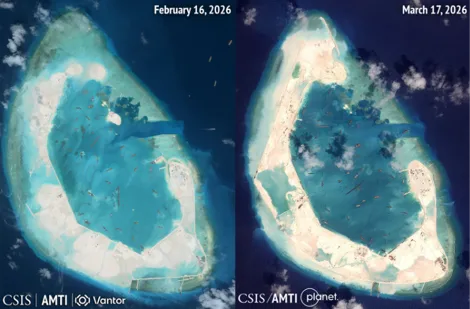
Image credit: CSIS Asia Maritime Transparency Initiative / Maxar Technologies, March 2026
The operation began covertly in October 2025, when Chinese dredgers gathered at the Zhujiang River estuary with their AIS transponders switched off, delaying detection en route to the reef. Once the reclamation appeared on satellite imagery, Chinese state media described it as strictly civilian, and the berthing facilities and access infrastructure built for construction vessels initially appeared plausibly logistical rather than military.[11]
By August 2026, eight months after dredging began, satellite imagery indicated the early development of a potentially military-capable facility. Fresh dredging was underway along the reef's northwestern edge, the only stretch straight and long enough for a runway of up to 10,000 feet. No concrete layout, but a 4,300-foot stretch had already been cleared to a 180-foot width, matching the dimensions of China's existing military runways at Woody Island, Fiery Cross, Subi, and Mischief Reefs, as per the AMTI August report.
Adjacent to this strip, excavation had begun on a 200-by-200-foot structure, consistent in size with the large aircraft hangars found at China's other outposts. Two temporary concrete plants were operating along the lagoon's northwestern and southern edges to supply building materials. Meanwhile, the eastern tip south of the lagoon channel had been fully transformed into an administrative headquarters, with new buildings, paved parking lots, and landscaping already in place. These developments suggest that although full militarisation has not occurred and construction is ongoing that Antelope Reef can be potentially used as a multi-use facility capable of supporting aircraft and naval vessels while conducting regional surveillance[12].
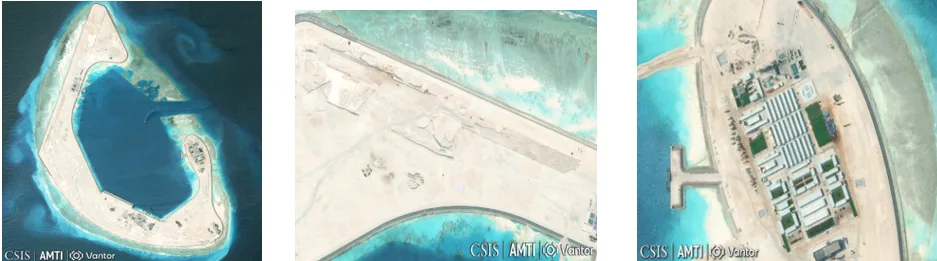
Early runway construction on Antelope Reef, August 2026.Image credit: CSIS Asia Maritime Transparency Initiative / Maxar Technologies
This would not be without precedent. Between 2023 and 2024, satellite imagery showed that Fiery Cross, Subi, and Mischief Reef—all previously considered complete were quietly upgraded. Subi Reef received two new radar domes, matching those already installed at Fiery Cross and Mischief and built to give overlapping surveillance coverage across the South China Sea; additionally, Mischief Reef also received new emplacements shaped to hold mobile artillery or rocket systems[13]. Lowell Bautista notes, Antelope Reef’s true strategic value thus lies not in its standalone capability, but in its integration into a broader security architecture. By acting as an additive node in China’s network across the Paracels and Spratlys, it significantly enhances Beijing's operational capacity, dispersal, and redundancy[14].
More broadly, analysts view Beijing's expansion of dual-use islands as a deliberate strategy to shift the regional status quo by manufacturing maritime entitlements that most other states regard as unlawful under the UN Convention on the Law of the Sea (UNCLOS). Beyond the physical alteration of the maritime terrain, these features can be used to assert de facto sovereignty and expand administrative control that other claimants view as illegitimate.
Andrew Chubb has described this as a “cumulative layer of state practice,” in which past assertiveness lays the logistical groundwork for future coercion. The artificial islands built between 2013 and 2015, for instance, directly enabled China's sustained maritime militia presence[15]. On this view, infrastructure development is not the end goal; it is the operational platform for projecting regional pressure over time.
4. Strategic Impact
Antelope Reef could offer China a significant advantage in a potential conflict over Taiwan. Analysts assess that a fully built-out base equipped with anti-ship missiles, radar jammers, and air defence systems could be positioned to detect, degrade, and delay any U.S. or allied naval force attempting to intervene[16]. If China deploys anti-ship systems such as the YJ-12B or YJ-18, their estimated range of 400–500 km, could bring maritime routes leading into the Taiwan Strait within its reach. Additionally, Antelope Reef sits roughly 300 km from China's naval base at Sanya, close enough that it could also support a heavily guarded submarine “bastion,” shielding China's strategic submarine fleet from surveillance.[17]
On the other side of the spectrum, analysts read China's approach differently, arguing that its island-building is fundamentally defensive, primarily driven by territorial concerns and the need to protect economically vital sea lanes.
[18]. There is also a physical limit worth noting. Fortified islands, however permanent, are bound by the range of systems stationed on them. Antelope Reef may help China dominate the South China Sea itself, but it would not extend Beijing's reach to waterways much farther afield, such as the Strait of Malacca, which would remain within range of allied submarines operating beyond the islands' effective coverage. Antelope Reef, in other words, offers a regional advantage rather than a global one[19].
5. Regional Response
5.1 Vietnam
Antelope Reef sits in the southwestern Crescent Group of the Paracels, the same islands China seized from South Vietnam by force in January 1974 that gave Beijing full control of the archipelago.[20] Hanoi has never accepted that outcome; as recently as 2025 its Foreign Ministry reaffirmed that "sovereignty over the Hoang Sa Islands belongs to Vietnam."[21] Vietnam, therefore, has been the most vocal of the claimant states. In March 2026, its Foreign Ministry formally condemned the development at Antelope Reef, with spokeswoman Pham Thu Hang stating that "any foreign activities conducted in Hoang Sa, including Hai Sam reef, without Vietnam's permission are completely illegal and invalid."[22] Separately, Hanoi has been running its own reclamation campaign since 2021, a longer-running, competitive rather than confrontational strategy[23].
5.2 Taiwan
As far as Taiwan's position is concerned, it illustrates the diplomatic constraints of shared historical claims with China. Taipei designates the feature as "Lingyang Reef." Consequently, Taiwan's government has refrained from issuing a formal protest, as challenging Beijing's jurisdictional logic would also compromise its own territorial legitimacy. However, analysts have flagged security concerns. Collin Koh emphasises that the reef's expansion could help China establish a submarine "bastion" in the South China Sea, potentially complicating submarine operations for both the United States and Vietnam[24].
5.3 United States
The US has also condemned these activities. A State Department spokesman told The Washington Times in August 2026 that China's Antelope Reef construction is "unacceptable" and "a bold attempt to advance its expansive and unlawful maritime claims."[25] Washington's response has otherwise been structural such as wider basing access in the Philippines, missile deployments, and larger exercises like the US-Philippines exercise Balikatan 2026, which included Japan and Australia[26].
From a security dilemma perspective, what China frames as defensive is read by the US and its allies as threatening, prompting responses such as naval patrols and expanded regional basing, which China, in turn, reads as encirclement[27]. The result is a self-reinforcing cycle that neither side fully controls, in which each side's countermeasures feed the other's justification for further construction rather than raising its cost.
The more consequential outcome may be a broader change in how the South China Sea is governed. International law and formal treaties are being pushed aside. In their place, the region is shifting toward a "practice-based order," in which rules emerge through sustained behaviours and enforcement rather than through formal agreements.[28]
Conclusion
The core dilemma is this: waiting until an artificial island is complete, makes it too late to reverse, yet no single stage of construction crosses a threshold that would justify a military response. Andrew Chubb argues that threatening military action is therefore counterproductive, since the escalation would undermine the US's credibility as a regional stabiliser; he recommends economic deterrence instead, given how heavily the Chinese government's legitimacy rests on domestic economic growth. Furthermore, he suggests that a unified front from the Association of Southeast Asian Nations (ASEAN) setting aside intra-ASEAN disputes would present a diplomatic barrier that Beijing would find harder to dismiss[29]. The clearest takeaway is that the US and its allies should focus on increasing the costs during the early phase of construction, rather than waiting to respond to a finished base. Moreover, the pattern is not just confined to the South China Sea; similar tactics of leveraging dual-use ports and civilian-appearing infrastructure are already emerging in the Indian Ocean region. For countries like India, Antelope Reef is a warning: once normalised in one theatre, it culd be applied to others.[30][31]
References:
[1]CSIS Asia Maritime Transparency Initiative, “Antelope Reef Could Now Be the Largest Island in the South China Sea,” March 19, 2026, https://amti.csis.org/antelope-reef-could-now-be-the-largest-island-in-the-south-china-sea/
[2] Ibid.
[3] Morris, Lyle J., Michael J. Mazarr, Jeffrey W. Hornung, Stephanie Pezard, Anika Binnendijk, and Marta Kepe. Gaining Competitive Advantage in the Grey Zone: Response Options for Coercive Aggression Below the Threshold of Major War. Santa Monica, CA: RAND Corporation, 2019. https://www.rand.org/pubs/research_reports/RR2942.html.
[4]Ragheyee Chauhan, "Grey Zone Warfare in the Indian Ocean Region," The Academic 4, no. 3 (March 2026): 853–868.
[5]Morris, Lyle J., Michael J. Mazarr, Jeffrey W. Hornung, Stephanie Pezard, Anika Binnendijk, and Marta Kepe. Gaining Competitive Advantage in the Grey Zone: Response Options for Coercive Aggression Below the Threshold of Major War. Santa Monica, CA: RAND Corporation, 2019. https://www.rand.org/pubs/research_reports/RR2942.html.
[6]Andrew Chubb, "China's Grey Zone Strategy: Historical Trajectory, Recent Trends and Policy Options," IDSS Paper No. 031, RSIS, May 23, 2022, https://rsis.edu.sg/rsis-publication/idss/ip22031-chinas-grey-zone-strategy-historical-trajectory-recent-trends-and-policy-options/.
[7] James J. Wirtz, “Life in the ‘Grey Zone’: Observations for Contemporary Strategists,” Defense & Security Analysis 33, no. 2 (2017): 106–114, 109.
[8]Tahir Mahmood Azad, Muhammad Waqas Haider, and Muhammad Sadiq, "Understanding Grey Zone Warfare from Multiple Perspectives," World Affairs 186, no. 1 (Spring 2023): 85.
[9] Major General Zhang Zhaozhong, quoted in Morris, Lyle J., Michael J. Mazarr, Jeffrey W. Hornung, Stephanie Pezard, Anika Binnendijk, and Marta Kepe. Gaining Competitive Advantage in the Grey Zone: Response Options for Coercive Aggression Below the Threshold of Major War. Santa Monica, CA: RAND Corporation, 2019. https://www.rand.org/pubs/research_reports/RR2942.html.
[11] The War Zone, "China's Massive New Artificial Island in the South China Sea Emerges, Primed for Militarization," August 2026, https://www.twz.com/news-features/chinas-massive-new-artificial-island-in-the-south-china-sea-emerges-primed-for-militarization.
[12] CSIS AMTI, "Is a New Chinese Runway Taking Flight at Antelope Reef?" August 17, 2026, https://amti.csis.org/is-a-new-chinese-runway-taking-flight-at-antelope-reef/.
[13]Newsweek, "China's Artificial Island Military Base Upgrades Revealed," December 5, 2025, https://www.newsweek.com/china-artificial-island-military-base-upgrades-revealed-11162696.
[14] Lowell Bautista, “China Is Remaking the South China Sea with a Return to Island-Building,” The Interpreter, Lowy Institute, April 27, 2026, lowyinstitute.org.
[15] Andrew Chubb, "China's Grey Zone Strategy: Historical Trajectory, Recent Trends and Policy Options," IDSS Paper No. 031, RSIS, May 23, 2022, https://rsis.edu.sg/rsis-publication/idss/ip22031-chinas-grey-zone-strategy-historical-trajectory-recent-trends-and-policy-options/.
[16] Sana Khan, “How Could China's New South China Sea Base Affect Taiwan,” Modern Diplomacy, August 19, 2026, moderndiplomacy.eu.
[17]Taipei Times, "China Upgrades Antelope Reef," August 26, 2026,https://www.taipeitimes.com/News/editorials/archives/2026/08/26/2003863130.
[18][18]M. Taylor Fravel, “China's Strategy in the South China Sea,” Contemporary Southeast Asia 33, no. 3 (2011): 292–319, cited in Shalyra Andini Tantra, “US–China Strategic Rivalry in the South China Sea: The Impact of China's Island Militarization on Escalation Risk (2013–Present),” Jurnal Transborders (2026).
[19]UPI, "Is the South China Sea a Military Springboard for Beijing?" February 4, 2026, https://www.upi.com/Voices/2026/02/04/South-China-Sea-Beijing-military-control/8471770214856/.
[20] Radio Free Asia, "Vietnam Protests China's Antelope Reef Reclamation," March 23, 2026, https://www.rfa.org/english/southchinasea/2026/03/23/vietnam-china-paracels-antelope-reef/.
[21]Radio Free Asia, "Vietnam Denounces China's Occupation of Islands in 1974," January 22, 2025, https://www.rfa.org/english/news/vietnam/condemnation-01222024110513.html.
[22]RFA, "Vietnam Protests China's Antelope Reef Reclamation.”
[23]Grace Stanhope, "What Could China's Decision to Militarise Antelope Reef in the South China Sea Imply?" Australian Institute of International Affairs, May 21, 2026, https://www.internationalaffairs.org.au/australianoutlook/what-could-chinas-decision-to-militarise-antelope-reef-in-the-south-china-sea-imply/.
[24]Reuters, "China Completes First Stage of Work at Disputed South China Sea Reef, Images Show," August 19, 2026, as carried by U.S. News & World Report, https://www.usnews.com/news/world/articles/2026-08-19/china-completes-first-stage-of-work-at-disputed-south-china-sea-reef-images-show.
[25]Bill Gertz, "Inside the Ring: China Building New Military Base on Disputed Antelope Reef," The Washington Times, August 26, 2026, https://www.washingtontimes.com/news/2026/aug/26/inside-ring-china-building-new-military-base-disputed-antelope-reef/.
[26]Stanhope, "What Could China's Decision to Militarise Antelope Reef Imply?"
[27]Robert Jervis, "Cooperation Under the Security Dilemma," World Politics 30, no. 2 (1978): 167–214, cited in Shalyra Andini Tantra, "US–China Strategic Rivalry in the South China Sea: The Impact of China's Island Militarization on Escalation Risk (2013–Present)," Jurnal Transborders (2026).
[28]Gilang Kembara, "Artificial Islands, Real Power: Reshaping Maritime Order in the South China Sea," 9DASHLINE, July 21, 2026, https://www.9dashline.com/article/artificial-islands-real-power-reshaping-maritime-order-in-the-south-china-sea.
[29]Andrew Chubb, "China's Grey Zone Strategy: Historical Trajectory, Recent Trends and Policy Options," IDSS Paper No. 031, RSIS, May 23, 2022.
The views expressed are those of the authors and do not represent the views of CNAWS.
ImageSource: ChatGPT
Tags
- #Antelope Reef
- #China
- #China-Vietnam Relations
- #Chinese Military
- #Grey-Zone Warfare
- #Indo-Pacific Security
- #Island Reclamation
- #Maritime Security
- #South China Sea
- #Taiwan Strait
Author
Rashi Manhas
Rashi Manhas holds a Master’s degree in International Relations and Area Studies from Jawaharlal Nehru University and is UGC NET qualified in Political Science. Her research interests include strategic and security studies, geopolitics, foreign policy, hybrid warfare, counter-terrorism, and grey-zone dynamics. Her regional focus spans South Asia, East Asia, and the broader Indo-Pacific, with particular interest in regional security and great-power competition.