Department of Hybrid Warfare & Irregular Conflict · Articles · Maritime Security ·
Chinese Maritime Militia Spotted East of Taiwan as Beijing Expands Grey-Zone Operations into the Pacific
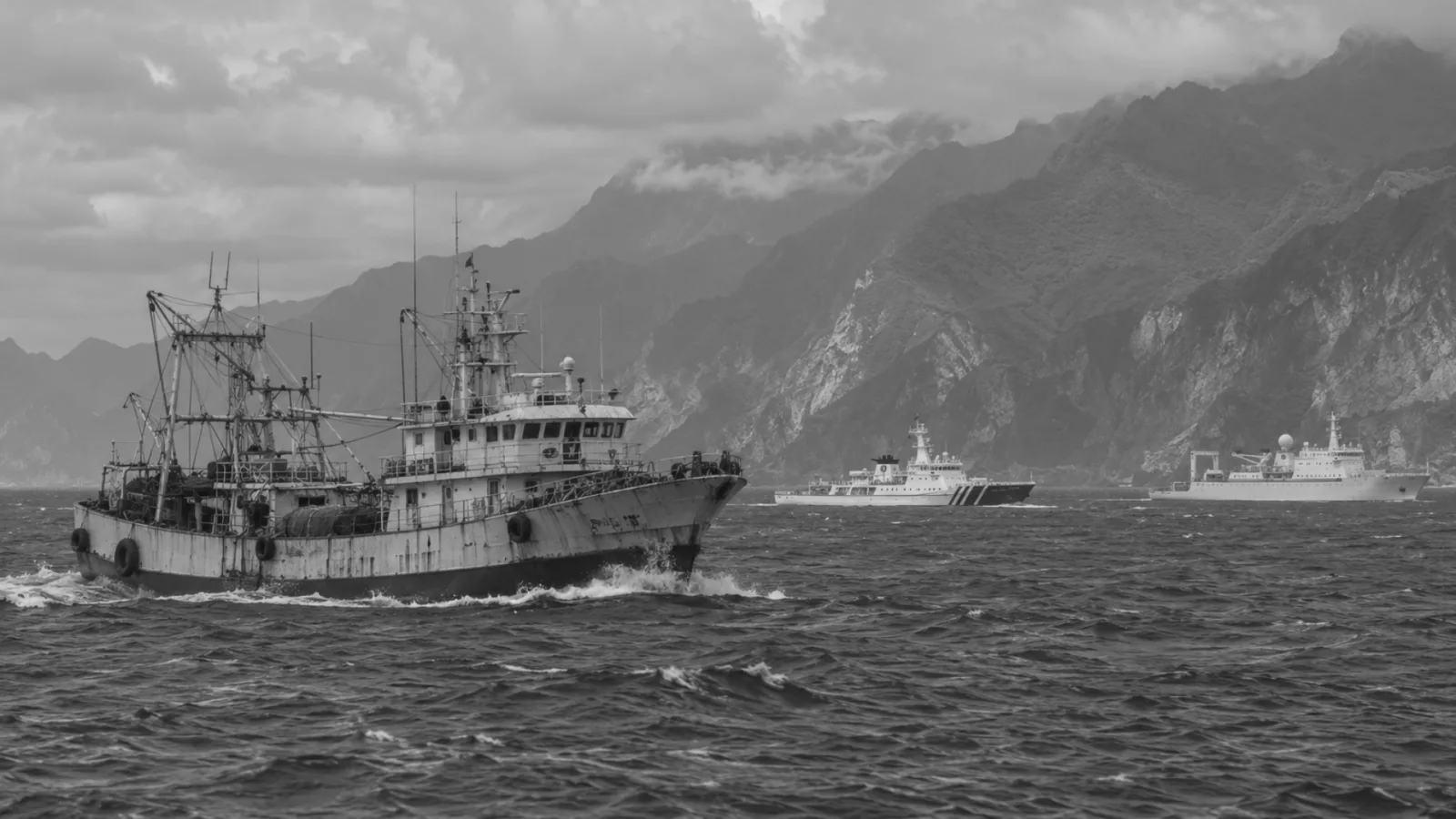
The detection of a suspected Chinese maritime militia vessel off Taiwan’s eastern coast in August 2026 marks a potentially significant geographical expansion of Beijing’s grey-zone maritime activities. According to reporting published on 8 October, the vessel was observed operating near a China Coast Guard cutter and an oceanographic research ship, raising concerns over China's growing presence in maritime approaches traditionally considered important for Taiwan’s external connectivity. The development coincides with an increase in Chinese coast guard patrols east of Taiwan, suggesting a gradual shift towards a more persistent maritime presence beyond the Taiwan Strait.
China’s integration of civilian-linked fishing vessels, coast guard platforms and conventional naval capabilities provides Beijing with multiple instruments for asserting maritime influence while maintaining ambiguity over operational intent. Such deployments could support surveillance, maritime domain awareness and future quarantine or blockade contingencies. However, the available evidence does not establish that the three vessels were conducting a coordinated military operation or rehearsing a blockade.
CNAWS assesses with moderate confidence that the incident reflects Beijing’s efforts to expand its maritime operating environment around Taiwan and gradually normalise Chinese state-linked activity in the island’s eastern approaches. For India, the development highlights the importance of monitoring China's broader maritime ecosystem, including civilian-linked vessels and dual-use research platforms, particularly in the Indian Ocean Region. Sustained deployments, closer coordination between maritime platforms and any transition towards interference with commercial shipping will be critical indicators of further escalation.
The detection of a suspected Chinese maritime militia vessel off Taiwan's eastern coast in August 2026 has raised fresh concerns over Beijing's expanding grey-zone operations in the western Pacific. According to a surveillance report by Taiwan-based Apex Aviation, reviewed by Reuters and published on 8 October, the Chinese fishing vessel Minfudingyu 07902 was observed operating in the vicinity of a China Coast Guard (CCG) cutter and an oceanographic research vessel. The incident represents the first publicly reported identification of a Chinese maritime militia vessel in this strategically sensitive area.¹
The three vessels were identified as Minfudingyu 07902, CCG cutter 2502 and research vessel Xiang Yang Hong 03. Apex Aviation detected the vessels more than 30 nautical miles off Hualien County using airborne radar, infrared imagery and Automatic Identification System (AIS) data. The vessels were distributed across an area extending roughly 10 nautical miles, although the surveillance company acknowledged that a single observation could not establish their respective missions or confirm operational coordination.
The development is significant because Taiwan's eastern coastline has traditionally been considered strategically important for maintaining external maritime connectivity during a potential conflict with mainland China. Unlike the Taiwan Strait, where Chinese military and maritime law-enforcement activities have been concentrated for years, the waters east of Taiwan open into the Pacific Ocean and provide access to possible reinforcement and resupply routes.
The appearance of a militia-linked vessel in these waters, alongside Chinese government ships, therefore raises questions about whether Beijing is broadening the geographical reach of its maritime coercion strategy. However, the available evidence does not establish that the vessels were rehearsing a blockade or undertaking a coordinated military mission.
China's Changing Maritime Posture Around Taiwan
The August detection was not an isolated development in China's maritime presence around Taiwan. Since June 2026, Chinese coast guard vessels have increased patrols off the island's eastern coastline, extending their activities beyond areas traditionally associated with cross-strait tensions.
Research published by the Asia Society Policy Institute's Center for China Analysis in September 2026 identified an important change in the composition of Chinese operations around Taiwan. Between 1 January and 19 August 2026, Taiwan's Ministry of National Defense recorded 1,763 sorties by People's Liberation Army (PLA) aircraft, compared with 3,603 during the corresponding period in 2025. Meanwhile, detections of Chinese government vessels outside the PLA Navy increased from 183 to 457. The latter category largely reflected growing CCG activity.²
These figures indicate that Beijing's pressure cannot be assessed solely through the frequency of PLA aircraft entering Taiwan's Air Defence Identification Zone. Although the overall volume of recorded Chinese activity declined during the comparison period, maritime law-enforcement vessels became a more prominent element of Beijing's operational presence.
China has also attempted to normalise this presence through administrative and legal terminology. During patrols east of Taiwan in July, the China Coast Guard described its activities as measures intended to maintain navigational order and protect the rights of fishermen. Taiwan's Coast Guard Administration rejected this justification and argued that Beijing was using law-enforcement activities to extend its effective control over contested waters.³
The operational significance lies in the gradual establishment of routine Chinese government activity in areas where such deployments were previously less common. Repeated patrols could enable Beijing to familiarise its crews with the maritime environment, test Taiwan's monitoring and response procedures, and strengthen its ability to sustain an extended presence around the island.
The Maritime Militia and China's Civil-Military Integration
China's maritime militia occupies a distinctive position within its wider maritime security architecture. Often described as Beijing's third maritime force, it comprises fishing vessels and personnel that can support state-directed activities while retaining an outwardly civilian character. Its organisation includes dedicated maritime militia vessels and sections of the broader fishing fleet that receive government support and may undertake assigned security functions.
The militia has become particularly visible in the South China Sea, where Chinese vessels have participated in confrontations involving the Philippines and operated alongside coast guard ships around disputed maritime features.
Research by the Center for Strategic and International Studies (CSIS) demonstrates the scale of these activities. Satellite monitoring by its Asia Maritime Transparency Initiative identified an average of 232 suspected militia vessels across 11 monitored South China Sea features in 2024, compared with 195 in 2023.⁴
The use of civilian vessels provides China with several operational advantages. Fishing vessels can maintain prolonged maritime presence at a lower cost than major naval platforms, support observation and reporting activities, and complicate an opposing force's ability to distinguish ordinary maritime commerce from security-related operations.
Their ambiguous status also creates political and legal complications for other countries. Responses to potentially coercive activity involving ostensibly civilian vessels may become more difficult when the distinction between ordinary fishing, maritime policing and military support is unclear.
Nevertheless, the presence of a fishing vessel near Chinese government ships should not automatically be interpreted as evidence of a coordinated military operation. In the Hualien incident, Taiwanese authorities identified Minfudingyu 07902 as belonging to China's maritime militia. However, the public reporting does not establish whether the vessel was conducting surveillance, maintaining presence, communicating with accompanying ships or performing another task.
This distinction matters because an observable pattern of simultaneous maritime activity is not necessarily proof of integrated command and control.
From Maritime Harassment to Blockade Preparedness
The most consequential question arising from the August detection concerns the potential role of Chinese maritime militia vessels in a future attempt to restrict Taiwan's external maritime access.
Military discussions frequently distinguish between a maritime quarantine and a blockade. A quarantine generally involves law-enforcement-led restrictions, inspections or controls over shipping, while a blockade involves military forces seeking to prevent or substantially restrict access to designated maritime areas.
A 2024 CSIS study examining potential Chinese quarantine operations assessed that Beijing could employ the CCG, Maritime Safety Administration, maritime militia and PLA in complementary roles. Under such a scenario, coast guard vessels could enforce shipping restrictions while militia vessels expanded surveillance coverage and complicated Taiwan's maritime response. PLA units could provide military support and deterrence against outside intervention.⁵
Unlike a full military blockade, a quarantine could be presented by Beijing as a domestic maritime enforcement measure. Such an approach would create uncertainty for commercial shipping companies and foreign governments over whether Chinese actions constituted routine law enforcement, economic coercion or the opening stage of a military operation.
China's capacity to mobilise large civilian fleets has already attracted attention. In January 2026, thousands of Chinese fishing vessels reportedly formed an extended maritime arrangement in the East China Sea. Research published by the Global Taiwan Institute examined the incident as a possible demonstration of mass maritime mobilisation and its implications for future quarantine or blockade contingencies.⁶
The August sighting near Hualien does not demonstrate that such an operation is underway. However, the arrival of a militia-linked vessel in an area already witnessing regular Chinese coast guard patrols is consistent with a broader expansion of Beijing's maritime presence.
The eastern coastline is particularly relevant because any attempt to isolate Taiwan would need to account for shipping and military support arriving from the Pacific. Even limited Chinese activity in these waters could generate additional surveillance requirements for Taiwan and complicate the planning of commercial or military movements during a crisis.
Why Taiwan's Eastern Coast Matters
Taiwan's geographical position makes maritime access fundamental to its economic and strategic resilience. The island depends heavily on international shipping for energy, commercial imports and the movement of essential materials. During a major confrontation, sustaining access to selected ports and sea routes would become an important element of national defence.
The eastern coastline, including the Hualien and Su'ao areas, is therefore significant in contingency planning because it faces the Pacific rather than the narrower Taiwan Strait.
During Taiwan's August 2026 Han Kuang military exercises, the navy and coast guard jointly conducted an anti-blockade escort drill involving a simulated merchant vessel. The exercise included mine-countermeasure activity and the escort of a vessel towards eastern ports, reflecting Taipei's concern over maintaining maritime access during a potential Chinese attempt at interdiction.⁷
Against this background, the appearance of Chinese government and militia-linked vessels in the eastern maritime approaches acquires greater strategic relevance.
A sustained Chinese presence could support maritime situational awareness by identifying vessel movements, observing response patterns and familiarising personnel with regional operating conditions. However, these are potential operational advantages rather than functions demonstrated by the specific vessels observed in August.
The geographical expansion also creates an additional burden for Taiwan's maritime surveillance architecture. Monitoring naval vessels, coast guard ships, research platforms and fishing fleets simultaneously requires substantial intelligence, surveillance and reconnaissance resources.
This challenge becomes more complex when vessels switch off AIS transmissions, operate under ambiguous designations or remain in areas where legitimate commercial activity is common.
A separate issue concerns the legal interpretation of maritime activity. The reported sighting more than 30 nautical miles off Taiwan does not itself demonstrate an unlawful incursion into territorial waters. The principal strategic concern is the vessels' identities, behaviour, possible state direction and their relationship to Beijing's wider efforts to assert maritime jurisdiction.
Implications for India and the Indian Ocean Region
The development offers important lessons for India, particularly in the context of China's expanding naval presence and dual-use maritime activities across the Indo-Pacific. Although China's maritime militia operations have primarily been documented in the South China Sea and adjacent East Asian waters, Beijing's use of civilian maritime platforms for strategically relevant activities is not confined to those regions.
Research by CSIS has documented the extensive activities of Chinese oceanographic research vessels in the Indian Ocean, including the potential military utility of data concerning seabed conditions, currents and the underwater operating environment. Such information can contribute to naval planning, particularly for submarine operations.⁸
However, Chinese research vessels and maritime militia vessels should not be treated as interchangeable categories. Oceanographic research may have legitimate civilian purposes, and the evidence from Taiwan does not establish that Beijing has deployed comparable militia formations into the Indian Ocean.
For India, the principal lesson concerns the importance of recognising patterns across different categories of maritime activity. A fishing vessel, survey ship or government patrol platform may appear unremarkable when assessed independently. Greater strategic relevance can emerge when movements are examined alongside vessel ownership, organisational affiliations, operating behaviour and the activities of nearby naval forces.
The Indian Navy's Information Fusion Centre for the Indian Ocean Region (IFC-IOR), established in Gurugram in December 2018, already provides an institutional mechanism for regional maritime domain awareness and information sharing.⁹ Continued integration of commercial satellite imagery, vessel-tracking information, maritime patrol aircraft and partner-country reporting could strengthen the identification of unusual maritime activity.
India's island territories, maritime trade approaches and wider Indian Ocean responsibilities make sustained surveillance particularly important. The Taiwan case illustrates how maritime competition can involve platforms that do not resemble conventional warships but may nevertheless contribute to broader state security objectives.
For New Delhi, the challenge is therefore not limited to monitoring the PLA Navy. It also involves developing a comprehensive understanding of China's wider maritime ecosystem while distinguishing lawful commercial and scientific activity from demonstrably coercive behaviour.
Strategic Assessment and Outlook
CNAWS assesses that the August detection represents a geographically significant development within China's expanding grey-zone maritime activities around Taiwan. The reported presence of a militia-linked fishing vessel east of the island is particularly noteworthy because it coincides with a broader increase in Chinese coast guard activity in the same maritime approaches.
The evidence supports an assessment of expanding Chinese maritime presence with moderate confidence. However, the available open-source information provides insufficient grounds to conclude that the three vessels were executing an integrated blockade-rehearsal mission. That more specific interpretation remains unconfirmed.
Beijing's wider operational approach appears to involve an increasingly prominent role for law-enforcement and civilian-linked maritime assets alongside conventional military capabilities. Such activity allows China to sustain pressure, reinforce asserted jurisdiction and develop operational familiarity without necessarily initiating overt hostilities.
The distinction between routine presence, coordinated harassment and preparation for a maritime quarantine will therefore become important in assessing China's future activities.
Indicators worth monitoring include repeated deployments of identifiable militia vessels east of Taiwan, persistent co-location with coast guard or research ships, changes in patrol duration, unusual concentrations of fishing vessels, reported interference with commercial shipping and formal Chinese announcements concerning maritime inspection or traffic-control measures.
Any transition from observation and presence towards interdiction, compulsory inspection or the physical obstruction of shipping would represent a more consequential escalation.
The central strategic implication extends beyond the particular vessel detected near Hualien. China's growing maritime presence demonstrates how competition over access and jurisdiction can unfold incrementally through a combination of military, law-enforcement and civilian platforms.
For Taiwan, this complicates the task of preserving reliable maritime access to the Pacific. For India and other regional maritime powers, it reinforces the requirement to examine the full spectrum of Chinese maritime activity rather than focusing exclusively on identifiable naval deployments.
The emerging concern is not that a Chinese blockade of Taiwan has begun, but that the maritime environment in which such a blockade or quarantine could eventually be attempted is becoming progressively more contested.
References
Yimou Lee, “China Militia Boat Spotted for First Time off Taiwan's East Coast, Patrol Finds,” Reuters, October 8, 2026. Read article.
Wei-Hao Ho and Lyle Morris, “Tracking Shifts in Chinese Military and Gray Zone Activity Near Taiwan in 2026,” PLA Watch, Center for China Analysis, Asia Society Policy Institute, September 10, 2026. Read analysis.
Yimou Lee and Liz Lee, “Coast Guard Monitoring Chinese Vessels East of Taiwan,” Taipei Times, August 1, 2026. Read article.
Asia Maritime Transparency Initiative, “Dropping the Act: China's Militia in 2024,” Center for Strategic and International Studies, February 27, 2025. Read report.
Bonny Lin, Brian Hart, Matthew P. Funaiole, Samantha Lu, and Truly Tinsley, “How China Could Quarantine Taiwan: Mapping Out Two Possible Scenarios,” Center for Strategic and International Studies, June 5, 2024. Read report.
Emerson Tsui, “China's Maritime Militia in a Taiwan Crisis: The Logistical and Regulatory Foundations behind a Maritime Quarantine,” Global Taiwan Brief, Global Taiwan Institute, August 12, 2026. Read analysis.
Ben Blanchard and Yi-Chin Lee, “Taiwan Holds Naval Drill during War Games as China Steps Up Maritime Pressure,” Reuters, August 13, 2026. Read article.
Matthew P. Funaiole, Brian Hart, and Aidan Powers-Riggs, “Surveying the Seas: China's Dual-Use Research Operations in the Indian Ocean,” Center for Strategic and International Studies, January 10, 2024. Read report.
Indian Navy, “Information Fusion Centre – Indian Ocean Region,” official website. Visit IFC-IOR.
Tags
- #China Taiwan Conflict
- #Chinese Maritime Militia
- #grey zone warfare
- #Indo-Pacific Security
- #Maritime Security
- #PLA Navy
- #Taiwan Blockade
- #Taiwan Strait
Author