Department of Strategic Foresight & Scenario Planning · Situational Reports · Geopolitics ·
Trump Meets Xi as Taiwan Arms Sales Test the Limits of US-China Strategic Stability
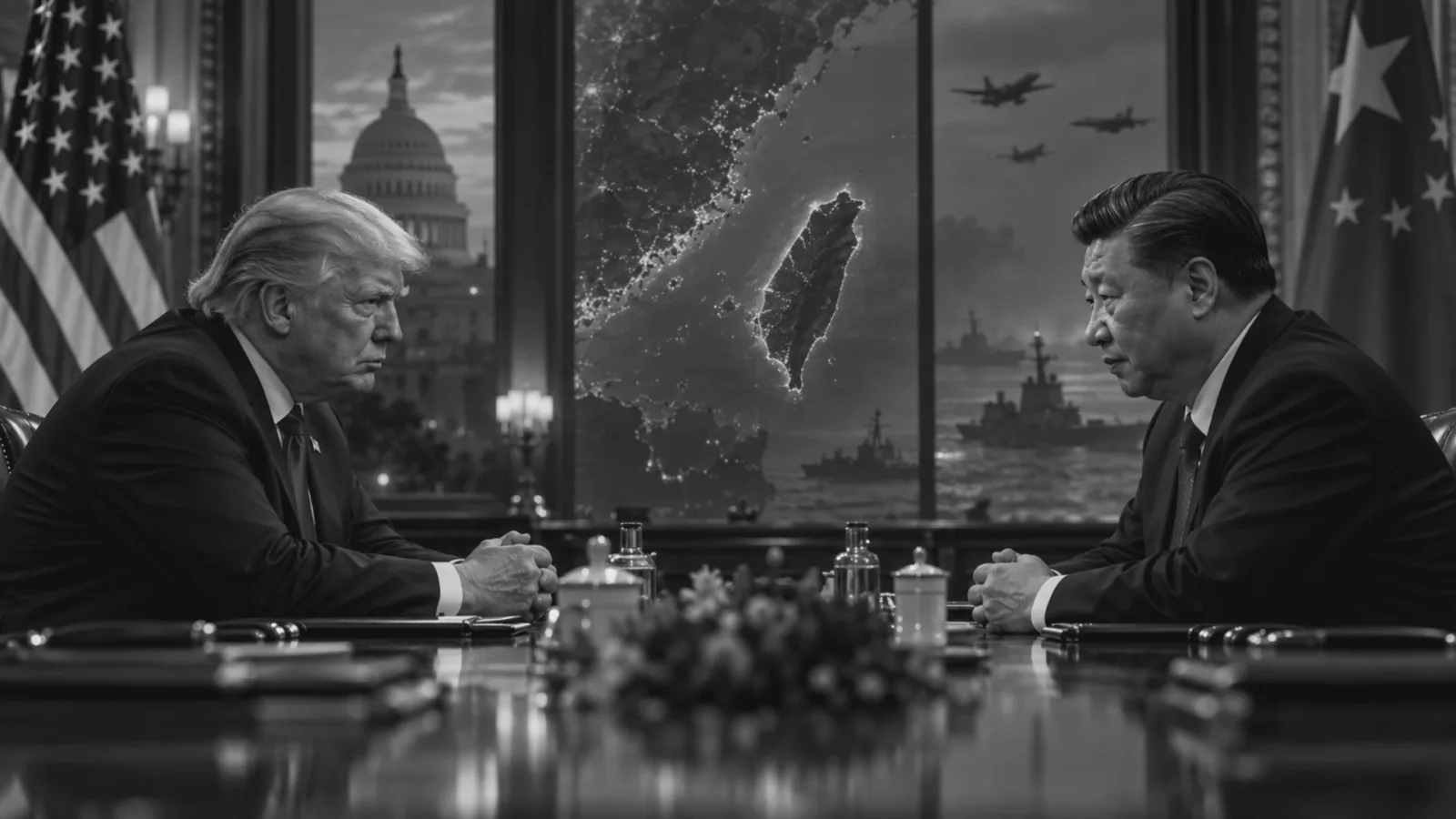
Chinese President Xi Jinping arrived in Washington on 23 September for his first visit to the US capital in more than a decade, setting up his second summit with President Donald Trump this year after their May meeting in Beijing. The ceremonial programme is unusually elaborate, with the White House announcing a full state arrival and military honours involving 479 US service personnel, while Xi used his arrival statement to argue that China and the United States should become “partners rather than opponents” and develop what Beijing has called a constructive relationship of strategic stability. Behind the choreography, however, sits a much harder contest over trade, advanced technology, critical minerals, Iran and Taiwan. The trade confrontation has temporarily eased, with US Treasury Secretary Scott Bessent saying the two sides had agreed to extend their tariff truce until 10 January, but the Taiwan question has emerged as one of the most consequential security issues surrounding the summit.¹
The immediate issue is not whether Washington recognises Beijing or Taipei, nor whether the longstanding US “one China” policy is formally being abandoned. The narrower and more operationally significant question is whether Trump will proceed with a roughly $14 billion package of additional weapons for Taiwan that has remained unresolved since his May meeting with Xi. Reuters reported ahead of the Washington summit that Xi is expected to press Trump to halt US arms sales altogether, including deliveries from previously approved packages, and to base that demand on Beijing's interpretation of the 17 August 1982 US-China Joint Communiqué. Trump, meanwhile, said after his May summit that the pending package represented a “very good negotiating chip”. This combination has transformed what would ordinarily be a defence procurement decision into a test of how Washington manages security commitments to Taiwan while simultaneously bargaining with Beijing over trade, rare earths, Iran and other issues.²
Taiwan returns to the centre of the summit
Taiwan has always occupied a distinct position within US-China relations, but the circumstances surrounding today's summit make the issue unusually sensitive. Reuters reported that Chinese officials want Washington not merely to postpone the next package but to stop weapons deliveries that have already been ordered by Taiwan. Beijing has also continued pressing Washington over the language it uses regarding Taiwan, with Chinese efforts reportedly seeking a US statement that Washington “opposes” Taiwan independence rather than the longstanding formulation that it “does not support” Taiwan independence. No such policy change has been announced, and Reuters reported that any alteration would encounter significant resistance in Washington, including from members of Congress concerned about the implications for Taiwan and US security relationships elsewhere in the Indo-Pacific.³
For Taipei, the uncertainty surrounding the arms package has consequently become nearly as important as the weapons themselves. Taiwan's government said on 24 September that it remained in close contact with Washington and thanked the United States for its support ahead of the Trump-Xi meeting. Taiwan's concern is understandable because Trump has already demonstrated that Taiwan arms sales can become part of his broader negotiating framework with Beijing. After meeting Xi in May, Trump said the two leaders had discussed Taiwan extensively, that he had made no commitment either way and that he would decide on future sales subsequently. Four months later, the approximately $14 billion package remains pending, while Reuters reported on 19 September that the delay was already affecting US defence company Anduril's planning in Taiwan.⁴
The 1982 communiqué is becoming relevant again
The legal and diplomatic argument is considerably more complicated than the proposition that Washington once promised to end arms sales. In the 17 August 1982 communiqué, the United States stated that it did not seek a long-term policy of selling weapons to Taiwan, that future sales would not exceed the qualitative or quantitative levels supplied in the years following diplomatic normalisation with Beijing, and that Washington intended gradually to reduce those sales. Beijing continues to cite that language when demanding that arms transfers cease and argues that continued large-scale American sales violate the political foundation of US-China relations. China's Foreign Ministry has repeatedly characterised the Taiwan question as the first “red line” in bilateral relations and has imposed countermeasures on American defence companies and executives involved in weapons transfers.⁵
Washington's historical interpretation of the same agreement is different. Declassified US documents published by the American Institute in Taiwan show that President Ronald Reagan's administration treated any reduction in arms sales as conditional on Beijing continuing to pursue a peaceful resolution of cross-Strait differences. Reagan's internal memorandum explicitly linked the quantity and quality of weapons supplied to Taiwan to the military threat posed by the People's Republic of China. The accompanying Six Assurances stated that Washington had not agreed to set a termination date for arms sales, had not agreed to consult Beijing before such sales, had not agreed to revise the Taiwan Relations Act and would not pressure Taiwan into negotiations with the PRC. The present disagreement is therefore not simply about whether the 1982 communiqué exists. Beijing and Washington have maintained materially different interpretations of what its commitments mean and what conditions govern them for more than four decades.⁶
The arms packages are changing Taiwan's defence posture
The scale and composition of recent weapons sales help explain why Beijing is treating the issue so seriously. In December 2025, Washington completed congressional notification for eight Taiwan arms-sale cases worth $11.1054 billion, at the time the largest package announced for the island. The package included additional HIMARS long-range precision-strike systems, M109A7 self-propelled howitzers, Javelin and TOW anti-armour missiles, ALTIUS unmanned systems, the Taiwan Tactical Network, AH-1W helicopter support and Harpoon missile maintenance. The HIMARS component alone was valued at approximately $4.05 billion and included 82 M142 launchers, 420 ATACMS missiles and substantial quantities of GMLRS ammunition, while the ALTIUS package incorporated both ALTIUS-700M loitering munitions and ALTIUS-600 intelligence and surveillance platforms. These are not simply replacement purchases. Together, they support Taiwan's wider effort to build dispersed precision strike, unmanned, anti-armour and networked battlefield capabilities.⁷
The second package, estimated at roughly $14 billion, is even more politically sensitive because it requires a presidential decision and reportedly contains advanced interceptor missiles. It was already approaching approval earlier in 2026 before becoming entangled with the May Trump-Xi summit. Taiwan's Defence Minister Wellington Koo said in March that Taipei understood the US review process to be progressing and that Taiwan had received a letter of guarantee from Washington, yet Trump's comments following the May meeting introduced a new element of uncertainty. The administration has not publicly abandoned the package, but neither had it approved it by the time Xi arrived in Washington. What began as a weapons transaction has therefore become a visible indicator of whether Taiwan security assistance is handled as a separate defence-policy process or incorporated into broader presidential bargaining with China.⁸
Beijing is seeking more than a delay
China's objective at the summit appears broader than preventing one $14 billion notification. Reuters reported that Beijing is expected to ask Washington to stop both future arms sales and deliveries connected to existing contracts. If accurately reflecting Beijing's position, the distinction matters because Taiwan has a substantial pipeline of US equipment that will be delivered over several years. Halting a prospective package affects future capability development, while disrupting previously contracted deliveries would influence programmes already incorporated into Taiwan's force planning. China has repeatedly argued that American weapons transfers encourage separatism and undermine cross-Strait stability, while Taiwan and successive US administrations have argued that defensive capability and deterrence reduce the risk of coercion. These are fundamentally competing theories of what produces stability in the Taiwan Strait, rather than a narrow disagreement over procurement.
Xi had already raised the subject directly with Trump well before the Washington visit. During a February telephone conversation, Xi described Taiwan as the most important issue in China-US relations and specifically told Trump that Washington needed to handle arms sales “with prudence”. The issue was raised again during their May talks in Beijing. Trump's subsequent decision to keep the next package in abeyance gave Beijing reason to continue pressing the matter, while the December 2025 package provided evidence that the administration had not abandoned large-scale military support for Taiwan altogether. The resulting policy picture is therefore mixed rather than representing either a definitive American retreat from Taiwan or an uninterrupted continuation of earlier practice.⁹
Trade, rare earths and Iran complicate the Taiwan question
The broader summit agenda creates the possibility of linkages that would not exist if Taiwan were discussed in isolation. Washington wants continued Chinese cooperation on critical-mineral supplies and improved access for US agricultural and industrial exports, while Beijing wants relief from restrictions affecting Chinese access to advanced American technologies. The two governments have already agreed to extend their tariff truce to January, and the May summit produced new bilateral trade and investment mechanisms as well as Chinese commitments regarding US agricultural products, Boeing aircraft and rare-earth supply issues. Reuters has also reported, citing people familiar with pre-summit discussions, that Beijing may offer assistance in exerting pressure on Iran while simultaneously raising its demands concerning Taiwan. There is no public evidence of a formal Taiwan-for-Iran or Taiwan-for-trade bargain, so such reporting should not be treated as proof that an exchange has been agreed. It does show, however, that Taiwan is being discussed in an environment where economic and geopolitical bargaining is taking place across several issues simultaneously.¹⁰
This is what makes the treatment of the arms package more consequential than its nominal value. If Washington proceeds with the package soon after the summit, it would show that the administration continues to separate at least some Taiwan defence decisions from economic negotiations with Beijing. If the package remains delayed, the more useful analytical question will be why, since postponement could reflect diplomacy with China, US production and stockpile considerations, internal review, Taiwan's own procurement process or some combination of these factors. The observable indicators after the summit will therefore matter more than summit rhetoric alone. These include the eventual presidential decision on the $14 billion package, the pace of already contracted deliveries, any modification of official US language on Taiwan, Chinese military activity around the island and whether expanded US-China military communication accompanies a reduction or an increase in operational friction. This is an analytical framework rather than a prediction of which course Washington will take.
The regional signalling extends beyond Taiwan
Washington has also been signalling that its Taiwan policy exists within a wider Indo-Pacific security framework. On 21 September, just days before the Trump-Xi meeting, the foreign ministers of the United States, Japan and South Korea issued a joint statement stressing the importance of peace and stability across the Taiwan Strait and opposing unilateral changes to the status quo. Taiwan publicly welcomed the statement. At the same time, US legislators from Trump's own Republican Party have urged the administration not to modify American security cooperation or arms sales in response to Chinese objections. These statements do not determine presidential policy, but they demonstrate that decisions taken at the summit are being watched not only in Taipei and Beijing but also by governments and political institutions that assess US commitments across the Indo-Pacific.¹¹
For India, this makes the summit relevant beyond the Taiwan Strait. New Delhi's principal interest is not the specific size of a Taiwanese arms package but the manner in which Washington manages simultaneous economic interdependence and security competition with Beijing. The US-China relationship increasingly combines military rivalry with trade negotiations, technology controls, critical-mineral dependence and crisis-management mechanisms, a combination India also has to account for in its own assessment of Chinese power. Any developments concerning cross-Strait deterrence, Chinese military reactions, US technology controls and Washington's security relationships in the first island chain can therefore influence the wider strategic environment within which India develops its Indo-Pacific partnerships, maritime posture and China policy. No single Trump-Xi summit will determine that environment, but the decisions that follow the Washington meeting will provide evidence about how both powers intend to manage competition without allowing individual disputes to collapse the broader relationship.
Assessment
The Washington summit is being presented by both governments as an exercise in stabilising one of the world's most consequential bilateral relationships. Xi's arrival statement emphasised partnership and peaceful coexistence, while the White House has placed significant emphasis on ceremony and presidential diplomacy. The economic track has already delivered a further extension of the tariff truce, and there may be additional agreements on trade, artificial intelligence and military communication. Yet Taiwan exposes the limits of strategic stability because the two governments continue to define the foundations of that stability differently. Beijing argues that US military support for Taiwan undermines sovereignty and encourages separatism, while the American policy framework has historically treated Taiwan's defensive capacity and a peaceful resolution of cross-Strait differences as interconnected.
The key question after 24 September will therefore not be whether Trump and Xi produce conciliatory language. It will be whether the summit changes actual policy. The approximately $14 billion Taiwan arms package provides an unusually clear indicator because it sits at the intersection of presidential diplomacy, US defence commitments, China's pressure campaign and Taiwan's military modernisation. Washington can seek economic accommodation with Beijing while continuing Taiwan arms transfers, or it can adjust the timing and scale of those transfers as part of its broader management of relations with China. Beijing, conversely, can continue treating the issue as a prerequisite for stable ties or accept continued disagreement while preserving cooperation elsewhere. The summit's strategic significance will become clearer through those subsequent decisions rather than through ceremony alone.
References
The White House, “First Lady Melania Trump Releases Details Ahead of His Excellency Xi Jinping, President of the People’s Republic of China, and Madame Peng Liyuan’s Visit to the White House,” September 21, 2026. White House
Trevor Hunnicutt, Yimou Lee, and Ben Blanchard, “China’s Xi Expected to Press Trump to Halt Taiwan Arms Sales under 1982 Agreement, Sources Say,” Reuters, September 22, 2026. Reuters report
David Brunnstrom and Joe Cash, “Key Issues for This Week’s Trump-Xi Summit in Washington,” Reuters, September 17, 2026. Reuters analysis
Reuters, “Taiwan Thanks US for Its Support Ahead of Trump-Xi Summit,” September 24, 2026. Reuters report
US Department of State, Office of the Historian, “The August 17, 1982 U.S.-China Communiqué on Arms Sales to Taiwan.” US State Department historical record
American Institute in Taiwan, “Declassified Cables, Taiwan Arms Sales and Six Assurances, 1982.” American Institute in Taiwan documents
Ministry of National Defense, Republic of China, “U.S. Government’s Congressional Notification Procedure for Arms Sales to Taiwan,” December 18, 2025. Taiwan Ministry of National Defense
Defense Security Cooperation Agency, “Taipei Economic and Cultural Representative Office in the United States, High Mobility Artillery Rocket Systems,” December 17, 2025. DSCA arms-sale notification
Ministry of Foreign Affairs of the People’s Republic of China, “President Xi Jinping Speaks with U.S. President Donald J. Trump on the Phone,” February 2026. Chinese Ministry of Foreign Affairs
Trevor Hunnicutt and David Brunnstrom, “Trump Welcomes Xi to Washington Looking for a Trade Win,” Reuters, September 24, 2026. Reuters report
Office of the President, Republic of China, “Presidential Office Thanks US, Japanese, and South Korean Foreign Ministers for Joint Statement,” September 22, 2026. Taiwan Presidential Office
Tags
- #China
- #China military
- #China Taiwan Conflict
- #Indo Pacific Security
- #Taiwan Arms Sales
- #Taiwan Strait
- #Trump Xi Summit
- #US China Relations
- #US China Trade War
Author