
Japan Eyes Indian Missile and Drone Training Ranges: Strategic Implications
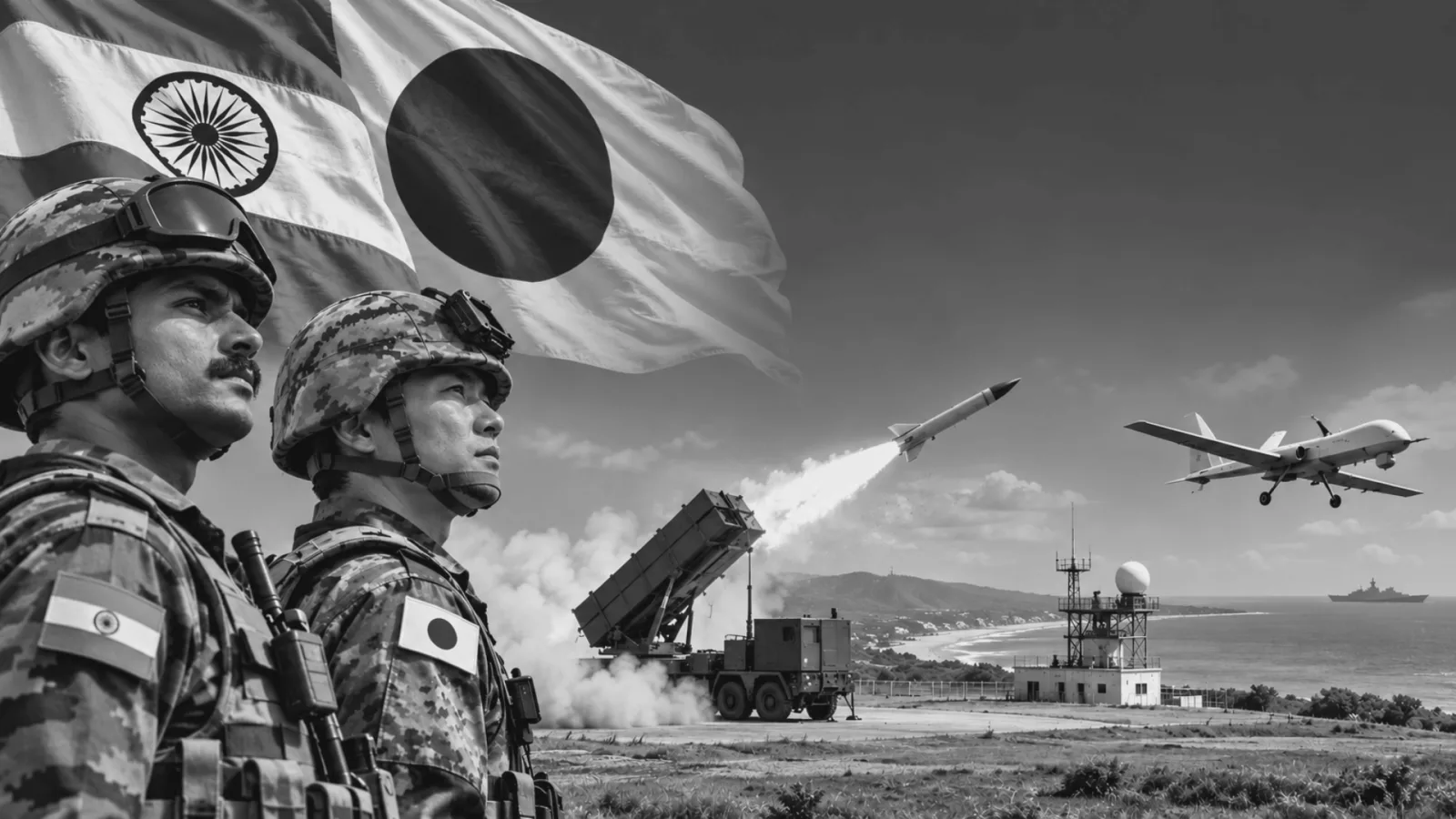
Japan is exploring the use of Indian military training facilities for long-range anti-ship missile firing and small attack-drone operations, marking a potential expansion of bilateral defence cooperation. On 27 October 2026, General Masayoshi Arai, Chief of Staff of Japan's Ground Self-Defense Force (JGSDF), confirmed that Japanese personnel had been dispatched to India for consultations. The initiative reflects Tokyo's need for suitable training environments as it introduces longer-range strike weapons and expands its unmanned capabilities. For India, the proposed arrangement could strengthen defence interoperability, enhance its role as a regional military training partner and deepen strategic cooperation with Japan amid China's expanding military presence across the Indo-Pacific.
The Development
Japan has confirmed that it is examining Indian military facilities for possible training involving surface-to-ship missiles and small attack drones. During a press conference on 27 October, General Masayoshi Arai acknowledged that Japanese personnel had been sent to India to coordinate potential arrangements, explaining that conducting realistic training with increasingly long-range missiles had become a significant challenge for the JGSDF. He also confirmed that training involving small attack drones formed part of the discussions.¹
The proposal is not entirely new. During his visit to India on 20 August 2026, Japanese Defence Minister Shinjiro Koizumi raised the possibility of Japanese Self-Defense Forces using Indian testing and training ranges during discussions with Defence Minister Rajnath Singh.² Subsequent consultations indicate an effort to translate that political understanding into practical military cooperation. However, neither government has announced a final agreement, designated a specific Indian facility or confirmed the weapons and dates for any proposed exercise.
Why Japan Needs Indian Training Facilities
Japan's requirement is closely linked to its expanding stand-off strike capabilities, particularly the Type-25 surface-to-ship guided missile, an upgraded version of the Type-12 system. The Type-25 entered service with the JGSDF in March 2026 and has a reported range of approximately 1,000 kilometres.³ Such capabilities significantly increase the distance at which Japanese ground forces could engage hostile naval formations, but their operational effectiveness depends on realistic training, targeting procedures, communications and coordinated engagement capabilities.
Japan's geography and the safety requirements associated with long-range live firing complicate the establishment of suitable training environments. India's extensive military testing infrastructure and access to large maritime exercise areas could provide an alternative, although any arrangement would require detailed coordination over airspace, maritime safety, range instrumentation and operational restrictions. India's Integrated Test Range in Odisha represents an established example of such infrastructure, but there has been no official confirmation that it has been selected for Japanese training.
The proposed drone component is equally important. Japan is developing its Synchronized, Hybrid, Integrated and Enhanced Littoral Defense (SHIELD) architecture, which envisages combining unmanned aerial, surface and underwater systems for layered coastal defence.⁴ Access to suitable Indian facilities could eventually support experimentation and training involving small attack drones, particularly where operational requirements extend beyond conventional short-range exercises.
Strategic Implications for India and Japan
First, the proposed arrangement would move bilateral defence cooperation beyond periodic joint exercises towards more sustained operational integration. India and Japan already conduct the Dharma Guardian army exercise, JAIMEX naval engagements and Veer Guardian air exercises. Their August 2026 defence consultations also emphasised increasingly complex exercises, greater integration of unmanned systems and opportunities for short-notice joint training.⁵ Providing access to specialised firing facilities could create a deeper institutional relationship involving technical coordination, training standards and operational familiarisation.
Second, the initiative carries significance for the regional military balance involving China. Japan's growing long-range anti-ship capabilities are closely associated with its concerns over maritime security in the East China Sea and potential contingencies around Taiwan. India, meanwhile, faces its own security challenges arising from China's military modernisation and expanding presence in the Indian Ocean. Although the proposed training arrangement does not constitute a joint operational plan against China, closer cooperation could enhance the preparedness of two important Indo-Pacific military powers and complicate Beijing's regional strategic calculations.
Third, India could strengthen its position as a provider of specialised military training infrastructure. Beyond hosting bilateral exercises, the availability of Indian facilities for sophisticated Japanese weapon systems could open opportunities for collaborative training, technical exchanges and defence-industrial engagement. Such cooperation would complement ongoing discussions on maritime mine countermeasures, naval shipbuilding and defence technology collaboration between New Delhi and Tokyo.
The latest engagement between Defence Ministers Rajnath Singh and Shinjiro Koizumi, held on 28 October in the Philippines, reinforced this broader trajectory. Their joint statement highlighted progress in maritime cooperation, air-force engagement and defence-industrial collaboration, while committing to further discussions ahead of the next bilateral 2+2 ministerial meeting.⁶
Assessment and Outlook
Japan's interest in Indian missile and drone training ranges reflects an emerging requirement within modern military partnerships: access to operational environments capable of supporting increasingly sophisticated weapons. As long-range precision-strike systems and unmanned platforms become integral to military planning, training infrastructure itself is acquiring greater strategic importance.
For India, the prospective arrangement offers an opportunity to deepen its defence partnership with Japan without necessarily entering into binding operational commitments. Nevertheless, implementation would require agreement on training access, safety protocols, protection of sensitive technical information and the scope of permissible activities.
CNAWS assesses that the significance of the initiative lies less in the immediate prospect of Japanese missiles being fired from Indian territory and more in the gradual institutionalisation of operational defence cooperation. The next meaningful indicators will be the announcement of a formal training arrangement, identification of approved facilities and inclusion of missile or drone activities in future bilateral exercises. Until then, the proposal should be treated as an exploratory initiative rather than an operationally established programme.
Endnotes
Japan Ground Self-Defense Force, “Regular Press Conference by Chief of Staff General Masayoshi Arai,” October 27, 2026 (Japanese), official transcript.
Japan Ministry of Defense, “Extraordinary Press Conference by Defense Minister Koizumi,” August 20, 2026, official transcript.
Japan Ministry of Defense, “Press Conference by Defense Minister Koizumi,” March 31, 2026, official statement; Jesse Johnson, “Japan Eyes Using Indian Test Ranges for Powerful Missiles and Small Attack Drones,” The Japan Times, October 27, 2026, article.
Japan Ministry of Defense, Defense of Japan 2026, section on strengthening unmanned defence capabilities, official white paper.
Japan Ministry of Defense, “Japan-India Joint Press Statement,” August 20, 2026, official statement.
Japan Ministry of Defense, “Japan-India Joint Press Statement,” October 28, 2026, official statement; Government of India, Ministry of Defence, “Raksha Mantri and His Japanese Counterpart Meet on the Margins of ADMM-Plus in Philippines,” Press Information Bureau, October 28, 2026, press release.
Tags

Author