
Taiwan’s Record 2027 Defence Budget : Is ‘Whole-of-Society’ Deterrence Becoming an East Asian Security Doctrine?
1. Introduction
Taiwan has proposed a defence budget of NT$1.1225 trillion for 2027, roughly US$35 billion, or 3.01% of GDP, marking a historic milestone[1].
It is the first time the defence spending has crossed the NT$1 trillion mark, accounting for nearly 29% of total government expenditure[2]. President Lai Ching-te has already pledged to keep defence above 3% of GDP and push it further towards 5% by 2030[3].
Most discussions focus entirely on the hardware the budget will buy: the missiles, drones and ammunition stocks. This analysis goes beyond the raw numbers. Beneath the budget lines, Taiwan has quietly built a second layer of defence alongside traditional military modernization, a whole-of-society-defence framework designed to make the island difficult to coerce and disrupt. The real question is what this record spending reveals about Taipei's view of deterrence today. Is it part of an emerging, shared security doctrine across East Asia, or simply a survival reflex driven by a uniquely hostile neighbourhood?
Three main ideas drive this analysis. First, the numbers only make sense when examined alongside Ministry of National Defence procurement plans and legislative pushback, since those political fights determine what gets delivered. Second, since 2022, Taiwan has added a civilian resilience layer to its asymmetric military strategy, aiming to alter an adversary's risk calculations before a conflict even starts. Third, as other East Asian democracies face similar pressures, the analysis explores whether their responses point to a genuine regional doctrine or are merely parallel national reactions to a common problem.
2. Where Taiwan Stands
Taiwan presents a stark paradox in East Asian security. It is an indispensable economic power with a near monopoly on advanced semiconductors[4], and it is also strategically isolated. It is the world’s 22nd-largest economy according to the IMF[5] and ranks 8th in the region for economic capability on the Lowy Institute’s Asia Power Index[6]. Yet that weight buys little diplomatic cover. Taiwan ranks 24th of 27 for diplomatic influence with a score of just 16.6 out of 100.[7] It has no nuclear deterrent and no mutual defence pact, and it lies barely 160 kilometres from a vastly larger adversary. Its security rests not on a binding treaty but on the domestic provisions of the US Taiwan Relations Act.[8]
On raw military strength, Global Firepower’s 2026 index ranks Taiwan 22nd of 145 countries and places it in the top ten for reserves, fighter aircraft and frigates (Table 1).[9] Such rankings say little about survivability, maintenance backlogs or modernisation. The same source suggests only about two-thirds of the tank fleet is available at any time, and its figure of 230,000 active personnel compares with roughly 169,000 posts the Ministry has actually filled.[10] The inventory was also built with conventional warfare in mind, whereas the pressure Taiwan faces day to day is grey-zone coercion, blockade and cognitive warfare. The rising defence budget is meant to close that gap.
Category | Stock | World rank (of 145) |
Overall Global Firepower ranking | – | 22 |
Reserve personnel | 1,657,000 | 5 |
Tanks | 1,090 | 20 |
Fighters | 258 | 8 |
Frigates | 21 | 2 |
Submarines | 4 | 13 |
Taiwan’s military strength and world rank, 2026
(Source: GlobalFirepower.com, 2026. Ranks are by unit count. Other sources put the tank inventory at between 888 and about 1,100)
3. What the Number Says
3.1 The Headline and Its Components
The record is real but less dramatic than the headline suggests, and the reason lies in how the total is built. The Directorate-General of Budget, Accounting and Statistics calculates it on a method similar to NATO’s, the same basis it applied to the 2026 proposal.[11] The Ministry of National Defense directly controls only about 62% of the headline figure. The rest is spread across separate arms procurement budgets, special funds, pensions and the Coast Guard (Table 2).
The GDP denominator matters too. Measured against the August 2025 GDP forecast used for 2026 (about NT$28.6 trillion), the same spending would equal 3.93 per cent of GDP, and on the larger forecast now used for 2027 (NT$37.3 trillion) it equals 3.01 per cent.[12] The 2027 share is therefore lower than the 3.32 per cent recorded for 2026.[13] The record is a nominal one.
Component | NT$ billion | Share |
Ministry of National Defense budget | 691.9 | about 62% |
Special budgets (large weapons purchases) | 218.2 | about 19% |
Military pensions and Coast Guard | 151.7 | about 14% |
Non-operating special funds | 60.7 | about 5% |
Total | 1,122.5 | 100% |
What the NT$1.1225 trillion contains
(Source: Focus Taiwan (CNA), 20 August 2026. Shares are the author’s calculation)
3.2 A Sustained Rise, and a Smaller Leap Than It Looks
Taiwan’s proposed 2027 allocation continues an earlier trend rather than marking a sudden spike. Spending rose under Tsai Ing-wen from 2% of GDP in 2017 to 2.5% in 2023.[14] The 2026 budget then jumped by 22.9% to NT$949.5 billion.[15] The 2027 proposal sounds dramatic at 18 per cent, but that is measured against the initial 2026 baseline of NT$949.5 billion.[16] Against the full 2026 budget of NT$1.0748 trillion, which includes special procurement budgets, the actual expansion is 4.4 per cent.[17]
The growth is nonetheless real. The fairest description is a steady rise that has steepened, with a headline inflated by definition and the choice of the baseline. The 5% of GDP defence target remains a steep climb, one that will test Taiwan’s fiscal capacity and its political consensus alike.
3.3 What the Ministry Set Out to Buy
The Ministry of National Defence’s public report to the Legislative Yuan of 20 April 2026 set out a NT$1.25 trillion, eight-year plan in seven categories.[18] It is heavily redacted, and the English version is a machine translation, but it is the best available primary document.
Category | Value (NT$) | Disclosed items |
1. Precision artillery | ~81 bn | 60 M109A7 self-propelled guns; 4,080 precision rounds; 60 ammunition carriers; 13 recovery vehicles |
2. Long-range precision strike | ~160 bn | 82 HIMARS launchers; 1,203 boxes of precision rockets; 420 tactical missiles |
3. Uncrewed systems and counter-measures | ~335 bn | 208,200 coastal attack drones; 1,446 coastal reconnaissance drones; 1,320 suicide uncrewed surface vessels; 32 Rui Yuan II maritime UAVs; 478 ALTIUS-600 and 1,554 ALTIUS-700M; 635 man-portable counter-UAV sets |
4. Air defence, anti-ballistic and anti-armour | ~550 bn | Strong Bow mid-layer system (2 sets, 128 missiles); 70 Javelin sets (1,050 missiles); 24 TOW-2B sets (1,545 missiles); three further items redacted |
5. AI-assisted and C4ISR | ~10 bn | AI decision support (redacted); 120,191 Taiwan Tactical Network and Team Awareness Kit devices |
6. Sustained combat capacity | ~50 bn | New ammunition, battery, propellant and armoured-vehicle production lines; 23,500 120mm and 60,000 105mm tank rounds; 260,000 30mm rounds; 356 motorised barrier sets |
7. Taiwan–US co-developed systems | ~64 bn | Entirely redacted in the public version |
The Ministry’s seven-category procurement plan (April 2026)
Source: Ministry of National Defense, public report to the Legislative Yuan, 20 April 2026 (machine translation).
3.4 Priorities and Procurement
Three ideas sit behind the growing budget. The first is deterrence. Announcing the proposal on 17 August 2026, President Lai argued that investing in defence is investing in peace.[19] The second is the threat. Pitching the special budget to lawmakers, the defence ministry pointed to relentless PLA joint drills as proof that readiness cannot wait.[20] The third is credibility with allies. The United States expects Taiwan to share the burden, and a larger spending package signals to US officials that Taipei takes burden-sharing seriously.[21]
These aims translate into three procurement priorities.
Air and missile defence. The layered ‘T-Dome’, or Taiwan Shield, is meant to speed up detection and interception and to protect civilians and property. Defence Minister Wellington Koo said the Chiang Kung system had cleared trials and been funded, though the network is still incomplete. Units will also get man-portable counter-drone kit. Koo conceded that firing multi-million-dollar Patriots at cheap commercial drones is unsustainable.[22]
Unmanned mass and networked strike. The emphasis is on volume over exquisite platforms, with more than 200,000 strike drones and more than 1,300 uncrewed boats, expanded munitions plants and joint research with the United States.[23]
Sustainment and domestic manufacturing. Planners expect a long blockade, so the budget includes more ordnance, spare parts and reserves to keep frontline units supplied in the opening weeks. Koo argued that annual allocations leave local suppliers living hand to mouth, whereas a multi-year special budget gives them the certainty to build factories and tooling.
The political path has been rougher than the plan. The Ministry’s original special programme of NT$1.25 trillion became a NT$780 billion act after the legislature removed items.[24] The drone and domestic-industry elements were taken out and are now moving through the annual budget and a supplementary request.[25]
4. How Taiwan’s Security Posture Evolved, 2000–2026
Taiwan’s present emphasis on whole-of-society resilience developed slowly and was not a sudden departure. This section draws mainly on John Dotson’s survey of Taiwan’s defence policy.[26] Under Chen Shui-bian (2000–08) and Ma Ying-jeou (2008–16), Taiwan moved towards a smaller all-volunteer force, cutting conscription from two years to one and then to four months. Chen’s ‘Decisive Battle Offshore’ favoured air and naval power. Ma’s ‘Hard ROC’ stressed asymmetric advantage, robust infrastructure and stockpiles, ideas that anticipate today’s resilience debate.[27]
Under Tsai Ing-wen (2016–24) spending rose by about 5 per cent a year from 2019 to 2023, reaching around 2.5 per cent of GDP. One-year conscription, announced in December 2022, formally began in January 2024.[28] The focus on indigenous defence production also increased; for instance, the Sea-Air Combat Power Improvement Plan Purchase Special Regulations provided a five-year supplemental budget of NT$240 billion (2022–2026) to produce domestic anti-ship and anti-aircraft missile systems and naval vessels.[29]
Civilian resilience developed alongside, probably prompted by the war in Ukraine and the crackdown in Hong Kong.[30] Tsai’s 2022 National Day address, ‘Island of Resilience: A Better Taiwan for the World’ ,made it a national priority. The All-Out Defense Mobilization Agency, authorised in May 2021, began work on 1 January 2022 by merging the mobilisation office and the reserve command.[31] In September 2022 the National Security Council began studying other countries’ resilience initiatives, including incident-response centres, civilian training, stockpiling, digital resilience, civil air defence and evacuation models.[32] Lai Ching-te (2024–) brought continuity with a reformist touch, notably a civilian defence minister, Wellington Koo.
Underneath sits a strategic dispute. Admiral Lee Hsi-min’s Overall Defence Concept (ODC) put dispersed, mobile, asymmetric forces first. The official alternative, ‘Resolute Defence, Multi-Domain Deterrence’, is criticised as too vague to set procurement priorities.[33] Part of the split is about the threat. Washington tends to plan for a conventional invasion, whereas Taipei lives with daily grey-zone coercion, cognitive warfare and blockade pressure.
5. Whole-of-Society Resilience in Taiwan: Enhancing Asymmetric Capabilities
5.1 Definitions and Logic
There is little agreement on what ‘resilience’ means, and definitions tend to follow the mandate of whoever uses them. For NATO it is the ability to keep performing essential functions during and after an attack[34], with baseline requirements that include continuity of government, resilient energy, food and water, and civil communications and transport.[35] RAND’s working definition for Taiwan is the ability of civil society to anticipate, prepare for, mitigate and survive an act of war, and to rebuild afterwards.[36] The Presidential Office frames it more simply government and society must be able to maintain normal operations in a national emergency or natural disaster.[37]
Whole-of-society defence is a claim about how resilience relates to deterrence. The logic is denial applied to society. If a state can show that its population, infrastructure and government will keep working under pressure, the adversary’s expected gain from coercion or attack falls. Brookings calls the resilience effort a substantial part of Taiwan’s approach to defence and deterrence.[38]
Chan and Murphy of the Global Taiwan Institute argue that a resilient society denies an aggressor victory through shock and paralysis, which raises the perceived cost and duration of conflict.[39] They name two assumptions in Beijing’s calculus that resilience is meant to break. The first is that force alone can create panic among the people. The second is that seizing territory or removing the leadership will induce capitulation. Recent conflicts, including Ukraine and the Iran-Israel conflict, showed that national survival cannot rely on forward defence alone. [40] On this reading resilience has moved from a supplement to a pillar of deterrence.
5.2 The Architecture
Taiwan’s civil defence strategy rests on two lessons. The first is the Cold War ‘total defence’ model used by small states such as Sweden, Finland and Singapore, where societal resilience forms part of national deterrence.[41] The second is Russia’s full-scale invasion of Ukraine in 2022, which showed how much civilian endurance and volunteer networks can shape the outcome of a war.[42] Sweden’s phased revival of conscription is one recent example.[43]
In Taiwan the idea first took shape under President Tsai, in the Overall Defence Concept of Chief of the General Staff Lee Hsi-min. It envisaged using civilian resources to support military operations, but its core aim was to defeat an enemy in the littorals by asymmetric means, and civilian participation in a territorial defence force was a last resort. The rest of the Ministry of National Defense never fully accepted the concept, so the civilian role it envisaged never materialised.[44]
The All-Out Defense Mobilization Agency, created in 2022, has as its main mission the organisation of reservists, with civil defence second. Its most visible civil defence act was a handbook published after Russia’s invasion of Ukraine.[45] A more concrete step came under President Lai, who in June 2024 set up the Whole-of-Society Defence Resilience Committee (WSDRC) and chairs it personally.[46]
5.3 The Whole-of-Society Defence Resilience Committee
The WSDRC has 27 members. The President is convener, with three deputy conveners and 23 representatives of government, industry, civil society and expert bodies. NT$150 billion (about US$5 billion) is earmarked for national resilience and territorial defence.[47] Its purpose is to keep government and society functioning in a national emergency or disaster, and its mandate covers natural disasters as well as military operations such as blockade or missile strikes.[48] Its objectives and pillars are set out in Table 4.
Objectives | Pillars |
Ensure continuity of government operations
| Civilian training
|
Sustain critical social services and core functions of society
| Strategic material stockpile and distribution
|
Provide civil support to military operations when necessary
| Critical infrastructure, including social welfare, medical care and evacuation
|
| Information systems, communications and financial networks
|
| Transportation resilience
|
WSDRC objectives and pillars
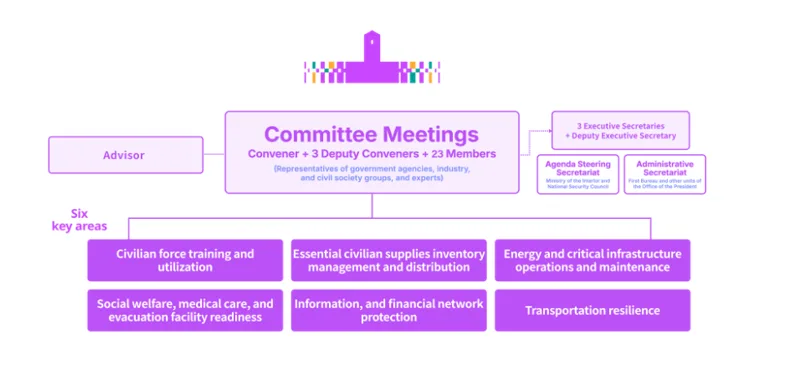
Figure 1: Flowchart of the structure of the Whole-of-Society Defense Resilience Committee, Taiwan Source: Office of the President, Republic of China (Taiwan), “About the committee” (organization chart)
6.4 From Reassurance to Rehearsal
The first operational benchmark was a field exercise on 27 March 2025. The newly established WSDRC mobilised around 1,500 personnel across municipal departments, critical infrastructure operators and civic groups such as the Tzu Chi Foundation and the Presbyterian Church in Taiwan.[49] Officially it was framed around natural disaster. The rehearsal nonetheless incorporated simulated sabotage and electrical failures. The scenarios combined an earthquake and tsunami with infrastructure disruption.[50]
Before 2025 the national Han Kuang exercise relied on scripted coastal firing demonstrations aimed at domestic reassurance. Han Kuang 41 in July 2025 broadened the integration considerably. The military extended its live-fire phase to ten continuous days and nine nights, replaced set-piece beach displays with unscripted urban warfare and called up more than 22,000 reservists.[51]
An urban resilience exercise merged the Wan An air-raid protocols with Min An disaster response. Community integration was tested in real time. Retail staff in selected supermarket chains such as PX Mart guided shoppers to basement shelters and gave first aid under simulated missile strikes.[52]
The April–August 2026 exercise cycle introduced higher-intensity, conflict-driven scenarios with public rationing posts, triage stations, and Central Joint Emergency Operation Centre was also established .[53]
Alongside Han Kuang 42, command posts in New Taipei, Yilan, Kaohsiung and Pingtung tested regional capacity to withstand simultaneous grey-zone disruption, including undersea cable cuts, power grid failures and drone harassment. Taiwan’s civil defence has moved from symbolic reassurance to mass sheltering and, increasingly, to testing state continuity under pressure.[54]
6. Is It a Regional Doctrine?
Barry Buzan’s regional security complex theory says that neighbouring states whose security problems are closely linked must be studied together.[55] Taiwan and Japan sit along the same island chain and face pressure from the same source, China’s grey-zone coercion and blockade risk.[56] South Korea’s main threat is North Korea, but it faces similar pressure on its homeland.[57]. These states share a problem, and each already holds many of the building blocks of societal resilience, including shelters, evacuation planning, civil protection law and civilian training. What differs is how the pieces are framed, joined together and rehearsed. Taiwan presents them as one deterrence concept. Japan and South Korea run them under other labels and for other threats. The result is convergence of threat and in part, of function, with wide variation in designs
The threats converge, but the answers do not. Each state deals with the problem in its own way, shaped by its geography, laws, and politics. A concept is a national doctrine when it is officially stated, institutionalised and exercised in practice . It is a regional doctrine only if the states concerned also form a security complex and coordinate the concept among themselves.
Taiwan meets the first and third conditions. The concept is officially stated and was first exercised in a field drill on 27 March 2025.[58] Institutionalisation is partial. The Whole-of-Society Defence Resilience Committee rests on presidential authority, President Lai has called for codification, and resourcing is still taking shape. Japan, South Korea and the Philippines face related pressures but have taken different routes (Table 5).
State | Articulation | Institutionalisation | Practice | Orientation |
Taiwan | Whole-of-society resilience (2024–) | Presidential committee; mobilisation agency; funding partial | Yes (2025–26) | Blockade, grey zone, invasion |
Japan | National resilience; economic security (2022) | Economic Security Promotion Act; Civil Protection Law (2004); Sakishima guidelines | Local civil protection drills, no deterrence framed exercise yet. | Supply chains; south-west islands |
South Korea | Civil defence (1975) | Framework Act; Civil Defence Corps | Nationwide civil defence dills , no deterrence framed exercise yet | North Korea and weapons of mass destruction |
Whole-of-society concepts against the national-doctrine tests
Japan : The Economic Security Promotion Act of 2022 sets up four systems covering critical supplies, essential infrastructure, key technologies and secret patents.[59] The Civil Protection Law of 2004 covers evacuation and relief in armed attack situations, and local governments train under it.[60]For the south-west islands, the government has planned shelters designed for stays of about two weeks in five Sakishima municipalities, and in March 2025 it published a plan to move about 120,000 people off the islands.[61] The functions are therefore present. The limits lie in the trigger, since the plan assumes a predicted armed attack, and the government has not defined what would set it off. These measures are framed as civil protection and economic security.
South Korea has a more mature civil defence system than Taiwan, built on the 1975 Framework Act and the Civil Defence Corps with about 3.28 million registered members, and nationwide drills.[62] It has been extended to cover weapons of mass destruction, and in 2023 President Yoon revived the central integrated defence council to link government, military, police and civilians.[63] The framework is directed above all at the threat from the northern borders , North Korea.[64] A Carnegie assessment noted the absence of a whole-of-government review.[65]
The verdict is mixed. Taiwan meets articulation and, newly, practice, but it is not yet fully institutionalised and its resourcing is still taking shape. On diffusion, the decisive test, functional equivalence is hard for an adversary or ally to read, and a deterrent signal has to be recognisable.
Convergence comes from the pressure. Bachmann reads Taiwan’s model as a response to cable cutting, air defence zone incursions, maritime militia exercises and quarantine or blockade signals, backed by Beijing’s ‘three warfares’.[66] This pressure falls on society and infrastructure as much as on the armed forces, so resilience sits alongside hardware.[67] A shared problem produces similar ideas, if not identical.
The link to the budget is conceptual. Hardware answers the ‘defeat’ end of Beijing’s options and resilience answers the ‘squeeze’ end, and both aim at denial.
Conclusion
Taiwan’s record 2027 defence budget is real and consequential. It continues with a steady and steepening rise, with a broad definition and an early baseline enlarging the headline figure, and it is best read together with two other developments. The first is a change in how Taiwan thinks about deterrence, from military capability alone, through the limited civilian role in the Overall Defence Concept, to the resilience of the whole society under sustained pressure. The second is a procurement process in which a NT$1.25 trillion plan became a NT$780 billion special programme, with the drone and domestic-industry elements now moving through the annual budget and a supplementary request.[68]
Is whole-of-society deterrence, then, becoming the new East Asian security doctrine? Not in the strict sense. Japan, South Korea and the Philippines have not adopted a common concept, common institutions or joint planning. Each works through its own framework, from economic-security law to civil defence to maritime defence. What they share is a common problem. Facing coercion that falls short of war, each is looking, to a different degree, beyond the conventional idea that defending a country is a task for the armed forces alone. That is a real and significant convergence. On the opening question, Taiwan’s effort is more than a survival reflex, since it is formally stated and exercised, but it is not yet a shared regional doctrine.
Taiwan is running the region’s most advanced and closely watched experiment in whole-of-society deterrence, and its outcome will shape how its neighbours think about their own vulnerabilities. Its value will be decided less by the number in the budget than by modest, measurable questions: What is contracted, what is delivered and what is rehearsed?
References:
[1] Focus Taiwan (CNA), 20 August 2026, https://focustaiwan.tw/politics/202608200011.
[2] Taipei Times, 20 August 2026, https://www.taipeitimes.com/News/front/archives/2026/08/20/2003862836.
Xinhua, "Mainland Denounces Taiwan Authorities' Move to Hike Defense Spending," China Daily Hong Kong, September 2, 2026, https://www.chinadailyhk.com/hk/article/638911.
[3] Taiwan President Ups Defence Spending Target to 5% of GDP," Reuters, August 22, 2025, https://www.reuters.com/world/china/taiwan-president-ups-defence-spending-target-5-gdp-2025-08-22/.
[4]Boston Consulting Group (BCG) and Semiconductor Industry Association (SIA), Strengthening the Global Semiconductor Supply Chain in an Uncertain Era (April 2021), 12–15; TrendForce, "Global Foundry Market Share Data."
Semiconductor Industry Association, Strengthening the Global Semiconductor Supply Chain in an Uncertain Era (Washington, DC: SIA, 2021), semiconductors.org.
[5]International Monetary Fund, World Economic Outlook Database (Gross domestic product, current prices).
[6]Lowy Institute, Asia Power Index (Sydney: Lowy Institute, 2024/2025), Taiwan Country Profile, https://power.lowyinstitute.org/countries/taiwan/.
[7]Lowy Institute, Asia Power Index (Sydney: Lowy Institute, 2024/2025), Taiwan Country Profile, https://power.lowyinstitute.org/countries/taiwan/.
[8]Taiwan Relations Act, Public Law 96-8, 22 U.S.C. §§ 3301–3316 (1979)
[9]2026 Taiwan Military Strength," Global Firepower, accessed 2026, https://www.globalfirepower.com/country-military-strength-detail.php?country_id=taiwan.
[10]Ministry of National Defense (Taiwan), National Defense Report / Legislative Yuan Budget Center; see also International Institute for Strategic Studies (IISS), The Military Balance 2024/2025, "Taiwan."
[11] Focus Taiwan (CNA), 20 August 2026, https://focustaiwan.tw/politics/202608200011.
[12]Taipei Times, 20 August 2026, https://www.taipeitimes.com/News/front/archives/2026/08/20/2003862836.
[13]Focus Taiwan (CNA), 20 August 2026, https://focustaiwan.tw/politics/202608200011.
[14]Taiwan’s Defense Spending to Reach Record NT$606.8 Billion in 2024,” Central News Agency (Taiwan), August 24, 2023, https://www.globalsecurity.org/wmd/library/news/taiwan/2023/taiwan-230824-cna03.htm.
[15] CNA, 21 August 2025, via GlobalSecurity, https://www.globalsecurity.org/wmd/library/news/taiwan/2025/taiwan-250821-cna01.htm.
[16] How Much Does Taiwan Spend on Defense—and Where Does That Money Go?,” CommonWealth Magazine, October 13, 2026, https://english.cw.com.tw/article/article.action?id=5061. Ministry of National Defense (Taiwan), National Defense Report 2026: FY2027 Expenditure Framework and Deterrence Planning (Taipei: MND, 2026); see also "Taiwan Proposes Record NT$1.1 Trillion Defense Outlay for 2027," Taipei Times, August 15, 2026.
[17]Executive Yuan, Directorate-General of Budget, Accounting and Statistics (DGBAS), Comprehensive Review of Special Procurement Appropriations and Supplementary Budgets: FY2026–FY2027 (Taipei: Executive Yuan, 2026).
[19] Taiwan, Office of the President, "President Lai Pens Washington Post Article on Boosting Defense Spending to Protect Taiwan’s Democracy," news release, November 26, 2025, https://english.president.gov.tw/News/7047.
[20] Executive Yuan. (2025, November 27). Cabinet approves draft act for defense resilience and asymmetric capabilities. Republic of China (Taiwan). https://english.ey.gov.tw/Page/61BF20C3E89B856/ca8813ba-ec5d-4dab-a4b9-8f74d60ca3ab
[21]Mistreanu, Simina, and Taijing Wu. "US Lawmakers Express Support for Stalled Taiwan Special Defense Budget." Associated Press, March 30, 2026. https://apnews.com/article/taiwan-us-lawmakers-defense-budget-congress-685b8cf5feef733a86b360325913e442 Congressional Research Service, “Taiwan: Defense and Military Issues”, updated 18 June 2026, https://www.everycrsreport.com/reports/IF12481.html.
[22]Yimou Lee, "Close Ties with US Pacific Command Boost Taiwan's Defense Readiness: Koo," Taipei Times, August 4, 2026, https://www.taipeitimes.com/News/taiwan/archives/2026/08/04/2003861903.
[23]Staff Writer, "Cabinet's Special Defense Bill Best Among Three: Koo," Taipei Times, March 24, 2026, https://www.taipeitimes.com/News/front/archives/2026/03/24/2003854355. Ministry of National Defense, special procurement report, 20 April 2026.
[24]“Taiwan’s Special Defense Budget Cut Will Cost Its Drone Capabilities,” The Diplomat, May 2026, https://thediplomat.com/2026/05/taiwans-special-defense-budget-cut-will-cost-its-drone-capabilities/. Taipei Times, 8 May 2026, https://www.taipeitimes.com/News/front/archives/2026/05/08/2003856996.
[25]Fang Wei-li and Jake Chung, "Premier Cho Says Weapons LOA Received," Taipei Times, May 20, 2026, https://www.taipeitimes.com/News/taiwan/archives/2026/05/20/2003857644.
Taiwan Approves Special Budget for Defence Acquisition," TurDef, January 18, 2022, https://turdef.com/article/taiwan-approves-special-budget-for-defence-acquisition.
[26] John Dotson, Journal of Indo-Pacific Affairs, Spring 2025, https://media.defense.gov/2025/Apr/24/2003696549/-1/-1/1/FEAT-JIPA-DOTSON.PDF.
[27]Dotson, Journal of Indo-Pacific Affairs, Spring 2025.
[28] Dotson, Journal of Indo-Pacific Affairs, Spring 2025.
[29] Dotson, Journal of Indo-Pacific Affairs, Spring 2025.
[30]Kepe and Harold, RAND, RR-A3388-1, https://www.rand.org/content/dam/rand/pubs/research_reports/RRA3300/RRA3388-1/RAND_RRA3388-1.pdf
[31]Brookings (Thompson), “Whole-of-society resilience: a new deterrence concept in Taipei”, December 2024, https://www.brookings.edu/articles/whole-of-society-resilience-a-new-deterrence-concept-in-taipei
[32]Brookings (Thompson), “Whole-of-society resilience”, December 2024.
[33]Dotson, Journal of Indo-Pacific Affairs, Spring 2025.
[34] NATO, Allied Joint Publication AJP-3.19, para. 1.12 (definition of resilience), as cited in CIMIC-COE, “Definition of Resilience,” CIMIC Handbook, ch. VII, accessed 22 October 2026, https://cimic-coe.org/?p=4067.
[35]¹ NATO, “Resilience, civil preparedness and Article 3,” NATO official website, accessed 22 October 2026, https://www.nato.int/cps/en/natohq/topics_132722.htm.
[36] Kepe and Harold, RAND, RR-A3388-1.
[37] Office of the President, Republic of China (Taiwan). 2024. "Whole-of-Society Defense Resilience Committee: About the Committee." Policy Vision. https://english.president.gov.tw/Page/670
[38]Brookings (Thompson), “Whole-of-society resilience”, December 2024.
[39]Chan and Murphy, Global Taiwan Institute, August 2025, https://globaltaiwan.org/2025/08/taiwans-path-to-whole-of-society-resilience/.
[40] Chan and Murphy, Global Taiwan Institute, August 2025, https://globaltaiwan.org/2025/08/taiwans-path-to-whole-of-society-resilience/
[41]ISDP, December 2025, https://www.isdp.eu/total-defence-in-comparative-perspective-lessons-from-finland-sweden-switzerland-and-singapore/.
[42]Kepe and Harold, RAND, RR-A3388-1.
[43]Heinrich Böll Stiftung, 13 January 2026, https://www.boell.de/en/2026/01/13/nordic-baltic-total-defence-easier-said-done.
[44]Chan and Murphy, Global Taiwan Institute, August 2025, https://globaltaiwan.org/2025/08/taiwans-path-to-whole-of-society-resilience/.
[45]Chan and Murphy, Global Taiwan Institute, August 2025.
[46]Brookings (Thompson), “Whole-of-society resilience”, December 2024.
[47]Chan and Murphy, Global Taiwan Institute, August 2025.
[48]Brookings (Thompson), “Whole-of-society resilience”, December 2024.
[49] Office of the President, Republic of China (Taiwan), “President Lai Observes 2025 Whole-of-Society Defense Resilience Committee Field Exercises,” news release, 27 March 2025, https://english.president.gov.tw/NEWS/6933.
⁵⁴ᵃ Reuters, “Taiwan Runs Response Drills for Disasters, Chinese Threats,” 27 March 2025, https://www.yahoo.com/news/taiwan-runs-response-drills-disasters-125623163.html.
⁵⁴ᵇ Central News Agency, “Tainan Simulates Emergency Response to Explosion in Civil Defense Drill,” 27 March 2025, https://www.globalsecurity.org/wmd/library/news/taiwan/2025/taiwan-250327-cna01.htm.
[50] https://www.taiwannews.com.tw/news/6062237
[51]Record-long live-fire Han Kuang drills open, target gray zone tactics,” Central News Agency (CNA), July 9, 2025, https://www.globalsecurity.org/wmd/library/news/taiwan/2025/taiwan-250709-cna01.htm; “Han Kuang 41 declared over,” Taiwan News, July 18, 2025, https://www.taiwannews.com.tw/news/6159342; “Taiwan’s longest Han Kuang drills end with sharp focus on countering China’s military playbook,” Tribune India, https://www.tribuneindia.com/news/china/taiwans-longest-han-kuang-drills-end-with-sharp-focus-on-countering-chinas-military-playbook; “Sharpening the Sword: Han Kuang,” U.S. Naval Institute Proceedings, October 2025
[52]Urban Resilience Exercise combines Wan An and Min An drills,” Taiwan News, https://www.taiwannews.com.tw/news/6147031; Taiwan uses actors in drill meant to simulate civilian response to Chinese attack,” Domino Theory, https://dominotheory.com/taiwan-uses-actors-in-drill-to-meant-to-simulate-civilian-response-to-chinese-attack; “PX Mart shoppers panic in simulated air raid,” Taiwan News, https://www.taiwannews.com.tw/en/news/6153122. Chan and Murphy, Global Taiwan Institute, August 2025.
[53] Marcin Jerzewski, “Taiwan’s Urban Resilience Exercises: From Preparedness Messaging to Institutional Learning,” Prospects & Perspectives No. 35, Prospect Foundation, July 6, 2026, https://www.pf.org.tw/en/pfen/33-12050.html; “Urban resilience drills to begin this month,” Taipei Times, April 6, 2026, https://taipeitimes.com/News/front/archives/2026/04/06/2003855094; “Official outlines drills in 2026 Urban Resilience Exercises,” CNA via OCAC News, March 2026, https://ocacnews.net/article/422609; Tom Wilson, Taiwan Insight, 26 May 2026, https://taiwaninsight.org/2026/05/26/what-taiwans-resilience-planning-is-missing/.
[54] “Urban resilience exercises to fully integrate with Han Kuang,” Taipei Times, July 21, 2026, https://www.taipeitimes.com/News/taiwan/archives/2026/07/21/2003861127.
[55]Barry Buzan and Ole Wæver, Regions and Powers: The Structure of International Security (Cambridge: Cambridge University Press, 2003).
[56] “Whole-of-Society Resilience: A New Deterrence Concept in Taipei,” Brookings Institution, https://www.brookings.edu/articles/whole-of-society-resilience-a-new-deterrence-concept-in-taipei; “Strengthening the U.S.–Philippine Alliance,” Heritage Foundation, Nov. 19, 2024, https://heritage.org/defense/report/strengthening-the-us-philippine-alliance; “Japan to evacuate 120,000 from Okinawa in event of armed attack,” Taiwan News, March 28, 2025, https://www.taiwannews.com.tw/news/6071363.
[57]“Civil Defence in South Korea,” Defence24, https://defence24.com/analysis-/civil-defence-in-south-korea.
[58]Kuang-Cheng Hsu and Calvin Chu, “Taiwan Bolsters Whole-of-Society Defense Resilience,” China Brief, 29 April 2025, https://jamestown.org/chinese-military-drill-escalates-tensions-underscoring-taiwans-commitment-to-whole-of-society-defense-resilience/.
[59] Elena Atanassova-Cornelis, "Japan’s Economic Security Strategy: The Merging of National Resilience and Supply Chain Sovereign Imperatives," Asian Security 21, no. 1 (2024): 45–48, doi.org
[60] Act No. 112 of 2004, Japanese Law Translation, https://www.japaneselawtranslation.go.jp/en/laws/view/5049; Tokyo Metropolitan Government, “Civil Protection,” https://www.bousai.metro.tokyo.lg.jp/content/e_book_04/guide-english/book/pageindices/index57.html.
[61] Japan to Set Up New Shelters on Southwestern Islands,” Jiji Press, https://sp.m.jiji.com/english/show/32098; “Japan to evacuate 120,000 from Okinawa in event of armed attack,” Taiwan News, 28 March 2025,
[62] “Echoes of Cold War: S. Korean civilians continue drills for an unseen war,” Korea Times, 20 August 2025, https://www.koreatimes.co.kr/amp/southkorea/society/20250820/echoes-of-cold-war-s-korean-civilians-continue-drills-for-an-unseen-war; Defence24, as in note 65.
[63]Report on the central integrated defence council meeting, Asia News Network, 9 February 2023, https://asianews.network/?p=83703.
[64]Defence24, https://defence24.com/analysis-/civil-defence-in-south-korea.
[65] Carnegie Endowment, Korea Net Assessment 2022, https://carnegieendowment.org/research/2022/12/korea-net-assessment-2022-shoring-up-south-koreas-national-security-apparatus.
[66] Sascha-Dominik Bachmann, “Taiwan’s Whole-of-Society Defence Resilience Model and Beijing’s Grey Zone Aggression,” Australian Outlook, Australian Institute of International Affairs, 28 April 2025, https://www.internationalaffairs.org.au/australianoutlook/taiwans-whole-of-society-defence-resilience-model-and-beijings-grey-zone-aggression/.
[67] Taiwan’s Path to Whole of Society Resilience,” Global Taiwan Institute, https://globaltaiwan.org/?p=33587.
[68] Taipei Times, 8 May 2026, https://www.taipeitimes.com/News/front/archives/2026/05/08/2003856996.
The views expressed are those of the authors and do not represent the views of CNAWS.
ImageSource: ChatGPT
Tags

Author
Rashi Manhas
Rashi Manhas holds a Master’s degree in International Relations and Area Studies from Jawaharlal Nehru University and is UGC NET qualified in Political Science. Her research interests include strategic and security studies, geopolitics, foreign policy, hybrid warfare, counter-terrorism, and grey-zone dynamics. Her regional focus spans South Asia, East Asia, and the broader Indo-Pacific, with particular interest in regional security and great-power competition.