
China's Tunnel Boring Machine Export Curbs and India's Infrastructure Vulnerability
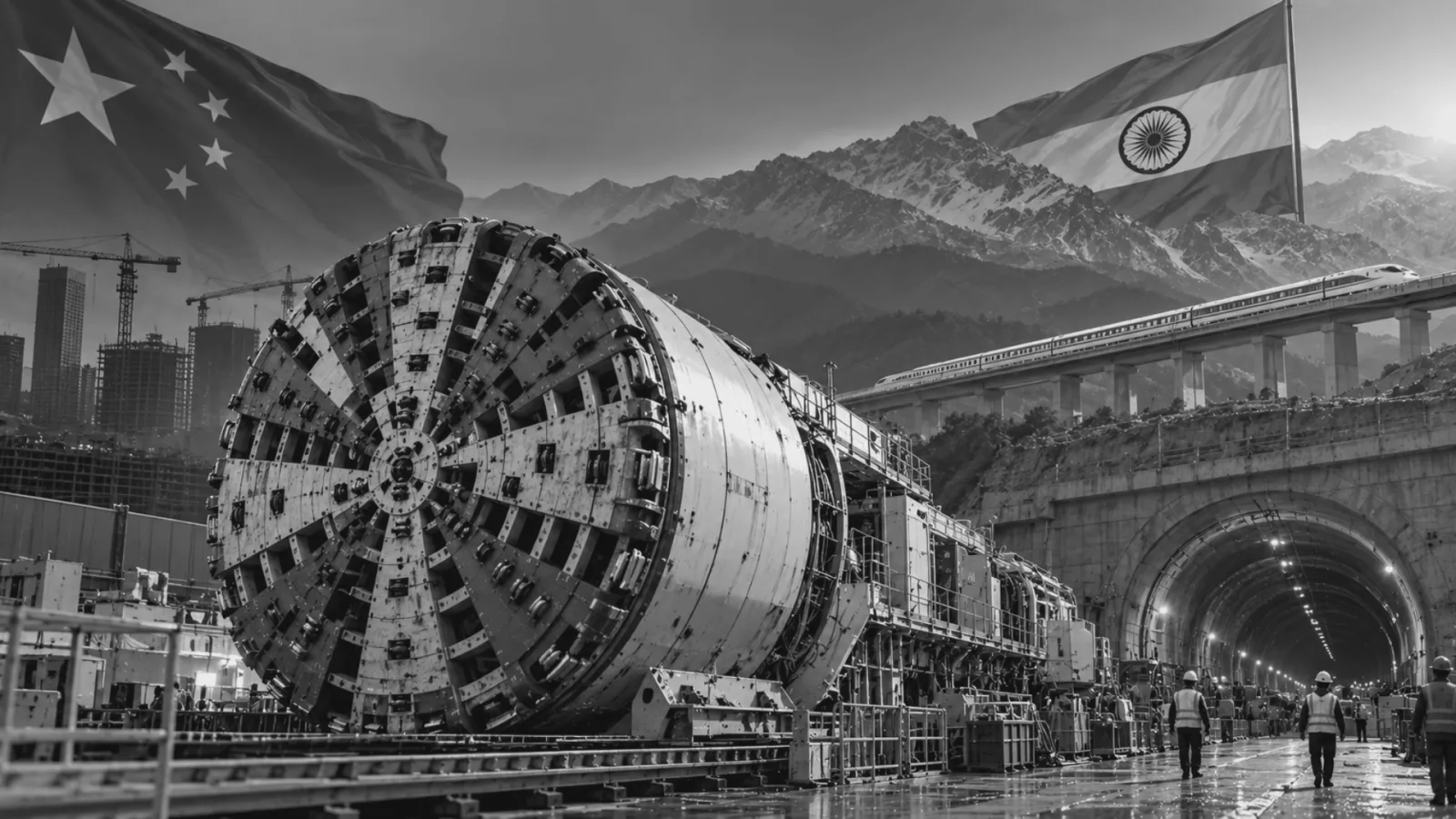
On 19 October 2026, China's Ministry of Commerce and General Administration of Customs announced new export controls on tunnel boring machines (TBMs), specialised components and associated technologies. The restrictions, issued under Announcement No. 50 of 2026, will take effect on 18 November. The measures also cover walking excavators and specialised concrete-spraying machinery designed for high-altitude construction. Beijing has justified the decision on national security grounds under its existing export-control framework. Although the announcement does not explicitly identify India, its implications are significant for New Delhi. India remains dependent on imported specialised tunnelling machinery for infrastructure projects, including metro networks, high-speed rail corridors and underground transport systems. More importantly, the restrictions extend beyond complete machines to critical components and technologies required for their continued operation. The development adds another dimension to the strategic vulnerabilities arising from India's dependence on Chinese manufacturing. Beijing's ability to regulate the export of specialised industrial equipment could create pressure points in infrastructure development without requiring overt trade sanctions or a complete export prohibition.
What Has China Restricted?
The new regulations cover three principal categories of construction equipment. The first includes full-face tunnel boring machines, covering earth-pressure-balance shields, slurry shields and multiple configurations of hard-rock tunnelling machinery. The restrictions extend to specially designed components, including cutterheads, screw conveyors, segment erectors and main drive systems, alongside remanufacturing technologies.
The second category covers walking excavators capable of operating in difficult terrain, including machines designed to cross substantial obstacles, navigate trenches and climb steep gradients. The third includes specialised wet-spraying machines intended for operations above 3,000 metres, subject to specified technical thresholds. Such equipment is used to apply concrete and stabilise excavated surfaces during tunnelling and other construction activities. ¹
The regulatory mechanism is particularly important. Exports to sensitive countries and regions having disputes with China require prior licensing approval. Exports to other destinations operate through a registration and certification mechanism, accompanied by restrictions on subsequent transfers to sensitive destinations. The announcement does not publish a list of countries covered by the more restrictive category.
Consequently, the measures should not be interpreted as an outright ban on Chinese tunnelling equipment entering India. Nevertheless, they introduce regulatory discretion that could permit Beijing to delay or restrict sensitive shipments. Reuters reported that China exported approximately $793 million worth of self-propelled coal or rock cutters and tunnelling machinery in 2025, illustrating its significant position in the broader equipment market. ²
India Has Encountered Similar Restrictions Before
India's exposure to Chinese restrictions on tunnelling equipment is not a new development. In October 2024, Commerce and Industry Minister Piyush Goyal raised concerns with Germany's then Vice Chancellor Robert Habeck over delays in the delivery of tunnel boring machines manufactured by German engineering company Herrenknecht at its facilities in China.
Herrenknecht subsequently acknowledged difficulties with Chinese customs clearance procedures. In November 2024, the company confirmed that extraordinary customs-related circumstances had disrupted its ability to meet delivery obligations for Indian customers. ³
The issue persisted into 2025. In September that year, German Ambassador to India Philipp Ackermann disclosed that at least three Herrenknecht machines had been delayed by Chinese customs. He also indicated that the company was exploring manufacturing expansion in India to reduce its exposure to such disruptions. ⁴
These incidents demonstrated how India's infrastructure procurement could be affected even when equipment was ordered from a European manufacturer. The geographical location of production, rather than the nationality of the supplier, had become the determining factor.
The October 2026 announcement potentially institutionalises this vulnerability. Whereas earlier disruptions involved customs-related obstacles, the new framework establishes formal procedures through which Beijing can exercise control over specified machinery, components and technological transfers.
Implications for India's Critical Infrastructure
India's expanding infrastructure network requires sophisticated tunnelling equipment for underground metros, railway corridors, urban connectivity projects and transport links through difficult geographical terrain.
The Mumbai–Ahmedabad High-Speed Rail Corridor provides a relevant example. The project includes a 21-kilometre underground section, of which approximately 16 kilometres is planned to be constructed using tunnel boring machines. The alignment includes a seven-kilometre undersea tunnel beneath Thane Creek. According to the National High Speed Rail Corporation Limited, the first TBM began excavation on 5 July 2026, followed by a second machine on 18 July. ⁵
The deployment of these machines demonstrates both the importance of advanced tunnelling technology and India's ability to progress with major projects when equipment becomes available. However, the new restrictions could complicate future procurement, specialised maintenance, replacement components and the mobilisation of additional machinery.
There is currently no publicly verified evidence establishing that the October announcement has interrupted an active Indian tunnelling project. Its immediate consequence is therefore better understood as increased procurement uncertainty rather than a confirmed construction stoppage.
The consequences could extend beyond individual project schedules. Delays in the availability of specialised equipment can affect contractors, financing arrangements, project sequencing and associated infrastructure investments. The potential damage is not necessarily proportional to the monetary value of the restricted component. A relatively small but essential mechanical assembly can influence the operation of an entire tunnelling system.
The Strategic Significance of High-Altitude Equipment
The inclusion of high-altitude construction equipment is particularly relevant from an Indian national security perspective. Much of India's strategic infrastructure development in the Himalayan region involves difficult terrain, steep gradients, extreme temperatures and challenging logistical conditions.
Specialised machinery capable of operating above 3,000 metres can support tunnelling, slope stabilisation and construction in such environments. Depending on project design and equipment specifications, these capabilities may have applications in infrastructure supporting border connectivity and military logistics.
China's decision to regulate machines with such operating characteristics therefore raises questions extending beyond commercial infrastructure.
Nevertheless, the announcement does not establish that particular Indian border projects depend on the controlled Chinese equipment. Nor does it demonstrate that Beijing has specifically designed these provisions to disrupt Indian military infrastructure.
The strategic concern lies in the possibility that equipment relevant to both civilian construction and defence-supporting infrastructure could become subject to selective export approvals during periods of bilateral tension.
Strategic Assessment
The principal significance of China's decision lies not in the immediate restriction of machinery exports but in the institutionalisation of control over essential industrial capabilities.
Three interconnected vulnerabilities emerge from the development.
The first is manufacturing dependence. India's procurement from international engineering companies does not necessarily eliminate exposure to China if those companies manufacture critical machinery or components within Chinese territory. The earlier Herrenknecht experience demonstrates that supplier diversification without manufacturing-location diversification may provide only limited protection.
The second is technological dependence. By including specialised components and remanufacturing technologies, the restrictions create potential exposure beyond the initial purchase of machinery. Even where complete machines have already been delivered, their operational sustainability may depend on the continued availability of specialist parts, technical support and maintenance capabilities.
The third is regulatory uncertainty. China's decision to distinguish sensitive destinations from other countries without publishing a definitive list gives Beijing considerable interpretative discretion. In India's case, the unresolved boundary dispute makes the application of this distinction an important issue to monitor. However, the available announcement does not confirm how Chinese authorities will formally classify Indian shipments.
Taken together, these factors could allow infrastructure-related trade to become an additional instrument of economic statecraft. Importantly, Beijing would not necessarily need to impose a comprehensive embargo to generate pressure. Delayed approvals, additional scrutiny or uncertainty surrounding component availability could be sufficient to influence procurement decisions and project planning.
At the same time, the export controls may accelerate efforts by importing countries and international manufacturers to relocate production or establish alternative supply chains. This creates a potential long-term cost for China's position in specialised machinery manufacturing.
India has already begun considering measures to address this vulnerability. In August 2026, Reuters reported that New Delhi was preparing a proposed $1.2 billion incentive programme to encourage domestic production of sophisticated construction equipment, including tunnel boring machines. The proposed seven-year scheme aimed to attract approximately $1.8 billion in fresh investment, with companies such as BEML and Larsen & Toubro among the potential beneficiaries. The proposal should not be treated as an approved programme without further official confirmation. ⁶
For India, the objective should extend beyond assembling complete machines domestically. Long-term resilience would require greater domestic capability in precision engineering, critical components, maintenance, refurbishment and technical expertise, alongside diversified international partnerships.
Outlook and Indicators to Monitor
The actual impact of China's export controls will depend primarily on their implementation after 18 November 2026. Particular attention should be given to whether Beijing applies the sensitive-destination licensing mechanism to India, how quickly applications are processed and whether existing contracts receive different treatment from new orders.
Additional indicators include any renewed customs delays involving European or Japanese manufacturers operating in China, reported disruptions to Indian infrastructure contractors, restrictions on replacement components and announcements concerning the localisation of tunnelling machinery manufacturing.
A restrictive interpretation affecting India would strengthen the assessment that Beijing is prepared to use specialised industrial equipment as an instrument of geopolitical pressure. Conversely, consistent approvals and uninterrupted deliveries would indicate that the immediate commercial consequences are more limited than the strategic risks suggested by the regulatory framework.
CNAWS Assessment
China's October 2026 export-control announcement reflects an important development in the relationship between industrial capability and national security. Beijing is extending regulatory control into specialised construction equipment whose strategic significance arises from its importance to infrastructure development rather than from its conventional association with military technology.
For India, the immediate threat is not a demonstrated halt to metro or high-speed rail construction. It is the possibility that future infrastructure procurement, equipment maintenance and specialised construction capabilities could become vulnerable to decisions taken in Beijing.
The earlier disruption of German-manufactured equipment demonstrates that this vulnerability is neither entirely hypothetical nor limited to direct purchases from Chinese companies.
CNAWS assesses with moderate confidence that the new restrictions increase China's potential economic leverage over Indian infrastructure procurement. The existence and scope of the controls are confirmed, but their precise application to India and any resulting project-level disruption remain uncertain.
The broader lesson for New Delhi is that strategic infrastructure security increasingly depends not only on domestic project execution but also on the geographical concentration of manufacturing, the availability of critical technologies and control over essential supply chains.
Endnotes
Ministry of Commerce of the People's Republic of China and General Administration of Customs, “Announcement No. 50 of 2026 on Export Controls for Shield Tunnelling Machines and Related Items,” October 19, 2026. Official announcement.
Reuters, “China Commerce Ministry Announces Export Controls for Tunnel Boring Machines,” October 19, 2026. Reuters.
Sukalp Sharma, “Tunnel Boring Machines: Machines for India Delayed, German Firm Flags Bottleneck at Chinese Customs,” The Indian Express, November 2, 2024. The Indian Express.
Keshav Padmanabhan, “German Tunnel-Boring Machine Maker to Set Up Shop in India after China Delays Exports of Machinery,” ThePrint, September 30, 2025. ThePrint.
National High Speed Rail Corporation Limited, “Second Tunnel Boring Machine Starts to Excavate India's First Undersea Tunnel beneath Thane Creek in Maharashtra for Mumbai–Ahmedabad Bullet Train Project,” July 18, 2026. NHSRCL.
Reuters, “India Set to Approve $1.2 Billion Incentive Plan to Make Building Equipment, Sources Say,” August 21, 2026. Reuters.
Tags
Author