
The Strange Logic of Espionage: How the World's Most Unusual Spy Methods Worked
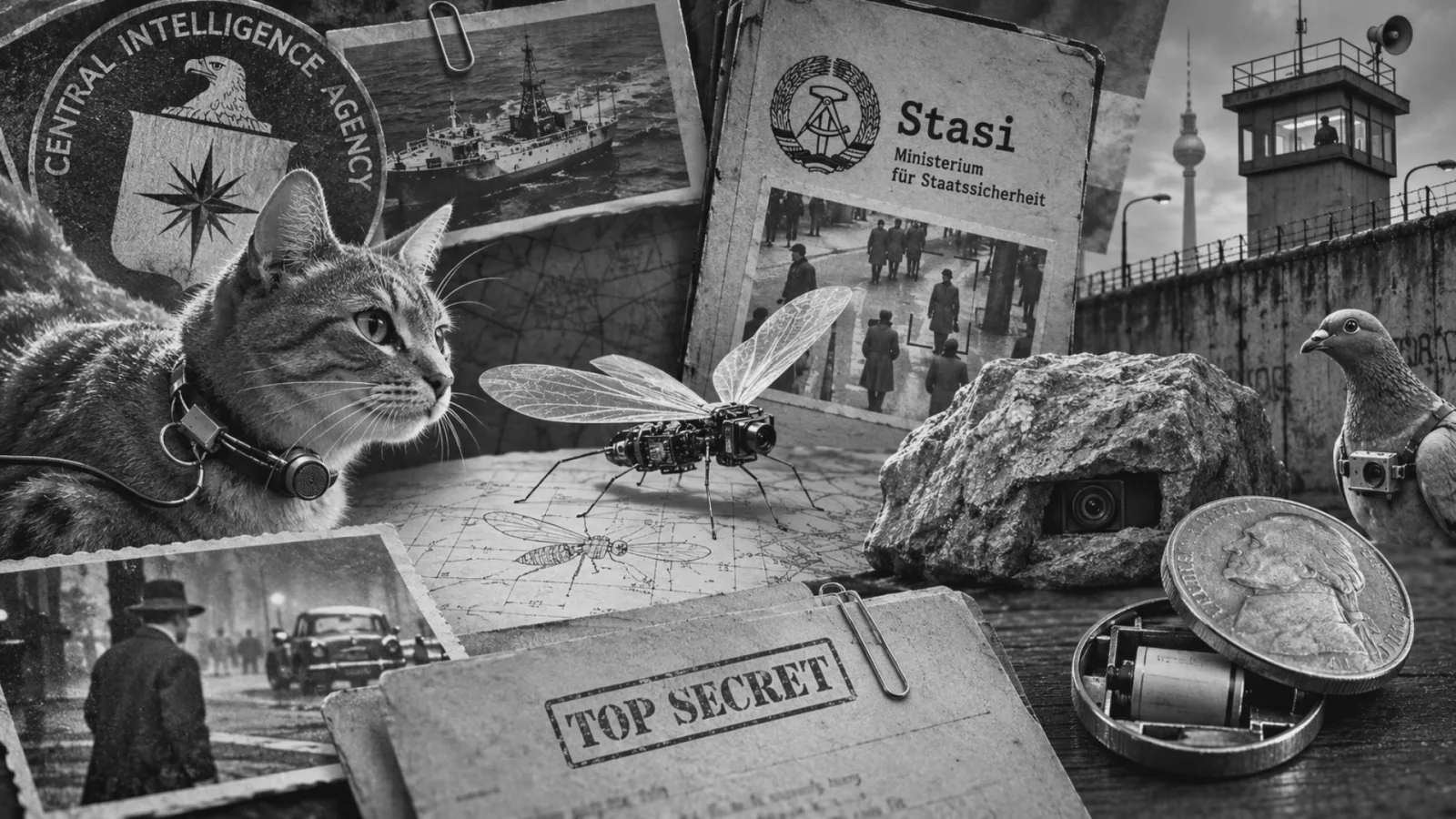
The history of espionage is filled with methods that appear absurd when separated from their operational context. The Central Intelligence Agency experimented with microphone-equipped cats, concealed messages inside preserved rat carcasses and developed miniature reconnaissance devices modelled on insects. East Germany's Ministry for State Security, or Stasi, collected human scent samples, cultivated informants within literary circles and used romantic relationships to penetrate sensitive West German institutions. Soviet intelligence concealed listening equipment inside diplomatic gifts and modified American embassy typewriters to transmit information. These activities were not expressions of eccentricity alone; they reflected different attempts to manipulate the relationship between what an observer encounters and what that observer considers threatening.
Historical evidence, however, challenges the popular assumption that ingenious espionage methods invariably succeed. Several exotic technologies never became operational, while comparatively ordinary human relationships and covertly modified equipment produced sustained intelligence access. Drawing on archival material and scholarship on intelligence deception, this explainer argues that unconventional espionage is best understood through five recurring mechanisms: environmental camouflage, psychological avoidance, manufactured trust, institutional legitimacy and the exploitation of technological dependencies. Its central finding is that successful espionage rarely depends on concealment alone. It depends on maintaining a believable explanation for an object's presence, a person's behaviour or an institution's activities, while anticipating the adversary's capacity to detect contradictions.
Introduction: When the Ordinary Becomes an Intelligence Weapon
On 16 April 1982, East Germany's Ministry for State Security preserved an individual's scent in a small glass jar containing a piece of cloth. The artefact, now held by Leipzig's Museum in der Runden Ecke, bears an identifying label and records that the sample was apparently obtained using a cloth placed beneath a chair covering. It was part of the Stasi's system of collecting human odours to assist tracking dogs during investigations. The practice was frequently concealed from the individuals concerned, and the ministry maintained distinctions between scent samples associated with identified persons and odour traces recovered from locations or objects. The surviving jar represents something considerably more disturbing than an unusual forensic experiment: it demonstrates how an intelligence organisation could convert an almost imperceptible feature of ordinary human existence into an instrument of surveillance.¹
The episode captures an enduring feature of espionage that is frequently obscured by the popular emphasis on intelligence officers, secret codes and sophisticated weapons. Intelligence collection often depends less on physically defeating security systems than on manipulating the assumptions through which people interpret their surroundings. A coin is treated as currency, a diplomatic gift as a symbol of goodwill, a familiar colleague as a trustworthy companion and a typewriter as an inert instrument for preparing documents. Intelligence services have repeatedly attempted to exploit those assumptions, using the apparent innocence of people, objects and everyday activities to conceal a second, clandestine purpose. What makes such methods remarkable is not simply that they are difficult to imagine, but that their effectiveness depends on patterns of human attention and institutional behaviour that may remain stable even as technology changes.
This distinction is essential because the history of unusual espionage contains both impressive operational achievements and conspicuous failures. The CIA's experimental robotic insects were defeated by environmental conditions, while Soviet engineers successfully compromised the mechanical typewriters of American diplomatic personnel. Similarly, the Stasi's systematic recruitment of informants demonstrated that a reliable social relationship could be more valuable than an elaborate listening device. Alison Lewis's A State of Secrecy: Stasi Informers and the Culture of Surveillance provides an important intellectual foundation for understanding the latter phenomenon. Drawing on archival research into East Germany's literary and cultural establishment, Lewis argues that surveillance depended on human relationships, concealed identities and varying forms of personal dependency, rather than technological observation alone. Her work encourages a broader interpretation of espionage as a social system in which secrecy influences the behaviour of both those collecting intelligence and those being monitored.²
1. The Stasi's Human Intelligence System: When Relationships Became Surveillance Infrastructure
Among the most consequential features of East German intelligence was its ability to integrate clandestine collection into everyday social life. Lewis records that the Ministry for State Security maintained approximately 90,000 full-time employees by 1989 and an estimated 189,000 registered unofficial collaborators around the collapse of the German Democratic Republic. These figures describe the extensive organisational foundations of domestic surveillance, although the roles, motivations and operational significance of individual collaborators varied considerably. In her examination of informants within literary and artistic circles, Lewis challenges the simplistic distinction between individuals who collaborated willingly and those compelled to cooperate. Ideological conviction, professional ambition, material advantage, emotional recognition, coercion and a sense of belonging could operate simultaneously, while an informant's relationship with the security apparatus could change substantially over time. Consequently, the Stasi's most important intelligence resource was not always access to secret documents, but the capacity to transform ordinary social relationships into sustained channels of information.³
A particularly revealing example emerged from the Stasi's foreign intelligence directorate, the Hauptverwaltung Aufklärung (HVA), which identified secretarial personnel in West German government institutions as valuable recruitment targets. An archived HVA training document from 1987 shows that the service closely studied the professional characteristics and potential vulnerabilities of secretaries employed in ministries, the Federal Chancellery, the Foreign Office and other sensitive organisations. These individuals were attractive because they frequently handled confidential correspondence and maintained institutional continuity despite changes in senior officials. Specially prepared recruiters, commonly described as Romeo agents, were deployed to establish personal relationships that could gradually be converted into intelligence access. Some relationships involved declarations of love, promises of marriage or staged weddings, while targets were not necessarily informed that the individual involved was working for East German intelligence. According to the German Federal Archives' accompanying historical account, West German counterintelligence identified 58 secretaries involved in espionage cases between 1949 and 1987; this figure must not be mistaken for a count of Romeo operations alone.⁴
The intelligence logic was more sophisticated than the familiar expression honey trap suggests. A conventional transactional recruitment arrangement requires an individual to recognise the intelligence relationship and decide whether to cooperate, whereas a relationship-based operation can gradually blur the distinction between personal loyalty and professional obligation. An individual who believes that information is being shared with a trusted romantic partner may not initially interpret the act as espionage, particularly when the partner conceals the true beneficiary of the material. The relationship itself becomes part of the operational cover, generating opportunities for repeated contact and continued access without the obvious signatures of an intelligence transaction. Yet these arrangements also carried uncertainties for the recruiting service, including emotional unpredictability, the possibility of exposure, and the challenge of sustaining a false identity over extended periods.
The Stasi's collection of scent samples and its recruitment of informants belonged to different operational functions, but both reveal the organisation's tendency to treat private life as an intelligence resource. This tendency extended into political repression through Zersetzung, a programme of psychological and social disruption described in the ministry's 1976 operational directive. Rather than relying exclusively on arrest or prosecution, security officers could employ disinformation, reputational attacks and interference with professional or social relationships to weaken targeted individuals. The directive explicitly contemplated damaging a person's standing through both true and false allegations, demonstrating how collection and covert influence could become mutually reinforcing instruments of political control. This was not foreign espionage in the narrow sense; it was domestic secret policing. Nevertheless, it provides a critical historical warning about the consequences of combining intimate human intelligence with unchecked institutional power.⁵
The scholarship offers a further corrective to the assumption that informants are simply passive tools of intelligence agencies. In a peer-reviewed study published in Security Dialogue, Sophia Hoffmann examines the Stasi's recruitment of Arab students in East Germany during the early 1980s, showing how the process simultaneously served bureaucratic surveillance objectives and enabled interventions into individual lives. Read alongside Lewis, this research demonstrates that informant recruitment can be understood as a mechanism of social governance as well as intelligence acquisition. A source's personal ambitions, affiliations and expectations shape what information becomes available, while the recruiting institution's own assumptions influence which individuals are considered suspicious or useful. The result can be an extensive intelligence system without any guarantee that its assessments will be accurate, proportionate or free from institutional prejudice.⁶
2. Dead Rats, Spy Cats and Robotic Insects: The Search for Biological Camouflage
While the Stasi demonstrated how people could become instruments of surveillance, American intelligence researchers explored the possibilities of turning animals and their surroundings into covert collection platforms. During the Cold War, the CIA's Office of Technical Services experimented with preserved rat carcasses as concealment devices for messages, money and photographic film. The reasoning was deceptively straightforward: a dead rat abandoned in an urban environment would generally provoke disgust rather than curiosity, reducing the likelihood that a passerby would inspect it. The concept initially encountered an unforeseen problem when stray cats removed the carcasses during testing. CIA specialists experimented with various deterrents before identifying wormwood oil as a means of discouraging feline interference. Although the technique is remembered for its grotesque ingenuity, its greater analytical significance lies in the failure of an otherwise reasonable assumption. The designers had considered the likely reactions of human observers but had initially overlooked the behaviour of other actors operating within the same environment.⁷
The CIA's Acoustic Kitty programme demonstrated the opposite problem: an animal capable of moving unnoticed could not necessarily be persuaded to behave in ways useful to intelligence collectors. Beginning in 1964, researchers explored the use of a cat fitted with a miniature microphone, transmitter and antenna to approach conversations that would otherwise be difficult to monitor. The intended operational advantage was considerable because a cat wandering near a park bench or other public meeting place would ordinarily attract little attention, whereas an unfamiliar person approaching the same conversation might provoke suspicion. Technical experiments reportedly demonstrated that the implanted equipment could function, but field tests exposed the difficulty of directing the animal towards specified targets. The programme was terminated in 1967 without operational deployment. The widely repeated anecdote that the cat was immediately killed by a vehicle during its first mission has been challenged by the CIA's own historical account, which identifies the story as a joke subsequently mistaken for fact.⁸
The pursuit of biological camouflage also encouraged the CIA to develop miniature mechanical platforms. During the 1970s, its Office of Research and Development constructed the Insectothopter, an experimental flying device modelled on a dragonfly and intended to carry surveillance equipment. Its mechanical design demonstrated notable progress in miniaturisation, including a small propulsion system and a concept for transmitting collected audio. Nevertheless, the platform's inability to maintain reliable control in crosswinds rendered it unsuitable for operational employment. Other experiments involved pigeons fitted with lightweight cameras and seismic sensors disguised as tiger droppings in the Vietnamese environment. In each case, the surrounding biological world offered a potential advantage: ordinary birds could blend into urban landscapes, and an object resembling animal waste was unlikely to invite inspection. Yet concealment and intelligence utility remained distinct requirements, because an inconspicuous platform was of limited value if it could not reliably observe the desired target, survive local conditions or return information in a usable form.⁹
These experiments expose an important distinction between environmental camouflage and operational control. A device may be exceptionally difficult for an adversary to recognise while remaining equally difficult for its operator to employ effectively. The dead-rat experiment demonstrated that successful concealment required an understanding of the entire operating environment rather than human behaviour alone, while Acoustic Kitty and Insectothopter showed that technical feasibility did not establish operational reliability. This distinction remains relevant to modern unmanned systems, autonomous surveillance devices and biomimetic technologies. Reducing the visual or electronic signature of a platform is useful, but it cannot compensate for inadequate endurance, navigation, predictable behaviour or dependable collection. For an intelligence agency, the relevant measure of success is not whether a device is ingenious, but whether it consistently produces intelligence that justifies its cost, exposure and operational risks.¹⁰
3. Operation Tamarisk: Finding Intelligence in What an Adversary Throws Away
Some of the most productive unconventional collection activities relied neither on elaborate disguises nor on sophisticated technology, but on identifying information that an adversary had already discarded. During the Cold War, the British Commanders'-in-Chief Mission to the Soviet Forces in Germany, known as BRIXMIS, conducted military reconnaissance within East Germany under arrangements originating in the post-war Allied occupation. Although the mission possessed a formal liaison role, its personnel also developed methods for observing Soviet military activity, equipment and installations. Accounts associated with Operation Tamarisk describe the recovery of documents from military refuse, including written material that Soviet servicemen had reused as toilet paper before discarding it. The practice appears extraordinary largely because the apparent worthlessness and unpleasant condition of the material concealed its potential intelligence value. A 2026 review of Andrew Long's BRIXMIS and the Secret Cold War, published in the CIA's Studies in Intelligence, specifically discusses the recovery of sensitive notes from rubbish piles outside Soviet facilities.¹¹
The intelligence mechanism was fundamentally different from that employed in a classical penetration operation. Rather than persuading an insider to reveal secrets, collectors exploited the gap between the information's original sensitivity and the low value assigned to it during disposal. A sheet of paper might have contained operational details when first prepared, yet subsequently become ordinary refuse in the eyes of the person discarding it. Even fragmented records could become useful when compared with other evidence about military deployments, equipment, logistics or organisational routines. The importance of this technique should not be exaggerated without access to individual intelligence assessments, because public descriptions of Tamarisk provide less systematic evidence of outcomes than they do of collection practices. Nevertheless, the broader lesson is substantial: intelligence value is not determined by the condition or apparent significance of its physical carrier, and an adversary's disposal practices may reveal weaknesses that conventional physical security measures do not address.
A different version of the same principle emerged in the United States in June 1953, when a Brooklyn newspaper delivery boy discovered that an ordinary-looking nickel was hollow. Inside the coin was a miniature photographic message containing groups of numbers, prompting an FBI counterintelligence investigation. The investigation did not immediately identify the responsible espionage network, but the discovery later became significant in the case against Soviet intelligence officer William Fisher, better known by the alias Rudolf Abel. The coin represented the exploitation of an object whose normal purpose was so familiar that its secondary function was unlikely to be imagined, while the accidental discovery illustrates how ordinary handling can defeat an otherwise effective concealment method. Unlike the material recovered through Tamarisk, the nickel was deliberately engineered to carry clandestine information; nevertheless, both cases depended on the mismatch between an object's apparent identity and its actual intelligence significance.¹²
These cases also challenge the notion that information must be physically inaccessible to remain secure. A concealed message can be compromised through chance, while a discarded document can retain its original intelligence value even after its owner has ceased to regard it as important. The effective security perimeter therefore extends beyond safes, guarded buildings and classified communications networks to encompass routine behaviours, material handling and disposal procedures. This is particularly relevant to modern organisations that manage large quantities of digital records, removable media, discarded electronic equipment and administrative information. The historical connection is analytical rather than technological: in both physical and digital environments, information may remain sensitive long after the system or individual responsible for it has assumed that it no longer matters.
4. The Great Seal and Operation GUNMAN: When Trusted Objects Became Intelligence Platforms
Among the most consequential examples of unconventional technical espionage was the Soviet installation of a listening device inside a carved wooden representation of the Great Seal of the United States. The object was presented to American ambassador W. Averell Harriman in Moscow in August 1945 and remained in the ambassadorial environment until the concealed device was discovered in 1952. Known to American investigators as The Thing, the device differed from conventional listening equipment because it did not require an internal battery to transmit continuously. Instead, its passive resonator could be activated by an external radio signal, allowing nearby conversations to modulate a reflected signal that could be intercepted remotely. Its technical characteristics made it difficult to detect using methods designed primarily to locate devices producing a continuous transmission. Equally important, the object entered the sensitive environment as a diplomatic gift, acquiring an apparently legitimate identity before its covert purpose was recognised.¹³
The success of the Great Seal operation resulted from the interaction of technical ingenuity and institutional trust. A diplomatic office is generally expected to apply strict controls to its personnel, visitors and communications, but an object already accepted into its environment can gradually become part of the surroundings rather than a continuing object of scrutiny. The Soviet device exploited that transition, while its passive design reduced the likelihood that conventional inspection methods would reveal its presence when it was inactive. Its effectiveness therefore depended on more than concealment inside wood: it required the recipient institution to interpret the object through its diplomatic symbolism and to overlook the possibility that the gift itself constituted an intelligence channel. The case illustrates a form of technical compromise in which the adversary does not need persistent physical access to a room once the collection mechanism has been successfully introduced.
An even more sophisticated penetration came to light during Operation GUNMAN, a United States National Security Agency investigation into Soviet modifications of American diplomatic equipment. On 23 July 1984, an NSA technician examining an IBM Selectric typewriter identified an anomalous component that ultimately helped expose a larger programme of equipment compromise. Investigators discovered implants in 16 typewriters associated with the American embassy in Moscow and consulate in Leningrad, including multiple versions of devices capable of sensing mechanical movements and transmitting encoded information. According to NSA historian Sharon A. Maneki's detailed account, the implants had undergone technological modifications over several years, with the earliest compromised machines dating from the 1970s. Their sophisticated design, intermittent transmissions and integration into existing components made the devices unusually difficult to discover through routine technical-security inspections.¹⁴
What distinguishes GUNMAN from conventional electronic eavesdropping is that the Soviet operation targeted the process through which information was being created. Diplomatic personnel could follow appropriate procedures when preparing documents, yet the supposedly trusted typewriters themselves had become collection instruments. The NSA's subsequent damage assessment was complicated by incomplete equipment records, personnel rotations and uncertainty about the precise documents processed on the compromised machines. Nevertheless, the case established that the mechanical operation of an information-processing device could be exploited to recover sensitive content without the need to steal completed documents. It also illustrated the limits of technological confidence: detection equipment and inspection routines that appeared adequate against known threats could become obsolete when an adversary introduced an unfamiliar collection mechanism.
The vulnerability of trusted objects was not confined to the Cold War. In January 2006, Russian authorities publicly accused British intelligence of using an artificial rock in Moscow to conceal electronic communications equipment. Although the episode was initially treated with caution in Britain, former Downing Street chief of staff Jonathan Powell acknowledged in 2012 that the device had indeed been part of a British intelligence operation. Its concealment was based on the ordinary appearance of a roadside object, but the exposure demonstrated that an unobtrusive device could still become vulnerable if counterintelligence personnel identified suspicious patterns of human behaviour around it. The episode reinforces a lesson visible in earlier operations: concealment is not a permanent condition but a relationship between the hidden mechanism, its users and an adversary's capacity for observation.¹⁵
5. Operation Mincemeat: When a Corpse Became an Intelligence Deception
While the Great Seal and GUNMAN involved the clandestine collection of genuine information, Operation Mincemeat represented an attempt to make an adversary accept false information as genuine intelligence. In 1943, British intelligence officers developed a plan to deceive German authorities about Allied intentions in the Mediterranean by placing misleading documents on the body of a deceased man, whom they presented as a Royal Marines officer. The body was deposited off the Spanish coast, where it was expected to enter channels through which the German intelligence service might obtain the documents. The planted material supported the impression that the Allies intended to undertake operations against Greece and Sardinia rather than concentrate on Sicily. The operation required the construction of an elaborate personal identity, incorporating military documentation and details of an apparently ordinary private life. As historian Denis Smyth demonstrates in Deathly Deception: The Real Story of Operation Mincemeat, the planners devoted considerable attention to ensuring that the body, documents and circumstances of discovery would withstand scrutiny.¹⁶
The deeper operational achievement lay in manipulating the adversary's process of intelligence evaluation. German authorities were not simply handed a false operational plan; they encountered material presented as having been accidentally obtained from a dead officer, creating an appearance of authenticity that a direct communication could never have achieved. The dead man's constructed personal history helped make the planted intelligence believable because it supported the impression that the officer had existed independently of the documents he supposedly carried. Yet Mincemeat must also be understood as one component of wider Allied deception efforts, rather than an isolated trick that single-handedly determined the invasion's outcome. Smyth's archival research supports its contribution to German misperceptions and subsequent deployments, but attributing the entire strategic result to one planted body would obscure the broader military and intelligence environment in which the operation unfolded.
Recent scholarship provides a particularly important corrective to romanticised accounts of deception. In a 2025 article in Intelligence and National Security, Ron E. Hassner challenges the assumption that intelligence agencies are easily deceived because their personnel suffer from predictable psychological biases. His analysis argues that successful deception is frequently difficult and resource-intensive because intelligence organisations compare information across multiple collection channels and are often appropriately sceptical of surprising evidence. From this perspective, Mincemeat's brilliance lay not merely in the unusual use of a corpse, but in the resources devoted to constructing a credible false reality and supporting it within a larger deception effort. The broader principle is that a convincing deception must survive the processes through which an adversary checks information, rather than simply appear plausible at first encounter.¹⁷
6. Operation Argo and Project AZORIAN: Manufacturing Entire Institutions as Operational Cover
In January 1980, American and Canadian efforts to evacuate six United States diplomatic personnel hiding in Iran culminated in a remarkably elaborate cover operation. CIA specialists created a fictional Hollywood production company, Studio Six Productions, to support the appearance that the six Americans were part of a Canadian film crew scouting locations for a science-fiction project called Argo. The scheme involved more than producing false passports or an improbable explanation for the group's presence in Tehran. It required a supporting commercial identity, promotional material, film-industry publicity and documentation that could withstand scrutiny if Iranian authorities investigated the supposed production. The company placed advertisements in Variety, and the deception was sufficiently developed to resemble a functioning entertainment enterprise rather than a hastily invented story. With Canadian assistance, the six Americans successfully departed Iran on 28 January 1980.¹⁸
Operation Argo demonstrates how an intelligence service can construct legitimacy by arranging for multiple ordinary details to reinforce one another. The supposed film crew required a plausible reason to travel, a production company capable of supporting its professional identity, documents consistent with that identity and a commercial explanation that did not appear extraordinary in the context of international filmmaking. The operation also reveals why deception should not be confused with intelligence collection. Argo was principally an exfiltration operation that used deception to protect individuals leaving a hostile environment, whereas Mincemeat attempted to alter an adversary's military assessments. Both, however, relied on manufactured identities supported by a broader framework of apparently independent evidence.
The CIA employed a comparable principle on a much larger industrial scale during Project AZORIAN, an operation to recover part of the Soviet submarine K-129 from the Pacific Ocean floor. After the submarine sank in 1968, American intelligence identified the potential value of recovering its equipment and associated material. The CIA subsequently developed a deep-sea salvage operation centred on the Hughes Glomar Explorer, a specially constructed vessel publicly associated with commercial seabed mining. The participation of billionaire Howard Hughes provided a plausible commercial explanation for the unusual engineering capabilities of the ship, while manganese-nodule exploration offered a legitimate-sounding reason for activities in deep ocean waters. In 1974, the vessel succeeded in recovering part of the submarine, although a substantial section broke away during the lift. The operation's commercial cover was publicly exposed the following year, undermining plans for further recovery.¹⁹
The contrast between Argo and AZORIAN reveals two different scales of the same intelligence technique. Argo constructed a temporary institution to validate a small group of identities, while AZORIAN used a commercial narrative to explain an extraordinary industrial and engineering undertaking. The larger the operation, the greater the need for supporting evidence, infrastructure, financial arrangements and coordination among individuals who might not know its ultimate purpose. Such methods cannot be reduced to ordinary camouflage because they do not merely conceal an object beneath a different appearance. Instead, they create a network of apparently legitimate activities through which the real operation can proceed. The effectiveness of this approach depends on the cover being sufficiently consistent with the observable world to withstand reasonable scrutiny, not on an adversary being incapable of suspicion.
A final American example demonstrates the value of operational innovation outside both deception and covert surveillance. During Project COLDFEET in 1962, American personnel descended onto an abandoned Soviet scientific station on Arctic ice to recover documents and technical material. They were subsequently retrieved using the Fulton Skyhook system, which enabled an aircraft to extract personnel without landing. The mission recovered more than 150 pounds of materials, according to the CIA's historical account. Unlike Acoustic Kitty or Insectothopter, this was an operationally employed unconventional capability with a documented collection result. Its importance lies in showing that unusual technology can succeed when it addresses a clearly defined operational constraint and integrates with a credible mission plan, rather than being developed simply because its engineering possibilities are intriguing.²⁰
7. Understanding the Strange Logic of Espionage: Five Recurring Mechanisms
Taken together, these historical cases suggest that unconventional intelligence operations are better understood through the vulnerabilities they exploit than through the novelty of their equipment. The dead rat, the hollow nickel, the Stasi informer and the modified typewriter employed radically different collection mechanisms, yet each depended on an adversary accepting an apparently ordinary explanation for something that served a clandestine purpose. The analytical challenge is to distinguish the mechanism that conceals an operation from the mechanism that produces its intelligence value. A concealed object may remain undiscovered without collecting anything useful, while an agent may obtain exceptional access through an apparently unremarkable relationship. Conversely, the success of a deception must be measured by its influence on the adversary's beliefs or decisions, not simply by whether the false story was encountered.
The cases can be organised into five recurring mechanisms, each with its own advantages, vulnerabilities and operational limitations.
7.1. Environmental Camouflage: Exploiting the Background
Environmental camouflage depends on concealing an intelligence activity within objects or events that are consistent with their surroundings. The CIA's rat carcasses, the Moscow spy rock and pigeon-mounted cameras all relied on the expectation that their presence would not appear sufficiently unusual to warrant investigation. Their underlying principle was not perfect invisibility, because the object could remain physically visible throughout the operation, but the avoidance of deliberate attention. Its effectiveness therefore depended heavily on the surrounding environment and on whether the concealed object behaved consistently with expectations. This explains why the dead-rat experiment was initially disrupted by cats and why an artificial rock could still become suspicious through the activities associated with it.
7.2. Psychological Avoidance: Using What People Prefer Not to Examine
A second mechanism concerns human aversion to unpleasant, embarrassing or apparently worthless material. Dead animals, refuse and discarded bodily materials can discourage ordinary inspection, creating concealment opportunities that are fundamentally psychological rather than technological. Operation Tamarisk illustrates a related phenomenon in which information could retain intelligence value despite having lost its apparent practical value to its original holder. However, psychological avoidance is an unreliable foundation for security because it depends on assumptions about how different observers will behave. Intelligence officers, sanitation personnel, curious bystanders and animals do not necessarily respond to the same object in the same way. Consequently, such techniques may succeed under narrowly defined conditions while remaining vulnerable to accidental discovery.
7.3. Manufactured Trust: Turning Relationships into Intelligence Access
The Stasi's Romeo operations and recruitment of cultural informants demonstrate that intelligence collection can be sustained by manipulating trust rather than circumventing physical security. Access emerges through a relationship that initially appears to serve an ordinary social or professional function, while the intelligence purpose remains concealed from the person being targeted. Lewis's research is particularly important here because it demonstrates that sustained collaboration cannot be adequately explained through a single motivation. Informants may develop emotional, ideological and material dependencies that become increasingly difficult to separate from their everyday identities. This form of espionage may therefore offer prolonged access, but it also introduces uncertainties associated with loyalty, emotional change, personal ambition and the possibility that information is being distorted to satisfy the expectations of the handling institution.
7.4. Institutional Legitimacy: Creating a Believable Explanation for the Operation
Operation Mincemeat, Argo and AZORIAN demonstrate the importance of constructing an apparently legitimate framework around an intelligence activity. A dead officer required a believable personal history, a fictional film crew required a functioning commercial identity, and an extraordinary salvage vessel required an industrial explanation for its capabilities. In each case, the operational cover became stronger when surrounding details reinforced the central narrative. Hassner's research helps explain why this matters: competent intelligence organisations normally seek corroboration, and a deception that survives examination across several information channels is likely to be more persuasive than one relying on a single fabricated claim. This creates a paradox for the deceiver, because more elaborate cover arrangements may improve credibility while also increasing cost, complexity and the number of opportunities for exposure.
7.5. Technological Trust: Exploiting the Instruments of Information Production
Finally, the Great Seal and Operation GUNMAN demonstrate how information can be compromised through objects that have already acquired institutional legitimacy. Their concealment did not necessarily depend on confusing a human observer at the moment of collection, because the compromised device had already entered the protected environment. The weakness lay in the assumption that its apparent function corresponded to its actual technical behaviour. GUNMAN is particularly significant because the typewriters were not primarily storage devices; they were instruments used to produce sensitive information. The operation therefore anticipated a central problem in contemporary information security: security cannot be established merely by protecting the final document or communication if an adversary has already compromised the equipment involved in its creation.
8. Why Extraordinary Tradecraft Often Fails
The historical record also suggests that intelligence organisations should exercise caution before treating unusual methods as evidence of exceptional operational capability. Successful cases are more likely to enter popular intelligence history because their outcomes are dramatic, while failed experiments may become famous precisely because their ideas were so extraordinary. This creates a distorted sample from which to draw conclusions about the wider effectiveness of unconventional tradecraft. The CIA's Acoustic Kitty and Insectothopter programmes demonstrate the gap between technical possibility and reliable deployment, while the exposure of the Moscow spy rock illustrates the possibility that otherwise effective devices can be compromised through patterns of human activity. Similarly, an elaborate cover story may be internally consistent yet fail when checked against independent information.²¹
A useful evaluation therefore requires more than determining whether a method was ingenious or whether it remained undiscovered for a particular period. Its operational value must be assessed against the intelligence actually collected, the reliability of that information, the resources consumed, the duration of access and the consequences of exposure. The same distinction applies to historical interpretation. A preserved device establishes that the technology existed, but not necessarily that it was successfully deployed; an intelligence agency's retrospective account may document an operation while omitting important failures or uncertainties; and a successful act of concealment does not automatically establish a strategically significant intelligence outcome. These qualifications are especially important when working with incomplete archives, declassified operational records or accounts produced by institutions seeking to explain their historical achievements.
The Stasi experience introduces a further complication because the scale of intelligence collection can itself become a source of analytical distortion. An organisation capable of generating enormous quantities of reports from informants, intercepted communications and surveillance activity may still struggle to distinguish meaningful information from speculation, personal grievances and deliberately misleading allegations. Lewis's discussion of informants emphasises the importance of understanding the social and personal circumstances in which information was produced, while Hoffmann's research demonstrates how recruitment and surveillance practices could themselves become instruments of governance. Taken together, these studies suggest that intelligence derived from extensive human networks must be evaluated in relation to the incentives and institutional structures responsible for its production. An intelligence system may penetrate society deeply without necessarily understanding it accurately.²²
This distinction also has implications for contemporary technical intelligence. The growing capacity to collect information across digital networks, electronic devices and distributed sensors should not be confused with an equivalent capacity to interpret events correctly. Historical experiences suggest that intelligence failures can arise at several distinct stages, including the selection of collection targets, the reliability of sources, the validation of information and the interpretation of evidence by analysts and decision-makers. Mark A. Jensen's research on intelligence failure emphasises the importance of distinguishing intelligence processes from their products and factual information from analytical judgements. Applied to unconventional espionage, this means that a successful penetration may produce little strategic advantage if the resulting information is incomplete, misleading or improperly assessed.²³
9. Lessons for Modern Intelligence and Counterintelligence
The enduring relevance of unusual historical espionage methods is not that contemporary agencies should reproduce the technologies of the Cold War. Rather, these cases demonstrate why intelligence and counterintelligence must examine assumptions that are embedded so deeply within daily operations that they cease to be questioned. The vulnerability exploited by the Great Seal was not simply a hidden resonator, but the acceptance of an apparently benign object within a sensitive environment. GUNMAN revealed the danger of trusting equipment whose technical integrity had not been adequately established. The Stasi's relationship-based recruitment demonstrated how privileged access could be obtained through personal dependency, while Operation Mincemeat and Argo illustrated the importance of constructing coherent narratives capable of surviving scrutiny.
For contemporary intelligence organisations, the historical evidence points towards the importance of examining entire information and access relationships rather than concentrating exclusively on identifiable threats. Counterintelligence assessments must consider the integrity of equipment, the provenance of information, the credibility of professional identities, the security implications of routine institutional activities and the human relationships through which sensitive knowledge is exchanged. Equally, unusual behaviour or unfamiliar technology should not automatically be interpreted as evidence of espionage. Sound counterintelligence depends on corroborated indicators, proportionate investigation and the ability to distinguish genuine compromise from coincidence or innocent irregularity.
The lessons are especially relevant in an era characterised by artificial intelligence, digitally mediated identities, remote information access and increasingly interconnected technical infrastructure. A fabricated professional identity can now be supported by extensive digital material, while information-processing systems may depend on complex arrangements of hardware, software, suppliers and external services. These developments do not establish that modern espionage follows an entirely new logic; instead, they provide new environments in which older principles of deception, trust exploitation and covert access may reappear. At the same time, contemporary verification technologies and multiple intelligence sources can make deception more difficult to sustain, particularly when conflicting evidence is available for independent assessment. The crucial issue is therefore not whether technology has made intelligence deception easier or harder in absolute terms, but how it has altered the balance between concealment, verification, access and exposure.
The history of unconventional espionage also reveals the importance of analytical imagination. Security institutions naturally concentrate on threats for which established procedures and detection systems already exist, but intelligence history repeatedly demonstrates that adversaries seek opportunities outside those familiar categories. An effective analytical culture must consequently remain willing to investigate improbable possibilities without abandoning evidence-based judgement. This requires a delicate balance: dismissing an unfamiliar threat because it appears implausible can create an exploitable blind spot, while accepting every extraordinary allegation as credible can produce paranoia, inefficient resource allocation and serious errors of attribution. The objective is neither perpetual suspicion nor automatic scepticism, but disciplined uncertainty supported by independent verification.
Conclusion: The Most Effective Espionage Exploits What We Believe to Be Harmless
The strangest espionage methods in history reveal a consistent tension between human ingenuity and the limitations of intelligence operations. Dead rats were employed because they appeared repulsive, cats were considered useful because they appeared harmless, romantic relationships were cultivated because they generated trust, and ordinary equipment became an intelligence vulnerability because its familiar purpose discouraged scrutiny. The same broad principle appears in complex deception operations, where artificial identities and institutions were designed to make clandestine activities appear consistent with everyday reality. Yet the historical record demonstrates that exploiting an assumption is not sufficient in itself. Success requires reliable execution, a plausible operational environment, sustained concealment where necessary and, above all, information or effects that advance a defined intelligence objective.
What emerges from these cases is an understanding of espionage that places human behaviour and institutional judgement alongside technology. Technical innovation can expand the possibilities of intelligence collection, but it cannot eliminate the operational importance of trust, attention, identity and credibility. Indeed, the most revealing historical contrast is between experimental devices that failed despite their sophistication and comparatively ordinary relationships or instruments that enabled sustained intelligence access. The future of espionage may involve artificial intelligence, autonomous platforms and increasingly sophisticated digital deception, but its underlying logic will continue to depend on how people and institutions distinguish the authentic from the fabricated, the familiar from the suspicious and the insignificant from the strategically important. In that sense, the history of strange espionage is not simply an account of what intelligence agencies once attempted; it is a study of the enduring vulnerabilities through which intelligence is acquired, concealed, manipulated and misunderstood.
Endnotes:
1. Museum in der Runden Ecke, “Geruchsprobenglas,” collection object no. 00358, dated April 16, 1982, Leipzig.
https://www.runde-ecke-leipzig.de/sammlung/index.php?inv=00358
2. Alison Lewis, A State of Secrecy: Stasi Informers and the Culture of Surveillance (Lincoln: Potomac Books, University of Nebraska Press, 2021), introduction, xiii–xxxviii.
https://api.pageplace.de/preview/DT0400.9781640124851_A49466015/preview-9781640124851_A49466015.pdf
3. Lewis, A State of Secrecy, introduction, especially xiv–xix.
https://www.nebraskapress.unl.edu/potomac-books/9781640123793/a-state-of-secrecy/
4. Bundesarchiv, Stasi-Unterlagen-Archiv, “Schulungsmaterial mit ausgewählten Erkenntnissen über die Berufsgruppe der Sekretärinnen,” BArch, MfS, BV Gera, Abt. XV, Nr. 282, Bl. 1–45, 1987.
https://www.stasi-mediathek.de/medien/schulungsmaterial-mit-ausgewaehlten-erkenntnissen-ueber-die-berufsgruppe-der-sekretaerinnen/blatt/32/
5. Ministerium für Staatssicherheit, “Richtlinie Nr. 1/76 zur Entwicklung und Bearbeitung Operativer Vorgänge,” January 1976, BArch, MfS, AGM, Nr. 198, Bl. 307–367.
https://www.stasi-mediathek.de/medien/richtlinie-176-zur-bearbeitung-operativer-vorgaenge/
6. Sophia Hoffmann, “Arab Students and the Stasi: Agents and Objects of Intelligence,” Security Dialogue 52, no. 1 (2021): 62–78.
https://doi.org/10.1177/0967010620904305
7. Central Intelligence Agency, “Natural Spies: Animals in Espionage,” April 22, 2024.
https://www.cia.gov/stories/story/natural-spies-animals-in-espionage/
8. Central Intelligence Agency, “Natural Spies: Animals in Espionage,” section “Spy Cats: Acoustikitty.”
https://www.cia.gov/stories/story/natural-spies-animals-in-espionage/
9. Central Intelligence Agency, “Insectothopter,” CIA Museum collection.
https://www.cia.gov/legacy/museum/artifact/insectothopter/
10. Central Intelligence Agency, “Natural Spies: Animals in Espionage,” sections concerning reconnaissance pigeons and disguised seismic detection equipment.
https://www.cia.gov/stories/story/natural-spies-animals-in-espionage/
11. Graham Alexander, review of BRIXMIS and the Secret Cold War: Intelligence Collection Operations Behind Enemy Lines in East Germany, by Andrew Long, Studies in Intelligence 70, no. 1 (March 2026).
https://www.cia.gov/resources/csi/studies-in-intelligence/studies-in-intelligence-vol-70-no-1-extracts-march-2026/review-brixmis-and-the-secret-cold-war/
12. Federal Bureau of Investigation, “Hollow Nickel/Rudolf Abel,” FBI History.
https://www.fbi.gov/history/cases-and-criminals/hollow-nickel-rudolph-abel
13. International Spy Museum, “The Great Seal,” museum collection and historical account.
https://www.spymuseum.org/exhibition-experiences/about-the-collection/collection-highlights/the-great-seal/
14. Sharon A. Maneki, Learning from the Enemy: The GUNMAN Project, 2nd ed. (Fort George G. Meade, MD: National Security Agency, Center for Cryptologic History, 2018).
https://media.defense.gov/2021/Jul/13/2002761779/-1/-1/0/LEARNINGFROMTHEENEMYGUNMAN.PDF
15. Alexandra Topping and Miriam Elder, “Britain Admits ‘Fake Rock’ Plot to Spy on Russians,” The Guardian, January 19, 2012.
https://www.theguardian.com/world/2012/jan/19/fake-rock-plot-spy-russians
16. Denis Smyth, Deathly Deception: The Real Story of Operation Mincemeat (Oxford: Oxford University Press, 2010).
https://doi.org/10.1093/acprof:osobl/9780199605989.001.0001
17. Ron E. Hassner, “How to Deceive: A Supply-Side Approach,” Intelligence and National Security 40, no. 5 (2025): 838–862.
https://doi.org/10.1080/02684527.2025.2546248
18. Central Intelligence Agency, “Rescue of the ‘Canadian Six’—A Classic Case of Deception,” CIA Museum; and Central Intelligence Agency, “Argo Ads and Articles in Variety,” CIA Museum collection.
https://www.cia.gov/legacy/museum/exhibit/rescue-of-the-canadian-six-n-a-classic-case-of-deception/
https://www.cia.gov/legacy/museum/artifact/argo-ads-and-articles-in-variety/
19. Central Intelligence Agency, “Project AZORIAN,” CIA Museum, historical exhibit and operational account.
https://www.cia.gov/legacy/museum/exhibit/project-azorian/
20. Central Intelligence Agency, “10 Fascinating CIA Missions,” section “1962: Project COLDFEET”; and CIA Museum, “Skyhook Extraction Mechanism Instructions.”
https://www.cia.gov/stories/story/ten-fascinating-cia-missions
https://www.cia.gov/legacy/museum/artifact/skyhook-extraction-mechanism-instructions/
21. Hassner, “How to Deceive,” 838–862.
https://doi.org/10.1080/02684527.2025.2546248
22. Lewis, A State of Secrecy, introduction, especially xviii–xxvii; and Hoffmann, “Arab Students and the Stasi,” 62–78.
https://api.pageplace.de/preview/DT0400.9781640124851_A49466015/preview-9781640124851_A49466015.pdf
https://doi.org/10.1177/0967010620904305
23. Mark A. Jensen, “Intelligence Failures: What Are They Really and What Do We Do about Them?,” Intelligence and National Security 27, no. 2 (2012): 261–282.
https://doi.org/10.1080/02684527.2012.661646
Tags

Author