Department of Hybrid Warfare & Irregular Conflict · Explainers · Defence Technology ·
What is Civil-Military Fusion?
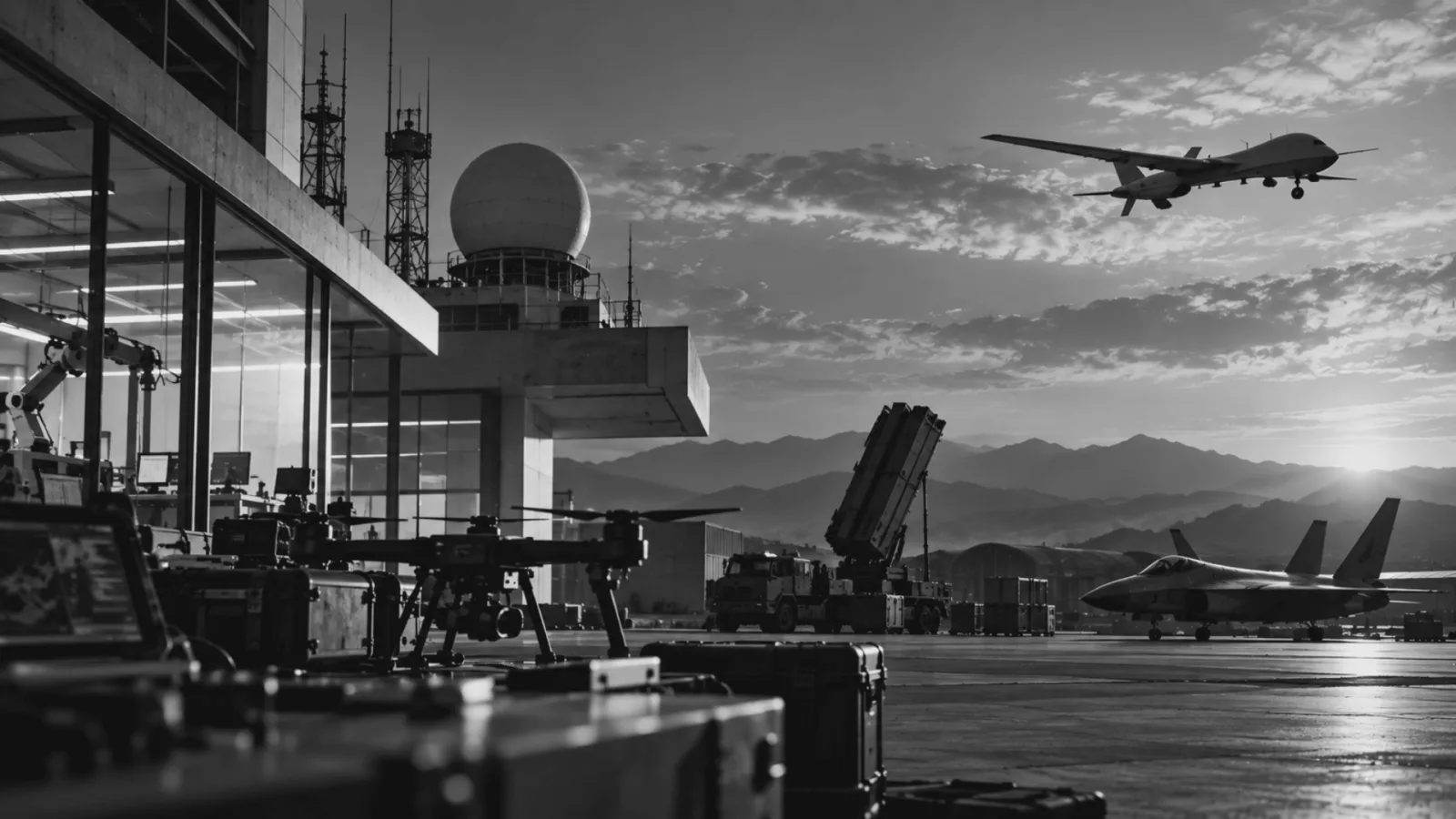
Civil-Military Fusion (CMF) is changing the dynamics with which states create and maintain their technological prowess. It refers to the integration of civilian and military technological, industrial, scientific and institutional capabilities to achieve comprehensive national-security advantage. CMF has become more prominent due to the growing technological frontlines of modern warfare lying outside traditional defence establishments. Technologies like AI, autonomous weapons, commercial ISR satellites, edge computing, cyber capabilities and advanced manufacturing are often developed in civilian ecosystems before entering military use.
This explainer explores the concept, development and rationale of Civil-Military Fusion. While drawing examples of international experiences in order to analyse the relevance of CMF today.
1. Introduction
The character of warfare is evolving. Military advantage is now no longer generated solely in defence laboratories or traditional defence establishments. It increasingly emerges from universities, startups, data platforms and commercial research ecosystems. AI, autonomous systems, commercial satellites, edge computing and digital communications and several dual-use technologies reflect this shift. Many technologies, shaping contemporary battlefields were not originally designed for war. Today, military organizations must not only develop technology but also identify, absorb and adapt innovation emerging outside the traditional defence establishment.
This is altering the relationship between civilian innovation and military capability. The traditional model largely moved from military research to defence production, later for civilian applications (e.g. internet and GPS). But the emerging model is more interconnected. Innovation can move in both directions. Civilian technologies can enter military systems, while military requirements can also shape civilian innovation. The speed of this interaction is becoming strategically important.
CMF is a strategy that maximizes complementarities between the civil and military domains in order to meet the challenges posed by the emerging scope of national security, which now encompasses food, environmental, cyber, human, economic and physical security. CMF seeks to connect military requirements with the wider national ecosystem of science, technology, industry and human capital. Its significance extends beyond acquiring commercial technologies. It concerns the ability to identify, adapt, test and scale innovation for national-security purposes.
CMF can be understood through three perspectives. First, the “multi-level consumerisation of technology” that brings more civilian technologies and tech-enabled platforms onto the battlefield. Thus, spreading their cost across the civil-military domain and making warfare more affordable. Secondly, CMF is not merely the military use of civilian technology, talent and facilities. It includes the reciprocal use of military facilities by the private sector to develop products, strengthen innovation and contribute to national economic growth. Third, the growing role of technology in warfare calls for deeper private-sector involvement in the national security matrix. Military innovation lies at the centre of these approaches forming the pivot of the CMF framework.[1]
Yet fusion does not automatically produce military advantage. Institutions can remain fragmented; procurement can remain slow and security restrictions can prevent technology transfer. Private firms may have little incentive to enter defence markets, particularly in developing nations.
For India, this presents both an opportunity and a challenge. The country possesses a growing defence-industrial base, technology sector, startup ecosystem and academic capacity. The critical question is whether these capabilities can be connected effectively. CMF therefore raises a larger strategic issue: how can a state convert the technological potential of its society into sustained national-security capability?
2. Definition and Scope
There is no single universally accepted definition of Civil-Military Fusion. Although the concept of CMF has evolved over centuries from integration to fusion. The term was formally coined by Hu Jintao in 2007 as "military-civil fusion" (junmin ronghe, 军民融合) at the 17th Party Congress of CCP.[2]
MP-IDSA (Sujan R. Chinoy) defines CMF as, “The concept of Civil-Military Fusion denotes the convergence of military and civilian resources and systems for maximising a nation’s ability to express its comprehensive national power both during war and peacetime.” [3] Dual-use technologies and collaborations serve as the heart of civil-military confluence.
Lt Gen Raj Shukla (Retd.) defines CMF as the qualitative aggregation of resources and capacities from both the civil and military domains, calling for the collapse of granite walls between institutional silos to enable a seamless infusion of talent, technology, and innovation among the armed forces, corporations, academia, scientific community, and entrepreneurs. He also puts forward cultural imagery to better understand the concept of CMF as the fusion of Goddesses Saraswati (Centre of Knowledge and Research), Lakshmi (Centre of Business & Wealth Creation) and Durga (Instrument of Power). [4]
In its broadest sense, CMF can be understood as the systematic integration of civilian and military resources, knowledge, institutions and capabilities for achieving comprehensive national-security and technological prowess. It includes the movement of civilian technologies into military applications. It also includes the movement of military knowledge, facilities and requirements into civilian innovation.
This distinction matters. CMF is often reduced to the "militarisation" of civilian technology. That is too narrow. Lt Col Akshat Upadhyay argues that the conventional understanding of CMF as merely military use of civilian technology, talent and facilities is restrictive. He highlights the reciprocal possibility of civilian firms using military facilities and expertise to develop commercial capabilities.
3. Historical Evolution
The roots of CMF predate the modern state. In antiquity, the boundary between civilian and military activity was often fluid. In ancient Rome, citizen-soldiers farmed in peacetime and fought during war. Centuries before modern states defined CMF, Kautilya’s Saptanga Theory treated military power, economic strength and public welfare as interdependent elements of statecraft, integrating the military into the core architecture of governance.[5] Medieval China, dynasties similarly linked agriculture and military service through systems such as Fubing (Divisional Militia) and Weisuo (Guard Battalion). Hereditary military households cultivated land during peace and provided soldiers during war. Such arrangements created self-sustaining defence systems and showed that security was historically embedded in wider social and economic structures.
The Industrial Revolution further evolved this relationship. Innovations and inventions in physics, chemistry, metallurgy and engineering for academic and commercial purposes like steam engines, telegraphs and improved steel production etc., were rapidly adapted for warfare. The two World Wars took this further. States mobilised civilian factories, including automotive, textile and chemical industries, for defence production. The United States became a major example during the Second World War. Civilian industry was reorganised on a massive scale to produce aircraft, tanks and warships. Yet this was largely emergency mobilisation, not a permanent peacetime fusion model.[6] CMF therefore developed first as an organic relationship between societal resources and military power rather than as a formal doctrine.
After 1945, defence systems became more specialised and secretive. Large military-industrial complexes emerged, particularly in the United States and Soviet Union. At the same time, military research generated important civilian applications. The Cold War therefore produced significant “spin-offs”, including the internet and GPS. [7]After the Cold War, however, the direction began to change. Civilian innovations in digital technologies, commercial computing and advances in medicine created greater scope for “spin-ons” in armed forces.
China presents the example of CMF’s formal institutional development. After the Sino-Soviet split, Beijing increased its focus on CMF to achieve self-reliance in atomic bombs, Space technology and military equipment. During 1980s, Deng Xiaoping’s “Sixteen Character” slogan called for “combining military and civil, combining peace and war, giving priority to military products, and making civil support the military.” During the 1990s, The PLA was also engaged in commercial activities to fund its modernization drive before Jiang Zemin banned it in 1998, redirecting the military towards its core functions.[8]
China removed deeper institutional barriers by 2000s. Military-civil integration gained greater strategic emphasis by 2007. In 2015, Xi Jinping elevated MCF into a national-level strategy and established the Central Commission for Integrated Military and Civilian Development in 2017.
The United States has developed a more decentralised ecosystem linking agencies such as DARPA with universities, startups and private industry. The fundamentals of civil military fusion in USA were achieved long back whose outcome was the mighty military industrial complex. The United States Army Futures Command (USAFC) was established in 2018 “to ensure the army and its soldiers remain at the forefront of technological innovation and war-fighting ability”.[9] Israel has built close military–industry–technology linkages through a revolving door ecosystem between civil and military domains. Türkiye’s defence technology ecosystem, including the development and use of the Bayraktar TB2, illustrates how private-sector innovation can contribute directly to national defence capability. Thus, CMF has evolved from an organic wartime relationship into a structured innovation ecosystem. Its contemporary form increasingly seeks to connect military requirements, civilian technology, private enterprise, national economic capacity and resilience.
4. How Civil-Military Fusion Works: The Operational Mechanism
CMF works through an ecosystem rather than a single institution. CMF works through a continuous exchange between the military, government, industry, academia and the wider innovation ecosystem. It begins with a military problem. The armed forces identify a capability gap or an operational requirement, this requirement is then opened to organisations beyond the traditional defence establishment. Startups, universities, research laboratories and private companies can bring different technologies and ideas to the problem. India’s Army Design Bureau follows this basic logic by connecting the armed forces’ problem statements with startups, MSMEs, academia and individual innovators.
The next stage is discovery and adaptation. Existing commercial technologies are assessed for military relevance. Where no ready solution exists, new technologies are developed through research and experimentation. This is particularly important for AI, robotics, autonomy, sensors, space systems and other dual-use technologies. The aim is not simply to transfer civilian products into defence. Technology must be modified to meet military requirements, including reliability, security, interoperability and operational conditions.
This leads to prototyping and testing. Military users become part of the development process. They test prototypes, identify weaknesses and provide operational feedback. The technology is then modified and tested again. This creates a shorter feedback loop between the developer and the end user. India, through iDEX provides funding (typically up to ₹1.5 crore, and up to ₹25 crore under the ADITI scheme), test facilities and co-development opportunities to start-ups, while the U.S. Defense Innovation Unit uses prototype contracts and flexible acquisition mechanisms to move commercial technologies towards military users.
The critical stage is scaling. A successful prototype has little strategic value if it remains confined to a laboratory or pilot project. CMF therefore requires procurement mechanisms that can move validated technologies into wider service. DIU, for example, uses the Commercial Solutions Opening and Other Transaction authority to prototype and transition commercial technologies more rapidly (60–90 days).
The cycle does not end with deployment. Operational use generates new data and new problems. These feed back into research and development. The process therefore becomes:
Military requirement → civilian research and innovation → prototype → testing → military experimentation → operational feedback → modification → procurement → deployment → further innovation
The real strength of CMF lies in the speed of this cycle. A country may possess universities, defence laboratories, startups and advanced industries. But without effective connections between them, these remain separate capabilities. CMF converts them into an interconnected national innovation system. Its purpose is therefore not merely to acquire civilian technology. It is to build an institutional mechanism through which knowledge, talent, capital, infrastructure and military requirements continuously reinforce one another.
5. Relevant Examples of CMF
5.1 China
China offers the most formalised contemporary model. Its approach evolved from military-civilian integration into Military-Civil Fusion (MCF), which was elevated to a national strategy in 2015 and given stronger central coordination in 2017. The core doctrinal objective was a "world-class military" by 2049 by systematically harnessing dual-use technologies, private sector innovations and global scientific talent for comprehensive national security and strategic dominance. Its effects are visible in AI, robotics, space and other dual-use fields. Recent analysis of PLA procurement found that more than 70 percent of companies winning multiple AI-related contracts in 2023–24 were non-traditional vendors. Commercial firms such as iFlyTek Digital, PIESAT and JOUAV therefore form part of the wider defence innovation ecosystem.[10] In 2017, Beijing established a "National Team" for AI development, designating civilian commercial giants to spearhead distinct fields like Baidu (for autonomous driving), Alibaba (smart city), Tencent (medical imaging), iFlyTek (smart audio, i.e. natural language processing) and Sense Time (smart vision), was added in 2018.[11]
The PLA’s use of a Unitree quadruped robot during the 2024 China-Cambodia exercise also showed how commercial robotics can acquire military applications. Although Unitree itself says it does not sell to the Chinese military.[12] At World Defense Show 2026 in Riyadh, a Chinese state-linked defence manufacturer unveiled the PF-070 system, a quadruped combat robot carrying four anti-tank guided missiles on its back.[13] China has also used MCF to attract global scientific talent. In July 2026, 2025 Nobel Chemistry laureate Omar M. Yaghi joined Tsinghua University full-time, where he is leading an AI-enabled materials research institute.[14] This is better understood as part of China’s broader effort to build scientific and technological capacity than as a direct military acquisition. Civil Military Fusion linked investment funds are also created by central and local governments and private investors.
5.2 United States of America
The fundamentals of civil military fusion in USA were achieved long back whose outcome was the mighty military industrial complex. The current wave of civil military fusion is only an extension of what happened earlier.
Historically dominated by a rigid Military-Industrial Complex (MIC) during the Cold War. By the 2000s, commercial R&D spending drastically eclipsed the federal defense budget. The Department of Defense (DoD) struggled with bureaucratic Federal Acquisition Regulations (FAR), slow requirements pipelines and cultural resistance, causing revolutionary commercial technologies to die in the procurement "Valley of Death.". To counter China’s rapid anti-access/area denial (A2/AD) capabilities and strategic MCF programs, the U.S. pivoted toward spin-on integration—actively ingesting commercial software, chips, and autonomy stacks to achieve military overmatch.
The United States follows a more decentralised path. DARPA pioneered this interaction. Later, the creation of In-Q-Tel in 1999 gave the intelligence community a venture-capital mechanism for accessing emerging commercial technologies. The CIA confirms that In-Q-Tel now works across AI, autonomy, cyber, space and biotechnology. Its portfolio includes Palantir and Anduril.[15] Palmer Luckey’s trajectory from consumer VR through Oculus to Anduril illustrates this revolving door between commercial technology and defence innovation. Anduril is now developing the YFQ-44A under the U.S. Air Force’s Collaborative Combat Aircraft programme.[16] Entities like the Defense Innovation Unit (DIU) in Mountain View, the Office of Strategic Capital (OSC), and AFWERX employ Other Transaction Authority (OTA) mechanisms to bypass traditional multi-year procurement rules, getting private prototypes into soldiers' hands within months.[17]
In 2018, the U.S. Army established the United States Army Futures Command in Austin, Texas—deliberately situating a four-star command outside military bases to be immersed in an urban tech hub. AFC bypassed typical 10-year development cycles by organizing into Cross-Functional Teams (CFTs) spanning Long-Range Precision Fires (LRPF), Next-Generation Combat Vehicles and the synthetic network.[18] AFC initiatives directly propelled programs like the Precision Strike Missile (PrSM) to operational readiness, field-tested modern counter-drone architectures (M-SHORAD), deployed cloud computing into field hubs via the Army Software Factory and integrated AI-driven targeting into the Joint All-Domain Command and Control (JADC2) enterprise.[19][20] An outlay of 18 bn USD has been allocated for development of laid down future capabilities in this model. AI Task Force based at Carnegie Mellon University was kicked off to harness breakthroughs in AI and apply them to a range of Army operations which include talent management in human Resources, predictive maintenance of equipment and extend to support in modernization projects of AFC.
Human capital flow between the Pentagon, Congress, think tanks and venture-funded technology start-ups is another key aspect of civil-military integration in America. Retired high-level military officials and former acquisition officers commonly transition to join boards of technology companies that develop defense-related products, such as Palantir (former Admiral William McRaven), Shield AI (former Navy Vice Admiral Mike Shoemaker), Anduril (General Hawk Carlisle, Christian Brose). Or else, they become general partners of venture capital firms focused on defense. On the other hand, technocrats are appointed to positions within entities such as the Defense Innovation Board (DIB).
6. CMF and India: Current Status, Possibilities and Challenges
India’s CMF debate must begin with a distinction. India does not yet have a formally articulated Civil-Military Fusion doctrine. However, its foundations are taking shape. They can be seen in military jointness, civil-military integration, Theatreisation, defence innovation and growing links between the armed forces, academia, startups and industry. MP-IDSA discussions have argued that India should approach CMF gradually. Service integration and jointness must strengthen before wider civil-military fusion can mature. This is important because India cannot simply replicate the US or Chinese model. India’s democratic system requires a different institutional pathway.
The first requirement is greater internal integration within the military. India’s past experience exposed the cost-of-service silos. The 1965 war revealed weaknesses in joint planning. The political leadership delayed permission for strikes on East Pakistan and Peshawar—causing heavy IAF losses at Pathankot—while simultaneously allowing the armed forces freedom to plan operations, though this crucial decision wasn’t conveyed to them in time. Similar problems appeared during the IPKF operations and during Kargil.[21] Issues included limited interoperability, separate planning and inadequate joint training. The problem, therefore, is not simply technological but also institutional.
The creation of the Chief of Defence Staff (CDS) and the Department of Military Affairs (DMA) in 2019–20 marked a revolutionary institutional response. The CDS combines responsibilities linked to jointness, tri-service planning and integration with the Ministry of Defence.[22] The DMA was also created to facilitate restructuring and better resource utilisation. Theatre-level integration can further clarify joint operational requirements. But jointness itself is a continuing process and Structural integration alone cannot produce it. India's military theaterisation plan has entered its final decisive phase, with the comprehensive structural report currently under active review by the government.[23]
The second transformation is taking place in the defence innovation ecosystem. Through the establishment of iDEX in 2018, there is now a straight pathway linking military needs with civilians who have innovative ideas. Startups, MSMEs and individuals can innovate for specific operational requirements. As of February 2026, the number of players in the ecosystem was 676. iDEX had introduced 566 challenges while signing 548 contracts. Fifty-eight prototypes had been given procurement clearance of around ₹3,853 crore. Forty-five procurement contracts had also been signed, totalling almost ₹2,326 crore.[24]
The ecosystem is also becoming more technology-intensive. The government programs have started including areas related to AI, robotics, autonomy, advanced manufacturing, counter-drone technologies and others. The Army Design Bureau has been instrumental in bridging the gap between the Army and industry & academic organizations through activities like Army Cells in IITs and Forward Area Tours.[25] ADITI aims to accelerate around 30 critical and strategic technologies in deep-tech space, whereas the Technology Development Fund helps in developing domestic defence technologies.[26] This creates a possible pathway for India to move beyond conventional hardware indigenisation towards AI-enabled warfare, autonomous systems, advanced ISR, SAR, secure communications, battlefield management systems and eventually frontier-AI applications. The important shift is from buying platforms to developing the technological ecosystem behind them.
Training offers another largely underused CMF opportunity. Many technologies that will shape future warfare are already developing rapidly in the civilian sector. AI, robotics, big-data analytics, simulation, VR and AR tools are examples. A civilian professional can support efforts relating to war-gaming, simulations, technical training and cybersecurity. Military organizations, on the other hand, bring operational challenges and specific expertise. The outcome is a mutual exchange of expertise rather than mere technology transfer.[27]
This has wider implications for comprehensive national security. India’s technological strength is spread across many institutions. CMF will enable these capabilities to be bridged. It can shorten the distance between an idea, a prototype and a deployable capability. CMF should not end at defence procurement. India can also use military facilities, expertise and testing environments to strengthen civilian technologies and wider economic activity.[28] Emergency landing strips on national highways, logistics infrastructure and the integration of civilian infrastructure into defence planning illustrate this wider logic. Such arrangements can create value in both directions. They can strengthen military resilience while generating civilian economic and technological benefits.[29] In this sense, CMF can support both military preparedness and broader technological capacity.
There remain several challenges like institutional silos, bureaucratic hurdles, funding, procurement etc. MP-IDSA noted that private firms remain reluctant to large R&D investments when future orders are uncertain. There is also a deeper cultural challenge. Trust is important in the case of CMF. The military establishment needs to be more receptive to civilian inputs. The civilian organization needs to appreciate the problems of the military. Bureaucratic processes must become facilitators rather than additional layers between the user and innovator. At the same time, greater integration cannot mean weakening civilian oversight or allowing commercial interests to determine national-security priorities. India therefore needs institutional fusion without abandoning democratic civilian control.
A workable Indian pathway would consequently rest on five connected layers: joint military requirements through CDS/DMA and theatre-level structures; Government-Private Partnership funded R&D; sustained military–academic interaction; startup and MSME participation through iDEX, ADITI and TDF; and industry-led scaling and production. The final objective should be a continuous loop from operational problem to research, prototype, testing, procurement, deployment and feedback. That would turn India’s considerable scientific, industrial and military resources into a more coherent national-security capability.
Conclusion
Civil-Military Fusion is not simply a new method of developing weapons. It represents a broader transformation in how national power is generated. Universities, startups, commercial technologies, data, capital and skilled people are increasingly shaping military capability alongside traditional defence institutions. The boundary between civilian and military innovation is becoming increasingly porous.
What has changed is the speed and scale of this interaction. AI, autonomous systems, commercial satellites, robotics, advanced computing and digital networks can move rapidly from civilian markets to military applications. Possessing advanced technology is therefore not enough. States must be able to identify, adapt, test, scale and continuously improve it.
For India, the foundations already exist through the Armed Forces, DRDO, universities, startups, MSMEs and the wider technology sector. Initiatives such as iDEX and ADITI are beginning to connect these ecosystems. The next challenge is to make these connections deeper, faster and more institutionalized. India does not need to replicate another country's model. India can build a CMF framework suited to its own needs.
CMF is ultimately about more than combining civilian and military resources. It is about building stronger connections across India's national innovation system. Strategic advantage will depend not only on how much a country spends on defence. It will also depend on how quickly it can turn knowledge, talent and technology into usable capability. For India, the real challenge is therefore to build these connections before the next wave of technology changes the character of warfare again.[30]
References:
[1][1] Akshat Upadhyay. ‘Civil-Military Fusion For Emerging Technologies In India’.2023. Vol. 2 Issue 1.MP-IDSA https://www.idsa.in/system/files/news/Civil-Military-Fusion-for-Emerging-Technologies-in-India-Akshat-Upadhyay.pdf
[2] Audrey Fritz. “China’s Evolving Conception of Civil-Military Collaboration”.2019. CSIS https://www.csis.org/blogs/trustee-china-hand/chinas-evolving-conception-civil-military-collaboration
[3] “Panel Discussion on ‘Civil-Military Fusion in India’”.2022. MP-IDSA https://www.idsa.in/idsa-event/panel-discussion-on-civil-military-fusion-in-india/.
[4] Ibid.
[5] Sunil Srivastava. “Civil Military Fusion In India-Promising Pathways”.2023. Vol. 2 Issue 1. CENJOWS https://cenjows.in/wp-content/uploads/2026/01/1.-Civil-Military-Fusion-in-India-Promising-Pathways-By-Lt-Gen-Sunil-Srivastava-Retd.pdf
[6] PR Shankar. “Civil Military Fusion: A Model For India”.2023. Synergy Journal. CENJOWS https://gunnersshot.com/2023/03/24/civil-military-fusion-a-model-for-india/
[7] Akshat Upadhyay. ‘Civil-Military Fusion For Emerging Technologies In India’.2023. Vol. 2 Issue 1.MP-IDSA
[8]Sujan R Chinoy. “Panel Discussion on ‘Civil-Military Fusion in India’”.2022. MP-IDSA https://www.idsa.in/idsa-event/panel-discussion-on-civil-military-fusion-in-india/.
[9] Ankush Banerjee. “The Case for Civil-Military Fusion to Enhance India’s Military Training Ecosystem”.2025. Occasional Paper no. 503, ORF https://www.orfonline.org/research/the-case-for-civil-military-fusion-to-enhance-india-s-military-training-ecosystem#_ednref13
[10] ‘Meredith Chen. China’s growing civilian-defence AI ties will challenge US, report says’.2023. South China Morning Post https://www.scmp.com/news/china/military/article/3324727/chinas-growing-civilian-defence-ai-ties-will-challenge-us-report-says?module=perpetual_scroll_0&pgtype=article
[11]Benjamin Larsen. ‘Drafting China’s National AI Team for Governance’.2019. Standford University https://digichina.stanford.edu/work/drafting-chinas-national-ai-team-for-governance/
[12] Charles Sun. ‘The Hidden System Turning Chinese Tech Companies into Military Suppliers’. 2026. War on The Rocks https://warontherocks.com/cogs-of-war/the-hidden-system-turning-chinese-tech-companies-into-military-suppliers/
[13] Alain Servaes. ‘WDS 2026: China Converts Robotic Dog into 4-Missile Autonomous Anti-Tank System’. 2026. Army Recognition Group
[14] Gillian Tang. ‘Nobel Laureate in Chemistry Omar M. Yaghi joins Tsinghua University full-time’. 2025. Tsinghua University https://www.tsinghua.edu.cn/en/info/1244/14984.htm
[15] Colin Demarest. ‘Exclusive: In-Q-Tel pivots strategy for "forward-deployed" warfare and espionage’. 2026. Axios https://www.axios.com/2026/05/05/inqtel-cia-venture-investing-autonomy
[16]Zach Rosenberg. ‘US Air Force designates Collaborative Combat Aircraft as YFQ-42A and YFQ-44A’.2025. Janes https://www.janes.com/defence-intelligence-insights/defence-news/air/us-air-force-designates-collaborative-combat-aircraft-as-yfq-42a-and-yfq-44a
[18] Jen Judson. ‘US Army’s Futures Command sets groundwork for battlefield transformation’. 2018.Defense News https://www.defensenews.com/digital-show-dailies/global-force-symposium/2018/03/23/us-armys-futures-command-sets-groundwork-for-battlefield-transformation/
[19] Kris Osborn. ‘New Technology Has the Army Futures Command Rethinking Modern Warfare’.2021. National Interest https://nationalinterest.org/blog/buzz/new-technology-has-army-futures-command-rethinking-modern-warfare-194937
[20] Maureena Thompson. ‘Transforming Soldiers into developers at the Army Software Factory’.2021. US Army
[21] Anil Gilani. “Panel Discussion on ‘Civil-Military Fusion in India’”.2022. MP-IDSA
[22] Monojit Das. ‘The CDS and India’s Long March towards Military Integration’.2026. IADN News
[23] Saurabh Trivedi. ‘Final Report on Theatre Commands under Consideration, Centre Tells House Panel’. 2026. The Hindu https://www.thehindu.com/news/national/final-report-on-theatre-commands-under-consideration-centre-tells-house-panel/article71325550.ece
[24] Anoop Verma. How iDEX, ADITI and TDF are transforming India’s defence architecture: Innovation to induction’. 2026.ETGovernment
https://government.economictimes.indiatimes.com/news/defence/transforming-indias-defence-with-idex-aditi-and-tdf-a-new-era-of-innovation/132816327
[25]Kamal Shah. ‘Indian Army’s Transformation Year Opens Doors For Domestic Defence Manufacturers’.2023. IADB https://www.iadb.in/2023/09/01/indian-armys-transformation-year-opens-doors-for-domestic-defence-manufacturers/
[26]PIB. “Def Connect 2024: Raksha Mantri launches ADITI scheme to promote innovations in critical & strategic defence technologies”.2024. Press Release. MoD https://www.pib.gov.in/PressReleasePage.aspx?PRID=2011171®=48&lang=2
[27] Ankush Banerjee. “The Case for Civil-Military Fusion to Enhance India’s Military Training Ecosystem”.2025. Occasional Paper no. 503, ORF
[28] Amoha Basrur. ‘Critical Determinants of Civil-Military Fusion in India’.2024. CAPSS
[29] Akshat Upadhyay. ‘Civil-Military Fusion For Emerging Technologies In India’.2023. MP-IDSA
The views expressed are those of the authors and do not represent the views of CNAWS.
ImageSource: ChatGPT
Tags
- #ADITI
- #Army Design Bureau
- #China Military-Civil Fusion
- #Civil Military Fusion India
- #Civil-Military Fusion
- #Civilian-Military Technology
- #CMF
- #Defence Ecosystem
- #Defence Industry
- #Defence Innovation
- #Defence Modernisation
- #defence technology
- #Dual-Use Technology
- #iDEX
- #Indian Defence
- #military innovation
- #Military-Civil Integration
- #US Defence Innovation
Author
Ashutosh Kumar Singh
Ashutosh Kumar Singh is a researcher and academic with a strong interest in international relations, strategic studies, and West Asian geopolitics. He completed his undergraduate and postgraduate studies at University of Allahabad and is a three-time NET-qualified candidate. His academic and research work focuses on foreign policy analysis, regional security dynamics, and contemporary geopolitical developments in West Asia. He is particularly interested in strategic affairs, diplomacy, and emerging political trends shaping the Middle East and global politics, with a commitment to evidence-based research and policy-oriented analysis.