
How Does Pakistan's Air Defence System Work? Radars, Chinese Missiles and India's SEAD Challenge
1. From Conventional Air Defence to Integrated Air Defence Networks
Pakistan's air defence system cannot be understood simply by examining the surface-to-air missiles in its inventory. It is the product of decades of military modernisation shaped by wars with India, changing patterns of aerial warfare, technological dependence on foreign suppliers and the increasing requirement to defend critical military infrastructure against stand-off weapons. During the early decades following independence, Pakistan relied principally on fighter interception, ground-controlled radar surveillance, anti-aircraft artillery and relatively limited surface-to-air missile capabilities. The fundamental objective was to detect approaching aircraft, alert the relevant air defence sector and direct fighters or ground-based weapons against the threat.
The 1965 and 1971 India–Pakistan wars demonstrated the importance of airfield protection, early warning and the relationship between offensive air operations and defensive counter-air capabilities. However, the technological character of air warfare changed substantially during the following decades. Low-altitude penetration, precision-guided munitions, electronic countermeasures and increasingly capable combat aircraft complicated the task of defending national airspace. Pakistan consequently invested in improved ground-based surveillance radars, fighter aircraft, command networks and foreign-supplied missile systems.
A particularly important development was the introduction of airborne early-warning and control aircraft. Pakistan inducted its first Saab 2000 aircraft equipped with the Swedish Erieye radar in 2009–10, followed by Chinese ZDK-03 airborne early-warning aircraft. These platforms allowed Pakistan to supplement fixed and mobile ground radars with airborne sensors capable of observing large areas and supporting fighter interception. Unlike ground-based radars, whose detection coverage is constrained by terrain and the curvature of the Earth, airborne radar platforms can provide a broader view of low-flying aircraft and help build a more comprehensive picture of activity across national airspace.¹
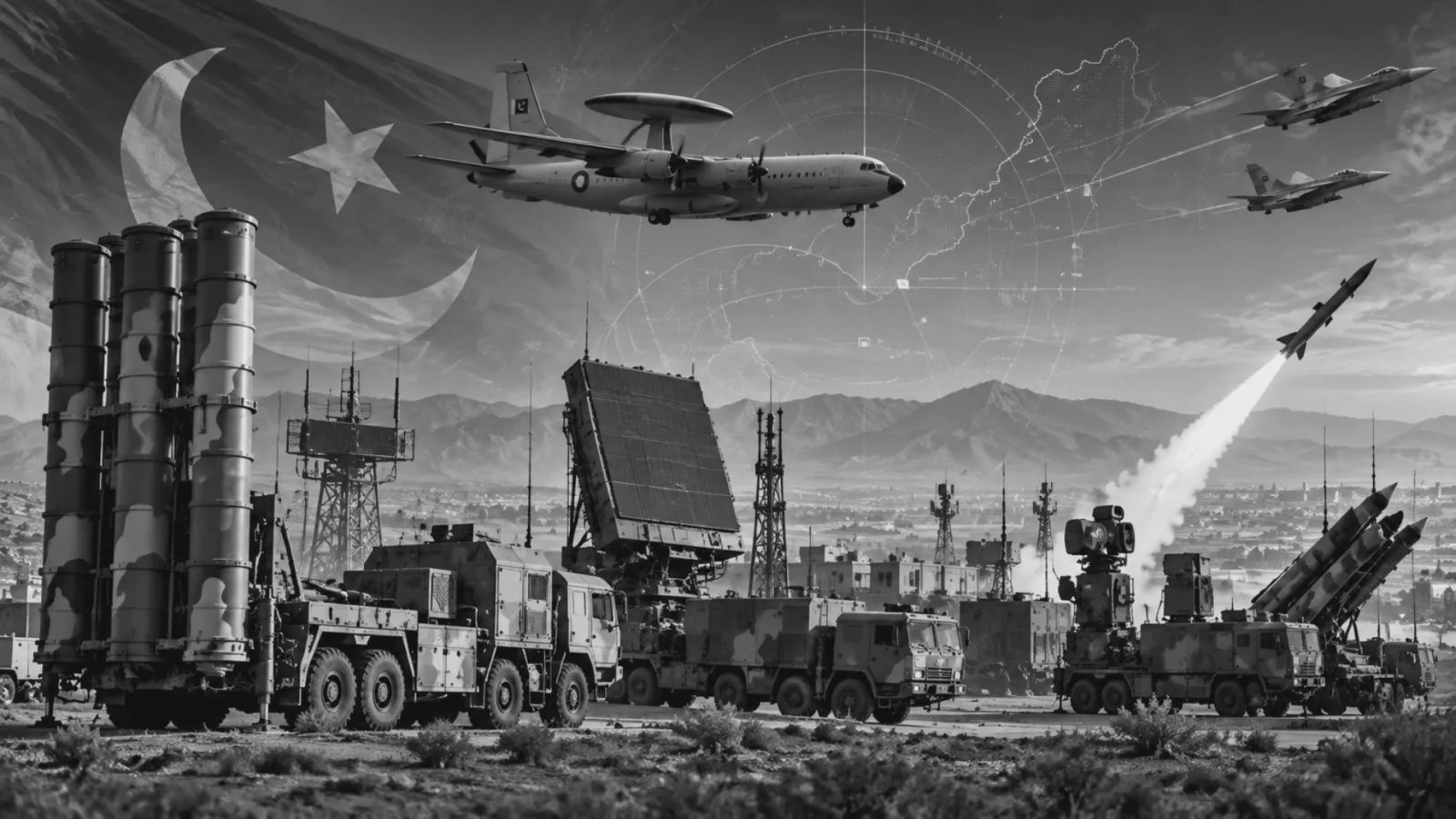
Pakistan's transition towards a more substantial ground-based missile defence network accelerated with the induction of the Chinese LY-80 system in March 2017. Four years later, the Pakistan Army commissioned the HQ-9/P long-range surface-to-air missile system, describing it as an important component of its Comprehensive Layered Integrated Air Defence architecture. The significance of these acquisitions was not merely the introduction of additional missiles, but the ambition to connect sensors, command centres and different interceptor categories into a coordinated defensive network.²
2. How Does Pakistan's Integrated Air Defence System Actually Work?
An Integrated Air Defence System (IADS) combines surveillance, identification, command-and-control, electronic warfare and weapons into a coordinated structure. Its principal function is to convert information about an approaching aerial object into a timely defensive decision. The system must establish whether the object is an aircraft, missile, drone or other airborne platform; determine whether it is friendly, neutral or hostile; assess the threat; and allocate an appropriate response.
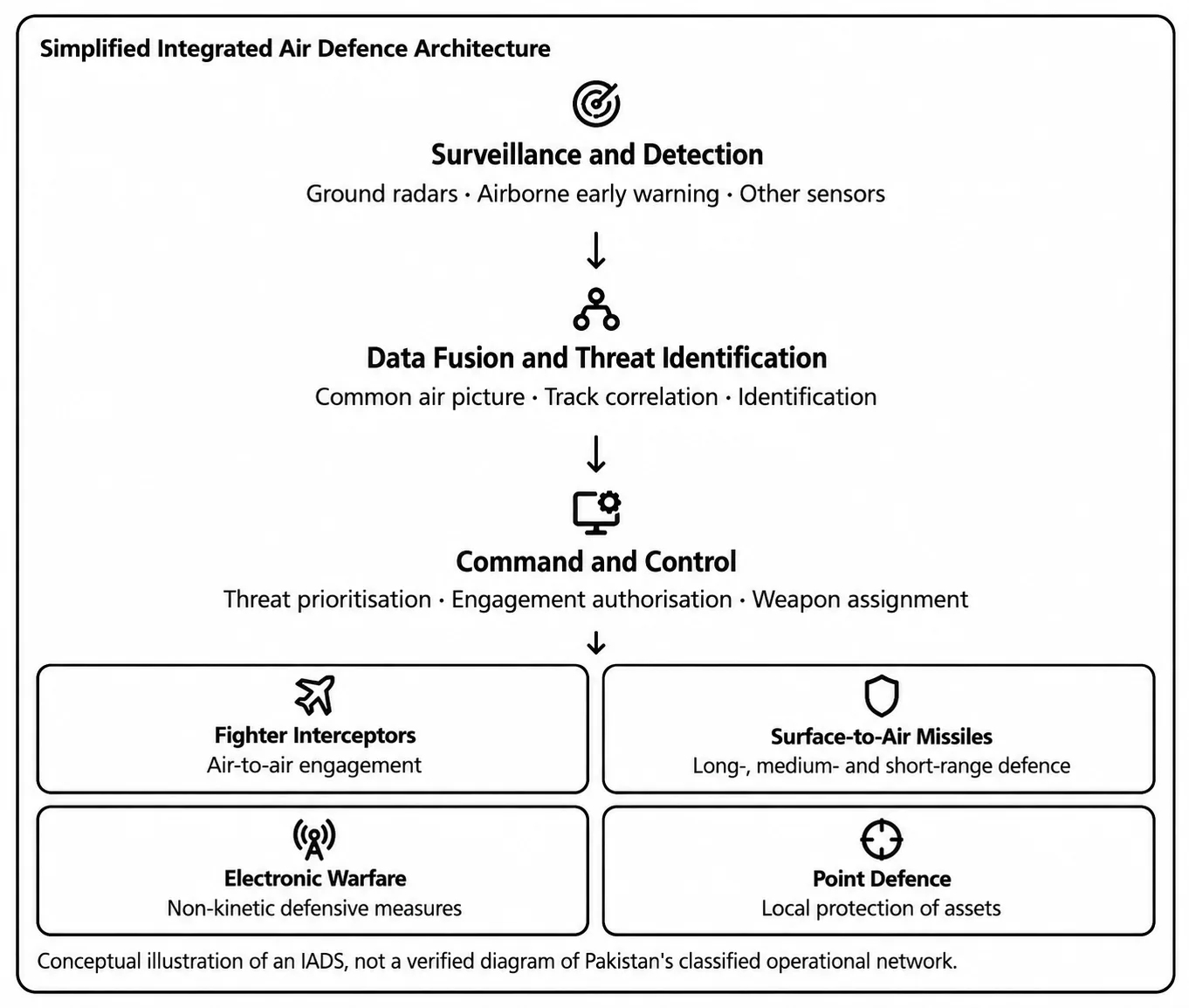
Detection: The First Layer of Defence
The defensive process begins with surveillance. Ground-based early-warning radars search for aircraft and other airborne objects, while airborne early-warning aircraft contribute additional coverage and situational awareness. Pakistan has historically operated a combination of Western and Chinese surveillance equipment, including American-origin TPS-series radars and Chinese-origin radar systems. Its Saab Erieye and ZDK-03 platforms have provided an additional airborne surveillance capability.³
However, radar detection is not synonymous with successful interception. A radar's ability to detect an object depends on numerous variables, including its altitude, radar cross-section, speed, surrounding terrain, electromagnetic interference and the characteristics of the radar itself. A large aircraft operating at medium altitude may be considerably easier to detect than a small drone or a low-flying cruise missile. Moreover, a surveillance radar may detect a target without providing sufficiently precise information to guide a weapon against it.
Identification, Data Fusion and Command Decisions
Once a potential target is detected, information from multiple sensors must be correlated to establish a reliable track. Identification Friend or Foe systems, flight information, electronic signatures and other sources may contribute to the assessment. The resulting information is passed to command-and-control elements, which determine the appropriate response and coordinate the available defensive assets.
This stage is particularly important because Pakistan operates equipment originating from several countries. Integrating Swedish airborne radars, Chinese missile systems, Western-origin fighter aircraft and indigenous communications infrastructure is more complicated than connecting systems designed around a single technological standard. Although Pakistan has invested in integrated command networks, the precise extent of interoperability, data-sharing latency and resilience under combat conditions cannot be independently established from public sources.
Engagement: Choosing the Appropriate Weapon
After a hostile target has been identified and an engagement authorised, the defensive network must select an appropriate interceptor. Long-range missiles may be assigned to certain high-value aerial threats, medium-range systems can protect designated areas, and shorter-range weapons provide localised defence. Fighter aircraft form another component of the broader defensive architecture, particularly when threats must be intercepted beyond the practical engagement envelope of ground-based missiles.
A successful engagement nevertheless requires more than a missile launch. The target must remain within the weapon's engagement parameters, sufficient tracking or guidance information must be available, and the interceptor must function as intended. Consequently, the advertised maximum range of an air defence missile should never be interpreted as a guarantee that every target within that distance can be destroyed.
3. Pakistan's Major Air Defence Systems
Pakistan's ground-based air defence inventory incorporates different missile categories intended to provide overlapping defensive capabilities. The publicly documented systems include Chinese-origin long- and medium-range surface-to-air missiles, alongside shorter-range missiles, guns and other point-defence equipment.
HQ-9/P — Long-Range Air Defence
Inducted in October 2021, the HQ-9/P is a Chinese-origin system intended to engage aircraft and certain missile threats. Pakistani official statements describe an engagement range exceeding 100 kilometres for suitable targets. Its effective range against low-flying cruise missiles may be substantially shorter, and the exact number of operational batteries is not publicly established.⁴
LY-80 / HQ-16 Family — Medium-Range Air Defence
Formally inducted in March 2017, the LY-80 provides mobile, low- to medium-altitude air defence. The export system is associated with the Chinese HQ-16 family and uses dedicated surveillance, tracking and missile-launching components. Its primary significance lies in extending ground-based missile protection beyond purely short-range weapons.⁵
FM-90 and Other Short-Range Systems
Short-range missile systems and anti-aircraft guns provide additional protection against aircraft and selected low-altitude threats. These weapons are particularly relevant to the defence of individual installations and military formations. Their effectiveness against modern drones and precision-guided munitions depends on the specific variant, sensors and engagement conditions.
Comparison of the Principal Defensive Layers
Layer | Representative assets | Principal role |
|---|---|---|
Long-range | HQ-9/P | Extended-area defence against suitable aerial threats |
Medium-range | LY-80 | Defence of designated areas and military assets |
Short-range | FM-90 and other systems | Localised protection |
Very short-range | MANPADS and anti-aircraft guns | Close-in and point defence |
Airborne interception | F-16, JF-17, J-10CE | Fighter-based air defence |
Surveillance | Ground radars, Erieye, ZDK-03 | Early warning and air-picture development |
The table describes publicly documented equipment categories. It does not establish current readiness, precise deployments or the number of operational interceptors.
4. China's Role in Pakistan's Air Defence Modernisation
China has become a central supplier of Pakistan's modern air defence capabilities. The acquisition of the LY-80 and HQ-9/P illustrates a broader strategic relationship extending beyond the purchase of individual weapon systems. Chinese assistance has contributed to Pakistan's fighter aircraft fleet, surveillance capabilities, missile technology and wider defence-industrial development. For Islamabad, this relationship provides access to systems that might otherwise be difficult to acquire because of financial constraints, Western export restrictions or changing geopolitical relationships.
The relationship also creates important questions concerning long-term technological dependence. Modern missile systems require replacement components, maintenance support, software management, technical training and periodic upgrades. These requirements can produce enduring relationships between suppliers and recipient armed forces. At the same time, equipment sourced from different countries must be integrated into national command networks, creating interoperability challenges and potential constraints on future modernisation.
It would nevertheless be inaccurate to assume that Chinese-origin equipment necessarily performs poorly or that its advertised specifications accurately predict battlefield effectiveness. Air defence performance is influenced by operational doctrine, crew proficiency, maintenance, electronic warfare conditions and the wider command network. The relevant question is therefore not whether a system is Chinese, Western or indigenous, but how effectively Pakistan can employ it within a resilient and coordinated defensive architecture.
5. What Are SEAD and DEAD Operations?
Suppression of Enemy Air Defences (SEAD) and Destruction of Enemy Air Defences (DEAD) are related but distinct military concepts. SEAD involves actions intended to temporarily or persistently reduce the effectiveness of hostile air defence systems, allowing friendly aircraft and other weapons to operate with lower risk. DEAD focuses more directly on physically destroying air defence assets. Modern military doctrine recognises that these missions can involve aircraft, precision-guided weapons, electronic warfare, intelligence collection and other coordinated capabilities.⁶
Historically, air defence suppression became increasingly important as surface-to-air missile technology improved. During the Vietnam War, American aircraft encountered substantial threats from radar-guided missile systems, contributing to the development of specialised suppression tactics and aircraft. Subsequent conflicts, including the 1991 Gulf War, demonstrated how coordinated electronic warfare, precision strikes and air operations could reduce the effectiveness of sophisticated defensive networks. Yet the Russia–Ukraine war has shown that modern mobile air defence systems can remain highly consequential even against technologically advanced air forces.
SEAD | DEAD |
|---|---|
Suppression | Destruction |
Temporarily disrupts, degrades or limits the effectiveness of hostile air defences. | Physically destroys air defence equipment or supporting infrastructure. |
The distinction matters because a defensive system can be temporarily ineffective without being destroyed, while the destruction of individual components does not necessarily eliminate the entire network.
For India, SEAD and DEAD are relevant to the broader problem of operating against a defended adversary possessing ground-based missile systems, fighter interceptors and early-warning networks. However, effective suppression is not simply a matter of possessing anti-radiation missiles or electronic warfare equipment. It requires coordinated intelligence, appropriate weapons, reliable communications and an understanding of how the opposing defensive system responds under pressure.
6. Operation Sindoor and the May 2025 Air Defence Contest
The India–Pakistan military confrontation of May 2025 provided an important, although incomplete, public record of modern air defence operations in South Asia. Following the Pahalgam terrorist attack, India launched Operation Sindoor on 7 May 2025, initially targeting what it identified as terrorist infrastructure in Pakistan and Pakistan-administered Kashmir. The confrontation subsequently expanded into reciprocal military actions involving aircraft, drones, missiles, air defence systems and military installations.
On 8 May, the Indian government announced that its armed forces had targeted air defence radars and systems at several locations in Pakistan. It specifically claimed that an air defence system at Lahore had been neutralised. Indian official statements also reported attempted Pakistani drone and missile attacks against military targets in northern and western India, which Indian air defence systems sought to counter.⁷
As the confrontation intensified, India conducted further strikes against Pakistani military infrastructure. Subsequent independent analysis of commercial satellite imagery established that several Pakistani airfields sustained physical damage. A Washington Post investigation identified damage at six airfields, including impacts affecting hangars, runways and supporting infrastructure. However, the existence of physical damage does not establish that Pakistan's entire air defence network was disabled or that every claimed target was successfully destroyed.⁸
Pakistan also reported defensive successes and claimed to have inflicted significant losses on Indian military assets. Several of these claims remain disputed. The Stimson Center's retrospective analysis concluded that publicly available evidence supported some Indian strike claims but was insufficient to substantiate a number of more expansive assertions made during and immediately after the confrontation. Claims concerning the destruction of particular airborne early-warning aircraft, air defence batteries and other high-value systems therefore require careful differentiation between official statements, independent verification and speculation.⁹
The principal analytical lesson is that modern air defence performance must be assessed at the network level rather than through isolated reports of individual missile interceptions or destroyed launchers. A country may successfully intercept some incoming weapons while simultaneously suffering damage to protected installations. Conversely, the penetration of a defensive network does not necessarily indicate that all its sensors, command centres and missile batteries have ceased functioning.
7. What Are the Structural Challenges Facing Pakistan's Air Defence?
Pakistan's modernisation has improved its potential ability to detect and engage aerial threats, but several broader challenges remain relevant to assessing its air defence architecture.
First, the challenge of low-altitude and small-target detection. Ground-based radar systems face physical limitations when observing low-flying objects, while small drones can present difficult detection and identification problems. Airborne surveillance platforms can help mitigate some of these constraints, but their effectiveness depends on availability, coverage and the ability to share information with defensive weapons.
Second, the challenge of defending against diverse threats simultaneously. Modern aerial threats range from fighter aircraft and cruise missiles to inexpensive drones and precision-guided weapons. These threats differ considerably in speed, size, altitude and cost. Defending against them requires a suitable combination of sensors, electronic warfare capabilities, missiles and close-in weapons rather than reliance on a single high-performance interceptor.
Third, the challenge of sustaining an integrated command network. The operational value of an IADS depends on the timely movement of reliable information between surveillance assets, commanders and weapons. Communication delays, incomplete situational awareness, identification errors and electronic interference can all reduce effectiveness. The exact resilience of Pakistan's current network under sustained electronic attack remains difficult to evaluate independently.
Fourth, the challenge of interceptor economics and replenishment. Advanced surface-to-air missiles are expensive, while certain unmanned aerial threats can be produced and deployed at much lower cost. A defender must therefore consider not only whether it can intercept an incoming object, but also whether the defensive response is economically and operationally sustainable over an extended confrontation. This problem has become particularly visible in contemporary conflicts involving large numbers of drones and missiles.
Finally, Pakistan must balance the protection of military installations, population centres, critical infrastructure and deployed formations within finite financial and operational resources. No air defence architecture can guarantee continuous protection of every potential target. As the Royal United Services Institute has emphasised in its wider research on integrated air and missile defence, such systems are fundamentally concerned with prioritising the protection of critical assets rather than creating an absolute defensive barrier.¹⁰
8. Implications for India: Beyond Missiles and Fighter Aircraft
For India, the development of Pakistan's integrated air defence architecture has implications extending beyond the conventional comparison of fighter aircraft and surface-to-air missile inventories. The growing availability of long-range sensors, modern interceptors and integrated command systems means that future air operations will increasingly depend on information superiority, electronic resilience, precision engagement capabilities and effective coordination between military services.
The first implication concerns the importance of understanding air defence as an interconnected system. Individual missile batteries represent only one element of the wider architecture. Their operational effectiveness depends on the surveillance and command arrangements supporting them. Consequently, assessments based solely on advertised missile ranges or the number of launchers are unlikely to provide an accurate picture of a country's defensive capabilities.
The second implication is the growing significance of unmanned systems and precision-guided weapons. The proliferation of drones, loitering munitions and stand-off missiles is changing the economics and operational complexity of air warfare. India must consider these developments both when assessing adversarial defences and when strengthening its own integrated air and missile defence capabilities.
The third implication concerns electronic warfare and network resilience. Modern military forces rely increasingly on data links, satellite navigation, radar networks and digital command systems. The reliability and security of these connections can influence the effectiveness of both offensive and defensive operations. Maintaining situational awareness in contested electromagnetic environments is therefore becoming as important as the performance of individual weapons.
The fourth implication relates to the strategic significance of China's growing defence relationship with Pakistan. Chinese-origin platforms are now important components of Pakistan's air combat and ground-based air defence capabilities. This creates a continuing requirement for Indian defence planners to monitor developments in Chinese surveillance technology, missile systems, electronic warfare and integrated command architectures, while avoiding the assumption that Pakistan's operational configurations necessarily mirror those employed by the People's Liberation Army.
9. The Future of Pakistan's Air Defence Architecture
The future trajectory of Pakistan's air defence modernisation is likely to be shaped by several developments already transforming military operations internationally. These include improvements in active electronically scanned array radars, greater automation of surveillance and track management, more capable electronic warfare systems, cheaper counter-drone weapons and the integration of additional sensors into shared command networks.
Artificial intelligence may eventually improve the speed at which defensive systems classify aerial objects, correlate sensor information and assist commanders in prioritising threats. However, automation also introduces questions concerning reliability, false identification, electronic deception and human control over weapons employment. Claims that artificial intelligence can independently eliminate the uncertainty associated with aerial combat should therefore be treated cautiously.
Pakistan may also seek to improve the balance between expensive missile interceptors and lower-cost defensive options. The experience of conflicts in Ukraine and the Middle East has highlighted the limitations of using high-value missiles against every inexpensive unmanned threat. Directed-energy weapons, improved electronic countermeasures and more economical short-range interceptors are among the technologies being investigated internationally, although their future adoption by Pakistan cannot be assumed without supporting evidence.
Ultimately, the modernisation of Pakistan's air defence system will depend not only on the acquisition of new equipment but also on the capacity to maintain, integrate and operate that equipment effectively. Training, technical support, ammunition availability, interoperability and institutional adaptation are likely to remain decisive factors.
Conclusion
Pakistan's air defence architecture has undergone a significant transformation over the past two decades, moving towards a layered network supported by airborne early-warning platforms, ground-based surveillance radars, Chinese-origin surface-to-air missiles and increasingly sophisticated command arrangements. The induction of the LY-80 and HQ-9/P systems represents an important part of this transition, but these acquisitions should not be confused with the creation of an impenetrable national air defence shield.
The May 2025 India–Pakistan confrontation reinforced the importance of integrated air defence, stand-off weapons, electronic warfare and precision strikes in contemporary South Asian military operations. It also demonstrated the difficulty of evaluating battlefield outcomes in an environment characterised by competing official claims, incomplete evidence and rapidly circulating misinformation.
For India, the central lesson is that the future contest with Pakistan's air defence network will not be determined by the performance of any single missile, radar or aircraft. It will be shaped by the interaction of surveillance, command-and-control, electronic warfare, precision weapons, defensive resilience and the ability of military institutions to adapt to technological change. In modern warfare, the decisive contest increasingly concerns not merely which side possesses more capable weapons, but which side can sustain a more effective and resilient operational system.
Endnotes
1. Observer Research Foundation, Pakistan Air Force: Assessing Capabilities and Modernisation Trends; “Early Warning Aircraft Inducted into PAF,” Dawn, January 1, 2010, Article.
2. “Army Inducts Chinese-Built Air Defence System to Its Arsenal,” Dawn, March 12, 2017, Article; “Pakistan Army Commissions HQ-9/P Air-Defence System,” Janes, Report.
3. “Pakistan's Air Power,” Defence Journal, July 10, 2020, Article.
4. Janes, “Pakistan Army Commissions HQ-9/P Air-Defence System,” Report.
5. “Chinese Air Defence System Inducted into Army's Arsenal,” Dawn, March 13, 2017, Article.
6. Royal Canadian Air Force, “Control of the Air,” Canadian Forces Aerospace Shape Doctrine, Chapter 2; Royal United Services Institute, “Getting Serious About SEAD,” Analysis.
7. Government of India, Press Information Bureau, “Air Defence Capabilities: Tech as the First Line of Protection,” Official release.
8. The Washington Post, “Indian Strikes on Pakistan Damaged Six Airfields, Post Analysis Finds,” May 14, 2025, Investigation.
9. Stimson Center, “Four Days in May: The India-Pakistan Crisis of 2025,” Research analysis.
10. Royal United Services Institute, “The Future of NATO's Air and Missile Defence,” Occasional paper.
Tags

Author