Department of Maritime Security · Articles · Maritime Security ·
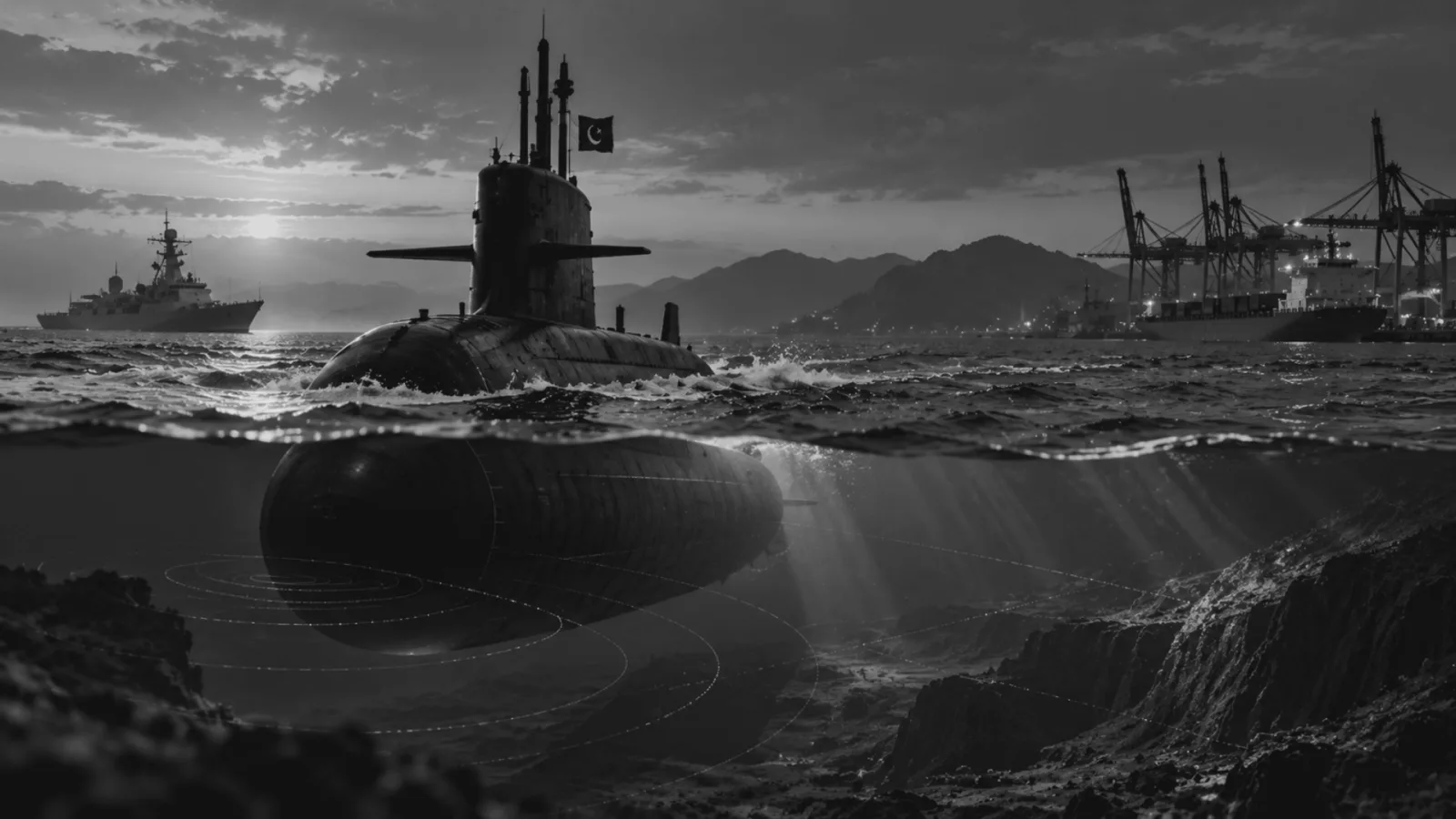
Pakistan’s Hangor-class submarines and the Bay of Bengal: Is India facing a new undersea challenge
Pakistan’s Hangor-class submarines introduce a new dimension to the undersea balance in the Indian Ocean. While the boats do not currently pose a direct sustained threat to India’s eastern seaboard, their AIP capability, potential Bay of Bengal operations and dependence on Chinese technology create longer-term strategic and surveillance challenges for India. The article examines the operational, logistical and geopolitical factors shaping this emerging undersea competition.
Introduction
Indian naval planners have long lived with a particular kind of unease, one that has little to do with anything that can be photographed from a coastal watchtower. A destroyer transiting a strait gets logged and reported within hours. A submarine gives away nothing of the sort. The basic asymmetry is; the sea floor simply keeps secrets better than the surface does. This very asymmetry has shaped Indian threat assessments for most of the last two decades. Chinese Yuan and Jin-class boats have surfaced uncomfortably close to Indian waters on more than one occasion, and a Chinese survey ship once spent months charting the contours of the Ninety East Ridge for reasons no one has satisfactorily explained. India, rather late, is now building the kind of fixed seabed sensor grid that the United States and Japan perfected against Soviet boats during the Cold War. Pakistan’s Hangor-class program has to be read inside that context, not treated as a stand-alone data point.
It would be easy to file Hangor away as simply another chapter in a threat picture China had already authored. That’s not wrong exactly, just incomplete, and it sidesteps the more useful question- does Hangor pose a challenge India must answer on its own operational terms, or is the more pressing problem sitting on India’s own side of the ledger?
The short answer is that a 2,800-tonne conventional hull with a Stirling-cycle engine does not currently threaten to contest sea control off India’s eastern seaboard. However, the sharper question is, which navy currently holds the conventional underwater-endurance edge in the Indian Ocean. As of mid-2026, the answer tilts toward Islamabad rather than New Delhi.
Pakistan’s own officers made the larger ambition explicit during a June 2026 port call in Colombo, when Commodore Omer Farooq told Sri Lankan counterparts That the boats induction gave Pakistan “the reach to maintain a presence in the Bay of Bengal”, describing it as a “game changer”.[1] India, notably, treated the remark as a signal worth answering, sending INS Airavat to Colombo within days.[2] This can be read as evidence that New Delhi is responding to the statement itself, independent of whether Hangor’s actual specifications back it up.
Three things drive the article below. The “Second-strike’ narrative built around the Babur-3 is far less technically settled than Islamabad’s messaging implies. [3]The Hangor program is constrained by supply chain decisions made in Beijing and export rules set in Europe, neither which of Pakistan controls. And while a sustained, independent Pakistani Navy presence in the Bay of Bengal remains operationally unfeasible in the near term given transit logistics, and indirect presence, enabled by Chinese infrastructure is fast approaching operational reality.
The operational matrix of this challenge relies on the Sub-Surface Encirclement Delta (SSED). This framework has three moving parts:
Chinese driven platform proliferation, Pakistani operational execution as a force-dilution vector, and logistics tri-node at Gwadar, Hambantota and Pekua.
What the Hangor-class program actually represents
The Hangor-class displaces roughly 2,800 tonnes, runs 76 meters in length, and is built around Stirling air- independent propulsion (AIP), an export version of China shipbuilding and Offshore International Company’s S26 design, itself derived from the People’s Liberation Army Navy’s type 039A/B Yuan class.[4] Retired Indian Air Admiral Sudarshan Shrikhande traces the design lineage back further, noting that the Yuan class descends from the Soviet era project 877/636 boats NATO knew as “Kilo”, the very class India itself bought ten of in mid-1980s and commissioned as the Sindhughosh class.[5] Pakistan signed for eight Hangor boats from China in 2015, out of which four are to be built at Wuchang Shipbuilding in Wuhan, four at Karachi Shipyard and Engineering Works (KSEW) under a technology - transfer agreement meant to leave Pakistan with some indigenous build capacity once the program closes out.
The naming has its own weight on the Indian side. The original PNS Hangor, a French Daphne-class boat, torpedoed the frigate INS Khukri off Gujarat on the night of 9 December 1971, and the ship’s captain Mahendra Nath Mulla, went down with her, an episode that still occupies a near-mythic place in Indian naval memory. Pakistan, for its part, plans to name the fifth boat of the class PNS Tasnim, after the Hangor’s skipper that night, Commander Ahmad Tasnim,[6] making it the first of the four hulls built at KSEW.
None of that history changes the schedule, which has slipped badly. Pakistan officials said in 2016 that the first four boats would be in service by 2022-2023. In fact, the lead boat did not begin sea trials until April 2024 and was only commissioned in April 2026. A delay of three to four years against the original plan, before making its way home via Colombo and reaching Karachi on 11 June. Three sister boats Shushuk, Mangro, and Ghazi, remained in what Pakistan Navy’s own public affairs office describes as the final stages of the trials as of mid-2026. [7]
Two technical factors distinguish the Hangor class from its Chinese fleet counterparts. The boat was originally designed around German MTU 12V 396 diesel engines; after a 2021 European Union finding that MTU had supplied engines to Chinese warships in violations of the arms embargo, Germany halted further export, forcing China to substitute its own CHD620 engine, a swap Pakistan had no say in.[8] And because Hangor is an export variant rather than the version PLA Navy operated domestically, independent assessments judge it to lag its Chinese parent precisely where it matters most for underwater survival: acoustic quieting, sensor fit, and combat management systems.
Stirling AIP significantly reduces the need to snorkel, but the vessel’s passive sonar performance and overall acoustic signature do not match frontline Chinese domestic hulls, directly impacting its survivability in contested waters. Together these two facts rule out any claim that Hangor is a mature, fully sovereign Pakistani capability. It’s a Chinese platform sailing under a Pakistani ensign.
The Second-Strike claim
The strategic weight attributed to the Hangor-class relies heavily on the integration with the Babur-3 SLCM. Tested in January 2017 and March 2018, the Babur-3 is a tube-launched, dual-capable (conventional/nuclear) cruise missile advertised by Inter-Services Public Relations (ISPR) as providing a “credible second-strike capability”.[9] Harvad Belfer Center, in its assessments of South Asian deterrence describe Pakistan as treating cruise-missile armed AIP submarines as cheaper substitute for a full nuclear powered SSBN fleet. Some analysts are calling it, and rightfully so, a “poor man’s SSBN”. [10]
However, accepting this narrative at face value overstates its actual military utility, for several reasons.
The first is a straightforward matter of operational endurance, nuclear- powered SSBNs (like India’s INS Arihant) possess virtually indefinite submerged endurance, limited only by crew food and supplies, which genuinely assures nuclear deterrence. Conversely, AIP diesel-electric submarines are capped at approximately 15 to 21 days submerged AIP operations before being forced to snorkel or return to base, leaving them vulnerable to anti-submarine warfare (ASW) tracking and crew fatigue over extended patrols.
Operational Range Discrepancies
ISPR reports a uniform 450 km range for the Babur-3. But, open-source intelligence and independent missile assessments estimate its realistic strike radius with a miniaturized operational nuclear warhead at 250 to 300 km. This shorter range drastically restricts the launch area, forcing a submarine commander targeting assets in the Indian interior to venture deep into India’s coastal ASW zone.
Escalation Ambiguity and Tube Compatibility
Rear Admiral Shrikhande points out that standard 533 mm torpedo tubes can launch conventional torpedoes as well as nuclear-armed cruise missiles.[11] If the Indian Navy detects and engages a Hangor-class boat during a high-intensity crisis, planners cannot verify whether the vessel carries conventional heavy weight torpedoes or nuclear SLCMs. This ambiguity compresses decision-making time in a crisis and raises escalation risks, without buying Pakistan the survivability of a true nuclear SSBN.
(Note: Discrepancies regarding Pakistan Navy readiness were further highlighted during India’s Operation Sindoor in May 2025, where information operations relied on outdated or manipulated imagery to inflate force readiness.
Strategic Doctrines and historical Antecedents
To evaluate Pakistan’s naval trajectory, its developments must be understood through International Relations (IR) theories of Internal Balancing and Anti-Access/Area-Denial (A2/AD). Unlike India, which seeks blue-water force projection and sea control across the broader Indo-Pacific, the Pakistan Navy operates primarily on a doctrine of sea denial.
Submarines act as the ultimate asymmetric asset in sea denial. By layering land and sea based anti-ship cruise-missiles such as the shore based Zarib missile (an adaptation of Babur land-attack missile) with AIP-equipped submarines, Pakistan builds a multi tiered A2/AD envelope. The goal is to hold high-value Indian assets like carrier battle groups above all, at risk in the northern Arabian Sea.
Historical Precedent
Pakistan’s ambition to operate in the Bay of Bengal is not without precedent. In late 1971, the Pakistani Navy deployed the PNS Ghazi, a leased, former US Navy Tench-class submarine (USS Diablo) on a long-range intelligence and strike mission off India’s eastern seaboard. Ghazi sank off of Vishakhapatnam in December 1971. This historic event demonstrates that long range dispatch to the Bay of Bengal is a longstanding component of Pakistani strategic doctrine, even if current transit logistics and modern sensor grids make unassisted deployments far more dangerous today.
Supply Chain Dependency and External Vulnerabilities
Pakistani naval power is still, in practice tied to Beijing’s industrial base, the Hangor program makes that plain. Relying on a single foreign patron for core platforms introduces severe operational frictions. Pakistan’s operational independence with Hangor is more limited than the platforms induction date suggests, because so much of what keeps the boat useful still runs through Beijing. That dependency deepens in a crisis. Say if tensions with India spiked to a point where Hangor’s tempo actually mattered, how fast and how far Pakistan could push the boat would hinge on whether Beijing chose to hand over real-time targeting data, hydrographic intelligence for unfamiliar waters like the Bay of Bengal, and other logistical support. A decision China would be making with its own interests in mind.
Conversely, because the Hangor class shares a baseline hull and acoustic signature with the PLAN’s 039B Yuan class, every patrol a Pakistani crew sails, provides Beijing with intelligence on India’s undersea surveillance patterns in the Bay of Bengal, allowing China to map regional hydrography without risking its own platforms diplomatically. For Indian planners, this dynamic offers an intelligence opportunity. Tracking Pakistani Hangor operations allows New Delhi to gather acoustic profiles on China’s primary conventional submarine class.
Operational Logistics and Hydrographic in the Bay of Bengal
The Pakistan Navy’s center of gravity is still the Arabian Sea, built around protecting vital SLOCs near the Strait of Hormuz and defending costal approaches to Karachi and Ormara (as re-emphasized during Operation Muhafiz-Ul-Bahr in March 2026). Extending routine submarine patrols into the Bay of Bengal includes navigating significant geographic and oceanographic hurdles.
Calculating the transit math from Karachi or Ormara to the Bay of Bengal reveals significant operational limitations.
Transit distance: 2,500 to 3,000 nautical miles.
Transit speed and time: Cruising at an economical 10 knots requires 10 to 12 days outbound and another 10 to 12 days inbound.
Patrol Window: Out of a standard 45-to-50-day maximum mission endurance, nearly half the time is consumed purely by transit, leaving a narrow patrol window of only 7 to 10 days on station in the Bay of Bengal.
Hydrographic and Oceanographic Realities
The physical environment adds its own complications. Massive freshwater influx from the Ganges-Brahmaputra river system creates sharp salinity gradients and pronounced thermoclines, and these thermal layers bend sonar signals, generating acoustic shadow zones that help silent AIP submarines conceal their presence from surface ship sonars. Large stretches of the northern Bay of Bengal, off West Bengal and Bangladesh, complicate that picture, though, because they feature shallow bathymetry dropping below 200 meters, and operating a 2,800-tonne hull in shallow littoral waters like these restricts vertical evasive maneuvering and increases detection risks.
The Sub-surface Encirclement Delta (SSED) and Regional Logistics
To understand how these platform dynamics, oceanographic constraints, and logistical limitations interact, South Asia’s sub-surface shift is best analyzed through the SSED. The SSED is a low visibility, asymmetric operational arrangement built on three linked nodes: Chinese platform technology, Pakistan Navy operational proxy execution, and regional logistics nodes anchored at Gwadar in Arabian Sea, Hambantota in the Central IOR, and Pekua in the Bay of Bengal. The primary strategic objective of the SSED is force dilution. The Pakistan Navy does not need to secure Maritime Control in the Bay of Bengal. By deploying Hangor into the eastern littoral Pakistan forces the Indian Navy to divert critical ASW assets (including Boeing P-8l Poseidon maritime patrol aircraft, MH-60R ASW helicopters, and nuclear attack submarines) away from the Arabian Sea and Malacca Strait to protect eastern strategic infrastructure.
The operational feasibility of the SSED in the Bay of Bengal also depends, to a large extent, on forward logistics access. In March 2023, Bangladesh commissioned BNS Sheikh Hasina, its first specialized submarine base, constructed by Chinese state contractor Poly Technologies at Pekua in Cox’s bazar at a cost of $1.21 billion.[12] Designed to berth six submarines and eight warships simultaneously, the facility was built primarily for Bangladesh’s two Chinese supplied Type 035G Ming-class submarines. At its inauguration, official statements noted the base could serve as a service point for ships sailing in the Bay of Bengal. A phrase CSIS analysts interpreted as a clear signal for potential PLA Navy access. [13]
Following political shifts in Dhaka in August 2024, bilateral military engagement between Pakistan and Bangladesh expanded, including joint participation in exercise AMAN-2025. Furthermore, Bangladesh’s 2025 entry into advanced negotiations with South Korea for six improved Jang Bogo-class submarines indicates a dual-patron hedging strategy. Should future diplomatic arrangements grant Pakistani or Chinese submarines resupply, berthing or emergency repair at Pekua, Chattogram or Mongla, the operational transit math changes fundamentally. Access to these forward nodes removes the long transit barrier from Karachi, allowing Hangor-class submarines to sustain continuous patrol eastward.
The Regional Strategic Triangle
If Beijing integrates access across Gwadar, Hambantota and Pekua, Indian planners face a dual front maritime encirclement. Under the pretext of commercial visits, anti-piracy escorts, or joint naval exercises, Chinese and Pakistani submarines can systematically map hydrographic conditions in the Bay of Bengal. A dual front presence like that puts several key Indian strategic nodes directly at risk:
INS Varsha: India’s classified, underground nuclear submarine base under construction near Vishakhapatnam.
Eastern Naval Command: Headquartered at Vishakhapatnam.
SSBN Bastion security: Proximity of Chinese or Pakistani submarines off Vishakhapatnam risks compromises to the stealth and survivability of India’s Arihant-class nuclear ballistic missile submarines as they exit port.
Comparative Underwater Domain Awareness (UDA) Architecture
To fully capture how the Hangor induction impacts regional balances, we must compare the sensor, tracking, and operational infrastructure maintained by both regional navies across the Indian Ocean Region.
Asset/Sensor Category | Indian Navy Capability | Pakistan Navy Capability |
Seabed Hydrophone Arrays | Deep Ocean Watch (NPOL) across Andamans and Ninety East Ridge | None (Dependent on Chinese acoustic data sharing) |
Acoustic Research Vessels | INS Dhruv(A135) and INS Anvesh (dedicated missile/ACINT tracking) | Limited surface survey boats; relies on Chinese hydrographic mapping |
Long-Range Airborne ASW | 12x Boeing P-8l Poseidon+ MQ-9B SeaGuardian UAVs | 3x Sea King/ ATR-72 ASW aircraft (Arabian Sea operational focus) |
Shallow Water ASW Surface fleet | 16x Arnala-class ASW-SWC Corvettes with low frequency sonars | Standard offshore patrol vessels (OPVs); no LVFDs integration |
Who holds the underwater edge: A direct comparison
Judged purely on platform-to-platform terms as of mid-2026, Pakistan currently holds the AIP-fielding advantage over India, not the other way around.
Air-Independent Propulsion:
PNS Hangor entered active service in April 2026 fitted with Stirling AIP. No Indian conventional submarine currently operates with AIP. DRDO’s indigenous fuel cell AIP system, sanctioned in 2014, faced repeated delays. Originally slated for INS kalvari, it was redirected to INS Khanderi, with sea trials not expected before mid-2027.[14] Thus, Pakistan fielded operational AIP a full year before India’s first test hull.Fleet Obsolescence vs. Project 75(1):
While India successfully delivered six Kalvari-class (Project 75) Scorpene- derived submarines between 2017 and 2024, its follow on project 75(1) program for six AIP-equipped submarines in partnership with Germany’s TKMS has suffered a 25-year procurement delay.[15] Cabinet Committee on Security approval is expected around late 2026, with first deliveries unlikely before 2035. By then, India’s legacy Russian Sindhughosh (kilo) and German Shishumar (Type 209) submarines will exceed 40 years in service.India’s Strategic Superiority:
On ASW and underwater domain awareness, India holds a clear and growing edge, reflected directly in the table above. Indi additionally maintains absolute superiority in nuclear propulsion, operating INS Arihant and INS Arighat, with INS Aridhaman under completion.
What Decision-Makers Should Take Away
The Hangor-class, considered alone, is not really the story. The story is that marginal, borrowed, delay-prone platform advantage has been enough to provoke a genuine Indian policy response. Which is itself a signal how thin India’s own margin currently is in conventional underwater endurance. Three conclusions follow :
The Bay of Bengal question is sort of a Bangladesh question: Strategic access to the Bay of Bengal centers on Bangladesh. Indian maritime strategy must focus on diplomatic engagement with Dhaka to prevent the dual-use militarization of facilities like Pekua.
Accelerate Project 75(1) Contracting: Upon final CCS approval for Project 75(l), defense procurement officials should enforce strict, legally binding builds milestones to prevent further scheduling delays.
Synchronize Sensor and Fleet Procurement: Seabed surveillance arrays provide warning time, but warning without available response hulls degrades deterrence, Fixed-sensor deployment schedules should be directly aligned with fleet delivery dates.
To avoid letting individual ship refit schedules anchor the nation’s underwater modernization, India Should fund a parallel integration track for DRDO’s AIP plug, insulating the overall fleet timeline from single point delays.
Expand Unmanned Undersea Vehicle (UUV) Programs: DRDO and private defense startups should accelerate the development of Extra-Large Unmanned Undersea Vehicles (XLUUVs) for long endurance oceanographic surveillance across Bay of Bengal, reducing the operational burden on crewed submarines and airborne ASW assets.
Is India Facing a New Undersea Challenge?
So no, not directly and not soon. Geographic distance, Pakistan’s own preoccupation with the Arabian Sea, and the absence of confirmed foreign basing rule out a sustained combat presence off India’s east coast for now. The harder problem sits one level down, in the slow accumulation of AIP platforms and forward access points that the Sub-surface Encirclement Delta describes.
By deploying AIP platforms into the Bay of Bengal, Pakistan can execute a low cost force dilution strategy that strains Indian ASW resources across two ocean fronts. A major long-term strategic complication for New Delhi would arise if Beijing or Islamabad expand defense exports or transfers Hangor-class platforms to regional nations like Bangladesh, as far as Bay of Bengal is concerned. Introducing advanced AIP hulls into the eastern littoral would permanently alter the regional undersea balance right along India’s doorstep.
At the same time, this operational proximity creates an intelligence opportunity for New Delhi. Because the Hangor class shares its structural baseline, propulsion technology, and acoustic characteristics with China’s Type 039A Yuan-class submarines, Pakistani operations in or near Indian waters allow the Indian Navy to collect critical acoustic signatures. Through passive sonar logging and tracking, Indian forces can profilr the thermal outputs, acoustic signatures, and maneuvering parameters of these platforms, gaining technical intelligence on Chinese submarine technology that would be far more difficult to acquire from evasive PLAN patrols.
References:
[1] Commodore Omer Farooq, quoted in "Pakistan Navy Expands IOR Reach," Regional Defence Journal, June 14, 2026.
[2] "India Deploys INS Airavat to Colombo Following Pakistani Naval Port Call," The Indian Express, June 18, 2026.
[3] Ankit Panda, "Pakistan Conducts Second Test of Babur-3 Nuclear-Capable Submarine-Launched Cruise Missile," The Diplomat, April 2, 2018.
[4] "Hangor-Class Submarine," Wikipedia, last modified August 2026.
[5] Sudarshan Y. Shrikhande, "Hangors in the Bay: Pakistan’s Submarine Strategy Unfolds," Bharat Shakti, August 31, 2026.
[6] "Pakistan Cuts Steel for 5th Hangor-Class Submarine 'PNS Tasnim'," Naval News, December 10, 2021.
[7] Pakistan Navy Public Affairs Office, Press Release, Rawalpindi, June 2026.
[8] "Pakistan's Hangor Bet," India Sentinels.
[9] ISPR, Press Release No. PR-10/2017-ISPR, January 9, 2017.
[10] Mansoor Ahmed, "Pakistan’s Tactical Nuclear Weapons," Belfer Center, Harvard Kennedy School, 2021.
[11] Shrikhande, "Hangors in the Bay."
[12] "Bangladesh’s First Submarine Base Starts Operation Monday," Dhaka Tribune, March 20, 2023.
[13] CSIS, "Closing the Undersea Surveillance Gap in Southeast Asia."
[14] "India’s 'Stealth Sub' Breakthrough," The Eurasian Times, March 10, 2026.
[15] India Prepares Final Approval for Project 75(I)," Army Recognition, August 2026
The views expressed are those of the authors and do not represent the views of CNAWS.
ImageSource: ChatGPT
Tags
- #AIP Submarines
- #Air-Independent Propulsion
- #Anti-Submarine Warfare
- #Bay of Bengal
- #China-Pakistan Defence Cooperation
- #Hangor-Class Submarine
- #Indian Defence
- #Indian Navy
- #Indian Ocean
- #Maritime Security
- #Maritime Strategy
- #Naval Strategy
- #Pakistan Hangor-Class Submarines
- #Pakistan Navy
- #Pakistan-China Military Cooperation
- #South Asian Security
- #Submarine Warfare
- #Submarine Warfare India
- #Undersea Warfare
- #Underwater Domain Awareness
Author
Sakshi Singh
Sakshi Singh is a geopolitical and strategic affairs analyst working at the intersection of regional security, maritime strategy and political intelligence. Her work spans Asia, the Indo-Pacific and India’s strategic environment, with a particular focus on defence, maritime security and evolving regional power dynamics. She combines OSINT-driven research with analytical writing, intelligence briefings and expert-led conversations to decode complex geopolitical developments into sharper strategic insight. Her interests lie at the confluence of geopolitics, sea power and the architecture of Asian security.