Department of Disruptive & Emerging Technologies · Articles · Defence Technology ·
India’s First Baaz Drone Battalion: What It Reveals About the Indian Army Post Op Sindoor
India’s first Baaz drone battalion signals a shift towards the institutionalisation of drone warfare within the Indian Army.
Its formation reflects lessons from the LAC and Operation Sindoor, while expanding the Army’s focus on persistent ISR, target acquisition, drone integration and counter-UAS capabilities.
1. Introduction
Drones have become a vital component in contemporary warfare, leading to significant investments by governments in their manufacturing and procurement. These Unmanned Aerial systems are reshaping the battlefield by mitigating risks for military personnel both in the air and on the ground, minimising the potential for increased fatalities and capture by the enemy state.
This transformation in modern warfare can be characterised by AI- enabled warfare systems, enhanced surveillance capabilities, precision strikes, and drone swarms, thereby altering traditional combat operations.
The multi-theatre conflict between the USA and Israel and Iran, along with its regional proxies, demonstrated the tactical efficiency of unmanned aerial systems, including loitering munitions and precision strike drones. This operational trend indicates rapid employment of drone systems in conventional military warfare.
The development of drones requires advanced technology and significant investments in R&D to produce drones and munitions capable of advanced deployment.
This operational efficacy was demonstrated during the 2020 and 2023 conflicts between Armenia and Azerbaijan, where the latter deployed the Turkish-made Bayraktar TB2 to target armoured vehicles, artillery, and logistics infrastructure with high-end precision.
2. From Drone Acquisition to Drone Warfare
Following Operation Sindoor, the Indian armed forces accelerated the acquisition, procurement and induction of drone systems and C-UAS weapon systems. According to the reports, the massive modernisation initiative includes more than $2 billion for procurement of drones. Government initiatives like Innovations for Defence Excellence have streamlined the procurement procedures, encouraging private corporations, attracting investments and accelerating manufacturing capabilities.
The Defence Forces Procurement of Drone Systems (DFPDS-2026) rules further support this pipeline by enabling decentralised procurement of tactical drones valued under INR 5 crore directly through service command revenue budgets, lowering acquisition friction for smaller platforms, as detailed in the DFPDS-2026 procurement framework for Indian manufacturers.
India is also advancing on its “Eagle in Arm” doctrine, as remarked by General Upendra Dwivedi, which aims to equip each soldier with drones, while simultaneously establishing 26 dedicated drone regiments. Incorporating drones in Armed Forces training and operations, it ensures seamless integration of drones on the battlefield.
Additionally, the Armed Forces are utilising 3D printers for manufacturing components during frontline operations.
As per reports, Zuppa, a deep tech company that builds drones and sensor systems, together with the Armed Forces, they are building rapid fabrication units, enabling on-site drone repairs, fabrication and mission-specific modification; this approach represents an ambitious modernisation initiative.
3. Understanding the Baaz Drone Battalion
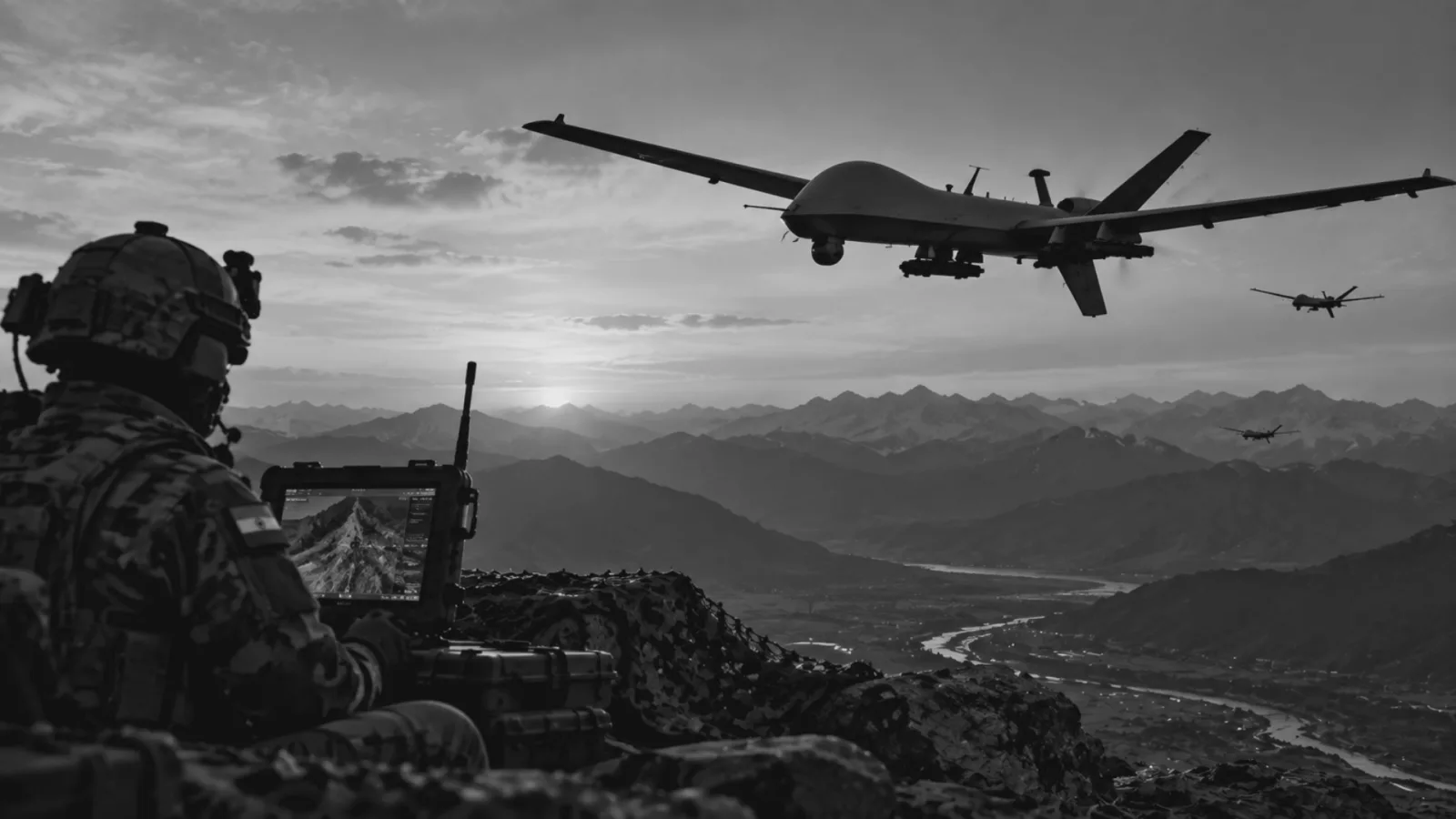
The Baaz (meaning hawk in Hindi) is a dedicated drone battalion formed by the Indian Armed Forces. It is based on the Army Aviation Corps' current remotely piloted aircraft.
This new unit ups the ante in India’s drone ecosystem, with a focus on ISR (Intelligence, Surveillance and Reconnaissance), deep area surveillance, target acquisition, and drone integration with ground formations.
The Baaz battalions differ from the existing Ashni drone systems, which are integrated into the infantry for tactical and short-range observation, and the Regiment of Artillery’s Divyastra batteries, which are responsible for deploying loitering munitions or one-way attack systems.
The Baaz battalion consists of specialised, skilled operators and technicians who will be responsible for overseeing the life cycle of drone systems.
The formation of this battalion is part of the Indian Army’s “Decade of Transformation Initiative”, emphasising the relevance of drones in the domain of technological warfare. According to the officials, the decision to form this battalion was prompted by the conflict at the LAC in 2020 and the operational use of drones in Operation Sindoor.
The Baaz Battalion operates with a mixed fleet of drones, which includes the American MQ-9 B SkyGuardian aircraft. As per the reports, the Army will receive eight of these drones, each capable of flying for 40 hours over 40,000 feet and carrying sensors and weaponry.
Over 31 drones will be ordered for all three military services, with ten arriving ready to fly and twenty- one being manufactured in India, with deliveries due in early 2029. Along with these, the battalion will also consist of Israeli- made Heron and Hermes and the indigenously developed Ghatak drones developed by DRDO.
4. India’s Doctrinal Shift
The formation of India’s Baaz battalion signals an evolution in India’s military strategy, shifting from treating drones as tactical weapon systems to integrating them into institutionalised combat operations.
The incorporation of drones into India’s broader defence ecosystem works in synergy with the Army’s Eagle-in-Arm doctrine, which integrates drones as an essential component of the infantry battalion.
The doctrine was announced on 26th July 2025, on Kargil Vijay Diwas, where the then Chief of Army Staff, General Upendra Dwivedi, outlined the Army’s latest formations, which included Ashni drone platoons across infantry battalions, Bhairav Light commando battalions and Rudra brigades, fusing infantry, artillery, missiles, and loitering munitions into one networked combat architecture.
The Indian Army’s drone doctrine has transitioned from an experimental phase, thereby making it an integral part of the forces and institutionalising the force architecture. Battalion-level deployment, restructuring of units, integration and creation of new units, and specialised training facilities are operating together as a unified system.
5. Operation Sindoor as an accelerator of India’s Drone ecosystem
Following Operation Sindoor, the objective was very clear: integration of drones throughout the military across all ranks. Units across infantry, artillery, and support arms, and ultimately incorporating drones as per specific mission profiles, including surveillance, logistical support and medical support, thereby enhancing the effectiveness of the missions.
To bring about this shift, the Indian Army is setting up specialised drone training centres. These centres include IMA Dehradun, OTA Chennai and Gaya, Infantry School Mhow, among others.
Operation Sindoor marked a pivotal shift in India’s military strategy; the operation showcased a comprehensive integration of drones, domestically produced precision-guided munitions, multi domain capabilities across three services, effectively targeting terror camps of Lashkar-e-Taiba, Jaish-e-Mohammad, and Hizbul Mujahedden.
During Operation Sindoor, the Indian Armed Forces also saw the use of hostile drones and munitions from Pakistan, specifically Turkish-origin Asisguard Songar models. Following the events, the Army initiated procurement of indigenously developed SAKSHAM (Situational Awareness for Kinetic Soft and Hard Kill Assets Management), a fully indigenous command and control system.
The system has been developed by the Indian Army in collaboration with Bharat Electronics Limited (BEL). It operates on Army data Networks; it ensures secure communications between command centres and field units, incorporating AI-driven technologies, allowing predictive identification of targets and faster decision-making.
The scale and intensity with which drones operated during Operation Sindoor made it clear that future conflicts would be dominated by drones and C-UAS systems, leading India’s defence ecosystem to invest in and accelerate the development of drones.
6. Strategic Implications for India
The formation of India’s Baaz drone battalion has implications beyond the acquisition of another class of unmanned platforms. Its importance lies in the institutionalisation of drones in India’s defence architecture.
In August 2026, the Indian Army raised its very first Baaz drone battalion along the Western front. The newly formed unit will function under the Jalandhar-based 11 Corps, also known as Vajra Corps. The battalion is deployed at the highly sensitive Indo–Pak border in northern Punjab. The battalion raised in Jalandhar will be crucial for surveillance on the stretches of the northern Punjab frontier.
Unlike smaller drones operated by the infantry, the Baaz battalion operates on a larger scale and consists of larger drones such as the searcher drones.
The battalion will function as a centralised brain for the army’s growing complex drone systems while managing functions such as flight operations, software updates, data exploitation, etc.
This platform will provide the armed forces with surveillance, deep-penetration reconnaissance, and real-time situational awareness over border areas and territories deep inside enemy lines.
As these drones are equipped with high-end surveillance capabilities, they can prove to be crucial to monitor and neutralise drones coming in from Pakistan, which are mainly used to smuggle firearms and narcotics.
Regular drone patrols with ISR capabilities can help detect smuggling patterns, types of drones used, and individuals associated with aiding these groups. The Baaz drone system, acting as a centralised brain, can provide enhanced coordination between the Armed Forces and intelligence agencies for more robust counter-terrorism strategies.
Conclusion
The formation and induction of the Baaz drone battalion represents not just the creation of another drone unit, but a wider restructuring and institutionalising of the Indian Army’s drone warfare systems.
The military leadership has framed the Baaz battalion as part of the broader “Decade of Transformation”, which aims to modernise the force in the era of technologically driven warfare.
Operation Sindoor and the LAC conflict in 2020 served as a driving force for India’s drone development. Along with the formation of this battalion. India is developing sophisticated C-UAS systems like SAKSHAM, which indicates the Army’s focus is shifting towards AI-driven threat evaluation and soft and hard kill coordination and a modular, scalable architecture adaptable to future threat evolution.
The effectiveness of the Baaz drone systems will be their ability to provide persistent ISR capabilities along with secure communications and electronic warfare, which will involve an overload of information, consistent SIGINT and video feeds. It will then be crucial to process that data effectively, separating signal from noise. The operators will need to focus on EW hardening, sophisticated encryption technologies, and an emergency contingency procedure in case of loss of control. India’s Baaz battalion has paved the way for an indigenous modernised warfare system which will sustain and evolve in the near -future in the ever-growing world of technological warfare.
References:
1. Indian Army’s New Baaz Battalions Mark a Structural Shift in Drone Warfare, 8th July 2026, Drone Federation India (DFI), https://www.dronefederation.in/media-hub/indian-army-new-baaz-battalion
2. Army Raises Specialised ‘Baaz’ Battalions for Long-Range Drone Surveillance, Precision Strikes, 29 June 2026, https://bharatshakti.in/army-raises-specialised-baaz-battalions-for-long-range-drone-surveillance-precision-strikes/
3. Indian Army to expand drone fleet, raise Baaz Battalions to boost surveillance capability: COAS General Upendra Dwivedi, 29 June 2026, https://www.aninews.in/news/national/general-news/indian-army-to-expand-drone-fleet-raise-baaz-battalions-to-boost-surveillance-capability-coas-general-upendra-dwivedi20260629183408/
4. Baaz drone battalion of the Army deployed at Jalandhar in Punjab, first in a state facing Pakistan, 22nd August 2026, The New Indian Express, https://www.newindianexpress.com/amp/story/india/2026/Aug/22/baaz-drone-battalion-of-army-deployed-at-jalandhar-in-punjab-first-in-a-state-facing-pakistan
5. India’s Military Drone Ecosystem, 22nd August 2026, Defence Standard, https://defencestandard.com/guides/india-military-drones/
6. Banerjee Aritra, Inside India’s Rs 1.46-lakh-crore defence push – and the race to prepare for the next drone war, 28 July 2026, Financial Express, https://www.financialexpress.com/business/defence/inside-indias-rs-1-46-lakh-crore-defence-push-and-the-race-to-prepare-for-the-next-drone-war/4304024/
7. Adya Madhavan, Vikrant Shinde, “Accelerating Tactical Drone Procurement for India”, Takshashila Discussion Document 2026-23, Version 1.0, July 2026, The Takshashila Institution, https://takshashila.org.in/content/publications/20260722-accelerating-tactical-drone-procurement-for.html#introduction
8. Kshitiz Bhardwaj, Central brain' for drone operations: How Baaz Battalions will transform the Indian Army, 1st July 2026, Firstpost, https://www.firstpost.com/india/central-brain-for-drone-operations-how-baaz-battalions-will-transform-the-indian-army-14028108.html
9. https://x.com/VajraCorps_IA/status/2090659750694535583
10. Pakistan-Made Larger Drones Carrying Drugs and Arms Detected in Punjab, The CSR Journal, https://thecsrjournal.in/pakistan-made-larger-drones-carrying-drugs-and-arms-detected-in-punjab
The views expressed are those of the authors and do not represent the views of CNAWS.
ImageSource: ChatGPT
Tags
- #Baaz Drone Battalion
- #C-UAS
- #Counter-UAS
- #defence technology
- #drone warfare
- #drone warfare India
- #Eagle in Arm
- #Indian Army
- #Indian Defence
- #ISR
- #military drones
- #Military Modernisation
- #operation sindoor
- #UAVs
- #unmanned systems
Author
Rajas Purandare
Rajas Purandare holds an M.A. (Hons.) in International Relations and Strategic Studies from the University of Mumbai, with a B.A. in Political Science and Economics. He has experience across geopolitical risk, strategic research, and policy analysis, having worked with WoRisGo, Kawach Organisation, and Indic Researchers Forum. He currently works as a Geopolitical Risk Intelligence Intern at the Sir Syed Centre for International Relations and Risk Analysis.