Department of Strategic Foresight & Scenario Planning · Commentaries · Geopolitics ·
How Israeli Weapons forged Sri Lanka’s military victories during its 30 years civil war?
This commentary examines the evolution and strategic importance of Israel–Sri Lanka defence cooperation during and after Sri Lanka’s 30-year civil war. It traces Israel’s supply of weapons, patrol boats, fighter aircraft, military equipment and training, and their role in strengthening the operational capabilities of Sri Lankan forces. Despite Colombo’s diplomatic caution towards Israel and its ties with the Arab world, defence cooperation remained largely insulated from political tensions. The relationship continued to evolve after the war, with renewed Israeli support in areas including defence technology, cybersecurity and the modernisation of Sri Lanka’s Kfir fighter fleet.
Recently revealed classified documents in Israel have disclosed the gravity of an arms deal that came into effect between Sri Lanka and Israel in the mid-80s, a turbulent period filled with chaos as Tamil militant separatism was pulverizing the short-lived political-economic prosperity of J.R Jayawardene’s government in Colombo. Given the complexity of the relationship between the two countries, what remains constant amid the uncertainty is the defence collaboration, which, in fact, plays a catalytic role in keeping the ties alive without letting them be completely eclipsed.
Sri Lanka’s earliest arms deal with Israel dates back to the formative years of the nation’s post-colonial state-building. The country’s first gunship, the SLNS Gajabahu, was acquired from Israel in 1958, having previously served in the Israeli Navy during the 1956 Sinai War. When Sri Lanka severed diplomatic ties with Israel in 1970, defense cooperation came to a halt. However, these collaborations were revived in the 1980s, particularly after Sri Lanka found itself without military support from its traditional Western allies, prompting a renewed engagement with Tel Aviv. Israel’s assistance during this critical period was made possible in large part by former CIA official Vernon Walters, who facilitated a key arms deal in 1984.
The first consignment of military equipment, comprising Mini Uzi submachine guns and night-vision goggles, arrived in Sri Lanka during the final quarter of 1984. This equipment significantly enhanced the operational capabilities of the Sri Lankan armed forces, particularly during nocturnal search operations. However, Colombo’s repeated requests to acquire Dvora-class patrol boats were initially met with persistent reluctance from Israeli officials. The situation changed following a meeting between Ravi Jayawardene, President J. R. Jayewardene’s son and Israeli Prime Minister Shimon Peres, who subsequently authorised the release of two Dvora boats to Sri Lanka.
Beyond the initial provision of small arms and military equipment, Israeli assistance played a significant role in supporting the transformation of the Sri Lankan armed forces from an institution with limited operational experience into a more capable and combat-oriented force. This assistance was particularly notable in relation to the newly established Special Task Force (STF). In 1984, advisers from Shin Bet visited Colombo to assist Sri Lankan authorities in training the first cadre of STF personnel. It was subsequently widely speculated that the LTTE’s bombing of the Oberoi Hotel in Colombo was intended, at least in part, to target Shin Bet personnel who were reportedly stationed in Colombo at the time to provide training and advisory support to the STF.
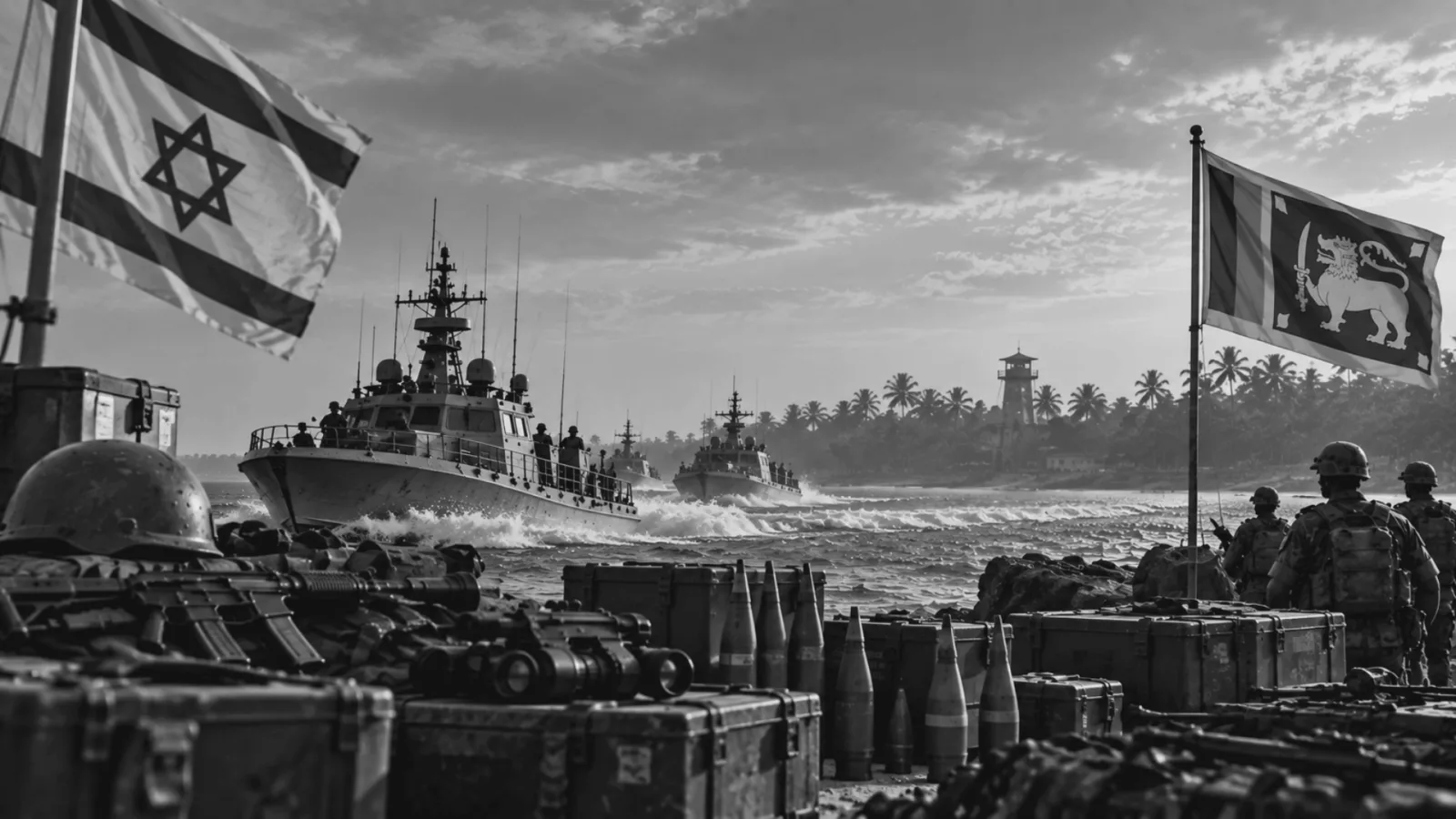
Arms transactions between the two nations surged, even as Colombo maintained an ambivalent diplomatic posture. The weapons and equipment acquired from Israeli defense firms proved highly effective on the battlefield. Israeli-supplied Dvoras, for instance, became a formidable threat to LTTE operations at sea, prompting the Sri Lankan Navy to intensify its acquisitions from Israel throughout the 1990s and into the early 2000s. The Navy’s only fast missile vessels are two Sa’ar 4-class attack craft purchased from Israel in 2001, while its fleet of swift patrol craft is largely modeled on dozens of Shaldag-class boats designed by Israeli shipyards. Subsequently, the Sri Lankan Navy began manufacturing its own ultra-fast “Colombo Class” attack craft, inspired by the Shaldag design.
In 1995, the Sri Lankan Air Force acquired seven Kfir fighter jets, followed by an additional eight in 2000. The Israeli-manufactured aircraft were instrumental in operations, with one Kfir squadron recording over 2,800 operational flight hours and deploying more than 3,500 tons of ordnance. The Sri Lankan ambassador to Israel confirmed that Sri Lankan pilots received training in Israel,while a spokesman for the Sri Lankan embassy in Washington stated that Israeli pilots had also flown the aircraft.
Colombo’s diplomatic ambivalence towards Tel Aviv out of trepidation due to island nation’s significant Muslim population and Sri Lanka’s traditional friendly countries in the Arab world did not upset any of those military ties that Sri Lankan forces were forging with the Israeli defense sector. On the contrary, Sri Lanka’s defence collaborations with the Jewish State regardless of Sri Lanka’s apparent Pro – Palestinian stances in the international forums indicating small nation’s pragmatic strategies for survival. In particular, amidst the Elephant Pass military debacle that humiliated Sri Lankan army at the hands of LTTE guerillas, then Sri Lankan President Chadrika Bandaranaike opened a resident embassy in Tel Aviv.
With the increase in defence-related purchases from Israel, Sri Lanka also became increasingly dependent on Israeli suppliers for the upgrading and maintenance of these defence systems. This development contributed significantly to the expansion of Israel’s arms trade with Sri Lanka, as Colombo frequently concluded defence procurement agreements with Israeli arms suppliers. Zvi Yosef and Moshe Stav were among the key suppliers involved in these transactions and played a significant role in facilitating arms deals between Israel and Sri Lanka. For instance, in 2003, Yosef facilitated a US$20 million agreement for the acquisition of new weapons-control systems for the Dabur-class naval patrol boats that the Sri Lankan Navy had purchased from Israel several years earlier.
However, allegations of corruption and irregularities periodically emerged in connection with certain defence deals, with politicians and arms agents reportedly seeking financial gains from such transactions. One notable example involved former Israeli minister Gonen Segev, who reportedly attempted to negotiate an arms deal with the Sri Lankan military by offering weapons at discounted prices. Nevertheless, Sri Lanka’s defence procurement from Israel remained closely connected to, and ultimately fell within the purview of, the Israeli Ministry of Defence.
During President Mahinda Rajapaksa’s tenure, two years prior to the conclusion of Sri Lanka’s Civil War, Israeli arms supplies to Sri Lankan defence forces experienced a significant setback. Israel was concerned that its military technology could be transferred to Iran, which was actively supporting Rajapaksa’s government during the final phase of the conflict. As a result, Tel Aviv suspended its defence shipments to Sri Lanka until the war ended in 2009. Yet, Sri Lanka–Israel defence ties never reached their lowest point. In the years following Sri Lanka’s victory, the relationship steadily improved, highlighted by growing Israeli support for strengthening Sri Lanka’s cyber security. Especially , in 2021, Israel Aerospace Industries (IAI ) marked the return to the island as IAI concluded a mega deal with Sri Lanka and it was announced to the media indicating that it Sri Lanka is no longer on Israel’s defence sales secret list. This year, another significant milestone was achieved: the Sri Lankan Air Force upgraded its Kfir fighter jets, refurbished by Israel Aerospace Industries under a $50 million agreement.
The overall assessment of defence collaboration between the two states shows that the volatility that pervaded their diplomatic relations has scarcely affected the issue of arms trade. Israel's defence exports and the strengthening of professional ties between its armed forces follow a twofold logic. On the one hand, Israel regards the imperative of securing ties with small states, in which arms trade stands as the paragon, and on Sri Lanka’s side, its armed forces are well aware of the reliability of Israeli supplies. Thus, defence collaboration remains the focal point for the relationship between the two states, which remains static regardless of all those political and diplomatic hindrances.
The views expressed are those of the authors and do not represent the views of CNAWS.
ImageSource: ChatGPT
Tags
- #Defence Cooperation
- #Defence Procurement
- #Israel–Sri Lanka Relations
- #Israeli Arms Trade
- #Israeli Defence Industry
- #LTTE
- #Military Modernisation
- #military technology
- #Sri Lankan Armed Forces
- #Sri Lankan Civil War
Author
Dr. Punsara Amarsinghe
Dr. Punsara Amarasinghe is a Lecturer in International Law at General Sir John Kotelawala Defence University, Sri Lanka. He holds a PhD in Public International Law from the Scuola Superiore Sant’Anna, Italy, and postgraduate degrees in Law and International Relations from South Asian University, New Delhi, and HSE University, Moscow. His research interests include military strategy, asymmetric warfare, and Indian Ocean studies. He is a regular contributor to international defence and strategic affairs platforms.