Department of Strategic Foresight & Scenario Planning · Articles · Defence Technology · Geopolitics ·
Examining the Pakistan-China Strategic Nexus: Military Cooperation, Technology Transfers, and its Impact on South Asian Security Dynamics
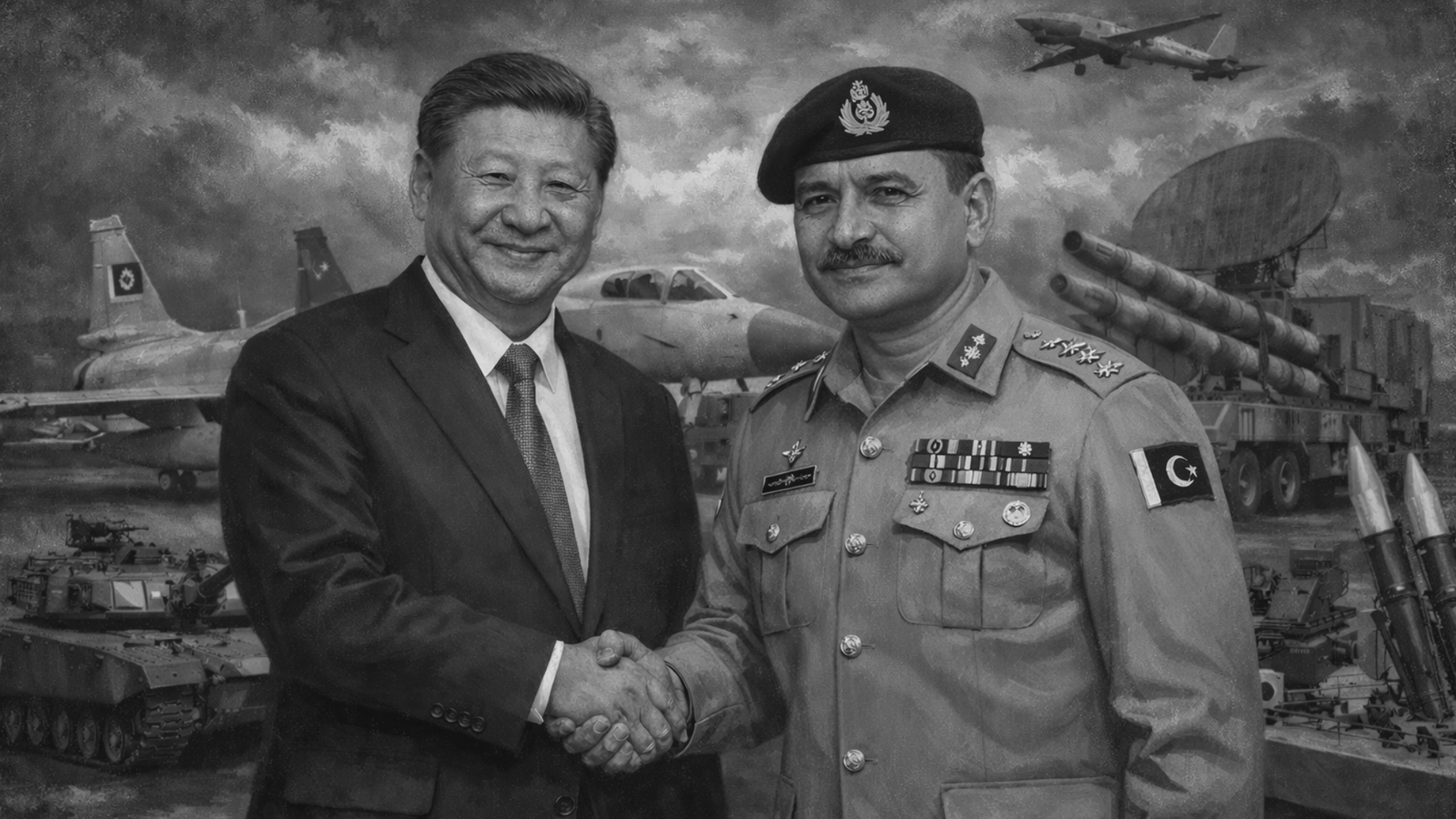
The strategic relationship with China is one of Pakistan’s most long-term and versatile, a “friendship in all weather” which has remained constant despite changing geopolitical landscapes and unforeseen setbacks.¹ It stems from common strategic needs and a mutual suspicion of others, overlaying a comprehensive strategic partnership that includes diplomatic, economic, and military cooperation. It is top-heavy with military participation and the transfer of defense technology; through the years, it has significantly added to Pakistan's capabilities in these areas and changed South Asia ’s security situation. This article examines Sino-Pak military relations in terms of technology transfer and joint production, and their implications for regional political and military stability relative to India. In essence it is argued that while the relationship is expanding Pakistan's strategic slot, it also creates destabilizing asymmetries which heighten India’s security concerns and complicate the efforts of the US to maintain a regional balance between states.
Historical Context And Evolution Of Military Cooperation
For a better understanding of the current level of current military collaboration among Pakistan and China, we need to look at how this situation came about. In the 1960s, China and Pakistan began moving toward each other in strategic terms as both countries shared a common antagonism towards India and the Soviet Union.²There had been the 1965 war with India and consequent Chinese assistance in form of artillery and planes marking the beginning of military technology transfer.³ Undergirded by these trade links and long-standing ties of commerce between peoples, the Pakistan-China military relationship has now matured into something far more significant than it of old was. China has emerged as Pakistan's principal source for sophisticated weaponry, supplying over 70% of those imports in recent years.⁴
Theoretically, this development reflects a conscious attempt by each country to balance against regional threats. For Pakistan, the Chinese support has been as a lifeline to counter India’s conventional superiority, which has helped Islamabad maintain something of a credible deterrence posture. For China, on the other hand, the partnership is all about exerting influence in South Asia and ensuring that its western flank is intact with hostilities brewing with India on their contested border. This mutual dependency, however, fosters a dynamic where Pakistan's military reliance on China could erode its strategic independence, potentially turning it into a client state in Beijing's broader geopolitical ambitions.⁵
Defense Technology Transfers: Scope And Implications
China's transfer of advanced military technology to Pakistan is a cornerstone of the Sino-Pakistani connection, and this includes conventional weapons, missile systems, or dual-use technologies. Examples include the JF-17 Thunder fighter jet. The aircraft was also jointly developed with Pakistan's own Pakistan Aeronautical Complex, while integrating Chinese avionics and radar into its arsenal.6 Furthermore, Pakistan has acquired ballistic missile technology from China; the Shaheen series not only has Chinese guidance and propulsion systems but is capable of transporting nuclear warheads.7 On top of this, dual-use transfers--such as satellite pictures or cyber technology have contributed to the expansion of Pakistan's intelligence and surveillance networks.8
These transfers are not just tactical in nature they constitute a strategic shot in the arm that has reset Pakistan's military calculations. However, it was actually China that did so by passing our allies first through asymmetric means such as precision-guided munitions and anti-ship missiles. This created a qualitative imbalance, and Pakistan now possesses the capacity to threaten India’s naval assets in the Arabian Sea — or strike deep into Indian territory by crossing its conventional conflict threshold. ⁹ At the same time, however, reliance upon foreign technology can also bring its own strengths and weaknesses. As Sino-U.S. tensions rise, for instance, Taiwan's ability to disrupt Pakistan’s air defense will further weaken the latter's long-term deterrent.¹⁰ In response, India has developed its own innovations in the form of missiles such as the BrahMos. But the resulting dissemination of these technologies reopens old questions about local arms races and fuels a spiral of escalation.
Joint Production Programs: Building Indigenous Capabilities
Beyond a strictly commercial link, Sino-Pakistan collaboration extends to joint production programs designed to get defense manufacturing localized and thus cut down on imports. The JF-17 program manifests this, in which China provides design blueprints and Pakistan chips in with assembly with General Mirage at Kamra facilities. ¹¹ Similarly, the Al-Khalid tank -- a hybrid of China's Type 90-II -- is produced in Pakistan, with local modifications made for desert combat.¹² These initiatives have energized Pakistan's defense industry, turning it into a nursery for skilled manpower and blue-sky jobs. Meanwhile they allow China to test and improve its exports in real world conditions.13
From an analytical point of view, collaborative programs of this type could be considered in the same way a symbiotic relation to influence positively both partner’s strategic position. For Pakistan, they also help dampen the risks of reliance on unilateral transfers by developing domestic capabilities that could encourage a more independent military posture. There is an argument to be made here, considering that Pakistan has sold JF-17 variants to countries such as Nigeria and Myanmar, which in turn brings both revenue and diplomatic capital. 14 but this dependency also means that China’s technological edge endures, since Pakistan is still dependent on Beijing for essential hardware. More broadly, these projects chip away at India’s near-monopoly over advanced arsenals on the subcontinent and push New Delhi to speed up its “Make in India” plans. 15 As Non-Western alliances like Sino-Pak challenge established supplier patterns dominated by the United States and Russia, there is a general tendency towards multipolarity in regional arms building.
Strategic Coordination: Beyond Bilateral Ties
Pakistan-China cooperation is not limited to traditional military exercises, with both countries engaged in intelligence sharing, joint naval patrols, counter-terrorism collaboration and cyber defence as well as acting together on multilateral stages. The Maritime Silk Road of China’s Belt and Road Initiative has given impetus to naval cooperation between the two countries, further augmented by Pakistan providing China with access at Gwadar Port that adds payload to Beijing’s strategic weightage in the Indian Ocean.16 Multilateral military drills such as the Shaheen series of military exercises increase the practice of working together and sharing logistics and data between collaboration group participants. 17 Pakistan has also provided intelligence on Uyghur militants to China, and in exchange has acquired sophisticated military and technological support.18 This tactical cooperation spans several strategic planes and encourages Pakistan to employ hybrid warfare tactics against India, comprising both conventional and unconventional methods. It also bolsters China’s regional sway through a so-called ‘string of pearls’ strategy in which New Delhi is strategically encircled by ports and partnerships in South Asia. 19 Chinese Diplomatic Support in Regional Crises, including the 2019 Pulwama Incident: This will enhance Pakistan’s deterrent ability and protect it from a broader international pressure at such times.20 However, these close relations also propose risks for Pakistan to become embroiled in China’s broader geopolitical conflicts such as those in South China Sea that do not necessarily coincide with its national priorities.21
Impact On South Asian Security Dynamics
The Sino-Pakistani axis has greatly influenced the regional stability of deterrence and the military balance in this part of sympathetic Asia. Beijing's largesse has upgraded its neighbor's ability to intimidate and bully, reducing the threshold for nuclear confrontation. Now Islamabad can use pinpoint strikes against India's command-and-control systems.²² This upends the old model that stabilized deterrence through a mix of attrition and leverage: Cold Start lured the opponents into limited conventional war; Pakistan's asymmetric arsenal requires a more cautious and nuclear-centric India.²³
From a strategic point, this set-up produces a security dilemma: Pakistan's gains drive India to invest in such countermeasure as missile defense systems and even cyber capacity, thus fueling a spiral of arms spending and tension.²⁴ For example, India's purchase of the S-400 air defense system from Russia appears to be a direct response to the JF-17's rapid spread.²⁵ The larger Indo-Pacific implications are just as significant. This axis further complicates American efforts to "pivot" to Asia, because China's military presence in Pakistan undermines both the quad (U.S., India, Japan, Australia) and all other American alliances with Asian clients.26 longer term, this could give rise to a fragmented security architecture where various nonstate actors harp on rivalry between China and Pakistan, thus aggravating tensions in Kashmir and Afghanistan.27
Conclusion
To conclude, the Sino-Pak strategic nexus built on military bonding and tech transplants has changed face of security politics in South Asia, strengthening Pakistan and bringing in elements of destabilization also. These advances strengthen deterrence and stimulate technology independence, but they perpetuate the asymmetry that India’s security environment faces and therefore regional stability bears. As the partnership matures, policy makers must tread lightly in this arena, bearing in mind that unfettered expansion could erode global arms control norms. Future research should also investigate new areas such as artificial intelligence in defense, where Sino-Pak cooperation could potentially further shift the scales. End of the day, this nexus tells us that partnerships in a multi-polar world have two sides to it whether to stabilize or destabilize and therefore requires nuanced diplomacy to prevent confrontation.
References
1. Garver, John W. China and Iran: Ancient Partners in a Post-Imperial World. Seattle: University of Washington Press, 2006.
2. Small, Andrew. The China-Pakistan Axis: Asia’s New Geopolitics. New York: Oxford University Press, 2015. (pp. 1–15)
3. Garver, John W. China and Iran: Ancient Partners in a Post-Imperial World. Seattle: University of Washington Press, 2006.
4. Stockholm International Peace Research Institute (SIPRI). “Arms Transfers Database.” Accessed October 2023. https://www.sipri.org/databases/armstransfers.
5. Tellis, Ashley J. Making Waves: Aiding India’s Next-Generation Naval Capabilities. Washington, DC: Carnegie Endowment for International Peace, 2020.(pp. 45–52)
6. Fisher Jr., Richard D. “China’s Military Aid to Pakistan.” Jane’s Defence Weekly, March 15, 2018.
7. International Institute for Strategic Studies (IISS). The Military Balance 2023. London: Routledge, 2023.
8. Singh, Niharika. “China-Pakistan Military Ties: A Strategic Partnership.” Observer Research Foundation. June 2022. https://www.orfonline.org/research/china-pakistan-military-ties/.
9. Tellis, Ashley J. Making Waves: Aiding India’s Next-Generation Naval Capabilities. Washington, DC: Carnegie Endowment for International Peace, 2020. (pp. 55–70)
10. Pillsbury, Michael. The Hundred-Year Marathon: China’s Secret Strategy to Replace America as the Global Superpower. New York: Henry Holt, 2015. (pp. 120–135)
11. International Institute for Strategic Studies (IISS). The Military Balance 2023. London: Routledge, 2023. (pp. 285–290)
12. Fisher Jr., Richard D. “China’s Military Aid to Pakistan.” Jane’s Defence Weekly, March 15, 2018.
13. Singh, Niharika. “China-Pakistan Military Ties: A Strategic Partnership.” Observer Research Foundation. June 2022. https://www.orfonline.org/research/china-pakistan-military-ties/.
14. “Pakistan Exports JF-17 Fighter Jets to Nigeria.” Dawn. January 10, 2023. https://www.dawn.com/news/1730000.
15. Pandit, Rajat. “India’s Defence Production Push.” Times of India. April 5, 2023.
16. Small, Andrew. The China-Pakistan Axis: Asia’s New Geopolitics. New York: Oxford University Press, 2015. (pp. 100–115)
17. “China-Pakistan Joint Military Exercises.” Global Times. December 20, 2022.
18. Pillsbury, Michael. The Hundred-Year Marathon: China’s Secret Strategy to Replace America as the Global Superpower. New York: Henry Holt, 2015. (pp. 140–155)
19. Kaplan, Robert D. Monsoon: The Indian Ocean and the Future of American Power. New York: Random House, 2010.
20. “China’s Role in Pulwama Crisis.” Hindustan Times. February 28, 2019.
21. Tellis, Ashley J. Making Waves: Aiding India’s Next-Generation Naval Capabilities. Washington, DC: Carnegie Endowment for International Peace, 2020.
22. International Institute for Strategic Studies (IISS). The Military Balance 2023. London: Routledge, 2023. (pp. 290–295)
23. Ladwig III, Walter C. “A Cold Start for Hot Wars? The Indian Army’s New Limited War Doctrine.” International Security 32, no. 3 ((Winter 2007/08): pp.158–190)
24. Buzan, Barry, and Ole Wæver. Regions and Powers: The Structure of International Security. Cambridge: Cambridge University Press, 2003.
25. “India Acquires S-400 Systems.” BBC News. October 15, 2022.
26. Campbell, Kurt M., and Ely Ratner. “The China Reckoning: How Beijing Defied American Expectations.” Foreign Affairs, March/April 2018, 60–70.
27. Felbab-Brown, Vanda. “Afghanistan’s Fate and the U.S. Role.” Brookings Institution. August 2021. https://www.brookings.edu/articles/afghanistans-fate-and-the-u-s-role/
The views expressed are those of the authors and do not represent the views of CNAWS.
ImageSource: ChatGPT
Tags
- #Al-Khalid Tank
- #Belt and Road Initiative (BRI)
- #BrahMos
- #china pakistan defence technology transfer
- #Gwadar Port
- #impact of china-pakistan alliance on south asian security
- #JF-17
- #operation sindoor
- #pakistan
- #pakistan china joint defence production
- #pakistan–china strategic nexus
Author
Pranoti Bankar
Pranoti Bankar is a Defence and Strategic Studies Post-graduate Student from Savitribai Phule Pune University, Pune (Integrated BSc + MSc). Her core interests include national security, international relations, military strategy and space security. During her Postgraduate, she has conducted academic work(Dissertation) on China’s Space Strategy and its implications on global security. She is inclined towards research-driven assessments and OSINT-based analysis, with an interest in studying threat landscapes, adversary behaviour and evolving warfare domains. She aims to build a career in strategic research and contribute to informed policy thinking in India’s national security ecosystem.