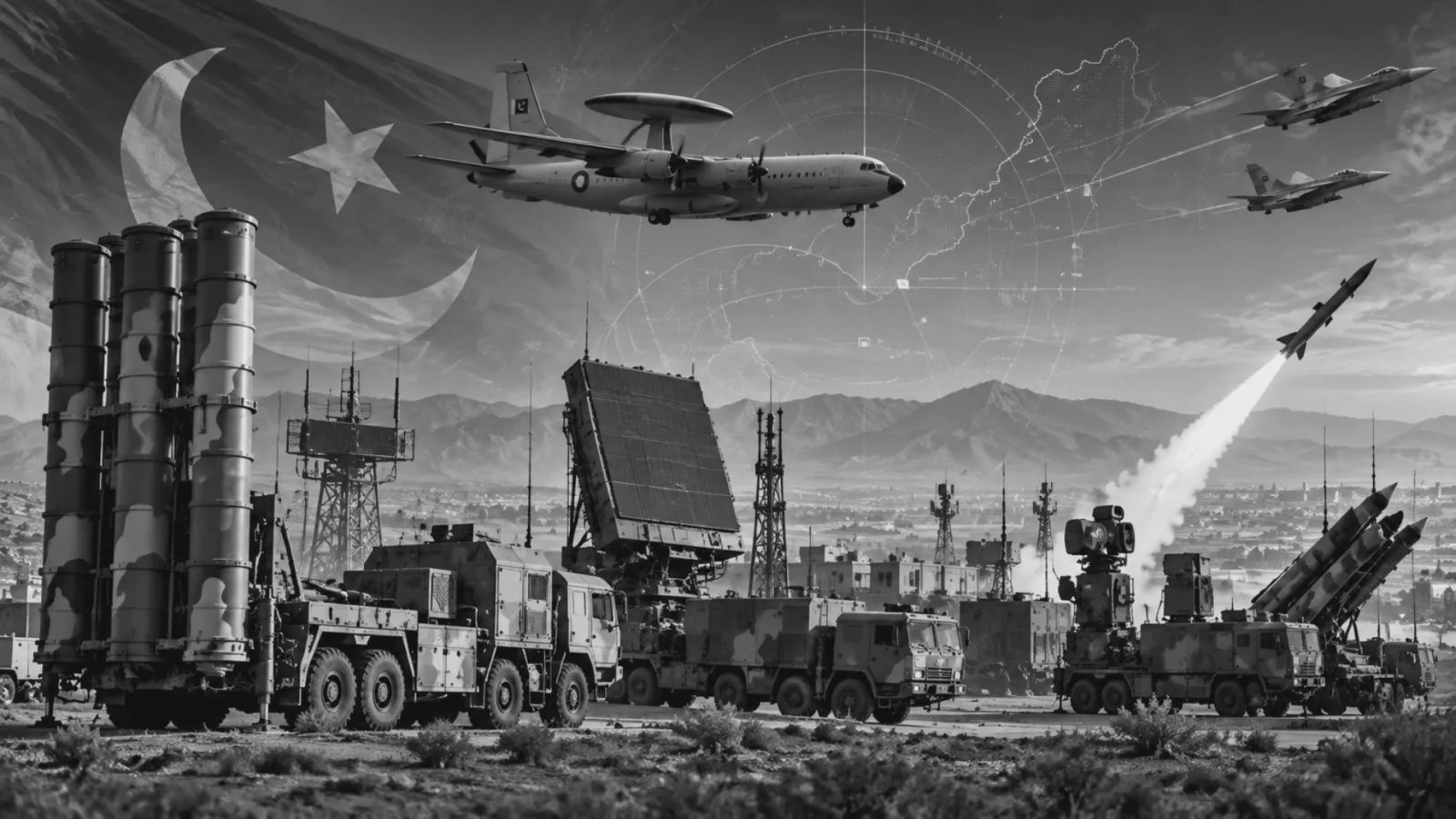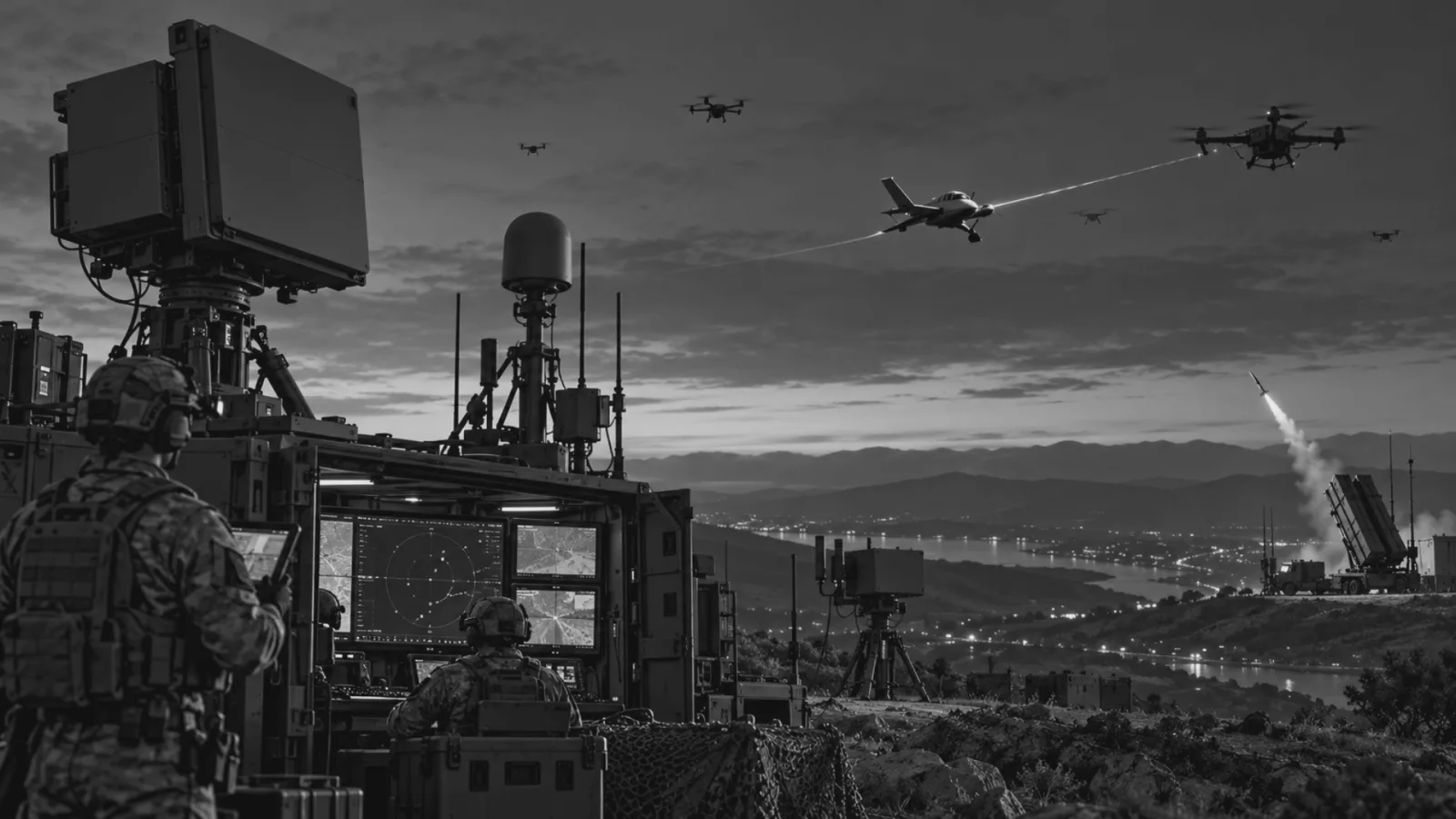

Pakistan's Emerging Drone and Cruise Missile Arsenal: Is the PAF Building a Saturation-Strike Capability Against India?
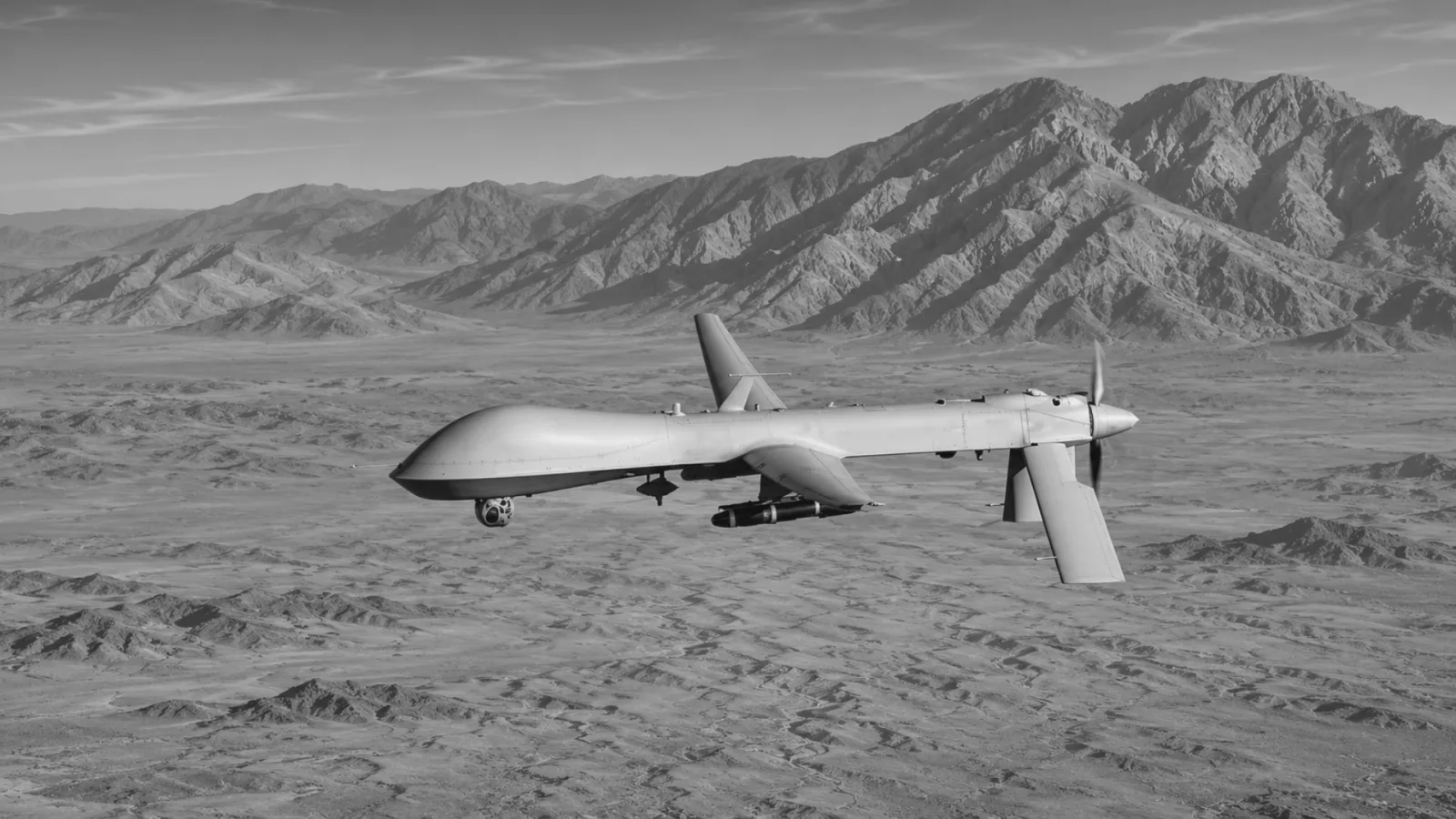
The Pakistan Air Force's (PAF) reported unveiling of several new loitering munitions, cruise-missile concepts and unmanned decoys on 8 November 2026 points towards a potentially consequential change in Pakistan's approach to conventional air warfare. The systems identified in subsequent open-source reporting include the Lightning-I and Lightning-II loitering munitions, the Arrow-I strike-drone or cruise-missile concept, an apparent jet-powered decoy, and an improved version of the Turkish-Pakistani YIHA-III, now associated with Baykar's Sivrisinek programme. Although the available imagery suggests an expanding range of unmanned strike capabilities, the operational status, production quantities and technical performance of several newly displayed systems remain unverified.¹
The development assumes particular importance following the May 2025 India–Pakistan military confrontation, during which Pakistan attempted large-scale drone incursions against Indian military infrastructure. India's armed forces reported approximately 300–400 drone intrusions across 36 locations during the night of 8–9 May, while subsequent engagements involved other drones and missiles. Indian air defences appear to have neutralised a substantial proportion of these attacks, although the precise number launched, intercepted or successfully employed remains uncertain.² ³
The emerging Pakistani approach appears to recognise that the operational value of unmanned weapons does not necessarily depend on their ability to destroy targets individually. Relatively inexpensive drones can impose detection, classification and engagement demands on an opposing integrated air-defence system. When combined with decoys, electronic warfare, cruise missiles and crewed aircraft, they could create a more complex air-defence problem than conventional missile attacks conducted independently.
Nevertheless, possessing several categories of unmanned weapons is not equivalent to possessing an operational saturation-strike capability. The latter requires adequate inventories, dependable guidance, resilient command-and-control systems, trained personnel, coordinated employment and sufficient industrial capacity to replenish expended weapons. None of these requirements can be established conclusively from the November promotional footage.
The developments should also be examined against the PAF's February 2026 Exercise Golden Eagle, which explicitly incorporated manned–unmanned teaming, long-range strike weapons, loitering munitions and operations across the electromagnetic spectrum. This provides stronger evidence of an emerging doctrinal direction than the latest equipment display alone.⁴
CNAWS assesses that Pakistan is attempting to develop a more diversified and potentially expendable conventional strike architecture intended to complicate Indian air-defence operations while reducing dependence on crewed aircraft for certain missions. Its immediate significance lies less in the individual platforms than in the possibility of combining reconnaissance, decoys, unmanned strikes and conventional missiles within an integrated operational framework. Whether Pakistan can translate this concept into a sustainable wartime capability remains the central unanswered question.
1. The November 2026 Disclosure and Its Significance
On 9 November 2026, Pakistani defence publication Quwa reported that a PAF promotional video released the previous day had revealed several unmanned systems associated with the service's developing strike capabilities. The reported equipment included Lightning-I, Lightning-II, Arrow-I, an updated YIHA-III/Sivrisinek-type aircraft and an unnamed jet-powered platform resembling a smart decoy or expendable munition. Additional reporting described displays of these systems at the National Aerospace Science and Technology Park (NASTP), which has emerged as an important institution within Pakistan's aerospace research and integration ecosystem.¹ ⁵
The presentation is significant because it suggests the PAF is pursuing multiple categories of unmanned weapons rather than a single standardised drone platform. These categories potentially cover tactical loitering, longer-range one-way attack missions, higher-speed unmanned effects and expendable platforms intended to complicate an opposing air-defence picture.
However, two important qualifications are necessary. First, the designation of a system as a cruise missile, loitering munition or decoy cannot always be established from its external appearance. These categories can overlap, especially where a platform incorporates autonomous navigation, a one-way mission profile or interchangeable payloads. Second, an institutional display or promotional video does not establish operational induction. That requires additional evidence of service acceptance, assigned formations, recurring training, maintenance arrangements and available combat stocks.
The available information is therefore best interpreted as an indication of Pakistan's development priorities and probable future force structure. It does not justify the conclusion that every displayed weapon has entered operational service.
Assessment of the Reported Systems
System | Reported or documented characteristics | Evidence status |
|---|---|---|
Lightning-I | Tactical, propeller-driven loitering munition, described in reporting as AI-enabled | Displayed or reported; performance and induction unverified |
Lightning-II | Apparent extended-range development of Lightning-I | Displayed or reported; range, payload and operational status unverified |
Arrow-I | Angular, potentially low-observable unmanned strike or cruise-missile/decoy concept | Classification, propulsion and operational performance unresolved |
YIHA-III / Sivrisinek | Catapult-launched one-way attack aircraft with documented Turkish development and published specifications | Platform independently documented; precise Pakistani configuration and November upgrade unverified |
Unnamed jet-powered platform | Apparent expendable decoy or strike munition, compared with Turkish Şimşek-type systems | Visual and functional assessment only; manufacturer, technical capabilities and induction unverified |
Source: Quwa, Janes, Baykar and Defence Security Asia. The table deliberately separates manufacturer documentation from interpretations of the November footage.¹ ⁵ ⁶
The distinction is especially important for Arrow-I. Some reporting describes it as a cruise missile or decoy, while other accounts suggest a low-observable unmanned strike platform. Its angular design may indicate an attempt to manage radar signature, but this cannot establish operational stealth characteristics without testing data. Likewise, an apparent resemblance between Pakistan's jet-powered concept and Türkiye's Şimşek family is insufficient evidence that the system is a Turkish product or a licensed variant.
The more consequential observation is the breadth of the portfolio. Pakistan appears interested in developing several types of expendable aerial systems that could perform different missions within a wider conventional air campaign. That direction is strategically relevant even before all individual programmes become operational.
2. Sivrisinek and YIHA-III: The Most Substantiated Component
Among the systems identified in the November reporting, the Sivrisinek/YIHA-III family has the strongest publicly documented development history. Janes reported that the aircraft had previously been associated with the Turkish-Pakistani YIHA-III programme and that a related design appeared at Pakistan's NASTP as early as 2023. Baykar subsequently unveiled the Sivrisinek at the SAHA 2026 exhibition in Istanbul, establishing a more detailed public technical baseline.⁶
The association is important because it connects Pakistan's unmanned strike developments with an established Turkish aerospace manufacturer possessing substantial experience in developing unmanned aircraft and their supporting systems. However, the extent of Pakistan's access to design technology, manufacturing rights, software development and critical subsystems remains unclear.
Baykar publicly offers two Sivrisinek configurations, designated UM and UMX. The UM is intended as a simpler and less expensive configuration, while the UMX incorporates more advanced electro-optical capabilities and communications options. According to the manufacturer's published specifications, both are catapult-launched aircraft powered by internal combustion engines driving pusher propellers.⁷
Published Sivrisinek Technical Specifications
Parameter | Sivrisinek UM | Sivrisinek UMX |
|---|---|---|
Operational range | 1,000 km | 900 km |
Endurance | More than 9 hours | More than 8 hours |
Maximum take-off weight | 76 kg | 78 kg |
Warhead | 20 kg | 20 kg |
Cruise speed | 55 knots indicated airspeed | 55 knots indicated airspeed |
Maximum speed | 70 knots indicated airspeed | 70 knots indicated airspeed |
Launch method | Catapult | Catapult |
Terminal guidance | GNSS | GNSS and electro-optical guidance |
Communications | Basic configuration | Enhanced links and relay options |
Source: Baykar's official Sivrisinek product specifications. These are manufacturer-published figures, not independently verified performance measurements of Pakistan's operational inventory.⁷
The UMX's additional guidance capabilities are especially relevant to military operations in electronically contested environments. Conventional satellite-navigation dependence can create vulnerability to jamming and interference. The ability to incorporate electro-optical guidance and alternative navigation methods potentially offers greater resilience, although effectiveness would depend on the installed equipment, environmental conditions and the quality of the underlying guidance software.
Baykar's April 2026 demonstration provides additional evidence of the programme's technical ambitions. According to the manufacturer, 10 Sivrisinek aircraft participated alongside five larger K2 unmanned aircraft and three Bayraktar platforms in a coordinated demonstration involving autonomous navigation and formation operations. Baykar also reported testing of visual navigation in an environment without conventional satellite positioning.⁸
This demonstration establishes that the manufacturer has developed and publicly demonstrated elements of autonomous multi-aircraft operation. It does not establish that Pakistan has acquired the same configurations, integrated them into its operational command network or demonstrated equivalent capabilities under combat conditions.
The relevance of the programme to Pakistan nevertheless predates November 2026. The Stimson Center's assessment of the May 2025 confrontation identified debris associated with the Turkish-origin YIHA-III among the available evidence of Pakistani unmanned attacks. This indicates that aircraft associated with the earlier programme had already appeared during an actual India–Pakistan military confrontation.³
The distinction between combat employment and combat effectiveness must be preserved. The identification of debris demonstrates the presence and use of a platform, but it does not independently establish how many were employed, how many reached their intended targets or what military damage they inflicted.
For Pakistan, a potentially more capable Sivrisinek variant could provide improvements in guidance, communications or mission flexibility. For India, the development reinforces the importance of assessing actual subsystem configurations rather than relying solely on the name or published range of the aircraft.
3. Lightning-I, Lightning-II and Arrow-I: What Can Be Established?
The Lightning-I and Lightning-II systems reportedly represent two related categories of propeller-driven loitering munitions. Available images show conventional unmanned-aircraft characteristics, including relatively straightforward wing and fuselage arrangements. The designations suggest differentiated operational requirements, with Lightning-II described as a longer-range variant. However, no sufficiently substantiated public technical dataset establishes their endurance, warhead, actual operating range or production status.⁵
The possibility of two related variants is nevertheless consistent with a broader military requirement for differentiated unmanned strike capabilities. Shorter-range systems may offer a less expensive option for certain missions, while longer-endurance aircraft can increase operational flexibility. Maintaining both categories could allow a force to employ weapons proportionate to different operational requirements rather than expending a relatively sophisticated long-range platform whenever a smaller system would suffice.
Yet this potential advantage depends on industrial commonality. If the aircraft share engines, electronics, communications equipment, warheads or other components, Pakistan could benefit from simplified maintenance and procurement. If their systems differ substantially, a larger number of designs might instead create a more complicated and expensive supply chain. The public evidence does not establish which arrangement applies.
Reporting describing the Lightning family as AI-enabled also requires careful qualification. Artificial intelligence can support a range of functions, from flight management and navigation assistance to image processing and automated recognition. These capabilities are technically and operationally distinct. The appearance of an aircraft in an exhibition does not establish which functions have been implemented or successfully tested.
Arrow-I presents a different assessment problem. The platform's angular design suggests an interest in a configuration different from the conventional tubular designs associated with many propeller-driven loitering munitions. Reporting has variously described it as a low-observable strike aircraft, a cruise-missile concept or a decoy.⁵
The operational consequences of these alternatives would be quite different. A conventional one-way attack aircraft, an unmanned decoy and a faster cruise-missile-type weapon impose different requirements on propulsion, guidance, payload, maintenance and command arrangements. Consequently, CNAWS does not consider it methodologically sound to assign Arrow-I a precise performance category or mission on the basis of external imagery alone.
The unnamed jet-powered system deserves attention for a related reason. Jet propulsion could support a different speed and flight-performance profile from piston-powered loitering munitions, but it would also introduce different fuel, maintenance and manufacturing requirements. A jet-powered decoy could potentially be used as an expendable element within a broader air operation, although its military value would depend on its ability to produce the intended effect against defensive sensors and command systems.
The reported resemblance to Turkish Şimşek-type systems is an observation rather than proof of common origin. There is insufficient publicly verified information to establish the specific aircraft's manufacturer, technical configuration or relationship with Pakistan's procurement system.
Collectively, these developments support an assessment of increasing experimentation and programme diversification. They do not yet demonstrate a mature, standardised and operationally integrated unmanned strike force.
4. Operation Sindoor and Pakistan's Search for a Different Strike Model
The November disclosures should be interpreted within the military experience of May 2025. Operation Sindoor and the ensuing India–Pakistan confrontation highlighted the increasing role of unmanned systems in a military relationship historically dominated by artillery, combat aviation, ballistic missiles and conventional ground forces.
During the night of 8–9 May 2025, Indian officials reported attempted Pakistani drone incursions at 36 locations along the western frontier involving approximately 300–400 aircraft. The Indian military stated that many were defeated using a combination of kinetic and non-kinetic measures. Officials also suggested that the incursions may have been intended partly to examine Indian air-defence reactions and collect intelligence.²
These figures remain official Indian reporting rather than a jointly verified inventory of Pakistani launches. Nevertheless, they establish that mass unmanned activity was already a prominent element of the confrontation.
Christopher Clary's detailed assessment for the Stimson Center concluded that India's integrated air and missile defences appeared to have largely defeated several Pakistani drone attack waves between 8 and 10 May. The study also identified significant limitations in the available evidence, particularly regarding the number of weapons employed, the damage inflicted and the effectiveness of individual systems.³
The apparent inability of the drone attacks to produce substantial observable military damage does not necessarily mean that their employment was operationally irrelevant. Unmanned incursions can impose air-defence alerts, require defensive deployments and generate information about an opponent's reactions even when they fail to destroy their intended targets. However, the military value of those effects must be measured against the attacker's expenditure, losses and operational objectives.
The May confrontation also illustrated the continuing importance of heavier and more sophisticated conventional weapons. Pakistan's reported use of ballistic missiles and India's employment of standoff strike systems demonstrated that unmanned aircraft were not replacing established precision-strike capabilities. Instead, drones were becoming another instrument within a wider contest involving missiles, combat aircraft, surveillance and air defence.
For Pakistan, one plausible lesson is that the mere availability of large numbers of drones does not guarantee successful strikes against a capable defensive network. A more effective approach would require better coordination, reliable guidance, improved command-and-control arrangements and the ability to sustain repeated operations. The November display is consistent with an attempt to diversify the tools available for such an approach.
This interpretation remains analytical. No publicly verified Pakistani after-action assessment has established precisely how the PAF evaluated its unmanned operations during the May confrontation or whether particular November programmes were initiated directly in response.
5. Is Pakistan Developing a Saturation-Strike Architecture?
The concept of saturation is frequently reduced to the idea that a sufficiently large number of inexpensive drones can overwhelm an expensive air-defence system. This is an incomplete understanding of the military problem. An integrated defensive network has several interdependent functions, including surveillance, track classification, command decisions, engagement management and the allocation of defensive weapons. A massed attack can impose pressure on these functions, but that does not mean every additional aircraft produces a proportionate increase in defensive difficulty.
The effectiveness of a mixed unmanned strike force depends on its ability to create operational consequences that exceed the costs and complexity of employing it. Low-cost drones could be used for reconnaissance, persistent aerial presence or expendable strike missions. Other unmanned systems might perform decoy functions, while conventional missiles and crewed aircraft would retain different capabilities and strategic value.
The potential relationship between these categories is important. A force operating different unmanned platforms could place continuing demands on an opponent's surveillance and air-defence organisation while retaining more sophisticated weapons for missions requiring greater payload, speed or accuracy. However, combining these capabilities successfully requires considerably more than possessing an assortment of aircraft.
CNAWS identifies three tests for determining whether Pakistan has developed a genuine saturation-strike capability.
First, can Pakistan sustain sufficient combat-ready inventories?
A loitering munition is normally expended during its mission. Its operational employment therefore depends on the availability of replacement aircraft, propulsion systems, electronic components, warheads and supporting equipment. A military may demonstrate advanced prototypes or conduct a limited number of successful attacks without possessing the production capacity necessary for a prolonged campaign.
For Pakistan, the critical question is whether domestic manufacturers can produce complete and reliable weapons at sufficient scale. The expanding role of NASTP and Pakistan's cooperation with foreign technology partners suggest an effort to develop that industrial base, but publicly available information does not establish sustained production quantities for the newly displayed Lightning or Arrow systems.
Second, can the PAF integrate these weapons within its wider operational network?
A saturation-strike capability requires consistent situational awareness, appropriate command authority and coordination across different platforms and service formations. The difficulty increases as the force attempts to combine aircraft with different performance characteristics, communication requirements and operational roles.
Pakistan's February 2026 Exercise Golden Eagle is relevant because the PAF described the exercise as incorporating manned–unmanned teaming, electronic warfare, cyber and space-related operations, and unified command and control through its next-generation all-domain command centre.⁴
The exercise demonstrates that these concepts have entered the PAF's publicly articulated operational doctrine. However, official exercise reporting is not equivalent to independent verification that the service can conduct similarly complex operations against a capable opponent during wartime.
Third, can the PAF demonstrate repeatable military effects?
Weapons displays, launch footage and manufacturer specifications cannot establish combat effectiveness. A credible assessment requires evidence that the aircraft can perform reliably, communicate or navigate as intended, and complete their assigned missions under operational conditions.
This is especially important for systems described as autonomous or AI-enabled. Such claims require evaluation of actual capabilities rather than promotional terminology. A platform's ability to navigate autonomously under controlled conditions does not establish that it can reliably distinguish targets, operate through interference or complete missions against an actively defended environment.
The operational significance of Pakistan's emerging drone portfolio will therefore depend on demonstrated performance over time. Without evidence of sufficient inventories, integrated operations and repeatable effectiveness, describing the November disclosure as proof of an established saturation-strike capability would be premature.
6. Decoys, Manned–Unmanned Teaming and the Evolution of Air Warfare
An important aspect of the November disclosure is the reported inclusion of a jet-powered decoy or expendable unmanned platform. Decoys are relevant because their purpose need not be direct destruction. Depending on design and employment, they can generate ambiguity, require identification and complicate the management of air-defence resources.
However, decoys are not automatically effective merely because they are inexpensive or numerous. Their utility depends on whether the defender recognises them as threats, how they appear to available sensors and whether their employment produces a meaningful operational advantage. A defensive network capable of differentiating threat categories and employing suitable countermeasures may reduce the costs associated with such attacks.
The broader development of unmanned systems has therefore produced a competition between attacking and defending architectures rather than a simple technological advantage for one side. The Royal United Services Institute's July 2026 assessment of the air war over Ukraine highlights the increasing use of massed one-way attack drones and decoys alongside cruise and ballistic missiles. It also shows how Ukrainian forces have adapted through short-range air defence, mobile defensive teams, electronic warfare and comparatively economical interception methods.¹⁰
The Ukrainian experience demonstrates that unmanned mass can impose persistent military pressure, but it also reveals the considerable industrial and logistical requirements associated with sustaining such operations. An attacker needs continuing production and reliable equipment, while the defender must preserve sufficient detection, interception and personnel capacity over time.
Pakistan's developing doctrine appears to reflect some of these wider trends. The PAF has publicly emphasised manned–unmanned teaming, networked warfare and the integration of different operational domains. Such capabilities could eventually allow unmanned systems to support conventional air operations in ways that reduce risk to more valuable crewed aircraft.
Nevertheless, the sophistication of a military's operational concept must be distinguished from the maturity of its equipment. The PAF's stated interest in coordinated unmanned operations is established, but the operational integration of Arrow-I and the Lightning family with specific fighter aircraft, command networks or other strike systems has not been independently demonstrated.
The November disclosure is therefore best understood as part of an evolving programme of experimentation and force development.
7. Implications for India's Integrated Air Defence
For India, Pakistan's expanding portfolio of unmanned systems presents a challenge that is not fundamentally new but may become more demanding as the variety, quantity and capabilities of such weapons increase.
India's experience during Operation Sindoor provides an important operational baseline. The Ministry of Defence reported that the country's air-defence network employed multiple systems, including Akash, legacy air-defence weapons, guns and integrated counter-unmanned aircraft capabilities. The Indian Air Force's Integrated Air Command and Control System supported the wider coordination of air-defence activity, while the Indian Army's systems contributed additional defensive capabilities.¹¹
The effectiveness attributed to these systems during the May confrontation is significant, although official claims must be distinguished from independently established engagement results. India demonstrated an ability to respond to widespread unmanned incursions, but this does not establish that future attacks involving different aircraft, guidance systems or operational circumstances would produce identical outcomes.
The central challenge is one of managing defensive resources over time. Sophisticated surface-to-air missiles are essential for particular categories of threats, but their use against every inexpensive unmanned aircraft may be economically inefficient. Conversely, relying exclusively on lower-cost countermeasures may be inadequate against faster or more capable weapons.
The appropriate response is therefore a layered defensive architecture in which different systems contribute according to their capabilities, the threat being encountered and the operational circumstances. Electronic warfare, short-range weapons, specialised counter-UAS equipment and more sophisticated air-defence systems all have potential roles.
An important lesson from Ukraine is that sustainable air defence requires sufficient depth, redundancy and stocks of suitable defensive weapons. The interception of individual aircraft is only one measure of success. Military forces must also preserve their ability to maintain coverage, protect essential infrastructure and continue operations through successive periods of heightened threat.¹⁰
For India, this suggests several areas of strategic importance.
The first is the continued integration of surveillance and command systems across services. An increasing number of unmanned threats could complicate the classification and management of airspace, making coordination between the Air Force, Army and other responsible institutions particularly important.
The second is the development of affordable and sustainable counter-drone capabilities. The economics of interception will become increasingly consequential if comparatively inexpensive unmanned aircraft are employed repeatedly. Defensive planning must therefore consider the cost of engagements and the ability to replenish defensive inventories alongside the technical effectiveness of individual systems.
The third is the resilience of military infrastructure and supporting networks. Even a largely unsuccessful unmanned attack may impose temporary operational disruption. Continuity arrangements, dispersal where appropriate, hardened infrastructure and rapid recovery capabilities can help reduce the consequences of such incidents.
The fourth is continued investment in electronic warfare and the ability to operate when communications or navigation systems are disrupted. However, electronic countermeasures should not be treated as universally effective against every unmanned aircraft. Different systems may possess different levels of autonomy, navigation redundancy and resistance to interference.
Finally, India should strengthen its ability to assess the production capacity and operational maturity of foreign unmanned systems. The number of different aircraft displayed publicly is a poor substitute for information about actual combat stocks, operational training and repeatable performance.
The most important implication is that the Indian response should focus on preserving the effectiveness and endurance of the integrated air-defence system rather than attempting to counter each newly announced Pakistani platform through a separate procurement programme.
8. Pakistan's Defence-Industrial Challenge
The expansion of Pakistan's unmanned strike portfolio is partly a technological development, but its success will ultimately depend on industrial capacity.
Compared with sophisticated combat aircraft and high-performance missiles, many categories of loitering munitions offer a potentially lower-cost means of generating conventional strike options. This can make them attractive to militaries facing financial constraints or seeking to increase the number of weapons available for expenditure during conflict.
Nevertheless, developing a prototype and establishing a reliable production system are fundamentally different achievements. Unmanned aircraft production requires consistent supplies of engines, navigation equipment, electronics, sensors, batteries or fuel systems, structural materials and warheads. The availability of these components must be matched by quality-control procedures, testing infrastructure and trained personnel.
Pakistan's collaboration with Turkish defence companies may provide access to valuable technical expertise. The Baykar relationship is particularly important because it connects NASTP with an established producer of unmanned systems. However, the strategic benefits depend on the extent of local manufacturing and the transfer of capabilities beyond final assembly.
A force that assembles airframes domestically but remains dependent on imported propulsion, navigation or guidance components may still encounter difficulties sustaining wartime production. The problem becomes more complicated if several different aircraft require separate supply chains and specialised maintenance arrangements.
The proliferation of platforms may consequently create its own challenges. A broad portfolio can provide operational flexibility, but it may also increase costs if the systems lack common components, standardised support arrangements or sufficiently large production runs.
The financial implications should not be overlooked. Large inventories of expendable unmanned weapons require sustained investment, while the PAF must simultaneously finance combat aircraft, airborne surveillance, air defence, electronic warfare and other modernisation priorities. The strategic value of relatively inexpensive drones will therefore depend on whether they deliver credible operational effects without placing disproportionate pressure on Pakistan's defence budget.
The actual costs of the Lightning and Arrow programmes remain unknown. No reliable public production figures or unit-cost data are available to establish their affordability relative to alternative weapons.
Consequently, Pakistan's long-term strike capacity cannot be estimated merely by counting displayed designs. Industrial endurance, supply-chain resilience and production quality will determine how effectively the new systems can be employed and replenished.
9. The Wider Conventional Balance and Escalation Risks
The increasing availability of expendable strike systems could alter the choices available to Pakistani military planners during a future confrontation with India. Unmanned weapons may allow a military to conduct certain missions without exposing combat pilots and expensive aircraft to the same risks associated with crewed operations. They can also offer a wider range of conventional responses between passive military signalling and the employment of more destructive strike systems.
However, the availability of additional response options does not necessarily make crises more stable.
One potential danger arises from ambiguity. A detected unmanned aircraft may be intended for reconnaissance, electronic deception or destructive attack. During a period of heightened military tension, the defender may have limited information about its purpose and may interpret a series of incursions as preparation for a broader strike.
The problem becomes more serious when drones operate in an environment that also includes ballistic missiles, cruise missiles and crewed combat aircraft. The defender must determine whether an incursion represents an isolated event or part of a larger military operation. Incorrect assessments could contribute to escalation, particularly when politically sensitive or strategically important facilities are perceived to be under threat.
A second danger concerns the relative ease with which unmanned operations can be repeated. A military possessing substantial inventories may view relatively limited attacks as a manageable way to signal resolve. The opposing side, however, may regard repeated incursions as an attempt to degrade its defences or prepare subsequent attacks. Such differences in interpretation can create pressure for pre-emptive or disproportionate responses.
A third concern is the interaction between conventional precision strike and the broader nuclear deterrence environment. India and Pakistan are nuclear-armed states whose conventional military operations occur within a politically sensitive strategic relationship. The increasing availability of long-range, precise and potentially autonomous weapons could complicate assessments of an adversary's intentions during a rapidly developing crisis.
The strategic implications therefore extend beyond the tactical effectiveness of individual drones. An expanding unmanned arsenal may increase the frequency and complexity of conventional military interactions while creating additional uncertainty over their scale and purpose.
India's response must consequently combine technological preparedness with the preservation of credible escalation-management mechanisms. Defensive effectiveness is important, but so is the ability to distinguish between limited incidents and operations that may indicate a larger military confrontation.
10. CNAWS Outlook and Assessment
Pakistan's November 2026 disclosures provide credible evidence of an expanding interest in loitering munitions, expendable unmanned aircraft and potentially integrated decoy-and-strike capabilities. The development is consistent with the PAF's previously articulated emphasis on manned–unmanned teaming and networked air warfare, as well as the wider military lessons emerging from Ukraine and the May 2025 India–Pakistan confrontation.
However, the available evidence does not establish that Pakistan has already developed an operationally mature saturation-strike architecture. The Lightning and Arrow programmes remain insufficiently documented, while the operational configurations and inventories of Sivrisinek-associated systems in Pakistani service are not publicly established. The reported jet-powered decoy likewise requires independent verification of its technical characteristics and service status.
Three developments will be particularly important to monitor.
The first is evidence of operational induction beyond exhibitions and promotional material. Recurring service exercises, formally identified operational units and publicly documented acceptance of production batches would provide stronger indicators of maturity.
The second is confirmation of the PAF's ability to coordinate unmanned platforms with conventional aircraft, electronic-warfare capabilities and other strike systems. Exercise Golden Eagle establishes the doctrinal direction, but further evidence would be required to assess the maturity and scale of such integration.
The third is Pakistan's ability to sustain manufacturing and operational employment. Serial production, dependable component supply, common support arrangements and the availability of trained personnel will determine whether a diverse collection of unmanned systems becomes a strategically consequential military capability.
For India, the development reinforces the importance of continued investment in integrated air defence, cost-effective counter-UAS capabilities, electronic warfare, surveillance integration and the protection of military infrastructure. Equally important is the ability to maintain these capabilities during prolonged periods of operational pressure.
The key strategic question is not whether Pakistan can acquire or manufacture inexpensive drones. It is whether the PAF can translate them into a dependable operational system that produces military effects sufficient to justify their cost, complexity and expenditure.
CNAWS assesses that Pakistan is pursuing a gradual transition towards a more diversified, unmanned-enabled conventional strike force, but the November disclosure should be regarded as evidence of emerging intent and capability development rather than proof of an established ability to overwhelm Indian air defences. The greater long-term challenge for India will arise if Pakistan succeeds in combining affordable expendable weapons with effective command networks, resilient guidance systems and sufficient industrial depth to sustain repeated operations.
India's advantage will therefore depend not merely on the ability to intercept individual threats, but on preserving the effectiveness, affordability and endurance of its wider defensive architecture. In this emerging competition, the decisive factor is unlikely to be the sophistication of any single drone. It will be the ability of each military to integrate technology, industry, command systems and operational doctrine into a force capable of functioning under sustained pressure.
Endnotes
Bilal Khan, “Pakistan Air Force Reveals New Loitering Munitions, Decoys & Cruise Missiles,” Quwa, 9 November 2026. https://quwa.org/pakistan-air-force-news/pakistan-air-force-reveals-new-loitering-munitions-decoys-cruise-missiles/
Ministry of External Affairs, Government of India, “Transcript of Special Briefing on Operation Sindoor,” 9 May 2025, as reproduced by the Embassy of India, Rabat. https://indianembassyrabat.gov.in/speech?id=k5
Christopher Clary, “Four Days in May: The India-Pakistan Crisis of 2025,” Stimson Center, 28 May 2025. https://www.stimson.org/2025/four-days-in-may-the-india-pakistan-crisis-of-2025/
Pakistan Broadcasting Corporation, “PAF Conducts Exercise Golden Eagle in Southern Command,” Radio Pakistan, 10 February 2026, reporting the PAF's official exercise announcement. https://radio.gov.pk/10-02-2026/paf-conducts-exercise-golden-eagle-in-southern-command
Defence Security Asia, “Pakistan's Arrow and Lightning Drones Signal a New Air Defence Challenge for India,” 9 November 2026. https://defencesecurityasia.com/en/pakistan-arrow-lightning-drones-india-air-defence/
Janes, “SAHA 2026: Baykar Unveils Sivrisinek One-Way Attack UAV,” May 2026. See also “Baykar Displays Previously Little-Known One-Way Attack UAV,” for the aircraft's earlier association with Pakistan's NASTP and YIHA-III programme. https://www.janes.com/defence-intelligence-insights/defence-news/air/saha-2026-baykar-unveils-sivrisinek-one-way-attack-uav; https://www.janes.com/defence-intelligence-insights/defence-news/air/baykar-displays-previously-little-known-one-way-attack-uav
Baykar Technology, “Sivrisinek,” official manufacturer specifications, accessed 10 November 2026. https://baykartech.com/en/uav/sivrisinek/
Baykar Technology, “Baykar's Next-Generation Platforms, the K2 Kamikaze UAV and the Sivrisinek Loitering Munition, Take to the Field,” 24 April 2026. https://baykartech.com/en/press/baykars-next-generation-platforms-the-k2-kamikaze-uav-and-the-sivrisinek-loitering-munition-take-to-the-field/
Reuters, “India and Pakistan's Drone Battles Mark New Arms Race in Asia,” 27 May 2025. https://www.reuters.com/business/aerospace-defense/india-pakistans-drone-battles-mark-new-arms-race-asia-2025-05-27/
Justin Bronk, “Four Years On: An Update on the Air War Over Ukraine,” Royal United Services Institute, 28 July 2026. https://www.rusi.org/explore-our-research/publications/commentary/four-years-update-air-war-over-ukraine
Press Information Bureau, Government of India, “Operation Sindoor: The Rise of Aatmanirbhar Innovation in National Security,” 14 May 2025. https://www.pib.gov.in/PressNoteDetails.aspx?ModuleId=3&NoteId=154455&lang=1®=3
Benjamin Jensen and Yasir Atalan, “Drone Saturation: Russia's Shahed Campaign,” Center for Strategic and International Studies, 13 May 2025. https://www.csis.org/analysis/drone-saturation-russias-shahed-campaign
Pakistan Broadcasting Corporation, “Pakistan Successfully Test-Launches Fatah-4 Cruise Missile,” Radio Pakistan, 6 October 2026. https://radio.gov.pk/06-10-2026/pakistan-successfully-test-launches-fatah-4-cruise-missile
Tags

Author