
China's Access to Cambodia's Ream Naval Base: Strategic Implications for Southeast Asia
China's growing involvement in the modernization of Cambodia's Ream Naval Base has emerged as an important development in Southeast Asia's maritime security landscape. Located in the Gulf of Thailand, Ream offers Beijing potential logistical advantages and a greater opportunity for sustained naval presence in the region. This article examines China's infrastructure investments, the presence of People's Liberation Army Navy vessels and the establishment of the China-Cambodia Joint Support and Training Centre. It explores the implications for Vietnam, Thailand, ASEAN and India, particularly in terms of regional security, strategic autonomy and maritime cooperation. However, it also considers the limitations of Ream as a potential Chinese military facility, highlighting its geographical constraints and the absence of conclusive evidence that China exercises exclusive control over the base. Ultimately, the strategic significance of Ream will depend on the extent of military access Cambodia permits China.
1. Introduction
An evolving element in the security dynamics of the Indo-Pacific region is the increasing Chinese military footprint. One such development that has gained particular importance recently is that of Beijing's role in the modernization and operation of the Ream Naval Base in Cambodia, which is located in the Gulf of Thailand. What was once a naval base of the Cambodian navy has come to be viewed as an area of strategic significance due to the Chinese funding for its infrastructure development as well as the continued presence of PLAN ships at the facility.
The importance of Ream is also due to its geographical location, situated in Preah Sihanouk province in southwestern Cambodia. From this location, access to the Gulf of Thailand and further to the South China Sea can be gained. In the case of China, having access to such a naval facility in a non-mainland area would give China the chance to make use of it for military cooperation as well as logistics purposes.
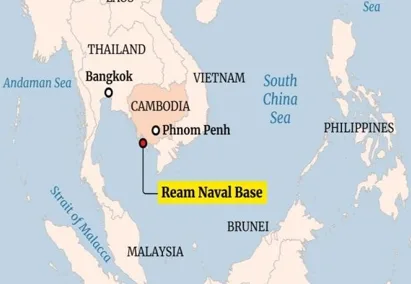
2. Ream Naval Base and the China Element
The Ream Naval Base is an old establishment that pre-dates China’s involvement and has traditionally been one of the significant bases of the Royal Cambodian Navy. The base became a topic of controversy in July 2019 after The Wall Street Journal reported on a rumored agreement that would allow China to use certain parts of the base exclusively for military purposes for 30 years with some possible extension. Even though the agreement caused worries in Washington due to the threat of a Chinese military presence in Southeast Asia, the claims were denied both by China and Cambodia. No official agreement regarding the exclusive military access to the base from either side has been presented since. The first physical proof of the Chinese-led re-development of the area came in the form of destruction of a U.S. built infrastructure.
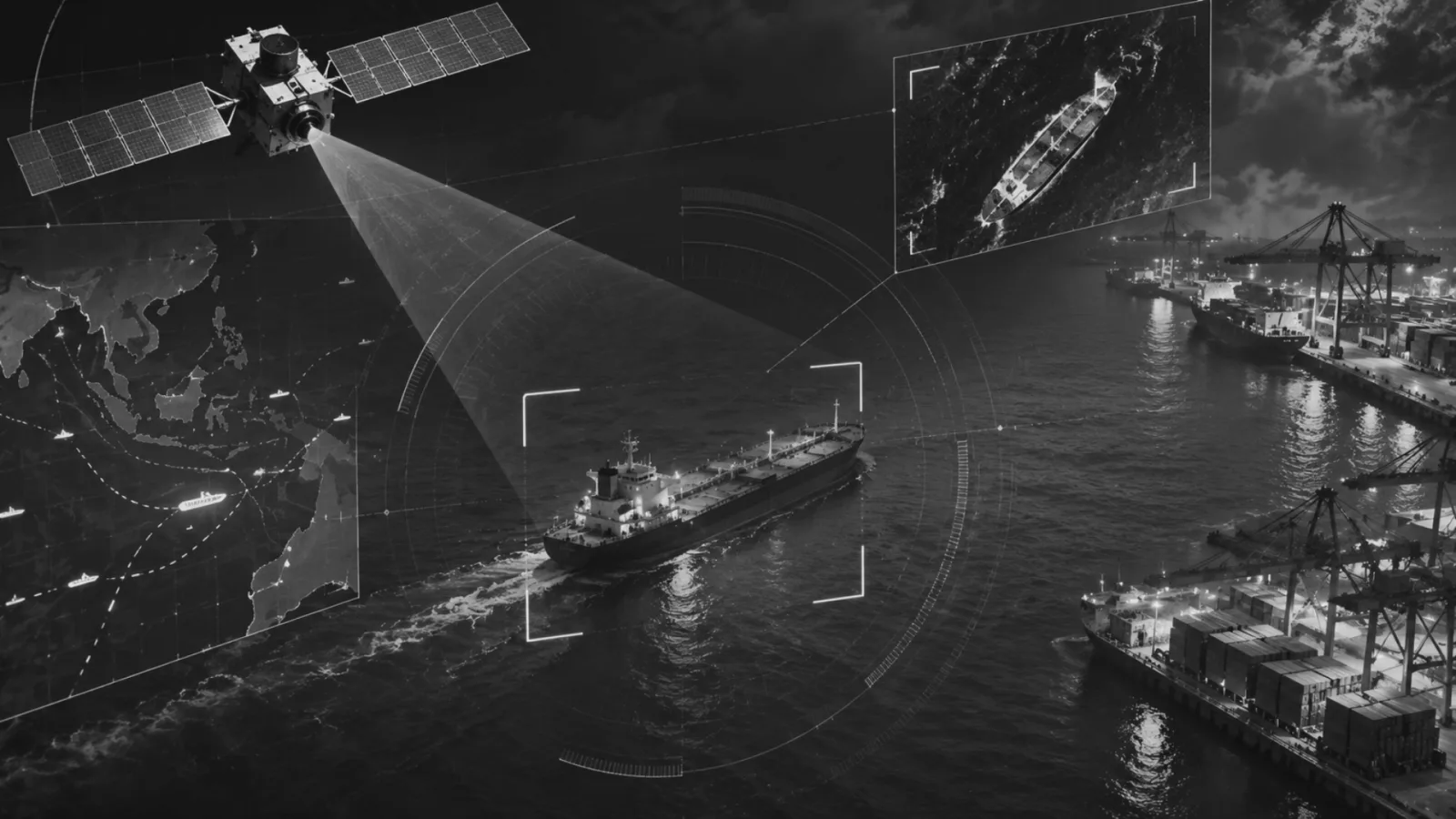
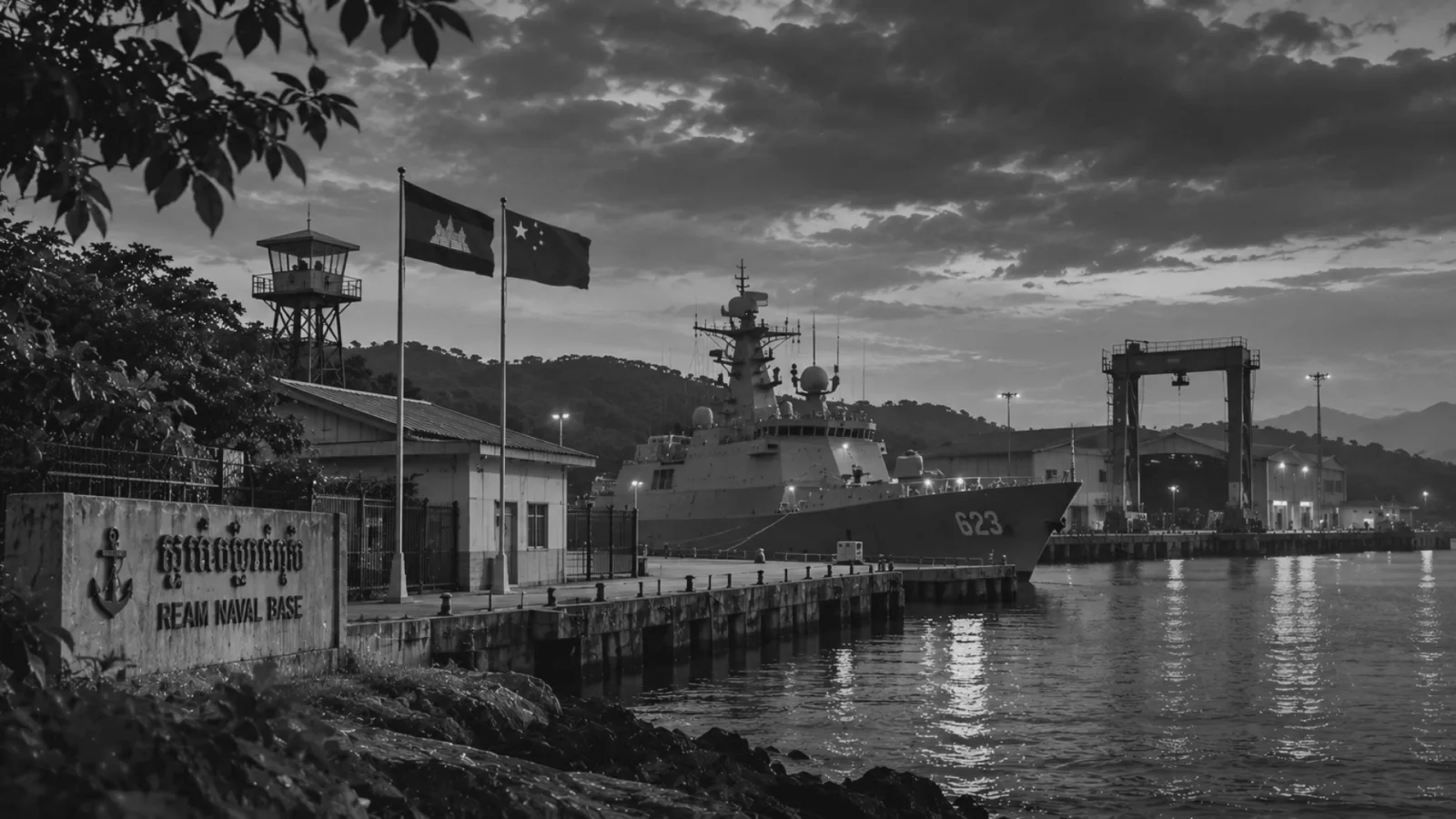
In September 2020, satellite photos revealed that the Tactical Headquarters of the National Committee for Maritime Security (NCMS) built in 2012 with the support of Washington was destroyed. Not long after, a US-funded maintenance facility for rigid-hull inflatable boats (RHIBs) was also dismantled. It occurred amid greater Chinese engagement in the base’s renovation, thus raising questions about Cambodia’s changing defence partnerships. From 2022, China-funded construction efforts intensified, bringing great changes to major parts of the complex. The renovation project entailed construction of an extended naval pier, dry docks, ship maintenance facilities, and administrative structures. The satellite images analysed by the Asia Maritime Transparency Initiative (AMTI) of CSIS showed the extent of this transformation process. Another noteworthy event took place in December 2023, Two PLAN Type 056A corvettes; the Wenshan (Hull 623) and Bazhong (Hull 625), docked at the newly built pier. Analysis of satellite imagery revealed that for 85 days out of 91 those ships were located there. Even if the ships sometimes changed, the constant presence of Chinese navy vessels attracted considerable interest. Another important step in the redevelopment was taken on April 5, 2025, as China and Cambodia officially inaugurated the China-Cambodia Joint Support and Training Centre located there. Within the framework of this project, PLA naval officers, logistics and technical personnel are stationed at the base for the management of the new dry docks and repair operations as well as training of Cambodian troops.
The main point concerning the Ream is not only the financial participation of China but the kind of access it obtains there. It is necessary to differentiate between port visits, logistical access, preferential use of certain facilities and foreign military basing. These are different degrees of military access, having completely different strategic importance. The facts of regular use of Ream by China are obvious. AMTI's research conducted in May 2025, called "A Tale of Two Reams," mentioned the division of the Ream Naval Base into two parts: northern one for Chinese ships and southern one for other visitors. The official statement from the Cambodian government insists that the base is still under the national sovereignty and foreign naval ships can visit with prior consent. In article 53 of the Constitution of Cambodia, there is the policy of neutralism and non-alignment that forbids the establishment of foreign military bases in Cambodia but at the same time permits the receipt of military aid, equipment, and training from other countries. There is no solid proof that the visiting navies had permission to visit the northern pier which sparked doubts about possible unequal access arrangements. On the other hand, there is no solid evidence that China has complete control over the facility and that Ream is already recognized as an overseas Chinese military base. China has also described the joint centre as an initiative aimed at boosting the bilateral defence cooperation via military training, logistics, counterterrorism, disaster prevention, and humanitarian aid.
3. China’s Strategic Interest in Ream Naval Base
The interest of China in Ream Naval Base should be viewed from the perspective of Beijing's general expansion plans and intentions regarding strengthening of its naval power and influence in the Indo-Pacific region. Ream could help China sustain a more persistent naval presence in Southeast Asia by providing an additional logistical support point closer to the region. In simpler terms, China needs facilities closer to the areas where its navy operates so that its ships can remain deployed for longer periods without repeatedly returning to mainland China for support. Being situated on the Gulf of Thailand, Ream could help China in sustaining its naval activities in these waters and improving the access to southern approaches of the South China Sea. The access to Ream would allow China to reduce the distance travelled by its naval ships from Hainan to the Strait of Malacca by 500+ nautical miles, which is equal to about 25 hours of traveling at the speed of 20 knots. Such an advantage could be particularly useful for those vessels heading for one of the most strategically important water passages between the South China Sea and the Indian Ocean. While Ream Naval Base does not give direct access to the latter, it certainly could facilitate the movement towards it.
The development of the Ream must be seen against the backdrop of the broader developments in the area of Chinese-Cambodian defence relations. Chinese assistance in infrastructure building, equipment supply, training and exercises has enhanced the defence cooperation between both nations. Such cooperation may result in institutional and technical ties that may emerge from the training courses, equipment supplies and future modernization of the military forces. For Beijing, such ties may increase its influence among Cambodian defense authorities and enhance its involvement in regional security issues. For Phnom Penh, Chinese assistance presents a chance to modernize its naval infrastructure and its military capacity. The role of China's possible increased maritime surveillance in Ream is another essential point in China's interests in Ream. With regards to the infrastructure of the naval base such as radar system and other support facilities, maritime surveillance becomes an important issue. China's increased naval activity in Ream could be an opportunity for observing the activity of commercial ships and regional navy in the Gulf of Thailand as well as naval exercises. This information could help China to have an overview of the situation in the area. In this way, the extent of China's surveillance would depend on the facilities' functions and the degree of access given to China by Cambodia. The establishment of an overseas military base in Djibouti in 2017 confirms China's interest in establishing overseas military bases outside of the region. Ream could help China to expand the network of overseas naval access in the region.
To sum up, the geographic location of Ream, logistical advantages, infrastructure development and growing military cooperation between China and Cambodia could help China to develop its presence in the Indo-Pacific.
4. Strategic Implications for Southeast Asia
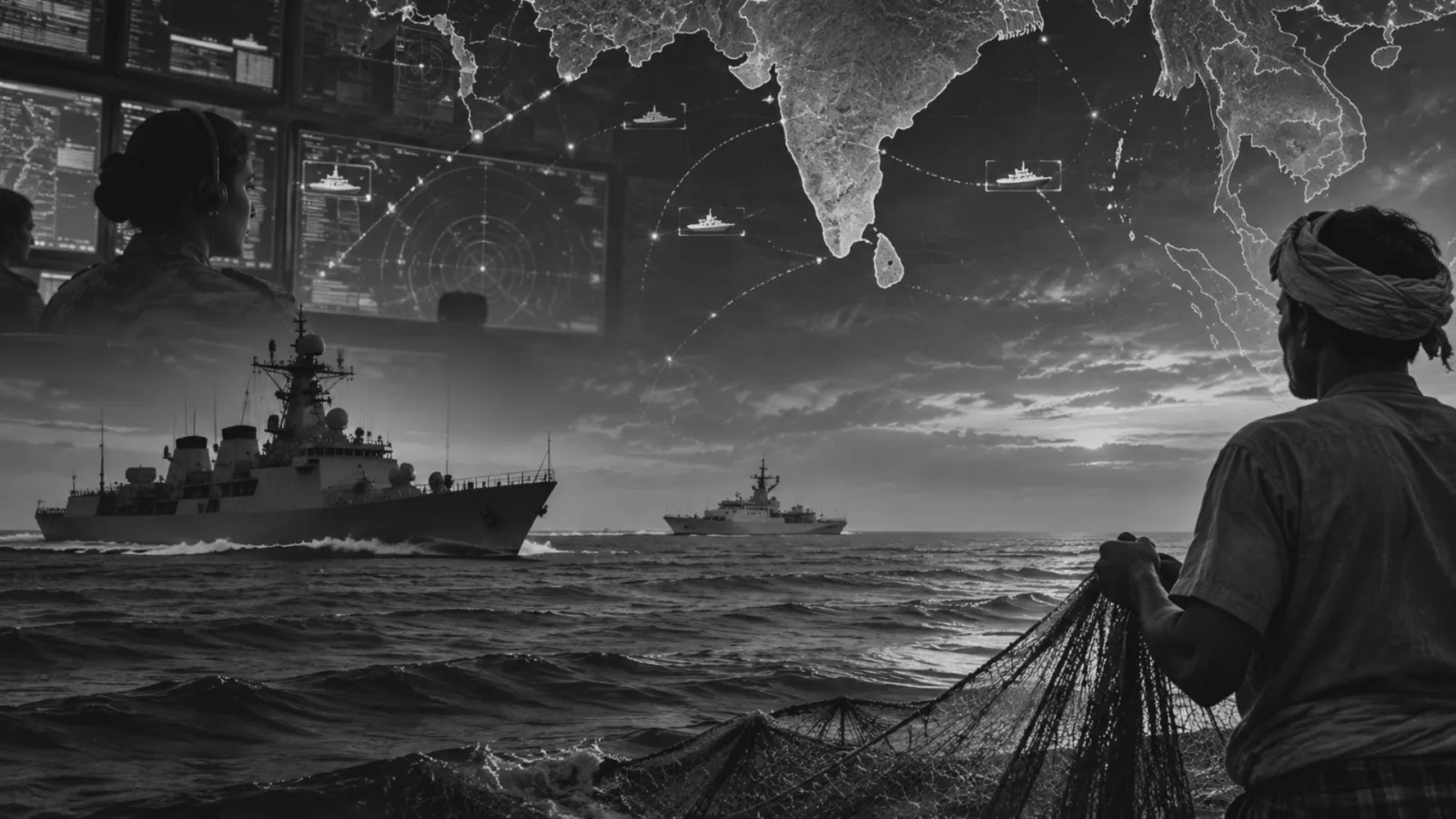
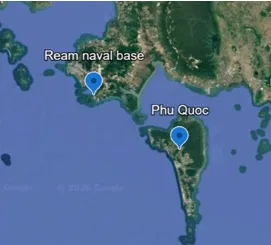
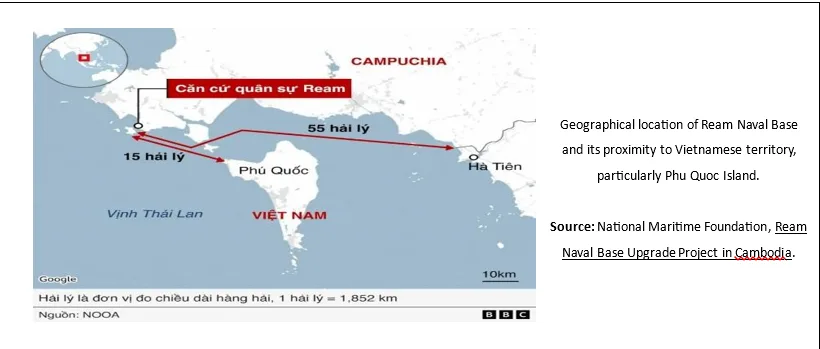
The increasing Chinese military presence at Ream Naval Base can have some repercussions beyond the Sino-Cambodian bilateral relationship as well since it may affect the security considerations of other countries in the region. As Chinese access to Ream Naval Base increases, the neighbouring countries might find themselves facing an increasing number of concerns regarding Beijing’s growing naval capabilities and consider reviewing their own security measures. One of the countries that would be most affected by such a development is likely to be Vietnam because of its geographic location relative to the naval base. The naval base is located on the southwestern coast of Cambodia, and it is roughly 15 nautical miles away from the Vietnamese island of Phu Quoc. As such, any prolonged Chinese presence in Ream will pose another factor for consideration in Vietnamese maritime security planning, specifically as far as the deployment, surveillance and logistical activities of the Chinese in the Gulf of Thailand go. Given the existing Vietnamese disputes with China over the South China Sea, this factor might push Hanoi to increase its military cooperation with the US. Such steps could include increased visits from US naval ships, increased maritime security cooperation, greater intelligence sharing and surveillance capacity, and defense cooperation. This does not necessarily mean that this would imply a step towards a military alliance between Vietnam and the United States. Instead, this could be part of Hanoi's strategy to diversify its strategic options and protect its maritime interests. In this sense, China's increased access to Ream could give the United States an indirect opportunity to increase its security cooperation with Vietnam.
Outside Vietnam, China's future military facilities at Ream could prompt other countries, including Thailand, Indonesia, and Singapore, to review their own needs for maritime security. For example, Thailand might start paying closer attention to any Chinese military activities in the Gulf of Thailand, considering its geographic location within the same maritime region. Indonesia's wider interest in protecting its maritime interests in the Indo-Pacific and South China Sea region would prompt it to increase its maritime security capabilities. The same applies to Singapore, located strategically close to the Strait of Malacca. These types of actions would not signal any military preparation against China, but instead signal attempts to observe regional happenings, protect its maritime interests, and better coordinate its response to any security issues. Therefore, the increasing involvement of China at Ream may prompt more maritime security readiness and cooperation by Southeast Asian countries.
The case presents challenges for ASEAN in terms of unity and strategic autonomy of the region, and in regard to the role of influential external powers. The fact that Cambodia has strong defence ties with China has at times hindered ASEAN from formulating common positions on issues that concern China, such as the disputes in the South China Sea. If Ream is to develop into a base that favours the Chinese military, it may pose challenges in terms of mistrust from some of the member countries. Nonetheless, Cambodia should be allowed its sovereignty in the matter.
Ream port in Cambodia is another angle of Southeast Asian maritime security for India. The first visit to the port by Indian naval forces in September 2026 during the year of ASEAN–India maritime cooperation suggests India's attempt to strengthen its maritime ties with Cambodia. Indeed, this is another attempt to foster the security collaboration between India and ASEAN nations via naval interaction, maritime-domain awareness and humanitarian assistance. On top of that, the visit suggests that Cambodia seeks to build its defence ties not only with China but with other parties, too, while the degree of the access granted to various navies is an important matter.
Thus, all of this proves that Ream becomes a piece of a greater puzzle in the regional debate on China's military influence and the choice of smaller Southeast Asian nations.
5. Limitations
Although there are many problems with respect to Ream, its strategic significance should not be overstated. Its geographic position, combined with physical limitations, makes it a less valuable asset in terms of being a base for projecting Chinese naval power overseas. First, the base is located far from the main maritime traffic routes between the Indian and Pacific Oceans via the Strait of Malacca, and the relatively shallow water area around the base limits the access of large naval vessels to the location. Secondly, the bases that China has in the South China Sea could provide greater advantage in carrying out operations in the region. Therefore, its strategic significance could be considered to be linked with access and logistics rather than with power projection.
Another aspect that raises concern about the potential of Ream is its use for intelligence-gathering activities.
Nevertheless, just by mentioning the existence of surveillance infrastructure, one cannot assume the fact that China is running specific intelligence operations using Ream.
Moreover, the stance taken by the government of Cambodia cannot be ignored either. Phnom Penh insists that Ream is under the control of Cambodia, that foreign military bases are forbidden by the Cambodian Constitution and that even though the new facilities have been built, they are open for visiting navies. The fact that the port is visited by navies of such countries as Japan, Vietnam, US and India clearly demonstrates that Cambodia maintains its relationships with other countries and not just with China. This makes it hard to argue that the whole base has become a strictly military base for China. The level of the support from China and access of the facilities depends greatly on their capabilities and on what has been allowed by Cambodia.
Conclusion
Ream Naval Base is yet another example of increased military and strategic activity of China in Southeast Asia. By means of financial support, infrastructure development and deployment of its naval fleet along with defense cooperation between China and Cambodia, Beijing has ensured opportunities for regular deployment of its naval fleet in the region, which could give it the advantage in terms of logistics and military cooperation in the region.
As far as Cambodia is concerned, such cooperation allows it to modernize its own naval forces and develop its military infrastructure. Yet, it poses challenges to independence of Cambodia's foreign policy and maintaining balanced relations with other powers. In turn, other neighbouring countries, especially Vietnam and Thailand, face the threat of greater Chinese military presence in the region through Ream Naval Base, along with all of the existing security threats in the region.
In any case, the importance of Ream Naval Base will be determined not only by the infrastructure developed there with the help of China and its naval fleet deployed there, but also by the degree of military access China is granted by Cambodia. The crucial point here is whether the installation will operate mainly as a modernized Cambodian naval base or a facility ensuring China's regular military presence in the region.
Cambodia’s strong relations with China, however, does not mean that it aims to make itself totally dependent on China. Indeed, its attempts to establish economic and diplomatic connections with other nations including South Korea, Japan and India, coupled with the deferment of its annual military drills with China beginning in 2021, point towards its willingness to have other partners. Cambodia might thus be interested in deriving benefits from China but in a way that allows it to retain some level of independence.
References:
3. Lowy Institute, Partnership of Convenience: Ream Naval Base and the Cambodia–China Convergence.
5. Cambodian Government, Constitution of the Kingdom of Cambodia, Article 53.
7. U.S. Navy, USS Cincinnati Arrives in Ream Naval Base, 24 January 2026.
9. U.S.–China Economic and Security Review Commission, 2025 Annual Report to Congress.
The views expressed are those of the authors and do not represent the views of CNAWS.
ImageSource: ChatGPT
Tags

Author
Nitika Dhiman
Nitika is a student with a keen academic interest in China, particularly its political landscape, foreign policy, international relations, and evolving role in global affairs. She is interested in exploring contemporary geopolitical developments and analysing China's influence on the changing dynamics of international politics. Through her writing, she aims to develop informed perspectives on issues shaping the global order.