Department of Hybrid Warfare & Irregular Conflict · Situational Reports · Defence Technology ·
Russia’s Jet-Powered Shaheds Are Rewriting the Air-Defence Equation
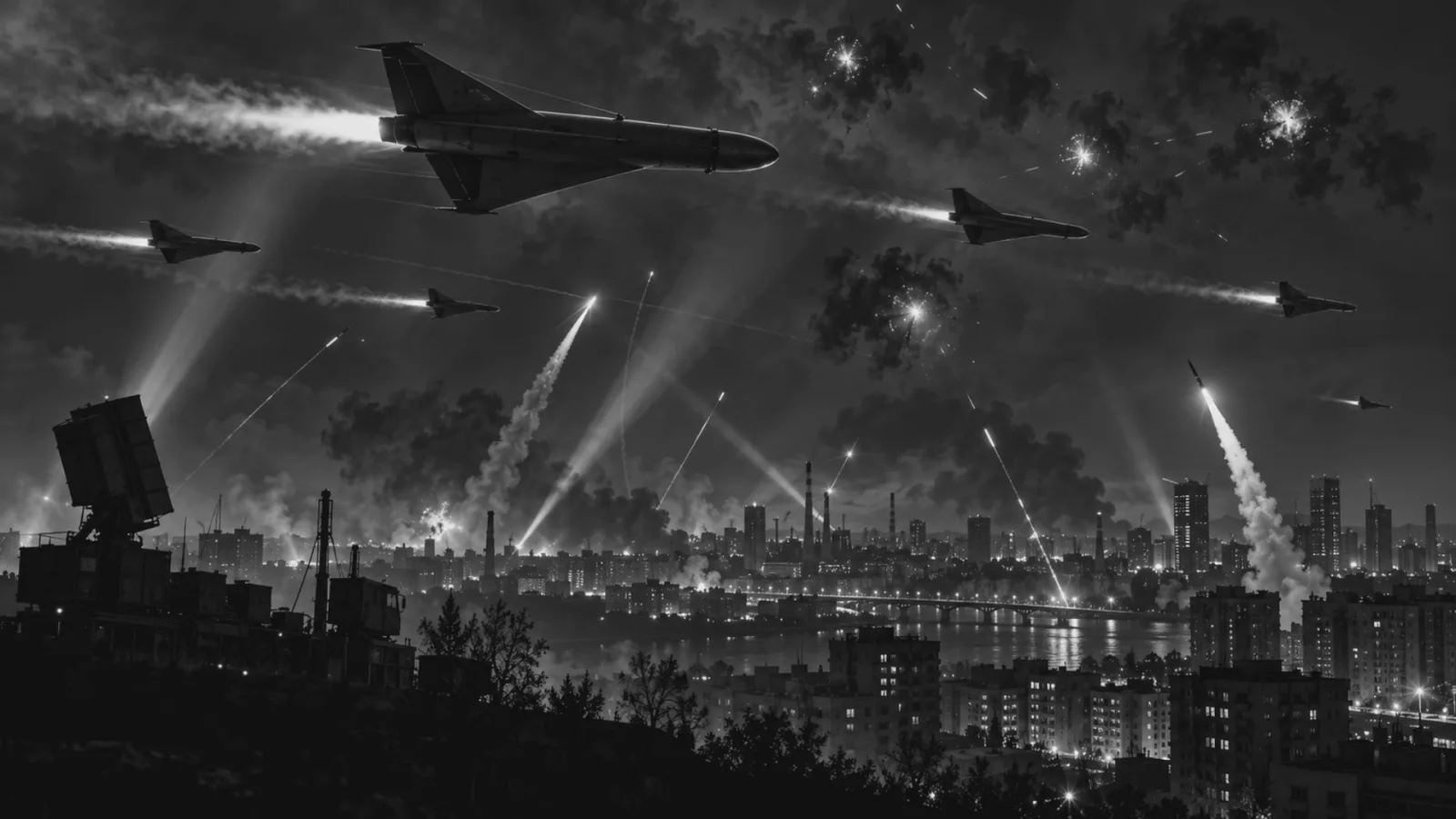
Russia's expanding use of jet-powered one-way attack drones is forcing another change in the air war over Ukraine. For much of the conflict, the Iranian-designed Shahed-136 and its Russian Geran derivatives represented a relatively slow, inexpensive threat that Ukraine increasingly learned to counter through a combination of electronic warfare, mobile fire groups, anti-aircraft guns, MANPADS and interceptor drones. That equation is now being disrupted by a new generation of turbojet-powered Geran systems flying substantially faster and, in some cases, considerably higher than their propeller-driven predecessors. Ukraine's Air Force says it is currently intercepting only around 60 percent of jet-powered drones, compared with more than 90 percent of earlier propeller-driven variants. Ukrainian personnel interviewed by Reuters said the new aircraft are operating at altitudes of four to seven kilometres, leaving many mobile teams equipped with shoulder-fired weapons unable to engage them effectively.¹ The significance extends beyond Ukraine. The transition demonstrates how a weapon originally valued because it was cheap and simple can evolve until it begins occupying the operational space between a conventional kamikaze drone and a cruise missile, while still being produced and employed in numbers large enough to stress sophisticated air-defence networks.
The Shahed threat has entered another phase
The scale of the change became particularly visible during the summer of 2026. Colonel Yurii Ihnat of the Ukrainian Air Force said in August that jet-powered UAVs had constituted as much as two-thirds of the drones in some Russian strike packages, although propeller-driven Shaheds still remained more numerous overall at that time. Ukrainian officials also reported that Russia used five times as many jet-powered UAVs in July as it had in June, while Ukrainian military leadership had previously assessed that Moscow intended eventually to make jet-powered systems approximately half of its long-range one-way attack drone inventory.² By September, the operational effect had become more apparent. Reuters reported that in the first three weeks of the month Russia launched about 2,100 jet-powered attack drones and 136 missiles, according to Ukrainian Prime Minister Sergii Koretskyi, after more than 2,800 such drones were launched during August. Ukraine said those September attacks killed 288 people, including four children. Russia has denied deliberately targeting civilians.
The numerical scale is important because the jet-powered Shahed is not replacing Russia's wider long-range strike arsenal. Instead, Moscow is creating another layer within it. Propeller-driven Gerans, decoy drones, jet-powered Gerans, cruise missiles and ballistic missiles can be launched in combinations that require Ukrainian operators to identify threats, allocate interceptors and decide which targets justify expenditure of scarcer air-defence weapons. Russia's broader aerial campaign has also increasingly targeted economic infrastructure including Black Sea ports, railway facilities, logistics nodes, warehouses and industrial installations, according to Reuters.³ The problem for the defender is therefore not simply that individual drones have become faster. The attacker is creating an increasingly heterogeneous strike package in which systems with different speed, altitude, radar signature and cost profiles arrive within the same defensive environment.
From the Shahed-136 to Geran-4 and Geran-5
Russia's adaptation of the Shahed family has been incremental but unusually rapid. Moscow began using Iranian-origin Shahed-136 drones in Ukraine in 2022 and subsequently established domestic production under the Geran designation. Over the following years, Russian engineers altered navigation systems, electronic-warfare protection, warheads, communications equipment and flight-control architecture while introducing commercial components from foreign supply chains. CSIS assesses that the defining feature of the programme has become the speed of its feedback loop. Battlefield modifications are tested, successful changes are incorporated into production and unsuccessful solutions are discarded, allowing significant redesigns to move from operational experience into manufacturing on a timeline measured in weeks or months rather than conventional procurement cycles.⁴
Propulsion eventually became one of the most important areas of development. The Iranian Shahed-238 introduced a turbojet-powered derivative of the original design, which Russia employed as the Geran-3. According to CSIS, the Geran-3 used a Chinese-origin turbojet and could reach approximately twice the maximum speed of the piston-powered Geran-2, but retaining the older airframe imposed structural limitations at higher speeds. Russia consequently moved towards redesigned Geran-4 and Geran-5 airframes in 2026. Ukrainian Defence Intelligence describes the Geran-4 as a turbojet-powered aircraft capable of carrying a roughly 50-kilogram warhead, with a reported range of about 770 kilometres and a maximum operating altitude around four kilometres. The larger Geran-5 is assessed by Ukrainian intelligence to carry a 90-kilogram warhead, cruise at approximately 450 to 600 km/h, reach about 950 kilometres and operate at altitudes up to six kilometres. The figures originate from Ukrainian exploitation of recovered systems and should therefore be treated as intelligence assessments rather than independently verified manufacturer specifications.⁵
These performance characteristics are narrowing the practical distinction between one-way attack UAVs and some categories of cruise missile. The Geran-5's airframe is itself more reminiscent of a cruise missile than the familiar delta-wing Shahed, while its jet propulsion, larger payload and substantially higher speed reduce the reaction time available to defenders. Yet Russia can employ the system within the production and operational ecosystem already developed around mass drone warfare. The result is not a substitute for conventional cruise missiles, which retain advantages in speed, payload, navigation, survivability and specialised target sets. It is instead an intermediate strike category that may be sufficiently capable to threaten infrastructure and fixed military targets without requiring Russia to expend more sophisticated missiles on every mission. CSIS describes the Geran programme as an example of a broader shift in which continuously adapting a moderately sophisticated weapon may sometimes produce greater wartime utility than pursuing a technically exquisite system that is slower or more expensive to replace.
Speed is attacking the Ukrainian interception model
The earlier Shahed presented Ukraine with a difficult but increasingly manageable problem. Slow-moving propeller drones could often be engaged by mobile teams positioned along expected approach routes, giving operators time to detect the distinctive engine noise, establish visual contact and employ machine guns, anti-aircraft cannon or short-range missiles. Electronic warfare could also interfere with navigation, while interceptor drones emerged as another comparatively inexpensive means of destroying incoming Shaheds. Ukraine's Ministry of Defence reported that during May 2026 its forces intercepted approximately 91.7 percent of Shahed, Gerbera, Italmas and other UAVs during an exceptionally intensive month of Russian aerial attacks.⁶ That aggregate figure included multiple drone types and cannot be directly equated with performance against every Shahed variant, but it illustrates how effective the Ukrainian defensive network had become against the earlier threat.
The jet-powered Gerans attack several elements of that system simultaneously. Ukrainian mobile air-defence personnel told Reuters that older Shaheds frequently flew around one to 1.5 kilometres above ground, whereas jet-powered aircraft are now appearing at four, five and even seven kilometres. At those altitudes, many of the teams that formed a relatively inexpensive defensive layer simply cannot reach the target. Higher speed compounds the problem because crews that previously had minutes to prepare an engagement may now have only seconds. Jet propulsion also permits greater flexibility in altitude and routing, while the faster aircraft can pass through vulnerable sections of an air-defence network before mobile units reposition. Ukrainian officials have therefore described the new systems as creating a threat increasingly similar to that posed by cruise missiles even though the drones remain a separate class of weapon.¹
The change illustrates a broader problem in air defence. A network optimised against one version of a cheap threat can become less effective once the attacker changes only a few parameters. If a slow UAV can be engaged by machine guns or relatively inexpensive interceptors, the cost exchange may favour the defender. Increase the drone's altitude and speed, however, and the defender can be pushed towards more capable missiles, fighter aircraft or specialised high-speed interceptors. Russia does not need every Geran to penetrate. It can derive operational value by forcing Ukraine to maintain radars, crews and aircraft at readiness, expend scarce interceptors, relocate air-defence assets and defend a growing number of civilian and industrial sites. Reuters quoted Ukrainian personnel describing almost continuous drone activity and the fatigue generated as attacks expanded beyond their previous tendency to concentrate at night.
The cost equation is becoming the centre of the contest
Russia's jet-powered Gerans are more expensive than the propeller-driven Shaheds they supplement, but Reuters reports that they remain cheaper than the cruise missiles Russia also uses against Ukraine. That middle position is strategically useful. Moscow can reserve expensive missiles for targets requiring specialised capabilities while employing large numbers of drones against infrastructure, air-defence positions, logistics hubs and other fixed targets. At the same time, every drone that forces a defender to launch a sophisticated surface-to-air missile produces an unfavourable exchange even if the drone is successfully destroyed. The relevant calculation is consequently not simply the price of one Russian drone compared with one Ukrainian interceptor. It also includes radar operating hours, aircraft sorties, personnel fatigue, ammunition consumption, maintenance and the opportunity cost of positioning air-defence systems around one target rather than another.
This challenge becomes more serious when combined with saturation. Ukraine must defend Kyiv and other cities while simultaneously protecting power infrastructure, ports, defence production facilities, railways and logistics routes. Russia can use low-cost decoys or older Gerans to complicate the air picture and then introduce faster systems into the same raid. Ballistic and cruise missiles create yet another layer of threat, requiring Ukraine to retain higher-end systems for weapons that lower-tier defences cannot reliably engage. The broader pressure on the interceptor inventory is already visible. Reuters reported separately in September that Ukraine's stocks of Patriot interceptors had become severely constrained while Russia expanded its use of adapted ballistic weapons, illustrating how the same defensive network must deal with threats ranging from drones to advanced missiles.⁷ The emergence of faster Gerans increases this competition for defensive resources rather than creating an isolated new problem.
Ukraine is trying to restore the low-cost defensive layer
Ukraine's answer is increasingly centred on producing interceptors fast enough to recover the cost advantage that conventional missile defence cannot provide at scale. Ukrainian companies have been developing turbojet-powered interceptor UAVs designed specifically to engage the Geran-4 and Geran-5. Janes reported in June that at least two Ukrainian manufacturers were testing jet-powered interceptors, with one company already claiming a successful engagement against a propeller-driven Geran during trials. Chaklun's dedicated Jet interceptor, displayed at Eurosatory 2026, was designed around automated target acquisition and computer-vision guidance and was awaiting Ukrainian certification during the summer.⁸ These programmes are intended to create a defensive weapon capable of matching the speed of newer Russian drones without forcing Ukraine to use scarce surface-to-air missiles for every engagement.
The technical problem remains substantial. High-speed interception places greater demands on propulsion, guidance, communications and terminal manoeuvring than destroying a slow Shahed. Reuters reported on 15 September that early Ukrainian attempts had encountered control problems at high speeds and that the development effort increasingly included faster interceptor drones, guided weapons and artificial-intelligence-assisted targeting. Germany is also supporting Ukrainian interceptor production, including a programme for thousands of Strila drones intended to counter Shahed-type threats. Despite these efforts, Ukrainian officials acknowledge that scaling production is constrained by financing. President Volodymyr Zelenskiy has said Ukraine faces a defence funding shortfall of approximately $27 billion this year, while the European Union recently provided another €3.3 billion tranche intended in part for missile and drone procurement.⁹ The air-defence contest is therefore increasingly industrial as well as technological. The side able to manufacture useful systems at the required volume may gain as much advantage as the side possessing the most sophisticated individual weapon.
Russia’s advantage is its adaptation cycle
The Geran programme also deserves attention because Russia is not treating the Shahed as a fixed weapon. CSIS documents a progression in which Moscow has repeatedly modified satellite-navigation antennas to resist jamming, introduced cellular and mesh-network communications, fitted cameras for reconnaissance and remote control, experimented with different warheads and even tested auxiliary weapons carried by Geran airframes. By early 2026, some models could participate in mesh communications networks through which drones acted as relays for others. CSIS argues that this rapid experimentation has allowed Russian producers to respond repeatedly to Ukrainian countermeasures, creating a cycle in which defensive success stimulates another offensive modification.⁴
Production is now adapting around the jet-powered variants themselves. Ukrainian Defence Intelligence told Militarnyi, as cited by the Institute for the Study of War, that Russia was seeking to expand production of Geran-4 and Geran-5 systems at the Alabuga Special Economic Zone and elsewhere, while the Geran-3 was reportedly being phased out in favour of newer designs. Ukrainian estimates cited by ISW suggested production capacity of around 3,000 Geran-4 and Geran-5 aircraft per month, although this figure originates from Ukrainian intelligence and cannot be independently verified.¹⁰ More important than the precise number is the direction of travel. Russia appears to be moving from experimentation with jet propulsion towards larger-scale serial production, suggesting that the current pressure on Ukraine's air defences is unlikely to remain a niche technological problem.
The lesson for Indian air defence
For India, the Ukrainian experience is relevant because Operation Sindoor already demonstrated the requirement to defend against mixed drone and missile attacks rather than a single threat category. The Government of India stated that Pakistani attempts to strike military targets during 7 and 8 May 2025 using drones and missiles were countered by India's Integrated Counter-UAS Grid and wider air-defence network. Official post-operation assessments highlighted the role of integrated command and control, Akash surface-to-air missiles, legacy air-defence systems and lower-level weapons operating as a layered architecture.¹¹ The lesson from the jet-powered Geran is that this architecture cannot remain static. A drone that sits comfortably within the engagement envelope of guns or short-range counter-UAS systems today may migrate into a different defensive tier when its speed, altitude and navigation resilience improve.
India's procurement trajectory already indicates recognition of the broader challenge. In July 2026, the Defence Acquisition Council granted Acceptance of Necessity for approximately ₹52,000 crore of proposals that included the Army's AKASH TARANG anti-UAV electronic warfare system, VSHORADS, additional MRSAM capability and a jet-based kamikaze drone system. The official statement specifically described AKASH TARANG as providing anti-UAV protection to Army formations, while DRDO's VSHORADS programme has been tested against high-speed aerial threats at different ranges and altitudes.¹² The Ukrainian case suggests that these capabilities will increasingly need to function as parts of a common detection and engagement network in which electronic warfare, guns, interceptor drones, VSHORADS and longer-range missiles are assigned targets according to threat characteristics and economics. Using an expensive missile against every drone is unsustainable, but depending exclusively on low-cost counter-drone weapons becomes equally problematic once hostile UAVs begin flying faster, higher and with stronger resistance to jamming.
The more important Indian lesson may therefore concern adaptation rather than any individual interceptor. Operation Sindoor demonstrated the value of layered air defence under compressed operational timelines, while Ukraine is demonstrating what happens when the attacking system changes faster than some layers of the defence can respond. Future counter-UAS architecture will have to cope simultaneously with very slow quadcopters, conventional one-way attack drones, high-speed jet UAVs, loitering munitions, cruise missiles and potentially coordinated swarms. Sensors need to identify and classify those threats quickly enough that the command network can allocate an economically appropriate response. The transition of the Shahed from a slow piston-driven aircraft into a jet-powered system approaching cruise-missile characteristics shows why separating "drone defence" from conventional air defence is becoming progressively less useful as an operational concept.
Strategic Assessment
Russia's jet-powered Gerans do not make conventional cruise missiles obsolete, nor have they rendered Ukrainian air defence ineffective. Ukraine is still destroying a substantial proportion of incoming aircraft and is already developing a new generation of interceptors. What has changed is the balance between the threat and the defensive mechanisms originally built to counter it. An interception rate that exceeded 90 percent against earlier Shahed variants has fallen to around 60 percent against jet-powered systems according to the Ukrainian Air Force, while faster flight profiles and higher operating altitudes are reducing the usefulness of some mobile teams that previously formed a highly cost-effective defensive layer. Russia has consequently reopened an operational window that Ukraine had spent years narrowing.
The wider significance lies in the speed with which this happened. The Shahed entered Russian service as a relatively simple Iranian one-way attack drone. It subsequently became a domestically produced Geran, gained improved navigation and communications, acquired larger and more varied warheads, received remote-control capability and is now evolving into a family of turbojet-powered strike aircraft. The offensive advantage is unlikely to remain permanent because Ukraine is already fielding or testing faster interceptors, which in turn will encourage further Russian modification. The enduring feature of the contest is therefore not the Geran-4 or Geran-5 themselves. It is the increasingly compressed cycle between attack, countermeasure and counter-countermeasure. For air forces watching Ukraine, the central warning is that the future drone threat may not remain slow, cheap and technologically simple long enough for a specialised counter-UAS architecture to solve it. Drone warfare is beginning to merge with the wider air and missile defence problem, and the boundary between an expendable UAV and a cruise missile is becoming increasingly difficult to define.
References
1. Sergiy Karazy and Olena Harmash, “Jet-Powered Russian Drones Strain Ukraine’s Air Defences,” Reuters, September 22, 2026. Reuters report
2. Janes, “Jet-Powered UAVs Make Up Two-Thirds of Some Russian Strike Packages, Says Ukrainian Air Force,” August 2026. Janes Report
3. Karazy and Harmash, “Jet-Powered Russian Drones Strain Ukraine’s Air Defences,” Reuters, September 22, 2026. Reuters report
4. Kateryna Bondar and Nicole Errera, “From Shahed to Geran: How Russia Continues to Reinvent the One-Way Attack Drone,” Center for Strategic and International Studies, September 4, 2026. CSIS analysis
5. Defence Intelligence of Ukraine, “Geran-4 UAV” and “Geran-5 UAV,” War & Sanctions database, accessed September 24, 2026. Database, Database
6. Ministry of Defence of Ukraine, “Ukrainian Air Defense Intercepted Nearly 92% of Drones amid Intensified Aerial Attacks in May,” June 5, 2026. Ukraine MoD Report
7. Reuters, “Revamped Missile Leading Russia’s Ballistic Onslaught on Ukraine,” September 18, 2026. Reuters report
8. Janes, “Ukrainian Companies Developing Jet-Powered Interceptor UAVs,” June 2026, and “Ukraine’s Chaklun Awaiting Certification for Turbojet Interceptor UAV,” 2026. Janes Report, Janes Report
9. Reuters, “Ukraine Races to Counter Russia’s Jet-Powered Drone Attacks,” September 15, 2026, and “Ukraine Receives €3.3 Billion under EU Loan,” September 18, 2026. Reuters Report, Reuters Report
10. Institute for the Study of War, “Russian Offensive Campaign Assessment, August 12, 2026,” citing Ukrainian Defence Intelligence reporting on Geran production. ISW Analysis
11. Government of India, Press Information Bureau, “Pakistan’s Bid to Escalate Negated, Proportionate Response by India,” May 8, 2025, and “Operation SINDOOR: Forging One Force,” May 18, 2025. PIB Report, PIB Report
12. Government of India, Ministry of Defence, “DAC Approves Capital Acquisition Proposals Worth Rs 52,000 Crore to Enhance Combat Readiness of Defence Forces,” July 3, 2026, and “DRDO Conducts Successful Flight-Trials of Very Short-Range Air Defence System,” February 27, 2026. MoD Report, MoD Report
Tags
- #Air Defence
- #asymmetric warfare
- #Counter Drone Technology
- #drone warfare
- #Geran Drone
- #hybrid warfare
- #Jet Powered Drones
- #Russia Ukraine war
- #Shahed Drones
- #Ukraine Air Defence
- #warfare technology
Author