Pakistan’s Digital Media Ecosystem: Strategic Narratives and Implications for India
The battlefield of regional security is increasingly shaped by what happens online. Pakistan’s digital media ecosystem has become a powerful space for building narratives, influencing public opinion, and shaping perceptions of India and the wider region. As information warfare becomes increasingly intertwined with geopolitical and security competition, understanding how these narratives are built- and how India responds to them, has become a strategic imperative.
1. Introduction
Pakistan’s digital media ecosystem has been an influential space for shaping public narratives and influencing its internal and foreign policy. The growing access to the internet, smartphones, social media, and digital outreach has enabled these central institutions, political leaders, and media organisations to influence the nation’s audience and the international community. The Digital Nation Pakistan Act, 2025, gave the government the power to institutionalise the country’s digital transformation across society, government, and the economy through secure, interoperable digital public infrastructure. The Pakistani military’s digital PR wing has grown, and international scholars refer to it as a fifth-generation communications and information wing. Political instability in POJK, the ongoing insurgency in Balochistan, and the evolving strategic partnership with China through the CPEC (China-Pakistan Economic Corridor) are all interconnected and influence public opinion and regional diplomacy.
From India’s point of view, how are all these narratives promoted and created, and why are they important to it? It has also become crucial because it affects regional security and the relations between India and Pakistan. This article also explores the digital media ecosystem in Pakistan, examines the key narratives promoted on digital platforms, assesses the security implications for India, and presents the strengths of India's policy recommendations and digital capabilities.
2. Pakistan Digital Media Ecosystem
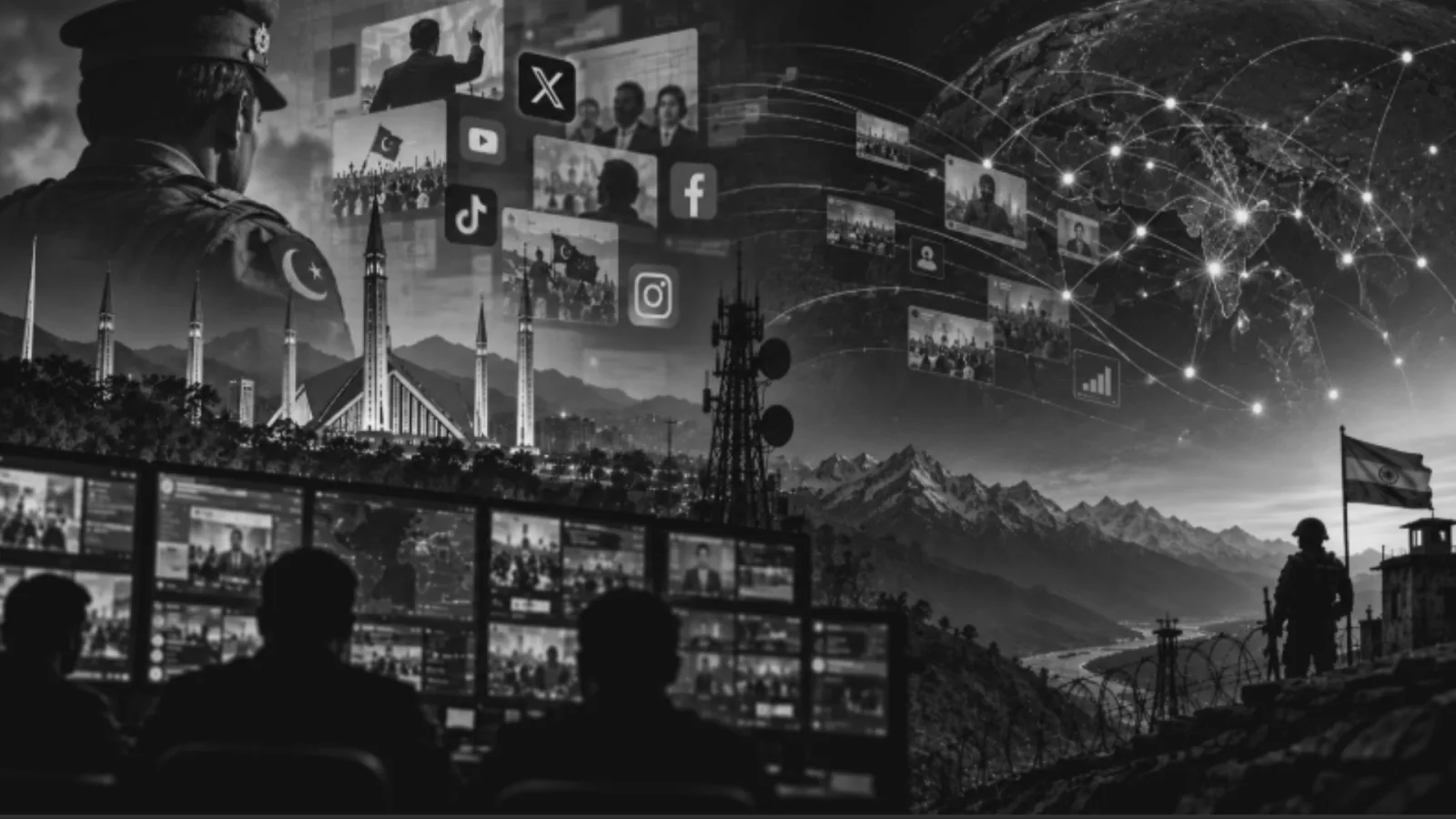
Pakistan’s digital media ecosystem has been growing rapidly. Due to the easy availability of cheap smartphones and the internet, people in Pakistan use platforms such as X, Facebook, YouTube, Instagram, and TikTok. Through all of this, people can easily access news and their views on political discussions. As of 2025, in Pakistan, there are an estimated 117 million internet users, 79.9 million social media users, and nearly 190 million mobile connections. For younger generations, social media plays a primary role in providing information, and it is also replacing newspapers and television.
In this ecosystem, the government includes their institutions, political parties, media houses, journalists and digital content creators. Among these, the military PR wing also plays a crucial role in shaping positions on defence, national security and their regional developments. As a result, these digital platforms became an important space for diverse public opinions and political discussions. In recent years, social media platforms have often been used to promote narratives or influence public opinion. Issues such as the PoJK and the ongoing situation in Balochistan are highlighted in their official statements, news and social media. These narratives are aimed not only at the domestic audience but also at the international audience.
Pakistan’s digital media is currently facing several challenges, including misinformation, political interference, media restrictions, and the rapid spread of false information on social media platforms. As a result, these developments made digital media an important space for the creation and spread of different narratives. These developments have significant implications for regional politics and influence India’s security environment.
3. Government and Military Narrative Building in Pakistan
Pakistan’s digital media ecosystem has become an important space, with more than 70 million social media users across platforms like X, Facebook, YouTube, Instagram, and TikTok. Therefore, digital media play a primary role in shaping public opinion by creating narratives about PoJK, Balochistan, India-Pakistan relations, domestic politics, human rights, and CPEC, all of which are presented by the government, political leaders, or military personnel. The rapid spread of narratives on social media allows them to reach millions of users in a short time.
These issues not only dominate online discussions but also elections, diplomatic discussions, terrorist incidents, and periods of increased tensions with India. The government generally uses social media to present their policies and diplomatic messages. In contrast, the military uses these platforms to communicate security-related narratives through press briefings and its official statements.
The growing influence of these digital platforms is clearly seen in how political leaders and parties use social media to communicate with the public. Political parties use social media to engage their constituencies in political discussions, shape their views, and expand their reach.
On the party level, Pakistan Tehreek-e-Insaf (PTI) maintains the strongest presence on digital platforms. Imran Khan has the country’s highest online followers, more than 21 million on X, 15 million on Facebook, 10 million on Instagram, and 12 million on TikTok. Shehbaz Sharif has a combined 10 million followers across all major platforms.
In Pakistan, the government and the military are two influential forces in shaping domestic narratives. Regarding the Kashmir issue with India, the government presented it to the UNSC (United Nations Security Council), stating that it can be resolved through bilateral meetings and before international organisations, as doing so puts the matter in the global spotlight. The government highlights trade, regional cooperation and infrastructure development.
Pakistan’s military communicates only on issues related to its security, defence, counter-terrorism efforts, border security, and national unity. The Inter-Services Public Relations (ISPR), the official media and public relations wing of the military, is responsible for sharing official information with the public through press releases, official websites and social media. Officially, the ISPR also highlights updates on operations against militant groups, border management, disaster response, and the armed forces’ role in maintaining internal security.
Pakistan’s military often mentions India in its official communication, especially during increased border tensions, diplomatic disputes, and developments in Jammu and Kashmir. During these periods, the ISPR issued official statements to explain Pakistan’s position on border incidents, violations of the ceasefire and other security challenges. Through these statements, Pakistan’s military position is to be presented to both domestic and international audiences. These statements highlight the role of the armed forces in safeguarding the country’s security and protecting its borders. These messages aim to build public trust in the military and promote national unity during security-related challenges.
During major security challenges, like terror incidents, border disputes and military conflicts, the military DGMO (Director General of Military Operations) is the primary source of official statements in Pakistan. In the media, television channels, newspapers, and digital platforms gave significant attention to official military updates and ISPR’s statements. These updates play an important role in informing the public about current developments and often influence people’s understanding of security issues across the country. With wide media coverage, attention becomes the primary source of information for the public during security crises, shaping public views both domestically and abroad. From India’s view, examining how the government and military update during these crises is important for understanding the country’s official narratives. It also provides insight into how these narratives can affect regional security, India-Pakistan relations, and perceptions of security developments in South Asia.
4. Security Implications for India
India’s national security faces new challenges through media coverage controlled by the Pakistani government. People use these social media platforms to share their news and viewpoints. People use these digital platforms to affect regional security, spread political positions, and shape public views. The events in India, Jammu and Kashmir, and the region’s security were influenced by the people’s stories and ideas, shared through digital platforms that reached millions.
Information warfare has become an important security challenge for India, especially during periods of military and political tensions. Governmental organisations, political parties, media organisations and social media users are actively using these digital platforms to strengthen their narratives on issues such as Jammu and Kashmir, India-Pakistan relations and human rights. A recent example of information warfare was Operation Sindoor, which demonstrated how digital platforms have become a major part of recent conflicts. During the operation, both India and Pakistan shared their official statements through television, newspapers, and social media platforms. During the operation- videos, images, and social media posts were circulated much more quickly online by both sides. In this, Pakistan also used old videos, edited images, AI-generated images and videos, and unverified claims. They spread all of these as official sources. In all this, it was so misleading for people to know which information was accurate and which was spread for misinformation. The information was not only seen by people in India and Pakistan; international audiences, global media and social media platforms saw it. As a result, the information shared by social media platforms can be influenced by public opinion, as shown on the ground. Operation Sindoor highlighted that modern conflicts are fought not only through military action but also through the speed at which information spreads on digital platforms. All this shows how information warfare has become an important part of national security.
Extremist groups may also use social media platforms to spread their ideas and reach wider audiences. These groups use social media to spread their views, increase followers and promote violence. Many digital platforms banned these types of accounts, but extremist groups again created new accounts and challenges to continue appearing or spreading their views. This is also a security issue because information on the internet can increase tensions among people and societies.
The spread of false information during emergencies is also a significant security concern. During border tensions, terrorist attacks, military operations, false news, edited videos, manipulated films and images and old photographs are shared on the digital media platforms. Because this content spreads quickly, it can create confusion and public anxiety, making it difficult for people to distinguish verified information from false claims. It was also more difficult for government authorities to control such situations.
Online articles from Pakistan aim to shape public understanding of these opinions. Pakistan’s online activities focus on Kashmir, human rights, and regional security. These issues are among foreign governments, international organisations, global media houses and policy think tanks. Through this approach, Pakistan aims to present its perspective on the issues, influence international discussions, and increase support for Pakistan.
These developments indicate that India’s national security extends to the digital domain. Apart from border security, India needs to strengthen its communication efforts, enhance its tracking capabilities, combat misinformation with reliable, accurate information, and collaborate with tech firms and foreign partners to address new information that threatens India’s image. To protect national interests, India should adopt a robust digital strategy to address the growing challenges in the digital information space. India must remain cautious when it comes to spreading online extremism, information warfare, global media, and cross-border information campaigns.
5. Policy recommendations for India
India should strengthen its strategic communication capabilities to address the growing influence of digital media narratives on regional security. An integrated approach that includes the Ministry of External Affairs, the Ministry of Home Affairs, security agencies, and government organisations is essential to ensure the proper, timely, and accurate sharing of information during periods of political or military tension. The clear, reliable information provided by government officials helps to counter misinformation, reduce confusion, and strengthen the public’s confidence in the country.
India should also improve its ability to monitor and analyse the digital information environment by using open-source intelligence (OSINT), data analytics and AI-based tools. The continuous monitoring of open-source data helps to identify the emerging narratives, coordinated information efforts, and misinformation related to Jammu and Kashmir, India-Pakistan relations and cross-border terrorist activities. The Indian government can collaborate with tech companies like X, Meta, YouTube, Instagram, and TikTok to strengthen efforts to detect and remove coordinated accounts that engage in inauthentic behaviour, fake accounts and content that violates the platform’s policies.
To counter this information warfare, the Indian government needs to invest more in digital education and public awareness programmes. During times of crisis, citizens should first verify the information, then share it, and rely on credible government sources. The government is expanding or has begun media literacy programmes in educational institutions and is also supporting fact-checking organisations. These can reduce the impact of misinformation and help the public to understand the risks of digital information. Along with this, India should promote research on digital narratives, online influence campaigns and regional security challenges through universities and think tanks.
India should strengthen its international cooperation to address cross-border false information and cybersecurity challenges. India should be working with partner countries, regional and international organisations, and tech firms to facilitate the exchange of best practices, strengthen information sharing, and support the development of a shared approach to counter misinformation. An integrated strategy that combines the technological, institutional coordination, public awareness and international cooperation, all of which enhance India’s ability to protect the national interests and manage challenges effectively in the digital media ecosystem.
6. Conclusion
Digital media has become an important platform for political discussions, official communication and public interaction. The Pakistani government, military, political parties, media organisations, social media influencers, think tanks, and overseas communities use these digital media platforms primarily to shape their narratives or to raise issues related to Jammu and Kashmir, India-Pakistan relations, national security, and politics. The rapid spread of social media narratives across digital platforms influences both domestic and international audiences.
From India’s perspective, these developments in social media highlight that information warfare has become an important part of regional security. Digital narratives can not only shape public opinion during a crisis but also influence diplomatic exchanges and shape international views on sensitive issues. While not every online campaign has direct national security implications, long-term communication efforts can help shape the wider information environment, which can affect both policy discussion and public undertakings.
These challenges require India not only to respond to them but also to prevent them by adopting an integrated strategy that combines strategic communication, digital monitoring, fact-checking, international cooperation and increasing technological capabilities. India needs to strengthen its digital literacy, invest more in research on information warfare, and also try to influence online communication campaigns; all of this will help India’s ability. As these digital platforms continue to shape regional politics and security, the Indian government needs to understand them better and respond to the evolving information campaigns by these actors, thereby helping it protect national interests and support stable, secure digital information warfare.
The views expressed are those of the authors and do not represent the views of CNAWS.
ImageSource: ChatGPT
Tags

Author
Manish Dhankhar
Manish Dhankhar is a postgraduate student pursuing an MA in International Relations and Peace Studies at Nalanda University. His research interests include international relations, national security, geopolitics, terrorism and counterterrorism, and strategic affairs. He is experienced in policy research and academic writing on contemporary security and geopolitical issues.