
Beyond CPEC: China's Expanding Role in Pakistan's Fuel Security and Wartime Logistical Resilience
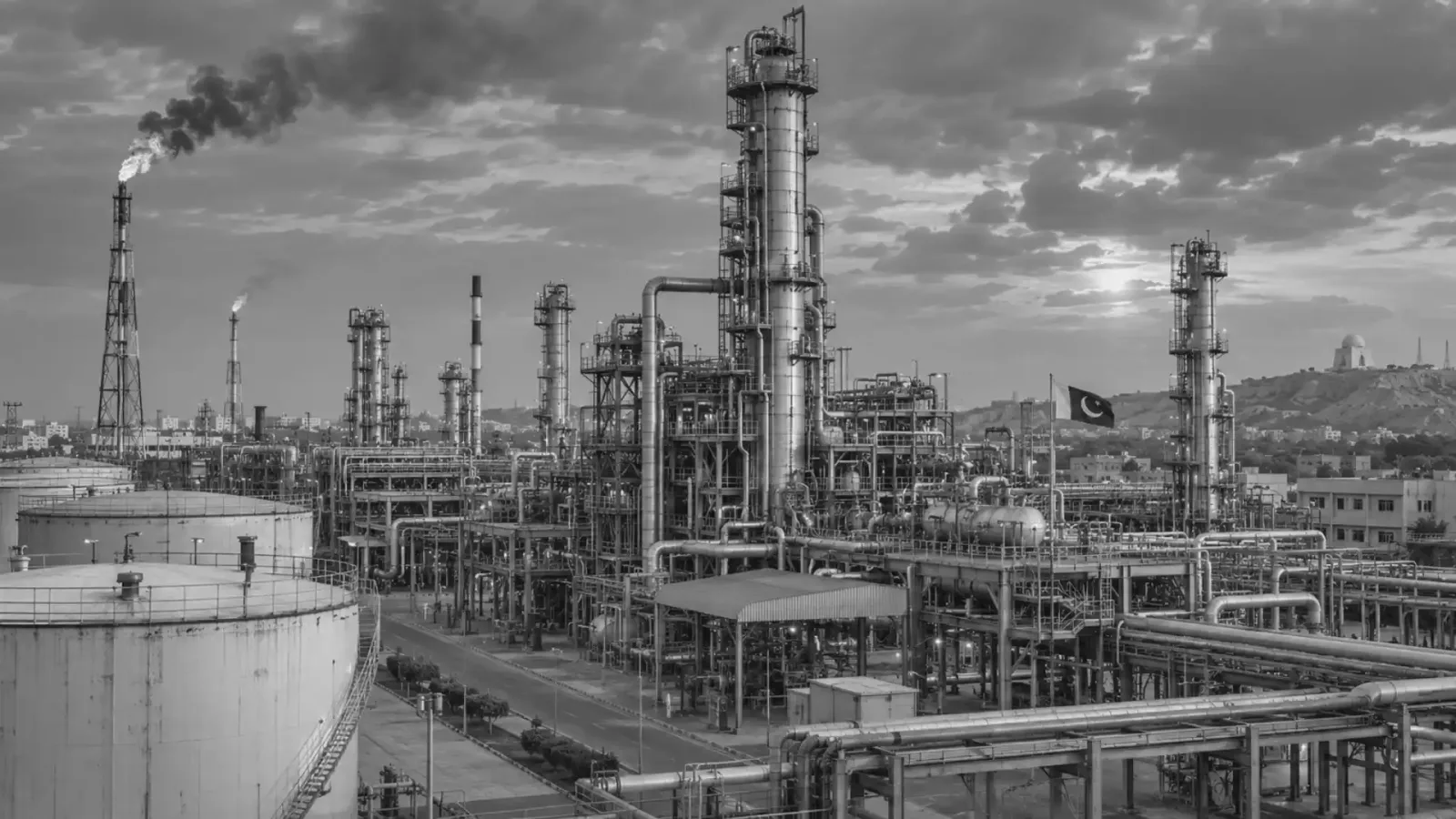
Pakistan and China have agreed to accelerate government-to-government cooperation in petroleum imports, storage infrastructure and terminal facilities, potentially expanding Beijing's involvement in Pakistan's downstream energy sector. The development comes against the backdrop of the 2026 Strait of Hormuz crisis, which exposed Pakistan's dependence on Gulf energy suppliers, inadequate emergency stockpiles and limited capacity to absorb prolonged supply disruptions. Although the proposed arrangements are primarily commercial, their successful implementation could have wider strategic implications for Pakistan's economic stability, crisis-management capacity and military logistical resilience. For India, the development warrants examination within the broader framework of China's growing involvement in Pakistan's critical infrastructure and national sustainment capabilities.
Background
On 25 November 2026, Pakistan's Federal Minister for Petroleum Ali Pervaiz Malik, accompanied by Additional Secretary for Policy Zafar Abbas and Pakistan State Oil (PSO) Chief Executive Officer Jawwad Ahmed Cheema, held discussions with Chinese Ambassador Jiang Zaidong and his commercial delegation to accelerate Chinese investment across Pakistan's energy sector. The discussions identified two immediate priorities under government-to-government arrangements. The first concerns the establishment of a liquefied petroleum gas (LPG) plant alongside associated storage and terminal infrastructure, while the second involves cooperation in motor gasoline (MoGas) procurement, storage and distribution.¹
Both countries also agreed to establish a Joint Commercial Team to identify investment opportunities, engage prospective companies and develop an implementation roadmap. Pakistan State Oil was identified as a principal commercial partner for Chinese downstream energy companies, while opportunities in offshore exploration, hydrocarbons and mineral development were also discussed.²
The significance of the development lies in China's potential expansion from financing and developing energy-generation infrastructure towards greater participation in the procurement, storage and distribution of petroleum products. Although China has historically concentrated its investments under the China-Pakistan Economic Corridor (CPEC) on electricity generation, transport infrastructure and industrial connectivity, the proposed arrangements could deepen its involvement in the systems responsible for sustaining Pakistan's domestic economy during external disruptions.
However, the announcement represents an agreement to advance prospective projects rather than the conclusion of binding procurement or construction contracts. Investment values, project locations, storage capacities, ownership arrangements and implementation timelines have not yet been publicly established.
Pakistan's Structural Dependence on Gulf Energy Supplies
Pakistan's energy security remains closely linked to developments in West Asia. Limited domestic hydrocarbon production, inadequate refining capabilities and sustained demand for imported petroleum products have created a structural dependence on external suppliers. This dependence is particularly pronounced in the case of motor gasoline, approximately 70 per cent of which Pakistan imported in FY2025, compared with approximately 29 per cent of its diesel requirements.³
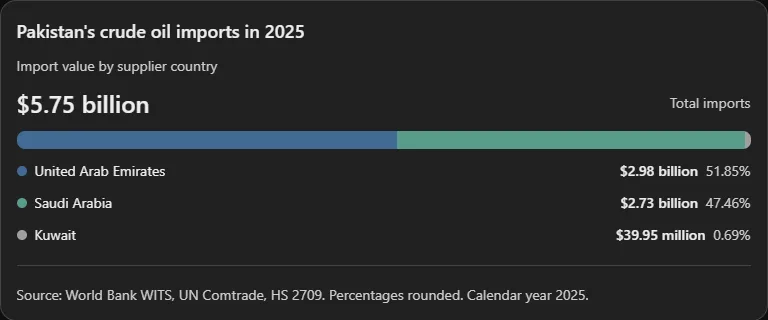
According to international merchandise trade data, Pakistan imported approximately $5.75 billion worth of crude oil and $5.96 billion worth of non-crude petroleum oils and preparations during the calendar year 2025. The United Arab Emirates and Saudi Arabia together accounted for approximately 99.3 per cent of Pakistan's recorded crude oil imports by value, highlighting the geographical concentration of its energy supply chains.⁴
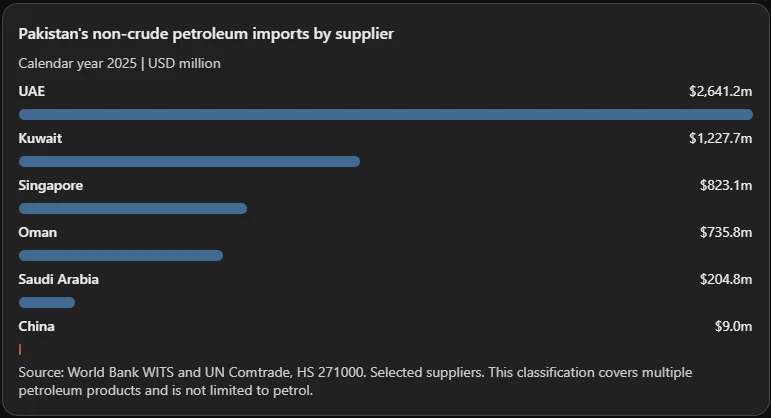
A similar pattern exists in Pakistan's imports of non-crude petroleum products. The UAE, Kuwait, Oman and Saudi Arabia collectively accounted for more than 80 per cent of recorded imports under the relevant commodity classification in 2025. China, in comparison, accounted for approximately $9 million, representing a negligible share of Pakistan's existing petroleum trade under this classification.⁵
The proposed cooperation with China must, therefore, be understood as a potential diversification of Pakistan's existing energy partnerships rather than an extension of an already substantial bilateral petroleum trade relationship. While Gulf suppliers are likely to remain central to Pakistan's energy security, Chinese participation could provide Islamabad with additional procurement channels, investment capital, technical expertise and infrastructure development opportunities.
The Strait of Hormuz Crisis and Pakistan's Strategic Petroleum Reserve Deficit
The disruption of maritime energy supplies through the Strait of Hormuz in early 2026 exposed several structural deficiencies in Pakistan's energy security architecture. In March 2026, Islamabad formally requested Saudi Arabia to facilitate alternative petroleum supplies through its Red Sea port of Yanbu following disruptions to established maritime supply routes.⁶ The crisis demonstrated that Pakistan's geographical proximity to major hydrocarbon-producing countries does not necessarily translate into assured access to energy during regional instability.
During the crisis, Pakistan's crude oil inventory reportedly declined to approximately 11 days of supply, necessitating emergency procurement measures, alternative shipping arrangements and changes to import-financing mechanisms. Between July 2025 and March 2026, Pakistan imported approximately 13.9 million metric tonnes of crude oil and petroleum products, incurring an expenditure of approximately $8.9 billion.⁷
These developments prompted Islamabad to accelerate plans for establishing a national Strategic Petroleum Reserve (SPR). On 25 August 2026, Pakistan's Petroleum Division formally initiated a feasibility study for the establishment of strategic petroleum reserves, appointing international energy consultancy Wood Mackenzie following a competitive tender process.⁸
Earlier government proposals envisaged progressively requiring refineries to maintain 15 days of crude oil stocks and oil marketing companies to maintain 30 days of finished petroleum products, alongside the development of dedicated emergency reserves. These proposed requirements were expected to be phased in by June 2028.⁹
An important distinction must be drawn between commercial petroleum storage and a sovereign strategic petroleum reserve. Commercial inventories are maintained primarily to facilitate routine consumption and distribution, whereas strategic reserves are designed specifically to provide emergency supplies during exceptional disruptions under predetermined release mechanisms. Increasing commercial storage capacity may contribute to national resilience, but it does not automatically create a strategic petroleum reserve.
The November agreement with China appears consistent with Pakistan's broader efforts to address these deficiencies. However, there is currently no publicly available evidence establishing that the proposed Chinese-backed facilities form part of the dedicated SPR programme.
China's Expanding Footprint in Pakistan's Energy Value Chain
Since the launch of CPEC, Chinese investment in Pakistan's energy sector has predominantly focused on electricity generation, including coal-fired, hydroelectric, solar and wind energy projects. The emerging emphasis on petroleum exploration, refinery modernisation, storage and downstream distribution indicates the possibility of a broader Chinese presence across Pakistan's energy value chain.
The November announcement was preceded by several developments during 2026 that indicate increasing bilateral interest in hydrocarbon infrastructure.
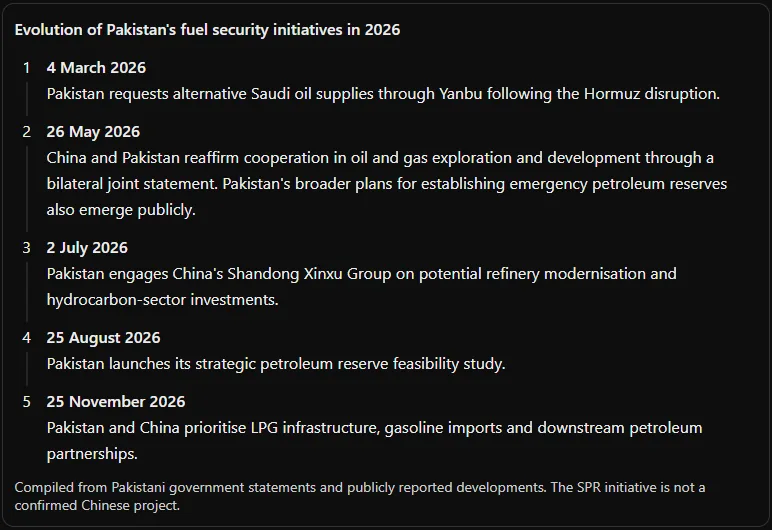
The bilateral joint statement issued on 26 May 2026 reaffirmed cooperation in oil and gas exploration and the development of Gwadar as a regional connectivity hub.¹⁰ Subsequently, on 2 July, discussions between Pakistan's petroleum minister and China's Shandong Xinxu Group included prospective refinery modernisation through technologies capable of converting lower-value furnace oil into higher-value petroleum products.¹¹
Pakistan's refining sector has historically struggled with outdated refinery configurations and an output mix that does not adequately correspond to domestic fuel demand. The country's five refineries have a combined annual capacity of approximately 20.22 million tonnes, but utilisation has remained below 60 per cent in recent years, according to research by the Pakistan Institute of Development Economics.³ Chinese investment in refinery modernisation could potentially increase domestic production of higher-demand fuels and reduce dependence on finished petroleum imports.
The identification of Pakistan State Oil as a principal commercial partner is particularly significant. PSO reported a petroleum storage network with a capacity of approximately 1.23 million metric tonnes during FY2026 and held approximately 42.7 per cent of Pakistan's white oil market.¹² Chinese collaboration with an established national petroleum company could facilitate integration into existing commercial supply chains rather than requiring the development of an entirely independent distribution network.
Implications for Pakistan's Wartime Logistical Resilience
The ability of a country to sustain military operations during a prolonged conflict depends not merely on its inventory of weapons and military platforms but also on the resilience of its national logistics architecture. Petroleum products remain indispensable to military mobility, aviation, maritime operations, transportation, engineering activities and the functioning of supporting industrial infrastructure. Consequently, the strategic significance of fuel security extends considerably beyond the commercial energy sector.
An expansion of Pakistan's petroleum storage and procurement capabilities could indirectly strengthen its ability to manage simultaneous civilian and military demand during a national emergency. A more resilient civilian fuel supply could reduce competition for petroleum products during crises, limit economic disruptions and provide the government with greater flexibility in allocating national resources. Assured supplies could also reduce the financial pressures associated with emergency procurement during periods of elevated international petroleum prices.
Nevertheless, the specific products identified in the November announcement impose limitations on its immediate military significance. LPG is principally associated with domestic, commercial and industrial consumption, while motor gasoline primarily serves civilian transportation requirements. Modern military formations are considerably more dependent on diesel, aviation turbine fuel and specialised petroleum products. The proposed arrangements cannot, therefore, be directly equated with an expansion of Pakistan's military fuel reserves.
Petroleum product | Relevance to national sustainment | Status under November announcement |
|---|---|---|
LPG | Household and industrial energy | Explicitly included |
Motor gasoline | Civilian mobility and economic continuity | Explicitly included |
High-speed diesel | Heavy transport and military mobility | No specific commitment announced |
Aviation turbine fuel | Civil and military aviation | No specific commitment announced |
Crude oil | Domestic refinery operations | No specific import commitment announced |
Strategic petroleum reserves | Emergency national sustainment | No formal linkage established |
The longer-term strategic implications would become more substantial if bilateral cooperation were subsequently extended to diesel, aviation fuel, refinery upgrades or government-controlled emergency petroleum reserves. Such developments could contribute to Pakistan's national capacity to absorb economic and logistical pressures during prolonged regional crises.
Can China Reduce Pakistan's Dependence on the Strait of Hormuz?
China possesses a substantial refining industry and could potentially emerge as an additional supplier of finished petroleum products to Pakistan. Its ability to provide alternative procurement opportunities could be particularly valuable during disruptions affecting traditional Gulf suppliers. Nevertheless, China's own dependence on imported crude oil and its regulation of petroleum exports constrain its ability to function as an unconditional alternative supplier.
Chinese petroleum exports are subject to domestic requirements, government-issued quotas and broader energy security considerations. During 2026, Beijing adjusted its refined petroleum export arrangements in response to evolving international supply conditions.¹³ Therefore, closer political relations between Islamabad and Beijing do not necessarily guarantee uninterrupted Chinese fuel exports during a global energy crisis.
Furthermore, although CPEC provides overland connectivity between China and Pakistan, this should not be confused with the existence of a functioning cross-border petroleum pipeline capable of replacing large-scale maritime imports. The November announcement did not identify any such infrastructure. Pakistan's dependence on maritime petroleum supplies is consequently likely to remain substantial, even if the geographical composition of its suppliers becomes more diversified.
It is also noteworthy that Pakistan's petroleum diversification strategy is not exclusively centred on China. As recently as November 2026, Kuwait Petroleum Corporation was pursuing arrangements to store petroleum products within Pakistan for domestic distribution and regional re-export, although the proposal remained subject to regulatory approvals.¹⁴ This indicates that Islamabad is seeking multiple external partnerships to strengthen its petroleum ecosystem rather than necessarily replacing its established Gulf energy relationships with Chinese alternatives.
Implications for India
For India, the proposed cooperation warrants assessment within the larger framework of China's expanding involvement in Pakistan's national infrastructure. The strategic relationship between Islamabad and Beijing increasingly encompasses defence manufacturing, military platforms, communications, space technology, transportation infrastructure and energy security. Greater Chinese participation in Pakistan's downstream petroleum sector would add another dimension to this relationship, potentially extending cooperation into the economic foundations that underpin national military power.
Indian assessments of Pakistan's long-term military preparedness should consequently consider developments in national sustainment capabilities alongside conventional indicators such as weapons procurement, military modernisation and force restructuring. Improvements in petroleum availability, domestic refining efficiency, emergency stockholding and economic resilience could influence Pakistan's capacity to manage the wider consequences of prolonged military tensions.
At the same time, it would be premature to interpret the November announcement as evidence of a coordinated Chinese effort to establish dedicated wartime fuel infrastructure for Pakistan. Such a conclusion would require additional evidence regarding the products involved, financing arrangements, ownership structures, emergency allocation mechanisms and any formal military participation.
From an Indian perspective, the more immediate lesson concerns the growing importance of energy security within comprehensive national defence planning. Recent international conflicts have demonstrated that the sustainability of military power depends heavily on the resilience of civilian infrastructure, industrial production, international supply chains and access to critical commodities.
Indicators to Monitor
The following developments would help determine whether the proposed commercial cooperation evolves into a more consequential strategic partnership.
Indicator | Analytical significance |
|---|---|
Signing of binding G2G petroleum supply agreements | Transition from diplomatic discussions to implementation |
Announcement of Chinese-backed storage projects | Expansion of physical petroleum infrastructure |
Inclusion of diesel and aviation fuel | Greater relevance to military and industrial sustainment |
Chinese participation in refinery modernisation | Potential reduction in finished-product import dependence |
Completion of Pakistan's SPR feasibility study | Progress towards an institutionalised emergency reserve system |
Formal linkage between Chinese investments and the SPR programme | Evidence of deeper involvement in national energy resilience |
Long-term financing and petroleum procurement arrangements | Improved ability to manage external supply and financial shocks |
Conclusion
The November 2026 agreement between Pakistan and China represents a potentially significant development in the evolution of their bilateral energy partnership. While earlier Chinese investments predominantly focused on electricity generation and economic connectivity, emerging cooperation in petroleum procurement, storage, refining and distribution could extend Beijing's involvement into the broader architecture of Pakistan's national sustainment capabilities.
The development is particularly relevant following the 2026 Strait of Hormuz crisis, which exposed Pakistan's dependence on geographically concentrated energy suppliers and the inadequacy of its emergency petroleum reserves. Chinese investment could help Islamabad address some of these deficiencies, diversify procurement channels and improve its economic resilience during external disruptions.
Although the immediate projects remain commercial and are not specifically oriented towards military fuels, their longer-term significance lies in the potential strengthening of the economic and logistical foundations upon which Pakistan's military capabilities depend. For India, the emerging partnership reinforces the need to examine Pakistan's military preparedness not exclusively through its acquisition of weapons systems but through the broader development of its national capacity to sustain a crisis or prolonged conflict.
Endnotes
1. Ministry of Energy, Petroleum Division, Government of Pakistan, “Pakistan and China Discuss New Opportunities in Energy & Mining Sectors; Resolve to Jointly Fast-Track Government-to-Government LPG and MoGas Projects and Upstream Partnerships,” November 25, 2026, https://petroleum.gov.pk/NewsDetail/NTkyYzVhN2EtYmI1Ny00ZWUxLWEwOGItODBmZTBlY2MwMTFk.
2. Radio Pakistan, “Pakistan, China Agree to Fast-Track Implementation of Key Energy Projects,” November 25, 2026, https://radio.gov.pk/25-11-2026/pakistan-china-agree-to-fast-track-implementation-of-key-energy-projects.
3. Pakistan Institute of Development Economics, “Powering Economic Security,” 2026, https://pide.org.pk/research/powering-economic-security/.
4. World Bank, “Pakistan Petroleum Oils and Oils Obtained from Bituminous Minerals; Crude Imports by Country,” World Integrated Trade Solution, 2025, https://wits.worldbank.org/trade/comtrade/en/country/PAK/year/2025/tradeflow/Imports/partner/ALL/product/2709.
5. World Bank, “Pakistan Petroleum Oils, Etc. (Excluding Crude); Preparation Imports by Country,” World Integrated Trade Solution, 2025, https://wits.worldbank.org/trade/comtrade/en/country/PAK/year/2025/tradeflow/Imports/partner/ALL/product/271000.
6. Reuters, “Pakistan Seeks Saudi Oil Supplies via Yanbu Port after Hormuz Disruption,” March 4, 2026, https://www.reuters.com/business/energy/pakistan-seeks-saudi-oil-supplies-via-yanbu-port-after-hormuz-disruption-2026-03-04/.
7. Saqib Ur Rehman Mughal and Nayyar Hussain Mirjat, “Building Pakistan's Fuel-Supply Resilience Against External Shocks,” Pakistan Institute of Development Economics, November 2026, https://cpec.pide.org.pk/pb/building-pakistans-fuel-supply-resilience-against-external-shocks/.
8. Ministry of Energy, Petroleum Division, Government of Pakistan, statement on the launch of the Strategic Petroleum Reserves feasibility study, August 25, 2026, https://www.petroleum.gov.pk/NewsDetail/NWQ4ODhmYjItOTliNS00YmZjLTg2NDItMzQ5NWViZTc2MzY1.
9. Reuters, “Pakistan Plans Oil Reserves, Storage Push as Hormuz Constraints Expose Vulnerabilities,” May 26, 2026, https://www.reuters.com/business/energy/pakistan-plans-oil-reserves-storage-push-hormuz-constraints-expose-2026-05-26/.
10. Ministry of Foreign Affairs, Government of Pakistan, “Joint Statement between the People's Republic of China and the Islamic Republic of Pakistan,” May 26, 2026, https://mofa.gov.pk/press-releases/joint-statement-between-the-peoples-republic-of-china-and-the-islamic-republic-of-pakistan-may-26-2026.
11. Ministry of Energy, Petroleum Division, Government of Pakistan, statement on discussions with Shandong Xinxu Group Corporation regarding investment in Pakistan's petroleum sector, July 2, 2026, https://www.petroleum.gov.pk/NewsDetail/MTNhZjZlMjMtYjY5OS00YzE3LTljZTktYTcxZGJlYzM2Nzkx.
12. Pakistan State Oil, “PSO Delivers Resilient FY2026 Performance as Core Business Grows Strongly through the Strait of Hormuz Crisis,” 2026, https://www.psopk.com/ur/media/press-releases/pso-delivers-resilient-fy2026-performance-as-core-business-grows-strongly-through-the-strait-of-hormuz-crisis.
13. Reuters, “China to Resume October Fuel Exports after Holiday Pause, Sources Say,” Euronext, October 9, 2026, https://live.euronext.com/en/financial-news/china-resume-october-fuel-exports-after-holiday-pause-sources-say.
14. “KPC Plan to Use Pakistan's Facilities to Store POL Products Awaits Govt Clearances,” Dawn, November 16, 2026, https://www.dawn.com/news/2044750.
Tags
Author