Department of Hybrid Warfare & Irregular Conflict · Explainers · Armed Conflicts ·
What is Asymmetric Warfare?
A handful of militants can paralyse a major city, a low-cost drone can threaten a warship worth millions, and a cyberattack can disrupt critical infrastructure without a single soldier crossing the border. This is the logic of asymmetric warfare, where weaker adversaries avoid confronting superior forces on their terms and instead exploit surprise, technology, proxies, propaganda and political pressure. From Pakistan-backed militancy and China’s grey-zone tactics to drone attacks in the Red Sea and digital influence campaigns, asymmetric methods are reshaping how wars are fought, deterred and understood. For India, confronting this evolving threat is no longer merely a military challenge. It requires the integration of intelligence, technology, financial regulation, diplomacy and national resilience.
Since times immemorial warfare has taken surprising turns to navigate the multipolar world. In a conflict, blood is drawn, not only conventionally with rules, but with unprecedented attacks as well. Asymmetric Warfare is an umbrella term garnering unconventional attacks in the modern times. When a handful of gunmen paralyze a metropolis, or when a nuclear-armed state finds itself unable to deter a group without its armed forces, it is asymmetric warfare. Given its ambiguous interpretation, it remains to be of the most used, yet most misused term in contemporary vocabulary of stratagems. Calibrated justifications to explain military setbacks, indoctrination by modern militaries and arduous analysis by think tanks; all nestle around this term. Yet, at its core, asymmetric warfare highlights an inherent power imbalance. It is such a conflict between adversaries who possess different power, methods and objectives. These tools are fundamentally unequal, hence the weaker counterpart does not take the battle one-on-one, and rather requires a calculated navigation.
For India, lessons are imperative. India is flanked by a nuclear-armed, morally weak Pakistan that has relied on proxies and militants time and again. Undoubtedly, open battle is evidently detrimental for the nation renowned for its terror financing. At the eastern borders, rests China. The expansionist vision of PRC has combined conventional heft with cyber, economic, and grey-zone tools. Asymmetric Warfare today shapes military doctrine, internal security policy, diplomacy and even financial regulation today.
Unearthing Asymmetric Warfare
In essence, asymmetric warfare is a situation "where there is a war between two opposing forces that have unequal military strengths and where the weaker one uses unorthodox ways of countering this inequality without matching the strengths of the other." In asymmetric warfare, unconventional strategies and tactics are employed by one army where the military power of opposing nations is highly unequal, preventing them from engaging in warfare the traditional way. Unlike army size disparity, asymmetric warfare goes beyond this, creating an entirely new form of logic behind the war itself. The stronger one wants a quick and decisive victory using conventional methods while the weaker side wants to survive and exhaust the stronger side.
In analyzing the laws of war, legal experts have found that this imbalance itself gives rise to certain temptations. According to ICRC's report, when one side adopts weapons or methods of warfare that provide it with "immediate, great military advantage," the other side is forced to react accordingly regardless of any conventions that may be in place. It is clear that if one Party, in contravention of certain rules, makes use of weapons or other methods of warfare giving it an immediate, great military advantage, the adversary may be tempted in its own defense to retaliate at once by similar methods. In other words, while asymmetry represents an unequal balance of power, it also represents the breakdown of restraint because the weaker party realizes that adherence to the "rules" that apply to symmetrical conflict between two states will spell its doom.
For this reason, asymmetrical warfare quickly becomes irregular warfare: surprise attacks, hostage-taking, suicidal attacks, raids, propaganda campaigns, and deliberately harming civilians or destroying infrastructure to create a psychological and political effect far greater than the expenditure of military assets. The Israeli-Palestinian conflict is often presented as a perfect example, where the traditionally more powerful nation confronts forces that do not possess any equivalent in terms of army, air force, or naval forces and use such methods as rockets, tunnels, and raids as compensation for the disparity.
Importantly, the concept of asymmetric warfare does not apply only to insurgencies; it may also be applied to wars between countries, where one of the nations possesses significantly more advanced technologies or air power than another one. NATO's 1999 air strike on Yugoslavia, where the alliance air power was confronted by a Yugoslav army lacking any equivalent in terms of air power, is a typical example of asymmetric war between nations.
A Global Grammar of Unequal Wars
Asymmetric warfare is not something specific to a particular region, but it may be said to be the prevailing language of war since the middle of the twentieth century in different accents around every continent.
Asia can provide the best examples. The Vietnamese War was the example par excellence – the advanced technology of the US military proved unable to translate itself into victory over the Viet Cong guerrillas entrenched among jungles and villagers. In South Asia, the relationship between India and Pakistan has always been characterized by asymmetry – as the conventional force was outmatched by India, Pakistan has used the tactics of infiltration, militancy and proxies working from Pakistani soil, which is called a slow "death by a thousand cuts".
In West Asia (the Middle East), asymmetric warfare has become the hallmark of the post-9/11 era. The non-state actors – Hezbollah, Hamas and even the Islamic State – have combined rockets, tunnel warfare, IEDs and decentralized propaganda to oppose state militaries whose budgets were many times higher. The ICRC pointed out that the war against international terrorism had taken the shape of an especially sharp example of the kind of warfare in which covert operations have replaced open battles for special belligerent situations.
Europe has had its own version in the Balkans, where the war in Kosovo involved the Yugoslav state forces, who enjoyed superiority in weaponry and numbers, fighting against the guerrilla outfit known as the Kosovo Liberation Army.
In Africa, asymmetric warfare can be seen in insurgencies of outfits like Boko Haram in the Lake Chad basin region and al-Shabaab in Somalia, taking advantage of their home states' weaknesses in terms of weak government capacities, open frontiers and local grievances in order to continue their wars against larger and more advanced military forces from the respective nations and the African Union.
In the Americas, there is an opposite but similar phenomenon in asymmetric war being waged between the state and non-state, powerful paramilitary forces of armed drug cartels that engage in acts of terrorism against both civilians and state authorities, such as in Mexico and historically in Colombia.
The Evolution from Guerrilla Bands to Grey-Zone Algorithms
Asymmetric warfare may be an old concept but its modern name. Its theoretical origins trace back through the writings of Sun Tzu on deception and indirection, through the colonial period of guerrilla warfare, through the writings of Mao Zedong on protracted people's warfare, where weaker revolutionary movements are advised to give space and time to avoid fighting against a stronger conventional force.
The term became prevalent in western strategic theory only in the course of and in aftermath of Vietnam War as the theorists sought to understand how the greatest military could fail to defeat an opponent weaker in resources. It found further development after the terrorist attacks of September 11, 2001, where non-state terrorism obliged the military as well as legal theorists to re-evaluate their assumptions made under symmetrical, nation-versus-nation warfare governed by Hague and Geneva conventions. Legal scholarship on the laws of armed conflict mentions that the laws of armed conflict rest upon an implicit ethic that "conflict should be symmetrical," making any enemy who does not conduct itself accordingly unworthy of the laws of armed conflict. The implicit ethic of Hague law is that conflict should be symmetrical and an adversary that does not conduct itself accordingly is not entitled to the protection of war laws.
The concept has gone through several overlapping stages since then:
- Guerrilla warfare and counter-guerrilla warfare (1950s-1980s): Emphasis on guerrilla war tactics in jungle and mountainous terrain – from Vietnam and Algeria to Afghanistan and fight against the Soviet invaders.
- Terrorism as a strategy (1990s-2000s): Non-state actors resorted to spectacular acts of violence against civilians and symbols of state power which had a political impact out of proportion to the material capability of such actors – from the 1993 World Trade Center attack to 9/11 and up to 2008 Mumbai attacks.
- Hybrid and grey zone warfare (2010s): States started using asymmetric tools themselves short of an all-out war – from Russian little green men in Crimea, disinformation campaign to proxy and deniable militias to change the ground reality without provoking a response.
- Asymmetry through technology (2020s onwards): Drones and cyber-attacks, strikes enabled by satellites and artificial intelligence have democratised the capacity for destruction so that materially weaker parties like Houthis or militia groups can threaten multimillion dollar navy vessels and critical infrastructures at a fraction of the cost – demonstrated well by the Russia-Ukraine war and Houthis attacks on the Red Sea navigation.
- This evolution underscores a consistent pattern. Each time, a stronger power builds overwhelming conventional dominance, adversaries revert to cheaper but lethal potent tools. This cycle, then, is likely to continue as artificial intelligence, commercial space technology and cyber capability seeks to expand virtual horizons.
India and its facade with Two-Front Asymmetry
While asymmetric warfare is simply a strategic concept for many countries around the world, India has had to experience its own version of the same on two quite distinct fronts for quite some time now.
Firstly, on the western front, where Pakistan has been facing a disadvantage both economically and militarily when compared to India for quite some years now, it has been compelled by its position to indulge in the practice of asymmetric warfare in the form of sponsorship of militants and proxy organizations that operate in the state of Jammu and Kashmir and even beyond. Apart from its nuclear strategy, it has also made use of the practice of proxy warfare and non-state organizations to indulge in asymmetric warfare against India.
Asymmetric thinking is even part and parcel of India's own military responses. In response to the 1999 Kargil conflict, the Indian army initiated the development of the so-called 'Cold Start' doctrine, consisting of rapid and limited conventional strikes against Pakistan in response to proxy attacks without having to cross the nuclear threshold that full scale mobilization might precipitate. A military response of India to several episodes of violence between it and Pakistan, starting from the Kargil conflict of 1999, the Cold Start Doctrine (CSD) envisages a set of limited attacks on Pakistan's territory in retaliation for asymmetric proxy attacks. The key idea was to create an advantage in the firepower fast enough to weaken the Pakistan's war fighting potential before an international pressure forced the ceasefire, while staying away from deep thrusts by corps that might cause the enemy to retaliate with nuclear weapons. The main objective would be also to undermine Pakistan's army's warfighting capability through asymmetric firepower from the ground and through massive air-to-ground battlefield air strikes, while at the same time making sure not to cross Pakistan's nuclear red lines. Over time, this has developed into surgical strikes, sub-conventional warfare strategies and, finally, Integrated Battle Groups.
On the northern and eastern frontiers, China offers an alternative and diverse asymmetry threat in the form of cyber-attacks, economic influence through trading and economic dependence, grey zone activities along the Line of Actual Control (activities below the threshold of armed conflict), and information operations. Contrary to Pakistan’s asymmetric approach through militancy, China’s strategy of asymmetric warfare makes use of its economic clout, technology superiority, and salami tactics that individually may not be sufficient to cause war but collectively can tilt the balance of power.
This twofold asymmetry poses a challenge for India because it cannot develop a security structure based on one paradigm.
Building Asymmetric and Counter-Asymmetric Capabilities
The development of the capacity for asymmetric warfare or, more crucially, to fight and resist it requires several key elements beyond just force modernization per se:
- Human Intelligence: As asymmetric adversaries operate among civilians, any response to asymmetric attacks relies more on human intelligence, signals intelligence and coordination between military and law enforcement than on high-end weapons systems.
- Special operations and rapid-reaction forces: Special operations forces and rapid reaction forces able to carry out surgical strikes (such as those that India conducted after the Uri and Pulwama attacks) ensure that conventionally dominant powers can retaliate to asymmetric provocations without going to full-scale wars.
- Asymmetry in technology: The possession of drones, loitering munitions, satellites and cyber technologies helps even relatively weak powers to inflict damage on the more powerful adversary - as India has learned from Ukraine and the Houthis.
- Financial and legal choke points: Blocking terrorist financing, penalising facilitators, and using multilateral institutions like the Financial Action Task Force (FATF) to put pressure on states and non-state supporters of militancy is now an integral part of the anti-asymmetric strategy, examined in more detail later in this section.
- Information and psychological resilience: Given that asymmetric actors depend on propaganda and psychological influence to magnify the effect of their limited material capabilities, media literacy, disinformation prevention, and maintenance of public morale is now considered a legitimate part of national security doctrine.
- Doctrinal agility: As illustrated by the Cold Start case, doctrines need to be continually updated; an unchanging conventional doctrine, tailored for symmetrical warfare between two similar armies, will inevitably lose out against an opponent who is unwilling to fight in this manner.
Asymmetric Warfare Cuts Deeper than the Battlefield: The Human and Economic Toll
The very nature of asymmetric warfare, which is aimed at obfuscating the distinction between civilian and combatants, makes its costs extend well beyond the immediate area of confrontation.
- Effect on civilians: Asymmetric warfare relies on suicide bombings, use of IEDs, hostage situations, attacks on markets, transport and religious places which are meant to produce maximum psychological and political shock with the least amount of expenditure, and therefore usually result in the suffering of civilians. The attacks in Mumbai 26/11, perpetrated by only few gunmen, resulted in the death of more than 160 people and immobilized India's financial capital for several days, demonstrating the conversion of civilians into combatants under asymmetric warfare. ICRC has pointed out on many occasions that "elementary considerations of humanity,"as set out in Article 3 of the 1949 Geneva Conventions are universally binding in these asymmetric and unequal wars. "Elementary considerations of humanity" as enshrined in article 3 common to the 1949 Geneva Conventions however constitute universally binding rules for all, even unequal and asymmetrical, parties to any situation of armed violence. Attacks on humanitarian organizations have shown that humanitarian relief can be against the interests of belligerent parties, or even worse, attacks on humanitarian workers may be a part of their true agenda.
- Economic impacts on finance and industries: Asymmetric attack and the defensive measures taken to counter them incur huge economic costs – from market disturbances that follow terrorist attacks, to government budget allocations for internal security, surveillance, and the decline of investments in regions prone to conflict like Jammu & Kashmir and some part of Africa’s Sahel region. Such industries as tourism, aviation, and insurance suffer more than others, because asymmetric attacks are intended at hitting civilian targets and economic infrastructure for achieving maximum disruption through minimum effort.
- Impacts on digital currency and financial assets: With conventional banking systems becoming stricter against militant funding, some of the non-state armed groups and their facilitators have resorted to using cryptocurrency and other informal means of value transfers. It became one of the new areas in the asymmetric strategy countermeasures, and financial intelligence units and central banks around the world began monitoring virtual asset service providers. It is an area where defence, financial regulation, and technology sectors need to collaborate which previously worked in their separate silos.
Terrorism as the Sharpest Expression of Asymmetric Warfare
Terrorism and asymmetrical warfare are different concepts, yet they share many aspects with each other. First of all, terrorism should be defined as just another very specific weapon of the asymmetrical strategy that involves the attack on the civilians or symbols of governmental power for achieving certain political effects and applying pressure on the government through fear and public attention. International terrorism is considered to be the most "epoch-making" form of asymmetrical conflict among those discussed by scholars analyzing humanitarian law, because it does not involve the traditional battlefield and uses another approach and means in order to achieve certain goals. The participants of the conflict have different goals and means and methods are used in order to achieve them. The terrorist attacks mentioned above represent only one exceptional, but very brutal and epoch-making form of the conflict.
These similarities explain why nowadays counter-asymmetric-warfare and counter-terrorism policies are closely related to each other; intelligence, sanctions regimes, special forces' doctrine, and legal means of fighting terrorism become the tools for combating asymmetric threats from proxies and insurgents.
Conclusion
The idea of asymmetric warfare is no longer some obscure theory used exclusively in counter-terrorism briefings, but it is rapidly becoming the modus operandi of modern warfare, whether it is at the Line of Control of Kashmir, or at the Red Sea maritime routes, or in the world of misinformation wars waged via social media sites. For India, which is surrounded by Pakistan and China - two countries which resort to proxy wars and technology respectively, it is imperative that they understand this grammar of asymmetric warfare. The Indian Armed Forces must possess doctrinal flexibility in the same way in which Cold Start has been developed, economic alertness as required by FATF and the UN resolutions, civilian resilience, and a strategy of laws and diplomacy which is geared up to deal with opponents which will deliberately not play according to the old rules of war.
Bibliography
- Belfer Center for Science and International Affairs. "A Cold Start for Hot Wars? The Indian Army's New Limited War Doctrine." Harvard Kennedy School, January 3, 2008.
- Financial Action Task Force. "Tackling Terrorism Financing: The Revised FATF Standards." FATF, 2012.
- Financial Action Task Force. "Guidance for a Risk-Based Approach: Criminalising Terrorist Financing (Recommendation 5)." FATF, October 2016.
- Geiß, Robin. "Asymmetric Conflict Structures." International Review of the Red Cross 88, no. 864 (December 2006): 757–777.
- Global Order. "India and Pakistan: The Elusive Quest for Conventional Deterrence Below the Nuclear Threshold." May 11, 2025.
- Institute for Defence Studies and Analyses (MP-IDSA). "India's Cold Start Doctrine and Strategic Stability." March 21, 2025.
- Ladwig, Walter C., III. "A Cold Start for Hot Wars? An Overview and Assessment of the Indian Army's Cold Start Strategy." Working paper, May 2008.
- Office of the United Nations High Commissioner for Human Rights. "Treaty on Suppression of Financing of Terrorism Comes into Force." OHCHR, April 8, 2002.
- Pfanner, Toni. "Asymmetrical Warfare from the Perspective of Humanitarian Law and Humanitarian Action." International Review of the Red Cross 87, no. 857 (March 2005): 149– 174.
- United Nations. "International Convention for the Suppression of the Financing of Terrorism." Adopted by General Assembly Resolution 54/109, December 9, 1999.
- United Nations Office on Drugs and Crime. "1999 International Convention for the Suppression of the Financing of Terrorism." UNODC, 1999.
- United Nations Audiovisual Library of International Law. "International Convention for the Suppression of the Financing of Terrorism." United Nations, 2009.
The views expressed are those of the authors and do not represent the views of CNAWS.
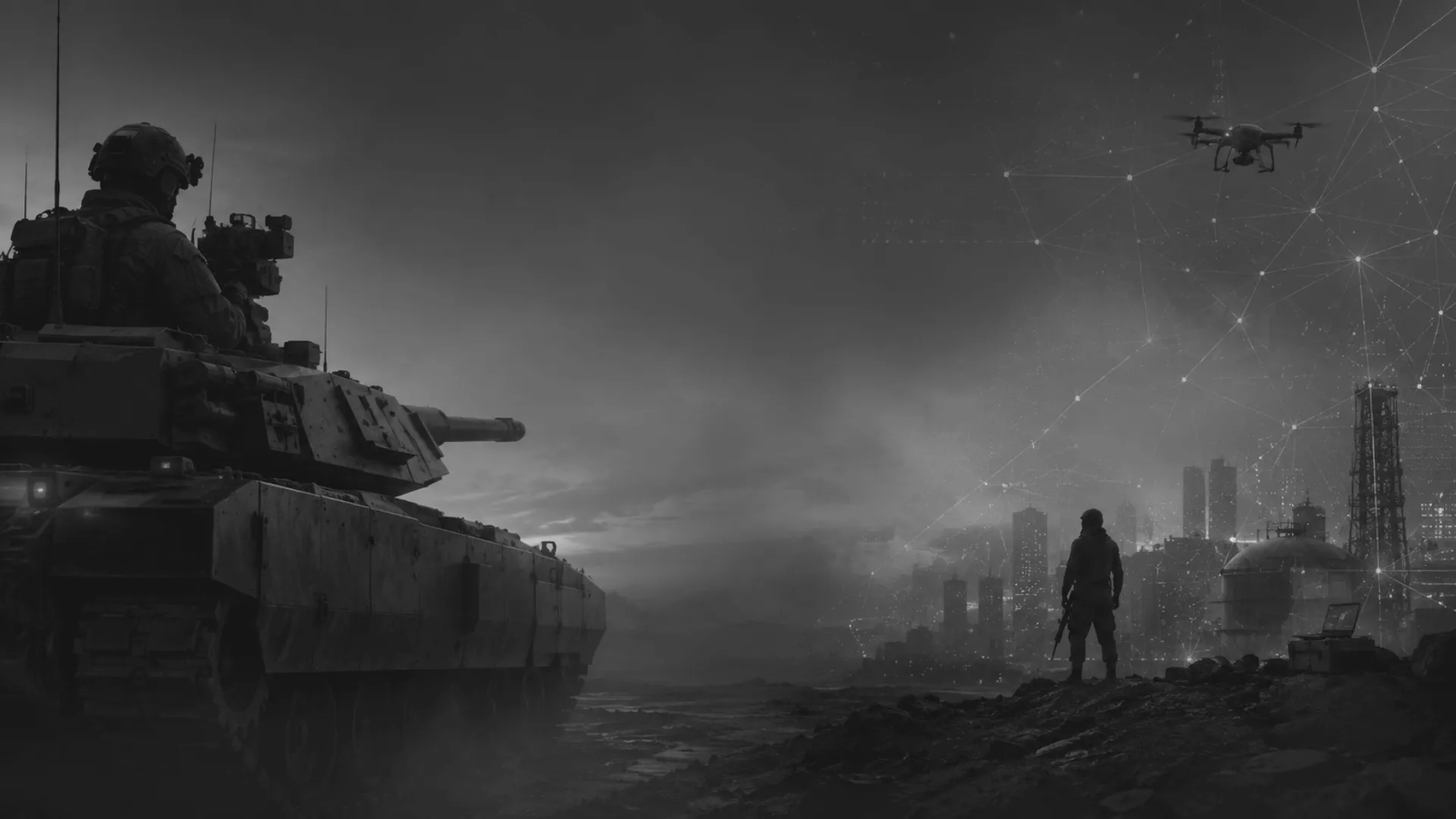
Image Source: ChatGPT
Tags
- #asymmetric warfare
- #cyber warfare
- #drone warfare
- #grey zone warfare
- #hybrid warfare
- #India national security
- #modern warfare
- #proxy warfare
Author
Priyal Jain
Priyal Jain is a former Indian Air Force Flying Cadet having rigorously trained for 2 years at the National Defence Academy. In addition to her core experience in the security, defence, and strategy domain, she is also an avid learner of Economics, Geopolitics and International Relations. She currently progresses in the field of public policy, consultation and strategy design.