
Badr Defence Agreement: Pakistan Building a New Defence-Industrial Network with Türkiye, Qatar and Indonesia
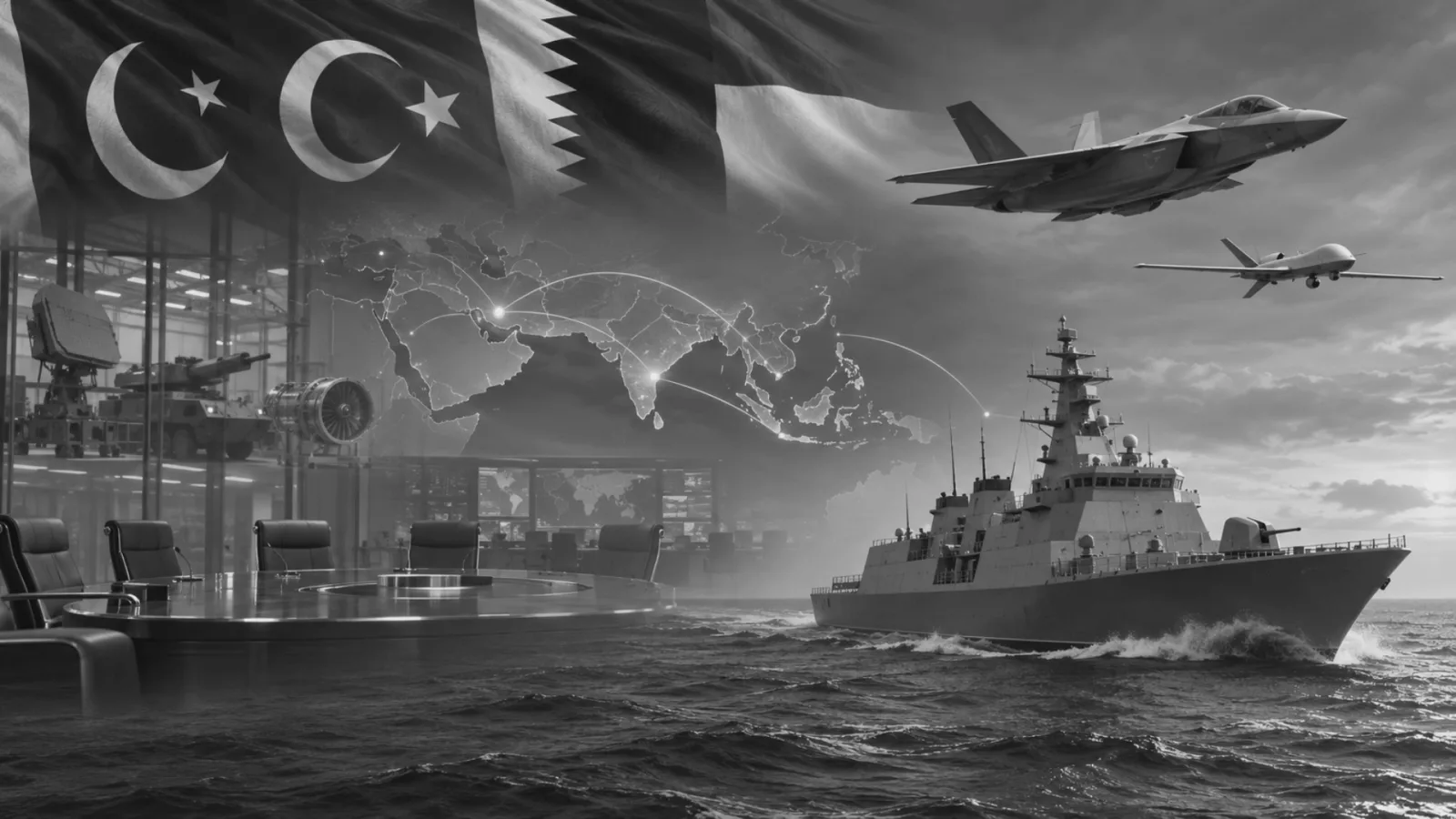
The four-nation agreement goes beyond conventional military procurement, raising questions about Pakistan's defence-industrial ambitions, Türkiye's expanding strategic influence and the implications for India's regional security environment.
The Development
Pakistan, Türkiye, Qatar and Indonesia signed the Badr Memorandum of Understanding (MoU) in Doha on 21 October 2026, establishing a multilateral framework for cooperation in defence manufacturing, technology transfer, research and development, and technical training. The agreement was signed by Pakistan's Defence Minister Khawaja Muhammad Asif, Türkiye's Defence Minister Yaşar Güler, Qatar's Deputy Prime Minister and Minister of State for Defence Affairs Sheikh Saoud bin Abdulrahman Al Thani, and Indonesia's Deputy Defence Minister Yusuf Jauhari. Pakistan's defence production establishment and Türkiye's Presidency of Defence Industries are also associated with the framework, indicating that its principal focus lies in industrial collaboration rather than conventional military coordination. The participating governments intend to pool their respective capabilities to develop defence technologies, strengthen domestic manufacturing and potentially supply military equipment to allied and friendly countries.¹
The agreement represents an attempt to institutionalise cooperation among four countries with different defence-industrial strengths and strategic priorities. Indonesia's Ministry of Defence identified three principal areas of cooperation: research, development and technology transfer; industrial collaboration and manufacturing; and human-resource development. Its statement also referred to financing, engineering capabilities and the strengthening of defence supply chains. Pakistan has similarly emphasised joint production, technology transfer and greater defence-industrial self-reliance.² Nevertheless, the publicly available announcements do not identify specific weapons programmes, committed investments or production schedules. Badr remains a framework for future industrial cooperation rather than evidence of an already operational multinational defence manufacturing consortium.
Beyond Defence Procurement: The Strategic Logic of Badr
The significance of Badr lies in its potential to move participating countries from bilateral procurement relationships towards a more interconnected defence-production network. Türkiye brings considerable experience in developing unmanned aerial systems, naval platforms, armoured vehicles, precision-guided weapons and defence electronics. Pakistan possesses established defence production facilities, particularly in conventional weapons, munitions, aircraft manufacturing and maintenance, while Indonesia has substantial shipbuilding, aerospace and defence-manufacturing ambitions. Qatar's potential contribution is more closely associated with financing, investment and defence-industrial partnerships. Although these capabilities are not necessarily interchangeable, their combination could allow participating countries to distribute manufacturing responsibilities, share development costs and pursue systems that would be more expensive to develop independently. The economic logic is particularly important because multinational production arrangements can provide economies of scale, larger export markets and more resilient supply chains.
For Türkiye, the initiative is consistent with its wider ambition to expand the international reach of its defence industry through partnerships involving local production and technology sharing. Ankara has already demonstrated the commercial and strategic value of this approach through its existing partnerships with Pakistan and Indonesia. The Pakistan Navy's MILGEM corvette programme, initiated in 2018, envisaged the construction of four warships, with two built in Türkiye and two in Pakistan, providing a practical example of bilateral industrial cooperation involving local production.³ Similarly, Türkiye and Indonesia signed a contract in July 2025 for 48 Turkish-developed KAAN fighter aircraft, incorporating provisions intended to support Indonesian industrial participation and technological capacity building.⁴ These existing arrangements make Badr more consequential than an entirely new diplomatic initiative, since it could build upon industrial relationships that already have procurement and production foundations.
However, multinational defence production is considerably more complicated than combining the financial and technological resources of participating countries. Technology ownership, intellectual property, export restrictions, third-country components and differing military requirements could constrain the scope of cooperation. Türkiye's own defence programmes remain dependent on foreign technologies in certain critical areas, while Indonesia and Pakistan have distinct procurement priorities and strategic relationships. The ability of Badr to overcome these limitations will determine whether it becomes an effective industrial mechanism or remains a broad expression of political intent.
Pakistan's Defence-Industrial Calculus
For Pakistan, Badr offers an opportunity to diversify defence-industrial partnerships without necessarily reducing its strategic dependence on China. Beijing remains central to Pakistan's military modernisation through combat aircraft, naval platforms, air defence systems and other major capabilities. However, dependence on a dominant supplier can create limitations in technology access, industrial autonomy, maintenance and the availability of alternative equipment. Closer cooperation with Türkiye and other partners could give Islamabad greater flexibility to acquire technologies, negotiate local production arrangements and expand its defence manufacturing capacity. The objective would not necessarily be to replace Chinese systems, but to develop additional technological and industrial options alongside them.
This distinction has particular relevance for India's assessment of Pakistan's military capabilities. Pakistan's long-term ability to sustain military operations depends not merely on the sophistication of imported platforms but also on its capacity to produce, maintain, repair and replenish equipment. Collaborative manufacturing and technology transfer could gradually improve this capacity, particularly if future agreements concentrate on expendable weapons, unmanned systems, electronic warfare equipment or components that can be manufactured domestically. These are potential areas of cooperation rather than confirmed Badr projects. Their significance would arise from the possibility of improving Pakistan's industrial depth and reducing the time required to replace equipment consumed or lost during military operations.
Badr also needs to be understood alongside the separate Makkah Joint Defence Agreement signed by Pakistan, Türkiye and Saudi Arabia on 7 August 2026. That agreement contains a collective-defence provision under which an armed attack against one signatory is treated as an attack against all three.⁵ Unlike Makkah, Badr establishes no publicly announced mutual-defence obligation. Nevertheless, the two agreements reflect a broader pattern of intensifying defence relationships involving Pakistan, Türkiye and important Gulf partners. If these arrangements mature independently, Pakistan could gain access to a wider combination of security partnerships, defence-industrial cooperation and financial resources. It would, however, be premature to interpret them as a single integrated military alliance.
Strategic Implications for India
India's principal concern should not be the emergence of an immediate four-country military bloc, but the possibility of Pakistan gradually expanding its defence-industrial options through external partnerships. If Badr produces meaningful technology transfers and manufacturing projects, it could strengthen Pakistan's ability to develop or locally manufacture selected military systems while broadening its network of defence suppliers. Such developments would matter particularly in technologies where production scalability, replacement rates and cost are as important as platform performance. India would therefore need to examine the actual industrial outcomes of Badr, especially any agreements concerning drones, precision-guided munitions, naval systems, defence electronics and maintenance infrastructure, rather than assess the initiative solely through its political symbolism.
Indonesia's participation introduces a more complex diplomatic dimension. Jakarta maintains a substantial defence relationship with India and signed agreements in July 2026 involving the BrahMos missile system and air-to-air missile cooperation.⁶ Furthermore, India and Indonesia commenced the eleventh edition of their joint special forces exercise, Garuda Shakti, on 27 October 2026, only six days after the signing of Badr.⁷ Indonesia's participation in the quadrilateral framework should therefore not automatically be interpreted as an alignment against India. Instead, it reflects Jakarta's preference for diversified defence partnerships that support its military modernisation and domestic industrial development. For New Delhi, the practical challenge will be to distinguish Indonesian industrial cooperation with Pakistan from any actual transfer of sensitive capabilities or technologies that could affect India's security interests.
There is also a broader implication for India's defence diplomacy. Türkiye is developing partnerships across several regions through a combination of defence exports, technology cooperation and strategic engagement, while Pakistan is attempting to use these relationships to widen its military and industrial options. India cannot assume that its bilateral defence partnerships will prevent partner countries from simultaneously engaging with Pakistan. Maintaining technological competitiveness, developing reliable export relationships and strengthening defence-industrial cooperation with countries such as Indonesia will therefore remain important components of India's regional strategy.
CNAWS Assessment
The Badr agreement should be viewed as an early attempt to establish a geographically dispersed defence-industrial partnership linking South Asia, West Asia and Southeast Asia. Its immediate military implications are limited because the agreement has not publicly produced identifiable joint weapons programmes, production commitments or operational integration arrangements. Its longer-term significance, however, lies in the possibility of creating institutional mechanisms through which financing, technological expertise, manufacturing capacity and defence exports can be coordinated across participating countries.
The decisive indicators will be the announcement of specific joint-development projects, the establishment of industrial joint ventures, allocation of financing, localisation of manufacturing, technology-transfer arrangements and the involvement of additional countries. Qatar's official announcement explicitly leaves open the possibility of other friendly states joining the framework with the consent of its existing members.⁸ Expansion alone would not demonstrate military effectiveness, but the appearance of funded production programmes and identifiable industrial responsibilities would indicate that Badr is moving beyond diplomatic cooperation.
For India, the more consequential development would be a measurable improvement in Pakistan's defence-production capacity rather than the number of countries associated with the agreement. Badr does not yet constitute a new military alliance, nor does it demonstrate an immediate shift in the regional military balance. Nevertheless, the initiative warrants sustained monitoring because defence-industrial integration, if successfully implemented, can generate military advantages that become apparent only over time.
Endnotes
Qatar News Agency, "Qatar, Indonesia, Pakistan, and Turkiye Sign Badr MoU to Promote Defense Industries Cooperation," October 21, 2026.
Ministry of Defence, Republic of Indonesia, "Indonesia Kembalikan Langkah Strategis Industri Pertahanan Lewat Penandatanganan MoU Quadrilateral 'Project Badr' di Doha," October 22, 2026; Radio Pakistan, "Pakistan, Qatar, Indonesia, Turkiye Sign 'Badr' MoU," October 21, 2026.
Ministry of Foreign Affairs, Government of Pakistan, "Visit of Vice President of the Republic of Turkiye to Pakistan," August 1, 2023.
Ministry of Defence, Republic of Indonesia, "Menhan RI Saksikan Penandatanganan Kontrak Pengadaan 48 Pesawat Tempur KAAN," July 28, 2025.
Ministry of Foreign Affairs, Government of Pakistan, "Makkah Al-Mukarramah Summit for Joint Defence," August 7, 2026.
Cabinet Secretariat, Republic of Indonesia, "Indonesia, India Strengthen Strategic Partnership Through 16 Cooperation Agreements," July 7, 2026.
Ministry of Defence, Government of India, "India–Indonesia Joint Special Forces Exercise Garuda Shakti Commences at Banyuwangi, Indonesia," Press Information Bureau, October 27, 2026.
Qatar News Agency, "Qatar, Indonesia, Pakistan, and Turkiye Sign Badr MoU to Promote Defense Industries Cooperation," October 21, 2026.
Tags

Author