Department of Strategic Foresight & Scenario Planning · Detailed Reports · space and strategic technologies ·
Tracking China's Space Activities: 12th - 19th September, 2026
Dear Reader,
The week ending 19 September opened with a jolt: Washington publicly acknowledged that it has “on-orbit space control weapons”, without revealing their nature or capabilities. Beijing lost no time in responding, urging the US to halt what it called the militarisation of space. The announcement does not, by itself, establish a violation of the 1967 Outer Space Treaty, which prohibits nuclear weapons and other weapons of mass destruction in orbit but does not broadly ban conventional orbital weapons.
Meanwhile, China maintained a busy launch schedule. Between 17 and 19 September, it completed three orbital missions in quick succession: a Long March 12 and a Kuaizhou-11 launch on the 17th, followed by a Long March 2D launch on the 19th.
Here’s the week, in order.
US confirms weapons in orbit
US Air Force Secretary Troy Meink said the United States has fielded on-orbit space control weapons capable of defending the Joint Force against hostile adversary action,” without detailing what the weapons are or how they work. A Space Force spokesperson tied the move to what it characterized as adversary weapons testing by Russia and China, treating space as an active warfighting domain. (Air, Space & Cyber Conference Youtube channel. 15 Sep 2026. Full Keynote: Advancing Combat Power in Air and Space. (National Public Radio. 16 Sep 2026)
The announcement was in line with President Trump’s broader space policy of recent years, arriving amid what some experts are calling a second space race, and follows his administration’s “Golden Dome” missile-defense push.
Beijing and Moscow’s Sharp Reaction to Washington
Beijing reacted spontaneously to the news. Chinese Foreign Ministry spokesperson Guo Jiakun, in a regular media briefing while giving response to a question on the US Space Force claiming to possess in-orbit space weapons, urged US to Halt Space Militarization. He reaffirmed China’s commitment to the peaceful use of outer space and its opposition to weaponizing the domain. Guo urged the US to “stop preparing for war” in space, while Russia’s Kremlin spokesman Dmitry Peskov said Moscow was “counting on broad international consolidation to continue working toward the complete demilitarisation of space.” Analysts noted the disclosure largely confirmed what had long been an open secret in the field , but that the timing risked deepening tensions with Beijing and raising the odds of an orbital arms race. (CGTN. 15 Sep 2026.) China urges US to stop expanding military buildup in outer space. Kyiv Post. 15 Sep 2026.) Russia Says Space ‘Must Be Free From Any Weapon’)
With no comprehensive legal framework governing military activity in orbit, this exchange is less about new capability and more about a shift toward open acknowledgment - one that raises the stakes for how China, and eventually other countries calibrate their own responses.
Hainan turning into a Space Hub
A South China Morning Post piece by reporters Wency Chen & Mia Nurmamat profiled how China’s rocket boom is reshaping Hainan province, where factories, supercomputing centres, and satellite firms are clustering around the Wenchang commercial spaceport as officials try to build a full aerospace ecosystem beyond tourism. The article highlights that two more launchpads are under construction and are likely to be operational by end of this year. Hainan’s strategy also explores building a superfactory which can produce 1,000 satellites annually, including the Qianfan series. This will be Asia’s largest satellite manufacturing facility. The ultimate aim as Ye Shiyang, Chairman of the holding company of Aerospace Supercomputing Centre, puts it, is to gain a larger share of the post-launch value chain - receiving, processing and trading satellite data. (SCMP. 17 Sep 2026.) China’s rocket boom has made Hainan a space hub. Can launches fuel wider growth?)
Hong Kong eyes space-sector IPOs
In a related development, Hong Kong’s stock exchange signalled it will examine listing-rule changes to attract space-sector IPOs, aligning the city’s capital markets with Beijing’s push to build a strong aerospace nation. The plan was announced as part of Hong Kong's first five-year plan aligning with Beijing's broader 15th five-year plan.(SCMP. 17 Sep 2026.) China’s rocket boom has made Hainan a space hub. Can launches fuel wider growth?)
Reusability of rockets remains the gap
Another SCMP piece examined China’s progress on reusable rockets — an area where, despite recent booster-recovery breakthroughs on land and at sea, China has yet to actually reuse a recovered booster, unlike SpaceX, which has flown boosters over 600 times. The gap illustrates where Beijing’s ambitions still trail Washington’s, even as China closes ground elsewhere.(SCMP.18 Sep 2026.) SpaceX might have a head start in reusable rockets, but Chinese commercial space companies are exploring ways to catch up in the cost-saving tech.
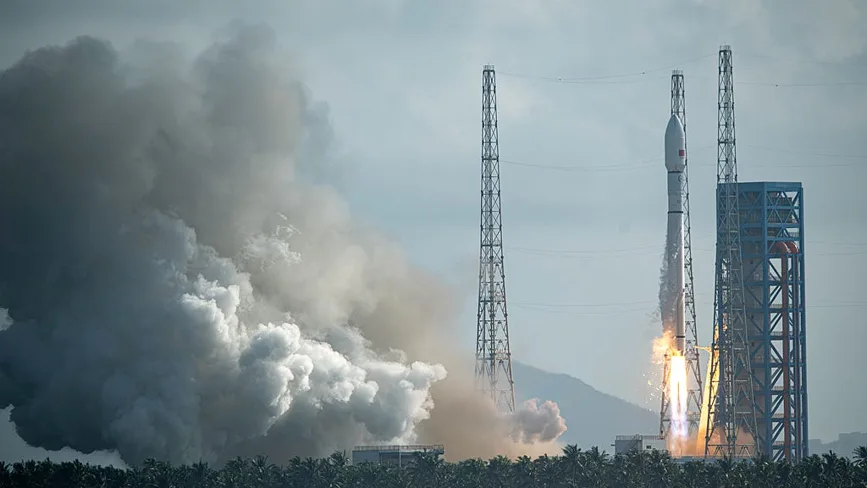
China launches a Long March-12 carrier rocket from the southern island province of Hainan, China, September 17, 2026. /VCG
Launch of 25 LEO Satellites
A Long March-12 rocket successfully launched 25th batch of nine guowang satellites into the LEO on 17 Sep 2026. The article highlights the parameters of Long March-12 as a single core rocket with a four meter diameter, 62 metres length and a payload capacity of 6 metric tons for 700 km sun-synchronous orbit. (CGTN 17 Sep 2026.) China launches new internet satellite group. (ST Daily. 17 Sep 2026. Page 3.) Long March-12 Rocket successfully launches 25th Batch of LEO Internet Satellites(长征十二号火箭成功发射卫星互联网低轨25组卫星))
Launch of Tianyi 51 and 52 satellites
A Kuaizhou-11 rocket launched from Jiuquan satellite launch centre on 17 Sep 2026, successfully inserted Tianyi 51 and 52 satellites into orbit. (PLA Daily. 19 Sep 2026. Page 3.) Tianyi 51 and 52 satellties successfully launched (我国成功发射天仪51、52星)
The week’s headline story was more on Washington’s admission on space weapons and Beijing’s pointed reply, a reminder that the space race is as much about deterrence as it is about rockets. Underneath that, China’s launch cadence and industrial build-out kept moving at pace, with reusability still the one visible gap in an otherwise fast-closing field.
As always, I’d welcome your thoughts and ideas to help shape future editions. Until next week, keep looking up!
Happy reading!
Tags
- #China Space Program
- #Chinese Satellites
- #Hainan Spaceport
- #Long March 12
- #Reusable Rockets
- #Satellite Launches
- #Space Warfare
- #Tracking China's Space Activities
- #US China Space Race
Author