Department of Disruptive & Emerging Technologies · Explainers · Defence Technology ·
What is Space Warfare?
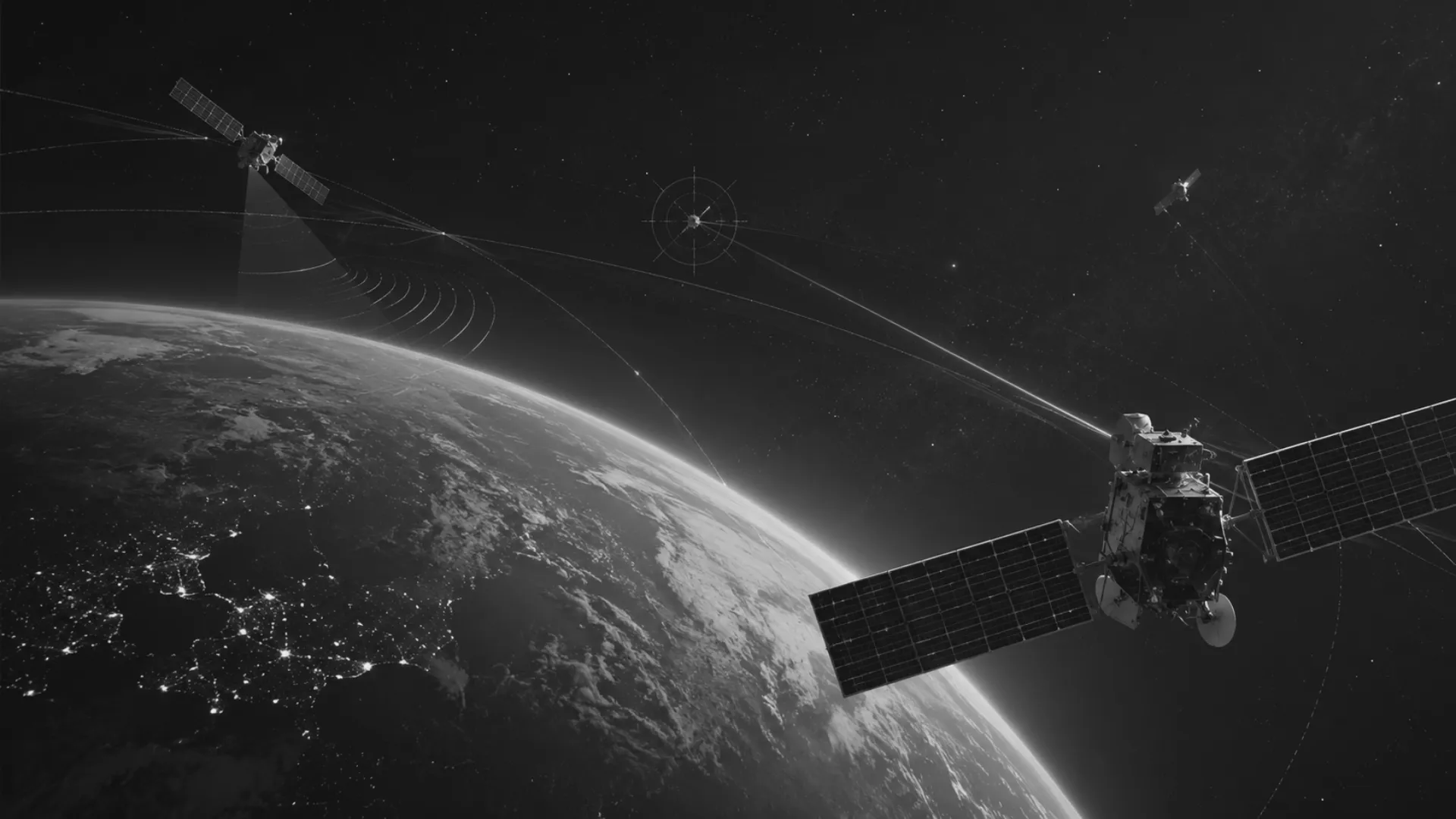
Outer space is no longer merely a support system for warfare on Earth; it is rapidly becoming a contested battlefield in its own right. From anti-satellite missiles and cyberattacks to GPS jamming, laser dazzling and autonomous orbital systems, states are developing capabilities to disrupt the satellites that underpin modern military operations and civilian life. This explainer examines the evolution of space warfare, the growing counterspace competition among major powers and why India must strengthen its doctrine, deterrence and space-defence architecture for conflicts that may extend far beyond the Earth’s surface.
What is Space Warfare?
Space warfare, literally, refers to the range of military and quasi-military activities conducted in, through, or against the outer space domain. These activities may be kinetic, electronic, cyber and directed-energy. The primary intent of such warfare practices is gaining, denying, or contesting an advantage in the orbits. The tactic can work in both offensive and defensive domains. As an offensive comrade, counterspace operations are designed to disrupt, deny, degrade, or destroy an adversary’s satellites and ground infrastructure. However, in the defensive and deterrent domains, measures are adopted to protect own space assets.
The capabilities can further be classified into “hard-kill” and “soft-kill”. The hard-kill capabilities include Direct-Ascent Anti-Satellite (ASAT) missiles and co-orbital interceptors that physically destroy a target. Whereas, the soft-kill capabilities include electronic jamming, cyberattacks, laser dazzling, and spoofing. These techniques temporarily disable or deceive a satellite without generating any space debris.[i] The most recent assessment of counterspace capabilities undertaken by The Secure World Foundation notes that thirteen countries are now pursuing at least some ability to attack adversary satellites. Although the findings also report that only non-destructive counterspace tools have been employed, thus far, in active military conflicts.[ii] It becomes important to consider that Space Warfare is an emerging space, comparatively less exploited, but a way larger paradigm. One who makes a large early leap, will be at heights beyond visual views.
Global Usage and the Contemporary Salience of Space Warfare
The prominence of tools crafted for communication, navigation, early warning, and intelligence, surveillance, and reconnaissance have explicit accounts. However, to add versatility, modern militaries depend on space-based assets for the aforementioned capabilities. This prudent dependence has transformed the orbital infrastructure. What was erstwhile, a passive support layer, is now modelled into a contested warfighting domain in its own right.[iii] The leaders in this game are the United States, Russia and China. They maintain an inventory of the most substantial counterspace arsenals, spanning direct-ascent missiles, co-orbital bodyguard satellites, and directed-energy systems. On the contrary, states like India, France, Japan, Israel, Iran, Australia and Germany are plotting their development briefly. Their focus lies in developing more limited but still consequential capabilities.[iv] The inference derived reflects that the radio-frequency jamming of navigation and communication signals has become especially widespread. This is due to the comparatively low cost and “reversible” nature of electronic interference relative to the destructive kinetic strikes.[v]
Connoting the Historical Trajectory of Space Warfare
The weaponization of space is not a novel phenomenon. It has been there, developing, openly, just not put into the limelight adequately. There are enough evidences that both the United States and the Soviet Union tested the rudimentary ASAT systems during the Cold War. The contemporary era transition of counterspace competitiveness, however, is marked by China’s January 2007 test. This test, remarkably destroyed the Fengyun-1C weather satellite at an altitude of roughly 865 kilometres, using a ground-launched kinetic-kill vehicle. This generated thousands of trackable debris pieces and resonated the threats of a “Space Pearl Harbour.”[vi]
Did India respond? Yes. At an interval of twelve years. Indian demonstration of Mission Shakti was conducted on 27th March 2019. It was when the Defence Research and Development Organization (DRDO) used a modified ballistic-missile interceptor to destroy the Microsat-R satellite in low Earth Orbit. This was deliberately conducted at a low altitude to hasten debris decay.[vii] This made India the fourth country to demonstrate and possess a kinetic ASAR capability.[viii] The question persists, whether in warfare arenas, soft and steady wins the race. More recently, Russia has delved into tactical evolution. It has pursued co-orbital rendezvous and proximity operations. These vastly include the prolonged geosynchronous manouevring of its Luch satellite. Strategically, the test was disclosed in February 2024, the same month of Ukraine invasion. Highlighting: it is an experimental satellite believed to be a nuclear-capable ASAT system.[ix]
Where is the Globe Heading
The nation states remain committed to investing in dynamic space operations, proliferated, disaggregated satellite constellations, and on-orbit servicing for this decade. The idea is to survive attack through redundancy and not hardening alone.[x] If we include the funding for the Golden Dome missile-defence architecture, then the United States Space Force’s fiscal year 2026 budget approaches a hefty forty billion dollars alone. This is more than double the service’s budget in its first year of existence. It serves as a reflection of a doctrinal shift toward treating space ecosystem as an active warfighting environment rather than a minimal support group. However, the robust growth of the Chinese Space Fleet underscores its ambition to displace the United States as the foremost space power. Its operational satellite fleet is reported to have more than one thousand and sixty spacecraft by mid-2025. Out of these, several are dedicated to intelligence, reconnaissance, and surveillance missions as well. Down the line, the growing eminence of bodyguard satellites, which will be capable of shielding high-value assets must be emphasized. This is a concept, not nascent, yet pursued by France, Japan, Germany, and India.
Space Operations in Practice
The war in Ukraine has been a testing ground for most counterspace operations thus far. Persistent jamming and spoofing Ukrainian and Commercial Satellite Communications by Russian Forces has not gone unnoticed. Repetitive attempts to disrupt Starlink terminals prompted SpaceX to issue urgent countermeasures which swept off the US Defence Officials. A cyberattack against the Viasat KA-SAT network disrupted Ukraine Military Communications. Notably, the timings coincided with the opening hours of Russia’s 2022 invasion. Hence, analysts link this event widely to Moscow. Additionally, Israel has also left its thumbprints in this domain. It has conducted multiple GPS jamming and spoofing to deter missile and drone threats from Iran and regional proxies. China, on the other hand, regularly attempts jamming attempts at satellite communications and navigation signals.
Strategic and Normative Implications
The implications carried by the proliferation of counterspace capability goes beyond the conventional battlefield. If a kinetic ASAT is launched, it generates a long-lived orbital debris. This is a potential threat for civilian satellites and crewed spacecraft alike, hence manifesting as a collective-action problem. In this, the security gains of a single state impose diffuse costs on the entire spacefaring community.
Moreover, generic civilian economy resides at the behest of positioning, navigation, and timing services. These services are expunged by the satellite systems, which are the eventual targets of the space warfare tactics. This means that a conflict extending into orbit could produce cascading disruptions to sectors far away from national defence.
Critical Relevance for India
India has not kept space warfare capabilities at the periphery; it has knit the domain closely into the core circuit of national security planning. 2019’s Mission Shakti was a clear signal at both technical capability and strategic intent. However, it is also true that the test is a comma, not a full stop,[xi] as remarked by various analysts. India’s space domination is well-renowned, the challenge remains in its optimum utilization, rightly, at the right time.
The Chief of Defence Staff announced in 2024 the release of a dedicated military space doctrine. It was later, unveiled as the Joint Military Space Doctrine in September, 2025. India has also hosted simulated space-warfare exercises, like the infamous, IndSpaceEx. It is cohesively designed to war-game threats, both to and from space-based assets, and also enlighten the pathway to doctrinal discourses and development.
India is actively progressive on its capability enhancement part. The Defence Research and Development Organisation is developing non-kinetic counterspace tools. These will include directed-energy weapons, cyber and electronic warfare system; the necessities of shifting warfare paradigms. These projects will be undertaken alongside the ongoing Space Based Surveillance program. This program envisages a launch of fifty-two additional military communication and surveillance satellites between 2025-2029.[xii] India presently uses its Network for Space Objects Tracking and Analysis to monitor thirty-four thousand trackable objects in the Earth orbit. This substantiates the country’s expanding space situational awareness and its dexter in the domain.[xiii]
These trends occur in light of the strategic relationships being built by India, including its space security cooperation with other nations in the Quadrilateral Security Dialogue framework and its participation in the Global Sentinel training exercise of the US Space Command, despite India’s emphasis on a defensive and responsible approach, as evidenced by its behavior during Mission Shakti. Considering the fast-expanding satellite constellation and counterspace capabilities of China and the increasing collaboration of Pakistan in space technology with China, the Indian policy-makers see credible counterspace deterrence, alongside its ballistic missile defence and cyber capabilities, as critical for protecting its military and civilian systems dependent on satellites.[xiv]
Conclusion
War in space has shifted from mere speculation to actual reality owing to the war in Ukraine, continuous testing by both great and middle powers, and rapid integration of artificial intelligence into the orbiting war systems. With space shifting from being an environment for the conduct of war between two great powers in the Cold War era to becoming a multipolar environment where over a dozen countries have counterspace aspirations, the significance of this struggle in terms of strategy, economy, and norms can only be expected to rise further.
Endnotes:
[i] Quentin Verspieren, “Killing Them Softly: China’s Counterspace Development and Force Posture in Space,” Journal of Strategic Studies, 2024, published online 2025
[ii] Secure World Foundation, “2026 Global Counterspace Capabilities Report” (Broomfield, CO: Secure World Foundation, 2026)
[iii] Julia Thompson, “The Advancement of Space Warfare”, Royal Military College Review, December 3, 2025.
[iv] Theresa Hitchens, “As More Nations Seek Counterspace Chops, GPS Jamming Also Rises: Report,” Breaking Defence, April 8, 2026
[v] Theresa Hitchens, “As More Nations Seek Counterspace Chops, GPS Jamming Also Rises: Report,” Breaking Defence, April 8, 2026
[vi] Alex Carter, “Space Warfare 2026: The Space Force Just Got $40 Billion to Prepare for Combat in Orbit,” Military Machine, April 11, 2026.
[vii] Adhyayan Foundation for Policy and Research, “The New Space Race: India’s ASAT Capability and the Militarization of Outer Space,” 2025.
[viii] Dimitrios Stroikos, “India’s Space Policy: Between Strategic Autonomy and Great-Power Partnership,” Council on Foreign Relations, 2025.
[ix] Kari A. Bingen, “Extending the Battlespace to Space,” in CSIS Defence Outlook 2026 (Washington, DC: Centre for Strategic and International Studies, 2025), chap. 8.
[x] Defence News Staff, “Space Warfare in 2026: A Pivotal Year for US Readiness,” Defence News, February 23, 2026.
[xi] Ajay Kumar, “Space as the Next Battlefield: Bharat’s Evolving Military Space Strategy Post-ASAT,” Swadeshi Shodh, August 13, 2025.
[xii] Universal Institutions, “Upgrading Mission Shakti: India’s ASAT Space Defence,” July 23, 2025.
[xiii] “Space Militarisation: Strategic Challenges and Policy Responses,” IMPRI Insights, 2026.
[xiv] The Geostrata, “Beyond Earth: Future of India’s Space Defence Strategy,” July 13, 2025.
Tags
- #Anti-Satellite Weapons
- #Counterspace Capabilities
- #Future of Warfare
- #India Space Defence
- #India Space Security
- #Military Space Technology
- #Satellite Warfare
- #Space Militarisation
- #Space Security
- #Space Warfare
Author
Priyal Jain
Priyal Jain is a former Indian Air Force Flying Cadet having rigorously trained for 2 years at the National Defence Academy. In addition to her core experience in the security, defence, and strategy domain, she is also an avid learner of Economics, Geopolitics and International Relations. She currently progresses in the field of public policy, consultation and strategy design.