
China and Pakistan's Espionage Trap on LinkedIn and India's Security Blind Spot
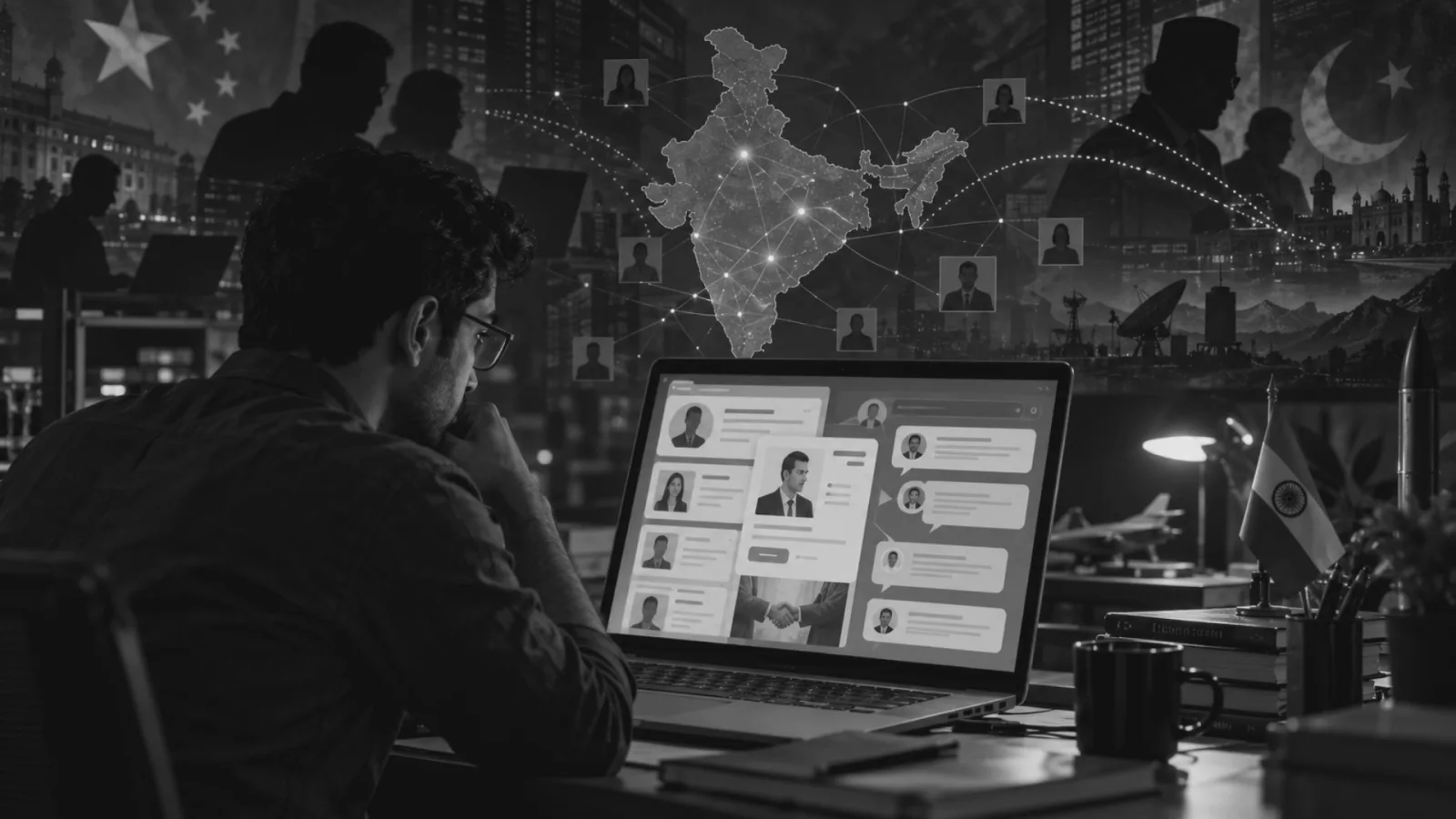
The suspected espionage case involving an Indian Army officer's wife exposes a wider vulnerability in India's national security ecosystem. Foreign intelligence recruitment is increasingly disguised as legitimate research, consultancy and professional employment.
The espionage investigation involving the wife of a serving Indian Army officer in Jammu has brought attention to a threat that extends well beyond the armed forces. On 16 October 2026, Jammu and Kashmir Police reportedly registered FIR No. 290/2026 at Gandhi Nagar Police Station following allegations that the woman had collected and shared sensitive information with individuals suspected of links to foreign intelligence agencies, including China. The woman, reportedly a freelance researcher from Telangana married to an Army Major, was questioned by investigators. She had not been arrested as of 19 October, and the allegations remain under investigation.
According to The Indian Express, investigators suspect that the woman came into contact with a Malaysian national running a consultancy allegedly linked to Chinese intelligence in 2024. She was reportedly commissioned to prepare papers concerning geopolitics, Line of Control dynamics, infrastructure development in Arunachal Pradesh and drone deployments. Sources claimed that she received approximately ₹5 lakh, with payments reportedly amounting to $200 per article. Other reports suggested that suspected Chinese operatives initially approached her as academicians, commissioning general research before gradually introducing defence-related subjects.
However, these details require careful qualification. While the registration of an FIR and questioning have been corroborated through police and military sources cited by multiple publications, the alleged Chinese intelligence connections, the reported payments and the nature of the information exchanged have not been independently established in publicly available evidence. The Indian Express also reported that investigators had found nothing incriminating in her writings at that stage. Whether classified information was actually transmitted, and whether the woman knowingly assisted a foreign intelligence service, remains unproven. Reports also differ over the precise provisions of the Official Secrets Act invoked in the FIR.
Nevertheless, the alleged recruitment pattern closely resembles a considerably broader counterintelligence threat. Chinese and Pakistani intelligence operatives are exploiting digital communication and professional networking platforms to identify individuals possessing valuable knowledge, institutional connections or indirect access to sensitive information. LinkedIn is particularly attractive because professional profiles voluntarily disclose expertise, previous employment, research interests and organisational affiliations.
Through the author's own observations of suspected foreign intelligence approaches, several recurring methods have emerged. Indian researchers, academicians, think-tank employees, students, retired defence personnel and independent analysts are contacted by individuals presenting themselves as representatives of established corporate intelligence firms, media organisations or research institutions. Initial assignments generally concern relatively innocuous subjects such as geopolitics, domestic politics, protests and regional developments. Payments have been observed originating from both offshore and domestic accounts.
The significance lies in how these relationships evolve. Once a prospective recruit demonstrates competence and reliability, subsequent assignments may become increasingly focused on strategic or tactical matters. Individuals with relevant personal connections may be encouraged to obtain exclusive assessments, unpublished information or insights unavailable through ordinary research. What initially appears to be legitimate freelance employment can gradually become an intelligence collection arrangement.
This is not merely a theoretical concern. In June 2026, the Five Eyes intelligence partnership publicly warned that Chinese intelligence officers were impersonating recruiters and consultants associated with seemingly legitimate companies on professional networking and employment platforms. The warning described the progression from routine analytical assignments to requests for privileged information. Pakistan-linked espionage investigations have likewise established the use of social media and intermediary networks, although the precise scale of Pakistani operations specifically on LinkedIn remains unquantified.
More concerning are the increasingly indirect recruitment arrangements identified by the author. In one observed case, individuals suspected of acting for Chinese intelligence approached the head of a small research centre and convinced him that he was undertaking legitimate work for an established organisation. He was subsequently tasked with recruiting individuals possessing expertise in maritime security. In another case, a suspected Chinese intelligence contact recruited an Indian human resources professional, who was then expected to identify and hire specialists on behalf of an apparently reputable firm.
These arrangements introduce an additional layer of separation between the intelligence collector and the eventual source. The person approaching a researcher may genuinely believe that the employment opportunity is legitimate. Consequently, checking only the recruiter's personal credibility may prove insufficient.
The author has also observed suspicious recruitment approaches through email. Some involved addresses resembling those of genuine firms and think tanks, occasionally differing by a single character. Others appeared to use independently operated or rented mail infrastructure rather than the organisation's recognised communication domain. Suspicious WhatsApp accounts were also encountered, including numbers apparently registered through third-party verification services. Such techniques can complicate attribution, although they do not make communications inherently untraceable. Importantly, these observed indicators alone cannot conclusively establish that every account belongs to a Chinese or Pakistani intelligence operative.
The cumulative danger is that foreign intelligence collection does not necessarily begin with a request for classified documents. Individually unremarkable observations about defence establishments, operational routines, infrastructure projects or personnel movements can become valuable when combined with other information. A person may inadvertently contribute to an adversary's intelligence picture without understanding the eventual application of their work.
The first line of defence must therefore be individual awareness and verification. Before accepting freelance assignments or employment offers, applicants should independently investigate the organisation, examine its website and operating history, and verify that the recruiter's email domain corresponds to an officially published organisational domain. Similar-looking domains, unverifiable recruiters and unexplained payments from unrelated accounts warrant scrutiny. Even a matching email domain is not sufficient proof of legitimacy without independent confirmation.
Job seekers should avoid applying indiscriminately to LinkedIn advertisements, particularly those promising unusually attractive remuneration for loosely defined geopolitical or defence-related analysis. Every unusual research request should prompt a basic question. Could the requested information, either independently or combined with other intelligence, assist a foreign adversary? Genuine academic inquiry must not be confused with espionage, but requests for non-public details, privileged contacts or sensitive operational information should be treated differently.
India also requires a substantially more ambitious public counterintelligence awareness campaign. The government should employ television advertisements, radio broadcasts, digital websites, YouTube campaigns, social media messaging and even mobile caller tunes to explain how hostile recruitment approaches operate. Such messaging should use realistic examples of fraudulent consultancy assignments, impersonated recruiters, suspicious communications and progressive information extraction.
Particular attention must be directed towards the families of armed forces personnel, Central Armed Police Forces, police officers and intelligence professionals. Spouses and children may possess fewer formal security restrictions despite having proximity to individuals engaged in sensitive responsibilities. Contractors and employees associated with defence manufacturing, space missions, strategic infrastructure and emerging technologies require equally focused awareness initiatives.
Security briefings should extend beyond serving officials to their families and relevant civilian partners. Universities, think tanks and research organisations should introduce practical verification and reporting procedures. Suspicious approaches should be preserved as evidence and reported through appropriate institutional security channels or law enforcement, rather than dismissed as ordinary online fraud.
Ultimately, the Jammu investigation should not be treated as proof of guilt against an individual whose case remains unresolved. Its larger significance lies in the vulnerability it illustrates. Modern espionage increasingly operates through professional credibility, employment opportunities and seemingly legitimate intellectual exchange. India's counterintelligence response must recognise that protecting classified information is no longer sufficient. It must also protect the much wider community of people whose knowledge, relationships and professional ambitions can be exploited to obtain it.
Tags
Author
Mohit Vashisth
Mohit Vashisth is a Doctoral Research Fellow at Jindal School of International Affairs, O.P. Jindal Global University, Haryana, India. He was earlier associated with Max Security Solutions as a coordinator at Global Security Operations Centre (GSOC). At MAX, he was responsible for intelligence gathering, analysis, travel & security operations, and risk mitigation on a global scale during routine and emergency. He also has three years of experience working in the renewable energy sector. He is an engineering graduate with a major in Electronics and Communications and holds a Master’s degree in Political Science and International Affairs. His research areas are critical and disruptive defence technologies, counter-terrorism and Open-Source Intelligence (OSINT).