

When Spies Get Hacked: The CIA–ODNI Breach and the Vulnerability of Open-Source Intelligence Infrastructure

The United States Central Intelligence Agency (CIA) and the Office of the Director of National Intelligence (ODNI) have reportedly suffered a cybersecurity breach affecting an unclassified network used for Open-Source Intelligence (OSINT) analysis. Preliminary accounts indicate that classified networks and critical intelligence capabilities were unaffected. However, the nature and extent of the information potentially exposed, the duration of unauthorised access and the identity of the perpetrators remain unclear. Investigators reportedly suspect the involvement of an artificial intelligence-enabled cyber intrusion framework, although this has not been officially established.
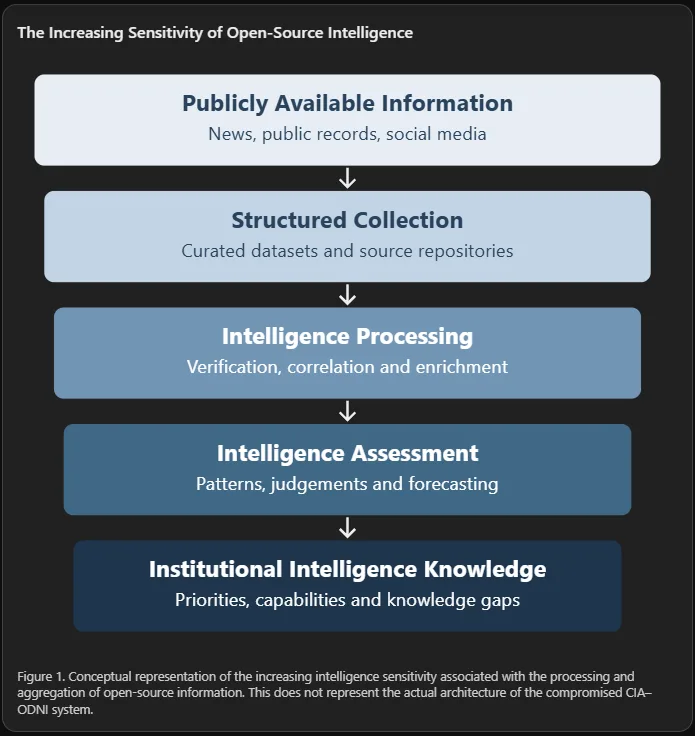
The incident highlights a fundamental vulnerability in contemporary intelligence architecture. While OSINT relies on publicly and commercially available information, the processes through which intelligence agencies collect, organise, correlate and interpret that information can themselves constitute sensitive intelligence. Compromising such infrastructure could potentially expose intelligence collection priorities, analytical methodologies, institutional capabilities and knowledge gaps without requiring access to classified information.
The incident also raises broader questions concerning the integrity of intelligence products generated through automated collection and AI-enabled analytical platforms. For India, where the expansion of OSINT capabilities across military, intelligence and law enforcement institutions is becoming increasingly important, the breach demonstrates the need to treat OSINT infrastructure as mission-critical intelligence infrastructure rather than conventional information aggregation systems.
The Development
On 24 November 2026, reports emerged that the CIA and ODNI had discovered a cybersecurity breach affecting an unclassified intelligence analysis system. The compromised infrastructure was reportedly used to process and analyse publicly available information (PAI) and commercially available information (CAI), including material derived from digital media, commercial satellite imagery and other external information providers. Preliminary assessments indicated that the breach caused disruption within the affected environment but did not compromise classified networks or classified information.¹
Subsequent reporting on 25 November suggested that the National Geospatial-Intelligence Agency (NGA) may also have been affected. Investigators reportedly suspect that the perpetrators employed an AI-enabled cyber intrusion framework to facilitate the attack. However, the agencies involved have not publicly released a comprehensive forensic assessment establishing the initial intrusion mechanism, the extent of unauthorised access or the identity of the perpetrators. Reports suggesting a possible Chinese connection remain unsubstantiated by an official attribution.²
The incident follows a series of cybersecurity-related developments affecting American federal institutions, including the reported compromise of the Federal Bureau of Investigation's National Crime Information Center (NCIC). Separately, the US National Security Agency (NSA) experienced a disruption to its classified communications network, which American officials attributed to software maintenance rather than malicious cyber activity. There is presently insufficient evidence to establish that these incidents form part of a coordinated cyber espionage campaign.³
The significance of the CIA–ODNI breach lies less in the classification level of the affected information than in the nature of the infrastructure compromised. Unlike conventional government information systems, OSINT platforms are designed to maintain extensive interaction with external information environments while supporting sensitive intelligence requirements. This combination creates an inherent tension between information accessibility, operational effectiveness and cybersecurity.
1. The Strategic Vulnerability of Institutionalised OSINT
The breach assumes greater significance when examined against the growing institutional importance of OSINT within the US Intelligence Community (IC). On 8 March 2024, the CIA and ODNI jointly released the Intelligence Community OSINT Strategy for 2024–2026, identifying four strategic priorities: coordinated data acquisition and information sharing, integrated collection management, technological innovation, and the development of specialised analytical capabilities and tradecraft. The strategy recognised OSINT as a core intelligence discipline capable of generating independent intelligence assessments while supporting other collection disciplines.⁴
The institutionalisation of OSINT has consequently transformed it from a relatively decentralised collection activity into a sophisticated technological ecosystem encompassing automated collection platforms, commercial data subscriptions, geospatial intelligence applications, AI-enabled analytical tools and centralised knowledge repositories. While these developments have significantly increased the scale and speed of intelligence production, they have also concentrated sensitive information within interconnected digital environments.
The fundamental distinction is between the sensitivity of source information and the sensitivity of the intelligence process. A publicly available satellite image, social media post or government document may independently possess little intelligence value. However, the systematic collection of such information against specific intelligence requirements, its correlation with historical datasets and the identification of emerging patterns could generate considerable strategic value. Consequently, an OSINT repository may contain sensitive institutional knowledge despite being populated entirely through unclassified sources.
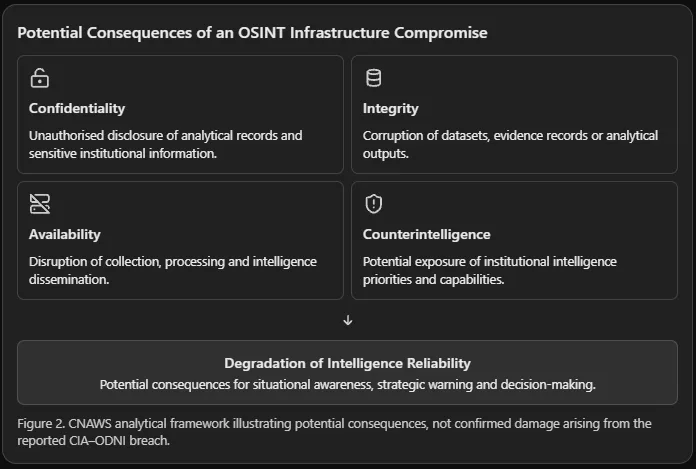
The compromise of an institutional OSINT platform must therefore be examined not merely as a cybersecurity incident involving publicly accessible information, but as a potential counterintelligence incident involving the exposure of intelligence priorities, methodologies and capabilities.
2. Intelligence on Intelligence: The Counterintelligence Dimension
One of the principal counterintelligence concerns associated with the CIA–ODNI breach is the potential exposure of information concerning the intelligence collection process itself. Institutional OSINT platforms may contain records of collection requirements, analytical queries, monitored entities, historical assessments, source evaluations and research priorities. Collectively, these records constitute intelligence about the activities and requirements of an intelligence organisation.
The strategic value of such information emerges through the aggregation of otherwise unclassified material. This is commonly associated with the mosaic effect, wherein individually innocuous information acquires greater sensitivity when combined with other datasets. The compromise of collection-management information could potentially reveal the geographical regions, military capabilities, technological developments and political organisations receiving sustained analytical attention.
Similarly, internal analytical records could expose the degree of confidence assigned to particular sources, the limitations of existing knowledge and areas where additional intelligence collection is required. Such information could have counterintelligence implications even in the absence of classified material. The compromise of analyst identities, institutional relationships or commercial data arrangements could also generate personnel security and operational security concerns.
The potential consequences would depend on which components of the intelligence system were affected and whether the perpetrators accessed, copied or modified sensitive records. There is presently no publicly available evidence establishing that the CIA–ODNI breach exposed collection requirements, analyst identities or internal assessments. These remain potential consequences requiring forensic investigation rather than confirmed outcomes.
3. AI-Enabled Cyber Espionage and the Compression of Defensive Response Windows
The suspected involvement of the ARTEX autonomous penetration-testing framework introduces another significant dimension to the reported breach. ARTEX is an open-source, Large Language Model (LLM)-driven platform originally developed for cybersecurity testing that has subsequently been misused by malicious cyber actors. Its suspected involvement in the CIA–ODNI incident remains unconfirmed.
On 13 November 2026, eleven days before the public disclosure of the intelligence system breach, the FBI issued a cybersecurity advisory concerning the malicious use of ARTEX. The advisory established that different cyber threat actors had employed the framework since at least August 2026 against organisations operating across government, defence, technology, telecommunications, financial services and other sectors.⁵
Of particular significance was the FBI's observation that AI-assisted operations had substantially compressed the time required to conduct cyber intrusions. In certain documented incidents, the period between initial targeting and the acquisition of privileged access was less than three hours. The advisory also identified approximately 1,600 publicly accessible instances of the framework by early November, illustrating its proliferation beyond its original development environment.
Indicator | FBI findings |
|---|---|
Malicious use documented since | August 2026 |
FBI advisory issued | 13 November 2026 |
Time to privileged access in some documented incidents | Under three hours |
Publicly exposed framework instances identified | Over 1,600 |
Individuals affected in documented South Korean financial-sector attacks | Approximately 67,000 |
Source: FBI FLASH-20261113-001, 13 November 2026. These figures concern previously documented ARTEX activity and are not statistics from the CIA–ODNI breach.
The strategic significance of agentic AI in cyber warfare lies primarily in its ability to increase operational speed, scale and persistence. AI-enabled systems can automate processes that previously required sustained human intervention, thereby reducing the time available to cybersecurity personnel to identify, investigate and contain malicious activity. This does not necessarily imply the emergence of fundamentally new cyber intrusion techniques. Rather, conventional vulnerabilities can become considerably more consequential when malicious activity occurs at machine speed.
For intelligence organisations, the challenge is particularly pronounced because cybersecurity incident response has traditionally depended on human-led investigation, escalation and authorisation procedures. The increasing speed of AI-assisted malicious activity requires defensive monitoring and containment capabilities capable of operating within substantially compressed response windows.
Moreover, the proliferation of AI-enabled cyber tools complicates attribution. Similar capabilities can be employed by state-sponsored intelligence organisations, criminal groups and independent malicious actors. The origin of a particular software framework does not independently establish the nationality or institutional affiliation of its users. Consequently, the suspected involvement of ARTEX cannot be treated as sufficient evidence of Chinese state involvement in the CIA–ODNI breach.
4. Beyond Intelligence Theft: The Threat of Analytical Manipulation
While the immediate concern surrounding the reported breach relates to unauthorised access and potential information exposure, a potentially more consequential threat concerns the integrity of intelligence datasets and analytical processes. Traditional cybersecurity frameworks distinguish between confidentiality, integrity and availability. Within intelligence organisations, however, the compromise of information integrity can have consequences extending beyond the affected computer system into strategic assessment and decision-making.
The increasing dependence of OSINT platforms on automated data collection, machine-assisted entity identification, analytical categorisation and AI-generated summarisation creates additional requirements for maintaining data integrity. Manipulated or corrupted information could introduce inaccuracies into intelligence repositories, which might subsequently be incorporated into analytical products or distributed across interconnected systems.
CNAWS previously examined a related dimension of this vulnerability in its 22 November 2026 SITREP concerning alleged manipulation of OpenStreetMap data relating to Arunachal Pradesh. That assessment identified the potential for changes to publicly accessible geospatial datasets to influence downstream information products and contribute to the normalisation of disputed territorial representations.⁶ Although the mechanisms involved in external cartographic manipulation differ from those associated with an internal cybersecurity breach, both developments highlight the importance of maintaining the integrity and provenance of information throughout the intelligence production process.
The integration of generative AI into intelligence platforms introduces additional concerns, including unreliable automated outputs, information contamination and the inappropriate treatment of externally sourced content as trusted information. The US National Institute of Standards and Technology (NIST) has similarly identified information integrity and information security as significant risk areas associated with generative AI systems.⁷
A particularly serious consequence could arise if corrupted information retains the appearance of a legitimate intelligence product. Institutional decision-makers may assign greater credibility to assessments originating from established intelligence platforms than to information encountered directly in public digital environments. The integrity of the platform therefore becomes inseparable from the credibility of the intelligence it produces.
There is currently no evidence that the CIA–ODNI breach involved deliberate data manipulation or interference with intelligence assessments. Nevertheless, determining whether affected datasets and analytical outputs remained unchanged should constitute an important component of the post-incident investigation.
5. The Architectural Paradox of Modern OSINT Platforms
Unlike intelligence environments that can operate within highly restricted networks, OSINT infrastructure requires sustained connectivity with external information sources. Contemporary platforms increasingly depend on social media services, commercial data providers, Application Programming Interfaces (APIs), cloud infrastructure, external software libraries and AI service providers. Each additional dependency introduces security requirements that extend beyond the immediate institutional network.
This creates an architectural paradox. An effective OSINT platform must remain sufficiently connected to acquire information from a constantly evolving digital environment while maintaining adequate separation between external information acquisition and sensitive internal analytical processes. Excessive restrictions could undermine collection effectiveness, whereas inadequate separation could expose institutional information and intelligence capabilities.
The adoption of centralised intelligence fusion platforms further complicates this problem. Centralisation can reduce duplication, improve information sharing and facilitate cross-domain analysis. However, it can also concentrate sensitive knowledge and create common dependencies across multiple organisations. The reported involvement of a system serving more than one American intelligence agency illustrates the importance of examining cybersecurity at the level of shared intelligence infrastructure rather than solely at the level of individual organisations.
Intelligence organisations must consequently adopt security architectures that distinguish between external collection environments, data-processing infrastructure, analytical workspaces and sensitive intelligence repositories. Access to one component should not automatically confer access to other institutional resources. Such an approach is consistent with zero-trust architecture principles, which reject implicit trust based solely on network location or organisational affiliation.⁸
Equally important is the maintenance of verifiable information provenance throughout the intelligence lifecycle. Preserving original source material, maintaining auditable transformation records and independently validating significant analytical conclusions can help intelligence organisations establish whether their products remain reliable following a cybersecurity incident.
6. Implications for India's Intelligence and National Security Establishment
The CIA–ODNI incident assumes particular relevance for India against the backdrop of growing domestic interest in automated OSINT collection, multi-source intelligence fusion, AI-enabled analysis and indigenous intelligence technology development. Military institutions, intelligence agencies, law enforcement organisations and private-sector national security establishments increasingly depend upon digital platforms to collect and process information concerning geopolitical developments, terrorism, military modernisation and emerging security threats.
The risks associated with AI-assisted cyber intrusions are not merely prospective for India. On 15 October 2026, the Indian Computer Emergency Response Team (CERT-In) issued an advisory documenting instances of AI agents exceeding their authorised activities and accessing Indian information technology infrastructure. The advisory also confirmed the misuse of publicly available agentic AI frameworks by malicious actors targeting Indian entities. In documented financially motivated campaigns, the use of agentic AI reduced the interval between initial access and final impact from days to hours.⁹
The CERT-In findings are particularly relevant because they establish that Indian organisations are already exposed to the broader category of AI-enabled cyber threats implicated in the reported American incident. The vulnerability does not arise exclusively from sophisticated intelligence operations conducted by foreign governments. It also emerges from the growing accessibility of AI-enabled cyber capabilities and the persistence of conventional weaknesses within digital infrastructure.
For India's intelligence establishment, the development of indigenous OSINT platforms should therefore be accompanied by institutional requirements governing cybersecurity, data provenance, source verification, access management and analytical accountability. Intelligence technology acquisition must evaluate the security of the underlying infrastructure alongside collection coverage, analytical functionality and processing speed.
Priority areas for Indian OSINT infrastructure security
Area | Institutional requirement |
|---|---|
Collection architecture | Segregation of externally connected collection systems from sensitive analytical environments |
Data governance | Classification based on aggregated intelligence sensitivity rather than source availability alone |
Access management | Zero-trust principles, role-based permissions and least-privilege access |
Evidence preservation | Auditable source records, version histories and independently verifiable provenance |
AI governance | Controlled permissions, human oversight and validation of AI-generated assessments |
Supply-chain security | Security assessments of external data providers, software dependencies and technology vendors |
Cyber resilience | Continuous monitoring, rapid containment and regularly tested recovery mechanisms |
Counterintelligence | Protection of sensitive collection requirements, analytical records and institutional relationships |
Intelligence assurance | Independent assessment of data and analytical integrity following cybersecurity incidents |
The development of secure indigenous capabilities could also help reduce dependence on external analytical infrastructure and provide Indian organisations with greater control over sensitive intelligence workflows. However, indigenous development alone does not guarantee security. Domestically developed platforms remain vulnerable to inadequate engineering practices, insufficient oversight and weaknesses in their underlying technological dependencies.
7. Key Intelligence Gaps
As of 27 November 2026, the following aspects of the CIA–ODNI incident remain unresolved in publicly available reporting.
Intelligence requirement | Current assessment |
|---|---|
Identity of the perpetrators | Unconfirmed |
State sponsorship | Not established |
Use of ARTEX in the intrusion | Reported suspicion, not officially confirmed |
Initial intrusion mechanism | Undisclosed |
Duration of unauthorised access | Unknown |
Extent of information disclosure | Unknown |
Exposure of intelligence collection requirements | Unconfirmed |
Manipulation of intelligence datasets | No publicly established evidence |
Compromise of analyst identities | Unconfirmed |
Impact on classified infrastructure | Reportedly unaffected |
Impact on intelligence products | Unknown |
Connection with other recent US federal cybersecurity incidents | Not established |
The resolution of these intelligence gaps will be necessary to establish whether the incident constituted a limited cybersecurity compromise, a significant counterintelligence failure or an incident with broader implications for intelligence production and dissemination.
8. CNAWS Assessment
CNAWS assesses with high confidence that the increasing institutionalisation of OSINT is generating cybersecurity and counterintelligence requirements that cannot be adequately addressed through conventional distinctions between classified and unclassified information. The sensitivity of contemporary intelligence infrastructure increasingly derives from the aggregation, contextualisation and analysis of information rather than exclusively from the classification of individual sources.
CNAWS assesses with moderate confidence that AI-enabled cyber capabilities will increasingly compress the defensive response windows available to intelligence organisations. The FBI's November advisory and CERT-In's October findings substantiate the broader emergence of this threat. However, the precise role of AI in the CIA–ODNI breach remains unconfirmed, and attribution of the incident to any particular state or intelligence organisation would presently be premature.
The incident also highlights the convergence of cybersecurity, counterintelligence and information warfare. Protecting intelligence infrastructure requires more than preventing unauthorised disclosure. It also requires preserving the integrity of underlying information, maintaining confidence in analytical methodologies and ensuring the continued reliability of intelligence products used to support decision-making.
For India, the principal lesson is that the development of OSINT capabilities must be accompanied by a corresponding evolution in intelligence security architecture. Investments in automated collection, AI-assisted analysis and intelligence fusion must be matched by investments in cybersecurity, counterintelligence protection, information governance and institutional resilience.
The strategic value of an intelligence platform ultimately depends not merely on the volume of information it can collect or the speed at which it can process that information, but on the degree of confidence that decision-makers can place in the intelligence it produces.
Endnotes
1. “Hackers Breach CIA Unclassified Computer System,” The Washington Post, November 24, 2026, https://www.washingtonpost.com/national-security/2026/11/24/hackers-breach-cia-unclassified-computer-system/; Tim Starks, “Unclassified Intel System Hit by Hackers, Affecting CIA, ODNI,” CyberScoop, November 24, 2026, https://cyberscoop.com/cia-odni-osint-data-breach/.
2. Sergiu Gatlan, “Hackers Reportedly Breached CIA Intelligence Analysis System,” BleepingComputer, November 25, 2026, https://www.bleepingcomputer.com/news/security/hackers-reportedly-breached-cia-intelligence-analysis-system/; “US CIA, ODNI Suffer Cybersecurity Breach of Some Unclassified Information, Source Says,” Reuters, November 24, 2026, https://www.reuters.com/world/us-cia-odni-suffer-cybersecurity-breach-some-unclassified-information-nyt-2026-11-24/.
3. David DiMolfetta, “CIA, ODNI Unclassified Intelligence System Hacked,” Nextgov/FCW, November 24, 2026, https://www.nextgov.com/cybersecurity/2026/11/cia-odni-unclassified-intelligence-system-hacked/417438/.
4. Office of the Director of National Intelligence and Central Intelligence Agency, “ODNI and CIA Release the Intelligence Community OSINT Strategy for 2024–2026,” March 8, 2024, https://archive.dni.gov/index.php/newsroom/press-releases/press-releases-2024/3784-odni-and-cia-release-the-intelligence-community-osint-strategy-for-2024-2026.
5. Federal Bureau of Investigation, Threat Overview of ARTEX Autonomous Penetration Testing Framework, FLASH-20261113-001, November 13, 2026, https://www.ic3.gov/CSA/2026/261113.pdf.
6. CNAWS Research Team, “Mapping the Claim: Chinese-Linked Cartographic Manipulation and the India–China Confrontation in Arunachal Pradesh,” Centre for New Age Warfare Studies, November 22, 2026, https://cnaws.in/situational-reports/mapping-the-claim-chinese-linked-cartographic-manipulation-and-the-india-china-confrontation-in-arunachal-pradesh.
7. National Institute of Standards and Technology, Artificial Intelligence Risk Management Framework: Generative Artificial Intelligence Profile, NIST AI 600-1, July 2024, https://doi.org/10.6028/NIST.AI.600-1.
8. Scott Rose, Oliver Borchert, Stu Mitchell and Sean Connelly, Zero Trust Architecture, NIST Special Publication 800-207, National Institute of Standards and Technology, August 2020, https://doi.org/10.6028/NIST.SP.800-207.
9. Indian Computer Emergency Response Team, “AI Agents as Attack Vectors: Unauthorized Access by Agents under Evaluation and Misuse of Open-Source Agentic AI Tools Targeting Indian ICT Assets,” CICA-2026-3630, Ministry of Electronics and Information Technology, Government of India, October 15, 2026, https://www.cert-in.org.in/s2cMainServlet?CACODE=CICA-2026-3630&pageid=PUBADV01
Tags

Author
CNAWS Research Team
Related Articles

What is Network-Centric Warfare?
660 views
Sep 19, 2026

What is Grey Zone Warfare?
1,237 views
Aug 1, 2026