Department of Hybrid Warfare & Irregular Conflict · Explainers · Narrative and Information Warfare ·
What is Information Warfare?
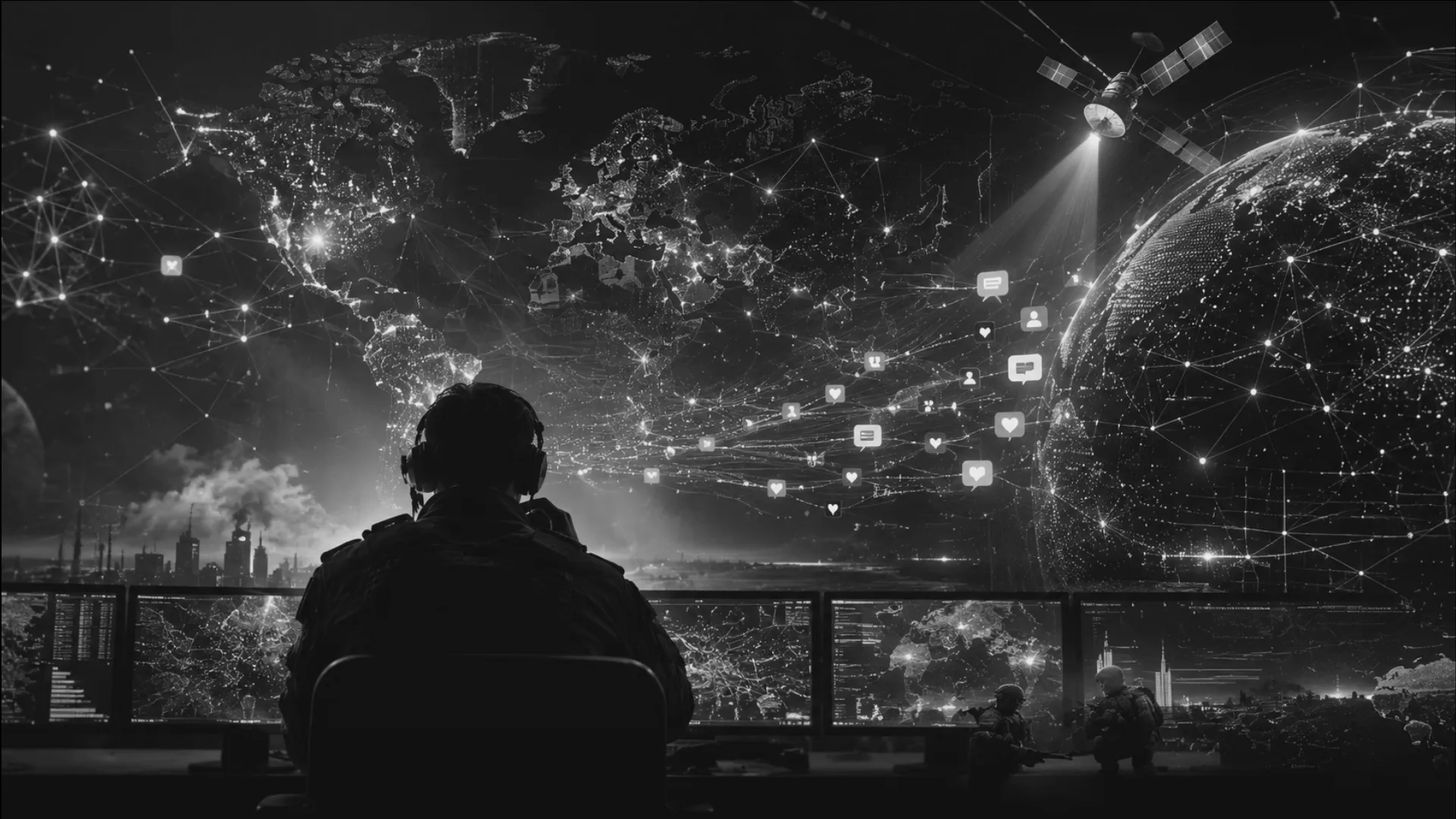
Information warfare has become a key aspect of modern warfare because the power to influence perceptions and decision making has taken precedence over the actual capacity to destroy an opponent's capabilities. States and non-state actors have increasingly utilized the use of digital technologies, cyberspace, artificial intelligence, strategic communication and social media to media to manipulate information, shape narratives and undermine an adversary's political and military will to fight effectively.
In this strategic explainer, the concept of information warfare is analysed through its history, theoretical foundations and application. It argues that information warfare leads to decision superiority making it a central instrument of statecraft and national security in the 21st century.
1. Introduction
Wars have not always been fought with weapons alone. They have also been fought with words, ideas, rumours and perceptions. Information shapes how societies understand conflict and how leaders respond to it. However, Information Warfare (IW) as a distinct form of warfare has emerged in last few decades by using information and technology to disrupt and manipulate adversaries internal functioning and decisions. In the digital age, controlling the information environment is as important as controlling territory.
The character of warfare is changing. States often compete below the threshold of conventional war. It is used to weaken political cohesion, military effectiveness and public confidence without necessarily firing a shot. Thus, Information become both a strategic resource and a weapon.
Modern conflicts illustrate this transformation. The Russia–Ukraine war has unfolded simultaneously across battlefields and digital platforms. During Operation Sindoor India extensively deployed information warfare and its counter measures against Pakistan. During the Israel–Hamas conflict, competing narratives spread rapidly across global platforms, shaping public opinion and diplomatic responses. Non-State actors have weaponised social media for recruitment and intimidation. Along with battlefield performance, the ability to influence perceptions at home and abroad had become a cornerstone of modern conflicts.
The rise of AI, big data analytics and algorithm-driven social media has amplified the effects of IW. Today, False narratives spread before official responses. Deepfakes undermine credibility of authentic evidence, while algorithms amplify emotional content regardless of their accuracy. The information domain has therefore become a contested battlespace.
For India, these developments present both opportunities and challenges. Building resilience against IW has therefore become an essential component of national security.
2. Definition and Scope
There had been several Definitions to it by different thinkers and authors. There is no unanimous definition to it. With the development of means to wage information warfare, its definition and interpretation had evolved.
According to NATO, "Information war is an operation conducted in order to gain an information advantage over the opponent”.[1] US DoD defines IW as “the integrated employment… of IRCs [Information Related Capabilities] in concert with other lines of operation to influence, disrupt, corrupt, or usurp the decision making of adversaries and potential adversaries while protecting our own.”[2]
Martin Libicki defines IW as "Coming to grips with information warfare...is like the effort of the blind men to discover the nature of the elephant: the one who touched its leg called it a tree, another who touched its tail called it a rope, and so on. Manifestations of information warfare are similarly perceived...taken together all the respectably held definitions of the elephant suggest that there is little that is not information warfare."[3]
Information warfare can be defined as the systematic application of information and communication capabilities to influence, manipulate, disrupt or protect the information environment against an adversary to achieve political or military objectives. The conduct of information warfare entails efforts to influence adversary perceptions and decision making, as well as ensuring the integrity of one’s own information and decision-making processes.
The scope of information warfare encompasses, but is not limited to, strategic communication, psychological operations, cyber operations, deception, electronic warfare, disinformation, misinformation campaigns and cognitive operations aimed at shaping perceptions, behaviour and decision-making.[4] Information in itself is not the objective. Information is the vehicle of influence that seeks to change choices. All information campaigns seek to effect behavioural change; whether by persuading populations, confusing military commanders, undermining confidence or building domestic support.
The impact of information warfare depends on the synchronization of intelligence, cyber operations, electronic warfare, media operations, diplomacy, military information operations and emerging technologies into a coherent strategy. The ability to determine what audiences believe, whom they trust and how decision-makers interpret unfolding events increasingly determines success in both peace and war.
3. Historical Evolution
Information warfare has been an important aspect of wars since ancient times. It has emerged as distinct domain of warfare with the advent of internet and related technologies. It has evolved alongside the changing character of war. What has changed is not the purpose of information, but the speed, scale and precision with which it can influence decision. Commanders with best intelligence about its adversary’s capabilities, troop strength, equipment and deployment have always achieved strategic advantage. Along with-it knowledge of the terrain, morale, motivations, psychology and weather has always enjoyed a greater likelihood of victory - from Alexander the Great to today's commanders in Iran, Russia and Afghanistan.
Armies across ancient Greece, Rome, and China routinely faked weakness or retreats to lure opposing forces into deadly ambushes by exploiting their desire for immediate victory. Spreading false Reports or rumours was used to break enemy morale and create confusion among opposing forces. Similar cases can be observed in Ancient India viz. Battle of Hydaspes, Mahabharata War (Death of Ashwatthama) etc. Art of War mentions deliberate use of double agents and spies to map enemy territory and feed false rumours into enemy command ranks.[5]
The World Wars marked the advent of institutionalised information warfare. Governments established propaganda ministries, censored communications and conducted psychological campaigns to maintain public morale while undermining adversary’s. Radio broadcasts, newspapers, posters and films became strategic weapons. Information became a means of shaping belief systems to sustain political legitimacy during prolonged conflict.
The Cold War transformed information into a permanent instrument of geopolitical competition. The ideological rivalry between the US and the Soviet Union was fought as much through narratives as through military power. Radio Free Europe, Voice of America, Soviet state media, covert influence campaigns and intelligence operations were used to influence domestic and foreign public opinion. The contest demonstrated that information can be weaponized regardless of direct military conflict.[6]
During the Vietnam War, when unchecked media coverage led to the loss of the war off the battlefield, the so-called "defeat on the home front" as a result of mass civil protests in the United States. The Vietnam conflict demonstrated the importance of controlling the media in influencing public opinion.[7]
The information revolution of the 1990s fundamentally altered this landscape. Satellite television, Internet and global telecommunications enabled information to circulate instantly across borders. With the rise of Network-Centric Warfare, Military operations become increasingly dependent on digital networks for intelligence, surveillance, command and control. Information became both a strategic asset and a vulnerability.
Cyber operations from Stuxnet against Iran to Russian electoral interference has emerged as key aspect of IW.[8] The rise of social media accelerated this transformation further. Now, Governments, PMCs, terrorist organizations and individuals participate in shaping narratives. Algorithms are used to amplify misinformation and plant narratives against adversary without direct engagement. The Information environment has become decentralised, contested and increasingly difficult to regulate.
Today, AI represents the latest phase in this evolution. Machine learning enables rapid content generation, automated influence campaigns, personalised messaging, designated chatbots and synthetic media such as deepfakes. Therefore, IW has moved beyond mass communication to precision influence.[9] Different audiences receive tailored narratives designed to maximise behavioural effects.
This historical progression reveals an important pattern. Every technological revolution has expanded the reach of information warfare. However, its strategic objective has remained consistent: influencing decisions while constraining the adversary's freedom of action.
4. Theoretical Foundations
Information warfare draws upon several strategic theories developed across different historical periods. Although these theories emerged before today's digital technologies, they remain relevant because they explain enduring principles of competition, influence and decision-making. Modern information warfare is therefore evolutionary rather than entirely revolutionary.
Kautilya's Arthashastra provides earliest mentions of IW. He emphasised espionage, covert operations, propaganda and psychological manipulation as instruments of statecraft. Intelligence was viewed as a prerequisite for sound decision-making. While deception was used for weakening adversaries without costly military engagements. These ideas demonstrate that information has always been inseparable from strategy.[10]
In The Art of War, Sun Tzu argued that "all warfare is based on deception." His insight was simple but profound. A commander who controls what the enemy knows can influence what the enemy does. Warfare is not just about brute strength but also about manipulating the enemy's perception of reality. His central proposition—that successful warfare depends upon deception—remains highly relevant in the digital era.[11] False signals, concealed intentions, manipulated narratives and strategic ambiguity are used to shape an opponent's perceptions before shaping the battlefield. Thus, Sun Tzu's emphasis on deception remains directly applicable to 21st century information warfare.
Carl von Clausewitz did not write about social media or cyberspace. Nevertheless, his concepts of friction, uncertainty and the fog of war provide another enduring foundation. Clausewitz argued that commanders rarely possess complete or accurate information during conflict. Decisions must therefore be made under conditions of uncertainty. Information warfare deliberately increases this uncertainty by flooding decision-makers with conflicting narratives, false intelligence, manipulated evidence or contradictory reports. The objective is not always deception alone. It is to increase cognitive friction until the adversary hesitates, miscalculates, or delays action. Clausewitz helps explain why controlling information has become essential to reducing uncertainty for oneself while increasing uncertainty for one's opponent.
Perhaps no theory explains contemporary information warfare better than John Boyd's OODA Loop—Observe, Orient, Decide, and Act. Boyd argued that military success depends upon completing this decision cycle faster and more accurately than an opponent. Victory belongs to the force capable of adapting more rapidly to changing circumstances. Information warfare directly targets every stage of this cycle. False information distorts observation. Manipulated narratives influence orientation. Confusion delays decisions. Cyber and psychological operations complicate implementation. By disrupting the adversary's OODA Loop while protecting its own, a state gains decision superiority. This explains why information warfare focuses on cognition rather than merely communication.
Developed by Soviet military thinkers, Reflexive Control Theory argues that an adversary can be induced to make decisions favourable to one's own interests through carefully managed information. Unlike coercion, reflexive control allows the opponent to believe that decisions are voluntary. The target unknowingly chooses the option desired by the initiator because the available information has been selectively shaped.[12] This makes Reflexive Control one of the most relevant theoretical foundations for understanding modern state-sponsored influence operations.
The emergence of digital networks transformed military thinking. Network-Centric Warfare argued that connecting sensors, commanders and military units through information networks would generate superior situational awareness and faster decision-making. This served as foundational concept for modern IW. Information superiority enables operational superiority because better information generally produces better decisions.
5. How Information Warfare Works
Information warfare is often misunderstood as the spread of propaganda or fake news. In reality, it is a systematic process that combines intelligence, technology, communication and psychology to influence behaviour. Its success depends less on controlling information itself and more on shaping how information is interpreted. The ultimate objective is to alter decisions without necessarily resorting to military force. Information warfare generally unfolds through interconnected stages.
5.1 Intelligence Collection: Understanding the Information Environment
Every successful information campaign begins with intelligence collection. States first seek to understand the target's political landscape, social divisions, cultural values, media ecosystem and decision-making structure. Intelligence agencies collect information from human sources, signals intelligence, satellite imagery, cyber reconnaissance and increasingly, open-source intelligence (OSINT). Objective is not merely to gather facts. It is to identify vulnerabilities that can be exploited. Polarised societies, contested elections, ethnic tensions, economic grievances or institutional distrust provide fertile ground for influence operations. Information warfare therefore begins with understanding people before attempting to influence them.
5.2 Narrative Construction: Competing to Define Reality
Information alone rarely alters behaviour. Individuals react to stories that affirm their personal beliefs and identities. Therefore, information warfare concentrates on developing narratives and not merely conveying facts. The narratives make things easier for people by reducing complicated realities into something they can easily comprehend and relate with. Deep fakes, morphed pictures and videos, memes etc. are used to convey narratives. Narratives do not necessarily have to be completely false.
Selective truths, omission of context, exaggerated claims and misleading interpretations often prove more persuasive than outright fabrications. Credibility is therefore a strategic asset. A narrative that appears believable is more likely to influence decisions than one that is obviously deceptive.
5.3 Dissemination and Algorithmic Amplification
After developing narrative, next step is to reach the intended, audience. Traditionally, governments relied on newspapers, radio and television. However, today social media platforms, messaging applications, online influencers and digital news outlets had emerged as dominant players. Algorithms have transformed this process. Social media platforms push engagement for extreme contents than balanced ones regardless of accuracy. This creates divisive factions in adversary’s citizens and commanders.
Furthermore, artificial intelligence adds a new dimension to this ability. Through bots, recommendation engines and automated content generation, influence operations can run 24/7 across many different mediums. The entire realm of information warfare has become scalable, cheap, and hard to attribute.
5.4 Influencing Cognition and Decision-Making
Decision-makers rarely possess access to perfect information every time. They depend upon prior beliefs, institutional routines and time-constrained judgement. Algorithmic systems have improved target selection and intelligence processing but final call rests at Commanders end. Information warfare exploits these characteristics by creating ambiguity, reinforcing biases or increasing uncertainty.
Strategically influencing political leaders may alter national policy. Operationally, misleading military commanders may delay deployments or misallocate resources. At the societal level, manipulation of the people's mind could undermine political unity and support for military activities. As Ajit Doval also mentioned in one of his speeches that civil society as a new frontier in 4th Generation warfare. It is inexpensive and affordable to conduct as civil society can be subverted, suborned, divided, manipulated to hurt the interests of a nation.[13] In all of these cases, it is behaviour that is the goal of information war.
5.5 Assessment and Adaptation
Information warfare is not a one-time event but an adaptive process. Campaigns are continuously monitored to evaluate whether intended audiences are responding as expected. Digital technologies make this assessment increasingly sophisticated. Social media engagement, online sentiment analysis, behavioural data and artificial intelligence enable near real-time measurement of public reactions. Messages that prove effective are reinforced, while ineffective narratives are modified or abandoned.
This feedback loop distinguishes contemporary information warfare from traditional propaganda. Rather than broadcasting identical messages to mass audiences, modern influence campaigns constantly adapt to changing circumstances and audience responses.
This cycle keeps running with changes as per the evolving situation. Parallelly, One had to secure and defend its own information systems. Effective countermeasures are deployed against adversaries IW campaign across all domains.[14]
6. Contemporary Examples
Contemporary conflicts had demonstrated that IW is no longer an auxiliary tool supporting military operations. It has become a strategic instrument. It is shaping political outcomes, influencing public opinion and affecting military decision-making before, during and after armed conflict. Although the technologies vary but underlying principle remains the same.
The Russia–Ukraine war represents one of the clearest examples of modern information warfare. Military operations have been accompanied by an equally intense struggle over narratives, legitimacy and international opinion by both sides. Russia–Ukraine War
Maj Gen. Gregory Gagnon stated Russia’s approach reflects its established doctrine of “informational confrontation,” which comprises two elements: the “information technical” (controlling the means of information) and the “information political” (shaping the message itself). [15] False claims of Ukrainian surrender and Zelenskyy’s alleged suicide were propagated to weaken morale and create confusion by Russia. Russia also used ghostwritten DPR articles to strain Ukraine–Poland relations. Russia’s Channel One’s “AntiFake” program was started to counter and debunk Western narratives. Cyber-enabled operations like DDoS, hack-and-leak operations with state and cyber mercenaries (APT28) is deployed. Ukraine responded through strategic communication, Zelenskyy’s Telegram messaging and the Ukrainian Cyber Army. Groups including Cyber Hunta, Cyber Hundred8, Null Sector and Ukrainian Cyber Troops targeted Russian websites and networks.[16] Thus, both sides combined narrative manipulation, cyber operations, and digital mobilisation to influence perceptions and decisions.
6.1 Israel–Hamas War: Competing Narratives in Real Time
The Israel-Hamas conflict is an example of how information warfare has become intertwined with modern military conflict. Military operations unfolded simultaneously with an intense competition over images, narratives and public opinion. Both sides attempted to shape their domestic audience as well as the world through imagery and narrative. Social media became another battleground where videos, pictures, government communications and user-generated content was shared in real time based on battlefield developments.[17]
Nevertheless, this conflict also showed the risks associated with the modern information landscape. Manipulated images, misleading videos and unverified claims were spread without any independent verification. Artificial intelligence has also made the task of verification harder since it can generate more sophisticated imagery and content. The conflict illustrates that speed often outweighs accuracy in the digital information ecosystem. Strategic advantage may be gained by influencing initial perceptions, even if later corrections emerge.
6.2 Operation Sindoor
India’s designated response to Pahalgam attack and 4 Day conflict served as example of modern IW. Operation Sindoor illustrated information warfare alongside kinetic operations. Pakistan circulated claims of Indian losses and damage, while India countered through PIB fact-checks, military briefings and verified evidence. India also used strategic communication internationally, sending seven all-party delegations to explain its position and counter Pakistani narratives. The episode shows how narrative control, rapid debunking and diplomatic outreach became integral to India’s war effort.[18][19]
7. Implications for India
Information warfare is becoming a direct national-security challenge for India because it can influence public confidence, military decision-making and diplomatic space without conventional force. Operation Sindoor demonstrated this convergence. Cyberattacks, fake narratives, deepfakes and fabricated claims were used alongside military operations. ORF documented attempts to spread false reports about attacks on India’s electricity grid, Jets downed and the capture of an Indian pilot.[20]
However, the major challenge is speed and scale of manipulation. AI generated content blurs difference between real information and altered deepfakes. This creates confusion and hinders intelligence assessment during critical crisis situations. India’s strength and weakness both lies in its diverse population and culture. Disinformation campaigns are often deployed by adversaries to damage internal cohesion and security. However, the greatest thing is that Indians unite regardless of any differences when comes to War or any National security threats.
However, the information domain also offers opportunities. India possesses strong digital infrastructure, a large technology sector, growing AI capabilities and expanding strategic communication capacity. India’s active internet users especially Gen-Z has emerged as cyber-force to counter Chinese, Pakistani or West propaganda campaigns maligning India’s image and integrity. PIB fact-checking and official military communication provide an institutional foundation for counter-disinformation efforts.[21] The experience of Operation Sindoor further demonstrated the value of coordinated diplomatic outreach and credible communication.
India should therefore move from reactive debunking to proactive information resilience.[22] This requires an integrated national information-warfare framework linking defence, intelligence, diplomacy, cyber agencies, media and technology firms. Indigenous AI tools should be developed and deployed to detect deepfakes and coordinated manipulation in real time. Indian missions abroad should strengthen digital diplomacy and crisis communication.
Ultimately, India’s strongest advantage is credibility. Investment in media literacy and cognitive resilience should become a national security priority. Citizens capable of critically evaluating information represent an important line of defence against hostile influence operations.
8. Conclusion
Information warfare reflects a fundamental transformation in the character of conflict. While military power remains essential, strategic success increasingly depends on the ability to influence perception before influencing events. Information has become a domain of competition because it shapes the quality of political and military decision-making.
Contemporary conflicts confirm this logic. Russia and Ukraine have demonstrated that credibility influences international support. China's Three Warfares doctrine shows how information can shape strategic competition below the threshold of armed conflict. ISIS reveals that digital influence can amplify the power of non-state actors, while the Israel–Hamas conflict illustrates how narratives now evolve as rapidly as military operations.
For India, the challenge is particularly significant. Protecting territorial sovereignty must be accompanied by protecting the integrity of the national information environment. The future of national security will therefore depend not only on stronger armed forces but also on resilient institutions, informed citizens, trusted communication and secure decision-making systems.
Ultimately, the objective of information warfare is not to dominate information itself but to shape human judgement. Information superiority becomes strategically meaningful only when it produces decision superiority. In the 21st century, states that can protect their own decision-making while influencing that of their adversaries will possess a durable strategic advantage. This makes information warfare not simply a feature of modern conflict, but one of its defining characteristics.
Footnotes:
[1] NATO, (n.d.). ‘Media – (Dis)Information – Security’. DEEP
https://web.archive.org/web/20210102062507/https://www.nato.int/nato_static_fl2014/assets/pdf/2020/5/pdf/2005-deepportal4-information-warfare.pdf accessed on 5 August2026
[2] Joint Chiefs of Staff Publication 3-13, Information Operations §.2012 https://defenseinnovationmarketplace.dtic.mil/wp-content/uploads/2018/02/12102012_io1.pdf
[3] Bellamy, C. (2001). What is Information Warfare?. In: Matthews, R., Treddenick, J. (eds) Managing the Revolution in Military Affairs. Palgrave Macmillan, London. https://doi.org/10.1057/9780230294189_4
[4] Bakshi, Bipin. (2018). Information Warfare: Concepts and Components. 5. 178-185.
[5] Christopher Klein. “The Ancient Warfare Tactics Behind Modern Cyber Attacks”.2025. History https://www.history.com/articles/cyber-warfare-parallels-ancient-warfare
[6] Bryczek-Wróbel, Patrycja & Moszczyński, Maciej. (2022). The evolution of the concept of information warfare in the modern information society of the post-truth era. Przegląd Nauk o Obronności. 48-62. 10.37055/pno/152620.
[7] Ibid.
[8] Premakanthan, Nihila. (2024). Information Warfare Through the Ages: Techniques and Impacts. Researchgate
[9] Bernd W. Wirtz, Jan C. Weyerer, Tirza F. Müller. 2026.“AI-based digital disinformation: A theory-informed and integrated trilateral framework of digital disinformation for information systems research”. IJIM https://doi.org/10.1016/j.ijinfomgt.2026.103066
[10] Sharadkumar Dattatray Shah.2025. "Arthashastra To Algorithms: Chanakya’s Wisdom For Digital Defense". Vol.13, Issue 4. IJCRT
[11] Sun Tzu. ‘The Art of War’. Internet Archive https://dn790006.ca.archive.org/0/items/TheArtOfWarBySunTzu/ArtOfWar.pdf
[12] Joao Ricardo da Cunha Croce Lopes.2025. ‘’The Russian Reflective Control: Theory and Military Applications’’. Vol. 12 Issue 1. Science Publishing group https://doi.org/10.11648/j.com.20251201.12
[13]NDTV. (n.d.). "Civil Society New Frontier Of War": National Security Advisor Ajit Doval”.2021 https://www.ndtv.com/india-news/civil-society-new-frontier-of-war-says-nsa-ajit-doval-can-be-manipulated-to-hurt-nations-interest-2608976
[14]Megan Burns. 1999. “Information Warfare: What and How?”. CSCMU https://www.cs.cmu.edu/~burnsm/InfoWarfare.html
[15]Matthew Slusher. 2025. “Lessons from the Ukraine Conflict: Modern Warfare in the Age of Autonomy, Information, and Resilience”. CSIS
[16] Ahmed Daifullah Algarni. 2023. “Information Operations in the Russia-Ukraine War”. Rasanah IIIS https://rasanah-iiis.org/english/centre-for-researches-and-studies/information-operations-in-the-russia-ukraine-war/
[17] Kumar, Pramod & Kuldeep, Kuldeep. (2026). Information Warfare in the Israel–Hamas Conflict: Strategic Narratives and the Challenges for Indian Foreign Policy. Exploresearch. 03. 122-128. 10.62823/ExRe/2026/03/01.173.
[18] Christopher Clary. 2025. “Four Days in May: The India-Pakistan Crisis of 2025”. STIMSON https://www.stimson.org/2025/four-days-in-may-the-india-pakistan-crisis-of-2025/
[19] PIB. 2025. “Operation SINDOOR: India’s Strategic Clarity and Calculated Force”. GOI https://www.pib.gov.in/Pressreleaseshare.aspx?PRID=2128748®=3&lang=2
[20]Harsh V Pant and Sameer Patil. 2025. “In the Aftermath of Operation Sindoor: Escalation, Deterrence, and India-Pakistan Strategic Stability”. Special report 263. ORF https://www.orfonline.org/research/in-the-aftermath-of-operation-sindoor-escalation-deterrence-and-india-pakistan-strategic-stability
[21] Bipin Bakshi. 2025. ‘Information Warfare: Impact On National Security And State Response’. CENJOWS
[22] Pant et. al. 2025. “In the Aftermath of Operation Sindoor: Escalation, Deterrence, and India-Pakistan Strategic Stability”. ORF
The views expressed are those of the authors and do not represent the views of CNAWS.
Image Source: ChatGPT
Tags
- #Artificial Intelligence
- #cyber warfare
- #Disinformation
- #hybrid warfare
- #information warfare
- #modern warfare
- #national security
- #psychological warfare
Author
Ashutosh Kumar Singh
Ashutosh Kumar Singh is a researcher and academic with a strong interest in international relations, strategic studies, and West Asian geopolitics. He completed his undergraduate and postgraduate studies at University of Allahabad and is a three-time NET-qualified candidate. His academic and research work focuses on foreign policy analysis, regional security dynamics, and contemporary geopolitical developments in West Asia. He is particularly interested in strategic affairs, diplomacy, and emerging political trends shaping the Middle East and global politics, with a commitment to evidence-based research and policy-oriented analysis.