Department of Hybrid Warfare & Irregular Conflict · Explainers · Narrative and Information Warfare ·
What is Cognitive Warfare?
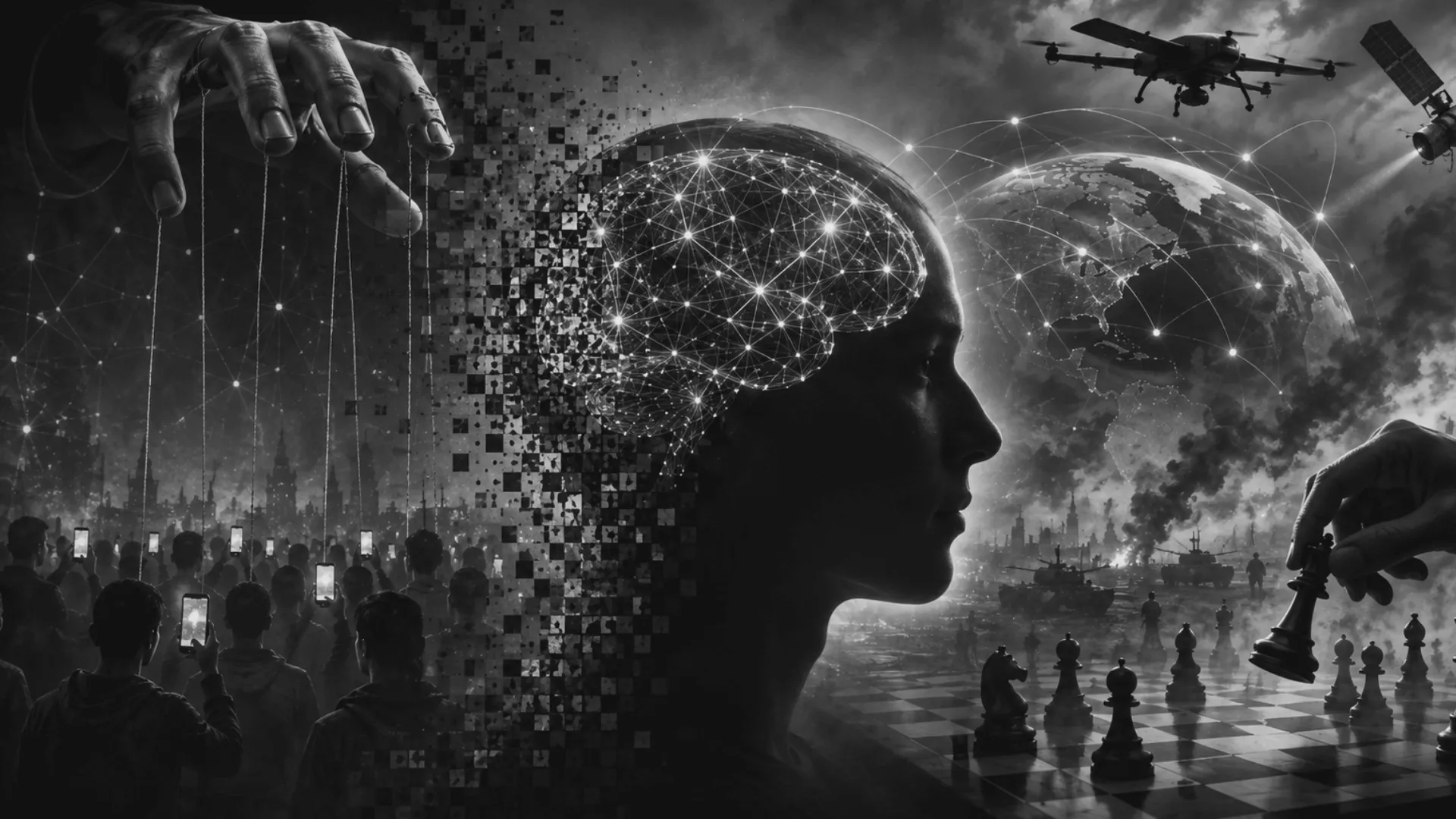
Cognitive Warfare represents a fundamental shift in the nature of modern conflict. From contesting of physical territories to trespassing into human cognition itself, this warfare seeks to corrupt the reasoning process of population through which they interpret reality and make decisions. This explainer draws from three doctrinal frameworks to understand the mechanism of Cognitive Warfare. It also traces the historical evolution of the concept, examines its operational mechanisms and its contemporary relevance in 2026, US-Israeli-Iran conflict. It also analysis its implication for India.
1. Introduction
Way before Indian and Chinese soldiers clashed at the Galwan Valley on the night of June 15, 2020, an information battle was already in motion. Within hours of the violence, China state media and The People’s Liberation Army kept strategic silence in real time, refusing to confirm casualties. Simultaneously, Pakistani social media posts started exploiting this information gap by circulating a viral photograph purporting to show slain Indian soldiers , which was later debunked by BOOM live, tracing it back to a 2015 Boko Haram massacre in Nigeria. It spread rapidly before it could be fact-checked. All while India’s account was still catching up. Illustrating how a quickly fabricated narrative amplified with public hysteria, can bury the truth during the real time.
There was a gap between the clash and the race to decide who looked like the winner, victim or the aggressor to the rest of the world, became the real battlefield. Over the months that followed, China carefully crafted the casualty narrative by acknowledging only 4 deaths, releasing strategic edited propaganda video timed with diplomatic talks, and a staged confession video of an Indian Officer.
Modern warfare isn't just about controlling territory; It’s about controlling the first impression because whosoever controls the first story, controls how the world reacts. The shift is simple: Winning the physical clash isn't enough anymore if the opponent tricks the world into believing you lost.
2. What is Cognitive Warfare?
Unlike conventional military force which targets land, sea, air, space and cyber; Cognitive warfare targets Human minds (cognition) itself. Cognitive Warfare targets not merely the flow of information but the cognitive process behind it, to erode social cohesion, influence decisions, sow distrust between population and the government.
NATO’S Allied Command Transformation (ACT) defines it as the weaponization of the human brain and affecting attitudes and behavior on both individual and population level by external entities.
Cognitive Warfare also acts as the overarching domain which synthesizes conflict: Information Warfare (Targeting information systems and their integrity), Psychological Warfare (Targeting morale and emotions) and Narrative Warfare (Targeting meanings of conflicts, the stories through which events are interpreted). Cognitive Warfare includes all three, ultimately manipulating the Human Cognitive process itself. It combines elements of cyber operations, psychological operations (PsyOps), social engineering, and data driven information systems to alter not just what people think, but how they think and act.

However not everyone accepts Cognitive Warfare as a new category itself. Many critics argue that it is at its core, a Psychological Warfare scaled up by modern algorithms. Many argue that Cognitive Warfare closely resembles the existing concept of Russian Reflexive Control. It is argued to be a repackaged version of existing concepts under the new label of Cognitive Warfare.
3. Historical Development of Cognitive Warfare
The development of the concept of Cognitive Warfare can be traced back to the Cold war era in our historical timeline.
3.1 The Early Cold War (1948) :
In 1948, US diplomat George Kennan wrote a foundational memo to the state department, coining the term, ”political warfare” in it, which meant using every tool a country has, other than just physical clash to weaken an enemy. Instead of deploying soldiers, States began building institutions like Radio Free Europe , which broadcasted Western news and values directly into Soviet Controlled Countries, in order to launch mass broadcasts aimed for shaping the mindsets of population behind the Iron Curtain.
However, it was just one way, mass broadcasting as it was a single radio station trying to influence millions of people.
3.2 The 1991 Gulf War: “The CNN effect”
In 1991, for the first time in history, a major military conflict was broadcasted live around the world, 24 hours a day by CNN. The military leaders realized that real-time media coverage heavily influenced the public opinion and public decisions. If people reacted negatively to the live media, then the military operations could be instantly halted or altered. Hence media management became one of the core battlefields
3.3 Post 9/11 (2001) : War of ideas
Following the terrorist attack, the conflict shifted from fighting terrorist groups to fighting their underlying ideology. There was a cognitive shift and the focus moved from winning physical battle to winning ideological legitimacy, convincing the population worldwide that which worldview is just and right.
3.4 Annexation of Crimea (2014) :”Firehose of Falsehood”
During the annexation of Crimea, Russia deployed a massive digital propaganda model that RAND called the “Firehose of falsehood”. Unlike old propaganda that tried to make people believe in a specific lie or angle, this model flooded the internet with hundreds of conflicting conspiracy theories, fabricated news articles. Its aim was not to convince people but to confuse them and make the human minds exhausted until people give up finding the truth.
3.5 COVID-19 Pandemic (2020) : The Weaponized “Infodemic”
While the virus was spreading, WHO informed that the massive wave of medical misinformation was also spreading just as fast. This showed that Cognitive Warfare wasn’t just limited to military crises and that public fear and uncertainty during health crises can also be weaponized by spreading conflicting narratives of vaccine safety and viral origin to shake the trust in public institutions and the government.
3.6 Invasion of Ukraine(2022)
Months before the invasion, digital narratives of “denazification” or “NATO aggression” were carefully seeded across global networks using AI, Automated bots and targeted behavioral algorithms to condition the public perception before actual fight.
Throughout the historical timeline, Cognitive warfare has evolved from mass broadcast to networked manipulation. By the mid-2020s, technology has made it hyper-personalized by using algorithms and your personal digital footprints to target your exact psychological vulnerabilities.

4.Theoretical Foundations
Different global militaries have different names and formalized strategies for Cognitive Warfare. The three dominant frameworks or the three doctrinal anchors shaping Cognitive warfare are as follows:
4.1 Russia: The Reflexive Control Theory:
It’s a classic Soviet/Russian military concept in which instead of forcing the enemy to do something, you feed them carefully curated or altered information and trick them into doing what you want them to do by believing it’s their own rational decision. It works through the target’s reasoning, not against it. For example, Russia can convince their adversary that the attack is coming from the North, by faking their military movements. In such a case, the rational decision by the adversary would be to move their assets towards the North, leaving the South open, where Russia actually intended to attack.
4.2 China: Three warfare Doctrine:
Embedded in the People’s Liberation Army (PLA) Political Work Regulation(2003), it comprises Public Opinion Warfare (shaping domestic and international media narratives); Psychological Warfare (manufacturing panic, or using digital intimidation to lower the morale of enemy soldiers and citizens) and Legal Warfare (using international laws or treaties, reinterpreting them to legally constrain the adversary actions and legitimize one’s own).
It is China’s strategy for non-Kinetic conflict, to aim for these three pillars to attack their target.
4.3 NATO: The Sixth Domain:
Traditionally, militaries fight across five domains- Land, Sea, Air, Space and Cyber. Now, NATO has proposed Human Cognition as the Sixth Domain of Warfare. Which means that human minds are now to be treated with same strategic weight as that of airspace or territorial waters. Hence, it is a battleground which should be fiercely defended as well.
5. How it Works
5.1 Psychological Mechanism:
To understand why these military doctrines are so effective, we need to look at behavioral psychology, especially the framework developed by Daniel Kahneman in his work, Thinking Fast and Slow(2011). According to him, the human brain processes information using two distinct systems.
System 1: It's fast, intuitive and emotional. The Cognitive Warfare targets it by triggering instant outrage, fear or loyalty, forcing you to react or share immediately.
System 2: It’s slow, deliberate and rational. Cognitive warfare aims to overwhelm you so fast before system 2 gets a chance to engage critical scrutiny.
So essentially, Cognitive Warfare is an assault on System 1. For example, by presenting emotionally charged content like the fake casualty photo from the Galwan crisis, adversaries trick your brain into reacting instantly before your logical system 2 can pause and ask, “wait, is this photo actually real?”
5.2 The Digital Infrastructure
Social media algorithms built for optimizing engagement rather than accuracy, cater to Cognitive Warfare. Because emotional, outrageous or terrifying content (system 1 triggers) naturally gets most engagement, the algorithms automatically boost it. It gives Cognitive Warfare actors a ready-made distribution system which does most of their heavy lifting for free.
5.3 Operational Mechanism
Adversaries execute Cognitive Warfare on a day-to-day basis. By using four main operational mechanisms.
- Narrative Seeding means planting a story or a specific explanation of an event early so that it becomes the reference point against judgment of every other account that follows after. Because our brain tends to show cognitive bias(anchoring) on the first story it hears.
- Algorithmic Amplification relies on social media mechanics explained in the previous section. It exploits platform engagement dynamics by deploying coordinated networks of bots and fake accounts to like and share a piece of disinformation the minute it’s posted.
- Deepfakes and Synthetic Media means using Generative AI to create hyper realistic image, audio or visual of the events that have never happened. In the 2024 election cycle in India, AI generated voice clones or figures of Indian political figures, and in some case Deceased political figures digitally resurrected were used to endorse their family’s political campaigns.
- Cognitive Overload, also known as the “firehose” method mentioned above to flood the information environment with multiple contradictory claims in order to confuse the human mind. It purposely overwhelms the human cognitive capacity, leading to mental fatigue until you give up finding out the truth.
The reason why these four mechanisms work is due to OODA loop developed by US Airforce strategist John Boyd. It states that every time the human brain makes a decision it goes through four continuous steps:

The Orient step intercepts what the data actually means based on culture, past experience and analysis. Cognitive Warfare is designed to corrupt this Orient Phase by using narrative seeding, algorithmic amplification, deepfakes and cognitive overload; the lens through which we analyze the facts becomes distorted despite our observation being correct. This naturally leads us to make flawed decisions all while believing that we have come to a rational conclusion on our own.
6. Contemporary Relevance
Today, Large Language Models (LLMs) and Generative AI tools have enabled both State and non-State actors to generate highly persuasive and tailored texts, audio and visuals instantly. Microsoft’s threat intelligence has flagged many state-sponsored entities are actively using these tools to lower the cost of operations. Social media platforms often unwillingly, functions as Cognitive Warfare infrastructure. And even after specific Deepfakes are exposed or debunked, the mere public awareness that deepfakes exists, enables adversarial actors to dismiss genuine evidence as fabricated. This phenomenon is known as Liar’s Dividend. Thus exploiting public skepticism to avoid accountability.
Case study: 2026 US-Israel-Iran Conflict
The most operationally mature example of modern Cognitive warfare to witness is 2026, US-Israel-Iran conflict triggered by Operation Epic Fury on February 28. On the US-Israel side, AI systems are heavily utilized to accelerate OODA loop as mentioned above. The US military systems have employed systems like Maven Smart System to compress data processing time to seconds. Since Iran faces deep military asymmetry against US-Israeli military force, Iran shifted its priority to modern Cognitive warfare tactics over military outcomes to exploit western political divisions and regional anxieties and project an inflated image of their strengths. According to the International Counter-Terrorism Institute, Iran’s kinetic missiles and drone strike was not to defeat enemy but to generate enough domestic and international pressure to stop US-Israeli operations. Parallelly, the information battle started unfolding within 24 hours of the first strikes. Social media began flooding with AI generated contents.
New York Times identified over 110 AI - Generated Images and videos in the first few weeks, Iranian state media and affiliated networks such as Press TV, started deploying Deepfakes to mock, intimidate and target their adversaries. It includes Bahrain high-rise ablaze, AI generated burial imagery, highly satirical LEGO-style animated rap music showing Trump and Benjamin Netanyahu being targeted by Iranian forces. Cyabra identified pro-Iranian networks generating 145 million views across TikTok in the same time.
What makes this conflict even more analytically distinct was the operating scale of Liar’s Dividend. Once people became aware of this influx of Deepfakes, even the genuine footage became suspicious to population as it is instantly dismissed by enemy actors as “AI Fabricated” providing utter confusion to the public and this made them unable to trust what they see. Every mechanism described in this explainer was deployed in real time , on a scale never seen before.
7. Implications for India
India is in a precarious geopolitical position with both its neighbors being nuclear powers. Both neighbors use different styles of Cognitive warfare. The Western front (Pakistan) is highly reactive, emotional and rapid.
For instance, in the 2019 Balakot airstrike, the moment Indian jets crossed the border, an intense information battle erupted. Everyone started assessing casualties and who won or lost. Showing how fast narrative battle can cover the whole international media coverage during the crisis.
On the other hand, the Northern/Eastern frontier (China) is more calculative, continuous, patient and institutionalized. China doesn’t wait for a crisis to start its cognitive engine. It’s deeply embedded in their doctrine and constantly shapes the international media.
India also has some internal vulnerabilities. The primary information medium is the WhatsApp ecosystem. Unlike other public platforms like X or Facebook where fact checkers flag a lie openly, WhatsApp has End-to-End Encryption. Fake news travels in private before the government even knows it exists. It's a hidden loop. There is also a literacy gap so many first-generation users treat anything sent to their phones as absolute truth. Combining it with low media literacy, pre-existing political, religious and caste fault lines make it easier for adversaries to sow seeds of lies that may spark domestic riot.
India does have some institutions like MeitY's IT Rules 2021, places obligations on media to prevent spread of false content on their platforms. Also, the Fact Check Unit under the Press Information Bureau actively monitors and counter government related disinformation. However, they both are largely reactive and only focus on addressing individual pieces of false content rather than addressing the underlying cognitive vulnerabilities which the cognitive warfare exploits. Right now, India lacks proactive, unified national doctrine.
8. Conclusion
Modern warfare has evolved from physical territories to cognitive domain of a human mind. Cognitive Warfare is uniquely dangerous as it turns our own biology against us. By exploiting our immediate emotional triggers and fears, adversaries can manipulate public opinion at an unprecedented scale and it’s only evolving more as AI capabilities expand.
For a nation like India which has a vibrant tapestry of language, faith and livelihood, the exposure to this threat is deeply intimate. Ultimately Cognitive Warfare forces a stark realization that a nation can possess all the military prowess, it can guard its skies and patrol its seas with flawless precision but can still remain vulnerable in its citizens’ reality which can easily be fractured by tailored algorithms.
In this century, the future of national security lies not just in physical territories but in building institutional and societal cognitive resilience, i.e. treating the minds of its citizens and decision-makers as a border that must be actively defended. For defending a country now means forging our truest armor not from steel, but from quiet stubborn resilience of a mind that refuses to surrender its clarity under the fire.
The views expressed are those of the authors and do not represent the views of CNAWS.
Image Source: ChatGPT
Tags
- #AI and Warfare
- #Cognitive Security
- #Cognitive Warfare
- #Cognitive Warfare India
- #Disinformation
- #information warfare
- #national security
- #psychological warfare
Author
Sharon Ekka
Sharon Ekka is a Research Intern at CNAWS and a postgraduate scholar pursuing an MA in Diplomacy, Law and Business at the Jindal School of International Affairs, O.P. Jindal Global University, with a specialisation in Indo-Pacific and East Asian affairs. She concurrently pursues an MA in Journalism and Mass Communications at Amity University. She has also served as an Editorial Intern at the Jindal Centre for Global South. Her research interests centre on contemporary maritime security, with a focus on undersea infrastructure vulnerability, unmanned naval systems, and India's strategic posture in the Indian Ocean Region.