
Department of Strategic Foresight & Scenario Planning · Detailed Reports · Geopolitics ·
Tracking the People's Liberation Army (PLA): 27th September - 03rd October, 2026
Colonel KK Venkatraman (Retd.)
Dear Reader,
Thank you for reading this week’s newsletter.
To avoid the perpetual backlog, I have skipped three weeks of Tracking the PLA. While I do hope to publish these three newsletters over the next few weeks, I will not be mailing it. It will be published in the website with a link in the next newsletter which follows. I do sincerely hope that this will be a satisfactory solution.
Major events over the week were the 77th Anniversary of the establishment of PRC and India identifying 28 places in Ladakh.
China observed the 77th Anniversary of its creation on 01 Oct 2026. More than 1,00,000 people attended the ceremony at Tiananmen Square. The previous day i.e. 30 Sep was observed as Martyrs Day. China is also observing the
On 02 Oct 2026, India identified 28 places/locations in Ladakh including in Aksai Chin and Shaksgam Valley. This is the second list of places/locations identified by India and comes in the backdrop of China-Pakistan Joint Boundary Commission holding its first meeting at Islamabad on 16 and 17 Sep 2026.
There were some interesting discussions in the PLA Daily on AI and unmanned warfare. While these are not the official views, they do highlight the rich discussion which happens within the PLA and a stark reminder that authoritarianism does not necessarily translate into limited discussions and poor innovation.
Read on.
Neighbourhood
India identifies 28 Places/Features in Ladakh
On 02 Oct 2026, India identified 28 places/features in Ladakh along with their locations on map. The places/locations identified include 15 in Aksai Chin which is occupied by China and 13 in Shaksgam Valley, which was ceded by Pakistan to China under the 1963 China-Pakistan Boundary Agreement (highlighted in red in the maps below).
The announcement came in the backdrop of the first meeting of China-Pakistan Joint Boundary Commission held at Islamabad on 16 and 17 Sep 2026. The Indian Ministry of External Affairs responded that the Joint Commission did not have a legal basis and called on Pakistan “to immediately vacate from areas under its illegal and forcible occupation.”
First, by identifying these locations, India has asserted the extent of its sovereignty over both areas. Second, unlike the six lists published by Chinese Ministry of Civil Affairs, which identified locations in Arunachal Pradesh, the present Indian identification addresses the Western Sector of the India-China border dispute. It remains to be seen whether India will identify locations in the Central Sector in future. Third, all 13 locations identified in Aksai Chin lie North of Chang Chenmo Range, possibly as this forms the largest disputed area in Eastern Ladakh. Fourth, by linking two complex issues - the boundary dispute between India and China and the Shaksgam Valley ceded by Pakistan to China - India has sent a message to the Chinese side that India considers both areas in its boundary talks with China.
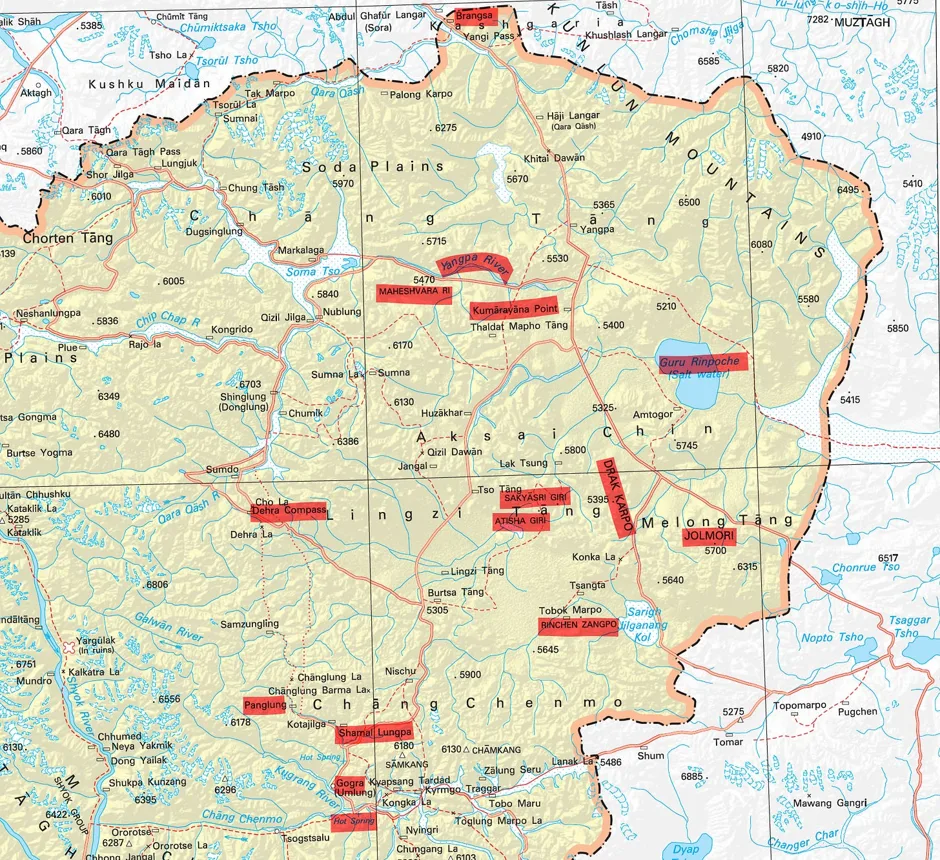
(15 locations identified by India in Aksai Chin: Map Source: Survey of India)
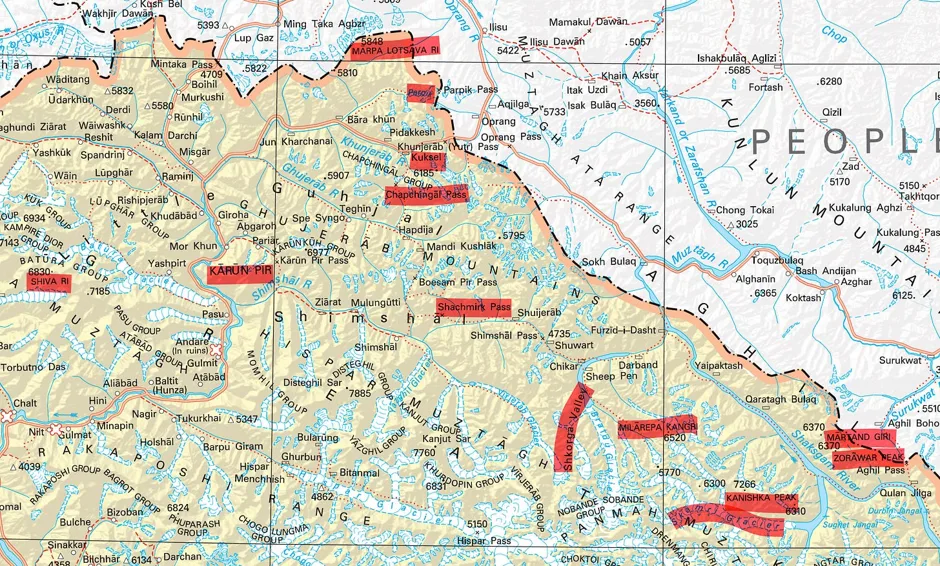
(13 locations identified by India in Shaksgam Valley. Map Source: Survey of India)
Taiwan
Arrival of F-16V aircraft
The first two F-16V aircraft ordered from Lockheed Martin arrived in Taiwan on 02 Oct 2026. The aircraft equipped with APG-83 AESA radar, are part of $ 8 billion order for F-16V aircraft and spares, placed by Taiwan in Aug 2020. The aircraft were to be delivered in Aug 2026 and were delayed due to Xi Jinping’s visit to US. Taiwan has placed a separate $ 14 billion order for weapons package which is awaiting President Trump’s approval.
PLA Activities across Straits
The PLA flew 49 sorties during the week of which 17 crossed the Median Line. The largest number of sorties flown was on 30 Sep - 23 sorties which included J-10, J-11, J-16, JH-7, Su-30, KJ-500 AEW and Y-8 EW aircraft. Concurrently, 5 - 7 PLA ships and 4 to 8 Coast Guard ships operated (Data source: https://x.com/MoNDefense?s=20)
Ideological and Political Education
Party Membership
A PLA Daily article highlights the selection process and criteria for Party membership amongst PLA personnel in an unidentified (UI) brigade of 83 Group Army. The protagonist, Xiao Liu had excelled in brigade level competitions and was identified as an ‘aspirant’(入党积极分子). However, he was not selected during the meeting of the Party Committee as it considered his attitude towards work and poor understanding of Party members’ responsibilities and obligations. The company Party Secretary subsequently explained that both ideological awareness and professional competence were required and that they would prefer to keep party vacancies unfilled rather than fill it up with someone who meets the criteria. The article concludes that the protagonist made consistent efforts to improve his attitude as well as understanding of the Party and was accepted as a party member the following year. (PLA Daily. 29 Sep 2026. Page 10. Deliberating on Party Membership: Why a Top-Tier Trainee Missed the Cut(研究发展党员,训练尖子缘何落选))
Maintaining Motivation
An interview of Political Commissar of an UI brigade of 83 Group Army highlights measures taken to maintain motivation amongst personnel posted to non-key appointments. The brigade uses a three-pronged approach of highlighting the criticality of both key and non-key appointments, ensuring that contributions of deserving non-key appointments are recognised, and defining the role of each post in a manner that highlights its criticality in the combat chain. The brigade has also created avenues for professional development, translating individual skills into collective capabilities and providing space for innovation. These, along with building robust platforms for integrated training, breaking down professional silos to build capabilities, and ensuring a deep-rooted commitment to combat readiness, are expected to motivate personnel posted to non-key appointments. Three other articles in the same page use examples of a network operator, a combat engineer and drone operator who was supported by his erstwhile competitors, to prepare for next level competition. (PLA Daily. 03 Oct 2026. Page 3. Making every Combat Post shine with a Focus on Victory(让每个战位都向战发光). Small Cabin is connected to the larger battlfield (小方舱连着大战场). There Are No “Supporting Roles” on the Battlefield(战场上没有“配角”). Supporting Comrades as They Charge into Battle (托举战友前行,也是向战冲锋))
Combat Theory
Man-Machine Collaboration
Zhang Qinghua and Song Xiaodong argue that man-machine collaboration is reshaping command channels and call for leveraging AI to enhance core capabilities. They highlight that AI, unmanned systems and cloud computing have enabled man-machine collaboration, resulting in structural optimisation of command system. The operational logic has shifted to a parallel, distributed model, characterised by connectivity across domains, dynamic adaptability, and resilience. Commanders can now focus on decision-making with AI analysing the vast volume of data to generate operational plans and enable commanders to focus on strategic decision-making, especially at critical junctures. Freed of routine functions, staff can focus on upgrading the quality of decision support, cross domain coordination and ensuring systemic resilience. Combat units will evolve into independent units capable of sensing, decision-making and coordinated command and control, thus maximising combat effectiveness. (PLA Daily. 29 Sep 2026. Page 7. Man-Machine Collaboration reshapes Combat Command Chain (人机协同重塑作战指挥链路))
Deprofessionaliation* with Intelligent, Unmanned Warfare
Hang Xinglong and Liu Yiqing call for restructuring of professional capabilities to adapt to the requirements of intelligent, unmanned warfare. They argue that with the rapid development of intelligent, unmanned technologies, professional standards of specialist soldiers are being absorbed by AI and warfare is shifting to system-centric, intelligence-powered operations, resulting in their deprofessionalisation. At the same time, man-machine interaction is increasingly becoming digital and humans in the rear can participate in combat through virtual networks. Hence, by leveraging integrated platforms and standardised protocols, technology companies, research institutions, and civilians with digital expertise can participate in combat support and system operations. Along with deprofessionalisation, they look at other changes such as shift in command functions to one of distribution coordination where certain units can execute autonomous functions such as reconnaissance, target identification based on preset protocols and creation of an unified system which integrates combat capabilties. (PLA Daily. 29 Sep 2026. Page 7. “Deprofessionalisation”: A New Trend in Unmanned Intelligent Warfare (“去专业化”:无人智能作战新趋势))
*Deprofessionalization, in Sociology, refers to the loss of unique occupational qualities such as monopoly over knowledge, autonomy in functioning and day to day work, and other’s trust in the professional having a service ethos.
National Defense Mobilisation Law
Xue Zhiliang, a Professor and researcher at PLA Army Command College analyses the National Defense Mobilisation Law which came into effect on 01 Oct 2026. First is the definition of National Defence Mobilisation. He quotes Article 1 of the Law “measures taken by the state in accordance with the law to respond to threats against national sovereignty, unity, territorial integrity, security, and development interests; to ensure a rapid transition from peacetime to wartime; and to transform economic and social strength into national defense strength”. Original text is given below.
本法所称国防动员,是指为了应对国家主权、统一、领土完整、安全和发展利益遭受的威胁,国家依法采取必要的措施,保障平战快速转换,将经济和社会实力转化为国防实力的活动
The author highlights the significance of the law as: Firstly, it incorporates development interests within the scope of national defence mobilisation and aligns with Comprehensive National Security Concept. Secondly, it integrates both ‘peace to war’ and ‘war to peace’ transitions including rebuilding of nation after war. Thirdly, it coordinates the development of national prosperity with military strength and lastly, it adheres to the rule of law. The author calls the primary mission of national defense mobilisation as to: break barriers between military and civilian sectors, facilitate exchange of resources, and promote the integration of capabilities. (National Defense News 30 Sep 2026. Page 3. An Analysis of the Statutory Concept of National Defense Mobilisation(国防动员法定概念解析))
Training
Joint Air and Naval Exercise in Scarborough Shoal
STC conducted joint air and naval exercise at Scarborough Shoal (Huangyan Dao) on 27 Sep 2026. The exercise focused on reconnaissance and early warning, rapid manoeuvre and search and rescue operations and was intended to test sea-air coordination, rapid support, and operational effectiveness of the system. The naval formation comprised of Type 056A Jiangdao class corvette Tianmen (Hull No 631), Type 54A frigate Yulin, and Type 908 replenishment ship Qinghaihu. They were supported by KJ-500 early warning aircraft and WZ-7 reconnaissance drones and Coast Guard ships Wanshan, Chuanshan and Sifang. Another PLA Daily article called it as a warning in response to Philippines’ activities in South China Sea. The article said that Phillippines was using its opportunity of chairing ASEAN DMM Plus to get ASEAN and non-ASEAN countries to conduct military exercises in Chinese territories in South China Sea. (PLA Daily. 28 Sep 2026. Page 1. Southern Theater Command Conducts Joint Sea-Air Exercises Near Huangyan Island (南部战区位黄岩岛周边海空域组织海空联合演训). Page 2. Curbing the Philippines’ Blatant Violants in South China Sea through Resolute Action (以坚决行动遏制菲方祸乱南海的恶劣行径))
Restructuring of Military Academies
An SCMP article highlights the establishment of new institutions in PLA Militiary Academies. The PLA Army Engineering University established the College of Unmanned and Intelligent Engineering, the College of Combat Support NCOs (Non-Commissioned Officers) and the College of Equipment Support NCOs on 02 Oct 2026. The National Defense University inaugurated its College of Discipline Inspection, Law and Politics on the same day while the PLA Joint Logistics Support Force Engineering University announced the establishment of 4 colleges and one institute though it did not share details. The institutions will help the PLA to train specialists for futuristic requirements as well as compliance with political thought.
Civil Defence
An article in the China National Defense News (中国国防报) covers civil air defence rehearsals carried out in China on 19 Sep as part of National Defense Education Day. The Civil Air Defense Law(人民防空法) permits local governments at county level and above to carry out air defence siren tests after informing the public five days in advance. The article highlights the three types of air-defense siren tests - ‘preliminary warning’ (预先警报) sound for 36 seconds, pause for 24 seconds), ‘air raid warning’ (空袭警报)sound for six seconds and pause for six seconds and ‘all clear signal’ (解除警报) - continuous sound for 3 minutes. Linyi city in Shandong had added another signal for disaster (灾情警报) sound for 15 seconds, pause for ten seconds, sound for 5 seconds and pause for 10 seconds, repeated thrice. Different provinces carried out different practices. While Liaoning sounded only the ‘all clear’, some cities in Anhui sounded the full sequence. (China National Defense News. 30 Sep 2026. Page 3. Sirens Wail, A constant reminder (警报长鸣 警示常在))
90th Anniversary of Long March
China is observing the 90th Anniversary of Long March. 22 Oct marks the 90th Anniversary of the completion of Long March. Long March started as a breakthrough during the Fifth Encirclement Campaign of the Nationalists in 1934. It also marked the ascendance of Mao Zedong as the undisputed leader of the CCP and China, a position which he held till his death in 1976. To commemorate the 90th Anniversary, older PLA units retraced their participation during the Long March while the post-long March ones drew lessons from the Long March. Some of the important battles in limelight were the crossing of Chishui River and Battle of Lazikou.

(Painting of Battle of Lazikou. Image Source: PLA Daily)
Defence Cooperation
Multinational Exercise Centre-2026(Центр 2026/中部-2026)
Troops from PLA’s Central Theatre Command participated in the multilateral exercise ‘Tsentr-2026’ hosted by Russia in Chelyabinsk, from 28 Sep to 03 Oct 2026. The PLA contingent followed a three-tier structure - Directing HQ, Joint Campaign HQ and mission units. The exercise was conducted in two phases - Preparatory and Execution stage. Live-fire exercises included multidimensional reconnaissance, information-fire strikes, guided entry, multi-axis assaults, and rapid rout-and-destroy operations. Apart from manned equipment such as Type 99A tanks and armed helicopters, PLA employed unmanned equipment such as drone swarms, tactical drones and unmanned ground vehicles during the exercise. The Commander of the PLA Contingent stated that the objectives of the exercise as: develop Sino-Russian comprehensive strategic partnership, enhance cooperation and strategic coordination, and safeguard global strategic stability. (PLA Daily. 03 Oct 2026. Page 2. PLA Troops begin withdrawal after completing Mission (中方参演部队圆满完成演习任务后启程回撤). Forging Elite Forces together, Safeguarding Peace Side by Side(携手砺精兵, 并肩卫和平))
The exercise assists China in drawing lessons from the ongoing Russian Special military operations in Ukraine, primarily in employment of manned-unmanned teams. Some of the lessons included deployment of troops in underground shelters, employment of electronic warfare and precision weapons, and employment of smaller, integrated tactical groups in multiple assault waves.
Peace Train 2026 (和平列车-2026)
PLA medical train which participated in the PLA-Laotian Army medical exercise ‘Peace Train 2026’ returned to China through Mohan Port, Yunnan on 22 Sep 2026. This year’s exercise comprised of 70 experts across 31 disciplines who were formed into four teams to cover the length and breadth of Laos. The exercise included HADR after a super typhoon disaster in which unmanned intelligent equipment including drones, robodogs were used for the first time. The PLA side also used AI Doctor (AI医生) for diagnosis. The exercise has evolved since the first exercise in 2017, which was organised in tents and switched to hospital train in 2022. This year is the sixth edition of the exercise. (PLA Daily. 29 Sep 2026. Page 4. May the Champa Flower Bloom Forever; May the Bond of Brotherhood Endure(占芭花常开 兄弟情常在))
Visit of 48th Task Force to Yangon
The 48th Task Force made a five day halt at Yangon from on its way back to China. The task force comprises of Type 52D Destroyer Tangshan (Hull 122) and Daqing (Hull 576).
That is all for this week, folks. Have a nice Sunday. See you soon with the next week’s newsletter.
Tags
- #China Military Exercises
- #China Military News
- #China Russia Defence Cooperation
- #Chinese People's Liberation Army
- #India China border dispute
- #PLA Artificial Intelligence Warfare
- #PLA Military Updates
- #Taiwan Strait Tensions
- #Tracking the People's Liberation Army (PLA)
Author
Colonel KK Venkatraman (Retd.)
Colonel KK Venkatraman (Retired) was commissioned in the Indian Army in December 1997. An alumnus of the Defence Services Staff College, Wellington, he has served extensively in Counter Terrorist Operations in Jammu and Kashmir, Counter Insurgency Operations in Assam and along the Line of Actual Control in the Eastern Theatre. He has served in General Staff appointments in the Eastern, Central and Northern theatres. While in service, the author was part of an in-service Study Group on “Teachings of Sun Tzu and its impact on Modern Day Polity, Society and Psyche” which piqued his life-long interest in China Studies. He holds an MPhil in Defence and Strategic Studies from Punjabi University, Patiala. His MPhil dissertation entitled, “International Dynamics of China’s Belt and Road Initiative (BRI): An Analytical Study”, analyses the BRI and its impact at the global, regional and national levels. He is currently pursuing his PhD in International Affairs at OP Jindal Global University, Sonepat, where he is working on China’s Holistic Approach to National Security. Previously, he was Research Fellow at Institute of Chinese Studies, New Delhi where he researched on ‘Application of Artificial Intelligence by PLA and its Implications on Warfighting’. The officer was NASC Fellow (Non-Resident) of 2023 and 2024 cohorts at The Takshashila Institution, Bengaluru where he researched on the PLA’s Western Theatre Command and the PLA Army Aviation respectively. He is a mentor at Atma Nirbhar Soch, independent think tank on Strategic Studies, and has delivered guest lectures at Takshashila Institution, Bengaluru and Delhi University. His weekly newsletter titled, “Tracking the PLA” covers happenings in the People’s Liberation Army of China.