Department of Hybrid Warfare & Irregular Conflict · Situational Reports · Terrorism and Militancy ·
SITREP: Karachi Rangers Headquarters Attack: Jamaat-ul-Ahrar, TTP Split and Urban Militancy
The 27 June attack on the Pakistan Rangers Headquarters in Karachi marks one of the most significant militant operations in the city since the February 2023 Karachi Police Office assault. The attack reportedly involved an explosive-laden vehicle followed by an armed assault, indicating a complex fidayeen-style operation against a fortified security installation.
Responsibility was claimed by the Khulafaye Rashideen Isteshhadi Brigade, presented as a faction of Jamaat-ul-Ahrar. However, the name has not previously appeared in open-source reporting as an established JuA suicide unit, raising the possibility that it may be a new operational label, a temporary branding mechanism, or a localized cell created for this attack.
The incident is significant because the central TTP leadership reportedly denied involvement at a time when relations between Noor Wali Mehsud-led TTP and Jamaat-ul-Ahrar appear increasingly fractured. JuA’s recent statements accusing TTP leadership of killing and marginalizing its commanders suggest that the group may be reasserting itself as an independent actor rather than a subordinate faction within the TTP umbrella.
Operationally, the Karachi attack points to planning, reconnaissance, coordination, and possible urban facilitation networks. JuA has historically demonstrated the ability to conduct high-profile attacks in Pakistan’s major cities, and this incident may indicate that elements of those networks remain active despite years of counterterrorism pressure.
Attribution remains fluid. There is currently no confirmed evidence of direct involvement by the Hafiz Gul Bahadur Group or other militant actors, although future evidence of logistical or tactical cooperation would be significant. The attack highlights Pakistan’s increasingly fragmented militant landscape, where splinter groups, rival factions, and tactical alliances may shape future threat patterns.
Key questions remain unresolved, including the exact number of attackers, confirmed casualty figures, the command structure behind the operation, and whether facilitators inside Karachi supported the assault. The incident should therefore be read not only as a tactical attack on a security installation, but as a potential indicator of renewed urban militant capability and deepening fragmentation within Pakistan’s anti-state militant ecosystem.
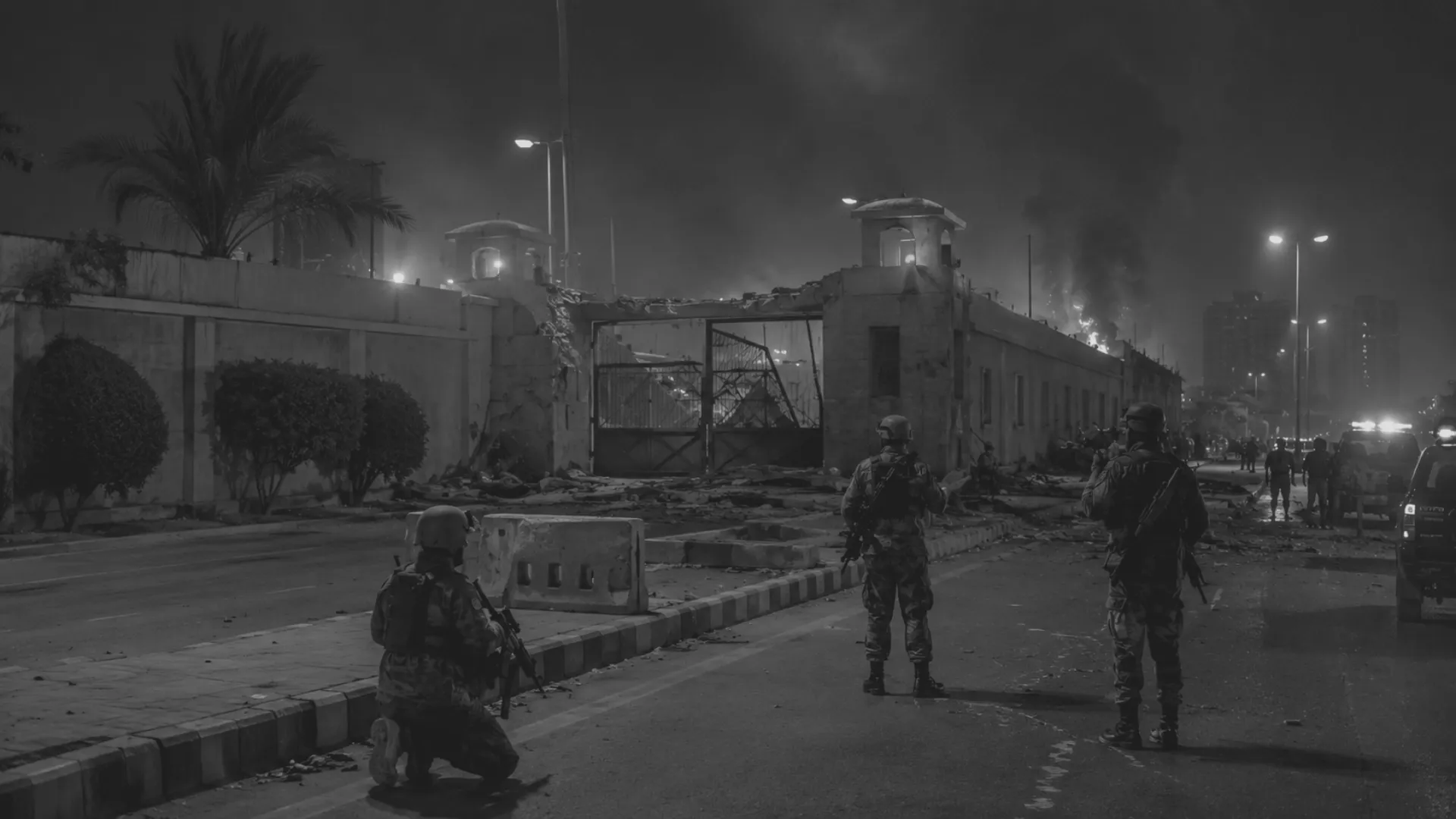
A major terrorist attack targeted a Pakistan Rangers installation in Karachi on the evening of 27 June, marking one of the most significant militant operations in the city since the February 2023 Karachi Police Office assault. The attack unfolded at the Rangers Headquarters located near Gulistan-e-Jauhar on University Road and involved a coordinated combination of an explosive attack followed by an armed assault, reflecting the hallmarks of a complex fidayeen-style operation.
Initial reports indicated that an explosive-laden vehicle detonated near the entrance of the compound, with subsequent reporting suggesting that security personnel positioned at the gate prevented the attackers from achieving a full breach. The explosion was immediately followed by sustained gunfire as multiple armed militants attempted to enter the installation, triggering a prolonged exchange of fire with Rangers personnel. Pakistani security forces quickly cordoned off the surrounding area while additional units were deployed to reinforce the installation. Rangers snipers reportedly occupied elevated positions on nearby buildings, and drones were employed to support aerial surveillance during the clearance operation.
As the operation progressed, conflicting reports emerged regarding the number of attackers. Early accounts suggested that three to four militants had entered the compound, while later claims circulating on militant-linked channels asserted that nine attackers participated in the assault. These figures remain independently unverified. Pakistani security sources subsequently stated that five militants were killed during the clearance operation, although official confirmation regarding the total number of attackers has yet to be released.
Casualty figures have also evolved throughout the incident. Initial reports confirmed injuries among security personnel, while later unofficial accounts suggested multiple Rangers casualties, including fatalities. At the time of writing, the exact number of casualties on both sides remains subject to official verification.
Shortly after the attack, a statement circulated on militant-linked channels claiming responsibility on behalf of the Khulafaye Rashideen Isteshhadi Brigade, identifying itself as a faction of Jamaat-ul-Ahrar (JuA). The statement described the operation as a coordinated suicide assault targeting the Rangers Headquarters. However, this designation warrants careful scrutiny. Unlike the Hafiz Gul Bahadur Group's well-documented Sufyan Karawan, the name Khulafaye Rashideen Isteshhadi Brigade has not previously appeared in open-source reporting as an established suicide operations unit associated with Jamaat-ul-Ahrar. It is therefore possible that the designation represents a newly adopted operational label, a temporary branding for the Karachi operation, or a localized cell rather than a permanent organizational formation.
Adding further complexity to the attribution, the central leadership of Tehrik-i-Taliban Pakistan (TTP) reportedly denied involvement in the attack. This denial is significant given the increasingly public rupture between the Noor Wali Mehsud-led TTP leadership and Jamaat-ul-Ahrar. Over recent months, JuA has released multiple statements accusing the TTP leadership of orchestrating the killing of its commanders, marginalizing Mohmand-based cadres, and employing religious decrees to justify internal purges against rival factions. One statement issued in May 2026 alleged that eighteen JuA members, including Commander Mumtaz Ummati, had been killed by forces aligned with Noor Wali Mehsud, declaring that JuA would no longer remain silent. These statements suggest that JuA increasingly views itself as an independent organization rather than a subordinate component of the TTP.
The Karachi attack therefore carries significance beyond its immediate tactical impact. Historically, Jamaat-ul-Ahrar distinguished itself from many other Pakistani Taliban factions through its demonstrated ability to conduct high-profile attacks in Pakistan's major urban centres. The group was responsible for several large-scale attacks in Lahore, Peshawar, Islamabad, and other cities before rejoining the TTP during the 2020 reunification process. The apparent re-emergence of JuA as an autonomous actor capable of mounting complex operations inside Karachi may indicate that portions of its historical urban facilitation networks remain active despite years of counterterrorism pressure.
From an operational perspective, the assault displayed characteristics associated with carefully planned fidayeen attacks. The combination of an explosive breach attempt followed by an armed assault on a fortified security installation suggests prior reconnaissance, coordinated movement, and a degree of tactical preparation exceeding that typically observed in opportunistic attacks. Whether these capabilities were developed independently by JuA or supported through external cooperation remains unclear.
One analytical question likely to receive increased attention concerns JuA's reported tactical relationships with other anti-state militant actors, particularly the Hafiz Gul Bahadur (HGB) Group. While there is currently no evidence confirming direct HGB involvement in the Karachi operation, the two organizations have previously been assessed as maintaining tactical relationships despite operating under separate leadership structures. HGB has demonstrated considerable expertise in conducting complex assaults against Pakistani security forces in the border regions, while JuA has historically specialized in projecting violence into major urban centres. Any future evidence indicating logistical cooperation, training support, or operational coordination between these organizations would represent a notable development in Pakistan's militant landscape. At present, however, such involvement remains speculative and unsupported by publicly available evidence.
Another notable feature of the incident has been the uneven flow of information. Pakistani mainstream television channels initially provided limited coverage of the attack, while updates emerged more rapidly through local journalists, eyewitness accounts, regional media outlets, and militant-linked communication channels. As with many fast-moving security incidents, competing narratives have circulated simultaneously, reinforcing the need for cautious verification before drawing definitive conclusions.
The Karachi attack also signals a broader shift in Pakistan's security environment. Rather than confronting a single centralized insurgent organization, Pakistani security forces increasingly face a diverse ecosystem of militant groups that may compete, cooperate, or temporarily align depending on operational objectives. Organizational labels alone may therefore provide an incomplete understanding of future attacks, particularly as splinter groups seek to establish independent identities while simultaneously maintaining tactical relationships with other actors.
At the time of writing, investigations into the Karachi Rangers Headquarters attack remain ongoing. Key outstanding questions include the precise number of attackers involved, the confirmed casualty figures, the exact command structure behind the operation, and whether additional facilitators or support networks inside Karachi contributed to the assault. Subsequent claims, arrests, propaganda releases, and forensic findings will likely provide greater clarity regarding both attribution and the broader implications of the attack.
The Karachi Rangers Headquarters attack represents one of the most consequential militant operations witnessed in Pakistan's commercial capital in recent years. Beyond its immediate tactical significance, the incident may signal the continued evolution of Pakistan's militant landscape, where autonomous organizations increasingly seek to demonstrate relevance through high-profile attacks while operating within an increasingly fluid network of alliances and rivalries.
Sources
Incident Reporting
- The Washington Post. Militants attack Pakistan Rangers Headquarters in Karachi (27 June 2026). https://www.washingtonpost.com/world/2026/06/27/pakistan-militants-attack-paramilitary-rangers-headquarters-karachi/f6a7895a-7254-11f1-8730-e7fd0e2a6404_story.html
- Associated Press. Militants attack Pakistan Rangers Headquarters in Karachi (27 June 2026). https://apnews.com/article/pakistan-militants-attack-paramilitary-rangers-headquarters-karachi-c587c48d9bceba758ede65b34bea75cd
- The Hindu. Pakistan security forces kill militants after attack on Rangers Headquarters in Karachi (28 June 2026). https://www.thehindu.com/news/international/pakistan-karachi-explosion-gunfire-updates/article71155477.ece
- The Straits Times. Three Pakistani Rangers killed in Karachi attack, Dawn newspaper reports (28 June 2026). https://www.straitstimes.com/asia/south-asia/three-pakistani-rangers-killed-in-karachi-attack-dawn-newspaper-reports
- Pajhwok Afghan News. Three Pakistani soldiers killed in Karachi attack on Rangers Headquarters (28 June 2026). https://pajhwok.com/2026/06/28/3-pakistani-soldiers-killed-in-karachi-attack-on-rangers-hq/
- Xinhua News Agency. Pakistani security forces foil attack on Rangers Headquarters in Karachi (28 June 2026). https://english.news.cn/20260628/e800d4b7c4f64eb591bb14731326ea51/c.html
Background & Analytical References
- Durand Dispatch. The Splintering Landscape: Jamaat-ul-Ahrar's Strategic Hedging. https://www.duranddispatch.com/p/the-splintering-landscape-jamaat-ul-ahrar-s-strategic-hedging
- Centre for New Age Warfare Studies (CNAWS). SITREP: Escalating Fracture within the TTP Sphere Following Kurram Killings. https://cnaws.in/situational-reports/sitrep-escalating-fracture-within-ttp-sphere-following-kurram-killings
- European Centre for Counterterrorism and Intelligence Studies (ECCI). Security Situation Analysis: Hafiz Gul Bahadur Group (Sufyan Karawan). https://ecrats.org/en/security_situation/analysis/6296/
- Pak Institute for Conflict and Security Studies (PICSS). Emergence of 'Ittehad-ul-Mujahideen Pakistan': A New Militant Alliance Challenges TTP's Monopoly (Weekly Report, 11–17 April 2025). https://www.picss.net/latest-reports/emergence-of-ittehad-ul-mujahideen-pakistan-a-new-militant-alliance-challenges-ttps-monopoly-weekly-report-11-17-april2025/
Tags
- #Jamaat-ul-Ahrar
- #Karachi Rangers attack
- #pakistan
- #Pakistan terrorism
- #Tehreek-e-Taliban Pakistan
- #terrorism
- #ttp attacks in pakistan
- #TTP fragmentation
- #urban militancy
Author
Sushant Pawar
Sushant serves as the Intelligence/ Lead Analyst for the Pakistan Security Desk at CNAWS, specializing in the Balochistan insurgency and Tehrik-e-Taliban Pakistan (TTP). His work spans monitoring the broader regional security environment , including insurgency trends, militant networks, and cross-border dynamics, to assess their impact on stability across South Asia. Beyond terrorism analysis, Sushant tracks Pakistan's evolving political and security landscape, delivering insights that inform regional stability and India's national security priorities.