Department of Strategic Foresight & Scenario Planning · Research Papers · Armed Conflicts · Geopolitics ·
Understanding Risk Acceptance: Pakistan’s Military Behaviour Beyond Doctrine
Pakistan’s security behaviour is best understood not as a series of repeated miscalculations, but as a system that has learned to normalise risk through repetition. Action against India is institutionally safer than restraint, because precedent, professional incentives, and external mediation together absorb escalation costs. Over time, behaviour has substituted for doctrine: what was done before becomes justification for doing it again. The result is a stable but narrowing strategic loop in which acting carries less risk than not acting.
I. Why Deterrence Theory Fails to Explain Persistence
Conventional deterrence theory suggests that costs and risks accumulate. Repeated punishment alters actor preferences over time. Applied to Pakistan, this framework anticipates restraint after crises, economic hardship, or reputational decline. Yet empirical evidence suggests otherwise. Deterrence has shaped Pakistan’s tactical calibration but not its strategic posture.
This divergence itself underscores a fundamental misalignment between theoretical assumptions and institutional realities. Deterrence theory presupposes a unitary actor whose utility function prioritises national welfare and lasting stability. In contrast, Pakistan’s security apparatus operates according to a distinct institutional logic. Costs that would ordinarily exert a constraining influence - such as economic deterioration, diplomatic isolation, or civilian harm, do not directly affect the institutional authority or reward structures of the military establishment. Consequently, deterrence pressures dissipate before reaching a level capable of inducing strategic adjustment. [i]
Furthermore, deterrence theory discounts the cognitive and organisational effects of repeated survival. When punishment fails to produce decisive losses, it is reinterpreted as manageable tension rather than prohibitive risk. Eventually, the system internalises a lesson: not that risk must be avoided, but rather that it can be absorbed. Therefore, Deterrence fails not because it is absent, but because its signals are filtered through an institutional context that privileges endurance over outcome. [ii]
II. Risk Normalisation Through Repetition: When Survival Becomes Evidence
Risk does not become acceptable in Pakistan's security system simply because it is encountered repeatedly; it becomes acceptable because repetition has been experienced without decisive institutional penalty. This distinction matters. Exposure alone does not normalise risk; survivability does. Each crisis that concludes without threatening the military's authority, cohesion, or centrality is recorded internally not as a narrow escape but as confirmation that escalation exists within a manageable operating space. [iii]
Over time, this produces a subtle but consequential change in how uncertainty is processed. Escalation ceases to be framed as an inherently destabilising event and is instead understood as a bounded episode- interruptible, containable, and ultimately reversible. The critical analytical move here is not habituation but reclassification: what deterrence theory treats as warning signals are reinterpreted as friction costs. Danger is acknowledged, but it is no longer decisive.
This process is reinforced by selective institutional memory. Episodes in which escalation was halted, regardless of the external drivers of de-escalation, are internalised as evidence of systemic control. The role of adversary restraint, international mediation, or contingency is discounted in favour of a narrative of internal competence. Repetition thus performs a filtering function: confirming experiences are retained, while disconfirming risks are treated as hypothetical. Over time, survivability hardens into an assumption.[iv]
Crucially, this form of learning narrows rather than expands strategic imagination. As escalation becomes familiar, the perceived cost of action declines relative to the perceived cost of restraint. Not acting begins to appear riskier, not because it invites immediate retaliation, but because it disrupts an established pattern of managed exposure. Risk normalisation, therefore, does not eliminate fear; it reorders it, shifting concern away from escalation and toward institutional passivity.[v]
Yet this logic is inherently fragile. It depends on the continued alignment of factors beyond institutional control: adversary thresholds, international intervention, and crisis fatigue. Repetition masks this dependency by converting contingency into expectation. The system becomes confident not because it has eliminated uncertainty, but because it has survived it often enough to mistake endurance for mastery.[vi]
III. Action Bias Without Doctrine: How Practice Replaces Policy
Pakistan's security posture exhibits a striking degree of behavioural continuity despite the absence of a formally articulated doctrine mandating repeated confrontation. This continuity is not a gap within strategic thinking but a functional arrangement. Action has become policy through repetition, allowing behaviour to stabilise without the constraints that explicit doctrine would impose. Practice, rather than codification, defines acceptable conduct.[vii]
The absence of written doctrine preserves tactical flexibility while shifting decision-making onto precedent. What has been done before serves as a reference point for what can be done again. Over time, this produces an action bias that does not require justification; it is embedded in institutional memory. Decisions are assessed less against abstract strategic principles than against conformity with established patterns of response. In such a system, restraint is not neutral; it is a deviation that demands explanation.
This behavioural continuity is reinforced by the routinisation of external mediation. Rather than functioning as an indicator of caution, mediation operates as a procedural extension of action itself. Escalation establishes relevance and signals resolve; mediation manages termination and absorbs diplomatic risk. By externalising escalation control and crisis closure, the institution preserves freedom of action without committing internally to limits or restraint. Mediation thus substitutes for doctrine, allowing the system to act first and negotiate limits later. [viii]
The result is a paradoxical form of stability. Tactical options expand, while strategic imagination contracts. Familiar cycles of action and mediated de-escalation acquire legitimacy through repetition, reducing incentives to explore alternatives that lack precedent. Over time, the expectation of external intervention lowers the organisational cost of acting and raises the perceived risk of inaction.[ix]
Action bias, in this sense, is not only sustained by ideological conviction but by professional incentive. Initiative signals conformity with institutional expectations, while restraint risks appearing as uncertainty or disloyalty. Behavioural consistency persists not only because outcomes validate it, but because repetition itself has become the safest organisational choice.[x]
IV. Nuclear Cover as Enabling Condition, Not Escalation Control
Pakistan's nuclear capability is frequently described as a deterrent designed to prevent large-scale conflict. Analytically, however, its more consequential function lies elsewhere. Rather than serving primarily as a brake on escalation, nuclear posture operates as an enabling condition that normalises lower-level risk-taking. It does not define limits; it reshapes perceptions of survivability within those limits.[xi]
This posture alters institutional risk calculus in two ways. First, it compresses the perceived space for conventional retaliation by signalling that escalation dominance at higher rungs is politically constrained. Second, it assumes that major powers will prioritise crisis containment over punishment. Together, these effects reduce the expected cost of limited action without requiring precise control over escalation dynamics.[xii]
Importantly, nuclear capability does not need to be actively invoked to perform this function. Its value lies in ambient presence rather than clear signalling. By embedding nuclear risk into every crisis, the system externalises the management of escalation to international actors whose overriding interest is the avoidance of catastrophe. This reinforces the action-first logic discussed earlier: if escalation is presumed to be internationally constrained, restraint becomes strategically optional rather than mandatory.[xiii]
This arrangement does not demonstrate confidence in escalation control so much as it does an acceptance of escalation ambiguity. The absence of clearly articulated thresholds is not a flaw to be corrected but a feature that preserves manoeuvrability. Ambiguity allows action to proceed without committing the institution to defensible red lines that could later be tested or violated.
Nuclear cover thus functions less as a stabilising doctrine than as a permissive environment. It absorbs uncertainty, redistributes risk, and lowers the organisational cost of miscalculation. The system does not require assurance that escalation will be controlled, only confidence that it will be collectively managed. In this sense, nuclear capability sustains behavioural continuity not by preventing conflict, but by making repetition survivable.[xiv]
V. Blowback as a Manageable Cost, Not a Strategic Failure
Blowback is often treated as evidence that Pakistan's security strategy is self-defeating. This interpretation assumes that internal violence, diplomatic isolation, and reputational damage are disqualifying outcomes. Analytically, however, these costs have been rendered tolerable through institutional adaptation rather than strategic correction.
Internally, blowback is unevenly distributed. Civilian populations, peripheral regions, and non-core institutions absorb the bulk of its consequences, while the security establishment remains insulated. This asymmetry matters. Costs that do not threaten organisational cohesion or resource control fail to generate corrective pressure. Violence becomes tragic but strategically survivable.[xv]
Externally, diplomatic penalties tend to be episodic rather than cumulative. Financial scrutiny, grey-listing, and rhetorical condemnation rarely translate into sustained material deprivation. Crisis de-escalation imperatives repeatedly override accountability. Over time, these conditions cause the institution to treat external pressure as transient noise rather than a forcing mechanism.[xvi]
Crucially, selective counterterrorism operations further blunt the impact of blowback. By targeting groups that challenge internal authority while tolerating or rebranding others, the system shows responsiveness without altering its core logic. Blowback is thus managed through segmentation, not elimination.[xvii]
The result is not strategic blindness but calibrated tolerance. Blowback persists because it does not threaten the primary objective: institutional primacy and operational freedom. So long as costs remain diffusely distributed and externally mitigated, they fail to register as failure conditions.
VI. Risk as a Loyalty Signal: How Action Sorts the Institution
Where earlier sections explain why action persists, this section analyses who benefits from it. Risk-taking is not merely permitted in Pakistan's military culture; it serves as a sorting mechanism that signals loyalty and institutional alignment.
Career advancement, post-retirement access to military-linked economic enterprises, and informal status are more closely tied to organisational fidelity than to strategic success. Initiative, especially against India, signals adherence to the institution's self-conception. Outcomes matter less than willingness to act within accepted patterns.[xviii]
This incentive structure produces a subtle but powerful effect. Officers who internalise caution, long-term optimisation, or reputational risk are systematically disadvantaged. Those who demonstrate alignment through action, even at cost, are rewarded. Over time, this selects for a leadership cohort that equates risk acceptance with professionalism.
Importantly, this dynamic operates independently of formal doctrine. Loyalty is not measured against strategic outcomes or national metrics, but against internal norms. Losses do not delegitimise action; they validate commitment. The institution thus reproduces itself by privileging conformity over correction.[xix]
This mechanism distinguishes risk-taking from just strategic choice. Action becomes an internal language of belonging. In such an environment, restraint is not a neutral option-it is a reputational risk. Strategy persists not because it succeeds, but because it sorts and stabilises the organisation itself.
VII. International Complacency as a Structural Enabler
Pakistan’s risk-acceptant security behaviour persists not despite international scrutiny, but partly because of how that scrutiny is applied. External actors have consistently prioritised crisis stability over behavioural correction. This preference creates a permissive environment in which repetition is safer than reform.
Global reactions tend to be episodic, reactive, and calibrated to avert escalation rather than impose cost. Sanctions, grey-listing, and diplomatic pressure are deployed as signalling tools, not enforcement mechanisms. Their reversibility matters more than their severity. Over time, these conditions led the security establishment to treat international pressure as cyclical and negotiable rather than cumulative.[xx]
Crucially, Pakistan’s strategic relevance, which includes nuclear status, geographic position, and counterterrorism utility, raises the cost of sustained coercion for external actors. This produces a paradox: the more destabilising the behaviour, the greater the incentive for outsiders to manage rather than confront it. Risk-taking thus becomes indirectly subsidised by the international system’s own aversion to disruption.[xxi]
International complacency does not require approval; indifference suffices. By repeatedly stepping in to manage escalation without demanding structural change, external actors reinforce the expectation that consequences will be moderated. Risk persists because it is not allowed to fail decisively.
VIII. Risk Normalisation as System Logic
Taken together, the preceding sections point to a system in which risk is not miscalculated but normalised. Repetition transforms danger into routine. What begins as an exception becomes a baseline; what appears reckless externally becomes predictable internally.
This system does not seek optimisation in the conventional strategic sense. Instead, it prioritises continuity, institutional primacy, and narrative coherence. Strategic myopia, action bias, and tolerance for blowback are not independent flaws; they are mutually reinforcing features. Each reduces pressure for recalibration while sustaining the others.[xxii]
Importantly, the system remains adaptive at the tactical level while static at the conceptual level. It learns how to manage crises more efficiently without questioning why similar crises recur. Learning is procedural, not strategic. Survival replaces success as the benchmark.[xxiii]
Risk, in this framework, is neither deterrence failure nor escalation accident. It is a governance tool used to signal resolve and loyalty, and to externalise costs. The system does not collapse under risk because it has reorganised itself around enduring it.
IX. Conclusion: Stability Through Exposure, Not Restraint
Pakistan’s security strategy is often described as failing because it produces repeated crises without decisive gain. This interpretation misreads the objective. The strategy endures because it delivers what the institution values: relevance, cohesion, and control over escalation narratives.
Risk-taking persists not because alternatives are unseen, but because restraint carries a higher internal cost than action. Losses are survivable, blowback is manageable, and consequences are shared outward. Over time, the system learns not how to avoid danger, but how to live inside it.[xxiv]
This does not imply strategic brilliance, nor does it suggest inevitability. It does, however, explain consistency. Pakistan’s behaviour is not erratic; it is patterned. The persistence of proxy logic, escalation, and mediation shows a system optimised for exposure rather than resolution.
Comprehending this distinction matters. Strategies designed to punish failure will continue to disappoint if failure is not how the system measures itself. Risk will remain central not until it becomes unbearable, but until the incentives that normalise it are altered.
X. Footnotes:
[i] Fair, Christine. 2016. “Pakistan’s Strategic Culture: Implications for How Pakistan Perceives and Counters Threats.” https://www.academia.edu/31520808/Pakistans_Strategic_Culture_Implications_for_How_Pakistan_Perceives_and_Counters_Threats. ; Pandey, Shubhangi. 2023. “US Sanctions on Pakistan and Their Failure as Strategic Deterrent.” Orfonline.Org. August 21, 2023. https://www.orfonline.org/research/us-sanctions-on-pakistan-and-their-failure-as-strategic-deterrent#:~:text=The%20US%20has%20subjected%20Pakistan,agenda%20and%20building%20on%20it.
[ii] Fair, “Pakistan’s Strategic Culture: Implications for How Pakistan Perceives and Counters Threats.”; Pandey, “US Sanctions on Pakistan and Their Failure as Strategic Deterrent.”
[iii] Fair, C. Christine. 2017. “Denying Pakistan the Dividends of Terror.” Georgetown, January. https://www.academia.edu/31136166/Denying_Pakistan_the_Dividends_of_Terror. ; Pandey, “US Sanctions on Pakistan and Their Failure as Strategic Deterrent.”
[iv] Fair, “Pakistan’s Strategic Culture: Implications for How Pakistan Perceives and Counters Threats.”; Pandey, “US Sanctions on Pakistan and Their Failure as Strategic Deterrent.”
[v] Chauhan, Shokin. 2025. “Pakistan Army’s Strategic Posture: Why Our War Will Never End.” Fair Observer, November 30, 2025. https://www.fairobserver.com/world-news/pakistan-armys-strategic-posture-why-our-war-will-never end/#:~:text=The%20persistence%20of%20Pakistan's%20strategy,indispensability%20in%20the%20domestic%20narrative.; Chauhan, Shokin. 2025. “The Captured Republic: Pakistan’s Military and the Illusion of Islamic Destiny.” Fair Observer, December 02, 2025. https://www.fairobserver.com/region/central_south_asia/the-captured-republic-pakistans-military-and-the-illusion-of-islamic-
[vi] Fair, “Pakistan’s Strategic Culture: Implications for How Pakistan Perceives and Counters Threats.”
[vii] Chauhan, “Pakistan Army’s Strategic Posture: Why Our War Will Never End.”
[viii]Hasnain, Syed Ata. 2025. “Pakistan’s Confidence Trap & India’s Strategic Caution.” Deccan Chronicle. October 8, 2025. https://www.deccanchronicle.com/opinion/columnists/of-cabbages-and-kings-as-ex-tory-suella-comes-home-to-farages-reform-will-exodus-start-farrukh-dhondy-1933875.
[ix] Kishore, Siddhant. 2025. “The Illusion of Deterrence: Why India Isn’t Buying Pakistan’s Nuclear Threats - Bulletin of the Atomic Scientists.” Bulletin of the Atomic Scientists. November 29, 2025. https://thebulletin.org/2025/11/the-illusion-of-deterrence-why-india-isnt-buying-pakistans-nuclear-threats/.
[x] Hasnain, “Pakistan’s Confidence Trap & India’s Strategic Caution.”; Kannoth, Sanjay. 2025. Pakistan Army’s Strategic Culture: Implications and Threat Assessment. United Service Institution of India. https://usiofindia.org/pdf/Book6.pdf.; Chauhan, “The Captured Republic: Pakistan’s Military and the Illusion of Islamic Destiny.”
[xi] Mazarr, Michael J. 2018. “Understanding Deterrence.” RAND. April 19, 2018.
https://www.rand.org/pubs/perspectives/PE295.html.
[xii] Nm, Rear Admiral Sudhir Pillai. 2025. “Deterrence by Design: Pakistan’s Playbook of Bluff and Influence.” Defence Research and Studies. June 1, 2025. https://dras.in/deterrence-by-design-pakistans-playbook-of-bluff-and-influence/.
[xiii] Kishore, “The Illusion of Deterrence: Why India Isn’t Buying Pakistan’s Nuclear Threats - Bulletin of the Atomic Scientists.”
[xiv] Chauhan, Pakistan Army’s Strategic Posture: Why Our War Will Never End; Nm, “Deterrence by Design: Pakistan’s Playbook of Bluff and Influence.”; Kishore, “The Illusion of Deterrence: Why India Isn’t Buying Pakistan’s Nuclear Threats - Bulletin of the Atomic Scientists.”
[xv]Fair, “Pakistan’s Strategic Culture: Implications for How Pakistan Perceives and Counters Threats.”
[xvi] Pandey, “US Sanctions on Pakistan and Their Failure as Strategic Deterrent.” Haqqani, Husain. 2020. “FAFT’s Grey List Suits Pakistan’s Jihadi Ambitions. It Only Worries Entering the Black List.” Hudson Institute. February 28, 2020. https://www.hudson.org/national-security-defense/faft-s-grey-list-suits-pakistan-s-jihadi-ambitions-it-only-worries-entering-the-black-list#:~:text=The%20reason%20Pakistan%20keeps%20entering,and%20Jaish%2De%2DMohammad.
[xvii] Shrivastava, Anuj, ed. 2026. “JeM Chief Masood Azhar Claims Thousands of Suicide Bombers Are Ready to Strike.” Wion. January 11, 2026. https://www.wionews.com/world/jem-chief-masood-azhar-claims-thousands-of-suicide-bombers-are-ready-to-strike-1768149775065.; Baruah, Priyadarshini. 2025. “Pakistan’s Perilous Gambit: ISKP Vs the Taliban and Baloch.” Orfonline.Org. September 24, 2025. https://www.orfonline.org/expert-speak/pakistan-s-perilous-gambit-iskp-vs-the-taliban-and-baloch.
[xviii] Kannoth. Pakistan Army’s Strategic Culture: Implications and Threat Assessment.; Chauhan. “The Captured Republic: Pakistan’s Military and the Illusion of Islamic Destiny.”
[xix] Kannoth. Pakistan Army’s Strategic Culture: Implications and Threat Assessment. ; Chauhan, “The Captured Republic: Pakistan’s Military and the Illusion of Islamic Destiny.”
[xx] Pandey, “US Sanctions on Pakistan and Their Failure as Strategic Deterrent.”
[xxi]Fair, Christine. 2017b. “America Must Stand by India—and Pressure Pakistan.” Georgetown, February. https://www.academia.edu/31136137/America_Must_Stand_by_India_and_Pressure_Pakistan.
[xxii] Chauhan, “The Captured Republic: Pakistan’s Military and the Illusion of Islamic Destiny.”
[xxiii] Vashisth, Mohit. 2025. “Explaining the Lull in Terrorist Attacks in Jammu and Kashmir After Operation Sindoor.” Centre for New Age Warfare Studies. October 26, 2025. https://cnaws.in/article/42/explaining-the-lull-in-terrorist-attacks-in-jammu-and-kashmir-after-operation-sindoor.; Tellis, Ashley J. 2019. “Pakistan.Will.Not.Change.” Carnegie Endowment for International Peace. February 25, 2019. https://carnegieendowment.org/posts/2019/02/pakistanwillnotchange?lang=en.; Chauhan, “Pakistan Army’s Strategic Posture: Why Our War Will Never End.”
[xxiv] Chauhan, “The Captured Republic: Pakistan’s Military and the Illusion of Islamic Destiny.”; Fair, “Pakistan’s Strategic Culture: Implications for How Pakistan Perceives and Counters Threats.” ; Tellis, “Pakistan.Will.Not.Change.”
The views expressed are those of the authors and do not represent the views of CNAWS.
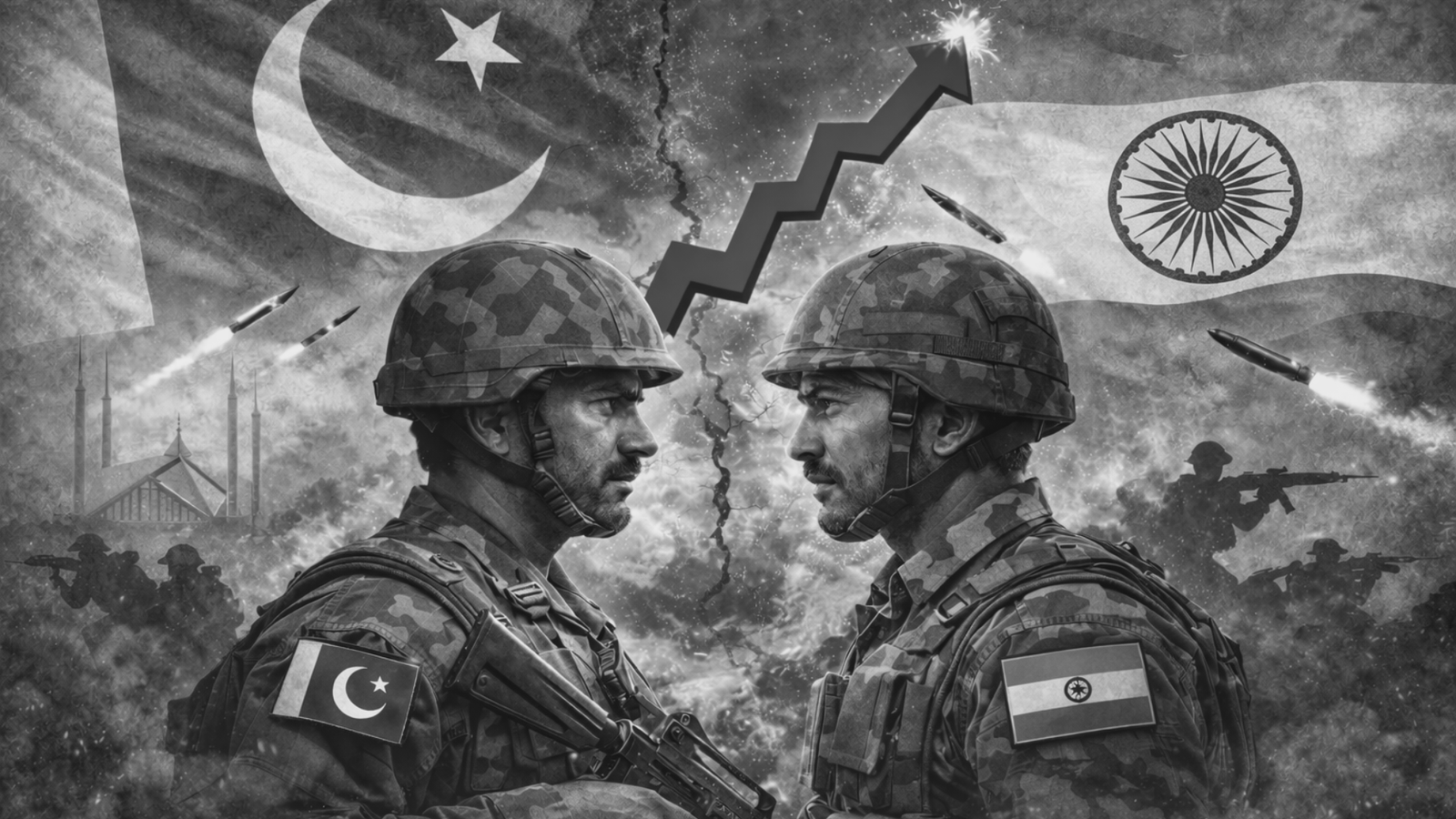
ImageSource: ChatGPT
Tags
- #deterrence failure south asia
- #india pakistan escalation dynamics
- #nuclear deterrence
- #nuclear deterrence stability instability paradox
- #nuclear escalation
- #pakistan
- #pakistan military strategy
- #pakistan strategic culture analysis
Author
Varda Dalal
Varda Dalal is an intern at CNAWS. She holds a Master's Degree in International Relations from Brunel University London. Her dissertation is a comparative study of intelligence failures prior to the Kargil War (India) and October 7 attacks (Israel). Varda's interests include International security, global affairs, policy and South Asian geopolitics.