Department of Strategic Foresight & Scenario Planning · Research Papers · Defence Technology ·
Mission Sudarshan Chakra: The Future of India's Air Defence System and Second-Strike Survivability
Mohit Vashisth, Bhaskar Jha and Chandan Vishwas
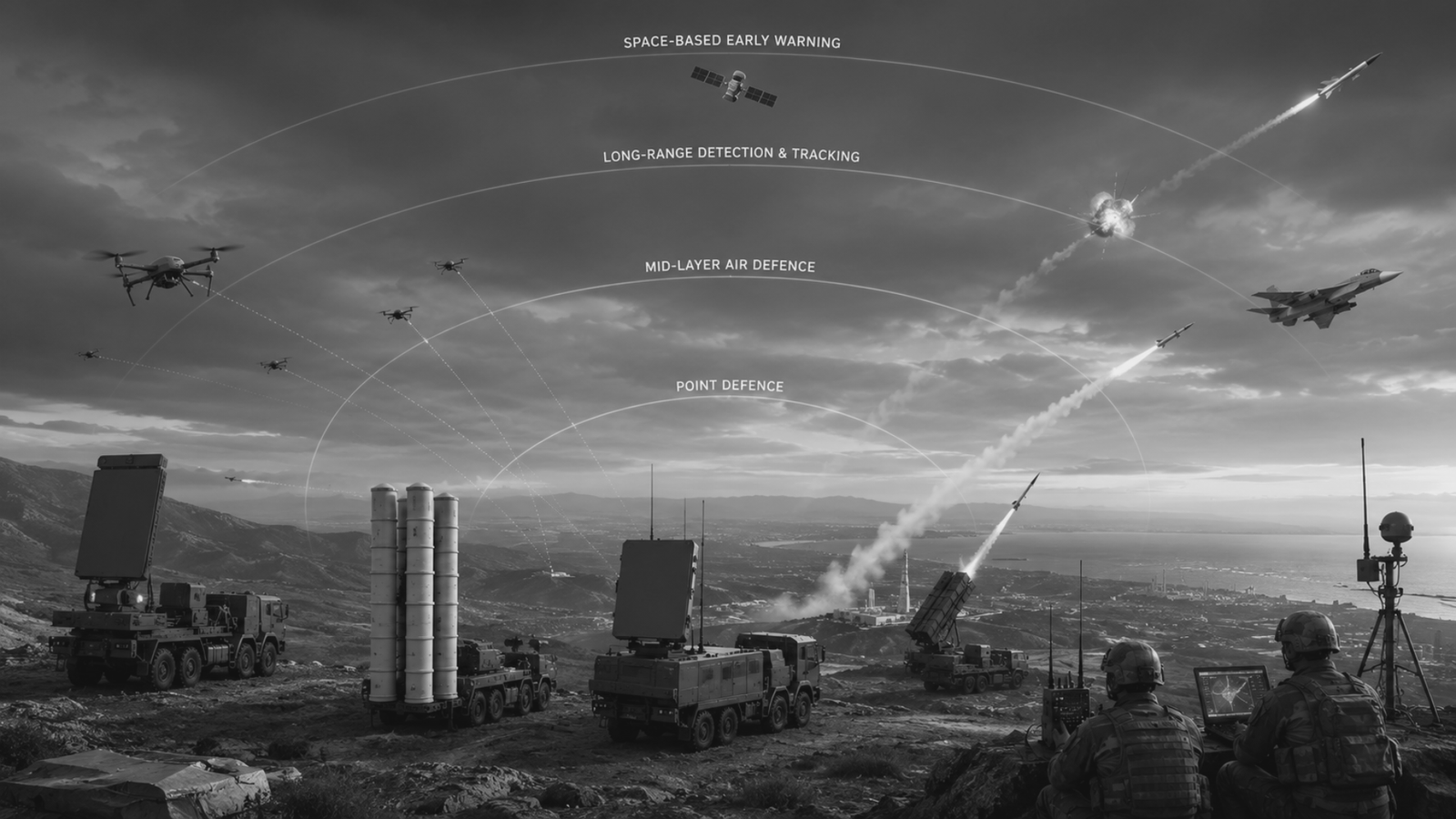
The evolution of aerial warfare is fundamentally reshaping the requirements of national air-defence architectures. The proliferation of drones, loitering munitions, cruise missiles, ballistic missiles, hypersonic weapons and networked precision-strike systems has expanded the threat spectrum confronting states and compressed operational decision timelines. In this environment, air defence can no longer be understood solely as a collection of missile systems but must instead be conceptualised as an integrated ecosystem comprising sensors, interceptors, command-and-control networks, electronic warfare capabilities, space-based assets and industrial support infrastructure.
This paper analyses India's ongoing efforts to develop a layered and indigenous air-defence architecture under the conceptual framework of Mission Sudarshan Chakra. It examines the evolution of key indigenous capabilities, including counter-drone systems, directed-energy weapons, QRSAM, VL-SRSAM, Akash-NG, Project Kusha and Ballistic Missile Defence Phase II, while assessing their role within a broader national air-defence network. The study further explores the significance of space-based early warning, advanced radar systems, artificial intelligence-enabled sensor fusion and electronic warfare in enhancing situational awareness, engagement effectiveness and operational resilience.
The paper argues that the strategic value of air defence extends beyond territorial protection and is increasingly linked to the survivability of critical infrastructure, military command networks and India's nuclear deterrent. Consequently, air defence must be viewed as a central component of second-strike survivability and strategic stability. Through a comparative assessment of Indian, Chinese and Pakistani air-defence capabilities, the paper identifies existing strengths, capability gaps and emerging challenges likely to shape the future battlespace.
The study concludes that the effectiveness of India's future air-defence architecture will depend not merely upon the acquisition of advanced interceptors but upon the successful integration of sensors, networks, space assets, electronic warfare capabilities and domestic industrial capacity into a coherent and resilient system of systems. As aerial threats become increasingly diverse, autonomous and technologically sophisticated, the development of an integrated indigenous air-defence ecosystem will be critical to preserving India's strategic autonomy, deterrence credibility and operational freedom of action in the decades ahead.
As the dynamics of modern warfare shift toward multi-domain and highly saturated aerial threats India’s air defence architecture is undergoing a radical indigenous transformation under the strategic umbrella of Mission Sudarshan Chakra. Relying on imported legacy platforms creates strategic vulnerabilities particularly during prolonged conflicts. Consequently, India is aggressively transitioning toward deploying fully indigenous Surface-to-Air Missile (SAM) systems across every interception segment.
By integrating next-generation platforms with the existing Integrated Air Command and Control System (IACCS) this modernization drive aims to establish an overlapping pan-India protective dome. This holistic air cover is designed not just to safeguard military installations but to blanket major civilian population centres and critical economic nodes. With the securing of the aerospace domain, this architecture guarantees India’s “second-strike window” an existential strategic requirement for a nation, flanked by two hostile nuclear-armed neighbours.
1. The First Layer of Defence: Countering Drones and Low-Cost Aerial Threats
A modern air defence system is only as strong as its ability to defeat the most numerous threats. While strategic attention often focuses on fighter aircraft, cruise missiles and ballistic missiles, recent conflicts have demonstrated that low-cost drones, loitering munitions and autonomous aerial systems are increasingly becoming the preferred weapons of state and non-state actors alike. From Ukraine and the Middle East to South Asia, the proliferation of inexpensive aerial platforms has fundamentally altered the economics of air warfare.
Mission Sudarshan Chakra therefore begins at the lowest layer of the threat spectrum. Before engaging advanced aircraft or long-range missile attacks, India's air defence network must first address the challenge posed by small drones, swarm attacks and low-altitude aerial intrusions. These threats may individually possess limited destructive power, but when employed in large numbers they can overwhelm traditional air defence systems, exhaust interceptor inventories and expose critical vulnerabilities in military and civilian infrastructure.
To counter this evolving threat environment, India is developing a combination of soft-kill, hard-kill and directed-energy solutions designed to provide an economically sustainable first line of defence.
1.1. DRDO D4 Anti Drone System
Once a threat is verified the DRDO’s D4 Anti-Drone System serves as the primary soft-kill layer. The D4 utilizes advanced spoofing and jamming technologies to instantaneously sever a hostile drone’s command links and GPS navigation rendering it blind and uncontrollable before kinetic weapons are required.
1.2. Bhargavastra
For engagements against overwhelming drone swarms Solar Defence and Aerospace Limited has developed Bhargavastra, the world’s first guided micro-missile counter-drone system. Designed for rapid network-centric deployment, a single Bhargavastra unit can launch a salvo of 64 highly manoeuvrable micro-rockets in a few seconds.
1.3. DRDO Directed Energy Weapon
The successful trials of Directed Energy Weapons (DEWs) in Kurnool signal a monumental paradigm shift in air defence economics. High-energy laser systems offer a virtually limitless magazine and a “near-zero cost per shot”. By utilizing electricity rather than expensive solid propellants, DEWs ensure economic sustainability in high-intensity asymmetric warfare preventing India’s defence budget to suffer in warfare including cheap drones.
2. Protecting the Battlefield and the Fleet
Modern air defence cannot be built around a single interception layer. While counter-drone systems and directed-energy weapons provide protection against low-cost aerial threats, they are insufficient against fast-moving aircraft, helicopters, precision-guided munitions and sea-skimming cruise missiles. As threats become faster, more manoeuvrable and capable of operating across larger distances, air-defence systems must extend both their engagement range and reaction speed.
This requirement gives rise to the intermediate layers of Mission Sudarshan Chakra. Positioned between short-range counter-UAS systems and long-range strategic interceptors, these agile defensive layers are designed to protect advancing ground formations, critical military infrastructure and naval assets operating in contested environments. Unlike fixed strategic air-defence systems, these platforms must remain highly mobile, capable of rapid deployment and able to engage threats from multiple directions with minimal warning.
The objective is to ensure that India's land and maritime forces can continue operating under hostile air and missile threats while maintaining freedom of manoeuvre across the battlefield.
2.1. Quick Reaction Surface to Air Missile (QRSAM)/Anant Shastra
Offensive ground manoeuvres require an air defence canopy that can move seamlessly with advancing forces. To fill this gap Quick Reaction Surface-to-Air Missile (QRSAM) has been developed for the Indian Army. Equipped with an advanced active Ku/X band seeker QRSAM provides critical fire-on-the-move capabilities and creates a 30-kilometer protective shield over advancing tank columns without requiring them to halt for deployment.
2.3. Vertical Launch Short Range Surface-to-Air Missile (VL-SRSAM)
The airspace above and vital naval assets is being secured by the Vertical Launch Short Range Surface to Air Missile (VL-SRSAM). Featuring advanced Radio Frequency (RF) seekers and a rapid 360-degree hot-launch capability, this system neutralizes low-flying, sea-skimming cruise missiles that frequently evade conventional ship-borne radar.
2.4. AKASH-NG
Akash-NG (New Generation) is an advanced, indigenous medium-range Surface-to-Air Missile (SAM) system developed by India's DRDO. Designed for the Indian Air Force (IAF), it intercepts high-speed, agile aerial threats like fighter jets, cruise missiles, and UAVs at ranges up to 70-80 km and speeds around Mach 2.5. For targeting highly agile and fast-manoeuvring fighter jets the Akash-NG (New Generation) provides a massive technological leap over its legacy predecessor. Utilizing a dual-pulse solid rocket motor, the Akash-NG retains high kinetic energy well into the terminal phase of its flight allowing it to effortlessly outmanoeuvre advanced hostile aircraft attempting high-G defensive evasions.
2.5. Project Kusha/Extended Range Air Defence System (ERADS)
The centrepiece of India’s future area-defence strategy is Project Kusha, officially designated as the Extended Range Air Defence System (ERADS). Designed to ultimately eliminate strategic reliance on imported platforms like the Russian S-400.
Project Kusha functions as a highly sophisticated and completely indigenous “Iron Dome”. The architecture relies on three distinct interceptor variants (the M1 at 150 km, M2 at 250 km and M3 up to 350 km) allowing it to track and destroy stealth fighters, AWACS and precision-guided munitions deep within enemy airspace.
Expanding this mainland shield to the maritime domain is the highly anticipated Naval Kusha program. Slated to utilize Mach 7 hypersonic interceptors, Naval Kusha will outrange legacy systems like the Barak-8. This capability establishes an impenetrable long-range bubble around Indian Carrier Strike Groups, effectively neutralizing anti-ship ballistic missiles at massive standoff distances before they can threaten the fleet.
3. The Missing Layer: Space-Based Early Warning
Despite India’s progress in ballistic missile defence, long-range sensors and interceptor development, its air defence architecture still needs a stronger space-based early warning layer. India’s Phase-II BMD test has already validated a network-centric system involving long-range sensors, low-latency communication, mission control and advanced interceptor missiles, but this still depends heavily on timely detection and tracking.
Space-based early warning matters because missile defence begins before interception. Infrared satellites can detect missile launches from space by identifying heat signatures generated during launch and boost phase, giving command networks more time to assess the threat and cue interceptors.
The United States provides the clearest model. Its Space Based Infrared System is designed to support missile early warning, missile defence, battlespace awareness and technical intelligence, with sensors providing continuous global strategic missile warning.
Washington is now moving beyond SBIRS through the Next Generation Overhead Persistent Infrared programme. The U.S. Government Accountability Office states that these infrared satellite-based sensors provide worldwide initial warning of ballistic missile attacks and are intended to replace SBIRS.
China is also strengthening this layer. The 2024 U.S. Department of Defense report states that China is improving early-warning capabilities needed to support a launch-on-warning posture and has developed large phased-array radars and early-warning satellites.
This matters for India because early warning is directly linked to second-strike survivability. A state that detects missile launches earlier gains more time to protect command structures, disperse forces, activate missile defence and preserve retaliatory options. This is especially important in a two-front nuclear environment involving China and Pakistan.
India already possesses important terrestrial and maritime elements of missile tracking and BMD support, but these cannot fully replace orbital detection. Ground and sea-based radars are constrained by geography and radar horizon, while space-based infrared systems can detect launches much earlier from above the battlespace.
For Mission Sudarshan Chakra, the logical next step is an indigenous missile-warning satellite constellation. Such a system would strengthen AD-1 and future AD-2 cueing, improve Project Kusha’s strategic relevance, support naval air defence, and add depth to India’s second-strike survivability.
The strategic implication is clear that interceptors destroy incoming threats, but early-warning satellites buy the time needed to make interception possible. Without a dedicated space-based warning layer, India’s air defence network may become strong at the terminal and mid-course interception stages but weaker at the earliest stage of the kill chain.
4. Sensors, Radars and the Battle for Detection
Kinetic interceptors are entirely blind without a pristine sensory network guiding them. To eliminate radar blind spots within the heavily shadowed valleys of the northern borders, the Indian Air Force is actively fortifying the Himalayas with new radar systems.
A critical component of this sensory upgrade is the deployment of advanced High Power Radars (HPRs) designed for long-range surveillance. Working in tandem with these systems is the indigenous Ashwini 4D Active Electronically Scanned Array (AESA) radar. Capable of tracking highly manoeuvrable targets up to 250 kilometres away with extreme precision, these AESA platforms feed unjammable data directly into the central command network.
Looking towards the imminent threat of 5th-generation stealth aircraft such as China’s J-20, India is actively investing in Quantum Radar technology. By utilizing entangled photons rather than traditional radio waves, quantum radars entirely bypass standard radar-absorbent materials. Once operational, this technology will ensure that no hostile aircraft, regardless of its stealth coating or electronic warfare suite, can penetrate Indian airspace undetected.
The future of Indian air defence will depend not only on the range of interceptors but on the speed, quality and reliability of the information that connects sensors, commanders and shooters. Modern air threats now include drones, cruise missiles, loitering munitions, ballistic missiles, stealth aircraft and hypersonic systems, each of which moves at different speeds, altitudes and signatures. This makes air defence a data-fusion problem as much as a missile-interception problem. India’s existing Integrated Air Command and Control System already reflects this logic, as it is designed to integrate ground-based sensors, airborne sensors, air-defence weapon systems and command-and-control nodes into an integrated air situation picture.
The Indian Air Force’s IACCS is therefore the foundation on which future AI-enabled air defence must be built. As early as 2010, the Ministry of Defence described IACCS as an automated command-and-control system for air-defence operations that would ride on the AFNET backbone and integrate sensors, weapons and command nodes. This shows that India has already moved away from isolated air-defence batteries toward network-centric air defence.
The operational logic of this approach was visible during Operation Sindoor, where official government material stated that the IAF’s IACCS brought together India’s air-defence elements and provided the net-centric operational capability required for modern warfare. This is important because future saturation attacks will not give commanders the luxury of manually processing every radar track, drone signature or missile trajectory.
AI-enabled sensor fusion should therefore become the next stage of Mission Sudarshan Chakra. Its purpose should be to combine inputs from ground radars, airborne early-warning aircraft, passive sensors, electronic intelligence systems, naval sensors, satellite feeds, counter-UAS systems and civilian airspace data into a single recognised air picture. NATO’s Science and Technology Organization has specifically identified artificial intelligence for military multi-sensor fusion engines as a capability area designed to provide militarily relevant fused information from heterogeneous sensors on distributed and moving platforms.
This matters because the main challenge in modern air defence is no longer simply detecting an object. The harder task is identifying what the object is, ranking how dangerous it is, deciding which weapon should engage it, and doing all this before the target reaches its objective. The Ministry of Defence has previously noted that complex tactical software developed for IACCS performs sensor-information fusion, provides an air situation picture and supports identification, classification and threat assessment.
Automated target prioritisation will be essential in a saturated battlespace. If India faces a simultaneous attack involving drones, decoys, cruise missiles and ballistic missiles, the system must decide which tracks are genuine threats, which are distractions, and which require immediate engagement. Human commanders should remain in control of lethal decisions, but AI can help compress the observe-orient-decide-act cycle by filtering clutter, correlating tracks and highlighting the most dangerous threats first.
Threat ranking is equally important because not every aerial object deserves the same interceptor. A small quadcopter, a loitering munition, a cruise missile and a ballistic missile impose very different levels of risk and require very different response options. Bharat Electronics’ Air Defence Control and Reporting System is explicitly designed for tactical command and control of Army Air Defence and for optimal utilisation of available weapons against hostile targets, which reinforces the principle that air defence success depends on matching the right weapon to the right threat.
AI-enabled fusion would also improve swarm tracking. Drone swarms create a different problem from conventional aircraft because they can appear in large numbers, fly at low altitude, use civilian-like signatures and attempt to overwhelm radar operators through volume rather than sophistication. India’s Project Akashteer has been described by the Ministry of Defence as a fully indigenous automated Air Defence Control and Reporting System that connects with IACCS and the Navy’s Trigun to create a clear real-time battlefield picture. This kind of joint, automated air-defence architecture is exactly the base on which counter-swarm tracking should be developed.
Predictive trajectory analysis should become another core requirement. In missile and drone defence, the defender must not only know where a target is, but where it is likely to be seconds or minutes later. This is especially important against low-flying cruise missiles, loitering munitions and manoeuvring drones that may exploit terrain, clutter and gaps in radar coverage. AI-assisted track correlation and prediction can help commanders anticipate likely impact points, allocate interceptors more efficiently and reduce the risk of delayed engagement.
The most important implication is that future air defence will increasingly depend on software, data architecture and decision-support systems rather than missiles alone. DARPA’s Mosaic Warfare concept captures this shift by treating future combat power as a flexible combination of sensors, shooters and command nodes that can be dynamically assembled depending on the mission. For India, this means Mission Sudarshan Chakra should not be viewed merely as a missile shield but as a software-defined air-defence ecosystem.
This does not mean replacing commanders with algorithms. It means giving commanders a faster, cleaner and more reliable operational picture in situations where human cognition alone cannot process the volume of incoming data. The United Kingdom’s Defence Artificial Intelligence Strategy notes that AI-enabled systems can reduce the cognitive burden on operators by helping interpret large amounts of sensor data and support faster decision-making.
For India, the strategic requirement is clear. IACCS, Akashteer and Trigun should evolve into a tri-service, AI-assisted air-defence kill web that links sensors, shooters and command authorities across land, air, sea and space. Such a system would improve target classification, reduce fratricide risk, conserve interceptors, counter saturation attacks and strengthen the credibility of India’s second-strike survivability. Official Indian statements after Operation Sindoor already emphasised that IACCS, Akashteer and Trigun worked together as a joint operational backbone, producing a unified real-time operational picture and enabling timely decisions.
The central lesson is that the future of Indian air defence will not be decided only by who has the longest-range missile. It will be decided by who can fuse data faster, classify threats more accurately, assign weapons more intelligently and preserve command continuity under attack. Mission Sudarshan Chakra will therefore require not only indigenous interceptors but indigenous algorithms, secure data links, resilient cloud architecture, AI-assisted command systems and human-supervised decision protocols.
5. Electronic Warfare as the Invisible Layer
Modern air defence is no longer defined only by missiles, radars and launchers. It is equally shaped by control of the electromagnetic spectrum, because every air-defence network depends on radar emissions, communication links, data transmission, satellite navigation and command-and-control connectivity. U.S. Air Force doctrine defines electromagnetic spectrum operations as military actions to exploit, attack, protect and manage the electromagnetic operational environment, with the objective of gaining information and decision advantage.
Electronic warfare therefore forms the invisible layer of any serious air defence architecture. It determines whether a radar can see, whether a missile can receive guidance, whether a drone can navigate, whether command centres can communicate, and whether an adversary can build a reliable picture of the battlespace. The U.S. Department of Defense’s Electromagnetic Spectrum Superiority Strategy explicitly treats control of the electromagnetic spectrum as essential to modern joint operations.
For Mission Sudarshan Chakra, this means that India’s future air defence network must not be understood only as a chain of interceptors from D4 and QRSAM to Project Kusha and BMD Phase II. It must also include electronic support, electronic attack and electronic protection as permanent layers of the kill chain. The US’s Joint electronic warfare doctrine divides EW into these broad functional areas because modern forces must detect hostile emissions, attack adversary electronic systems and protect their own access to the spectrum at the same time.
Radar jamming is one of the most direct ways in which electronic warfare affects air defence. An attacker can use noise jamming, deception jamming or digital techniques to degrade surveillance radars, confuse tracking radars and reduce the engagement range of surface-to-air missile systems. The Naval Air Warfare Center’s electronic warfare handbook explains that radar-focused EW seeks to deny, deceive, degrade or exploit radar systems by manipulating the electromagnetic signals on which they depend.
This is why modern suppression of enemy air defences is rarely a purely kinetic mission. Before aircraft or missiles physically destroy an air-defence battery, electronic warfare can locate radar emissions, interfere with acquisition and tracking radars, disrupt communications and create false or degraded target pictures. RUSI’s study of competitive electronic warfare notes that EW has been central to air operations since radar became the primary means by which air defenders track aircraft.
Electronic support is equally important for India’s defensive architecture. Electronic support measures allow forces to detect, intercept, identify and locate adversary electromagnetic emissions. In practical terms, this means that hostile radars, communication nodes, datalinks, drone control stations and missile-guidance emissions can be mapped before or during an engagement. Joint electronic warfare doctrine treats electronic support as a critical source of threat recognition, targeting data and situational awareness.
Electronic attack should also be built into India’s counter-UAS and air-defence planning. Cheap drones, loitering munitions and some precision weapons rely heavily on radio-frequency control links, satellite navigation and datalinks. GPS jamming blocks navigation signals, while GPS spoofing transmits false positioning information to mislead a receiver.
This has direct relevance for the DRDO D4 Anti-Drone System, directed-energy weapons and future counter-swarm capabilities discussed earlier in the article. Against low-cost drones, the most efficient response is often not a missile but an electronic effect that severs the control link, disrupts satellite navigation or forces the drone to crash or miss its target. India’s naval Shakti electronic warfare system is officially described as providing an electronic layer of defence against modern radars and anti-ship missiles, which shows how Indian force planning already recognises EW as a survivability layer rather than a support function.
Decoys and deception are another essential part of the invisible layer. Modern air attacks often use false targets, expendable decoys and electronic deception to saturate or mislead air-defence networks. The objective is to force defenders to reveal radar locations, waste interceptors, misclassify threats or delay engagement decisions. NATO identifies electromagnetic warfare as a domain where exercises, testing and training are required to identify capability gaps and prepare forces for future developments in the electromagnetic battlespace.
Electronic protection is the defensive counterpart to electronic attack. India’s own air-defence network will be a priority target for adversary jamming, spoofing, cyber-electromagnetic intrusion and datalink disruption. Therefore, radars, command centres, missile batteries, airborne early-warning aircraft and naval sensors must be hardened through frequency agility, emission control, encryption, anti-jam waveforms, passive detection and redundant communications. U.S. doctrine stresses that electromagnetic spectrum operations include not only attack and exploitation but also protection and management of the spectrum environment.
Network warfare is the final and perhaps most decisive component. A layered air defence shield is only as effective as the network connecting its sensors, shooters and command nodes. If an adversary disrupts the data links between radars, missile batteries, airborne sensors and command centres, the defender may still possess powerful interceptors but lose the ability to employ them coherently. The Indian Air Force’s own indigenisation compendium stresses that integration with the Integrated Air Command and Control System is essential for seamless data fusion and real-time situational awareness.
The central lesson is that many air battles are shaped before any missile is launched. If an adversary can blind radars, jam communications, spoof navigation, create false targets or fracture command networks, the defender’s missile inventory becomes less relevant. Conversely, if India can protect its own spectrum access while degrading the adversary’s, Mission Sudarshan Chakra will become more than a missile shield. It will become a resilient electromagnetic, digital and kinetic defence architecture.
For this reason, India should treat electronic warfare as a permanent design principle of its future air defence system. Every major layer, from counter-drone systems and QRSAM to Project Kusha, naval air defence and BMD, should be integrated with electronic support, electronic attack and electronic protection capabilities. The future of Indian air defence will not be decided only by how far its interceptors can fly, but by whether its networks can see, communicate, decide and survive inside a contested electromagnetic environment.
6. Protecting India’s Nuclear Deterrent
India adheres strictly to a “No First Use” nuclear doctrine. As the national survival hinges entirely on assured retaliation, guaranteeing the “second-strike window” against the China-Pakistan axis requires the interception of incoming nuclear ballistic missiles before they can strike Indian command centres.
To this end India’s Ballistic Missile Defence (BMD) Phase II programme is introducing the highly classified AD-1 and AD-2 kinetic kill vehicles.
These Phase II interceptors are designed specifically to intercept 5,000-kilometer class Intercontinental Ballistic Missiles (ICBMs). By operating in both the exo-atmospheric and endo-atmospheric domains these interceptors ensure that the hostile nuclear warheads are physically destroyed in the vacuum of space long before atmospheric re-entry.
This exo-atmospheric shield is supported by INS Dhruv (India’s ocean surveillance and missile-tracking vessel). By deploying far into the maritime domain, INS Dhruv functions as an ultra-early warning system. It detects adversary missile launches at their exact point of ignition feeding critical real-time telemetry back to the mainland to cue the AD-1 and AD-2 interceptors.
India’s air defence architecture must be understood not only as a shield for cities, air bases and critical infrastructure, but also as a protective layer for the country’s nuclear deterrent. India officially remains committed to credible minimum deterrence and No First Use, which means the survivability of its retaliatory capability is central to the credibility of its nuclear posture.
This makes second-strike survivability a core air defence problem. If India absorbs a first strike, its command structures, missile units, storage infrastructure, communication nodes and sea-based deterrent must remain functional enough to enable assured retaliation. India’s official statement after INS Arihant’s first deterrence patrol described the patrol as completing the establishment of the country’s survivable nuclear triad.
The Strategic Forces Command is central to this architecture because official PIB releases identify SFC involvement in operational launches of nuclear-capable missile systems. PIB has described the SFC as handling India’s nuclear weapons assets and has recorded SFC involvement in Agni and Prithvi missile launches.
The protection of missile forces is therefore inseparable from air and missile defence. India’s Prithvi-II has been described by PIB as a mobile Transporter Erector Launcher based missile, giving it battlefield manoeuvrability and operational flexibility. Mobility improves survivability, but mobile launchers still require protection against drones, cruise missiles, loitering munitions, aircraft and ballistic missile threats.
India’s BMD Phase-II programme is directly relevant to this requirement. DRDO’s AD-1 interceptor is designed for both low exo-atmospheric and endo-atmospheric interception of long-range ballistic missiles and aircraft. During the 2022 AD-1 test, all BMD weapon-system elements were deployed at different geographical locations, showing that missile defence is already being developed as a distributed network rather than as a single isolated weapon.
The protection of nuclear command centres is equally important. India has stated that it maintains a robust nuclear command-and-control structure, effective safety assurance architecture and strict political control under the Nuclear Command Authority. Any credible air defence architecture must therefore protect not only launch platforms but also the political, military and communication structures that make retaliation possible.
Communication survivability is a decisive requirement because nuclear deterrence depends on the ability to transmit authorised orders under extreme crisis conditions. PIB has described India’s Defence Communication Network as a strategic, secure and state-of-the-art communication network providing converged voice, data and video services to the three Services, Integrated Defence Staff and Strategic Forces Command with redundancy.
India’s sea-based deterrent adds another layer of survivability. INS Arihant’s first deterrence patrol was officially described as completing India’s survivable nuclear triad, and the Prime Minister’s Office stated that India had joined a small group of countries capable of designing, constructing and operating SSBNs. This makes the protection of naval bases, SSBN support infrastructure, maritime communication links and anti-submarine surveillance networks an indirect but essential part of India’s nuclear deterrent.
This is where Mission Sudarshan Chakra becomes strategically significant. A layered air defence system that combines counter-UAS systems, short-range air defence, long-range interceptors, BMD assets, radars, C4ISR networks and electronic warfare would protect the physical and digital infrastructure on which India’s second-strike capability depends.
India’s emerging automated air defence systems also matter in this context. Akashteer has been described by PIB as a fully indigenous automated Air Defence Control and Reporting System that integrates radar systems, sensors and communications into a single operational framework. BEL’s Air Defence Control and Reporting System lists multi-sensor tracking, data fusion, identification, threat evaluation and weapon assignment among its functions.
The central argument is therefore straightforward. A nuclear deterrent is not survivable merely because missiles exist. It is survivable only if launchers, storage sites, command authorities, communication links, submarines, bases and supporting sensor networks can endure a first strike and remain operational. India’s future air defence system must therefore be treated as a shield for national deterrence, not merely as a shield against aircraft and missiles.
7. Comparative Air Defence Balance: India, China and Pakistan
India’s future air defence architecture must be assessed against the two-front threat environment created by China and Pakistan, because both adversaries possess layered air defence systems, missile forces and growing sensor networks.
China currently operates one of Asia’s most dense integrated air defence systems, combining early-warning radars, fighter aircraft and multiple surface-to-air missile systems across the mainland and near its coastline. China’s long-range air defence layer includes the indigenous HQ-9 family and Russian S-400 systems, with the S-400 providing China a reported engagement envelope of up to 400 km depending on interceptor type. China has also developed upper-tier missile defence capabilities such as the HQ-19, which has been compared to the American THAAD system and is designed for ballistic missile interception. Open-source assessments also mention Chinese work on systems such as HQ-26, although details remain limited due to the opacity of China’s missile defence programmes. China’s advantage is not only in interceptors but also in the wider air and missile defence ecosystem, since Chinese military writings and foreign assessments point to increasing emphasis on space-based early warning, infrared detection and integrated space-ground missile warning.
Pakistan’s air defence network is smaller than China’s but has become increasingly China-dependent. Pakistan inducted the Chinese-origin HQ-9/P long-range air defence system in 2021, giving the Pakistan Army its first major high-to-medium air defence capability. Pakistan also operates the LY-80, the export variant of China’s HQ-16 medium-range SAM system, which was inducted by the Pakistan Army in 2017. At the short-range layer, Pakistan operates the FM-90, an export variant of the Chinese HQ-7B system intended for low-altitude air defence. Pakistan’s air defence strength therefore lies in Chinese-supplied layered systems, but its weakness remains dependence on imported platforms, limited indigenous missile-defence depth and uncertain resilience against saturation attacks, electronic warfare and precision stand-off weapons.
India’s current advantage lies in the simultaneous development of imported, indigenous and networked air defence layers. India signed a contract for five S-400 squadrons with Russia, giving the Indian Air Force a long-range air defence capability against aircraft, cruise missiles and other aerial threats. As mentioned earlier, India is also developing Project Kusha as an indigenous long-range surface-to-air missile system under DRDO, with reported plans for a multi-layered interception architecture comparable in role to the S-400. At the indigenous medium and short-range levels, systems such as Akash, Akash-NG, QRSAM and VSHORADS strengthen India’s ability to build a self-reliant layered air defence network rather than depend entirely on foreign suppliers. India’s Phase-II Ballistic Missile Defence test in July 2024 validated a networked BMD architecture involving land and sea-based radars, mission control systems and interceptor launch elements.
The key strategic difference is that China is ahead in integrated aerospace defence and missile early-warning depth, Pakistan is heavily dependent on Chinese systems, and India is attempting to build a more sovereign, multi-layered and increasingly indigenous air defence shield. India may therefore emerge as the most diversified air defence power in South Asia, but it still needs to close the gap with China in space-based missile warning, persistent surveillance and strategic missile defence integration.
8. Operational Lessons from Operation Sindoor
The evolution of India's air defence architecture cannot be understood solely through technological developments and procurement programmes. Recent combat experience has reinforced the reality that future conflicts will involve simultaneous employment of drones, loitering munitions, cruise missiles, electronic warfare and information operations designed to overwhelm traditional air defence networks. The lessons emerging from Operation Sindoor highlight the operational relevance of Mission Sudarshan Chakra and underscore why India is investing heavily in layered indigenous air defence capabilities.
8.1. Drone Saturation and the Economics of Air Defence
One of the most important lessons from Operation Sindoor was the growing prominence of unmanned aerial systems in modern conflict environments. The proliferation of low-cost drones demonstrated how relatively inexpensive aerial platforms can impose disproportionate costs on defenders when expensive interceptor missiles are employed against every incoming target. Similar trends have been observed in conflicts across Ukraine, the Middle East and the Red Sea region, where mass drone attacks have increasingly challenged conventional air defence doctrines. The experience reinforces the necessity of integrating systems such as the DRDO D4 Anti-Drone System, Bhargavastra and Directed Energy Weapons into India's broader air defence architecture. Rather than relying exclusively on kinetic interceptors, future air defence networks must possess the ability to neutralize hostile drones through jamming, spoofing, electronic attack and low-cost energy-based solutions. This approach improves sustainability during prolonged conflicts and preserves high-value missile inventories for more sophisticated threats.
8.2. The Growing Threat from Loitering Munitions
Operation Sindoor also demonstrated the increasing importance of loitering munitions and one-way attack drones. Unlike traditional missiles, these systems can remain airborne for extended periods while searching for targets and can exploit gaps in radar coverage through low-altitude approaches. Such weapons blur the distinction between drones and precision-guided munitions, creating unique detection and interception challenges. The threat environment therefore requires a dense network of short-range air defence systems capable of providing continuous protection to military bases, command centres, logistics nodes and critical infrastructure. Systems such as QRSAM, Akash-NG and future indigenous counter-UAS platforms will play an essential role in countering these evolving threats.
8.3. Cruise Missiles and Terrain-Masking Challenges
The growing availability of precision-guided cruise missiles presents another major challenge for Indian air defence planners. Cruise missiles exploit terrain masking, low-altitude flight profiles and high manoeuvrability to evade traditional radar networks. Unlike ballistic missiles, they provide limited warning time and can approach from unexpected directions. The operational lessons from recent conflicts demonstrate that defending against cruise missiles requires an integrated sensor network comprising ground-based radars, airborne surveillance assets, maritime sensors and space-based surveillance systems. India's investments in Ashwini AESA radars, High Power Radars, INS Dhruv and future integrated sensor networks are therefore as important as the interceptor missiles themselves. Air defence effectiveness increasingly depends upon the speed and quality of detection rather than interceptor performance alone.
8.4. Radar Networking and Sensor Fusion
A recurring lesson from modern warfare is that isolated air defence systems are vulnerable, while networked air defence systems are resilient. Operation Sindoor highlighted the importance of integrating multiple sensors into a common operational picture. Radar stations, airborne early warning aircraft, naval sensors, satellite feeds and electronic intelligence platforms must all contribute to a unified command architecture capable of rapidly identifying and prioritising threats. India's Integrated Air Command and Control System (IACCS) provides the foundation for such a network-centric approach. As the number and diversity of airborne threats increase, artificial intelligence and automated sensor fusion will become indispensable for reducing decision-making timelines and preventing saturation of command centres.
8.5. The Imperative of Counter-Swarm Capability
The future battlefield is likely to witness coordinated attacks involving dozens or even hundreds of autonomous drones operating simultaneously. Traditional air defence systems were designed to engage limited numbers of aircraft and missiles rather than large-scale drone swarms. Operation Sindoor reinforced the importance of developing dedicated counter-swarm capabilities capable of detecting, tracking and neutralizing multiple targets simultaneously. Directed Energy Weapons, AI-enabled threat classification systems and specialised anti-drone interceptors represent critical components of this future defence architecture. Without effective counter-swarm capabilities, even sophisticated air defence networks risk being overwhelmed through sheer target volume.
8.6. Civil-Military Airspace Coordination
Another important lesson concerns the management of increasingly congested airspace. As civilian drones become more common across India, distinguishing legitimate civilian activity from hostile incursions will become progressively more difficult. Effective air defence therefore requires not only military capabilities but also robust regulatory and civil aviation frameworks. A comprehensive national drone registry, real-time airspace monitoring and seamless coordination between military authorities, civilian aviation regulators and law enforcement agencies are essential to reducing false positives and ensuring that defensive resources are directed toward genuine threats. The effectiveness of future air defence systems will depend as much on information management and airspace governance as on missile technology itself.
9. Limitations and Challenges
9.1. Navigation Network Degradation and Second-Strike Vulnerabilities
A fundamental prerequisite for air defence architecture is an independent and highly resilient satellite navigation network. The Indian Regional Navigation Satellite System (NavIC) currently faces critical operational loopholes.
Recent anomalies including degradation of on-board atomic clocks across legacy platforms, have periodically pushed the active constellation below the minimum four-satellite threshold required for accurate and real-time positional fixes. The integrity of India’s Ballistic Missile Defence (BMD) shield and its second-strike nuclear survivability rely heavily on uninterrupted and highly precise geospatial telemetry.
In a high intensity conflict forced reliance on foreign satellite constellations such as the American GPS or Russian GLONASS could result in signal denial and degradation which can compromise India’s strategic autonomy and exposing a critical vulnerability in the nation’s sensor-to-shooter loop.
9.2. C4ISR and Orbital Deployment Challenges
An advanced air defence canopy is entirely dependent on the continuous feed of space-based early warning and reconnaissance data. In recent years India has encountered operational friction in maintaining a consistent cadence for deploying crucial military satellites including anomalies and delays impacting advanced Earth Observation and cartographic platforms. Setbacks in orbital deployment restrict the Indian Armed Forces C4ISR (Command, Control, Communications, Computers, Intelligence, Surveillance and Reconnaissance) capabilities.
This gap in the space-based surveillance prevents continuous and real time monitoring of adversary missile silos and stealth fighter deployments. Consequently, this creates a temporal blind spot that ground-based long-range radars cannot fully mitigate early warning window necessary to pre-emptive measures.
9.3. Hypersonic Threat Matrix and Indigenous Countermeasures
The rapid development of hypersonic missiles by China, most notably through the deployment of Hypersonic Glide Vehicles (HGVs) and advanced hypersonic cruise missiles exposes a severe capability lag in traditional air defence networks.
Current Surface to Air Missile (SAM) radars are primarily calibrated for predictable ballistic trajectories and subsonic targets which rendering them highly vulnerable to the extreme velocity, low-altitude trajectories and unpredictable mid-course manoeuvrability of hypersonic platforms. India’s active testing of its indigenous Hypersonic Technology Demonstrator Vehicle (HSTDV) provides a strategic pathway to mitigate this threat.
The aerodynamic, kinetic and thermal data acquired through the development of offensive hypersonic platforms grants the Defence Research and Development Organisation (DRDO) the foundational physics and engineering models required to conceptualize and field counter-hypersonic interceptors and presenting an opportunity to close this defensive loophole through parallel technological development.
9.4. Expanding the Maritime Umbrella: The Imperative for an Aegis Equivalent
As the geopolitical centre of gravity shifts decisively toward the Indo-Pacific and India’s air defence coverage must extend beyond its terrestrial borders deep into the Indian Ocean Region (IOR). While current frontline combatants like Project 15B destroyers, which utilize systems like the Barak-8 (MRSAM) to secure immediate fleet perimeters.
However, Indian Navy lacks a true, long range air defence system comparable to the American Aegis Combat System. To effectively secure strategic maritime choke points and project sustained power, Indian Navy must equip its next-generation destroyers with an Aegis-equivalent architecture. Integrating long-range exo-atmospheric interceptors with advanced maritime multi-function radars potentially a naval iteration of Project Kusha would expand India’s protective umbrella and can transform naval assets from fleet escorts into sovereign mobile air defence fortresses capable of theatre-wide air defence shield.
10. Air Defence Challenges of 2035
By 2035, India’s air defence challenge will not be limited to aircraft, cruise missiles and ballistic missiles. The threat environment is likely to be shaped by autonomous drones, loyal-wingman UCAVs, hypersonic glide vehicles, stealth unmanned aircraft, counter-space threats and networked missile salvos. This makes Mission Sudarshan Chakra a long-term systems challenge rather than a one-time procurement programme.
The first major challenge will be AI-enabled drone swarms. Drone swarms are dangerous because they can create saturation, confuse radar operators, exhaust interceptor inventories and attack from multiple directions at low cost. DARPA’s OFFSET programme was built around the military problem of using large numbers of unmanned air and ground systems in complex environments, which shows that swarm warfare has already moved from theory to serious military experimentation.
For India, this means counter-UAS defence cannot depend only on kinetic interceptors. Systems such as jamming, spoofing, directed-energy weapons, micro-missile interceptors, passive detection and AI-enabled swarm classification will be essential because the cost of defeating a drone must remain lower than the cost imposed by the drone attack itself.
The second challenge will be loyal-wingman UCAVs and collaborative combat aircraft. The U.S. Air Force has already designated YFQ-42A and YFQ-44A under its Collaborative Combat Aircraft programme, and the programme is designed to field uncrewed aircraft that can work with crewed combat aircraft. The U.S. Air Force has also described CCA as part of the Next Generation Air Dominance family of systems and as a software-defined, modular airpower model.
This matters because future air attacks may not be conducted only by manned fighters. A hostile package could include manned aircraft, loyal-wingman drones, decoys, electronic-warfare platforms and stand-off missiles operating together. India’s air defence system will therefore need to identify the manned aircraft, the unmanned escorts, the decoys and the actual weapons inside the same compressed engagement window.
The third challenge will be hypersonic glide vehicles and hypersonic cruise missiles. Hypersonic weapons are difficult to defend against because they combine very high speed with manoeuvrability and non-traditional flight profiles. The U.S. Missile Defense Agency’s Glide Phase Interceptor effort exists specifically because hypersonic glide threats require interception during the glide phase rather than relying only on traditional terminal defence.
China is already central to this threat matrix. The U.S. Department of Defense’s 2024 China military power report describes China’s continuing development of advanced missile capabilities, including hypersonic systems and long-range precision-strike weapons. India has demonstrated progress in hypersonic technology through DRDO’s successful flight test of the Hypersonic Technology Demonstrator Vehicle, but offensive hypersonic progress must be matched by dedicated counter-hypersonic sensors, interceptors and command systems.
The fourth challenge will be stealth UCAVs and low-observable unmanned systems. Stealth is no longer limited to manned aircraft. As autonomous and semi-autonomous aircraft become cheaper and more capable, low-observable unmanned platforms may be used for reconnaissance, electronic attack, decoy missions and precision strike. The U.S. Air Force’s CCA programme already points toward a future in which uncrewed platforms complement manned fighters in contested airspace.
For India, this means radar modernisation must go beyond range. Future sensors must combine AESA radars, passive detection, infrared search and track, electronic-support measures, multi-static radar concepts and AI-enabled track correlation. A stealth target may not be visible to every sensor at every moment, but a fused network can still build a reliable track from partial signatures.
The fifth challenge will be threats to space-based infrastructure. Modern air defence depends heavily on satellites for communication, navigation, surveillance, missile warning and timing. Secure World Foundation’s 2026 Global Counterspace Capabilities Report assesses publicly available counterspace capabilities across co-orbital systems, direct-ascent weapons, electronic warfare, directed energy and cyber, showing that space is now an active military competition zone.
This has direct relevance for India because any future air defence grid will depend on space-enabled C4ISR. If navigation, satellite communication, reconnaissance or missile-warning satellites are degraded, the sensor-to-shooter loop will slow down. India must therefore treat space resilience, satellite redundancy, anti-jam communications, sovereign PNT and rapid satellite replenishment as part of air defence planning, not as a separate space policy issue.
The sixth challenge will be autonomous missile networks and coordinated salvos. Future missile attacks may involve ballistic missiles, cruise missiles, drones, decoys and electronic attack arriving together to overwhelm command systems. This is why the future of air defence is moving toward kill webs, where sensors, shooters and decision systems are distributed across land, air, sea, space and cyber rather than arranged in a rigid linear chain. The U.S. Air Force’s description of CCA as software-defined and modular reflects this wider shift toward networked, adaptable combat systems.
India is not entering the 2035 threat environment from a standing start. Programmes such as HSTDV, Akashteer, Project Kusha, AD-1, AD-2, CATS and indigenous directed-energy weapons indicate that New Delhi has already begun investing in many of the technologies likely to define future air warfare. DRDO’s LR-AShM has been officially described as a hypersonic glide missile capable of engaging static and moving targets, while recent reporting indicates that India conducted a second test of the system off the Odisha coast in May 2026. The challenge is no longer recognising emerging threats. The challenge is integrating these capabilities into a coherent, layered and resilient air-defence ecosystem capable of operating across land, air, sea, space and the electromagnetic spectrum.
India’s response should be clear. Mission Sudarshan Chakra must evolve into a 2035-ready architecture built around AI-enabled sensor fusion, counter-swarm defence, counter-hypersonic capability, space-based early warning, electronic warfare resilience, indigenous interceptor production and tri-service command integration. The decisive question will not be whether India has individual advanced weapons, but whether those weapons can function as one resilient network under saturation, deception and electronic attack.
11. Conclusion: Building the Shield of Strategic Autonomy
The future of Indian air defence will not be defined by any single missile, radar or interceptor. It will be determined by India's ability to integrate sensors, shooters, command networks, space assets, electronic warfare systems and industrial capabilities into a unified and resilient defensive ecosystem. Mission Sudarshan Chakra represents the most ambitious effort yet to achieve that objective.
The character of aerial warfare is changing rapidly. The threats confronting India are no longer limited to conventional aircraft or ballistic missiles. Drone swarms, loitering munitions, stealth platforms, hypersonic weapons, electronic attack and space-enabled precision strike systems are compressing decision timelines and challenging traditional air-defence architectures across the world. Future conflicts will be fought across multiple domains simultaneously, requiring defenders to detect, classify, track and engage diverse threats in real time.
India has already begun laying the foundations for this transition. Indigenous programmes such as Akash-NG, QRSAM, VL-SRSAM, Project Kusha, AD-1, AD-2, Akashteer, the Combat Air Teaming System, directed-energy weapons and hypersonic technology development collectively demonstrate an effort to reduce strategic dependence on foreign suppliers while building a layered and technologically sophisticated defensive shield. At the same time, investments in radar modernisation, network-centric warfare, artificial intelligence, electronic warfare and space capabilities indicate an understanding that future air defence will depend as much on information superiority as on missile performance.
Yet significant challenges remain. India must strengthen its space-based early warning architecture, improve resilience against hypersonic threats, secure its military satellite networks, expand electronic warfare capabilities and ensure that industrial production can sustain prolonged conflict. The success of Mission Sudarshan Chakra will ultimately depend not only on technological innovation but also on the ability to integrate these capabilities into a coherent national architecture capable of operating under conditions of saturation, deception and strategic surprise.
At its core, Mission Sudarshan Chakra is not merely an air-defence programme. It is an effort to safeguard India's strategic autonomy. A credible No First Use policy, assured second-strike capability and effective deterrence all depend upon the survivability of India's military infrastructure, command networks and strategic forces. Air defence therefore becomes more than a battlefield function. It becomes a pillar of national security and strategic stability.
In the coming decade, the nations that succeed in air defence will not necessarily be those possessing the largest missile inventories. They will be those capable of fusing data faster, adapting more rapidly and maintaining resilient networks across land, air, sea, space and the electromagnetic spectrum. If successfully realised, Mission Sudarshan Chakra could provide India with precisely such a capability: an indigenous, layered and future-ready shield designed not only to defend Indian skies but to preserve India's freedom of action in an increasingly contested strategic environment.
The views expressed are those of the authors and do not represent the views of CNAWS.
Image Source: ChatGPT
Tags
- #Air Defence Modernisation
- #air defence systems
- #air power and escalation control under nuclear shadow
- #Airborne Early Warning Systems
- #Ballistic Missile Defence India
- #Future Warfare Technologies India
- #Hypersonic Weapons India
- #India Air Defence System
- #Indian Missile Defence Shield
- #operation sindoor
- #Operation Sindoor lessons
- #Project Kusha
- #Strategic Deterrence India
Author
Mohit Vashisth, Bhaskar Jha and Chandan Vishwas
Mohit Vashisth is the Founder and Executive Director (Intelligence) at CNAWS. Bhaskar Jha is a master's student in OP Jindal Global University. Chandan Vishwas is a postgraduate researcher currently pursuing a Master’s in Diplomacy, Law & Business at O.P. Jindal Global University, with an academic background in History and Political Science.