Department of Hybrid Warfare & Irregular Conflict · Research Papers · Narrative and Information Warfare ·
Information Warfare and Pakistan’s Use of Narrative Control
1. Introduction
Modern warfare has integrated information warfare as a vital component of its operations. States no longer rely only on military force to protect their interests. States now attempt to direct public understanding about events which affect their people and the worldwide community. The capacity to manage information and media content together with public viewpoint remains a fundamental requirement for national defense. This type of warfare occurs when combatants use news organizations and social media platforms and official declarations and cultural communication methods to fight their enemies.
Information warfare depends on narrative control as its main instrument. The term describes a state's power to determine how people will perceive and understand and keep in their minds certain events. Governments use selective storytelling to maintain their authority while uniting the public and deflecting negative feedback. During emergencies and political crises organizations use narrative control together with existing security measures.
Pakistan serves as an important case study to study information warfare. The country faces long-standing security challenges which include regional conflicts and terrorism and international scrutiny. The Pakistani state institutions developed communication systems which effectively managed all domestic and international storytelling requirements through their established communication systems. The organization achieves its goals through traditional media and digital platforms and official communication channels. The military and state authorities control information during this time which enables them to shape public opinion through their information control activities.
This paper tries to study Pakistan's use of narrative control as a weapon for information warfare. The study explores how different techniques and instruments of narrative control management work together with their specific objectives to determine their impact on public and worldwide perceptions. The paper analyzes the effects of these strategies which include ethical issues and media freedom restrictions in their implementation.
Pakistan functions as a pivotal research site for investigating information warfare. The country faces long-standing security challenges which include regional conflicts and terrorism and international scrutiny. The Pakistani state institutions established effective communication systems which enabled them to handle all domestic and international storytelling requirements. The organization achieves its goals through traditional media and digital platforms and official communication channels. The military and state authorities control information during this time which enables them to shape public opinion through their information control activities.
The study tries to examine how Pakistan uses narrative control as an information warfare weapon to study its operations. The research evaluates the techniques and tools and objectives of narrative control management while assessing its impact on both public and international perceptions. The paper evaluates two research strategies which are used to establish specific ethical standards and media freedom boundaries.
2. Information Warfare and Narrative Control
The information warfare strategy focuses on the use of strategic information to manipulate people’s perceptions and beliefs and their behavior for political and security purposes. This strategy is different from traditional warfare in that it is carried out without the need to win through the strength of the military. This system focuses on controlling the perceptions of the public about historical events and military conflicts and government operations. With the emergence of the digital world, there are new challenges in the information warfare strategy, especially because of the fast communication channels and the accessibility of digital platforms for the dissemination of information on the battlefield.
According to scholars, information warfare has different operational fields, which include the media, cyberspace, education, and diplomacy. This process includes two distinct types of activities. Defensive operations are carried out to protect the information space of the state, while the offensive operations are carried out to influence the information of the opponents. The activities of this organization are carried out in all periods, which include periods of peace and periods of war.
Narrative control is the most crucial factor in information warfare. A story is not merely a set of facts but a logical sequence of events which make sense. Strategic narratives are used by states to provide an explanation of their national identity in addition to justifying their policies and finding allies and enemies. Using narrative control, governments are trying to make their definition of what happened to prevail in popular discourse.
People need to understand narrative control as a distinct concept which exists separate from propaganda and disinformation. The term propaganda describes a communication method which transmits information in one direction to persuade people through selective or biased content. Disinformation means the intentional distribution of incorrect or deceptive content. Narrative control enables organizations to use factual data for their political objectives by establishing particular political narratives through their factual presentation. The approach creates hidden elements which become active when time progresses.
The control of narratives depends on the operation of media systems. The Internet-based distribution of news includes digital platforms which establish new methods for people to access information. States maintain their media control through traditional channels which include television and newspapers. The Internet has created new information warfare techniques through its development of digital platforms. Social media enables states to reach their citizens and global audiences without needing traditional media controls. The system creates higher chances for opposing viewpoints and evaluative feedback to emerge.
All information warfare operations require participation from both state organizations and non-state entities. Governments create narrative strategies with their primary control over storytelling processes which non-state groups including political organizations and online activists and media professionals use to either support or contradict official government statements. The process of controlling narratives results in ongoing battles between various groups because it does not produce permanent results.
States use narrative control to protect their legitimacy and control public opinion during security emergencies and armed conflicts. International perception depends on this process which then shapes diplomatic relations and economic partnerships and foreign policy decisions. The study of information warfare and the study of narrative control function as vital tools which researchers use to study how modern states including Pakistan approach their security challenges within the current information environment.
3. Historical Background of Information Warfare in Pakistan
Since its establishment in 1947, Pakistan has strongly emphasized on the issue of information control as a state building and national security mode. Since the young period of independence, the political leaders and the institutions of the state were aware of the need to influence the national identity and the opinion of the people in the country with the territorial conflicts, internal confrontations, and regional rivalry. Information management thus was directly associated with the security policy and legitimacy of states.
The post-independence phase of the first two decades utilized the traditional media in controlling information since the system relied on radio broadcasting and newspapers distribution and television programs that were latterly accessed. Media organisations sponsored by the state were pivotal in fostering a sense of unity within the country and offering official opinions on political events. There was a high relationship between media coverage of war conflicts with India and national defence and patriotism and external danger threats. The stories enabled people to be on the side of the government during war and political turmoil.
Information management activities came under the control of military when military forces assumed power in 1958, the first time in the history of the country. Military regimes that succeeded in the military rule put in place more instruments through which the state can control its media and communication. Information control was employed in the 1965 and 1971 wars with India to enhance the morale of the military and limit the coverage of the negative news. The authorities closely monitored the military operations and the media were just unable to provide alternative explanations of the occurrences.
The reign of General Zia-ul-Haq (1977 -1988) was a significant information revolution to Pakistan. The media began to incorporate religious convictions along with ideological notions in their narrative. Through the governmental style of communication, Islamisation was encouraged and citizens were expected to uphold national discipline and be loyal to the ruling government. The official ideology exercised control over the educational resources such as school curriculums and TV programs and social addresses as the majority of society members still have faith in these official versions nowadays.
The development of the Pakistani private media started in the 1990s. When independent television channels and newspapers were established, the diversification of the news system distribution was created. The power of state institutions was sustained by the fact that they applied pressure and regulatory measures and employed informal means to regulate the situation even after the liberalisation in the country. The development of the private media necessitated organizations to come up with sophisticated means of producing content that transcended below engaging in simple mechanisms of censoring their information.
Information warfare gained momentum after 2001 with the involvement of Pakistan in the war on terror all over the world. This is since the state adopted aggressive global image management since it was being subjected to international criticism over its militant operations and security policies. The official discourses employed by the official sources began to present Pakistan as a victim of terrorism rather than a country that brings instability. The media were spreading the news on military sacrifices and anti-terrorism operations and portraying the capacity of the country to endure challenging conditions.
The proliferation of the digital media in the 2010s changed the information environment in Pakistan. Social media enabled fast spread of official narratives and facilitated criticism and counter-narratives. State institutions in reaction to this change responded by becoming more online and coordinated digital messages. Pakistan therefore changed its traditional media control to information warfare which is a hybridized model of regulation, strategic communication and engagement online.
This historical context reveals that the concept of narrative control in Pakistan is not a new occurrence. Rather it has changed through decades in reaction to political change, war and technology. This history is important in the analysis of the modern application of information warfare in Pakistan.
4. Tools and Mechanisms of Narrative Control
To control narratives is a part of the broader information warfare strategy in which Pakistan employs a variety of tools and mechanisms to control the narratives. These tools work through the traditional media, digital media, law and the institutions of culture. They, in combination, enable authorities in states to advance some favorite interpretations of events and inhibit other or dissenting interpretations.
4.1 Governmental Institutions and Strategy Communication
One of the most important in the narration role was played by the state institutions, particularly military and the government information agencies in Pakistan. The central member of the formation of security-based discourse is the media of the armed forces called Inter-Services Public Relations (ISPR). ISPR propagates the message of the military as necessary, professional, and disciplined that guarantees stability in the country in the form of press releases, press conferences, documentaries, songs, and social media posts.
This also occurs through the control of the narratives by government ministries and spokespersons through provision of coordinated statements whenever crisis arises. These words tend to emphasize self-determination, foreign aggression, and national unity. Intersection of the same between one institution to another contributes to the expansion of one dominant narrative and does not confuse readers.
4.2 Traditional Media: Television, Print and Regulation
The television continues to be one of the most effective sources of information in Pakistan. The role of news channels, talk shows and political debates is significant to form the opinion of people. Even though the Pakistan has a huge personal media industry, it exists under a strict control mechanism. Pakistan Electronic Media Regulatory Authority (PEMRA) is empowered to impose fines, licence suspension, or block content that is deemed to be of a national unfavourable interest.
This is a regulatory environment that promotes self-censorship among the media outlets. It is a common practice by editors and journalists not to touch on issues that can make them be pressured by their authorities. Due to this, security matters are reported so that they are in line with governmental stories. The television stations are also more likely to use official briefings and approved professionals in times of sensitive events, so there is little room to air the dissenting opinion.
4.3 Digital Media and Social Media Platforms
With the emergence of the social media, Pakistan information environment has been transformed tremendously. Social platforms like X (previously twitter), Facebook, YouTube and Tik Tok have become some of the most important tools in spreading narratives. Official messages, images and hashtags are actively exchanged by state institutions through these platforms. It enables a quick reaction on the events that take place and immediate contact with the domestic and the international audience.
The amplification of official narratives is usually achieved through coordinated hashtag campaigns. Influencer and anonymous users are supportive accounts that contribute to popularizing these messages in the trends. Although in some instances, it is hard to demonstrate that direct coordination of states occurs, researchers have pointed out trends of organised online behaviour that underscores official stances.
Simultaneously, narrative control is also challenged by digital media. Alternative interpretations can be shared by independent journalists, activists and citizens. In reaction, the government has been using content control, temporary internet blockages, and laws against cybercrime in order to control internet spaces.
4.4 Legal/Administrative Controls
The other significant narrative control mechanism is legal frameworks. Speech is controlled through laws that deal with cybercrime, national security and defamation. The Prevention of Electronic Crimes Act (PECA) offers law enforcement agencies extensive capabilities to search online materials and block them. Critics believe that such laws are usually selective, especially in relation to journalists and political opponents.
Administrative procedures, e.g. warnings to media houses or informal instructions, are contributory factors too. These are not as visible as direct censorship, and can be as effective in manipulating coverage and deterring critical coverage.
4.5 Education, Culture and Popular Media
News and politics are not the only places of narrative control. The long-term instruments of formulating the national identity and the historical knowledge in an individual are education and popular culture. School textbooks can be simplified or biased descriptions of historical events, especially in terms of relations with India and the military.
Narrative formation is also done through television dramas, films, and patriotic songs. The films and dramas referring to military subjects tend to depict the security forces as heroic and morally right. These cultural products not only legitimize some views, but they also contribute to the normalisation of some views over time.
4.6 International Communication and Image Management
At the international level, narrative control is another activity done by Pakistan. Presenting Pakistan as a responsible state with a complex security problem is done through English-language media, diplomatic briefs, and taking part in the global forums. Other essential targets of this communication strategy include think tanks, foreign journalists, and international social media audiences.
This is an outside narrative control that tries to refute the bad images of terrorism, governance and unrest in the region. Pakistan aims at persuading the foreign governments and the international opinion by portraying itself as a victim of terrorism and an important security partner.
5. The Nokkundi Incident: Narrative Construction and Information Control
The Nokkundi scandal is one of the bright examples of the functioning of narrative control even after a piece of new information gets publicly exposed. In contrast to the situations when the initial misunderstanding has been used to account for the variation in the reports, this episode demonstrates how a certain version of the events remained propagated despite the subsequent and publicly covered accusations of the Baloch insurgent group of being accountable. That is why, the incident becomes very helpful to analyze the question of the indirect information control in Pakistan.
5.1 Background of the Incident
The assault occurred close to the headquarters of the Frontier Corps in Nokkundi, one of the regions that have had a history of security issues. The first reports indicated that there was an attack on the FC facility and a counter strike by the security forces. During the morning there was little information and official releases influenced the initial reporting.
This premature framing is typical of security cases and is usually conceded as temporary. Things, however, were different in the Nokkundi case as it was not about the absence of early information but how the later developments were handled.
5.2 Ownership and Separated Narrations.
Following the event, the Balochistan Liberation Army came out to accept the attack. Such a statement was covered by a number of foreign and regional media and presented the incident in the context of the Baloch insurgency.
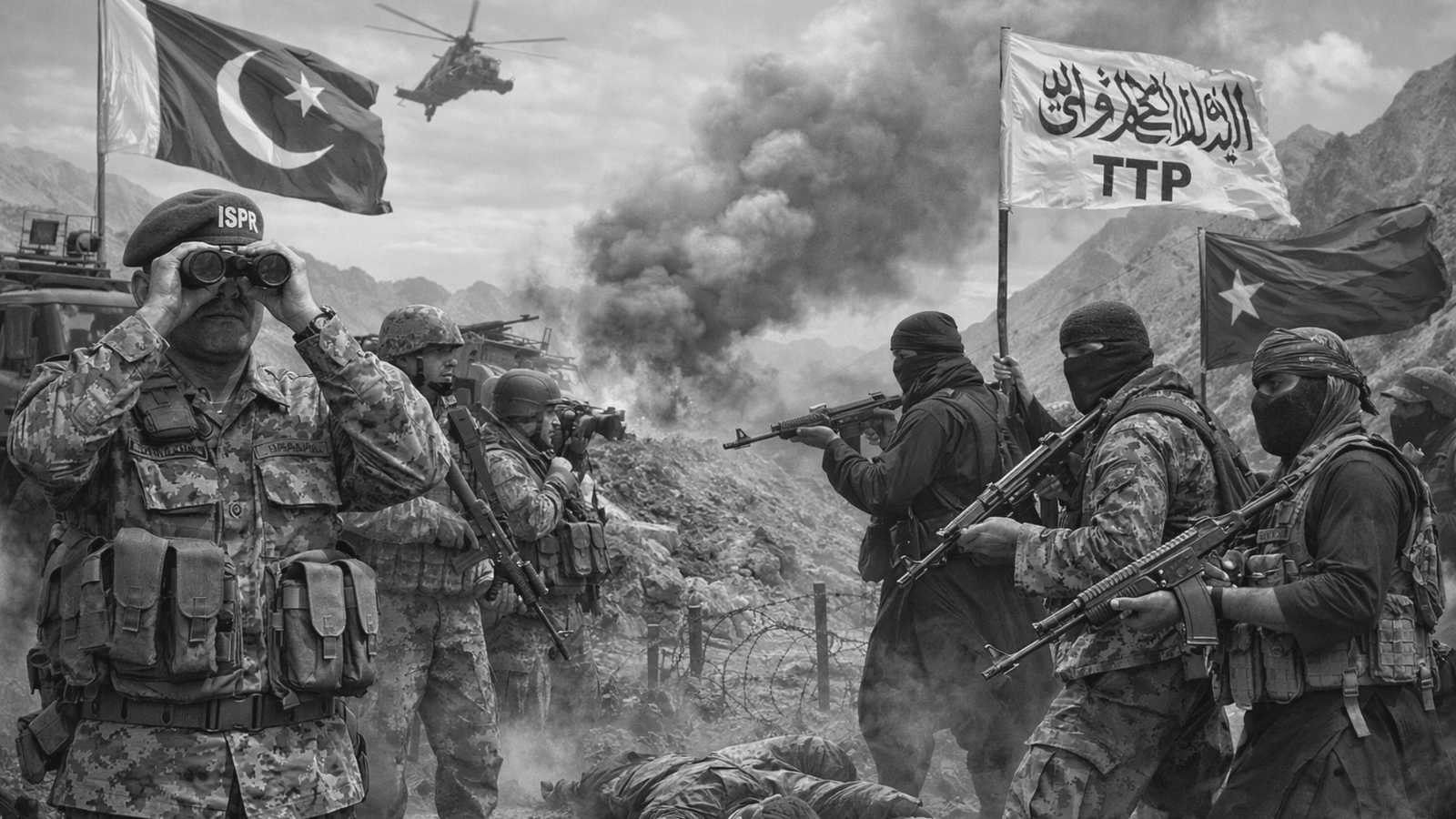
In spite of this, Pakistani mainstream media remained to report that the attack was due to the Tehreek-e-Taliban Pakistan. This attribution was similar over television, newspapers, and online news. This focus on TTP continued after the BLA claim had been subjected to the public sphere.
This was not put forward as a controversial matter or rival account. Rather the other assertion was overlooked mostly in domestic coverage. This implies that there was a conscious decision to keep a certain story intact instead of information vacuum or lateness in reporting.
5.3 Rational Rationale of the Preferred Attribution.
The relationship of the attack with TTP integrated the incident to the counterterrorism in dominance by Pakistan. TTP is typically associated with religious extremism and home-grown terrorism, stealing the usual national and international security scripts. Rather the identity of BLA would have attributed relevance to the political and separatist elements of the Baloch insurgency that would have drawn focus to the unresolved internal conflicts.
The choice to stay silent about the role TTP played in the attack enabled allowing the representation of the event as part of the greater war on terror rather than acknowledging it as part of the local political grievance. This framing reduced the need to speak of local causes or state policy in Balochistan or the problems of political representation.
5.4 Role of Pakistani Media
The Pakistani mainstream media contrived to perpetuate this narrative. Coverage was very attentive to official briefings and repeated the attribution across the formats. Ticker news, headlines, talk shows and commentary by experts supported the TTP narrative without mentioning the BLA claim.
The consistency of such a platform implies coordination and not coincidence. No discussion or explanation left the space of alternative interpretation open and guaranteed that domestic audiences had one and only version of events.
5.5 Global Aspect of Story Control
The continuation of the TTP narrative was also aimed at an international level. By describing the incident as a terrorist attack, the government of Pakistan was putting itself on par with the discourse of global counterterrorism. It has depicted the state as a victim of terrorism as opposed to having an internal insurgency.
This would be used to control the perception of Pakistan to the outside world, as it does not dare to scrutinize its treatment of Baluchistan internationally. This framing among foreign viewers was further promoted by the messaging in English and selective exposure to foreign media.
5.6 Implications
The Nokkundi incident demonstrates that the process of narrative control does not stop with the release of information. State and media institutions still may push an agenda of preferred version of events even when the responsibility is publicly taken by another actor. This mode of control is premised on repetition, omission and alignment within media outlets as opposed to censorship.
Although useful in creating short-term impression, these practices have long-term implications. Constant discrepancies between the narratives presented and facts on the ground can erode credibility, particularly among people who have access to global and online media.
All in all, the Nokkundi case showing the way in which narrative control is used in Pakistan using the mechanism of sustained attribution and selective silence has proven to be a good example of the way in which information warfare is conducted in a non-direct manner.
6. Impact and Effectiveness of Narrative Control
The way security events and political developments unfold in Pakistan depends on which narratives people choose to believe. State institutions control domestic public opinion through their information distribution methods which create specific ways to view events. The first 60 minutes of a crisis situation demonstrate how effective these strategies are because they enable organizations to establish main viewpoints during emergency events.
The government uses narrative control to achieve two goals which are to protect national security and to uphold political authority. State institutions and mainstream media outlets need to provide unified messages which will help people understand events better while preventing panic and confusion. Official statements during security incidents show national unity and national resilience and public confidence in governmental institutions. This approach will allow the administration to gain popular support and minimize the negative comments on its moves in the next short term. The official discourse is the main source of understanding by the majority of citizens who rely on TV news.
Techniques of narrative control validate the national security beliefs that have been in existence over a long period of time. The perception of the people has been changed by various examples of presenting threats that involved terrorism and the local wars. These stories earn the security measures strong reasons that create a national identity that is shared among people through the use of cultural products that encompass television dramas and patriotic communication that form a standard mode of thought.
The global arena is one place where Pakistan can use narrative control as the tool to create its global image. The English-language communication and diplomatic processes and the participation in the international forums allow Pakistan to introduce itself as a responsible country that addresses complex security problems. The strategy has been able to curb certain external criticism as it makes known the counterterrorism efforts of Pakistan. When these narratives were based on official data and official statements, the international media and policymakers used these elements.
The narrative control technique seems to be effective, but it has certain limits that define its limit of operation. Nowadays, digital media technologies provide users with access to information spaces that become impossible to control completely. Official narratives can be challenged by independent journalists and civil society organizations and international observers who present different versions of events. Public confidence decreases when official statements fail to match what people can see. The younger audience and urban audience who use social media platforms as their main news source experience this effect most strongly.
Strong narrative control creates both immediate expenses and expenses which will continue to exist in the future. The process of restricting public discussions together with the prohibition of vital news coverage results in two major consequences which include decreased policy development effectiveness and diminished governmental oversight power. This will erode the democratic system as the democracy processes and international credibility of the same will be damaged. The crisis management of narrative control at the current era is a positive mechanism but the method demands open systems that ensure the sustaining of constant standards and also apply accurate criticism process producing long lasting outcomes.
Pakistan has used narrative control successfully because it shapes public discussions and controls how people view security incidents. The system shows inconsistent effects which receive increasing disputes because digital warfare methods now operate differently from past military strategies.
7. Ethical and Political Implications
There are significant ethical and political concerns over the adoption of narrative control in Pakistan. Morally, manipulation of information to convince people to agree with a specific view of a state tends to be in contradiction with the ideas of transparency, freedom of expression and independence of journalists. By media houses and digital sources mostly communicating official stories, citizens can get a partial or a one-sided interpretation of what is happening. This may impede the formation of informed opinion in the citizens and undermine democratic accountability.
On the political front, narrative control enhances the authority of the institutions of the state, especially the military and executive branches, on the general discourse. Providing a particular interpretation of security events and events that are related to the nation, authorities can influence the population directly to accept their policies and decisions, occasionally at the cost of voices of opposition. Although this can stabilise governance in times of crisis, it can also reduce the ability to criticise the government legitimately, political pluralism, and hold the authorities accountable using civil society.
The biases of application of legal and administrative practices, including the cybercrime legislation and press controls, also complicate the ethical environment. Such actions can be justified under the umbrella of national security but when done in an uneven manner, they will be viewed as instruments of political control. This can create distrust in the citizens and strip away trust in state institutions.
Narrative control also has an international implication. The image on the market versus the reality on the ground in terms of public relations is likely to undermine the credibility held by Pakistan in the minds of foreign governments, media and international organizations. This will eventually harm the soft power of the state and its ability to influence the global perceptions in an effective manner.
And finally, the long-term reliance on narrative control would possibly have a social influence. It can be reinforced by subsequent exposure to narrow framed narratives and by the promotion of intolerance, the encouragement of biases, and the reduction of critical thinking capacity. In extreme cases, it may favour polarisation or cause perception of external threat to be more acute. Even though narrative control can probably be a valuable method of managing crises and matters related to national security, it possesses certain ethical risks and political costs. In order to be legitimate and trusted by people, one must balance the necessity to present the message in a coherent manner against the necessity to observe the transparency, accountability, and open discussion.
8. Conclusion
This paper has discussed the application of narrative control by Pakistan as one of the major elements of information warfare. As the analysis shows, the state resorts to numerous instruments such as the conventional media and education, online platforms and diplomacy, and messages to the masses to create and condition the perception and direct both domestic and international listeners. Narrative control enables the power to process events, address crises, and support national identity, especially when security-related events take place.
The Nokkundi incident case study describes the way narrative control can be applied in practice. The state managed to form a dominant narrative in a short period, through the coordination of the official statements, mainstream and social media, as well as the promotion of messages related to security. This interpretation was well facilitated by traditional and digital media, and alternative views were not as widely received. This proves the power of the narrative strategies in the short term, especially where there is an elevated level of security concern.
At the same time, the negative connotations and the ethical considerations of which the narrative control is also raised in the paper. The emergence of digital media and even independent journalism makes the ability of the state to completely dominate the information spaces questionable. The reliance on the manipulated stories can undermine transparency, reduce trust in the individuals and limit the critical discourse. Even though legal and administrative tools are expected to guarantee national security they pose a risk of selectivity of use that is of concern according to the question of fairness and accountability. Both these elements suggest that narrative control is effective in terms of creating immediate perceptions but its outcomes in the long term should be dependent on the wise balance and plausible credibility.
All in all, what we have observed in Pakistan is that information warfare may not necessarily be a military or physical act. It is also worrying about the art of perception, which is to put the actions in perspective and meanings. Narrative control is a powerful instrument that supports the purpose of security, unity of the nation and international communication. However, it must be considered concerning its ethical, political and social implications in order not to damage the credibility and trust of the population. Research needs to be further carried out on the effect of new digital technologies, social media and global connectivity in further defining the strategy of narrative in Pakistan and elsewhere as the information war continues to be more of a fundamental element in statecraft.
The views expressed are those of the authors and do not represent the views of CNAWS.
ImageSource: ChatGPT
Tags
- #balochistan insurgency analysis
- #hybrid warfare in the grey zone
- #hybrid warfare information operations
- #information warfare
- #information warfare and cognitive domain modern conflicts
- #information warfare and influence operations
- #pakistan
- #propaganda
- #psychological warfare
- #terrorism
- #ttp attacks in pakistan
Author
Kalpesh Bhagoji Khandekar
Kalpesh Bhagoji Khandekar is pursuing his Master’s degree in Defence and Strategic Studies at Rashtriya Raksha University and is currently in his final year. His research interests centre on the dynamics of drone warfare and the transformation of modern battlefields through unmanned systems. Kalpesh is keen on contributing to the study of air power, drone warfare, and strategic innovation in future warfare.