Department of Disruptive & Emerging Technologies · Research Papers · Defence Technology ·
AI-Driven Warfare and Indian Military Doctrine: Challenges in Adoption and Integration
The use of Artificial Intelligence (AI) in modern warfare is no longer a distinct futuristic concept or idea. AI-driven warfare has become a reality today. This report will analyse the transformative impact of AI in reshaping the modern warfare while drawing from benchmark global trends through case studies from the People’s Republic of China (PRC), the United States, Israel and the current conflict between Russia and Ukraine. The analysis will delve deep to understand India’s current AI capabilities, doctrine and future plans vis-à-vis other countries. This report identifies that India’s progress in AI is fundamentally constrained by civil-military disconnect, tech dependency on foreign actors, no clear doctrinal approach and budgetary pressure. These challenges exist amidst an accelerating AI arms race around the globe, defined by China’s shift to “Intelligentised Warfare” and Pakistan’s initiatives in autonomous systems like Pakistani Drone Force. Therefore, this report highlights that AI integration is not an optional upgrade but an existential imperative for India. Lastly, it provides actionable recommendations for pro-active approach and initiatives for India.
Introduction
Artificial Intelligence (AI) is gradually becoming a decisive and a battlefield-proven capability to reshape modern warfare. As the era of fifth generation warfare begins, the application of emerging and disruptive technologies (EDTs) blurs the notion of frontlines through unrestricted and irregular warfare therefore, making the difference between commandants and non-commandants indistinctive. The Russia-Ukraine war serves as a stark example, where AI-powered weaponry and battlefield tactics have made warfare more flexible, manoeuvrable and faster. The integration of AI in Unmanned Aerial System (UAS) has tremendously improved intelligence, surveillance, reconnaissance (ISR) capabilities.
This has driven changes in doctrine globally; China’s People’s Liberation Army (PLA) has formally shifted to “intelligentized warfare” through a 2024 restructuring to prioritize AI, big data and autonomous systems. On the other hand, the US established an Algorithmic Warfare Cross-Functional Team (Project Maven) back in April 2017 with the aim to integrate and explore the potential of AI, Machine Learning (ML), big data and deep learning to support its ISR capabilities. This initiative incorporated more advanced computer vision technology for Processing, Exploitation, and Dissemination (PED) to support tactical UAS and Mid-Altitude Full-Motion Video (FMV).
During Operation Sindoor the Indian Army claimed that with the help of AI, it was able to precisely identify, prioritize, locate and engage targets with a success rate of 94 percent. This marked India’s first operational use of indigenous AI tools in the battlefield. As a result, Pakistan is aggressively procuring advanced AI-enabled Turkish drones and missiles such as the Bayraktar TB2, AKINCI UAVs and KEMANKE 1 smart cruise missiles; along with the Wing Loong II drones from China, considering its poor performance during the conflict.
However, India’s victory can be short-lived with the challenge of a collaborative China-Pakistan axis. Despite pockets of excellence, India lacks jointness and integrated operational model because of doctrinal gaps and slow structural reforms. Hence, this creates an urgent imperative for India to remain proactive in adopting AI. Therefore, for India, the application of AI in warfare is existential to counter the “Intelligentized Warfare” and its adversarial duo.
Global AI-Driven Warfare Trends
To assess the India’s efforts towards AI upgradation, it is essential to examine the global AI warfare. In this section, the three distinct models provide critical real-life benchmarks.
China’s AI Push: Upgradation to “Intelligentized Warfare”
The People’s Liberation Army (PLA) has formally updated its guiding doctrine from "informationized" (信息化) warfare to "intelligentized" (智能化) warfare. With this, China look forward to operationalize AI and its enabling technologies like big data analytics, quantum, machine learning to enhance its ISR capabilities through autonomous and AI-enabled weapons. By 2030, the PLA expects to deploy a range of “algorithmic warfare” and “network-centric warfare” capabilities. By this, China aims to advance it C4ISR systems to enable rapid, effective multi-echelon decision-making.
This doctrine is driven by military-civil fusion (军民融合) development strategy, also called Integrated National Strategic System and Capabilities (一体化的国家战略体系和能力). Through this strategy, China aims to integrate its defense industrial base with civilian technology and industrial base to facilitate cooperation for technological advancement for military purposes to become “world-class force.” The Military-Civil Fusion (MCF) conceptualizes a “whole-of-society” approach. The MCF fosters collaboration by integrating the university sector, research institutions or Chinese tech gain companies (such as Huawei and Baidu) with the military to build an intelligentized force. This allows the PLA to leverage over the innovation of civilian S&T advances to access and incorporate dual-use technology for military purposes.
Therefore, the PLA is now capitalizing on AI and MCF to develop autonomous intelligent systems to create “Multi-Domain Precision Warfare (MDPW)" concepts that integrate big data and AI directly into its C4ISR network.
U.S. & Allies: The Data-Centric Network (CJADC2)
The United States Department of Defense (DoD), now Department of War, is pursuing the concept of Combined Joint All-Domain Command and Control (CJADC2). CJADC2 aims to improve command and control of the US across all the Military Services and with its allies and partners. CJADC2 is not itself a system but is a way to use data and analytics to make and communicate better decisions in battle. The CJADC2 connect all US assets- sensors (like drones and satellites) and shooters (like fighter jets and artillery)- across all domains (air, land, sea, space, and cyber) into a single, unified, data-centric network. This connects various military departments and organizations, and helps to share and analyze command and control information and data. This allows decision-makers to identify threats in very little time and enables them to execute and monitor operations more efficiently. Algorithmic Warfare Cross-Functional Team (Project Maven), which uses AI, Machine Learning (ML), big data and deep learning to process ISR data and identify targets, remains a key component of this effort.
Israel’s AI-powered targeting
Israel declared its May 2021 conflict in Gaza its “first AI war.” Multiple AI-based systems or tools, most notably “the Gospel (Habsora)” and Lavender have been employed by the Israel Defense Forces (IDF) to identify targets.
“The Gospel” analyses large sets of information from a range of sources, such as drone footage, intercepted communications, surveillance data and information drawn from monitoring the movements and behavior patterns of individuals and large groups. It is mainly used to generate targets for the military. The targets include buildings, equipment, and personnel; then it recommends them to the human analyst to make a decision. The AI-system generated 100 targets a day, whereas previously, human-centric processes produced only 50 targets per year.
Additionally, the IDF developed Lavender, which uses Machine Learning (ML) to filter out requested criteria from intelligence databases and narrow down lists of potential targets, including people. Lavender ranks people between 0 and 100 based on how likely it is they are to be militants. Furthermore, the Iron Dome has been upgraded with the use of AI. The AI is being used to improve the efficiency and accuracy of the system. It uses AI-powered algorithms to analyze data from radar and sensors to track incoming projectiles and calculate the best time to intercept them. It also helps to schedule the launch of interceptor missiles and prioritize targets that pose the greatest threat.

India’s Current AI Efforts in Defence
Against the global backdrop, India has been developing its AI-enabled defense capabilities, through autonomous systems driven by a combination of state-led R&D, creating startup ecosystem, and proactive adoption.
State-led R&D: Role of DRDO & DPSUs
The Defense Research and Development Organization (DRDO) is India’s premier R&D agency. Its Centre for Artificial Intelligence and Robotics (CAIR) in Bengaluru is the key laboratory tasked with the development of AI-powered ISR, robotics, and autonomous security systems for the military. However, along with DRDO, the state-led R&D in AI-related systems include various other Defense Public Sector Undertakings (DPSUs) like Bharat Electronics Limited (BEL), Hindustan Aeronautics Limited (HAL) etc.
The AI-enabled portfolio of DRDO is growing and includes a wide range of applications including development of an AI-based Intercept Management System (IMS), an “AI-Enabled Airborne Electro-Optic Infrared System” for advanced surveillance and a “Cognitive Radar” that uses Deep Neural Networks for more robust target detection. DRDO has successfully developed an anti-drone system capable of soft and hard kill. It is capable of neutralizing swarm drones. There are various projects related to autonomous vehicles like DRDO Ghatak, an Unmanned Combat Aerial Vehicle (UCAV) project, and the Rustom II (TAPAS) drone.
For soldier-level systems, DRDO has developed a Smart Helmet, the “Internet of Battle Things (IoBT),” which generates a 3D map of unknown environments in real-time , acting as a positioning system in GPS-denied areas.
Additionally, Bharat Electronics Limited (BEL) is leveraging AI for C4ISR and electronic warfare. Its portfolio includes an “Enemy Aircraft Activity Recognition & Classification” system to predict adversary plans, and an “AI-Based Anomaly Detection” platform for the maritime domain.
Other DPSUs are integrating AI to enhance platform and logistical efficiency. Hindustan Aeronautics Limited (HAL) has developed a “Health and Usage Monitoring System (HUMS)” for helicopters that uses AI to predict the remaining useful life of components. Similarly, BEML has created a “Driver Fatigue Monitoring System” for military vehicles. In the naval sector, Mazagon Dock Shipbuilders (MDL) is deploying an “AI-Enabled Remotely Operated Vehicle (ROV)” for underwater inspections.
The Startup Ecosystem: The iDEX Model
Innovations for Defense Excellence (iDEX) scheme was launched in 2018 by Defense Innovation Organization (DIO) under Ministry of Defense. The iDEX is designed to build an ecosystem to foster innovation technology development in Defense and Aerospace by engaging industries including MSMEs, start-ups, individual innovators, R&D institutes & academia by providing grants/fundings and other necessary support to carry out R&D. The iDEX model works by issuing specific "Problem Statements" from the armed forces through the Defense India Startup Challenge (DISC). It then provides fundings to innovators to develop prototypes and to commercialize products or solutions in the area of National Defense and Security.
The model has a tremendous potential, and it can act as a catalyst for Indian military and civilian fusion. Through this, India can develop dual-use technologies with the collaboration between its well-established DPSUs and civilian or commercial entities by empowering innovation.
Service-Level Integration: Applications on the Ground
The individual military services have begun to integrate AI and Big Data Analytics in siloed applications, Operation Sindoor was one such example along with the regular ISR operations. During the four-day long conflict with Pakistan, India used various indigenous produced AI tools to identify and destroy targets.
The Indian Army operationally validated these capabilities by deploying systems like Battlefield Surveillance System (BBS), “Sanjay” and “Trinetra.” The AI-driven BSS integrated with the “Trinetra” system fused data from multiple ground-based and airborne sensors to provide commanders with a common operational picture even where the communication networks were jammed. An indigenous AI-based Electronic Intelligence Collation and Analysis System (ECAS) was used to identify and eliminate enemy’s various systems that emitted electronic signatures like radars and missile units. Anuman 2.0, one of the 23 AI applications used during the conflict, provided real-time and highly precise weather forecast up to 48-hours in advance which assisted the artillery fire missions.
Additionally, Indian Army is undergoing a significant technological transformation through the strategic deployment of advanced electronic warfare systems and artificial intelligence capabilities. These include systems like SAMBHAV (Secure Army Mobile Bharat Version), Samyukta, and Himshakti. SAMBHAV is an end-to-end secure mobile ecosystem to establish a network-agnostic secure communication environment. The other two systems aim to use AI for forecasting potential threats by detecting, analyzing and counter enemy electronic emissions across the operational spectrum. Thus, helping Indian Army to maintain situational awareness in contested electromagnetic environments.
The Indian Air Force (IAF) mainly uses AI for its logistics and maintenance purposes. An AI-enabled Health and Usage Monitoring Systems (HUMS), analyses aircraft’s engine and systems health data to predict equipment failures before they occur. This has helped IAF to reduce aircraft downtime by up to 30%.
These technologies and systems have substantially strengthened military capabilities by enhancing ISR; improving logistics and maintenance; and bolstering command-and-control for superior situational awareness. Collectively, they have enabled more effective target identification, prioritization, and engagement, resulting in higher mission success rates and increased operational efficiency.

Challenges for India in AI-Driven Warfare
Despite the pockets of tactical successes, India’s progress is fundamentally constrained by deep, systemic, and structural obstacles. The broader integration of AI into its military architecture is hindered by deep-seated structural and doctrinal impediments.
Doctrinal Lag: A “Platform-Centric” Mindset
The orthodox offensive doctrine has been at the centre of Indian Military thinking, which inclines more towards a “Platform-Centric” mindset. Here, the main focus is on the individual platforms like tanks, fighter jets, ship, satellites, each acting as a self-contained unit. In contrast, “Data-Centric” mindset is driven by data, networks, and information flows, not individual platforms. Here, data is the decisive weapon based on ISR, sensors, and analytics. The latter is faster, distributed and autonomous. Therefore, the transformation from platform-based to data-centric network like CJADC2 has become essential for India considering China’s intelligentized warfare which opens up new domains of warfare like space, cyber and data.
For platform-centric network, India needs to work tremendously towards “jointness” within the military. Despite the creation of Chief of Defence Staff (CDS), the Army, Navy and Air Force work in silos with poor coordination. Additionally, India has designated year 2026-27 as the “year of networking and data centricity,” as it lacks in this field and needs to act fast. India does have doctrinal documents like Joint Doctrine for Multi-Domain Operations (MDO) but it misses a fully operationalized, data-centric and integrated doctrine based on implementation plans, fixed timeline, training reform, and resource alignment.
Tech Dependency and Reliance on the Foreign Entities
India’s transition to AI-driven warfare has structural hurdles rooted in dependency on foreign technologies and components. The country lacks an indigenous AI ecosystem for defence. Around 90% of India’s AI workloads run on overseas cloud serves and the most high-performance computing hardware and chips are manufactured primarily outside the country. India’s investment in AI development was only $15 billion as compared to $150 billion and $100 billion for the US and China respectively. The domestic semiconductor manufacturing remains limited to 180nm chips, with advanced chips still imported from overseas.
Additionally, low private sector engagement in deep-tech defence innovation further slows the development of AI solutions for warfare. India currently imports over 40% of its drone components. More alarmingly, approximately 70% of the global supply chain for drone electronics is controlled by China. Moreover, despite holding 6% of global reserves, India imports 100% of its rare earth magnet requirements, a critical component for the high-performance electric motors used in drones. This means India faces a distinct possibility of supply chain interdiction in a conflict scenario. The very hardware needed to deploy Indian AI could be cut off by the adversary India seeks to deter.
The Civil-Military Disconnect
Civil-Military Fusion (CMF) refers to the “convergence of military and civilian resources and systems for maximising a nation’s ability to express its comprehensive national power during war and peacetime.” Unlike India, other countries like China and the US began the CMF in the 1980s to ensure their Army and its soldiers remain at the forefront of technological innovation and offloaded pressure from its government agencies. CMF entails the systematic integration of military and civilian sectors, combining the armed forces’ emphasis on structure, discipline, and procedural standardization with the civilian domain’s efficiency, flexibility, and speed of execution. Such an approach is increasingly viewed as essential for defense modernization in complex and rapidly evolving technological environments.
While there have been several notable success stories of private companies in the Indian defence market, there is a need to explore how “defence-civilians” can be expanded and infused with institutional functioning and R&D in the military through educational institutes like IITs, IIMs, IISc, NITs and other research universities. The government’s support and policy frameworks like iDEX, ADITI 1.0, Technology Development Fund and the Defence Export Promotion Policy has given a great push for the future but in order to compete with global market and rapidly changing technologies, India need a dedicated policy and determination.
Technological and Budgetary Dependencies
The defense budget is the biggest problem for AI integration. The 71% of the budget goes to revenue expenditures like paying for personnels salaries, pensions, and upkeep. The resulting 71:29 revenue-to-capital ratio leaves "insufficient funds" for modernization, which is not at all close to the recommendations of the 2021 Standing Committee on Defense- stating the ideal equilibrium between revenue and capital expenditure should be 60:40.
Gross Domestic Expenditure on R&D (GERD) in India has always been range-bound around the mark of 0.64-0.7 % of GDP, which is much lower compared to the major global rivals of India in innovation, like the USA at 3.5 %, China at 2.4 %, and innovation pioneers like Israel at approximately 5.7%. In defense, the Defense Research and Development Organization (DRDO) receives only 5–6 % of total defense expenditure. Hence, enhancing R&D funding and more capital expenditure are essential to reducing India's technological dependencies.
Ethical and Legal Ambiguity on LAWS
India has adopted a position of strategic ambiguity at the UN Group of Government Experts (GGE) on Lethal Autonomous Weapons Systems (LAWS). Rather than supporting a legally binding treaties, India favours non-binding norms and principles. In 2019, India supported the 11 non-binding guiding principles, which emphasized on compliance with International Humanitarian Law (IHL) and accountability of states. In November 2024, India abstained from voting on UNGA Resolution L.77, which called for prohibitions and regulations for autonomous weapons systems (AWS). While acknowledging ethical concerns, India's official position is that negotiating a legally binding instrument is premature considering rapid advancement in AI. Additionally, India highlights how autonomy can, in fact, increase precision and accuracy; and reduce human errors and loss of lives.
However, this can also be seen as a deliberate choice by India to keep its options open for developing its own autonomous systems in the meantime. This international ambiguity creates a legal and ethical vacuum in the country without a clear AWS doctrine or framework for its research organisations and private sector. Therefore, resulting in slow development and creating of significant future risks.
Opportunities for India's AI-Driven Transformation
While the challenges are systemic, India possesses unique advantages that, if leveraged correctly, could facilitate a rapid AI-driven transformation.
Leveraging India’s IT sector and AI Talent Pool
Human capital is India’s primary strategic asset. It possesses one of the world’s largest AI-trained professionals, only second to the US with 16% of global total. Moreover, this is expected to grow from approximately 6,50,000 professionals to over 1.25 million by 2027. For this, government through nationwide framework and major Indian tech companies are already mass-training their workforces for future. However, this opportunity is tempered by a critical “readiness” contradiction. The 2025 IMD World Talent Ranking (WTR) reveals that while the quantity of talent is high, the quality and investment are low. There has been a decline in India’s overall ranking from 58th in 2024 to 63rd in 2025. Additionally, India was ranked last (69th) in “Investment and Development” of home-grown talent, with its ranking in “Readiness” of skills being at 42nd. Therefore, this indicate that India has a large potential talent pool but not yet skilled for high-end, deep-tech AI R&D. This challenge is not a lack of people, but lack in focused investment towards its “readiness.”
Harnessing Dual-Use Technologies
In AI, unlike in traditional defense hardware, the civilian sector is leading innovation. In 2018, NITI Aayog launched a “National Strategy for Artificial Intelligence,” showcasing Indian government’s initiative and acknowledgement. AI has immense dual-use potential for military applications in ISR, cybersecurity, logistics and autonomous vehicles. To address this, the iDEX model is explicitly designed to identify and fund these dual-use innovations to allow the military to leverage commercial solutions and to bypass the slower defence R&D mechanism. The startups and MSMEs are now the primary drivers of AI innovations that can be adopted for dual-use military purposes too in the field of intelligence, surveillance and logistics.
Deepening International Collaboration
India’s strategic partnerships with countries like the US and other grouping like QUAD presents a powerful opportunity for co-development in technology. The US and India have established various framework like the Defense Technology and Trade Initiative (DTTI) which creates seven Joint Working Groups for ISR and other security systems; and Strategic Trade Authorization tier 1 status to facilitate license-free access to many advanced dual-use technologies.
Various key initiatives form the architecture for this collaboration:
- iCET: In 2022, under Biden administration, India and the US launched an initiative on Critical and Emerging Technology (iCET). This significant step integrates technology and defense supply chain between the two countries.
- TRUST: In February 2025, India and the US launched the "Transforming the Relationship Utilizing Strategic Technology" initiative to advance critical and emerging technologies in defense, AI, semiconductors, quantum, biotechnology, energy, and space
- QUAD: The QUAD partnership includes flagship initiatives for Critical and Emerging Technology including artificial intelligence, semiconductors and cybersecurity; also hosting forums like the ‘San Diego Process’ with main focus on CET for active deliberations.
- INDUS-X: The India-U.S. Defense Accelerator Ecosystem acts as a defense innovation bridge to foster partnerships between defense companies, startups, universities, and investors from both countries to accelerate co-development of advanced defense technologies, research, and production; and to strengthen other initiatives like iCET.
The true value of these partnerships would depend on human capital development, R&D collaboration, and establishment of common standard to resilient supply chains and not just in purchasing or co-producing hardware to address the “talent readiness” gap in India’s domestic ecosystem.
Way Forward and Recommendations
India must pursue a series of radical and interconnected transformations to overcome its institutional inertia and capitalize on its opportunities.
Recommendation 1: Adopt a proactive AI Doctrine and Structure
There is a need to formally shift India’s military doctrine from platform-centric to data-centric, which essentially means moving from a culture of “coordination” to the unified “command.” This means establishing a stable and effective jointness that sets common data and interface standards. While India has showcased its new battle formations like “Rudra” and “Bhairav”, there is yet to be contextualisation of AI and jointness of force in Indian context. For instance, a unified, tri-service AI command like USA’s CDAO should be established. If established, this body shall be mandated for the following:
- Formulate, coordinate and publish India’s unified AI warfare doctrine.
- Set and enforce data standards and protocol to act as ethical guardrail for all three services.
- Consolidate AI strategy, standards, ideas and procurement for talent acquisition and rapid prototyping.
This will empower jointness and integration of data streams over inter-service resistance and drive the implementation of Integrated Theatre Commands with a proper AI structure and doctrine to follow.
Recommendation 2: Prioritize and Restructure Defense Budget
There has been sustained consensus among academia, military officials and strategic experts regarding the imperative to increase India’s defense budget for capital expenditure. As pointed out earlier, majority of India’s military budget goes for revenue expenditure like salaries and pensions. Therefore, defense expenditure should be increased from its current 1.9% to 3% of the Indian GDP with equilibrium between revenue and capital expenditure be 60:40.
Additionally, a certain amount should be especially fenced for critical emerging technologies like AI, cyber, and space, while minimizing the chances of funds being used for other reasons. Most importantly, there is urgent need to increase R&D budget to boost domestic innovation. India spends only 0.64% of its GDP on R&D with private sector expending 36.4% of it. the DRDO receiving only 3.94% of the total defense budget. This statistic is very low compared to other global leader like the US, China etc.

Recommendation 3: Incorporation of AI Wargaming and Ethics into PME
For better implementation of AI doctrine, it is essential for military officials to apprehend the function and structure of AI and other critical emerging technologies, even for seniors who were not taught about it during their training. Hence, India’s Professional Military Education (PME) institutions must fundamentally prepare officers for AI-driven warfare. Therefore, application of AI simulations through wargaming must be integrated into PME curricula with training programs for senior officers.
This will improve critical thinking, enhance cognitive skills, and joint-service planning among the officers. Moreover, there should be clear guidelines by Minister of Defence, in consultation with Ministry of External Affairs and legal experts for the military to promote ethical development and deployment of AI in real wartime.
Recommendation 4: Defence R&D and Military-Civil Fusion Ecosystem
India must operationalize a “Military-Civil Fusion” (MCF) strategy that integrates its currently fragmented innovation base to build a robust indigenous AI defence ecosystem. This ecosystem must function in synchronisation of academia (IITs), startups, iDEX and DRDO. This would integrate foundational research through IITs and DRDO labs (TRL 1-4) with Regional Technological Nodes (RTNs), startups and iDEX for funding, trial and rapid prototyping (TRL 4-7) which will ultimately lead to certification by the government with subsequent production by DRDO, DPSUs or private companies. This ecosystem will structurally integrate and bridge various levels of R&D into one single framework which will help to accelerate innovation, military-civil collaboration and development and deployment of the technologies on the ground.
Conclusion
To conclude, Artificial Intelligence has emerged as the decisive “new battlefield multiplier,” while altering the characteristics of war on-ground and otherwise from kinetic to non-kinetic featuring hyper-accelerated algorithmic precision. Therefore, India stands at a juncture for its transformation towards non-contact warfare. While India’s Operation Sindoor proves the efficiency of indigenous solutions, it also highlights deep-seated strategic fragility like “platform-centric” doctrinal legacy, a fragmented R&D ecosystem and import dependencies for critical raw materials and defence infrastructure.
While facing the PLA’s advanced “Intelligentized Warfare” model and a Pakistan’s aggressive integration of autonomous systems, India cannot afford a reactive stance. Hence, the cost of inaction is existential. Certainly, the current trajectory is incremental however, it is insufficient against these converging threats. To be secure from all sides, India must treat AI integration is not an optional technical upgrade, but as a structural modification at fundamental stages. This necessitates a drastic change, including operationalizing Military-Civil Fusion to close the innovation gap, institutionalizing a single "data-centric" doctrine, and making sure that "Atmanirbhar India" is defined by deep-tech ownership rather than merely software prowess. In the cognitive age, stagnation is a sign of defeat, so if India does not incorporate AI into its doctrine now, it runs the risk of falling behind.
The views expressed are those of the authors and do not represent the views of CNAWS.
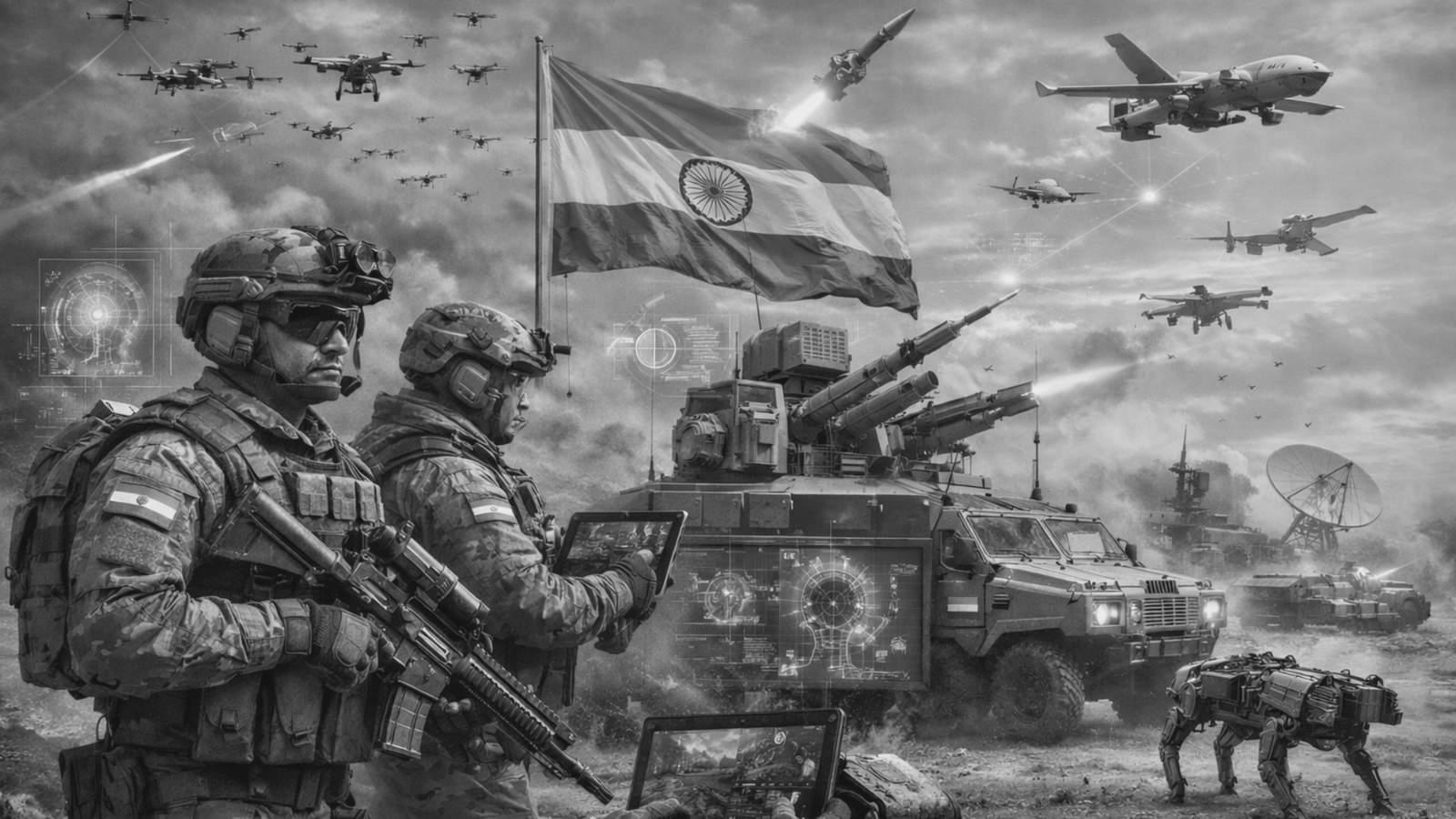
ImageSource: ChatGPT
Tags
- #ai warfare india
- #autonomous combat systems
- #battlefield ai
- #defence ai analysis
- #emerging military technologies
- #future combat systems
- #indian army modernization
- #military ai research paper
- #modern war technology
- #next generation warfare
Author
Vansh Pincha
Vansh Pincha is a Research Intern at the Centre for New Age Warfare Studies, where he focuses on the evolving landscape of 21st-century conflict. A candidate for a B.A. (Hons) in Global Affairs with a minor in Public Policy at O.P. Jindal Global University, he is currently an exchange student at Sciences Po, Le Havre.