Department of Hybrid Warfare & Irregular Conflict · Explainers · Armed Conflicts ·
What is Attrition Warfare?
This explainer examines attrition warfare as one of the most enduring concepts in military strategy. It explains how wars are not always won through rapid manoeuvre, technological superiority, or decisive battlefield breakthroughs. Instead, many conflicts are shaped by the ability of one side to steadily exhaust the enemy’s manpower, equipment, logistics, economy, morale, and political will.
The explainer traces the evolution of attrition warfare from ancient and industrial-age conflicts to modern wars such as Verdun, Vietnam, the Arab-Israeli War of Attrition, the Iran-Iraq War, the Russia-Ukraine War, and contemporary West Asian conflicts. It shows that attrition is not simply mindless destruction, but a deliberate strategy of imposing cumulative costs until the adversary can no longer sustain resistance.
Attrition warfare is important because modern technology has not eliminated prolonged war. Drones, precision weapons, cyber operations, sanctions, industrial production, and information warfare have only expanded the ways in which attrition is applied. For India, the concept is especially significant because future conflicts with nuclear-armed and geographically proximate adversaries may test not only battlefield capability, but also national endurance, defence production, supply chains, political cohesion, and strategic resilience.
1. Introduction
For much of the post-Cold War period, analysts believed that progress in precision-guided munitions, network-centric warfare, artificial and real-time intelligence would transform the warfare. Future conflicts were expected to be swift, decisive and characterized by precision strikes that would dismantle an adversary's military capabilities. The emphasis was shifted towards manoeuvre, speed and technological superiority, rendering attrition warfare to relic of past.
However, recent conflicts have challenged this assumption. From the trenches of Ukraine and the urban tunnel battlefields of Gaza to the strategic confrontation involving Israel, Iran and US the contemporary warfare has demonstrated that attrition remains a central element in military conflicts. Despite all the advances in technology states and non-state actors still engaged in prolonged struggles where they seek to drain manpower, resources and political will of the adversary. The victory in war is often determined not by the ability to deliver the first blow, but by the capacity to absorb the attack and endure longer than one's opponent.
Attrition warfare is often misunderstood as a strategy of indiscriminate destruction without proper military planning. In reality, it represents a deliberate strategic approach aimed at wearing down the enemy through continued accumulation of cost until the resistance becomes unsustainable. While attrition is often associated with massive casualty and prolonged stalemates, its logic extends beyond the battlefield to encompass economic resources, logistics, morale and political cohesion.
In today’s context, the significance of attrition warfare has profound implications for military strategists across the world. Major powers around the world prepare for potential long-duration conflicts. As non-state actors continue to demonstrate remarkable resilience against technologically superior opponents, understanding the dynamics of attrition has become more important. For India, situated in a complex security environment characterized by nuclear-armed rivals and contested borders, the lessons of attrition warfare are particularly significant.
This explainer article examines the evolution, theory, mechanisms, and contemporary relevance of attrition warfare. Through historical and modern cases of attrition warfare—including the Battle of Verdun, Vietnam War, War of Attrition 1967, Russia-Ukraine War and Israel-Iran-US confrontation—it argues that attrition remains one of the most enduring and influential forms of warfare in the 21st century.
2. Definition and Scope
Nicholas Murray defines- “Attrition warfare is the term used to describe the sustained process of wearing down an opponent so as to force their physical collapse through continuous losses in personnel, equipment and supplies or to wear them down to such an extent that their will to fight collapses”[i]. Trevor N Dupuy theorises, “Attrition is a reduction in the number of personnel, weapons, and equipment in a military unit, organization, or force.”[ii]
There are several definitions to it but generally Attrition warfare can be defined as a military strategy aimed at wearing down an adversary through the systematic depletion of personnel, equipment, resources, logistics and political will to a point where enemy’s ability to fight collapses.
Attrition warfare is usually a last resort because it requires vast amount of resources and manpower which none of the country wants to put on stake in an increasingly interdependent globalized world. However, by not giving a decisive blow to enemy leaves a room for adversary to retaliate later.[iii] Success is measured not by territorial gains or dramatic battlefield triumphs but by the cumulative costs imposed gradually on the opponent.
The concept is generally associated with large-scale conventional wars such as WW1, Vietnam War, etc. It can occur across different forms of conflicts like interstate wars, insurgencies, counterinsurgency campaigns and strategic competitions involving economic and political instruments. Modern attrition warfare extends into multiple domains like economic sanctions, industrial production races, cyber operations, and information campaigns.[iv] However, the objective remains the same: to incur greater costs on the adversary than one is required to bear.
3. Historical Development
3.1. Early Origins
The term attrition derives from the Latin word attritionem which means “a rubbing against” reflecting the nature of strategy.[v] The strategy has been used in some form since ancient times and stands in contrast to the tactic of manoeuvre warfare.
Ancient military leaders often sought to wear down their opponents through prolonged campaigns, sieges and economic disruption. Roman military campaigns (Gallic Wars, Jewish-Roman war etc.) often relied on superior manpower and logistical endurance to exhaust adversaries who could not sustain prolonged resistance.[vi] In Ancient India War of Mahabharata, Ramayana, Ashoka conquest of Kalinga etc. are few examples of attrition warfare.
During the 19th century, attrition emerged as a more formalized strategic concept. Improvements in firearms, artillery, transportation, and mobilization expanded the capacity of states to sustain large armies for extended periods.
3.2. The First World War and the Rise of Industrial Attrition
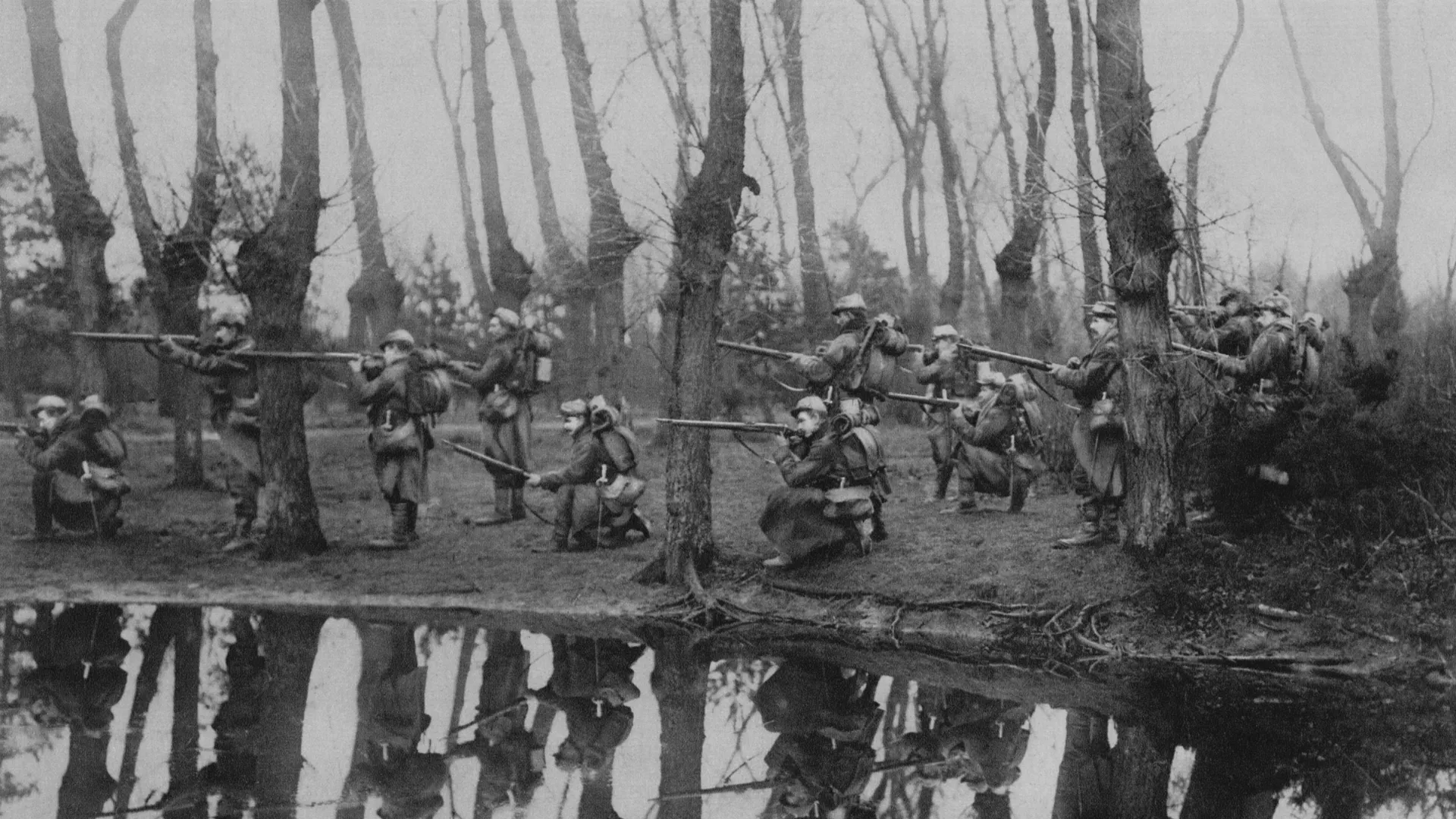
The First World War remains the archetypal example of attrition warfare. Battles such as Verdun and Somme demonstrated how industrialized states could mobilize enormous resources and absorb staggering casualties while attempting to wear down their opponents. Trench warfare limited the advances and forced to rely on attrition warfare. Generals often accused of simply throwing soldiers in great numbers to break the stalemate.[vii]
German Chief of Staff Erich von Falkenhayn's strategy at Verdun explicitly sought to "bleed France white" by forcing the French Army into a battle of endurance.[viii] Although the strategy ultimately failed to achieve decisive results, it illustrated the central logic of attrition: victory through exhaustion rather than manoeuvre.
The war also demonstrated that industrial capacity, logistical networks, and national morale were as important as battlefield performance. States capable of replacing losses and sustaining production gained significant advantages in prolonged conflicts.
3.3. Theoretical Foundations
The Theoretical roots of attrition warfare can be traced to classical military thinkers such as Carl von Clausewitz. Clausewitz argued that war is a contest of wills between two adversaries. Military operations are not conducted merely to destroy enemy forces but to compel an opponent to submit to one's will.[ix] Attrition serves this purpose by gradually increasing the costs of resistance.
The concept also aligns with Clausewitz's notion of the "culminating point," beyond which an adversary can no longer sustain offensive or defensive operations effectively. The goal of Attrition warfare is to push opponents toward this threshold.
Modern military theory often contrasts attrition warfare with manoeuvre warfare. While manoeuvre aims at paralyzing enemy decision-making through operational shock and disruption but attrition focuses on reducing the enemy's ability to continue fighting. Nevertheless, usually, all military operations incorporate both of the strategies.
3.4. How Attrition Warfare Works
There is no formal unanimous universal Attrition Warfare operational doctrine. However, Amos C fox describes Attrition serves operational and tactical activity in three basic ways.
The initial approach links attrition operations and tactics via the application of firepower to create a continuous stream of death and destruction. At the operational level of war, the aim of attrition is to create a resource imbalance that hastens strategic system exhaustion and thus forces the adversary to negotiate and end hostilities[x].
The secondary version is common mental model which is more refined and focal. In this approach, overwhelming firepower is used to overcome particular battlefield conditions, both operational and tactical. Here seemingly overwhelming amounts of firepower is employed to create temporal (windows), physical (zones) or spatio-temporal (both temporal and physical) opportunity. As Murray argues, attritional warfare in the First World War was frequently used to overcome prevailing battlefield conditions.[xi]
Third, Svechin asserts that attrition is applicable when decision is not at hand or not possible in a specific theatre, campaign or operation.[xii] The purpose of attrition is to create the potential for decision on an adjacent battlefield by compelling an adversary to reallocate resources to address attritional operations, thereby undermining adversary’s stance on the adjacent battlefield and consequently creating chance for decision.
3.5. Forms of Attrition Warfare
The three qualifying situations of attrition are the foundations for attritional warfare’s operations and tactics, five of which are offensive and two are defensive.
The offensive forms of attritional warfare are siege, ambush, frontal attack, flank attack and breach. Offensive attritional operations and tactics are marked by the immediate destruction of enemy forces and followed by taking control of the territory they once occupied.
Defensive attritional operations and tactics focus on using firepower to eliminate hostile forces aiming to reclaim the territory held by another force, or on eliminating the hostile forces between an advancing force and the objective somewhere behind the intervening force[xiii]. In these situations, the area defence and the defence in depth are attritional warfare’s two types of defensive operations and tactics.
3.6. Examples of Attrition Warfare
3.6.1. Battle of Verdun
The Battle of Verdun represents one of the striking examples of attrition warfare. It was one of the longest, bloodiest, and most-ferocious battles of the war; French casualties were about 400,000, German was 350,000. Some 300,000 were killed[xiv]. Planned by the German Chief of General Staff, Erich Von Falkenhayn to secure victory for Germany on the Western Front with motto of to "bleed France white". Rather than achieving a rapid breakthrough, the campaign aimed to wear down French military capacity. The battle closed ended on 15 December, as winter conditions and results of fighting on the Somme made further activity impossible.[xv]
The attrition warfare was used effectively. The continual bombardment, trench assaults and battles led to very high casualties among the civilians. Industry was crucial since both sides required a lot of ammunition. Despite causing heavy casualties to the French, the Germans were not able to break the French defence as the latter had a good logistical system and also rotated their soldiers. The war became an industrial contest rather than a military manoeuvre one. Both sides sustained huge casualties without territorial gains, illustrating that attrition can exhaust the attacker as much as the defender.
3.6.2. Vietnam War
The Vietnam War is one of the most notable examples of attrition warfare in the modern era. The United States entered the conflict to prevent the spread of communism under the Domino Theory and protect the government of South Vietnam. The strategy of attrition was incorporated into the Vietnam War by General William C. Westmoreland in 1964 to be victorious in South Vietnam due to the political and operational constraints of winning through territory.[xvi] The success of this approach was premised on technological superiority and the power of air and fire. Likewise, the North Vietnamese army under Ho Chi Minh utilized attrition warfare combined with guerrilla warfare, protracted warfare, trench warfare, and deception tactics to ensure they achieved victory even though their resources were inferior to those of their opponents. The country became one of the strongest military powers in Southeast Asia after the war, but the agricultural, industrial, and commercial sectors were adversely affected by the effects of the war.[xvii]
American strategy emphasized "search and destroy" operations, extensive aerial bombardment, artillery strikes, Chemical weapons like Napalm and Agent orange and helicopter-borne assaults. Success was measured primarily through enemy casualties, commonly referred to as the "body count."[xviii] Conversely, North Vietnam pursued a strategy of protracted warfare, accepting high losses while continuously replenishing forces through external support from the Soviet Union and China. Attrition extended beyond military casualties to include political legitimacy, public morale, and economic endurance.[xix] Over time, mounting American casualties, financial costs and declining domestic support became as decisive as battlefield outcomes.
Attrition proved ineffective for US because it focused on destroying enemy manpower rather than undermining the adversary's political will or logistical resilience. While North Vietnam demonstrated a greater capacity to absorb losses and sustain prolonged conflict using Attrition. The war exposed the limitations of technologically superior forces when confronting a determined adversary employing asymmetric tactics.
3.6.3 War of Attrition 1967-70
Following the Arab defeat in the Six-Day War, Egypt decided to reclaim territories occupied in the vicinity of the Suez Canal without embarking on an outright conventional attack on Israel. President Gamal Abdel Nasser launched the War of Attrition by Egypt against Israel between 1967 and 1970.[xx][xxi] The goal was to keep applying military and economic pressure on Israel in order to weaken its will to keep control of the Sinai Peninsula
Egypt resorted to sustained artillery bombardments, commando raids, air attacks, and limited offensive operations along the Suez Canal. Israel responded with counter-battery fire, deep-penetration air strikes, and targeted raids into Egyptian territory.[xxii] Both sides suffered personnel and equipment losses while investing heavily in air defence systems, fortifications, and logistics. Unlike total wars, the conflict remained geographically limited while imposing incurring costs over time. Both sides received external military support from the US and USSR respectively.[xxiii]
Neither Egypt nor Israel won a clear-cut military victory. Nevertheless, the war proved that attrition may be used as a means of political pressure rather than a way of conquering territory. Egypt gained back military confidence, became better prepared for operations, and got useful combat experience that was used during the Yom Kippur War. As for Israel, it kept military superiority, but had to bear higher economic expenses and losses of manpower.
3.6.4 Iran–Iraq War – Prolonged Industrial and Human Attrition
The Iran–Iraq War began in 1980 when Iraq, under Saddam Hussein, invaded Iran, expecting a rapid victory following the Iranian Revolution. Initial Iraqi advances stalled due to stiff Iranian resistance, transforming the conflict into an 8-year war of attrition.[xxiv] Both countries aimed to deplete the other's military, economic and political capacity rather than secure rapid operational breakthroughs.
The conflict resembled many characteristics of World War I, including trench warfare, prolonged artillery duels, fortified defensive positions, and repeated offensives producing limited territorial gains. Iran employed large scale infantry assaults and ideological mobilisation, while Iraq emphasized mechanized forces, artillery and later the extensive use of chemical weapons. The war moved beyond the battlefield through the "Tanker War," attacks on oil infrastructure and economic disruption.[xxv] Massive casualties, destruction of industrial capacity, and depletion of national resources characterized the war. Iran used human wave attacks whereas Iraq heavily resorted to chemical weapons such as Mustard Gas, Tabun, Tear gas etc.[xxvi]
The war ended without either side fulfilling their political aims. Iraq could not manage to topple the regime of Iran, while Iran also did not succeed in defeating Iraq. The war caused serious damage to the economy of both the countries and finally led to the exhaustion of the army which compelled them to accept an UN-brokered ceasefire. The war highlighted that prolonged attrition imposes enormous economic, industrial, and societal costs while rarely producing decisive strategic outcomes. It also demonstrated the importance of sustaining defence production, logistics, and international support during extended conflicts.
4. Contemporary Relevance
Contrary to post-Cold War expectations, the 21st century has not witnessed the decline of attrition warfare but its transformation. Precision-guided munitions, artificial intelligence (AI), autonomous systems, cyber capabilities, and space-based intelligence were believed to bring rapid and conclusive war. However, recent conflicts have proved while the technological changes have shifted the methods of applying force but not the underlying essence of attrition warfare. Contemporary wars remain a contest in which victory goes to the side able to sustain combat power and impose costs on its opponent over time.[xxvii]
The Russia–Ukraine War offers the clearest illustration of this evolution. Started in February 2022 as Russia's attempt to quick regime change through manoeuvre turned into a war of attrition following the failure of the Kyiv offensive. Gradually both sides have shifted their focus from decisive territorial gains to degrading each other's military capacity by targeting artillery, logistics networks, ammunition depots, command-and-control systems, energy infrastructure and defence industries. The conflict demonstrated a transition from terrain to capability-centric warfare, weakening the enemy's capacity to sustain combat.[xxviii] Military assessments shows that success depends less on tactical victories but on the ability to mobilise manpower, replenish equipment, expand defence-industrial production and maintain external support.
Of no lesser importance is the change that took place in the tools used for attrition. Ukraine has showed how cheap first-person-view (FPV) drones, loitering munitions, electronic warfare, and persistent intelligence, surveillance and reconnaissance (ISR) systems can incur disproportionate costs on high-value military assets. The rise of extensive drone-enabled attrition zones has made large-scale manoeuvre increasingly costly, forcing both armies into a continuous cycle of adaptation.[xxix] Rather than replacing attrition, technological innovation has made it more persistent, decentralised and economically efficient. The decisive advantage has shifted from not only possessing advanced technology but in the ability to innovate faster, reduce losses and sustain wartime production.
The Israel–Iran–US conflict started in February 2026 illustrates how attrition has expanded beyond conventional battlefields into a multidomain contest of strategic endurance.[xxx] Unlike traditional interstate wars centred on territorial conquest, the conflict has been characterised by calibrated missile and drone strikes, attacks on military infrastructure, cyber operations, Blockade of Hormuz chokepoint and sustained diplomatic and economic coercion.[xxxi] Instead of outright military victory, each actor has attempted to incrementally erode the other's military capability, deterrence credibility and political leverage. Iran attacked its neighbours supporting US war efforts in order to engulf them in war putting pressure to end hostilities. Repeated cycles of strikes, retaliatory actions and negotiated pauses[xxxii] underscore that contemporary attrition increasingly operates below the threshold of total war. The objective is not annihilation but the gradual exhaustion of an adversary's strategic options.
All these conflicts suggest that the future of attrition warfare will differ fundamentally from the trench warfare of WWI or the mass mechanised campaigns of WWII. It can be anticipated that future attrition wars will be characterized by the integration of autonomous systems, AI-enabled targeting, cyber operations, economic coercion, information warfare and resilient logistics. Strategic success will depend less on achieving rapid battlefield victories than on sustaining military production, protecting critical infrastructure, absorbing economic shocks, and maintaining political cohesion throughout prolonged conflicts. Even though new technology may change the nature of attrition warfare, it will not affect its strategic principles, as shown by recent cases of attrition warfare.
5. Implications for India
Attrition Warfare has important ramifications for national security of India considering the possibility of a two-front war with China and Pakistan.[xxxiii] Attrition will be useful in any war in North and Eastern sector of land border against China because once winter comes, it will disrupt the supply lines of the Chinese army.
Recent wars have indicated that mere technical superiority is not enough for winning; rather what matters is sustainment, resilience of industries, logistics and regeneration of combat power. Wars in Ukraine and Gaza have underlined the need for defence-industrial resilience. Sustainment capability of the Indian army in case of war would depend not only on the existing stockpiles but also upon the production capabilities during wartime.[xxxiv]
Attrition has undergone an important shift due to extensive use of drones. Relatively inexpensive drones can inflict disproportionate costs on high-value military assets. India must invest in both offensive and defensive drone ecosystems.
For India, key lesson includes endurance as one of the fundamental pillars of deterrence. This requires investment in self-reliant defence production through Atmanirbhar Bharat, building up strategic stockpiles of crucial munitions and missiles, developing scalable drone and counter-drone technologies and maintaining robust supply chains[xxxv] that can sustain intensive operations.
Equally important is enhancing jointness across the three services, improving mobilisation infrastructure along the northern and western borders, and integrating cyber, space, and information capabilities into conventional warfighting.[xxxvi]
Indian policymakers should avoid viewing attrition solely through a military lens. Economic stability, societal cohesion, technological innovation, and strategic communication will be equally important in any prolonged conflict.[xxxvii]
Future conflicts are unlikely to reward the side with the most sophisticated platforms alone; they will favour the state that can absorb losses, replenish resources rapidly, and sustain military and political resolve over an extended period. For India, therefore, preparedness for attritional warfare is no longer a contingency—it is an imperative for credible deterrence and long-term strategic stability.
6. Conclusion
The persistence of attrition warfare across conflicts—from Verdun and Stalingrad to Ukraine and the contemporary West Asia—demonstrated that while the character of war continues to evolve, its underlying strategic logic remains constant. Recent conflicts have shown that precision weapons, autonomous systems and artificial intelligence have not displaced attrition; instead, they have made it more distributed, technologically enabled, and multidimensional. Modern warfare is increasingly a contest of industrial resilience, economic endurance, technological adaptation, and political will as much as battlefield performance.
Looking ahead, future wars will not only be defined by rapid, decisive campaigns but also by prolonged competition across military, economic, cyber, informational and industrial domains. States that can rapidly regenerate combat power, secure resilient supply chains, leverage emerging technologies and sustain domestic resolve will possess a decisive strategic advantage. For India, this necessitates a shift from preparing merely to fight wars to preparing to endure them. In an era of persistent geopolitical rivalry and contested security environments, national resilience—not simply military capability—will increasingly determine strategic success.
Attrition warfare therefore remains not a relic of the past, but a defining feature of contemporary and future conflict.
Endnotes:
[i]Nicholas Murray: Attrition Warfare, in: 1914-1918-online. International Encyclopedia of the First World War, ed. by Ute Daniel, Peter Gatrell, Oliver Janz, Heather Jones, Jennifer D. Keene, Alan Kramer, and Bill Nasson, issued by Freie Universität Berlin, Berlin 2016-01-13. DOI: 10.15463/ie1418.10802
[ii] Fox, Amos C. 2025. “A Theory of Attrition.” The RUSI Journal 170 (6–7): 38–52. https://doi.org/10.1080/03071847.2025.2589830
[iii] https://fs.blog/attrition-warfare/ accessed on 26 June 2026
[iv]Manoj Joshi. “Two Ways of War: Attrition vs Precision in Modern Conflict”. 2026. Raisina Debates. ORF https://www.orfonline.org/expert-speak/two-ways-of-war-attrition-vs-precision-in-modern-conflict
[v]Richard Sheposh. “Attrition Warfare”.2019. EBSCO https://www.ebsco.com/research-starters/military-history-and-science/attrition-warfare
[vi] Ibid.
[vii] Nicholas Murray: Attrition Warfare, in: 1914-1918-online. International Encyclopedia of the First World War, ed. by Ute Daniel, Peter Gatrell, Oliver Janz, Heather Jones, Jennifer D. Keene, Alan Kramer, and Bill Nasson, issued by Freie Universität Berlin, Berlin 2016-01-13. DOI: 10.15463/ie1418.10802
[viii] Richard Sheposh. “Attrition Warfare”.2019. EBSCO https://www.ebsco.com/research-starters/military-history-and-science/attrition-warfare
[ix] Clausewitz, Carl von (1873). On War Accessed on 27June 2026
[x] Amos Fox. “Setting the Record Straight on Attrition”. 2024. War on the Rocks. https://warontherocks.com/setting-the-record-straight-on-attrition/
[xi] Murray, The Dark Path, p. 160. https://www.armyupress.army.mil/Journals/Military-Review/MR-Book-Reviews/Book-Review-Archives/2025/Dark-Path/
[xii] Svechin, Strategy, pp. 241–46. https://resistir.info/livros/svechin_strategy.pdf
[xiii] Fox, Amos C. 2025. “A Theory of Attrition.” The RUSI Journal 170 (6–7): 38–52. https://doi.org/10.1080/03071847.2025.2589830
[xiv]Britannica. (n.d.) https://www.britannica.com/event/Battle-of-Verdun
[xv] https://www.iwm.org.uk/history/first-world-war/western-front/verdun
[xvi] Dissertation Chapter. (n.d.) Research Prospect.https://www.researchprospect.com/reasons-for-employing-attrition-in-vietnam-and-afghanistan-dissertation-chapter-4-findings/
[xvii] Vietnam War. (n.d.). Britannica https://www.britannica.com/event/Vietnam-War
[xviii] Spector, Ronald H., and Andrew F. Krepinevich. “U.S. Army Strategy in the Vietnam War.” The Army and Vietnam. International Security 11, no. 4 (1987): 130–34. https://doi.org/10.2307/2538840
[xix] "Ho Chi Minh's Leadership: Politics & Strategy in North Vietnam." Study.com. May 27, 2026. https://study.com/academy/lesson/ho-chi-minhs-leadership-politics-strategy-in-north-vietnam.html.
[xx] "1967 – Six-Day War Ends." History, www.history.com/this-day-in-history/six-day-war-ends Accessed 27 June 2026
[xxi] Ruth, Michael.“War of Attrition (1969-1970)”.2022. EBSCO https://www.ebsco.com/research-starters/history/war-attrition-1969-1970
[xxii] Ahmad Shamih Khalidi. “The War of Attrition”. Vol.3 No.1 -Autumn1973 https://www.palestine-studies.org/en/node/38277
[xxiii] Bill Norton. “The Arab-Israeli War of Attrition 1967-73”. 2023. Helion & Company https://armorama.com/news/the-arab-israeli-war-of-attrition-1967-1973
[xxiv] Ranj Aladdin. “How the Iran-Iraq war will shape the region for decades to come”. Commentary. Brookings https://www.brookings.edu/articles/how-the-iran-iraq-war-will-shape-the-region-for-decades-to-come/
[xxv] Burch, Kurt. “Iran-Iraq War”. 2021. EBSCO https://www.ebsco.com/research-starters/history/iran-iraq-war
[xxvi] Ali, Javed. (2001). Chemical weapons and the Iran‐Iraq war: A case study in noncompliance. The Non-proliferation Review. 8. 43-58. 10.1080/10736700108436837. https://www.researchgate.net/publication/237814661_Chemical_weapons_and_the_Iran-Iraq_war_A_case_study_in_noncompliance
[xxvii] Alex Vershinin. “The Attritional Art of War: Lessons from the Russian War on Ukraine”.2024. Commentary. RUSI https://my.rusi.org/resource/the-attritional-art-of-war-lessons-from-the-russian-war-on-ukraine.html
[xxviii] Syrskyi, Oleksandr & Lebedenko, Andrii & Семененко, Олег. (2025). Ukraine in a “War of Attrition”: The Warfare Paradigm Shift. Міжнародний науковий журнал «Military Science». 3. 6-19. 10.62524/msj.2025.3.2.1. https://www.researchgate.net/publication/394161973_Ukraine_in_a_War_of_Attrition_The_Warfare_Paradigm_Shift
[xxix] Gady, Franz-Stefan, and Michael Kofman. 2024. “Making Attrition Work: A Viable Theory of Victory for Ukraine.” Survival 66 (1): 7–24. doi:10.1080/00396338.2024.2309068
[xxx] Mauricio D. Aceves. ‘’The geometry of attrition: Iran-Israel-U.S. theatre” Gateway House. 2026. https://www.gatewayhouse.in/the-geometry-of-attrition-iran-israel-u-s-theatre/
[xxxi] Spenser A. Warren. ‘A conflict of attrition: Iran’s bet on asymmetric warfare’. Analysis. 2026. Bulletin of Atomic Scientists https://thebulletin.org/2026/04/a-conflict-of-attrition-irans-bet-on-asymmetric-warfare/
[xxxii] Harsh V Pant. ‘The US-Iran War: How It Is Redefining the Global Order’. Commentaries. 2026. ORF https://www.orfonline.org/research/the-us-iran-war-how-it-is-redefining-the-global-order
[xxxiii] Manoj Joshi. “Two Ways of War: Attrition vs Precision in Modern Conflict”. 2026. Raisina Debates. ORF https://www.orfonline.org/expert-speak/two-ways-of-war-attrition-vs-precision-in-modern-conflict
[xxxiv] Lt. Gen Raman Dhawan. “India Needs to Prepare for a War of Attrition”. 2026.Raksha Anirveda https://raksha-anirveda.com/india-needs-to-prepare-for-a-war-of-attrition/?srsltid=AfmBOooWZ1ZVxDfJykRSPNkiwB791xvcDJeS_po2uSUx19lII0mcmnzE
[xxxv] Rajneesh Singh. ‘Limits of Industrial Endurance and Doctrines: Lessons from War in West Asia.2026 Issue Brief. IDSA https://idsa.in/publisher/issuebrief/limits-of-industrial-endurance-and-doctrines-lessons-from-war-in-west-asia
[xxxvi] Major General Badri Narain Raizada. ‘As modern warfare transforms, the lessons now for Indian defence’.2026. Expert Explains. Indian Express https://indianexpress.com/article/explained/india-defence-vision-2047-future-warfare-10760282/
[xxxvii] Group Captain (Dr) Swaim Prakash Singh. ‘Russia-Ukraine Conflict: Military Lessons for India’. (n.d.). USI https://usiofindia.org/pdf/JULY-SEPT13.pdf
The views expressed are those of the authors and do not represent the views of CNAWS.
Image Source: ChatGPT
Tags
- #affordable mass warfare
- #asymmetric warfare
- #Attrition warfare
- #defence strategy
- #drone warfare
- #future warfare
- #hybrid warfare
- #iran asymmetric warfare
- #military strategy
- #modern warfare
- #next generation warfare
- #Russia Ukraine war
- #war of attrition
Author
Ashutosh Kumar Singh
Ashutosh Kumar Singh is a researcher and academic with a strong interest in international relations, strategic studies, and West Asian geopolitics. He completed his undergraduate and postgraduate studies at University of Allahabad and is a three-time NET-qualified candidate. His academic and research work focuses on foreign policy analysis, regional security dynamics, and contemporary geopolitical developments in West Asia. He is particularly interested in strategic affairs, diplomacy, and emerging political trends shaping the Middle East and global politics, with a commitment to evidence-based research and policy-oriented analysis.