Department of Strategic Foresight & Scenario Planning · Detailed Reports · Geopolitics ·
Tracking the People's Liberation Army (PLA): 8th - 13th June, 2026
Colonel KK Venkatraman (Retd.)
Dear Reader,
Welcome back to this week’s newsletter. A major highlight of this week was the visit of President Xi Jinping to North Korea on 8 & 9 June 2026. Coming on the back of Trump and Putin’s visit to Beijing, the visit was a major success. Both sides focused on building bilateral Party and State relations and enhancing trade and cooperation. While media coverage was silent on military cooperation, the presence of Admiral Dong Jun suggests that military issues were discussed. The visit also sends a signal to Trump about cooperation between China and North Korea.
On the military side, PLA Daily articles cover some of the shortcomings which need to be overcome for Joint Operations to be successful. In particular, these stress the need for change in organisational culture, developing high level skills, focusing on principles of warfare and achieving victory rather than be bound by technological advancement.
Last is the Chinese perception of Indian Air Force’s Fighter Induction. Their conclusion is that India has a long way to go before it can address its shortcomings in indigenous design and production.
Happy Reading and have a nice weekend.
Visit of President Xi Jinping to North Korea
Xi Jinping along with Peng Liyuan visited North Korea on 08 and 09 Jun 2026 and met the North Korean President Kim Jong-un. He was accompanied by Cai Qi, Member of PBSC, Wang Yi, Minister of Foreign Affairs and Admiral Dong Jun, Minsiter of National Defense. Judging by media coverage on both sides, the visit was a grand success. Xi Jinping and Kim Jong-Un announced the reaching of an important consensus on development of bilateral relations and conveyed a message of strengthening bilateral cooperation. A Xinhua commentary suggests that Xi Jinping announced his full support for North Korea and Kim Jong-Un, regardless of international situation. Further, both sides are aligning their development strategies and expanding pragmatic cooperation in areas such as economy and trade, agriculture, construction, science and technology, and healthcare. While discussions on military issues were not covered in the media, North Korean official media confirmed the presence of Chinese Defence Minister Dong Jun during the visit, suggesting that greater military cooperation is in the offing. (PLA Daily. 10 Jun 2026. Page 2. Promote high-level development of China-DPRK relations.(推动中朝关系高水平发展).Xi Jinping and his wife attended luncheon hosted by Kim Jong Un and his wife.(习近平夫妇出席金正恩夫妇举行的小范围午宴))
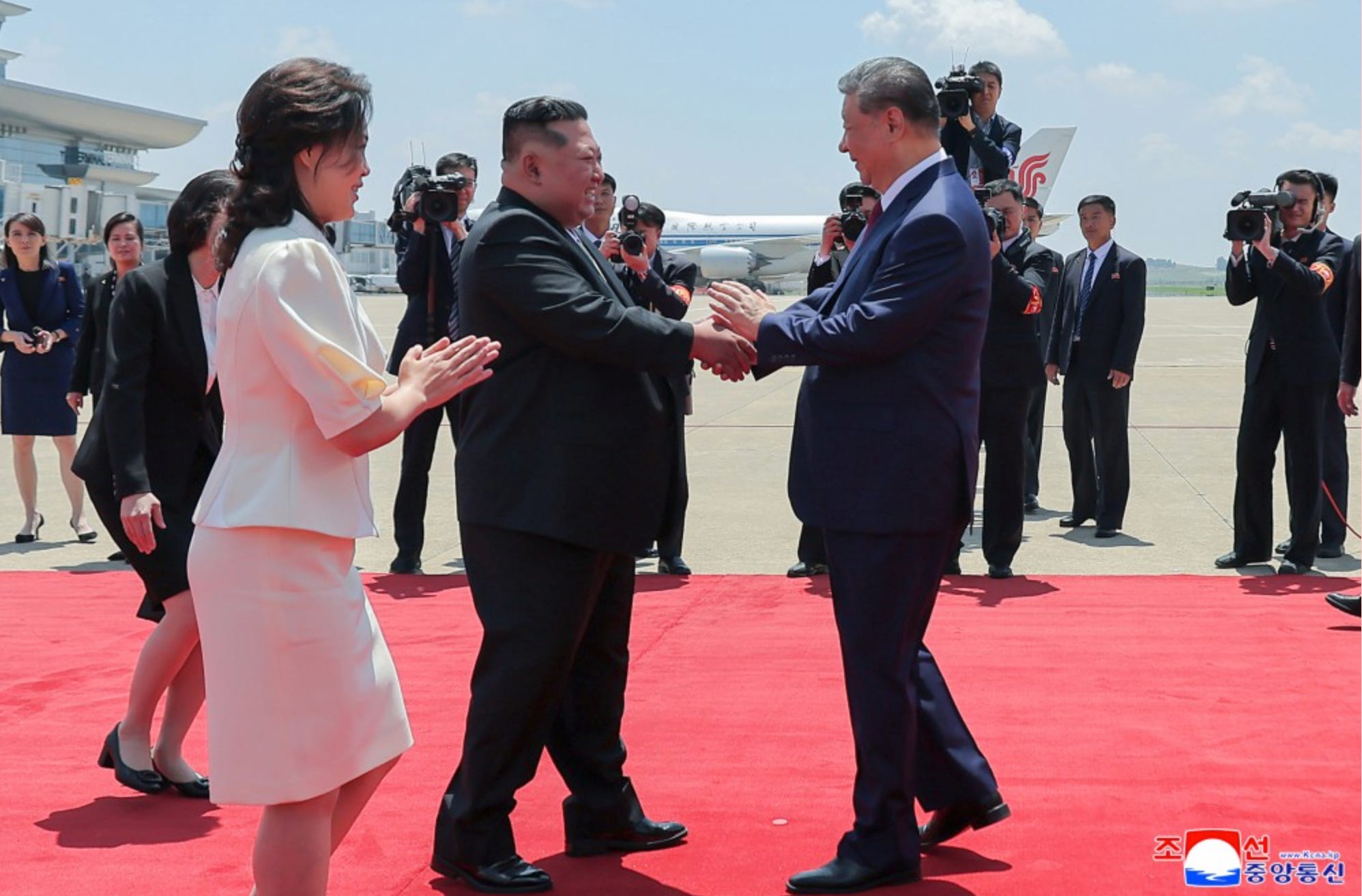
(Xi Jinping and Kim Jong-Un at Pyongyang. Image Courtesy: KCNA)
Ideological and Political Education
Creating an Organisational Culture for Joint Operations.
NDU’s Research Center for Xi Jinping Thought on Socialism with Chinese Characteristics recently published an article on creating an organisational culture within the PLA for Joint Operations. The unidentified authors argue that without a paradigm shift towards automatic coordination, voluntary cooperation, and self-initiated integration, it would be difficult to create an effective Joint Operations System. Highlighting the relevance political factors in joint operations, they call for absolute obedience to the Party’s leadership, ensuring that all units perform their duties effectively and create mutual trust and collaboration. Reiterating that modern warfare is a confrontation of systems, the authors call on all ranks to overcome deep rooted differences and problems such as service/arm specific mindset and rise above organisational silos. Finally, the authors call on all ranks to integrate efforts of all services and service branches, develop advanced joint operational concepts such as information dominance, system support, elite force operations, and achieve joint victory. (PLA Daily. 10 June 2026. Page 7. Cultivating a Cultural Consciousness of Winning Through Joint Operations(培塑联合制胜的文化自觉))
Shortcomings in Same Service Coordination.
After-action review of counter-drone exercise of an unidentified Air Defence (AD) brigade of PLA Army highlights challenges faced in achieving Joint Operations capability. The article suggests that there were coordination issues between the AD brigade and the AD battalions of Combined Arms Brigades (CAB), atleast till recently. Some of the reasons were concerns over lack of ‘credit’, ‘ambiguous’ command channels, and ‘simply not my job’. The ad hoc party committee worked to arrive at a solution, only to face heavy resistance in implementation. While the brigade’s focus was long range surveillance and system wide support, the battalions wanted to focus on short range operations. Finally, the units integrated by sharing data, anti-jamming techniques and counter-drone experience. Subsequent exercises suggested improvement in coordination and progress towards integration, enabling them to handle bigger challenges. Another article suggests similar issue faced by PLAN Aviation units coordinating for ASW, which was rectified. (PLA Daily. 08 June 2026. Page 10. Discarding Narrow Calculations to Forge a “Powerful Fist”(摒弃“小算盘” 攥成“铁拳头”). 07 June 2026. Page 2. Train to forge a closed fist; Command forces with the ease of moving one’s own arm and fingers.(训练攥指成拳 打仗如臂使指))
Going by the exercise location in the Western desert, the brigade and the units are likely to be of 76 Group Army. As early as 2021, the Western Theatre Command had announced the integration of AD elements of PLAAF and PLA Army and reduction in time of sharing of data. The current article’s coverage of gaps between the AD brigade and AD battalions of CABs of the same Group Army suggests that the the PLA has some way to go before it achives coordination within the same service, leave alone Multi-Domain Integrated Joint Operations.
Building Deep-rooted Expertise.
Hao Guowei and Mou Shiqi call for building deeper expertise rather than being satisfied with shallow achievements. They suggest that some PLA personnel are satisfied with minor achievements and spread their efforts over several areas and resulting in poor standards. The authors call on all ranks to focus on their primary task and improve on the skills essential to accomplish it. Subsequently, they should focus on developing secondary skills and broader capabilities while maintaining balance. Finally, they call on all ranks to avoid taking on too many tasks, uncoordinated development of skills and blindly following trends and focus on greater specialisation in the area, consistent improvement and methodical approach. (PLA Daily. 10 June 2026. Page 6. Learn to “Dig a Deep Well”(学会“挖深井”))
Combat Theory
Evolution of AI-powered Military Organisation.
Marxist Theory suggests that mode of production decides the nature of society. Similarly, military organisations are shaped by their weapons and equipment. Yi Haiming, Qian Le and Li Yunjie suggest that the convergence of data creation, interconnection of everything and intelligent decision making will lead to flatter and cross-connected organisations. They call for sharing of pan-organisational sharing of information and resources, seamless connectivity across domains and down to the last soldier for real-time decision making, cross-domain fusion led by largescale integration and small, multi-domain integrated units, flexibility based on data-driven processes, algorithmic support, and man-machine collaboration, resilience of systems and openness where the military and civil are integrated or atleast their boundaries are blurred. (PLA Daily. 9 June 2026. Page 7. A Brief Analysis of the Evolutionary Characteristics of Intelligent Military Organizational Forms (浅析智能化军队组织形态演进特征))
‘Atavism’ in Warfare.
Hang Xinglong and Liu Yexin argue that while modern warfare is evolving towards intelligentisation, traditional war techniques such as trench warfare and tunnel warfare, together with improvised weaponry and traditional communication methods, are making a come back. The authors suggest that this does not mean a return to the past but is part of evolutionary spiral. By adopting older, cheaper techniques, the weaker side can reduce the tremendous costs of modern warfare as well as vulnerabilities of modern technology. Just as ‘advanced technology ’ is not a panacea for everything, the authors suggest that ‘Atavism’ is not backwardness. They recommend rejecting pure technological advancements and a return to the fundamental of warfare and principles of victory. (PLA Daily. 9 June 2026. Page 7. “Atavism”: An Alternative Logic of Combat Capability Development (“返祖现象”:战斗力建设的另类逻辑))
Guarding against AI ‘Bias’ in Warfare.
Chen Changxiao and Yao Fang call for guarding against AI Bias, which arises due to AI’s endeavour to cater for user emotions and preferences, and human bias finding their way into AI algorithms. The authors argue that while AI is deeply integrated in different areas of modern warfare including Command and Control and analysis of intelligence, and has become an indispensable tool, it can erode the commander’s independent thinking and act as a filter for preconceived notions. This would result in incorrect judgments due to a fall sense of security, amplify operational risks due to fault intelligence assessment and spiralling mistrust in man-machine collaboration. They call for correcting algorithmic biases, establishing institutional safeguards such as requiring AI to support its recommendations with data, provide alternatives along with human review and the need for human beings to maintain their independent thinking and quest for truth. (PLA Daily. 9 June 2026. Page 7. Maintain due Vigilance against “AI Sycophancy”(保持对“AI谄媚”应有的警惕))
Training.
Cao Wentao calls for upgradation in conduct of training to keep pace with the evolution of warfare towards informatization and intelligentization. Amongst others, he calls for distributed training across locations thus facilitating large scale training across different locations, immersive scenario based training by leveraging Virtual Reality(VR), Augmented Reality (AR), and Mixed reality(MR), unmanned autonomous training and virtual-real interactive training. (PLA Daily. 11 June 2026. Page 7. A Glimpse into the Evolution of Military Training Organization and Conduct(管窥军事训练组训方式之变))
Training
The Joint Operations College of the National Defense University organised a Command Wargame, powered by AI, recently. The trainees utilised the college’s AI Decision Support system and database of tactics from reconnaissance and intelligence collection to decision making. The exercise alternated between ‘joint operation’ and ‘intelligent’ modes. While the ‘joint operation’ mode helps to improve overall strategic planning, decision-making, and joint operations, the ‘intelligent’ mode has created a prototype for future AI-enabled combat command models and creating establishing a new ecosystem of cognitive, application, and design intelligence. The college has created a teaching, research, and training support platform which integrates based on networks, cloud computing, big data, AI, and simulation based wargaming. The platform includes a command centre, command and control systems, realistic combat data, scenario creation, “visualization-enabled” support centers, intelligent platforms, and exercise teams. Employing these, the college conducts realistic, intense, holistic, multi-dimensional joint operations exercises. (ST Daily. 12 June 2026. Page 6. Upholding the Spirit of the Anti-Japanese Military and Political College, Forging an AI-Era Vanguard(传承抗大精神,锻造智能化尖兵))
Going by the accompanying picture, the course is for middle ranking officers of the rank of Majors and Lieutenant Colonels. The use of dual mode suggests that while NDU has the infrastructure, both Joint Training and AI models are still in the experimental stage and the exercise would provide/validate Joint operations concepts as well as generate data for AI models.
Combat Readiness.
A PLA Daily article covers the combat readiness status of multiple units. It highlights the upgradation of combat readiness state of an unidentified brigade of 82 Group Army, a PLAAF transport division creating detailed loading procedures for Army and Airborne units, a brigade of 71 Group Army conducting a long distance mobilisation to the Gobi Desert (in WTC) and an unidentified unit of PLAN carrying out operational readiness drill. (PLA Daily. 11 Jun 2026. Page 7. Joint-Service and Combined Arms Units strengthen Combat Readiness (多军兵种部队推动战备建设不断走深走实))
While news coverage of PLA formations and units preparing and updating combat readiness plans (战备方案) appear regularly, this is probably the first report in recent years about validation of combat readiness plans. It is likely that these will be a regular feature.
Nuclear Force Levels
China Expanding its Nuclear Arsenal.
Stockholm International Peace Research Institute(SIPRI) released its yearbook recently. It estimates China’s nuclear stockpile as around 620 warheads and is expanding its nuclear arsenal. It further suggests that the three missile silos in Northern China have been loaded with missiles while 30 silos are under construction in Eastern China.
International Cooperation
Visit of Chinese Defense Minister to South Africa.
The Chinese Defense Minister, Admiral Dong Jun visited South Africa from 31 May to 03 Jun 2026. He met South African Minister of Defence and Military Veterans, Angie Motshekga and Lt Gen Michael Ramantswana, Chief of Staff of South African National Defence Force (SANDF). Both sides discussed strengthening strategic communication, improving institutional mechanisms, enhancing professional exchanges, and deepening education and training. (PLA Daily. 10 June 2026. Page 2. MND Spokesperson answers Reporters’ Questions on recent Military-related Issues (国防部新闻发言人就近期涉军问题答记者问))
Joint Border Disarmament Compliance Inspection.
A joint inspection team comprising of representatives of Kazakhstan, Kyrgyzstan, Russia, and Tajikistan carried out the first round of joint inspection for this year, in the Eastern section of the Chinese border from 27 May to 4 June. The units inspected include a patrol boat detachment of an unidentified Border Defense brigade of NTC on the Chinese side and an unidentified air defence brigade at Birobidzhan on the Russian side. The second round of joint inspection for the Western section of the border was carried out in Xinjiang Military District from 9 to 11 Jun 2026 in which a regiment of XMD was inspected. According to the 1996 Agreement on Confidence Building in the Military Field in Border Areas and the 1997 Agreement on Mutual Reduction of Armed Forces in Border Areas, between the five countries, which permit verification of military and equipment deployment within 100 km of the border. (PLA Daily. 7 Jun 2026. Page 4. (China, Kazakhstan, Kyrgyzstan, Russia, and Tajikistan conduct Annual Joint Border Disarmament Compliance Inspection.(中哈吉俄塔共同组织年度首轮边境裁军履约视察). 13 Jun 2026. Page 4. China, Kazakhstan, Kyrgyzstan, Russia, and Tajikistan Conduct New Round of Border Disarmament Compliance Inspections(中哈吉俄塔开展新一轮边境裁军履约视察))
Steppe Partner-2026.
The closing address of Sino-Mongolian Joint Exercise which commenced on 30 May 2026, was held at Zhurihe in Inner Mongolia on 6 June 2026. In the final exercise, both sides joined hands to destroy an illegal armed group. PLA drones, robot dogs and an armoured reconnaissance vehicle carried out reconnaissance of ‘enemy’ positions, along with reconnaissance elements of Mongolian Army. Based on the inputs received, the joint command post took decisions including employment of artillery to strike ‘enemy’s outer positions. Tanks, Infantry Fighting Vehicles and Multi-barrel rocket launchers were used to assault enemy positions, subsequently. Both sides also established an air defence position to protect against ‘enemy’ drones. PLA Daily. 8 Jun 2026. Page 4. Forging a Sharp Sword together, Safeguarding Peace with united Mind(携手铸利剑 同心卫和平)
As highlighted in a previous newsletter, the level of firepower and the tactics highlighted in the joint exercise are disproportionate for dealing with illegal armed groups. It is likely that the Mongolian Army is focusing on improving training for conventional operations.
13th Annual Strategic Dialogue between China and New Zealand.
The 13th Annual Strategic Dialogue between China and New Zealand was held at Shanghai on 08 Jun 2026. Both sides discussed bilateral relationship and exchanged views on regional and global security issues. The conference was attended by Vice Chief of Defence Force Rear Admiral Mathew Williams and Deputy Secretary Policy and Planning of the Ministry of Defence Richard Schmidt on the New Zealand side. The previous iteration was held at Wellington in 2024. (New Zealand Ministry of Defence. 08 Jun 2026. Annual New Zealand-China Strategic Defence Dialogue)
Health
Very few armies are deployed at altitudes above 4000m. Hence experiences of different armies are of importance. This week’s health column focused on eyecare and diet in High Altitude.
Eyecare.
An Opthalmologist from 940 Hospital covers the problems in eyecare in high altitude areas and recommended measures to overcome them. Problems include higher intensity of UV radiation (3 to 5 times at altitudes of 3000m and above and 80 - 90 reflection in snow) as compared to plains, dry air, hypoxia and nutritional imbalance. To address this, the author suggests use of UV 400 glasses(PLA standard issue), following the 20-20-20 rule (work outdoors for not more than 20 minutes and then focus on a 20 feet distant article for 20 seconds), use of humidifiers in dormitories and sentry posts, good nutrition (carrots, spinach, nuts, egg yolks, blueberries and other foods rich in vitamins A, C, E, lutein and anthocyanins), eye exercises and hot compression. (PLA Daily. 7 Jun 2026. Page 7. Guard the Plateau, Take care of your eyes(呵护明眸守高原))
Diet in High Altitude.
Narrating an anecdote from a doctor’s perspective, a PLA Daily article describes physiological changes which occur in high altitude areas, such as increase in red blood cells, which on breakdown create purine and elevated uric acid levels. In addition, hypoxia creates higher levels of lactic acid, which inhibit the kidneys from flushing out uric acid fully. The doctor recommends reducing consumption of meat products, greater intake of vegetables, drinking a minimum of 2 to 3 litres of water per day, and minimum 30 minutes of exercises. The exercises suggested are baduanjin (八段錦), a set of 8 traditional exercises, dating back to the Song era. At the end, the doctor informs that following the prescriptions, the affected individual improved his health and was able to qualify in his fitness tests. (PLA Daily. 7 Jun 2026. Page 7. An enduring remedy(一剂长久的良方))
Winning “Hearts” and “Minds”
An unidentified brigade of 77 Group Army assisted in reactivation of Party Committee of Wayue village, Karuo District in Qamdo, Tibet Autonomous Region and providing assistance to the villagers. This includes construction of construction of water reservoir, conducting night classes for adults, veterinary care and establishing a tyre repair shop in this isolated region. The tyre repair shop generated ¥ 50,000 in its first year. By these activities, the brigade has developed a close relationship with the villagers. (PLA Daily. 7 June 2026. Page 5. PLA are neighbors—and even more so, family. (“金珠玛米”是邻居,更是亲人))
PLA units regularly carry out community welfare activities in the regions they are located/deployed. What is of interest in this article is the confirmation of movement of a unidentified brigade to Wayue in 2020. This would place the move sometime during the Galwan clashes along the LAC. Going by the battle honours (卫国模范连, 猛虎红八连, and 群众工作模范团) which pertain to the erstwhile 446 Regiment/149 division, this is likely to be 150 Mountain Combined Arms Brigade. The village is located at an altitude of 4200 metres and thus troops would be fully acclimatised for operations in the Tibetan Plateau.
Space Technology
Unveiling of Chaozhisuan AI Satellite.
Chaozhisuan No 1 satellite was unveiled at the Super Intelligence Computing Tianyan Conference(超智算天衍生态大会) was held at Beijing on 29 May 2026. The satellite integrates laser communication for inter-satellite communication and has high-density, low-latency AI processing unit to process and carry out real-time analysis of remote sensing data, thus reducing data response time from hours to minutes. The technology has applications in earth observation, disaster relief, marine monitoring, and financial services. It will be launched onboard a Lijian-1 (Y18) carrier rocket during the second half of the year to verify core technologies such as inter-satellite laser communication and cross-satellite task migration. The long term plan involves a constellation of 1000 satellites in Low Earth orbit (LEO) by 2030. The conference also saw the signing of Super-Intelligent Computing Space Computing Industry Alliance, which has two main segments: a technology layer which will focus on core technologies like space-borne computing, inter-satellite networking, and space-ground coordination and an application layer, which aims to drive the large-scale industrial application of space computing across various sectors. (ST Daily. 11 June 2026. Page 7. “Chaozhisuan No. 1” Computing Power Satellite Unveiled in Beijing(“超智算一号”算力卫星在京首发). Futurephecda. “Chaozhisuan-1” Computing Satellite Unveiled in Beijing; Plans Underway for a Constellation of 1,000 Low-Earth Orbit Computing Satellites “超智算一号” 算力卫星在京首发 规划千颗低轨算力卫星集群).
Launch of Qianfan DTC-01.
The Qianfan DTC-01 satellite was launched successfully to the Low Earth Orbit onboard an improved Zhuque-2 rocket from the Dongfeng Commercial Aerospace Innovation Test Zone on 09 Jun 2026. The rocket successfully placed the China Mobile-02 satellite in orbit. The China Mobile satellite will carry out experiments such as direct mobile broadband connection with satellites and network integration of space and ground. The improvements in the rocket primarily relate to rapid launch capability, integrated design of rocket and satellite, Payload environment optimisation, greater reliability and cost optimisation. (PLA Daily. 10 June 2026. Page 3. Improved Zhuque-2 (Y6) Rocket successfully launched (朱雀二号改进型遥六运载火箭发射成功))
Communication Technology Experimental Satellite-25 Launched.
The Communication Technology Expermiental Satellite No 25 was successfully launched from Wenchang Satellite Launch Centre onboard a Long March-5 rocket on 11 Jun 2026. The satellite will validate multi-band and high speed satellite communication. A CASTC Press release suggests that 9 technical improvements have been incorporated in Long March-5 launcher. (PLA Daily. 12 Jun 2026. Page 3. Communication Technology Test Satellite-25 successfully Launched (我国成功发射通信技术试验卫星二十五号)
Chinese Perception of India’s Fighter Acquisition Plans
As part of its coverage of military developments across the world, the PLA Daily covered IAF’s fighter acquisition programme. Li Yanlin and Jiang Zihan analyse the French refusal to provide source codes of Rafale aircraft and the Russian offer for local production of Su-57E. The authors highlight that while India has attempted to develop its aviation industry by trying to acquire technology, Western companies have not shared access to core technologies and source codes. This refusal comes from two concerns - one, the loss of revenue in the long term and two, the possible loss of data, compromising security. Without source codes, India can neither integrate indigenous equipment without French assistance nor can it customise them as per its requirements. While India has threatened to cancel the contract, it will face a critical shortfall if the Rafale deal does not go through. India will also have a widening gap between its ambition of ‘self-reliance’ and reality. Comparing with the Russian history of share technology and coproduction, the authors perceive India can attain a better deal by exploiting the French-Russian competition and reduce its dependence on imported technology in the long term. The authors conclude that while Indian MoD has created a restructuring plan for its defence industry, it will take a long gestation period before India can achieve self-sufficiency. (PLA Daily. Jun 2026. Page 10. Mixed Fortunes for India’s Fighter Jet Procurement(印度外购战机遭遇冷热两重天))
This weekly newsletter is first published by the author on platracker.substack.com and subsequently republished on the CNAWS website.
Tags
- #AI warfare
- #China
- #China defence analysis
- #China military
- #China North Korea relations
- #Chinese space technology
- #India fighter aircraft
- #PLA
- #PLA Daily
- #Tracking the People's Liberation Army (PLA)
Author
Colonel KK Venkatraman (Retd.)
Colonel KK Venkatraman (Retired) was commissioned in the Indian Army in December 1997. An alumnus of the Defence Services Staff College, Wellington, he has served extensively in Counter Terrorist Operations in Jammu and Kashmir, Counter Insurgency Operations in Assam and along the Line of Actual Control in the Eastern Theatre. He has served in General Staff appointments in the Eastern, Central and Northern theatres. While in service, the author was part of an in-service Study Group on “Teachings of Sun Tzu and its impact on Modern Day Polity, Society and Psyche” which piqued his life-long interest in China Studies. He holds an MPhil in Defence and Strategic Studies from Punjabi University, Patiala. His MPhil dissertation entitled, “International Dynamics of China’s Belt and Road Initiative (BRI): An Analytical Study”, analyses the BRI and its impact at the global, regional and national levels. He is currently pursuing his PhD in International Affairs at OP Jindal Global University, Sonepat, where he is working on China’s Holistic Approach to National Security. Previously, he was Research Fellow at Institute of Chinese Studies, New Delhi where he researched on ‘Application of Artificial Intelligence by PLA and its Implications on Warfighting’. The officer was NASC Fellow (Non-Resident) of 2023 and 2024 cohorts at The Takshashila Institution, Bengaluru where he researched on the PLA’s Western Theatre Command and the PLA Army Aviation respectively. He is a mentor at Atma Nirbhar Soch, independent think tank on Strategic Studies, and has delivered guest lectures at Takshashila Institution, Bengaluru and Delhi University. His weekly newsletter titled, “Tracking the PLA” covers happenings in the People’s Liberation Army of China.