Department of Hybrid Warfare & Irregular Conflict · Detailed Reports · Terrorism and Militancy · Intelligence ·
The Quiet Transformation of Conflict in Balochistan - Part 1
Balochistan’s conflict is no longer defined by sporadic violence. It is becoming more deliberate, more lethal and more strategically focused. Fewer attacks now produce greater impact, targeting security forces, infrastructure and state authority, suggesting an insurgency that is not expanding rapidly, but steadily making governance more difficult to sustain.
Operational Analysis
Balochistan’s insurgency has long been characterised as persistent but unresolved. That framing is now insufficient. The conflict is not merely continuing; it is becoming increasingly structured, selective, and strategically aligned. It unfolds across long desert highways, in coastal outposts and scattered settlements where the state’s presence is visible but rarely secure. Checkpoints punctuate the roads, and convoys move with caution. Yet despite this visible security architecture, control remains uncertain.
For years, the province has been described as Pakistan’s most unstable region, a place where insurgency persists without resolution. That description no longer captures what is happening. The violence in Balochistan is not simply continuing. It is becoming more precise, more efficient and more closely aligned with strategic objectives that extend beyond the immediate battlefield.
Data from CNAWS Pakistan Militancy dataset, points to a shift that is easy to miss if one looks only at headline numbers. Across Pakistan, militant groups continue to initiate the majority of violent incidents, accounting for roughly 82 percent of activity, while security forces respond after the fact. Within that broader pattern, Balochistan stands apart. It records fewer incidents than Khyber Pakhtunkhwa, yet accounts for about 58 percent of total casualties. This is not an anomaly. It is the defining characteristic of the conflict.

In Balochistan, violence is not frequent, but it is consequential. Each incident carries weight. Attacks are more likely to involve ambushes on convoys, coordinated strikes on fixed positions or the selective targeting of individuals linked to the state. The result is a conflict environment where lethality is concentrated rather than dispersed, and where each engagement reinforces a broader strategic effect.
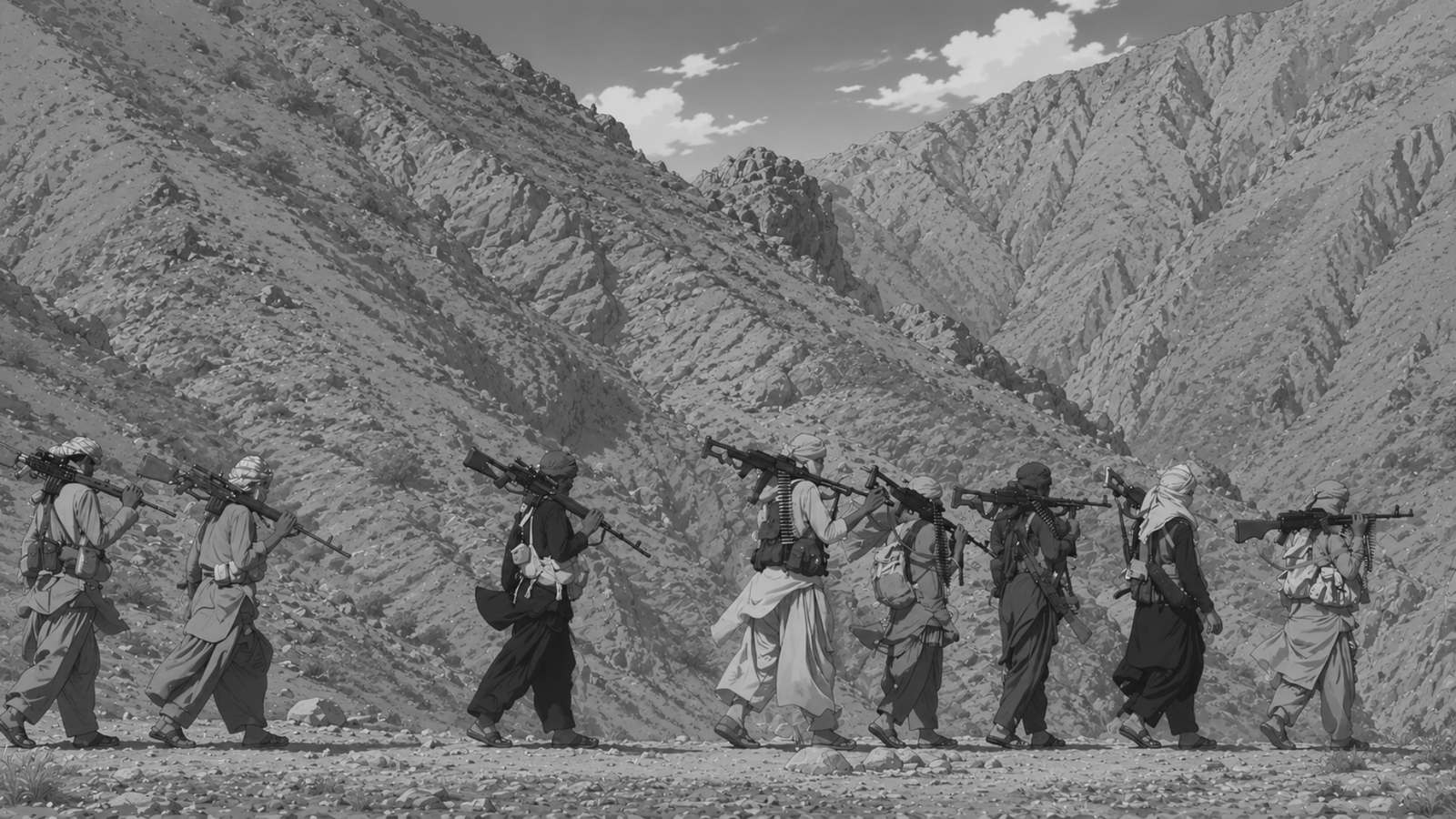
 BLA Insurgents Before Jiwani Attack
The attack near Jiwani, where militants targeted Pakistani Coast Guard personnel on a vessel along the Makran coast, illustrates a notable evolution in the operational profile of Baloch insurgent groups. The location is strategically significant, positioned near sensitive maritime routes and within proximity to Gwadar, the centrepiece of Pakistan’s coastal and CPEC-linked development strategy. The Balochistan Liberation Army (BLA) later claimed responsibility, stating that the attack was conducted by its newly announced naval wing, Hammal Maritime Defence Forces, and resulted in the deaths of three Coast Guard personnel.
This incident reflects a clear expansion of the conflict domain from land-based insurgency into the maritime environment, signalling both intent and emerging capability to operate in coastal and near-shore zones. While the broader conflict remains geographically concentrated and structurally persistent, such attacks indicate a targeted shift toward high-value, strategic assets, particularly those linked to state presence and economic infrastructure. The use of a specialized “naval wing” designation also suggests an effort to project organizational sophistication and signal a widening operational scope, even if actual capabilities remain limited at this stage. This logic is visible across incident-level data. Security forces remain the primary targets, particularly while in motion. Convoys, patrols and checkpoints are repeatedly engaged through ambushes using small arms. These operations do not rely on advanced systems, but on predictability. Movement routes are known. Timings can be observed. Over time, the cost of maintaining a security presence increases, not through a single decisive blow, but through repeated exposure.

At the same time, infrastructure is being drawn into the conflict. Roads, transport corridors and logistical routes are disrupted through sabotage and explosive attacks. These incidents often produce limited casualties, but their effect is cumulative. They slow movement, increase uncertainty and signal that even economic lifelines are vulnerable.
Civilian targeting, though less frequent, follows its own pattern. Individuals linked to the government or suspected of cooperation are singled out. These are not random killings. They are messages. They raise the cost of collaboration and weaken the state’s ability to build durable local networks. Control, in such an environment, becomes difficult to sustain.
Taken together, these dynamics point to an insurgency that is not trying to escalate quickly. It is trying to endure.
CNAWS data shows that small arms account for the majority of attacks, roughly 70 percent, while explosives are used selectively as force multipliers. This combination supports a model of violence that is both low-cost and repeatable. It allows militant groups to sustain pressure without overextending themselves or relying on complex operations that increase risk.

There are also signs of gradual adaptation. In major attacks, militants have been reported to use automatic rifles and, in some cases, heavier systems such as grenade launchers, indicating access to more capable weaponry. These additions do not change the balance of power outright, but they increase the lethality of engagements when it matters.The actors behind this violence are not new. Groups such as the Baloch Liberation Army have operated in the region for years. What has changed is the coherence of their operations. Large-scale coordinated attacks in recent months, involving multiple targets across different locations, have demonstrated an ability to scale beyond localized engagements. Even when such operations are rare, they reveal capacity. They show what is possible.

April 24, Quetta – BLA claimed to have taken control of OIL and Gas company site, destroying machinery and vehicles
The strategic context makes this evolution more significant. Balochistan is not just a peripheral province. It is a corridor. It hosts key segments of the China Pakistan Economic Corridor (CPEC), including Gwadar port, and contains major mineral reserves such as the Reko Diq project. It borders Iran and Afghanistan, creating both opportunity and complexity for movement and control.
This geography elevates insurgent activity beyond a localized security challenge into a strategic risk environment. Attacks on roads, convoys or project sites can disrupt investment timelines, increase costs and deter future engagement. Even low-intensity incidents, if sustained, can shape perception. They signal risk. And perception, in this context, is as powerful as disruption.
Despite these developments, CNAWS analysis assigns an Expansion Index of 3.8/10, indicating controlled diffusion rather than rapid expansion, a pattern consistent with a conflict that is stabilising structurally while becoming more effective operationally. Most activity remains concentrated in established districts, with only limited spillover into peripheral areas. These peripheral incidents tend to be isolated, low in impact and not sustained over time.
This is precisely what makes the situation difficult to interpret. The conflict is stable in volume, yet increasingly effective in outcome. For policymakers, stability often signals containment. In Balochistan, it signals persistence. Militant groups retain the initiative. They decide when and where to act. Security forces respond, but rarely disrupt in advance. This imbalance allows insurgent networks to operate with relative freedom within core areas while gradually testing the edges of their reach. The conflict does not need to intensify to become more consequential. It can achieve strategic effects through accumulation. Each ambush, each targeted killing, each disrupted road contributes incrementally to an environment where governance becomes harder, security more costly and investment more uncertain. What is taking shape in Balochistan is not a sudden breakdown of order. It is a slow erosion of control. The province is not descending into chaos. It is settling into a pattern of sustained, adaptive insurgency. The violence is calibrated. The targets are chosen. The methods favour endurance over spectacle. Balochistan is no longer slipping out of control. It is being systematically rendered ungovernable, one calculated, cumulative, and strategically aligned attack at a time.
Tags
- #Baloch insurgency
- #Baloch Liberation Front
- #Balochistan
- #Balochistan conflict
- #balochistan insurgency analysis
- #Balochistan Liberation Army
- #cpec security challenges
- #CPEC security threats
- #Gwadar port security and Baloch conflict
- #maritime insurgency
- #pakistan
- #pakistan counterinsurgency
Author
Sushant Pawar
Sushant serves as the Intelligence/ Lead Analyst for the Pakistan Security Desk at CNAWS, specializing in the Balochistan insurgency and Tehrik-e-Taliban Pakistan (TTP). His work spans monitoring the broader regional security environment , including insurgency trends, militant networks, and cross-border dynamics, to assess their impact on stability across South Asia. Beyond terrorism analysis, Sushant tracks Pakistan's evolving political and security landscape, delivering insights that inform regional stability and India's national security priorities.