China’s Fishing Fleet as a Dual-Use Military Asset: An OSINT Analysis of Scale, Doctrine, Economics and Operations

Department of Maritime Security · Detailed Reports · Maritime Security · Intelligence · Geopolitics ·

China’s Fishing Fleet as a Dual-Use Military Asset: An OSINT Analysis of Scale, Doctrine, Economics and Operations

Pen Name: Boykaboy

China has engineered the world's most consequential maritime grey-zone instrument by weaponising its civilian fishing fleet. Numbering more than 57,000 blue-water-capable industrial vessels and backed by an opaque, multi-billion-dollar state subsidy architecture, China's Distant-Water Fishing (DWF) fleet simultaneously functions as a sovereign food-security shield, a geopolitical coercion tool, a globally distributed ISR network, and the indispensable logistical backbone of future high-intensity military campaigns, most critically a prospective amphibious assault on Taiwan.

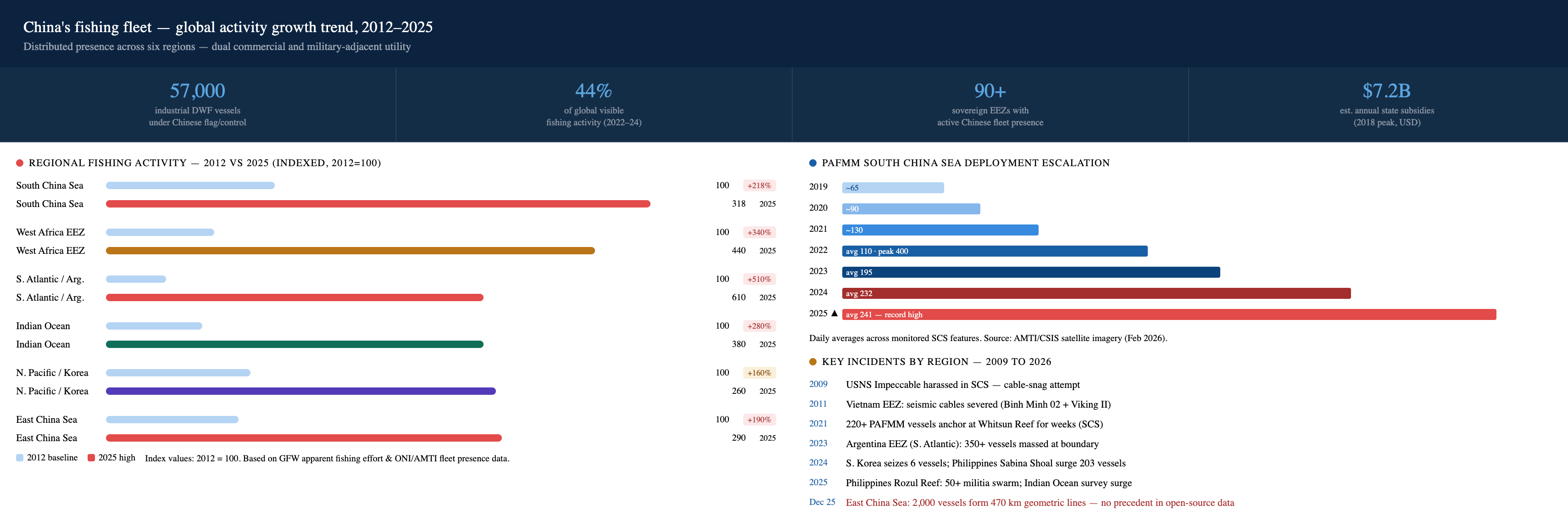
The People's Armed Forces Maritime Militia (PAFMM), the institutional sinew binding this civilian fleet to the People's Liberation Army (PLA), has broken deployment records consecutively in 2024 and 2025. Satellite imagery analysed by the Asia Maritime Transparency Initiative (AMTI) documented a daily average of 241 militia vessels in contested South China Sea waters throughout 2025. Meanwhile, in December 2025 and January 2026, approximately 2,000 and 1,000 Chinese fishing boats, respectively, assembled in precise geometric formations spanning 400 kilometres across the East China Sea, events that senior analysts at CSIS described as having "no clear precedent in publicly available data."

The central strategic insight of this assessment is economic: a fishing trawler costs a tiny fraction of a naval combatant to build, crew, fuel, and maintain, yet it can perform persistent ISR, generate crippling radar clutter, provide amphibious lift, conduct acoustic data relay, and enforce area denial, all with near-complete legal impunity under the civilian-vessel protections of UNCLOS. This makes the fishing fleet, per dollar of state investment, arguably the most cost-efficient tool of blue-water power projection in the history of maritime warfare.

1. Fleet Architecture and Scale

1.1 The Domestic-to-Distant-Water Pivot

China's domestic fishing fleet peaked at an estimated 1,072,000 vessels in 2013 before being deliberately reduced by roughly 47 percent through capacity-reduction guidelines and seasonal moratoriums issued by the Ministry of Agriculture and Rural Affairs. By 2023-24 the domestic fleet had contracted to approximately 564,000 vessels. This headline reduction, however, is deeply misleading. It masks a deliberate qualitative upgrade: the tonnage, engine power, and endurance of average vessels increased substantially, and the resources freed by domestic contraction were redirected toward aggressive expansion of the Distant-Water Fishing fleet.

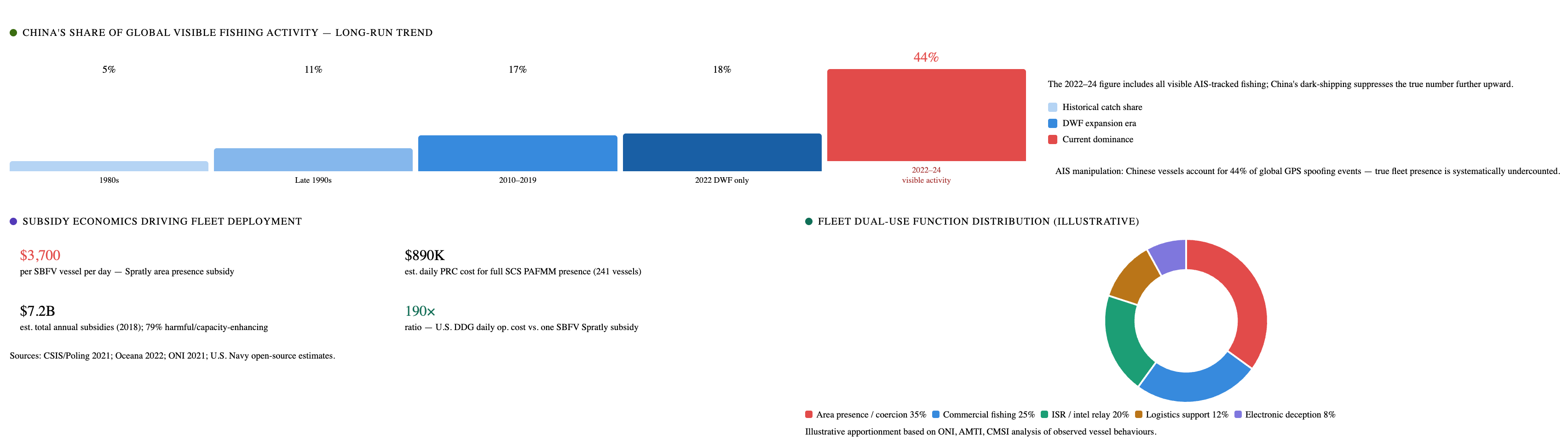
Today's DWF fleet of roughly 57,000 industrial fishing vessels operates across the EEZs of more than 90 sovereign nations. Between 2022 and 2024 these vessels — most heavily subsidised — accounted for 44 percent of all visible fishing activity worldwide. Chinese marine catch as a share of global production surged from approximately 5 percent in the 1980s to 17 percent between 2010 and 2019, with DWF production alone reaching 2.33 million tonnes (roughly 18 percent of the national wild catch) by 2022.

1.2 The PAFMM's Two-Tier Operational Structure

The institutional architecture binding this civilian fleet to PLA strategic objectives is the People's Armed Forces Maritime Militia (PAFMM). It is not an informal grouping of patriotic fishermen but a state-organised, state-funded, and state-directed armed mass organisation that reports directly through local People's Armed Forces Departments (PAFDs) up to Commander-in-Chief Xi Jinping.

1.2.1 Professional Maritime Militia Fishing Vessels (MMFVs)

MMFVs are purpose-built for paramilitary operations. They are constructed to military-grade specifications with heavily reinforced steel hulls displacing over 1,000 tons, and are equipped with high-powered water cannons, internal weapons storage, and advanced military communications suites. Financing flows directly from national defence budgets via a dedicated construction fund. Crews are full-time paramilitary personnel drawing state salaries from state-owned enterprises. Because they have no commercial fishing imperative, MMFVs are invariably the frontline vessels in direct physical confrontations — acting as the coercive vanguard in sovereignty disputes.

1.2.2 Spratly Backbone Fishing Vessels (SBFVs)

SBFVs are ostensibly commercial fishing boats, typically 45-65 metres in length and displacing over 200 tons, with reinforced steel hulls capable of deliberate ramming. Owners and crews operate under formal contracts mandating participation in sovereignty missions, intelligence collection, and military training. In exchange, Beijing's "double fuel subsidy" mechanism compensates them at extraordinary rates when deployed in designated contested zones. AMTI analysis shows that a large SBFV exceeding 1,200 kW can receive state payments of approximately USD 3,700 per day simply for maintaining a persistent physical presence — meaning the catching of fish is economically irrelevant to these vessels' primary mission.

2. The Economics of Blue-Water Power Projection

2.1 The Subsidy Architecture

China's fisheries subsidy system is uniquely structured to maximise geopolitical rather than commercial returns. Prior to 2016, the government published detailed annual subsidy figures in the China Fisheries Yearbook; since then, reporting has grown deliberately opaque, with central funding increasingly shifted to subnational "general funds" that can be deployed with discretion across fuel, vessel construction, and area-presence payments. When China submitted its WTO notification in 2019, it did not include a fuel subsidy estimate, citing these reporting changes.

Between 2009 and 2018, Beijing reduced "beneficial" conservation subsidies and more than doubled "capacity-enhancing" subsidies — those directly enabling increased fishing effort and fleet size. Oceana's analysis of available data estimates that in 2019 central government transfers (GTPs) totalled approximately CNY 11.7 billion, with 79 percent allocated to domestic fuel subsidies. The Subsidised Technology Program (STP) totalled CNY 8.6 billion, of which an estimated CNY 7.1 billion went to fisheries development — categorised as harmful to sustainable fishing. An estimated USD 7.2 billion in total subsidies were flowing to fishing fleets by 2018.

Crucially, subsidies flow disproportionately to the DWF sector — the fleet operating in foreign waters and performing military-adjacent functions — despite it representing only approximately 22 percent of China's total catch. Provincial city-level competition for DWF operators adds an additional layer of incentive: Zhangzhou municipality, for example, offered CNY 3 million (USD 480,000) for any firm relocating its base, CNY 500 per tonne of distant-water catch landed locally, and CNY 200,000 per new approved vessel entry. New entrant firms could access discounted corporate loans at 40 percent off standard rates through state-controlled banks.

2.2 Cost Comparison: Fishing Vessel vs. Naval Combatant

The core economic argument for China's fishing-fleet strategy is compelling. A purpose-built SBFV — even fully subsidised and counting all state compensation — represents a vanishingly small fraction of the acquisition and lifecycle costs of even the cheapest naval combatant. The following comparison illustrates the asymmetric cost efficiency:

The cost asymmetry is stark. For the acquisition price of a single U.S. Arleigh Burke destroyer, China can subsidise and maintain an entire SBFV force numbering in the hundreds — force elements that collectively outperform the destroyer in ISR persistence, area presence, logistical support, and grey-zone coercion, while being largely immune to conventional kinetic response.

The fleet's commercial operations add a further critical dimension: even when performing military-adjacent missions, fishing vessels generate revenue from their catch, offset their fuel costs through subsidies, and attract international trade finance — effectively making the military instrument partially self-funding. No conventional naval asset achieves this. A Type 052D destroyer at sea costs the state approximately USD 150,000-250,000 per day; an SBFV on a Spratly sovereignty mission costs the state approximately USD 3,700 per day while returning a catch that offsets part of that expenditure.

2.3 The Reefer Transshipment Model as Military Logistics

The DWF fleet's global endurance — routinely operating for over a year without returning to mainland ports — is sustained by a mature at-sea transshipment architecture centred on refrigerated cargo vessels ("reefers"). DWF vessels offload catch directly to reefers at sea, which resupply them with fuel, food, fresh water, and replacement gear. This existing commercial infrastructure has direct, immediate military applications. In a wartime or high-intensity paramilitary context, reefers serve as decentralised replenishment-at-sea nodes, sustaining the PAFMM indefinitely without port calls. In a Taiwan invasion scenario, pre-fitted reefers and cargo ships become floating logistical hubs for PLAN combatants, enabling refuelling, emergency towing, firefighting support, and mass casualty triage — all distributed across hundreds of ostensibly civilian hulls that allied forces would face significant legal and ethical barriers to engaging.

3. Grey-Zone Coercion: Patterns and Tactics

3.1 Record Deployment Patterns (2024-2025)

AMTI's satellite imagery analysis, using Planet Labs imagery at 11 South China Sea features throughout 2024 and 2025, confirms a sustained escalation in PAFMM deployments. The 2024 daily average of 232 militia vessels represented a 15 percent increase over 2023's 195, itself a 35 percent increase over the prior year. The 2025 daily average of 241 vessels marked the highest level on record. Mischief Reef and Whitsun Reef together accounted for nearly half of total observed militia presence, with Mischief Reef recording four distinct peaks exceeding 200 vessels during 2025, reinforcing its role as a command hub monitoring tensions with the Philippines at Sabina Shoal and Second Thomas Shoal.

A significant doctrinal shift was also observed: in 2024, a majority of militia ships spent their days anchored within the lagoons of China's island military outposts rather than at unoccupied reefs where they might plausibly maintain a fishing facade. AMTI analysts interpreted this as reflecting a diminishing interest in sustaining the pretence of commercial fishing activity — the international community's growing awareness of their paramilitary character means the camouflage value has declined, and vessels now prioritise easier resupply and comfort within Chinese-controlled bases.

3.2 The East China Sea Geometric Formations (Dec 2025 – Jan 2026)

The most operationally significant recent event was the unprecedented geometric massing of Chinese fishing vessels in the East China Sea. On Christmas Day, 25 December 2025, approximately 2,000 vessels arranged themselves into two parallel inverted-L formations, each approximately 400 kilometres in length — a total span of roughly 400 kilometres. A second formation of approximately 1,000 vessels was detected on 11 January 2026. The events were verified through AIS data analysis by AFP, corroborated by Unseenlabs satellite radio-frequency intelligence, and cross-referenced against nighttime satellite imagery and Global Fishing Watch fishing-effort algorithms.

AIS tracking confirmed the vast majority of vessels originated from Zhejiang Province — a major PAFMM homeport region. Expert analysis was unequivocal: the vessels were not fishing (no fishing-detection algorithm classified their movements as apparent fishing activity), and the geometric precision of the formations had no precedent in publicly available maritime data for civilian commercial operations. Gregory Poling of CSIS stated he had never seen such a massing outside of port.

Expert consensus points to one plausible explanation: China was conducting a large-scale mobilisation readiness exercise — testing its capability to rapidly marshal thousands of civilian vessels that could serve as decoys, logistical support, or amphibious lift assets in a contingency operation targeting Taiwan or involving Japan. Thomas Shugart, a former U.S. Navy officer now at CNAS, summarised the strategic logic: "In the absence of that dual-purpose, civil-military maritime mass, I don't think they can invade Taiwan. With that, it turns into a 'maybe they can.'"

Video Source: NikkeiAsia

3.3 South America, Africa, and the Global Grey Zone

The grey-zone playbook is not confined to the Near Seas. In December 2025, over 350 Chinese vessels amassed at the edge of Argentina's EEZ in the South Atlantic, prompting Argentina in March 2025 to deploy military surveillance assets to protect its EEZ from intruding Chinese vessels. One specific vessel, Lu Qing Yuan Yu 205, was conducting slow grid-pattern manoeuvres consistent with unauthorised bathymetric mapping or seabed surveillance — not commercial trawling. In June 2025, the Philippine Coast Guard reported more than 50 Chinese maritime militia vessels "swarming" Rozul Reef within the Philippines' EEZ, with many vessels going dark simultaneously.

These incidents demonstrate that the operational architecture perfected in the South China Sea is being systematically exported to the global maritime commons, leveraging the DWF fleet's genuine commercial presence as cover for state-directed intelligence and influence operations.

3.4 Tactical Toolset: From Swarming to Electronic Deception

The PAFMM employs a layered tactical toolkit that escalates from passive presence to active electronic warfare:

4. The C4ISR Network: Fishing Fleet as Global Intelligence Grid

4.1 Information Boats and Intelligence Personnel

The PLA explicitly tasks the PAFMM and DWF fleet with filling the "blind spots" (补盲) in its global maritime situational awareness — the coverage gaps that dedicated naval intelligence assets cannot cost-effectively maintain. Naval War College China Maritime Report No. 46 (Martinson, 2025), drawing on PLA primary sources, confirms that militia forces specialising in intelligence are organised into "maritime reconnaissance" (海上侦察) units distributed across China's coastal provinces.

Specific vessels within these units are designated "information boats" (信息船) outfitted with advanced commercial sensors, high-fidelity satellite navigation, and shortwave and satellite communications enabling beyond-line-of-sight data transmission. Embedded within these vessels are "information personnel" (信息员) — part-time intelligence specialists who maintain continuous secure contact with PAFDs while at sea, relaying visual identification of foreign warships, acoustic anomalies, and signals intelligence directly to PLA operational commands. Because these vessels carry civilian documentation, they can legally loiter near foreign naval bases, monitor exercise zones, and transit critical straits without triggering a legally justifiable response.

PLA experts have also advocated for embedding intelligence personnel on Chinese vessels operating in distant-water regions — and NWC's Martinson assesses this is likely already occurring across the global DWF fleet. China's Distant-Water Fishing fleet additionally hosts Party cells and security stewards under a "far-seas policing" model, with the BeiDou satellite navigation and communications system providing the secure data backbone.

The scale of latent ISR capacity is staggering. Even if outfitted only with basic commercial-grade sensors, a fleet of 57,000 vessels theoretically covers over 1.2 million nautical miles per day — a distributed, globally resilient intelligence network with genuine deniability.

4.2 The Transparent Ocean Architecture

The fishing fleet's ISR role is embedded within China's broader "Transparent Ocean" (透明海洋) strategy — a five-layer architecture designed to eliminate the acoustic and stealth advantages of U.S. and allied submarines in the Western Pacific and beyond. The five layers are: (1) an orbital satellite constellation using interferometric radar altimetry and ocean lidar; (2) the Air-Sea Interface layer, comprising smart buoys, wave gliders, unmanned surface vessels, and critically, the fishing fleet; (3) autonomous underwater vehicles and acoustic gliders below the mixed layer; (4) fixed seabed sonar arrays across strategic straits; and (5) mainland AI-fusion processing hubs creating a real-time kill web.

The fishing fleet is operationally irreplaceable within Layer 2. Acoustic data from seabed sensors travels as slow, low-bandwidth packets that cannot easily penetrate the ocean surface to reach orbital assets. Fishing vessels equipped with specialised receivers loiter at strategic choke points, receive this subsurface data, and translate it into high-bandwidth satellite bursts transmitted securely to mainland processing centres. PLA Navy officers have also published analyses proposing the use of fishing nets and dragged equipment to physically destroy or spoof U.S. hydrophones and towed arrays in a conflict — blending passive acoustic surveillance with kinetic undersea sabotage capability.

By late 2025, multiple Chinese survey and research vessels — including Shi Yan-6, Shen Hai Yi Hao, and Lan Hai — were actively mapping the Indian Ocean's undersea terrain, a deployment that India's security establishment views as part of Beijing's push to refine oceanographic and submarine intelligence capabilities. Sri Lanka imposed a year-long moratorium on all foreign research vessels in early 2024 after anxieties about dual-use survey ships operating near sensitive areas.

4.3 The BeiDou Backbone and Dark Shipping

China's BeiDou Navigation Satellite System, officially recognised by the IMO in November 2014, provides the fishing fleet with a secure, state-controlled communications and positioning backbone that operates independently of Western GPS infrastructure. Vessels equipped with BeiDou VMS (Vessel Monitoring System) terminals transmit position and status to mainland monitoring centres every 10 minutes — enabling real-time operational control of thousands of vessels simultaneously. Crucially, this system operates on Chinese-controlled infrastructure, meaning Beijing can selectively share or withhold vessel position data from international tracking platforms.

Chinese fishing vessels account for 44 percent of global GPS manipulation events detected by commercial maritime intelligence firms. The fleet routinely disables AIS transponders, rotates vessel names and MMSI identifiers mid-voyage, and operates under flags of convenience. A CSIS Futures Lab case study tracking a single suspected militia vessel through 2024 documented the vessel appearing under at least 11 different MMSI identifiers, briefly entering Taiwan's ADIZ and then disappearing from AIS detection repeatedly — strongly indicative of intentional identity obfuscation coordinated with PLA exercise timelines.

5. Wartime Integration: Amphibious Lift and the Taiwan Scenario

5.1 Bridging the PLAN's Amphibious Lift Deficit

A widely cited analytical assumption has been that the PLAN lacks sufficient dedicated amphibious lift to execute a viable cross-strait assault on Taiwan. The PLAN's grey-hulled amphibious fleet can transport approximately 20,000 troops in a single lift; a realistic force requirement for an initial Taiwan assault and pacification campaign has been estimated at 300,000+ personnel. This apparent gap has led some analysts to dismiss near-term invasion scenarios as implausible. The civil-military fusion doctrine fundamentally invalidates this reasoning.

PLA operational planning explicitly bridges the lift-capacity deficit through comprehensive national defence mobilisation of the civilian maritime sector. As of 2015, the civilian logistics force formally earmarked for military mobilisation consisted of over 5,000 large-capacity ships organised into 89 transportation units, 53 waterway engineering units, and 143 specialised support units. The PLA's "model of selecting militiamen according to their ship" (依船定兵模式) pre-trains regular civilian crews on complex military operational tasks and integrates them into command-and-control structures long before any hostilities commence.

The December 2025 and January 2026 geometric formations in the East China Sea — involving Zhejiang-based militia vessels massing in precise, disciplined formations over 30 continuous hours — are consistent with exactly this kind of mobilisation readiness exercise. The military utility of the formations would include: convoy corridor establishment, mine-laying route rehearsal, decoying adversary targeting systems, and inter-vessel coordination for second-echelon troop transport.

5.2 Civil-Military Maritime Logistics Matrix

5.3 The Distributed Logistics Advantage

By distributing wartime logistical requirements across thousands of civilian hulls, the PLA creates a supply chain that is highly resilient, massively redundant, and legally ambiguous to attack. Allied forces seeking to interdict this support network would face the deeply uncomfortable necessity of identifying, classifying, and potentially sinking hundreds of vessels indistinguishable from innocent commercial shipping — a task demanding enormous magazine depth, near-perfect target discrimination, and tolerance for diplomatic and moral exposure that Western democracies may be politically unable to accept. This asymmetry is a deliberate design feature, not an accident.

6. Global Footprint and BRI Integration

6.1 IUU Fishing as Strategic Penetration

The IUU fishing activities of the DWF fleet represent more than environmental crime — they constitute a persistent, low-cost mechanism for establishing Chinese maritime presence, mapping foreign EEZs, and generating diplomatic leverage in economically vulnerable states. Africa loses an estimated USD 11.2 billion annually to IUU fishing, with USD 9.4 billion in West Africa alone; Latin America incurs up to USD 2.3 billion in annual losses. Chinese fishing firms routinely offer bribes and coercive funding through BRI mechanisms to local government officials to deter enforcement. South Korea seized six Chinese vessels fishing illegally within its EEZ in December 2025; North Korean waters have at times hosted up to 800 Chinese trawlers, constituting what Global Fishing Watch has described as the largest known case of illegal fishing by a single industrial fleet.

The strategic intelligence dividend from this global presence is significant. Chinese fishing vessels operating from West Africa to the South Atlantic to the Indian Ocean are acquiring bathymetric data, mapping undersea cable infrastructure, monitoring foreign naval traffic patterns, and establishing de facto familiarity with distant sea lanes that could support future PLAN deployments. By late 2025, multiple Chinese research vessels were simultaneously mapping undersea terrain across the Indian Ocean, prompting India to intensify its maritime domain awareness investments and Sri Lanka to implement a blanket moratorium on foreign research vessels.

6.2 Belt and Road Ports as Forward Operating Bases

The military utility of the DWF fleet is being exponentially amplified by China's BRI port investment network. Commercial port facilities developed under BRI in locations spanning West Africa, Pakistan, Sri Lanka, and across the Indian Ocean littoral can seamlessly serve dual logistical purposes. A Chinese fishing or cargo vessel departing from a commercially owned BRI port can act as a covert forward logistics node, replenishing PLAN vessels in international waters via transshipment without triggering military alert systems. These sovereign-controlled commercial facilities allow the DWF fleet to forward-deploy regionally, acting as localised ISR networks monitoring U.S. and allied naval movements across critical maritime choke points long before those forces reach the Pacific theatre.

Concerns about China's potential use of Myanmar's Coco Islands — proximate to India's nuclear submarine base at Rambilli, Andhra Pradesh — for naval intelligence purposes exemplify the strategic sensitivity of this footprint. In October 2025, Myanmar denied Chinese naval presence at the Coco Islands while simultaneously refusing an Indian Navy access request, leaving New Delhi with unresolved questions about Chinese surveillance activity against its most sensitive strategic assets.

7. Legal Asymmetries and Countermeasures

7.1 The UNCLOS Exploitation Problem

The dual-use fishing fleet is structurally engineered to exploit the foundational assumptions of UNCLOS, which was drafted for good-faith state actors and not for state-funded, heavily armed paramilitary armadas disguised as commercial fishermen. Because these vessels operate as legal civilians, allied naval commanders face extreme legal and moral friction in crafting Rules of Engagement. When a civilian fishing vessel actively relays targeting telemetry to a shore-based anti-ship battery, or attempts to physically destroy a submarine's towed array, its legal status as a protected civilian entity becomes deeply ambiguous — paralysing the rapid decision-making that modern naval warfare demands. The PAFMM's tendency toward aggressive swarming, high-speed ramming, and dangerous intercepts simultaneously raises the risk of fatal miscalculation. A U.S. destroyer that accidentally sinks a PAFMM vessel during a chaotic grey-zone encounter gives Beijing an instant strategic propaganda victory.

7.2 Countermeasure Framework

Neutralising the dual-use fleet's operational advantages requires a shift away from purely kinetic naval responses toward a multi-domain, layered interdiction approach:

  • Logistics: Logistical node targeting: Systematic non-kinetic degradation of at-sea reefer replenishment operations would impose hard temporal and geographic limits on the PAFMM's coercive persistence. Without at-sea replenishment, vessels would be forced to return to port, breaking the "infinite presence" model.
  • Intelligence: Automated anomaly detection at scale: Frameworks such as Coalition Joint-Maritime Anomaly Cells (CJ-MAC) must fuse multi-source intelligence — AIS, satellite SAR, RF detection, nighttime imagery, and fishing-effort algorithms — to publish real-time alerts on suspect vessels engaging in identity obfuscation, grid-pattern mapping, or tactical masking of PLAN combatants.
  • Sanctions: Targeted financial and legal pressure: A rolling public blacklist of repeat grey-zone offenders — combined with sanctions on their owners, insurers, flag registries, and corporate shell structures — strips Beijing of plausible deniability and raises the economic costs of hybrid maritime warfare.
  • Legal: UNCLOS reform advocacy: The international community must press for legal framework updates that address the specific abuse of civilian maritime law by state-directed paramilitary organisations. This includes establishing internationally recognised criteria for stripping civilian legal protections from vessels demonstrably integrated into military command chains.
  • Capability: Non-kinetic intermediate force capabilities: Academic and military research (Dobias, 2024) has argued for non-lethal acoustic devices, vessel-stopping systems, and high-power microwaves as scalable countermeasures that preserve escalation control while shaping adversary behaviour — permitting responses to swarming tactics that avoid the binary of doing nothing or firing on civilians.
  • Legal theory: Privateer framework considerations: Some analysts (Jaeger, USNI Proceedings, April 2024) have proposed that PAFMM vessels, by engaging in acts functionally equivalent to piracy within foreign EEZs, may be subject to interdiction under existing maritime law — effectively reframing them as privateers rather than protected civilians.

8. Conclusion: The World's Most Cost-Efficient Military Force Multiplier

China's fishing fleet represents a strategic innovation of the first order: a force of over 57,000 vessels that simultaneously generates commercial revenue, secures food supply, establishes political presence, collects distributed intelligence, masks naval combatants, enables amphibious logistics, and enforces territorial claims — all while carrying civilian legal status that constrains adversary response. No conventional military instrument achieves this range of effects across this scale at this cost.

The economic logic is irresistible from Beijing's perspective. The entire PAFMM presence in the South China Sea — 241 vessels daily at the 2025 average — costs the Chinese state approximately USD 890,000 per day in maximum SBFV subsidy payments. This maintains persistent sovereignty enforcement over an area of the world's most strategically important waterways. The United States, by contrast, must deploy billion-dollar surface combatants to enforce freedom of navigation through those same waters — at daily operating costs exceeding a single vessel's SBFV subsidy programme for the entire year.

The unprecedented geometric formations of December 2025 and January 2026 — 2,000 fishing vessels in disciplined parallel lines spanning 470 kilometres — have moved the analytical debate from theory to observable fact. China is actively rehearsing the civil-military maritime mobilisation required for a Taiwan contingency, and it is doing so openly in the East China Sea, testing whether the international community will respond. The silence, so far, has been instructive for Beijing.

The ocean is no longer a neutral domain contested by grey-hulled warships. It is a layered grey zone, and China has deployed its most potent asset to control it: a fleet of fishing boats that are simultaneously economic instruments, intelligence nodes, coercive tools, and the logistical foundation of the largest potential amphibious operation in the 21st century. Recognising this strategic reality is the indispensable first step toward developing the doctrine, law, and capabilities necessary to secure the global maritime commons.

Key Open-Source Intelligence Sources

The following primary and secondary OSINT sources were consolidated in this assessment:

  1. Fishing fleet - Food and Agriculture Organization of the United Nations, accessed on February 23, 2026, https://www.fao.org/3/cc0461en/online/sofia/2022/fishing-fleet.html
  2. Chinese distant water fishing fleet - European Parliament, accessed on February 23, 2026, https://www.europarl.europa.eu/RegData/etudes/BRIE/2023/747900/EPRS_BRI(2023)747900_EN.pdf
  3. Foreign Governments' Use of Their Distant Water Fishing Fleets as Extensions of Their Maritime Security Forces and Foreign Policies - ONI, accessed on February 23, 2026, https://www.oni.navy.mil/Portals/12/reading_room/20210616_Congressional%20Report_Final%20-%20%2019AUG21.pdf
  4. China's Fishing Offensive: How China's Fishing Fleet Monopolizes Food Around the World, accessed on February 23, 2026, https://chinaselectcommittee.house.gov/media/press-releases/china-s-fishing-offensive-how-china-s-fishing-fleet-monopolizes-food-around-the-world
  5. China's changing fisheries, in numbers - Dialogue Earth, accessed on February 23, 2026, https://dialogue.earth/en/ocean/chinas-changing-fisheries-in-numbers/
  6. China Dominates 44% of Visible Fishing Activity Worldwide - Oceana, accessed on February 23, 2026, https://oceana.org/press-releases/china-dominates-44-of-visible-fishing-activity-worldwide/
  7. Fishing and Force: China's Dark Fleets and Maritime Militias, accessed on February 23, 2026, https://www.orfonline.org/expert-speak/fishing-and-force-china-s-dark-fleets-and-maritime-militias
  8. China's Maritime Militia and Fishing Fleets - Army University Press, accessed on February 23, 2026, https://www.armyupress.army.mil/Journals/Military-Review/English-Edition-Archives/January-February-2021/Panter-Maritime-Militia/
  9. The Strategic Significance, of the Chinese Fishing Fleet, accessed on February 23, 2026, https://www.armyupress.army.mil/Journals/Military-Review/English-Edition-Archives/May-June-2021/Landreth-Chinese-Fishing-Fleet/
  10. China's Role in the Exploitation of Global Fisheries: Issues for Congress, accessed on February 23, 2026, https://www.congress.gov/crs_external_products/R/PDF/R47065/R47065.1.pdf
  11. Combating the Gray Zone: Examining Chinese Threats to the Maritime Domain, accessed on February 23, 2026, https://carnegieendowment.org/russia-eurasia/posts/2024/06/combating-the-gray-zone-examining-chinese-threats-to-the-maritime-domain
  12. China's Third Sea Force, The People's Armed Forces Maritime ..., accessed on February 23, 2026, https://digital-commons.usnwc.edu/cgi/viewcontent.cgi?article=1000&context=cmsi-maritime-reports
  13. Civilian Shipping and Maritime Militia: The Logistics Backbone of a ..., accessed on February 23, 2026, https://digital-commons.usnwc.edu/cgi/viewcontent.cgi?article=1020&context=cmsi-maritime-reports
  14. A Short History of China's Fishing Militia and What It May Tell Us | RAND, accessed on February 23, 2026, https://www.rand.org/pubs/commentary/2020/04/a-short-history-of-chinas-fishing-militia-and-what.html
  15. Fact Sheet: China's Maritime Militia | Andrew S. Erickson, accessed on February 23, 2026, https://www.andrewerickson.com/2019/04/fact-sheet-chinas-maritime-militia/
  16. "China Maritime Report No. 46: China's Fishermen Spies ..., accessed on February 23, 2026, https://digital-commons.usnwc.edu/cmsi-maritime-reports/46/
  17. Pulling Back the Curtain on China's Maritime Militia, accessed on February 23, 2026, https://csis-website-prod.s3.amazonaws.com/s3fs-public/publication/211118_Poling_Maritime_Militia.pdf?Y5iaJ4NT8eITSlAKTr.TWxtDHuLIq7wR
  18. Maritime Militia - Wikipedia, accessed on February 23, 2026, https://en.wikipedia.org/wiki/Maritime_Militia
  19. Dropping the Act: China's Militia in 2024 | Asia Maritime Transparency Initiative, accessed on February 23, 2026, https://amti.csis.org/dropping-the-act-chinas-militia-in-2024/
  20. The China Maritime Militia Bookshelf: Latest U.S. Gov't & Other ..., accessed on February 23, 2026, https://www.andrewerickson.com/2026/02/the-china-maritime-militia-bookshelf-latest-u-s-govt-other-assessments-yellow-east-south-china-seas-oob-wikipedia-grokipedia-entries-more/
  21. Exposed Undersea: PLA Navy Officer Reflections on China's Not-So-Silent Service, accessed on February 23, 2026, https://cimsec.org/exposed-undersea-pla-navy-officer-reflections-on-chinas-not-so-silent-service/
  22. Chinese Nationalism and the “Gray Zone”: Case Analyses of Public Opinion and PRC Maritime Policy - GovInfo, accessed on February 23, 2026, https://www.govinfo.gov/content/pkg/GOVPUB-D208_200-PURL-gpo156589/pdf/GOVPUB-D208_200-PURL-gpo156589.pdf
  23. Understanding and Countering China's Maritime Gray Zone Operations - RAND, accessed on February 23, 2026, https://www.rand.org/content/dam/rand/pubs/research_reports/RRA2900/RRA2954-1/RAND_RRA2954-1.pdf
  24. China's IUU Fishing Fleet: Pariah of the World's Oceans - U.S. Naval War College Digital Commons, accessed on February 23, 2026, https://digital-commons.usnwc.edu/cgi/viewcontent.cgi?article=3005&context=ils
  25. Signals in the Swarm: The Data Behind China's Maritime Gray Zone Campaign Near Taiwan - CSIS, accessed on February 23, 2026, https://www.csis.org/analysis/signals-swarm-data-behind-chinas-maritime-gray-zone-campaign-near-taiwan
  26. Signals in the Swarm, accessed on February 23, 2026, https://csis-website-prod.s3.amazonaws.com/s3fs-public/2025-10/251008_Macias_Signals_Swarm.pdf?VersionId=3jH1pNHrJK.6x6sNUKXgv8xkS07NyvbY
  27. Hidden Tides: IUU Fishing and Regional Security Dynamics for India, accessed on February 23, 2026, https://carnegieendowment.org/russia-eurasia/research/2025/06/hidden-tides-iuu-fishing-and-regional-security-dynamics-for-india
  28. China's exploitative fishing fleet - The Australian Naval Institute, accessed on February 23, 2026, https://navalinstitute.com.au/chinas-exploitative-fishing-fleet/
  29. No Ordinary Boats: Cracking the Code on China's Spratly Maritime Militias, accessed on February 23, 2026, https://cimsec.org/no-ordinary-boats-cracking-the-code-on-chinas-spratly-maritime-militias/
  30. China Is Deploying an Underwater Web Against US Submarines, accessed on February 23, 2026, https://militarnyi.com/en/news/china-is-deploying-an-underwater-web-against-us-submarines/
  31. China's burgeoning undersea sensor net aims to turn the ocean transparent - Defense One, accessed on February 23, 2026, https://www.defenseone.com/threats/2025/10/chinas-burgeoning-undersea-sensor-net-aims-turn-ocean-transparent/408815/
  32. China's military wants to target US undersea sensor network: Analysis - Defense News, accessed on February 23, 2026, https://www.defensenews.com/global/asia-pacific/2025/08/13/chinas-military-wants-to-target-us-undersea-sensor-network-analysis/
  33. One Hundred Unorthodox Strategies - dokumen.pub, accessed on February 23, 2026, https://dokumen.pub/download/one-hundred-unorthodox-strategies-battle-and-tactics-of-chinese-warfare-9780813346595-0813346592.html
  34. China Maritime Report #46—“China's Fishermen Spies: Intelligence Specialists in the Maritime Militia” | Andrew S. Erickson, accessed on February 23, 2026, https://www.andrewerickson.com/2025/04/china-maritime-report-46-chinas-fishermen-spies-intelligence-specialists-in-the-maritime-militia/
  35. Dynamic sequential radar cross section properties of airborne corner reflector in array, accessed on February 23, 2026, https://www.researchgate.net/publication/372102397_Dynamic_sequential_radar_cross_section_properties_of_airborne_corner_reflector_in_array
  36. Radar Target Characterization and Deep Learning in Radar Automatic Target Recognition: A Review - MDPI, accessed on February 23, 2026, https://www.mdpi.com/2072-4292/15/15/3742
  37. How Much Military Capability Does China Want to Develop? How Much Will it Succeed?: The Dragon at Sea, accessed on February 23, 2026, https://www.nids.mod.go.jp/english/event/symposium/pdf/2006/e2006_08.pdf
  38. China Military Power - Defense Intelligence Agency, accessed on February 23, 2026, https://www.dia.mil/Portals/110/Images/News/Military_Powers_Publications/China_Military_Power.pdf
  39. China's Global Navy—Today's Challenge for the United States and the U.S. Navy, accessed on February 23, 2026, https://digital-commons.usnwc.edu/cgi/viewcontent.cgi?article=8144&context=nwc-review
  40. Degrading China's Integrated Maritime Campaign > National ..., accessed on February 23, 2026, https://ndupress.ndu.edu/Media/News/News-Article-View/Article/2808063/degrading-chinas-integrated-maritime-campaign/
  41. Crafting hybridity: institutionalizing and governing maritime militias' public-private collaboration - Frontiers, accessed on February 23, 2026, https://www.frontiersin.org/journals/political-science/articles/10.3389/fpos.2025.1592455/full
  42. The Strategic Significance of the Chinese Fishing Fleet - Army University Press, accessed on February 23, 2026, https://www.armyupress.army.mil/Portals/7/military-review/Archives/English/MJ-21/Landreth-Chinese-Fishing-Fleet.pdf
  43. China's exploitation of overseas ports and bases - Atlantic Council, accessed on February 23, 2026, https://www.atlanticcouncil.org/in-depth-research-reports/issue-brief/chinas-exploitation-of-overseas-ports-and-bases/
  44. China's Logistics Capabilities for Expeditionary Operations, accessed on February 23, 2026, https://www.uscc.gov/sites/default/files/2020-04/China%20Expeditionary%20Logistics%20Capabilities%20Report.pdf

The views expressed are those of the authors and do not represent the views of CNAWS.

Header Photo Credits: Los Angeles Times

Tags

  • #China maritime militia
  • #China nine dash line dispute
  • #China Taiwan invasion strategy
  • #China-Taiwan Conflict
  • #Chinese fishing fleet military use
  • #Chinese naval hybrid warfare
  • #distant water fishing China
  • #maritime ISR China
  • #OSINT China maritime analysis
  • #People's Liberation Army
  • #PLA
  • #PLA maritime strategy
  • #South China Sea grey zone tactics
  • #South China Sea maritime security
  • #UNCLOS grey zone warfare

Author

Pen Name: Boykaboy

Boykaboy leads a team of OSINT Analysts at CNAWS.