Department of Maritime Security · Articles · Geopolitics ·
The Arctic in Transition: Climate Change, Great-Power Rivalry, and India's Strategic Stakes
The Arctic is no longer a remote frozen frontier defined only by scientific cooperation and environmental governance. Accelerating climate change is opening new maritime routes, exposing vast hydrocarbon and critical mineral reserves, and turning the region into a major arena of great-power rivalry. Russia’s control over the Northern Sea Route, NATO’s expanding Arctic posture, China’s Polar Silk Road ambitions, and renewed strategic interest in Greenland are reshaping the High North into a contested geopolitical space. For India, the Arctic matters not only because of climate impacts on monsoons and Himalayan glaciers, but also because of future energy access, critical mineral security, maritime connectivity, and emerging trade corridors such as Chennai-Vladivostok. The article argues that India must treat the Arctic as a long-term strategic theatre and pursue a balanced approach built on science, climate security, energy partnerships, maritime connectivity and cooperation with both Russia and the Nordic states.
The Artic, once regarded as a remote inhospitable frozen region, characterised by de-escalation, scientific cooperation and environmental governance is now re-emerging as a key theatre of Global strategic competition.
While great-power competition has intensified the Arctic's strategic significance, the region's geopolitical transformation, however is fundamentally rooted in the accelerating impacts of climate change. The rapidly receding ice cover is altering the geographical landscape and also simultaneously reshaping the region’s geopolitical significance. As new maritime spaces open up, new sea routes are emerging thereby making the region’s vast untapped hydro-carbon reserves and critical mineral wealth increasingly accessible. This has repositioned the Arctic as a key strategic frontier while major powers along with arctic states, increasingly recalibrate their approaches in the higher north.
The Geopolitical Impact of Climate Change
Climate change is undoubtedly the largest structural threat and nontraditional security challenge for the Arctic, the most vulnerable region globally, to the looming climate crisis. As studies point out, the Arctic is warming three to four times faster than the global average with one particular study proving that during the period from 1971-2021, in the last 43 years the Arctic has been warming four times faster than the global average. Another study highlights that from 1991-2020, while the global average was 0.26 C per decade, Europe was the warmest continent with a temperature rise of 0.53 C per decade with the Arctic region warming by 0.69 C per decade which remains the highest rate of global warming. This accelerated pace of climate change referred to as ‘Arctic amplification’ is caused by self-reinforcing feedback loops such as the ‘Ice Albedo effect’. The bright white ice of the Arctic was its greatest shield as it reflected the sunlight back but as the Arctic’s cryosphere continues to melt rapidly, the melted ice is replaced with dark ocean water which absorbs the heat leading to the Ice Albedo effect . Similarly, due to vast stretches of frozen artic soil thawing, trapped greenhouse gases are being released, causing ‘Permafrost thawing’ further warming the atmosphere. Other factors such as ‘Lapse rate feedback’ and warm air and ocean currents from lower attitude transporting extra heat into Arctic along with Ice Albedo effect and Perma frost thawing together create a feedback loop which intensifies the warming in the Arctic.
New Shipping routes in the Arctic
The intensive warming and rapidly receding ice cover, has led to new shipping routes such as the Trans polar sea route cutting across the central arctic traversing the north pole is a future possibility by the mid-century (2045-2060). The image below shows the three shipping routes namely the Northern Sea Route (NSR), Northwest shipping route (NWP) and the future Trans polar sea route (TSR).
 Source: (Arctic Institute, 2016)
Among the two existing trade routes, the use of NWP traversing through Canadian Arctic waters is heavily restricted due to hazardous thick ice conditions and hence is accessible in the ice-free season that is highly variable and often lasts only for 6 to 12 weeks. Further the sovereignty dispute between Canada and US, wherein Canada claims NWP to be its internal waters while US and other countries argue it to be international waters, complicates the route’s potential as a commercial shipping route.
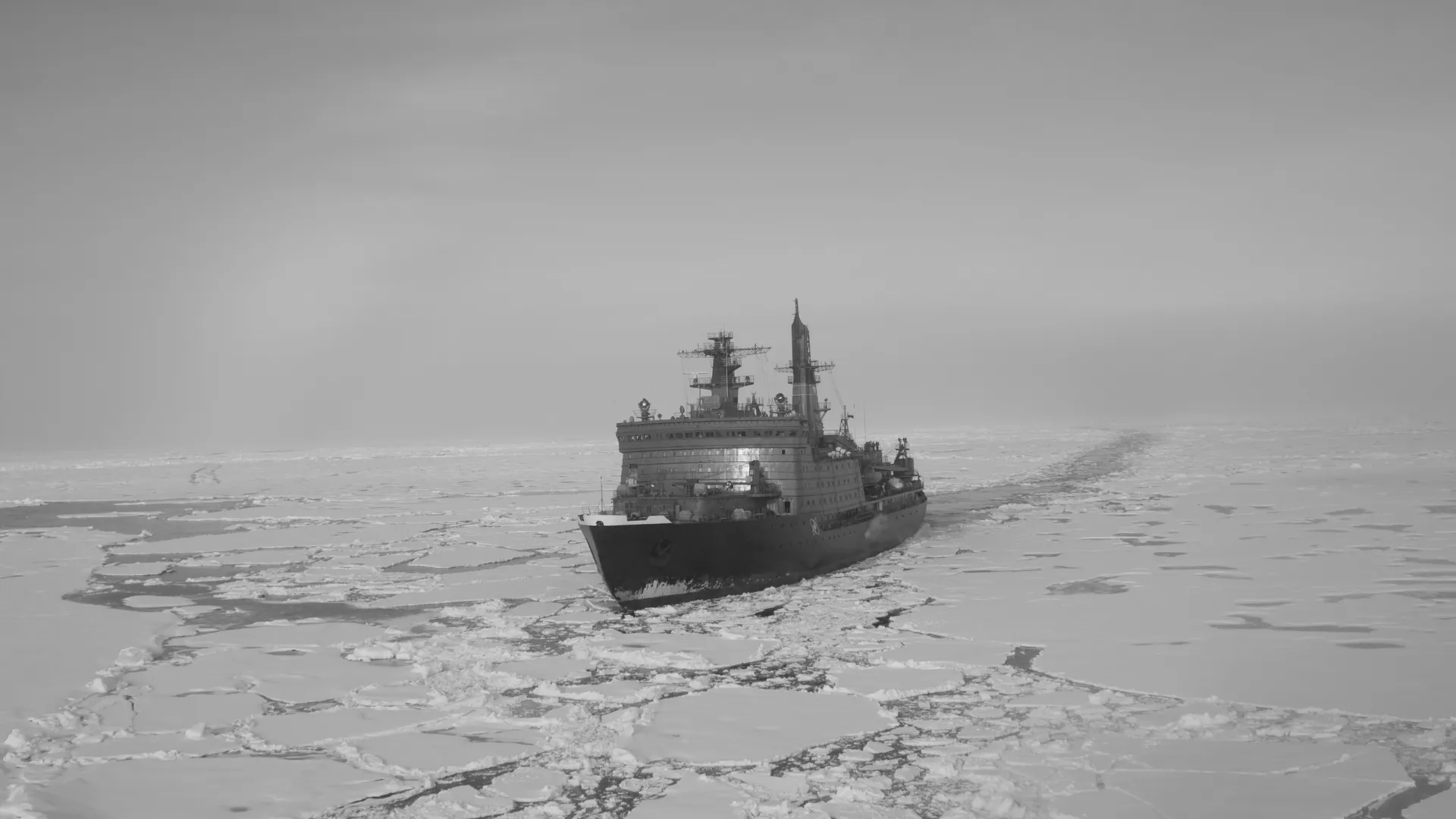
The Northern Sea Route (NSR) running along the Northern coast of Russia, on the other hand remains the most commercially developed route and is currently accessible for standard commercial navigation during the summer and autumn months from July to November. However, this access remains dependent on transit, navigation and ship escort facilities from Russia which operates the world’s only fleet of nuclear-powered icebreakers. Russia currently has 8 nuclear powered ice-breakers and 34 diesel powered vessels to keep the route operational, year-round. Further the route remains under direct control of Moscow through its state agency Glavsevmorput (Northern Sea Route administration) which regulates the use of the route, through enforcement of mandatory passage permits, rules requiring Russian pilots onboard and mandatory escort by its fleet of ice breakers while charging fees for the use of these services.
As Arctic ice continues to recede along with Russia increasing its fleet of icebreakers, the NSR will be increasingly accessible, year-round. A scientific study has further estimated that due to the advanced levels of global warming by 2065 onwards, the NSR will be accessible throughout the year , without assistance of ice breakers. In this backdrop the NSR is emerging as a potential alternative to the traditional Suez Canal route, as it cuts travel time from Europe to East Asia by 40% compared to the Suez Canal route. For example, a voyage from Japan to Northern Europe takes 29 days via Cape of Good hope and 22 days via Suez Canal but it takes just 10 days via the NSR route. Further the sailing distance between for example, Yokohama, Japan to Rotterdam, Netherlands is estimated to be 20,000 kms through the Suez Canal but this distance through the NSR reduces to mere 9,000 kms. Russia’s control of the NSR route gives it immense leverage over the geoeconomics of the region, as since it remains the most accessible route and also a cost-effective alternative to the Suez Canal route, operational currently.
Untapped Hydrocarbon and Mineral wealth
The Arctic region is home to world’s significant untapped hydrocarbon and mineral wealth. According to assessment conducted by US Geological survey (USGS), the Arctic is estimated to hold 13%, equivalent to 90 Bn barrels of world’s undiscovered conventional oil resource along with 30% of global undiscovered conventional natural gas resource. Among all the eight circumpolar nations, Russia continues to remain the biggest oil and gas producer with Russia’s production accounting for 91% of all oil and gas produced in the Arctic. Further 80% of gas and 60% of oil produced in Russia comes from the Russian arctic region alone. Thus Arctic’s hydrocarbon reserves remain an important pillar of Russia’s economy wherein reserves from Russian Arctic besides yielding 70% of Russia’s oil revenue, also account for 20% of the nation’s GDP and 30% of its total exports. As shown in the map below major hydrocarbon reserves in Arctic remain distributed across and limited to five key countries/ territories namely Russia (Barents and Kara seas, Yamal Peninsula and western Siberia) which also holds majority of Arctic’s hydrocarbon resources , Norway through it’s exclusive economic zone (EEZ) in Barrents Sea, Canada through it’s Canadian Arctic islands and Beaufort sea, United States with hydrocarbon reserves in the Arctic Alaska basin which is also home to the Prudhoe Bay field, the largest conventional oil field in the entire North America. Lastly Greenland’s basins especially Eastern Greenland which is estimated to hold 31.4 billion barrels of oil, however these are only estimates since no commercial oil production has begun in Greenland yet.

Source: (Nordregio, 2019)
Besides hydrocarbon reserves, the Arctics possess ‘Rare Earths’, another natural resource of immense strategic significance to the current global world. Rare Earth Elements (REE) comprise of 17 critical resources which are integral to modern technologies with their unique properties making them irreplaceable, useful in appliances ranging from permanent magnets, driving wind turbines, electric vehicles to advanced electronic and laser appliances. The REE’s are unique in their ability of enabling devices to operate with lower energy consumption while enhancing their technological efficacy and increasing operational speed, thereby making REE’s primordial in development of sustainable energy solutions and crucial to combat climate change.
Further REE’s also remain a critical component in various military technologies ranging from precision guided munitions and missiles, aircrafts and drones, sonar and radar systems, nuclear submarines and destroyers, used for night vision and surveillance, and lastly in the highly advanced stealth technology. Approximately 78% of US’s weaponry and defence programs now increasingly rely on REE making them essential to America’s national security interest. However, China currently is a dominant player in the REE market since it controls 70% of global REE mines and 90% of global REE production. This makes it increasingly important for the US to find other alternative sources of REE with Arctic, particularly Greenland emerging as one of the alternatives.
Greenland possesses 1.5 million tonnes of REE and ranks 8th in the world in terms of REE reserves along with the largest quantities of two rare deposits namely Kvanefjeld and Tanbreez, though no mining of REE has taken place. Besides REE and hydrocarbon reserves, Greenland also possesses significant reserves of iron ore, graphite, tungsten, palladium, vanadium, zinc, gold, uranium and copper. Greenland’s hydrocarbon resources, rare earth reserves, mineral wealth and its strategic location between Northern America and Europe, in the heart of Arctic makes it a centrepiece of America’s Arctic strategy, as US seeks a deeper strategic control of Greenland. In 2019, during Trump 1.0 administration, US entered in a Memorandum of understanding (MOU) with Greenland for a joint survey of the region and exchange of technological and scientific cooperation, to jointly develop rare earth and critical minerals, however efforts to renew the deal failed under the Biden administration and even now under Trump 2.0 administration, the MOU has not been renewed yet and is slated to expire soon.
Militarization of Arctic
Geopolitical tensions in Arctic have escalated dramatically following the Russian invasion of Ukraine in 2022. The Arctic council, once considered a successful model of circumpolar co-operation on environmental protection, sustainable development, and scientific collaboration among the eight Arctic states despite having two long standing adversaries US and Russia has become increasingly dysfunctional, post the Russia-Ukraine war. With formal dialogue mechanisms largely suspended, and the remaining seven members imposing sanctions on Russia, there has been an erosion of the post–Cold War cooperative framework. The Arctic exceptionalism that shaped regional governance is no more a reality. The Ukraine conflict has had a direct impact on Arctic’s security architecture as understood from NATO’s enlargement to include Sweden and Finland, an idea which was almost unthinkable a decade ago. This enlargement has expanded NATO’s border from a mere 196 km border between Norway and Russia to a 1,340 km border, a shift which has been followed by intense militarization by both the sides. The military modernization undertaken by Nordic nations is evident as the e demands for advanced military hardware from US has reached an all-time high.
The Russia-Ukraine war, since 2024 has created significant escalation in Arctic tensions, as it was the first time since 1944, when an actual attack in the Arctic region took place. Ukraine since 2024 is repeatedly attacking Russia’s bases particularly the Olenya base in Murmansk region while targeting Russia’s strategic bombers like Tu-95MS and Tu22M3. Another target for Ukraine in the Russian Arctic is the Kola Peninsula, which is home to Russia’s northern fleet command housing its most advanced ballistic missile submarines having second strike nuclear capability. The Murmansk and the Kola peninsula regions are one of the most militarized regions globally and serve as Russia’s strategic node centres along the NSR route.
Besides the Russia-Ukraine war, President Donald Trump’s rhetoric on Greenland has further exacerbated the geopolitical tensions in the High North. President Trump has continued to intensify his rhetoric with proposals to purchase Greenland, offer financial inducements to its population and also more coercive suggestions, in the event of strategic necessity. This has also endangered the Trans-Atlantic Alliance of NATO. The US’s statements and plans of a probable military invasion of Greenland, an autonomous territory of Denmark has divided NATO and has put its members in a conundrum on how to respond when a dominant NATO member challenges the sovereignty of another NATO member state. Following this, some NATO members mainly European countries sent small troops to Greenland giving a message of protecting Greenland’s sovereignty. While this exercise was short lived it nevertheless marked an unforeseen escalation and rupture in the Trans-Atlantic partnership.
The map below shows Russia’s extensive military infrastructure in the Arctic and includes shows all the military bases including that of NATO and Russia in the Arctic.

Source: (Statista, 2025)
Russia has the largest military infrastructure in the Arctic which runs parallel to its NSR route. The US currently has just one base in Greenland which is the Thule, now Pituffik space base in Greenland, and is actively negotiating with Denmark to establish three new military bases in Southern Greenland especially in Narsarsuaq (a deep sea water port) and Kangerlussuaq, to accomplish its strategic interests in the Arctic.
China’s growing engagement in the Arctic
In recent years, China’s growing engagement in the Arctic has been a topic of considerable geopolitical interest. China has been a late entrant to the region’s geopolitics and signed the Svalbard treaty on the insistence of France. However, it was only post 1991 that China first engaged with the Arctic. In the next decade (1993-2013), China deepened its interest and established its yellow river station at Svalbard, Norway, signed agreements on polar research with Norway and Canada, and also became an observer at the Arctic council. It was only post 2017 that China decided to extend its engagement beyond scientific cooperation to build strategic and economic presence in the Arctic. ‘Xue long’ became the first Chinese ship to traverse all the three arctic shipping routes. This was followed by China announcing its Polar Silk Road project with Russia under its flagship BRI (Belt and Road Initiative program) which aims to give China access to the Arctic through joint investments and development of Russia’s NSR route. Further in 2018, China released a white paper on its Arctic policy stating China to be an important stakeholder in Arctic affairs and self-proclaimed itself to be a Near Arctic state. China’s cooperation with Russia in Arctic has continued to strengthen with China investing USD10 billion in the Russian Arctic, especially in the Yamal Energy pipeline project and Arctic LNG 2 project, wherein China’s State owned enterprise, China National Petroleum corporation (CNPC) owns 20% stake in the projects. Further CNPC has a 20-year contract with its Russian counterpart wherein 50% of output of REE and hydrocarbons from these projects will be exported to China. Another example of growing Sino-Russian collaboration in the Arctic, are the joint patrols by the Chinese and Russian coast guard vessels first in October 2024 which alarmed the US. On the economic aspect, as Russia continues to face western sanctions and China navigates recurrent trade tensions with the US, their partnership in the Arctic has acquired a renewed strategic importance with both countries viewing the development of NSR route as strategic necessity to expand connectivity, strengthen economic cooperation while circumventing US’s pressure.
India’s stakes in the Arctic
Although not an Arctic state, India has rising strategic stakes in the region owing to the implications Arctic has on climate patterns, emerging maritime connectivity, energy security, and access to critical minerals. To address its strategic objectives, India released its Arctic policy in 2022 which is built on 6 key pillars viz., Science and Research, Climate and Environmental protection, Economic and human development, Transportation and Connectivity, Governance and Cooperation, and National Capacity building. Out of these pillars, science and research remains a priority for India which has been conducting advanced scientific research through its Arctic research station Himadri.
Science and Research
The science of climate change in Arctic is of special significance to India, as the changes in the Arctic climate have a direct impact on India’s monsoon system and thereby its food security. Further scientific research has pointed out the profound interlinkages between the climate change occurring at both the poles - Arctic and Antarctic and the glacial melting in the Himalayas, also known as the ‘Third Pole’. These interlinkages make India a true Tripolar nation and make Polar science a top priority for India
Secondly, The Arctic hydrocarbons and REE’s remain of strategic interest to India as the region’s resources can strategically meet India’s growing energy and critical mineral needs. The Russian Arctic including the Far East is of particular significance to India. The geographical proximity of the region is vital for India to source its energy needs. Following the Russia-Ukraine war, Russia has offered favourable trade terms for purchase of crude oil from its Northern and Eastern regions. This has led to a significant increase in bilateral trade over the last three years with Russia becoming the largest crude oil supplier to India. Though India’s purchase of Russian oil has drawn western criticism, nevertheless India through its purchases continues to play a stabilizing role in global supply chains.
Maritime Connectivity
Regards to Maritime connectivity, the NSR in itself is not as lucrative for India in terms of access, shipping distance and time. However, India has a keen interest in developing new connections between India and the end points of the NSR namely Vladivostok in East and Murmansk in the West. In March 2025, Russian President Putin unveiled an ambitious plan to enhance Arctic connectivity through the Trans Arctic Transport corridor (TATC), linking key ports from St Petersberg to Murmansk to Vladivostok in the East via land, sea rail and inland waterway systems. As shown in the map below, The NSR route will now be a key section of this comprehensive TATC route, at the end of which in Vladivostok, it will have international linkages to India through the Chennai-Vladivostok corridor in the East while Murmansk was supposed to be connected to Mumbai via the INSTC.

Source: (Sharma, 2026)
While the INSTC corridor remains affected by the ongoing crisis in Iran and West Asia, both Russia and India are working to implement the Chennai- Vladivostok maritime corridor, a direct sea route stretching 5,600 nautical miles (10,300 km) connecting Chennai to Vladivostok and passing through the Malacca strait, South China sea and Sea of Japan reducing transit times from 40 days via Suez canal to 22-24 days. This new maritime corridor gives India an alternate route to access Russian Arctic, its hydrocarbon and critical mineral resources and is at the centrepiece of India’s Arctic strategy.
Arctic Co-operation
Besides deepening cooperation with Russia, India also continues to have significant engagement with all Arctic states particularly Norway and the Nordic states as understood from PM Modi recent visit to the Nordic for the 3rd India Nordic Summit. Major outcomes of the summit were the elevation of bilateral ties with Nordic countries to Green Technology and Innovation strategic partnership, cooperation on sustainable blue economy and discussions on integrated cooperation in the Arctic and Indo pacific. This demonstrates India’s multi stakeholder approach to the Arctic wherein it maintains significant cooperation with both Russia as well as Nordic nations in order to pursue its strategic objectives in the Arctic.
Conclusion
The Arctic is undergoing a profound transformation at both the geographic and geopolitical levels, with climate change being the principal catalyst. As ice continues to recede, the opening of new shipping routes and improved access to hydrocarbon reserves and critical mineral resources has increasingly made the region a battleground for great-power competition. In the process, the notion of Arctic exceptionalism that once insulated the region from wider geopolitical rivalries under considerable strain.
While tensions and military build-up between Russia and NATO remain a defining feature of the contemporary Arctic security landscape, emerging differences among Western allies, particularly regarding the United States' approach towards Greenland, have complicated the NATO’s established security architecture in the Arctic. At the same time, China's Arctic ambitions, including the Polar Silk Road, continue to face geopolitical, economic, and infrastructural constraints.
For India, developments in the Arctic carry implications that extend beyond the High North, particularly in relation to climate security, maritime connectivity, energy resources, and critical mineral supply chains. As the region assumes greater strategic prominence, understanding its evolving geopolitical and geoeconomic dynamics will become increasingly important for assessing India's long-term interests.
The views expressed are those of the authors and do not represent the views of CNAWS.
Image Source: Canva
Tags
- #Arctic climate change
- #Arctic geopolitics
- #Arctic militarization
- #Arctic rare earth minerals
- #Arctic shipping routes
- #China Polar Silk Road
- #India Arctic policy
- #India strategic interests
- #Maritime Security
- #Northern Sea Route
- #Russia Arctic strategy
Author
Himanshu Kulkarni
Himanshu Kulkarni is a political economist, researcher and writer. He holds a Bachelor’s degree in Socio-Economic Policy from University of Canberra (Australia), a Master’s in International Relations, Security and Strategy from OP Jindal University and a Master’s in Political Economy of Development from SOAS University of London, UK. His research areas are Political Economy, Geo Economics, Non-traditional Security and Resource politics.