Department of Disruptive & Emerging Technologies · Articles · Defence Technology ·
One Stone for Each Bird: India’s Strategic Case for Dual-Use Defence Technology
As countries race to meet growing military benchmarks and build modern innovation standards across a vast array of critical technologies, the term 'dual-use' has become the new normal. Dual use refers to the application of tools, technologies and practices across both the military and the commercial industry. This article examines the viability, advantages and rationale behind India adopting a dual-use approach to defence and critical infrastructure, drawing on international precedent - from Sweden's dispersed air-basing doctrine to China's state-directed model of civil-military fusion - to map three models through which nations institutionalise dual use, and argues that India's own trajectory, from a state-driven system toward a hybrid, coordinated model, offers the most realistic path forward.
Introduction
For time immemorial, infrastructure, technology, operations and growth have been measured by either one of two yardsticks. Either it has to be 'military grade' - capable of operating under extreme duress and prioritizing survivability over Quality of Service (QoS) and with next to no margin of error. The other is commercial viability. Commercial and relative qualitative measures of growth allow for failures but opt for convenience, ease of life and comfort over resilience. In a world increasingly shaped by geopolitics, budgetary constraints, global feuds and international rivalries across every metric quantifiable, the benefits of implementing a dual use strategy for modern technologies is multifold.
Dual-Use in Practice
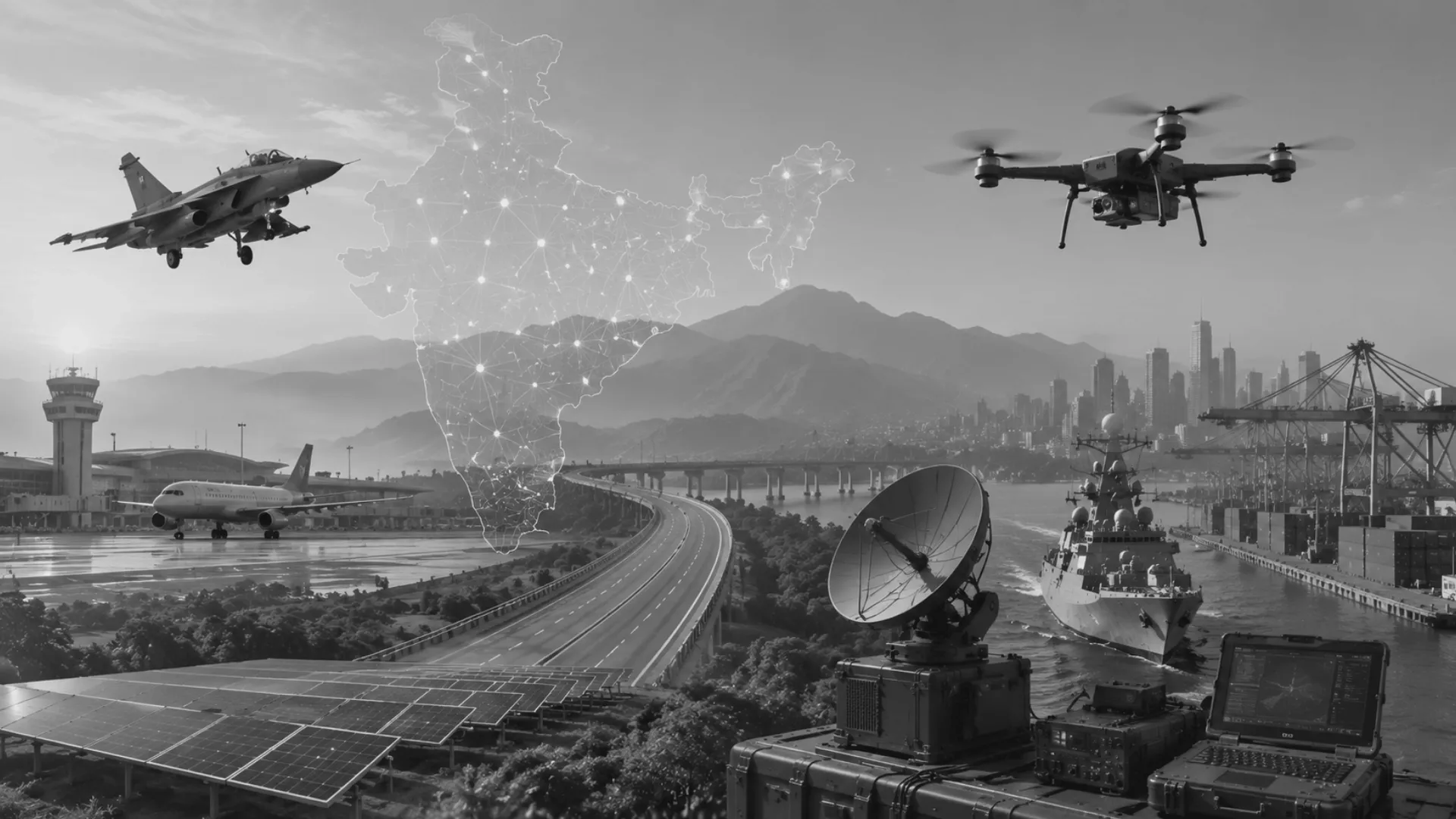
To illustrate, there are a number of Indian airports today that serve commercial airliners and military aircraft of the Indian Air Force (IAF) and Indian Naval Stations (INS) such as Dabolim airport in Goa, a civil enclave within the Indian Navy's INS Hansa air station; Lohegaon airport in Pune, a civil enclave on Lohagaon Air Force Station; and Srinagar Intl. Airport in J&K, a civil enclave within the Indian Air Force's Srinagar air base, just to name a few. Residential cantonments are an example of civil life blended with the standards, security and cleanliness of armed forces establishments across the country. Very often, conversations comparing the quality of life differences inside and outside cantonment areas are debated in social circles.
These examples underscore the growing importance of dual use. Drones manufactured en masse during the Ukraine conflict are now being used in agriculture, surveying and resource identification below layers of earth. SpaceX's Starlink satellite constellation, initially used to provide high-speed, low-latency internet access, can now be used by the same drones for military communications, combat and ISR (Intelligence, Surveillance and Reconnaissance) missions [1]. The conflict in Ukraine has merely shed light on the extent of possibilities. Civilian innovations in fields such as Artificial Intelligence, Semiconductor Fabrication, Drones, Operations Technology (OT), Internet of Things (IoT) etc, are now complemented by advances in the military domain. Their origin remains irrelevant when their value is realized in tandem and scaled across both sectors.
Historical Precedent: Sweden's Bas 60/90 Doctrine
A fascinating case study is of the Swedish Air Force (and by extension, the Finnish Air Force). While Sweden already boasts an impressive military-industrial complex with giants like Saab AB, it is complemented by its highway network. In the 1950's, during the cold war, Sweden quickly realized that their entire air force could be wiped out in a single, potentially nuclear strike. Fearing an outcome akin to what the Egyptian Air Force suffered in the Six-Day War against Israel [2], the Bas 60 plan was conceived. Updated in the 1970's to the Bas 90 program, the idea is simple; make use of existing infrastructure such as underground bunkers and public highways as makeshift landing strips to scatter its air force [3]. This drastically improves survivability of mission-critical assets like fighter jets in case of a potential conflict. This doctrine is followed by many nations today, in India and abroad. This is an early example of a dual use policy.
The Multifold Benefits of Dual Use
In this article, we will continue to observe cases of foreign strategy to shed light on how beneficial a holistic dual-use strategy can be for any nation. The multifold benefits referred to earlier include, but are not limited to:
- Cost efficiency: Not 'reinventing the wheel' by modifying and implementing existing technologies across sectors.
- Time advantage: Adopting existing technology can allocate much needed R&D time elsewhere.
- Access to next-gen technology: Private R&D can be more efficient in next-gen technology as compared to government-controlled funding. Companies such as Anduril Technologies have proved this in a heavily contested American military-industrial complex long dominated by primes [4].
- Domestic resilience: Adopting a dual use strategy improves self-reliance, reduces dependency on foreign Original Equipment Manufacturers (OEMs) and builds capability right at home.
The Evolving Pattern of Civil-Military Fusion
The pattern's evolution can be visualized over the years. At the start of the 20th Century, applications that originated in defence flowed into the civil sector. Technologies would be developed for military purposes, were validated and then saw slow introduction into civil life. Examples include the Internet and GNSS systems for navigation.
During the cold war, when active conflicts reduced, civil technologies saw faster growth and started contributing to nation-building. While defence still led innovation, the industry started contributing once technology was more accessible to the daily user. Some examples can be the start of cybersecurity tools and practices, personal computers and so on.
Once the cold war subsided at the start of the 21st century and defence budgets shrank, the onus fell on the civil sector to lead innovation. This period saw commercial industry driving the civil economic markets which took centre stage as global economies were prioritized over defence strength at this point in time.
Today, geopolitical tensions have forced countries to prioritise defence requirements with enhanced focus on data sovereignty and economic upkeep. To meet these needs, civil-military fusion has finally matured into a complementary, symbiotic relationship that is being examined today. AI algorithms, drone and robotics all conceived by civil pioneers are being retrofitted to fight battles and win today's wars.
Closing the Kill Chain
In today's global order, adopting dual use is the quickest way to close the invisible kill chain. Commercial Off The Shelf (COTS) sensors, advanced Machine Learning models and robotics that can be built in a college laboratory are being considered military grade after their use in the contemporary battles of today. These serve in advanced robotics, quantum computing and encryption, renewable energy, semiconductor design, space and autonomous systems, all areas where commercial sectors and military can benefit simultaneously. An added benefit is that once adopted into military settings, it receives the same strategic importance that other critical assets enjoy. For example, the United Kingdom's National Security and Investment Act of 2021 requires foreign investors to notify the government when acquiring interests in an array of 17 sectors [5].
India's Path Forward
For India, this means adopting a strategy that calls for closer collaboration between military and academia, civil-military fusion, partnerships and increased collaboration between stakeholders. The same public sector entities that have served the country for decades might not necessarily require to carry the entire burden on their own. As we often do, we can turn to the case of China. There are numerous examples of dual-use being implemented in practice. Their policy for the Seven Sons of Learning - a group of technical academic institutions that actively engage in R&D with the People's Liberation Army of China [6] - and usage of commercial Yuan Wang, Xiang Yang Hong & Da Yang Hao so-called 'research vessels' by the military [7], are all telltale signs of a coherent, decisive dual use strategy. Woody Island in the contested South China Sea is a further example of this pattern, combining a functioning civilian settlement and tourist access with an active military airbase and garrison [8]. While each example is an article in and of itself, it points to a model where dual-use can be intertwined with national policy to meet strategic objectives.
This is one of 3 models that can be used in India's own context to oversee a dual use program. A state-coordinated dual use policy. The governments of Russia, North Korea, Iran and China are all related examples. They follow state-defined mandates. R&D can be linked to a few giants who are all closely related to the government or military directly. Acquisition is centralized and funding is prioritized by the government for most, if not all development projects.
The second model is a market guided system. Academia and startups accelerate growth at the grassroots level while VC grants and investors give commercial companies the foundation needed to innovate at scale. Here, the government takes a supporting role. Incubators and accelerators bridge the gap and are given access, including necessary security clearances to support the military in their own respective areas. In this model, the defence adapts to the technical timelines and funding is more accessible which raises the limit on how far the technology can reach. Some examples here are Israel, with its incubators embedded with ex and serving military personnel [9]. Sweden and South Korea with its export-oriented approach and the United Kingdom are good illustrations as well.
Both these approaches can lead to a state supported model as well. A hybrid of sorts where procurement is structured, coordinated efforts are undertaken across academia, industry and the military. It sees incubators, testbeds and accelerators coordinate as in a market driven model but joint R&D takes place with coordinated efforts from public sector, SMEs and commercial entities with grants from the state in forms of subsidies, grants and more. Common examples are Singapore, Japan and France with a framework driven, government supported, cluster-based system.
Policy in Practice: The Indian Context
Policy setting and policy implementation, however, are two different stories. While it may be easy to conceive a policy, implementing it is a challenge of its own. In India's context, what started out as a state driven approach is gradually evolving into a hybrid model.
While private companies like Skyroot Aerospace, and its support from the T-Hub incubator [10], are making headlines today, it is often framed as the result of years of hard work. It serves as proof that the private industry can compete and support a dual use framework. For the most part, however, the industry has remained dormant, at least until recent times. Whether by choice or by design can be debated, but the fact remains that not all companies have the same runway to spend as Skyroot did. While evolving towards a hybrid state-market model, the Indian context is still optimized for a state driven system with Defence Public Sector Undertakings (DPSU's) eating the majority of contracts, having separate procurement pathways and earning a reputation for being a bureaucratic, slow and inefficient entity. Arguments against a drawn-out procurement policy, distrust between the state and industry in disclosing confidential military data, combined with unnecessarily lengthy regulatory and compliance requirements, have only exacerbated the issue.
That's not to say a DPSU is completely redundant. They have years of experience, relationships with foreign entities and both technical and commercial expertise within their ranks. However, bound by the own rules of the government that gave birth to them, they lack agility to operate in the modern era and a bridge between them and the private industry is the need of the hour. There are some common steps that every successful case study has proven thus far. These can be considered in India's context as well. After all, there is no ‘wrong’ model per se. Combining a decisive doctrine with the most suitable model and extracting the most out of it is a common playbook of successful case studies.
A Structured Approach
- The government has to be involved to some capacity: Similar to how top management needs to be involved in any organizational policy, the government is the main authority when it comes to setting procurement pathways, policy guidelines and providing access between all stakeholders.
- Select the right model: Decisiveness shown in the cases of Sweden, France, South Korea are all examples that there is no right or wrong model, just a most suitable one based on the climate of the country.
- Flow of innovation: Innovation flows from the bottom up. Foundational knowledge of sensors, shooters and seekers is paramount to creating innovations in any field. Subject matter and Domain experts evolve foundational knowledge into integrated functional systems that finally matures into a system of systems network.
- The pathway to success: To ensure that any model does not stall in mid-air a structured approach is needed. Mapping of civilian requirements to military standards, co-investment with the industry, validating innovations in specially designed incubators and testbeds, deployment and validation with agile procurement paths and sustainment of any innovation are all routine steps in global success stories.
Conclusion
For India, this means revisiting the Defence Acquisition Policy of 2020 which is due to undergo its routine reform in 2026, holding DPSUs accountable, fostering the world's largest student population, its vast technical expertise, collaboration and knowledge transfer between those who already have it, be it abroad or in-house. Records such as ‘largest student population in the world’, ‘largest startup incubator in the world’, and ‘Fastest growing economy in the world’ are more than records, they are proof that the foundational know-how exists. Military teachings tell us that the one who Observes, Orients, Decides and Acts first wins. Global cases have already taught us that competitors and adversaries are about to close it, if not closed already.
Footnotes:
[1] The Hindu (Brought in for civilian use, Starlink is now integral to Ukraine’s war effort), The BBC (Ukraine using AI drones to strike vital convoys supplying Russian troops)
https://www.bbc.com/news/articles/cdjp0n7rn41o
[2] “Air Power in the Six-Day War”
Pollack, K. M. (2005). Air Power in the Six-Day War. Journal of Strategic Studies, 28(3), 471–503. https://doi.org/10.1080/01402390500137382
[3] “Learning from the best – Dispersed basing Operations of the Finnish and Swedish Air Forces” – Robert M Moxeley, Major, United States Air Force.
https://www.airuniversity.af.edu/Portals/10/AUPress/Papers/WF_97_Moxley_learning_from_the_best.1.pdf
[4] The Nation (Welcome to the New Military-Industrial Complex) & The Economist (Anduril, Palantir and SpaceX are changing how America wages war)
https://www.thenation.com/article/economy/anduril-military-industrial-complex-drones; https://www.economist.com/international/2026/04/20/anduril-palantir-and-spacex-are-changing-how-america-wages-war
[5] United Kingdom Government https://www.gov.uk/government/collections/national-security-and-investment-act
[6] Joske, Alex. “The Seven Sons of National Defence.” The China Defence Universities Tracker: Exploring the Military and Security Links of China’s Universities, Australian Strategic Policy Institute, 2019, pp. 06–07, http://www.jstor.org/stable/resrep23061.7. Accessed 10 Aug. 2026.
[7] Center for Strategic and International Studies. Surveying the Seas: China's Dual-Use Research Operations in the Indian Ocean. https://features.csis.org/hiddenreach/china-indian-ocean-research-vessels/
[8] South China Morning Post (2025, December 26) China opens shopping centre on Woody Island in disputed Paracels in South China Sea https://www.scmp.com/news/china/diplomacy/article/3337811/china-opens-shopping-centre-woody-island-disputed-paracels-south-china-sea
[9] The Wall Street Journal (2024, September 3) This Israeli Army Unit Has Become an Incubator for Tech Startups. https://www.wsj.com/podcasts/tech-news-briefing/this-israeli-army-unit-has-become-an-incubator-for-tech-startups/f7ca3e86-58f6-47f0-b4c5-5008ae19b5c6
[10] India Today. (2026, July 20) How Telangana startup T-Hub helped Skyroot's Vikram-1 fulfil India's space dream https://www.indiatoday.in/science/story/skyroot-vikram1-orbital-launch-success-t-hub-telangana-startup-ecosystem-2951937-2026-07-20
The views expressed are those of the authors and do not represent the views of CNAWS.
Image Source: ChatGPT
Tags
- #Civil-Military Integration
- #Defence Industry
- #Defence Procurement
- #defence technology
- #Dual-Use Technology
- #India defence strategy
- #Indian Defence Innovation
- #military technology
Author
K. N. Dhruv Ramesh
K. N. Dhruv Ramesh works with the Office of the CEO at C2C Advanced Systems Ltd., a publicly listed defense technology company specializing in C5ISR systems. In this role, he supports initiatives related to defense technology, strategic planning, and emerging security challenges. He holds a B.Tech in Electronics and Communication Engineering from VIT Chennai and previously interned with the Security and Law Division of NITI Aayog. Having completed an Open-Source Intelligence (OSINT) certification hosted by CNAWS, his research focuses on military aviation, defense procurement policy, unmanned aerial systems, space initiatives, cybersecurity, and C4I networks. He is particularly interested in how the intersection of technology, policy, and strategy shapes India’s future security environment.