Department of Strategic Foresight & Scenario Planning · Articles · Defence Technology ·
From Platforms to Networks: Assessing India’s progress in Network Centric Warfare
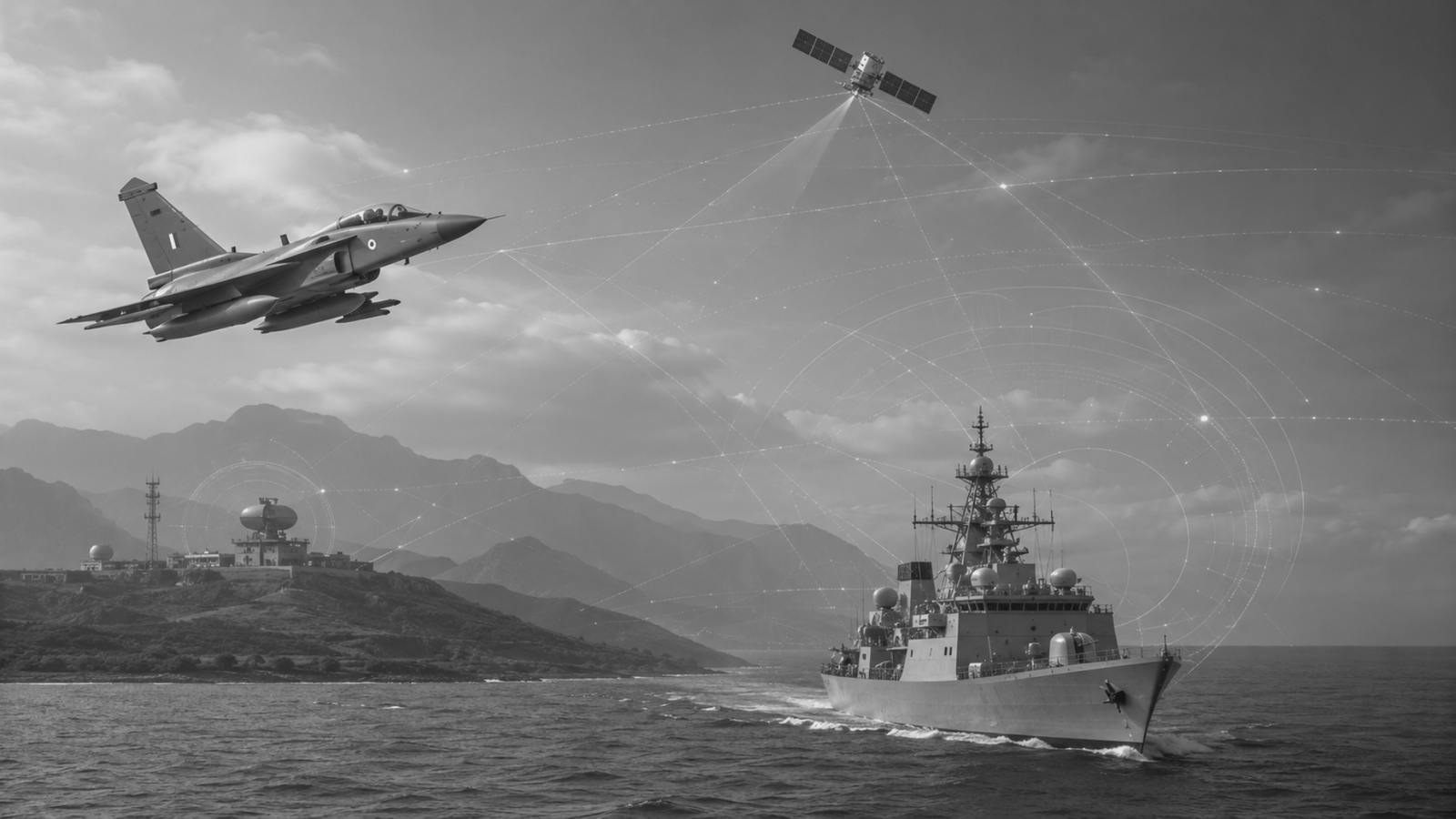
India’s military modernisation is increasingly moving beyond the traditional acquisition of platforms toward the creation of networked combat capabilities. This article assesses India’s progress in Network-Centric Warfare by examining how the Army, Navy and Air Force are building systems that connect sensors, commanders and shooters into faster decision-making loops. It argues that modern military power no longer depends only on the quality of individual aircraft, warships, artillery systems or missiles, but on the ability to convert information into action more rapidly than the adversary.
The Indian Air Force appears to be the most advanced among the three services in networked operations, driven by the operational requirement for real-time air defence and rapid threat response. Systems such as AFNET and the Integrated Air Command and Control System have enabled a more fused air picture by linking sensors, command nodes and air-defence assets. However, limitations remain in airborne early warning capacity, mixed-platform integration and seamless data-link compatibility across imported and indigenous systems.
The Indian Navy has made steady progress in maritime networking through combat management systems, maritime domain awareness initiatives and shore-based information fusion networks. Its model demonstrates how platforms can function as sensors, communication hubs and weapons nodes within a wider operational grid. Yet, the resilience of these networks under cyber, electronic warfare and communications-disruption conditions remains a critical test.
The Indian Army has developed important mission-specific systems such as ASCON, SHAKTI, SANJAY and Akashteer. These have strengthened communications, artillery command, battlefield surveillance and air-defence reporting. However, the Army’s challenge lies in integrating these modular systems into a coherent land-warfare architecture that connects manoeuvre, fires, surveillance, logistics and electronic warfare across formations.
The article’s central argument is that India has made visible progress in network-enabled operations, but it is not yet a fully network-centric military. The key limitation is not the absence of digital capability, but fragmentation across service-specific networks. Future conflicts will demand a common operational picture that integrates air, land, maritime, space, cyber and electronic warfare domains. Three parallel service networks cannot substitute for a genuinely joint combat grid.
The road ahead requires interoperability to become the core principle of defence modernisation. Procurement decisions must assess whether new systems can communicate securely and efficiently with the wider joint force. Common data standards, software-defined radio waveforms, resilient satellite communications, cyber protection and electromagnetic survivability must be built into capability development from the outset. India must also avoid confusing digitisation with integration. A force may possess advanced digital systems and still fail to operate as a unified network under combat stress.
India is therefore in transition. It has moved significantly beyond platform-centric thinking, but its next challenge is to build a truly integrated tri-service network. In future warfare, advantage will depend less on isolated platform superiority and more on the ability to see, decide and strike through a resilient, joint and interoperable information architecture.
The Real Test of Modern Military Power
Military modernisation is often discussed through the language of platforms such as fighter aircraft, warships, artillery systems, drones and missiles. These assets remain important, but they are no longer the sole indicators of military effectiveness. Even a force equipped with advanced platforms may operate in a piecemeal fashion if information from sensors, commanders and weapons systems is not shared rapidly enough. A key question is whether a military can convert information into action more rapidly than its adversary. This is where the concept of Network-Centric Warfare emerges. Recent developments in India's defence sector suggest that military modernisation increasingly incorporates networked capabilities alongside traditional platform-centric approaches. Important digital systems, communication backbones[1] and sensor-fusion capabilities have been developed by the Army, Navy and Air Force. However, progress has been uneven. The Air Force[2] appears to possess some of the most developed air-domain networking capabilities among the three services, the Navy has made steady advances in shipboard combat capability and maritime domain awareness, and the Army has enhanced several mission-specific systems, including artillery, surveillance and air-defence networks. Nevertheless, these developments do not yet amount to a fully integrated tri-service combat grid. Rather than focusing solely on the acquisition of advanced platforms, India is increasingly investing in combat networks across the services. However, it remains some distance from becoming a fully networked force in which sensors, shooters and commanders from all three services operate within a seamless information architecture.
What Network-Centric Warfare Means
Network-centric warfare is not simply about the use of computers in warfare. It is a form of warfare in which information functions as a critical operational resource. Sensors identify threats, networks relay data, command systems analyse information and weapons systems must respond rapidly and accurately. The objective is not merely to see more, but to make decisions and act more quickly. Information may be transmitted through cable, satellite or radio networks, but technology alone does not create military integration. Services must share data, adopt common standards, train together, trust one another's systems and operate within clearly defined command relationships. A common operational picture is produced through a combination of technology, doctrine, procedures and organisational culture. While many recent developments in India demonstrate technological progress, a more difficult institutional question remains: who will own the common data architecture, and how effectively will information move across service boundaries during a crisis? This remains one of the central questions in India's ongoing transition toward network-enabled operations.
The Indian Air Force: Sensor Fusion and Air-Domain Networking
The Indian Air Force provides perhaps the clearest example of network-centric thinking among the three services. This is partly because air defence depends on real-time awareness. Aircraft move quickly, threats can emerge suddenly, and command decisions often must be made within very short timeframes. This operational requirement contributed to the development of a fused air picture. The AFNET[3] backbone is a major enabler of this development, as is the Integrated Air Command[4] and Control System (IACCS). AFNET was inaugurated in 2010, and IACCS was built on that backbone to combine ground-based and airborne sensors, air-defence weapons and command-and-control nodes. This architecture has been reinforced through the addition of AWACS, AEW&C platforms[5], satellite communications and secure airborne radio[6] systems. A notable feature of the Air Force's architecture is its ability to integrate information from multiple sensors into a common air picture. This reflects an important characteristic of networked air operations. At the same time, limitations remain. India's AEW&C fleet is relatively limited, and the coexistence of imported and indigenous platforms creates integration challenges. Beyond the technical details of onboard sensor fusion[7], a key question is whether modern aircraft can be seamlessly integrated with India's broader command systems, data links and identification architecture.[8]
The Navy: Maritime Networking and Domain Awareness
The Indian Navy's evolution appears relatively straightforward because naval warfare naturally combines platform control, tactical data exchange and maritime domain awareness. A warship functions simultaneously as a sensor node, a communications hub, a contributor to the maritime picture and a weapons platform. This has contributed to a relatively gradual evolution toward networked naval operations. Shipboard Combat Management Systems[9] are particularly important. They gather and correlate information from ship sensors, helicopters, aircraft and other sources, detect threats across the air, surface and subsurface domains, evaluate threat levels and assist with weapon assignment. As a result, a modern warship becomes part of a larger information network rather than an isolated fighting unit. The Navy's broader maritime architecture also includes the National Maritime Domain Awareness[10] programme, which is planned to incorporate AI-enabled features, as well as IMAC, IFC-IOR and NC3I.[11] This represents one of the more developed examples of network-based capability development in India because it links ships, shore centres, aircraft and maritime information networks into a more comprehensive operating picture. The remaining questions concern survivability and cross-domain integration. A network that performs effectively in peacetime must also function under conditions of cyber-attack, electronic warfare, disrupted communications and the uncertainty associated with high-intensity conflict.
The Indian Army: Mission-Specific Networks and the Challenge of Land Integration
The Indian Army has made measurable progress, although progress has been less even than in the air and maritime domains. Land warfare involves large formations, diverse terrain, multiple command echelons, legacy equipment, varied radio environments and constant movement. It is therefore unsurprising that the original vision of a single, wide-area battlefield network has proven difficult to translate into one unified architecture. Clear progress is visible in several specific systems. ASCON remains an important communications backbone, with Phase IV moving toward IP/MPLS over fibre, microwave and satellite links. SHAKTI[12] improved artillery command and decision support. SANJAY, introduced in 2025, is designed to combine ground and aerial sensors into a common surveillance picture. Akashteer[13] provides automated air-defence control and reporting, while secure software-defined radios are intended to help the Army move from primarily voice-oriented combat-net radios toward more flexible voice-and-data networks. These developments indicate continuing efforts to modernise operational capabilities, but they also reveal the limits of the current approach. The Army has developed several well-established mission-specific systems for artillery, surveillance, air defence and communications. Less visible in open-source material is a comprehensive land-battlespace architecture that seamlessly integrates manoeuvre, logistics, electronic warfare, surveillance and fires across formations. The earlier vision associated with the Battlefield Management System and Tactical Communication System appears to have evolved toward a more modular approach. That approach may prove workable, but it will require a clear doctrinal roadmap to ensure that the individual modules eventually form a coherent operational grid.
The Challenge of Jointness
One of the principal challenges in India's transition toward a network-based force is not the absence of capability, but the fragmentation of capability across services. Each service has legitimate operational reasons to develop systems tailored to its own requirements. Future conflicts, however, are unlikely to respect those organisational boundaries. Air defence, maritime surveillance, land operations, space assets, cyber defence and electronic warfare will increasingly overlap. India has recognised this issue. Efforts toward greater integration are visible in the Defence Communication Network, Headquarters Integrated Defence Staff[14], the Chiefs of Defence Staff structure, discussions surrounding theatre commands, ICADS and joint communications studies. Analytical discussions also emphasise common tactical data links, joint waveform[15] interoperability and a shift from a "need to know" culture toward a "need to share" culture. The concept of a "need to share" culture is particularly significant because information is a core element of network-centric warfare. If each service maintains a separate data architecture, the result may be three parallel networks rather than one integrated network. The goal should be a genuinely common operational picture, not merely three separate pictures displayed side by side. Experiences from Kargil, Budgam and more recent operations have highlighted the importance of networks. Kargil exposed serious weaknesses in surveillance, battlefield transparency and information fusion[16]. These shortcomings helped drive later investments in radars, AWACS, AEW&C platforms and IACCS. The broader lesson was that delays in information availability can significantly reduce operational effectiveness. a more consistent real-time picture, and systems like IACCS, Akashteer[17] and naval networks are now being touted as part of a common response[18]. Such statements are to be interpreted cautiously as they are official claims not full-time, field-based audits. India increasingly frames operations as network-enabled rather than merely network-supported. The 2019 Budgam Mi-17[19] fratricide highlights a related but distinct lesson. Better networking alone does not automatically eliminate the possibility of error. A faster network can still produce tragedy if identification systems, command discipline and operational procedures are inadequate. In network-centric warfare, verification, training and accountability must advance alongside speed. Official reporting on Operation Sindoor in 2025[20] suggests that India's networks are increasingly capable of producing a more consistent real-time operational picture and that systems such as IACCS, Akashteer and naval networks are being presented as part of a common response framework. Such claims should be interpreted cautiously because they primarily reflect official assessments rather than independent operational audits. Nevertheless, they may indicate a shift in institutional thinking India is increasingly discussing operations conducted through networks rather than operations merely supported by networks.
The Road Ahead
India next challenge is not simply to acquire additional platforms or announce new digital projects; it is to execute integration effectively. Major acquisitions should be evaluated against a straightforward question: can the system communicate with the wider joint force at acceptable levels of cost, speed and security? Common standards, data models, software-defined radio waveforms, gateway rules and spectrum-resilience measures should be built into procurement decisions from the outset rather than treated as optional additions. The Army will need to connect its modular systems into a broader land-warfare architecture[21]. One potentially useful model is the Navy's combination of shipboard combat-management systems and maritime-domain-awareness networks, which demonstrates how platform-level and theatre-level networks can be linked. India is also likely to require additional airborne warning capability, more resilient satellite communications and tighter integration of mixed aircraft fleets into sovereign decision-making loops. Cyber and electromagnetic resilience should be treated as core operational requirements across all three services rather than as purely supporting functions. Most importantly, India should avoid confusing digitisation with integration. A force may possess advanced digital systems without necessarily operating as an integrated network under stress. The gap between those two conditions could determine whether a future conflict is fought through three largely separate service networks or through one genuinely connected joint force.
Conclusion
India is shifting towards networked warfare, but it is not yet fully networked warfare. The nation has tangible advances to show in the field of sensor fusion in air, maritime information networks, Army surveillance and air-defense systems, satellite communication[22] and secure radios. This advancement cannot be taken lightly as it reflects the sophistication and de-platformisation of India's defense modernisation programme. Meanwhile, there is a weak point in the joints. The three parallel networks are not a network-centric military. It is designed when Army, Navy and Air Force can exchange information, task and act with a common data architecture. India is progressing towards that objective farther than it did twenty years ago but is not yet there. The next step will thus have to focus on interoperability rather than on individual excellence. In future conflict, advantage may depend less on individual platforms and more on the ability to see, decide and strike through an integrated network.
Endnotes:
[1] Ministry of Defence, ‘Defence Minister Inaugurates Army Communication Network — Mercury Thunder’ (Press Information Bureau, 13 September 2006) https://www.pib.gov.in/newsite/erelcontent.aspx?relid=20679 accessed 30 May 2026.
[2] Indian Air Force, Doctrine of the Indian Air Force (Air Headquarters 2022)
[3] Ministry of Defence, ‘AFNET to Herald Network Centric Operations in IAF’ (Press Information Bureau, 8 September 2010) https://www.pib.gov.in/newsite/PrintRelease.aspx?relid=65621 accessed 30 May 2026.
[4] Ministry of Defence, ‘Army Static Switched Communication Network (ASCON) Phase IV of the Indian Army to be Established by M/s ITI’ (Press Information Bureau, 1 October 2020) https://www.pib.gov.in/PressReleaseIframePage.aspx?PRID=1660685 accessed 30 May 2026.
[5] Defence Research and Development Organisation, ‘NETRA’ https://www.drdo.gov.in/drdo/en/offerings/products/netra accessed 30 May 2026.
[6]Ministry of Defence, ‘Raksha Mantri Shri Rajnath Singh Flags-Off “SANJAY — The Battlefield Surveillance System” from New Delhi’ (Press Information Bureau, 24 January 2025)
[7] Dassault Aviation, ‘Synthesise and Facilitate’ https://www.dassault-aviation.com/en/defense/rafale/synthesise-and-facilitate/ accessed 30 May 2026.
[9] Bharat Electronics Limited, ‘Combat Management System (CMS)’ https://bel-india.in/product/combat-management-system-cms/ accessed 30 May 2026.
[10] Ministry of Defence, ‘Indian Navy Signs Contract with M/s BEL for Implementation of NMDA Project’ (Press Information Bureau, 8 July 2025) https://www.pib.gov.in/PressReleaseIframePage.aspx?PRID=2143191 accessed 30 May 2026.
[11] Ministry of Defence, ‘Initiatives to Strengthen Coastal Security’ (Press Information Bureau, 16 December 2014) https://www.pib.gov.in/newsite/PrintRelease.aspx?relid=111871 accessed 30 May 2026.
[12] Ministry of Defence, ‘SHAKTI Dedication to Indian Army’ (Press Information Bureau, 12 June 2009) https://www.pib.gov.in/newsite/erelcontent.aspx?relid=49161 accessed 30 May 2026.
[13] Ministry of Defence, ‘Aatmanirbhar Bharat: MoD Inks Two Contracts with BEL, Worth Rs 2,400 Crore, for Procurement of Automated Air Defence Control & Reporting System “Project Akashteer” for Indian Army & Sarang Electronic Support Measure Systems for Indian Navy’ (Press Information Bureau, 29 March 2023)
[14] Ministry of Defence, ‘Headquarters, Integrated Defence Staff (IDS) Celebrates its 24th Raising Day’ (Press Information Bureau, 1 October 2024) https://www.pib.gov.in/PressReleseDetailm.aspx?PRID=2060683 accessed 30 May 2026.
[15] Vivek Gopal, ‘Joint Waveform Interoperability System’ (Centre for Joint Warfare Studies, 8 June 2021) https://cenjows.in/wp-content/uploads/2025/12/Joint-Waveform-Interoperability-System-by-Lt-Col-Vivek-Gopal-on-08-Jun-2021.pdf accessed 30 May 2026.
[16] Kishore Kumar Khera, ‘Kargil to Balakot: The Tumultuous Journey of Indian Air Power’ (2019) 13(3) Journal of Defence Studies 87 https://idsa.in/system/files/jds/13-3-2019-kargil-to-balakot.pdf accessed 30 May 2026.
[17] Ministry of Information and Broadcasting, ‘Akashteer: The Unseen Force Behind India’s New War Capability’ (Press Information Bureau, 16 May 2025) https://www.pib.gov.in/PressReleasePage.aspx?PRID=2129132 accessed 30 May 2026.
[18] Ministry of Defence, ‘Operation Sindoor Demonstrated Tri-Services Synergy with Unified Real-Time Operational
Picture, Enabling Timely Decisions, Enhancing Situational Awareness & Reducing the Risk of Fratricide; True Example
[19] Snehesh Alex Philip, ‘IAF Probe Confirms 27 February Budgam Chopper Crash Was Caused by Friendly Fire’ ThePrint (23 August 2019) https://theprint.in/defence/iaf-probe-confirms-27-february-budgam-chopper-crash-was-caused-by-friendly-fire/280553/ accessed 30 May 2026.
[20] Ministry of Defence, ‘Operation Sindoor Demonstrated Tri-Services Synergy with Unified Real-Time Operational Picture, Enabling Timely Decisions, Enhancing Situational Awareness & Reducing the Risk of Fratricide; True Example of Jointness: Raksha Mantri’ (Press Information Bureau, 30 September 2025)
[21] Kartik Bommakanti, ‘Strengthening the C4ISR Capabilities of India’s Armed Forces: The Role of Small Satellites’ (Observer Research Foundation, 15 June 2020) https://www.orfonline.org/research/strengthening-the-c4isr-capabilities-of-india-s-armed-forces-the-role-of-small-satellites accessed 30 May 2026.
[22] Indian Space Research Organisation, ‘GSAT-7’ https://www.isro.gov.in/GSAT_7.html accessed 30 May 2026.
The views expressed are those of the authors and do not represent the views of CNAWS.
Image Source: ChatGPT
Tags
- #C4ISR India
- #defence technology India
- #Indian Air Force IACCS
- #Indian Army Akashteer
- #Indian military modernisation
- #Indian Navy maritime domain awareness
- #Network Centric Warfare India
- #tri service integration
Author
Avalokit Singh Palhawat
Avalokit Singh Palhawat is an International Relations researcher with a strong interest in strategic studies, defence modernisation, military technology, and national security. His research explores the evolving character of warfare, network centric operations, emerging defence technologies, and the institutional challenges of military integration and security governance. Beyond academia, Avalokit is an accomplished squash player, having won 25 national titles, represented India at multiple international events, secured a bronze medal at the Hong Kong Open, earned a bronze medal at the Khelo India Games, and achieved a career best world ranking of 45th at the World Junior Squash Championship.